“Rev War Revelry” Sails into Boston Harbor to talk Tea Party

On December 16, 1773, a protest orchestrated by the Sons of Liberty in Boston, Massachusetts turned words into action. Upset over recently passed legislation and the belief that “no taxation without representation” 116 people dumped 342 chests of tea owned by the British East India Company into Boston Harbor. The event was one of the milestones on the way to the American Revolution and American independence. As the Boston Tea Party, as it is known to history, closes in on its 250th anniversary, Emerging Revolutionary War will invite Evan O’Brien, the creative director for the Boston Tea Party Ships and Museum this Sunday, June 25, evening for the next “Rev War Revelry.”

We hope you can join us at 7 p.m. EDT on Emerging Revolutionary War’s Facebook page for a discussion of the history behind and on December 16, 1773 and the efforts to commemorate and interpret that time frame. If you are contemplating venturing up to Boston in December to be in the city for the 250th anniversary of this event, you will not want to miss this discussion, as Evan will share some of what the museum has been planning to commemorate when Boston Harbor became a “tea-pot.”

Address from the Officers of the Virginia Regiment: December 31, 1758

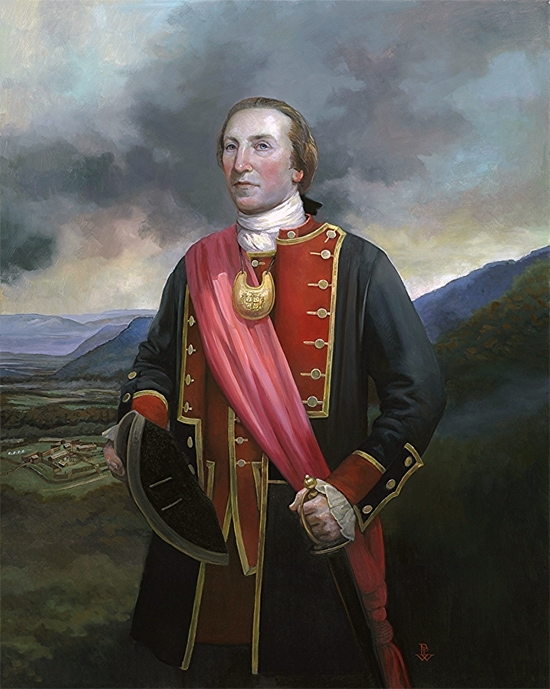
Young George Washington’s performance in the French and Indian War is largely viewed as one of failure and recklessness. His actions in the Ohio River Valley ignited a conflict in North America that in turn lit the world ablaze. He could boast of no great military laurels, other than that he had emerged unscathed from the bloody battle of the Monongahela, and that he had commanded colonial provincials in Gen. John Forbes’ successful campaign against Fort Duquesne. He left military service following the latter event, with his hopes of receiving a commission in His Majesty’s Army worthy of his merit dashed years before.

“Young George Washington” by Pamela Patrick White, White Historic Art (whitehistoricart.com)

However, one aspect of Washington’s service in the French and Indian War has been widely neglected. The commander of the Virginia Regiment was tasked with defending the western frontier from enemy raiding parties. It was an unenviable position that he tackled with limited resources. It was during this period that Washington began to develop the leadership qualities that would inspire others to follow him into the depths of Hell some twenty years later. On the last day of 1758, as Washington prepared to pursue a life outside of military greatness, the officers of the Virginia Regiment drew-up a heartfelt petition to urge the now 26 year-old colonel they had grown to admire to rescind his resignation. Below is that document:

“To George Washington Esqr. Collo. of the Virginia Regiment & Commander of all the Virginia Forces The humble Address of the Officers of the Virginia Regiment

Fort Loudoun, Dec. 31st 1758

Sir,

We your most obedient and affectionate Officers, beg Leave to express our great Concern, at the disagreeable News we h⟨ave received⟩ of your Determination to resign the Command of that Corps, in which we have under you long ⟨served⟩.

The ⟨happine⟩ss we have enjoy’d and the Honor we have acquir’d, together with the m⟨utua⟩l Regard that has always subsisted between you and your Off⟨icers,⟩ have implanted so sensible an Affection in the Minds of us all, that we cannot be silent at this critical Occasion.

In our earliest Infancy you took us under your Tuition, train’d us up in the Practice of that Discipline which alone can constitute good Troops, from ⟨the⟩ punctual Observance of which you never suffer’d the least Deviation.

Your steady adherance to impartial Justice, your quick Discernment and invarable Regard to Merit, wisely intended to inculcate those genuine Sentiments, of true Honor and Passion for Glory, from which the great military Atcheivements have been deriv’d, first heighten’d our natural Emulation, and our Desire to excel. How much we improv’d by those Regulations, and your own Example, with what Alacrity we have hitherto discharg’d our Duty, with what Chearfulness we have encounter’d the severest Toils, especially while under your particular Directions, we submit to yourself, and flatter ourselves, that we have in a great Measure answer’d your Expectations.

Judge then, how sensibly we must be Affected with the loss of such an excellent Commander, such a sincere Friend, and so affable a Companion. How rare is it to find those amiable Qualifications blended together in one Man? How great the Loss of such a Man? Adieu to that Superiority, which the Enemy have granted us over other Troops, and which even the Regulars and Provincials have done us the Honor publicly to acknowledge! Adieu to that strict Discipline and order, which you have always maintain’d! Adieu to that happy Union and Harmony, which has been our principal Cement!

It gives us an additional Sorrow, when we reflect, to find, our unhappy Country will receive a loss, no less irreparable, than ourselves. Where will it meet a Man so experienc’d in military Affairs? One so renown’d for Patriotism, Courage and Conduct? Who has so great knowledge of the Enemy we have to deal with? Who so well acquainted with their Situation & Strength? Who so much respected by the Soldiery? Who in short so able to support the military Character of Virginia?

Your approv’d Love to your King and Country, and your uncommon Perseverance in promoting the Honor and true Interest of the Service, convince us, that the most cogent Reasons only could induce you to quit it. Yet we with the greatest Deference, presume to entreat you to suspend those Thoughts for another Year, and to lead us on to assist in compleating the Glorious Work of extirpating our Enemies, towards which so considerable Advances have been already made. In you we place the most implicit Confidence. Your Presence only will cause a steady Firmness and Vigor to actuate in every Breast, despising the greatest Dangers, and thinking light of Toils and Hardships, while lead on by the Man we know and Love.

But if we must be so unhappy as to part, if the Exigencies of your Affairs force you to abandon Us, we beg it as our last Request that you will recommend some Person most capable to command, whose Military Knowledge, whose Honor, whose Conduct, and whose disinterested Principles we may depend upon.

Frankness, Sincerity, and a certain Openness of Soul, are the true Characteristics of an Officer, and we flatter ourselves that you do not think us capable of saying anything, contrary to the purest Dictates of our Minds. Fully persuaded of this, we beg Leave to assure you, that as you have hitherto been the actuating Soul of the whole Corps, we shall at all times pay the most invariable regard to your Will and Pleasure, and will always be happy to demonstrate by our Actions, with how much Respect and Esteem we are, Sir, Your most affectionate & most obedt humble Servants.”[i]


[i] “Address from the Officers of the Virginia Regiment, 31 December 1758,” Founders Online, National Archives, https://founders.archives.gov/documents/Washington/02-06-02-0147. [Original source: The Papers of George Washington, Colonial Series, vol. 6, 4 September 1758 – 26 December 1760, ed. W. W. Abbot. Charlottesville: University Press of Virginia, 1988, pp. 178–181.]

“Our Flag Was Still There…” Book Talk on “Rev War Revelry”

On September 14, 1814, United States forces defending Fort McHenry in Baltimore repelled the British attempt to capture the city. Flying defiantly over the brick parapets was a 30 x 42 -foot the following day, clearly seen by the British and one captive American, Francis Scott Key. Over 100 years later the poem Key began writing on September 15 became the national anthem of the United States of America. But, what about the flag that the military commander of Fort McHenry, Major George Armistead had made? Well, this iconic flag became a part of the Armistead family for almost the next century as well.

Now, historian Tom McMillan, who has written on another member of the Armistead family, returns with his latest publication, Our Flag Was Still There: The Star-Spangled Banner that Survived the British and 200 Years–and the Armistead Family Who Saved It. This fascinating read, tracing the flag and its intertwined connection with the Armistead family, will be the subject of this week’s “Rev War Revelry.” McMillan gave a bit of a teaser to entice you to listen in on Emerging Revolutionary War’s Facebook page Sunday at 7 p.m. EDT.

OUR FLAG WAS STILL THERE details the improbable two-hundred-year journey of the original Star-Spangled Banner — from Fort McHenry in 1814, when Francis Scott Key saw it, to the Smithsonian in the 21st century – thanks to three generations of an enduring military family, the Armistead’s, who defended, kept, hid, and ultimately donated the most famous flag in American history.”

We hope you grab your favorite beverage and tune in. The book is now available for purchase and Tom will have details on how to attain a copy!

“…but he whose heart is firm, and whose conscience approves his conduct, will pursue his principles unto death.” 

Thomas Paine wrote the line used as the title for this post in his pamphlet titled “American Crisis” in 1776. Most people recognize the opening lines that Paine penned in that same essay.

“These are the times that try men’s souls: The summer soldier and the sunshine patriot will, in this crisis, shrink from the service of their country; but he that stands it now, deserves the love and thanks of man and woman.”

However, on this Memorial Day, while reading through his essay, I was struck by the line I used for the title. Furthermore, by the far too numerous men who served in the militia and Continental service that lay in unknown or unmarked graves throughout the eastern United States. To them that gave the ultimate sacrifice in pursuit of the principles they held most dear, we remember on this day. To them and the thousands that came after and paid with their lives so others can have “life, liberty, and the pursuit of happiness” we also remember today on this Memorial Day.

One of the main objectives of Emerging Revolutionary War is to visit the sites attributed to the American Revolutionary War era and to provoke interest and expand learning on the people, places, and history. That includes remembering those that lay in these unmarked graves “known only to God.”

Photos courtesy of Dan Welch.

Rev War Revelry Tackles the Myth of the Battle of Waxhaws

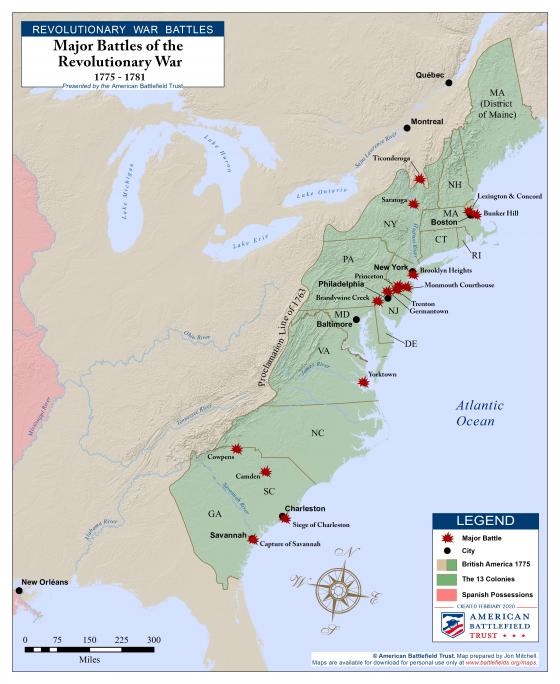
The Battle of Waxhaws, fought on May 29, 1780, was a lopsided British victory by Lieutenant Colonel Banastre Tarleton’s British cavalry over American Colonel Abraham Buford’s Continental forces in Waxhaws South Carolina. Buford lost 316 of 350 men with the British losing less than 20. Known popularly as “Buford’s Massacre,” Continental leaders used the battle as a propaganda tool against the Crown forces in the south. But, was it really a massacre?

Join us as we welcome historian and author Dr. Jim Piecuch as we discuss his research and theory about the Battle of Waxhaws and its aftermath. Dr. Piecuch has written several books on the Southern Campaign of the American Revolution including his book “Blood Be Upon Your Head: Tarleton and the Myth of Buford’s Massacre.” This Rev War Revelry will be pre-recorded and posted on May 28th at 7pm. Grab a drink and a good seat and enjoy this great presentation on one of the most controversial battles of the American Revolution.

Celebrate Mother’s Day with Emerging Revolutionary War!

The Mary Ball Washington Monument and grave site, Fredericksburg, VA

Happy Mother’s Day to all the moms out there! In honor of Mother’s Day, Emerging Revolutionary War welcomes will be welcoming historians and staff from the Washington Heritage Museums to tonight’s Rev War Revelry. WHM manages and operates the home and grave site of Mary Ball Washington, the mother of George Washington located in Fredericksburg, VA.

The relationship between George Washington and his mother has been of interest in historians. Their relationship was complicated and much debated by Washington contemporaries and historians today. Mary never remarried when her husband passed (rare for the time period) and mostly lived on her own in Fredericksburg. She also was not afraid to complain about her lack of resources and once applying to the Virginia General Assembly for financial support (to much frustration from George Washington). We will cover many of the myths and interpretations of Mary and her relationship with her son.

So grab a drink and join us as we discuss Mary Ball Washington, her relationship with her son George and what the Washington Heritage Museums are doing today to interpret and preserve her story. Our revelry tonight is previously recorded so we could spend time with the mom’s in our life, but as always we will respond to any comments and questions posted.

The Revolutionary War Conference 250 in the Mohawk Valley – June 9-11, 2023

There are many great Revolutionary War events coming up in 2023! Last week we highlighted the American Revolutionary War in the West conference and this week we highlight a great event with our friends at Fort Plain Museum and Historical Park in New York. Also Save the Date for our very own Emerging Revolutionary War Symposium on October 20-21, 2023 in partnership with the North Carolina Museum of History in Raleigh, NC.

Below are the details of the great event at Fort Plain this June!

Returning for 2023 as Conference Master of Ceremonies is Mohawk Valley Legend and “Voice”, Historian Bob Cudmore

Fireside Chat – James Kirby Martin with Guest Host Mark Edward Lender (Sponsored by Westholme Publishing and the Journal of the American Revolution)– Professor and Student Discuss the American Revolutionary War, the Upcoming 250th Anniversary and Their Legacies

Friederike Baer – Hessians: The German Soldiers in the American Revolutionary War

John “Jack” Buchanan – The Battle of Musgrove’s Mill, 1780

Benjamin L. Carp – The Boston Tea Party at 250: Reflections on the Radicalism of the Revolutionary Movement

Vivian E. Davis – Over 250 Years Ago! The Battle of Golden Hill, January 19, 1770

Holly A. Mayer – Congress’s Own A Canadian Regiment, the Continental Army, and American Union

Steven Park – 250 Years of Remembering: The Changing Landscape of Gaspee History

Nina Sankovitch – The Abiding Quest of a Forgotten Hero: How Josiah Quincy Battled Overwhelming Odds to Bring Together the Northern and Southern Colonies in 1773, Fanning the Flames of Revolution and Laying the Groundwork for Independence from England

Eric H. Schnitzer – Picturing History: The Images of the American War for Independence

Sergio Villavicencio – St Eustatius and the American Revolution

Mohawk Valley Resident Historian – Terry McMaster – A Revolutionary Couple on the Old New York Frontier: Col. Samuel Clyde & Catharine Wasson of Cherry Valley 

New York State and the 250th: Where Things Stand – Presenters: Devin R. Lander, New York State Historian, Phil Giltner, Director of Special Projects, NYS Office of Parks, Recreation and Historic Preservation, Constance M. Kehoe, President, Revolutionary Westchester 250 and Lauren Roberts, Saratoga County Historian        

The Fort Plain Museum Board Chairman – Norman J. Bollen – The Fort Plain Museum & Historical Park’s Grand Enhancement Plan – Rebuilding the Blockhouse for the 250th

Good News! We have added a 2nd Bus. We do need to have a certain number before we can run it. Please sign up right away or reach out to us at info@fortplainmuseum.org

Bus Tour – Forts and Fortified Homes of the Mohawk Valley – Join Tour Leaders Bruce Venter, Wayne Lenig and Norm Bollen as they guide you through the Mohawk River Valley touring the many sites that housed troops during the Revolutionary War. This is an in-depth, never done before tour of the historic forts, fortified homes and sites that formed the defensive perimeter around Fort Rensselaer (Fort Plain).

Site visits will include Fort Failing, Fort Ehle, Fort Clyde, Fort Plank, Fort Rensselaer, Fort Kayser, Fort Paris, Fort Nellis, Fort Klock and more. Lunch and a Bus Tour Booklet are included. This Bus Trip will start at the Fulton-Montgomery CC – 2805 NY-67, Johnstown, NY 12095 – Parking Lots B & C – Please wear comfortable walking shoes and bring snacks/beverages. This is a rain or shine Bus Tour.

Registration:

LodgingPlease Click Here for the Hotel-Lodging Information – 2023 Rev War Conference

Conference Location – The Fulton-Montgomery Community College‘s Theater – The Visual Arts & Communications Building (Campus Map Building #2) – 2805 NY-67, Johnstown, NY 12095 – Please Park in Lots 5, 4 or Visitor’s Lot – Please Click Here – FMCC Campus Map

Conference Schedule – 2023 Rev War Conference 250 Schedule – (Please note, this Schedule is subject to changes and will change – last changed 4/25/2023)

Rev War Revelry Discusses NEW Emerging Rev War Book!

Charleston, South Carolina is one of the most beautiful and historic cities in the United States. Numerous sites, battlefields, and buildings from the period of the Revolution still exist.

Join us this Sunday at 7pm as we discuss ERW’s newest release “To The Last Extremity: The Battles for Charleston” by Mark Maloy. In To the Last Extremity: The Battles for Charleston, historian Mark Maloy not only recounts the Revolutionary War history of Charleston, he takes you to the places where the history actually happened. He shows you where the outnumbered patriots beat back the most powerful navy in the world, where soldiers bravely defended the city in 1779 and 1780, and where thousands suffered under occupation. Through it all, brave patriots were willing to defend the city and their liberty “to the last extremity.”

We will talk to Mark about his research, his favorite and most compelling stories and why this book is a “must have” for any history buff. Join us this Sunday, April 16 at 7pm on our Facebook page to join in on the conversation. As always, if you can not join us live you can catch the talk at any time on our You Tube or podcast channel.

Looking toward May and warmer weather…

For those in certain geographical areas of the United States winter weather and temperatures are upon us. The barometer fluctuates between highs and lows and wind whips through open spaces. Similar to the winter encampment at Valley Forge in 1777-1778. Much like the soldiers of the Continental army, looking toward warmer weather in the spring so should you! And it includes a visit to Valley Forge as well!

Join Emerging Revolutionary War historian Phillip S. Greenwalt and other historians in the Pursuit of History: Forging the Continental Army as part of the HistoryCamp.org event weekend. Starting on May 19, 2023 the event rolls through the weekend, Check out the full event page, including the book package where you can secure a copy of The Winter that Won the War, the Winter Encampment at Valley Forge 1777-1778, a volume in the popular Emerging Revolutionary War Series published by Savas Beatie, LLC.

To learn more and book your spot, click here.

Rounding out the year with a round-up from our friends at Americana Corner

As 2022 winds down, Emerging Revolutionary War wanted to share one more round-up of what our good friends at Americana Corner were doing in this last month of the year. We hope to continue to partner with Americana Corner in the 2023 and bring new content and new enthusiasm for this critical period in American history to the forefront. To all our readers, thank you and we all at Emerging Revolutionary War hope you have a great ending to 2022 and a Happy New Year!

A few blog posts for light reading as you wind down December…

Washington Takes Command
December 27, 2022

When it came to finding the right man to command the new Continental Army assembled around Boston, George Washington was the logical choice. John Adams quickly nominated Washington and Congress unanimously approved. As Adams stated, “This appointment will have a great effect in cementing and securing the Union of these colonies.”

Read More

George Washington Enters Politics
December 20, 2022

As befitting a wealthy landowner in colonial Virginia, George Washington became active in the colony’s politics in the 1750s. He first ran for a seat representing Frederick County in the Virginia House of Burgesses in 1755 but lost the election. Interestingly, it was the only political race he would ever lose. Washington ran for that same seat in 1758 and was victorious, and he held this seat for seven years.

Read More

The Life of Martha Washington
December 13, 2022

Martha Washington was our nation’s first First Lady and lived in the shadow of her larger-than-life husband George. However, most Americans do not realize that she was a very capable woman and, when given the opportunity, managed her own affairs quite well.

Read More

George Washington’s Life at Mount Vernon
December 6, 2022

When George Washington resigned as Colonel and Commander of the Virginia Regiment in 1758, he returned to Mount Vernon to begin his life as a gentleman planter. Although in less than twenty years Washington would be called away by his country, his time between the French and Indian War and the American Revolution was a significant portion of this great man’s life.

Read More