By late April of 1777, nerves were on edge for the fifteen or so families taking refuge in the stockade at Boonesborough, including a few enslaved people and a handful of rifleman. Since early March, settlers there had been forced to venture out from the safety of the fort in small groups in order to ready their fields for the spring planting. Armed guards accompanied the farmers as they were under constant threat of Indian attack.
Chief Blackfish and roughly 200 Shawnee warriors had crossed south of the Ohio that spring, establishing a base camp near the Licking River from which they could launch sustained attacks on the Kentucky strongholds of Harrodsburg, Logan’s Station, and Boonesborough. Conditions in the American stockades were cramped. A couple of young hunters were scouting for the three settlements, carrying messages back and forth, and providing meat. One was a tall young man from Virginia known as Simon Butler. He had been in Kentucky since serving in Lord Dunmore’s war in 1774 but in April 1777 he was fairly new to Boonesborough. He was hard and tough; a man “with the bark on.” He happened to be at the fort on the morning of Thursday, April 24th. Continue reading “Simon Kenton: Frontiersman, Soldier, Spy”→
On the night of September 20, 1777, while encamped in Chester County, PA just outside Philadelphia, a division of American soldiers was defeated in a swift surprise attack by a slightly smaller British force. American propagandists, in an effort to galvanize Patriot support, would make the most of this encounter to show the British Army as overly brutal and bloodthirsty. On the foggy morning of December 9, 2019, members of the ERW paid a call on this battle site; Paoli Battlefield Historical Park.
A reflection on the previous month’s exploration in South Carolina.
August 16, 1780 would prove to be a devastating day for the American Army in the south, known as the “Grand Army” by its commander, Maj. Gen. Horatio Gates, the Hero of Saratoga. The battle between this army and that of Lt. Gen. Charles, Earl Cornwallis, in the Pine Barrens near the South Carolina town of Camden, would end in the total rout of the Americans and the destruction of the reputation of its commander. It would also temporarily leave the southern colonies without a central army to oppose the British.
On November 1, members of the Emerging Revolutionary War Era staff took a road trip to Camden, SC to research the battle, walk the battlefield and meet with local historians in preparation for an upcoming addition to our book series, on the Battle of Camden. On the way down, we took the opportunity of visiting other sites of combat, actions that occurred prior to and after the fight at Camden. Continue reading “Visiting the Scene of Action: Battle of Camden”→
So, vacation time rolls around again and this year my family and I had an opportunity to travel to Paris, France for a few days. Riding into the city from Charles de Gaulle Airport, our taxi driver, by chance, took us past an old, green-corroded bronze statue, set in the middle of a little flowered square. From my vantage, I could only see the bottom portion of the statue; what appeared to be the lower portion of a man in buckled shoes, seated in a wooden chair, atop a marble pedestal. My wife happened to be in the right spot in the vehicle as we quickly drove by. “Looks like Benjamin Franklin, I think.” she said, and with those words, she sent me on a journey to find that statue again and, hopefully, other sites in Paris associated with Mr. Franklin.
Unlike his colleague from New England, John Adams, who was from good, plain Puritan stock, the pulse of a city like Paris, with its decadence, opulence and social intrigue, fit Benjamin Franklin like a glove. As ambassador to France after the signing of the Declaration of Independence, Franklin was instrumental in helping to obtain for our fledging nation the financial and military support necessary for bringing our war for independence to a happy conclusion. To the people of Paris, he was somewhat of a celebrity, due to his experiments with electricity. He spoke French and endeared himself to the people by displaying, in his dress and speech, what they considered his “rustic” demeanor. In a word, they were charmed by Benjamin Franklin. The fur cap he was fond of wearing only added to his disguise of “homespun rusticity”. So, finding a monument to him in this city was not much of a surprise. Continue reading “Another American in Paris”→
Nestled in Hanover County, VA, near where modern residential communities meet farm fields that have been worked for centuries, is the site of a colonial-era plantation home called Studley. It was here on this site that Patrick Henry, the “Voice of the Revolution”, was born.
A 600-acre tobacco plantation, Studley was built in the 1720’s for its original owner, Colonel John Syme and his bride, Sarah, the former Sarah Winston. The surrounding community, as it does today, took its name from the site. (By the mid-19th century, the Studley area was called Haws Shop, after a nearby blacksmith shop. In the latter part of May, 1864, Union and Confederate cavalry units fought a dismounted action here just prior to the battle of Cold Harbor. Prominent among the Union commanders engaged was Brig. Gen. George Armstrong Custer.)
Not long ago, I had the pleasure of accompanying our group of student interns from Richmond National Battlefield Park on a short field trip to the George Washington Birthplace National Monument (GWBNM), in Westmoreland County on Virginia’s famed Northern Neck. First established near Pope’s Creek by John Washington, great-grandfather of our future first president, it was, as the name implies, the site of George Washington’s birth on February 22, 1732. This much we know.
George Washington Birthplace National Monument
The grounds were designated a United States National Landmark in 1930 and deeded to the Federal government. In honor of George Washington, the current Memorial House was constructed at the site in 1931. Along with the house, visitors can find a colonial-style kitchen building and blacksmith’s shop. Costumed interpreters also manage the Colonial Living Farm with barn, pastures and livestock. The site depicts life on a middling-sized Virginia tobacco plantation during the mid-18th Century. Continue reading “Inheriting the Preservation Efforts of the Past”→
The post-colonial era conflict between the United States and Great Britain, known in America as the War of 1812, has often been described as America’s second war for independence. In UNSHACKLING AMERICA: HOW THE WAR OF 1812 TRULY ENDED THE AMERICAN REVOLUTION, published by St. Martin’s Press 2017, author Willard Sterne Randall promotes the idea that this war, largely unremembered today in Great Britain, was actually a continuation of the earlier American Revolution.
The book begins by chronicling the relationship between America and Britain from the years of the French and Indian War or Seven Years War to the end of the American Revolution and beyond. While the Treaty of Paris in 1783 basically ended the overt military conflict between the former colonies and the mother country, Randall maintains that, in the years that followed, Britain continued to deny economic independence to the United States through regulations on trade, thereby denying full independence to the young nation. Continue reading “Review: Unshackling America How the War of 1812 Truly Ended the American Revolution by Willard Sterne Randall”→
Over the years, it has been my pleasure to stop in at the old Yorktown Victory Center. The primary focus of the museum, as one might expect, was on the October 1781 siege, which not only brought about the surrender of British forces under General Charles, Lord Cornwallis, but also hastened the eventual end of hostilities between Britain and her former colonies. More recently, I’ve had the pleasure of working at the museum for special occasions as a volunteer for the Jamestown-Yorktown Foundation (JYF).
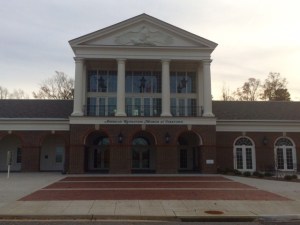
The Foundation has since expanded its view of Revolutionary America with a new museum, built upon the bones of the original, which looks beyond the confines of the Yorktown siege and takes a broader view of the conflict as a whole. In the fall of 2016, JYF opened its new American Revolutionary War Museum at Yorktown.
The building itself is large and impressive, with over 22,000 square feet (I’m told) of exhibition space. There is a natural flow between the various galleries, which chronicle our nation’s journey from subjugated colonies to Republic. Visitors, especially those who are not well versed in the history of the Revolutionary War, can more easily follow “the road” that led to our independence.
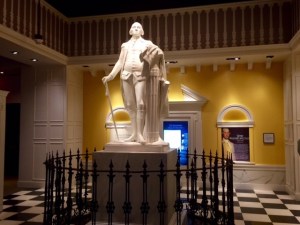
I started my visit by viewing the new introductory film, “Victory Forever”. The story of the Revolution is told by a 19th century showman who has visited many of the sites associated with the war and the events preceding its outbreak. As I began my own trip “down the road”, I was happy to see that the Foundation’s impressive collection of 18th century weapons and other artifacts are part of this new vision. There are new acquisitions on display as well, such as an original broadside of the Declaration of Independence which dates back to 1776.
There are new interactive films and exhibition galleries that tell the story first of the changing relationship between America and Britain after the end of the Seven Year’s War or, as it was known in America, the French and Indian War. This, of course, includes the rifts that arose beginning in the 1760’s over taxation.
The “Revolution” exhibition chronicles the weapons and tactics used in the conflict itself, from Lexington and Concord to Yorktown. And I was pleased to see an exhibition that focuses on the war in the south and the major players who led those events such as Daniel Morgan, the “Gamecock” Thomas Sumter, and the notorious Banastre Tarleton.
In prior years, the site also featured a Continental Army encampment and a 1780’s-era Virginia farmstead. The encampment has been expanded to include a small amphitheater for use in artillery and small arms demonstrations. This farm area is also undergoing considerable change as it will now represent a Virginia farmstead during the Revolutionary War era. Not yet completed, a conversation with friend and farm site manager Jay Templin gave me an idea as to some of the changes that are coming. “We’re now presenting life during the Revolution so we’ll need to scale back; there will be changes to what we’re growing.” Said Templin. “We’ll certainly still be growing some tobacco but not the large field as in years past.”
Although the American Revolutionary War Museum at Yorktown opened to the public in October, it is generally considered a “soft opening” as the entire site is not yet in its completed state. I’m told by staff there that the grand opening is slated for March 2017. I have to say that I was pleased with the new facilities and the fact that the focus of the museum is now on the broader era of the war. I wholeheartedly recommend a visit.
In Fincastle, nestled in the mountains of Virginia’s Botetourt County and once considered the “jumping off” spot for people traveling to the frontier, they tell a story about William Clark. Prior to his journey west with Capt. Meriwether Lewis and the Corps of Discovery, William Clark was in the village of Fincastle one day when, it is said, he spied two young girls on horseback. They were both pretty young things, the story goes, but Clark’s fancy was captured by only one of them.
William Clark
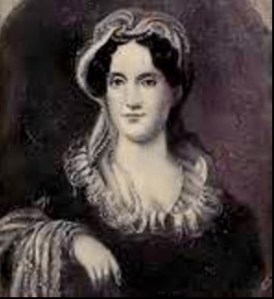
Her name was Julia Hancock; Clark called her “Judith”. She was the teenage daughter of former United States Congressman George Hancock of Santillane; one of Botetourt County’s most distinguished families.
Julia Hancock
The story goes that Clark, who was twice her age, pledged his heart to the lass; it was his intention to marry her. While on his journey to the “western ocean’, Clark named a river in Montana in her honor. It was dubbed the Judith.
The Judith River
Upon his return to Fincastle, Clark was as good as his word and conducted the beautiful Miss Hancock to the alter.
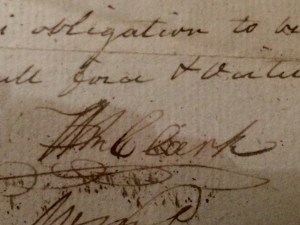
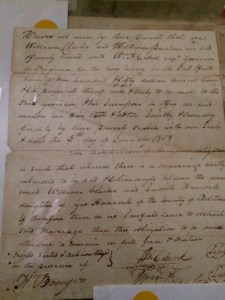
Among the historical documents that can still be found in the Botetourt County Circuit Court is the marriage bond for the two, signed by William Clark. The couple married on January 5, 1808.
William Clark’s SignatureMarriage Bond
Sadly, after 12 years of marriage and 5 children, Julia Hancock Clark died in 1820. Not long after however, in St. Louis, Clark happened to meet up with another Fincastle girl. She was a widow named Harriet Kennerly Radford. Needing a mother for his children, Clark would marry Harriet Radford on November 28, 1821. But still, there was a connection; Clark had known his new bride back in Virginia. Not only was Harriet Kennerly Radford a first cousin of Julia Hancock, she was also the other young girl Clark had first seen on horseback in Fincastle all those years before!! They tell the story in Fincastle.
By the spring of 1781, British military forces under the able command of General Charles, Lord Cornwallis, were moving north. It was clear that the southern campaign had not gone quite the way it was planned. Though successful initially in South Carolina in 1780 with the capture of Charleston and the subsequent battles of Camden and Hobkirk’s Hill, the British had been handed some setbacks by the end of the year. Twice had Lord Cornwallis lost his left wing through defeats at Kings Mountain in October and Cowpens in January 1781. In March, a contentious battle at Guildford Courthouse in North Carolina left the British in control of the field but badly mauled by American forces under General Nathaniel Green. By April, Cornwallis had devised a plan to move north, into Virginia, to conquer that province which he believed would be critical to achieving ultimate success and ending the war in favor of His Britannic Majesty.
Lord Charles Cornwallis
By June 1781, Cornwallis was in Richmond. Joined by forces under the American turncoat Benedict Arnold and General Alexander Leslie, Cornwallis commanded a fighting force of around 7,000. To counter this threat were fewer than 1500 American soldiers under the young Marque de Lafayette.
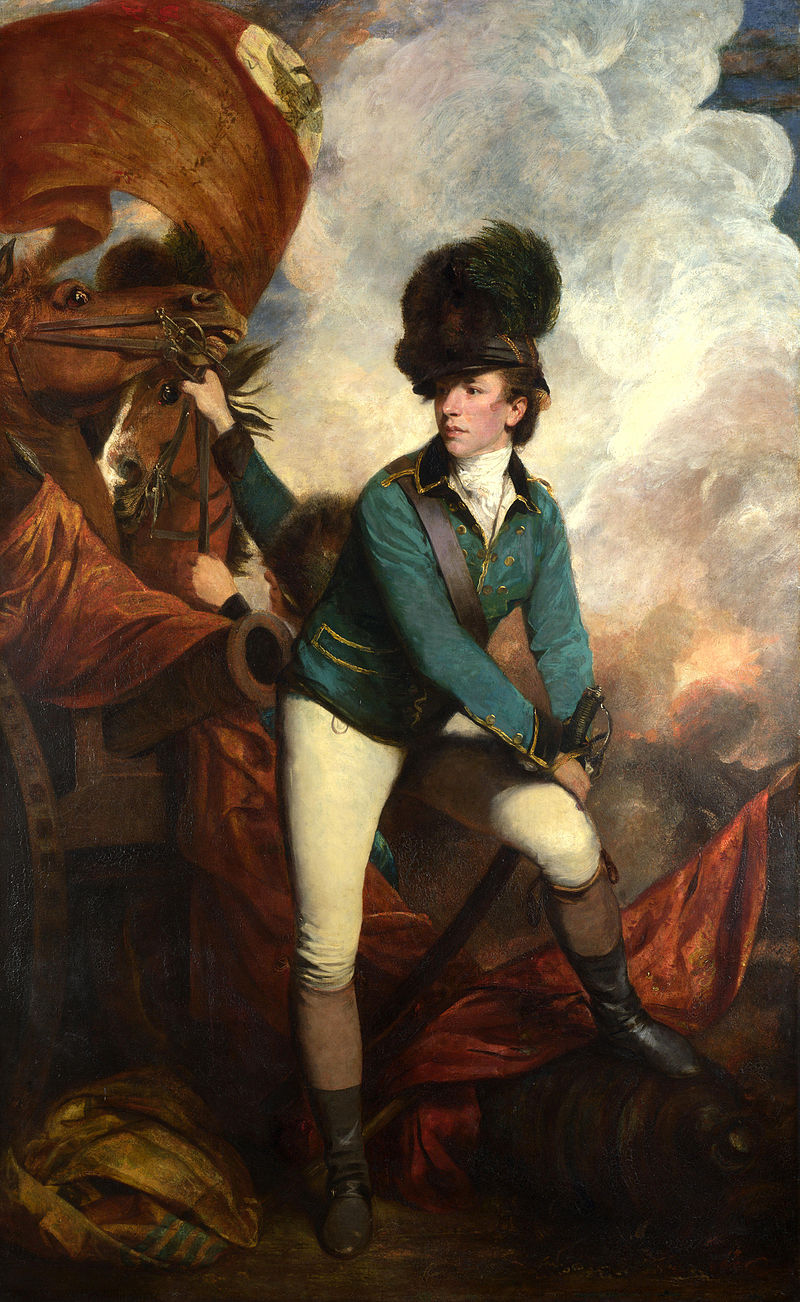
While encamped near Hanover Courthouse, Cornwallis learned that Virginia Governor Thomas Jefferson and the General Assembly had relocated to Charlottesville, around 50 miles west of Richmond. He decided to send the brash Colonel Banastre Tarleton there with a small strike force to bag the whole lot. On June 3, Tarleton’s force set out.
Today, as it was 235 years ago, June in Central Virginia is hot and almost unbearably humid. To avoid the extreme heat of the day, Tarleton decided to rest his men and resume the march after dark. His route would take him through Louisa County via modern Route 33. Just before halting for the night, Tarelton passed by Cuckoo Tavern, a small and out-of-the-way place that got its name from the cuckoo clock that once ticked off the minutes inside the tavern. Slumped against the picket fence in the tavern yard, trying to catch some sleep after a long day of work and a few drinks in the taproom, was a local lad by the name of Jack. John “Jack” Jouett, Jr., known as Captain Jack due to the military coat he was fond of wearing, routinely freighted produce from his family’s farm in Louisa to the tavern his father kept in the town of Charlottesville. The Swan Tavern was certainly a going concern and, at that moment, was playing host to several of the lawmakers of the Virginia General Assembly.
Captain Jack, 26 years old, had just returned to Louisa after a long round trip to the tavern. Sitting out in the yard that night, he was aroused by the sound of marching feet. He stood and there saw Tarleton’s column moving along to Louisa Courthouse. It wasn’t difficult for Jouett to figure the destination of these midnight marchers and he knew he couldn’t let them get to Charlottesville and capture the government. So once the soldiers had marched past, he saddled up his horse “Sally” and lit out for town.
Banastre Tarleton
He rode all night, covering the 40 plus miles to Charlottesville ahead of the British. He traveled by narrow, little-used roads under low-hanging tree branches; paths certainly unknown by most save a few locals. By the time Jouett reached Charlottesville, his face and arms were scratched and bloody. He rode first to Monticello and warned Thomas Jefferson, although Jefferson took such a long time getting himself together that he narrowly escaped capture by Colonel Tarleton’s forces who came trotting up onto the west lawn of Monticello only minutes after Jefferson had finally departed.
Jouett went on to his father’s tavern where he warned several of the delegates staying there of Tarleton’s approach. The British were only 3 hours behind Jouett by the time he splashed across the Rivanna River and into Charlottesville. Even with this warning, several of the legislators were captured by Tarleton including a representative from Kentucky County by the name of Daniel Boone.
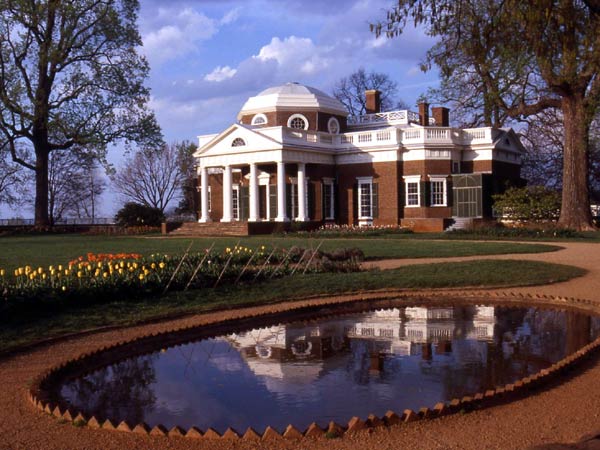
Monticello
Only a year after his ride, Jack Jouett left Louisa County and moved west to the Kentucky territory where he later flourished as a horse breeder and influential member of society for the rest of his life. Jouett died in Kentucky in 1821.
Today, Cuckoo is little more than a dot on a Virginia roadmap. The tavern is long gone; only an empty field now. Across the road stands Cuckoo, the brick, federal style home built by a family of physicians in 1819. Hard to believe that such a quiet place could have once been the scene of such high drama.



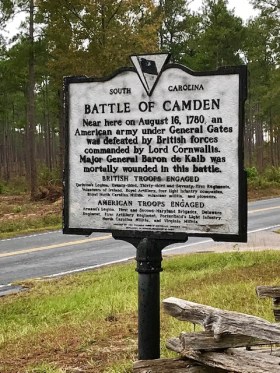 August 16, 1780 would prove to be a devastating day for the American Army in the south, known as the “Grand Army” by its commander, Maj. Gen. Horatio Gates, the Hero of Saratoga. The battle between this army and that of Lt. Gen. Charles, Earl Cornwallis, in the Pine Barrens near the South Carolina town of Camden, would end in the total rout of the Americans and the destruction of the reputation of its commander. It would also temporarily leave the southern colonies without a central army to oppose the British.
 So, vacation time rolls around again and this year my family and I had an opportunity to travel to Paris, France for a few days. Riding into the city from Charles de Gaulle Airport, our taxi driver, by chance, took us past an old, green-corroded bronze statue, set in the middle of a little flowered square. From my vantage, I could only see the bottom portion of the statue; what appeared to be the lower portion of a man in buckled shoes, seated in a wooden chair, atop a marble pedestal. My wife happened to be in the right spot in the vehicle as we quickly drove by. “Looks like Benjamin Franklin, I think.” she said, and with those words, she sent me on a journey to find that statue again and, hopefully, other sites in Paris associated with Mr. Franklin.
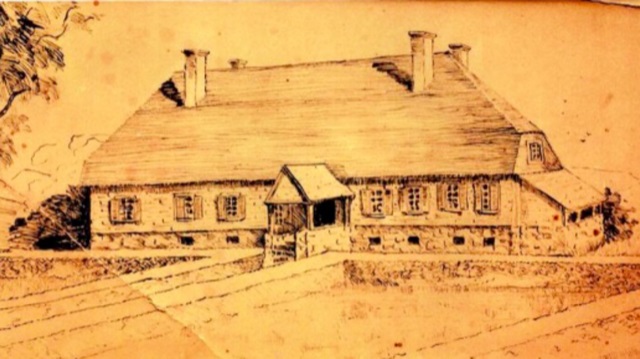

 The post-colonial era conflict between the United States and Great Britain, known in America as the War of 1812, has often been described as America’s second war for independence. In UNSHACKLING AMERICA: HOW THE WAR OF 1812 TRULY ENDED THE AMERICAN REVOLUTION, published by St. Martin’s Press 2017, author Willard Sterne Randall promotes the idea that this war, largely unremembered today in Great Britain, was actually a continuation of the earlier American Revolution.
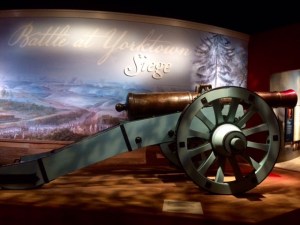
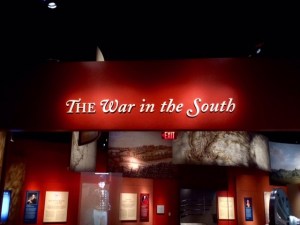 The “Revolution” exhibition chronicles the weapons and tactics used in the conflict itself, from Lexington and Concord to Yorktown. And I was pleased to see an exhibition that focuses on the war in the south and the major players who led those events such as Daniel Morgan, the “Gamecock” Thomas Sumter, and the notorious Banastre Tarleton.
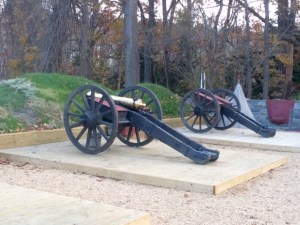 This farm area is also undergoing considerable change as it will now represent a Virginia farmstead during the Revolutionary War era. Not yet completed, a conversation with friend and farm site manager Jay Templin gave me an idea as to some of the changes that are coming. “We’re now presenting life during the Revolution so we’ll need to scale back; there will be changes to what we’re growing.” Said Templin. “We’ll certainly still be growing some tobacco but not the large field as in years past.”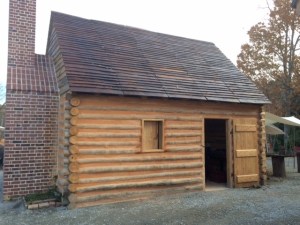




 Emerging Revolutionary War Era