Emerging Revolutionary War welcomes guest historian Drew Palmer. A biography follows at the end of this post.
What does it look like when veteran soldiers do not want to fight anymore? When morale plummets and the realities of war take their toll on men. This is exactly what happened to 150 men in the Maryland Line of the Continental Army in the late summer of 1780.
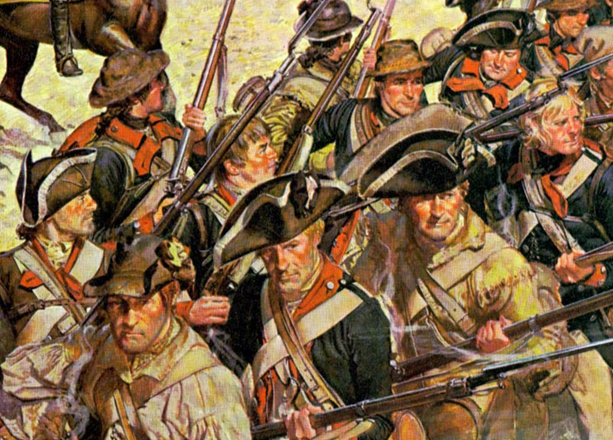
The 1st Maryland Regiment holds the line at the Battle of Guilford Courthouse, March 15, 1781
The continental regiments of Maryland that made up what became known as the “Maryland Line” or “Old Line State” had earned the reputation as a reliable, brave, and disciplined fighting force as early as 1776 after their actions in the Battle of Long Island.1 At the Battle of Camden on August 16, 1780, the 1st and 2nd Maryland Brigades offered a stout defense as Gen. Charles Cornwallis’s British force crashed into Continental soldiers from Maryland and Delaware. In the end, though, Maj. General Horatio Gates’s Southern Continental Army was completely routed from the field, with many of the Maryland Continental troops taken prisoner and held in the small village of Camden after the battle.2
The village of Camden, South Carolina, was an unpleasant place to be after the battle. The crowded conditions and brutal summer climate of South Carolina began to produce sickness amongst Cornwallis’s men and the American prisoners that were held in Camden. To prevent further sickness from spreading, Cornwallis decided to split the American prisoners held at Camden into divisions of around 150 men. These divisions were guarded by small detachments of the British army and marched from Camden to Charlestown, South Carolina.3 One detachment of the British 63rd Regiment of Foot escorted 150 prisoners of the 1st Maryland Brigade captured at Camden. The division made it to Thomas Sumter’s abandoned plantation at Great Savannah, about 60 miles northwest of Charleston. As the Maryland prisoners and their British guards halted for the night, militia commander Francis Marion received word from a Loyalist deserter that the Marylanders were nearby and decided to ambush the British element in hopes of freeing the Maryland prisoners.4 In the early morning hours of August 25, 1780, Marion’s militia attacked.
Join us this Sunday, December 14th at 7pm as we return LIVE for this Rev War Revelry on the Canadian Campaign of 1775. We will discuss Arnold, Montgomery, Morgan and others on America’s attempt to capture Montreal, Quebec and create a “14th state.” From Arnold’s arduous march to Quebec through the wilds of Maine to Montgomery’s capture of Montreal, our historians Alex Cain and Mike Cecere will cover the entire campaign and answer the question “was the capture of Canada possible?”
This fall and winter mark the 250th anniversary of the campaign and the battles of Montreal and Quebec, and both of our speakers have taken part in the commemorative events. Grab a drink and watch live on our Facebook page, also add questions in the chat.
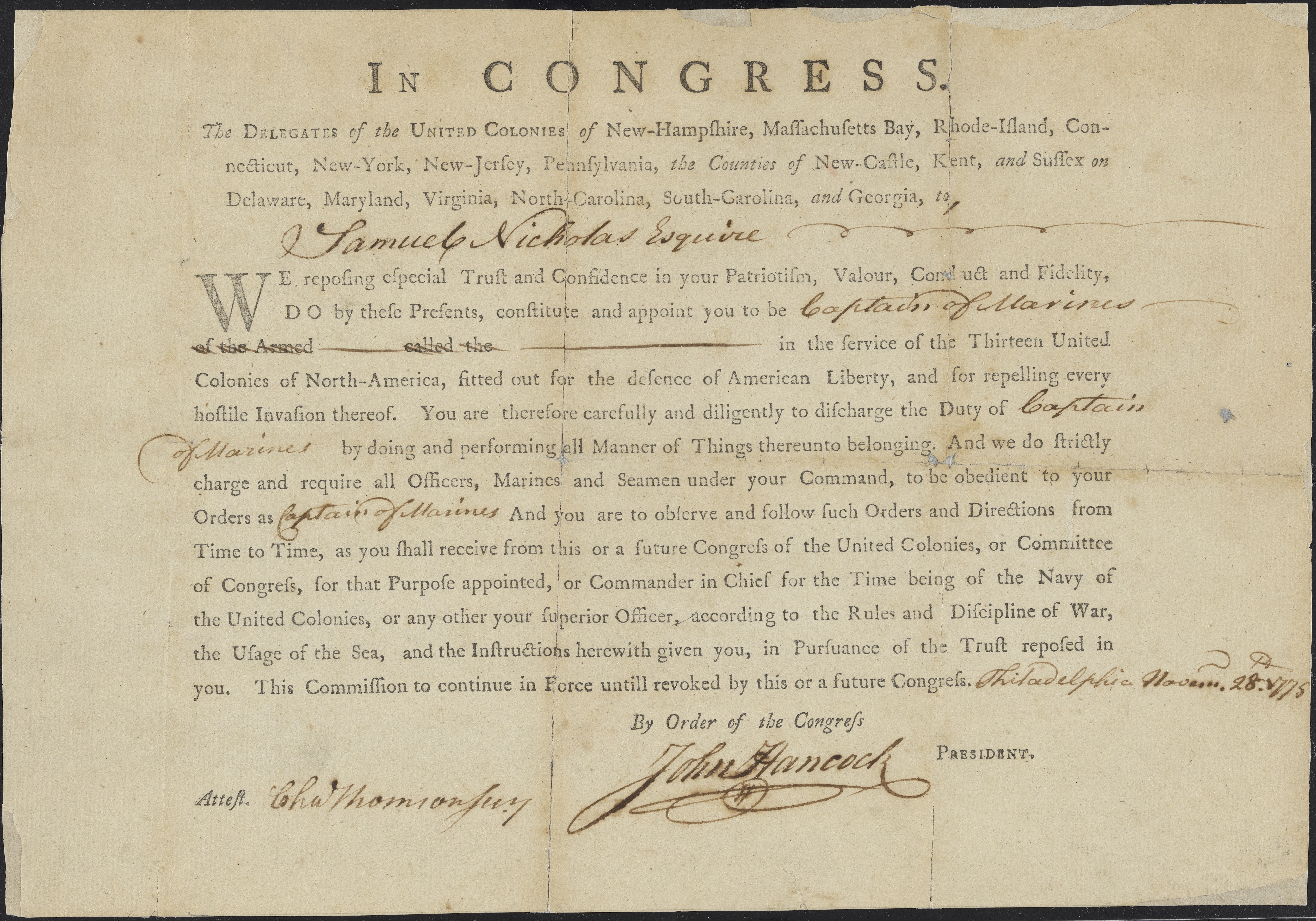
The Commission of Captain Samuel Nicholas, the first American Marine. (USMC)
Today marks the 250th birthday of the Marine Corps. November 10, 1775 was a milestone in the creation of American naval power, but the birthday story is a little more complicated.
The Continental Congress resolved to create a navy under its auspices on October 13, 1775, but much work remained to build American naval power to a point where it might serve a strategic purpose. Individual colonies had already begun creating naval forces and George Washington had leased ships under the army’s authority. Thus, the resolution served as more of milestone on a long road, rather than a fresh beginning.
On October 30, the Continental Congress considered the reports of its naval committee and confirmed recommendations for two vessels of 14 and 10 guns. Moreover, it resolved to add two more ships to its burgeoning navy, one of 20 guns and one carrying up to 36 guns. It also added four new members to the naval committee, bringing it to a total of seven. Stephen Hopkins (RI), Joseph Hewes (NC), Richard Henry Lee (VA), and John Adams (MA) joined John Langdon (NH), Silas Deane (CT), and Christopher Gadsden (SC).[1] On November 2, Congress gave the naval committee authority to call on the treasury for up to $100,000 to acquire a navy and delegated to the committee the authority to recruit officers and seamen, offering them prize money in the amount of one-half the value of all warships and one-third the value of transports made prizes.[2] It also took up a petition from a Committee of Safety in Passamaquoddy, Nova Scotia to join the association represented by the Continental Congress. Naturally, Congress appointed a committee—Silas Deane, John Jay, Stephen Hopkins, John Langdon, and John Adams to consider the matter. The naval expansion and Passamaquoddy petition sparked a new round of thinking about American naval power.
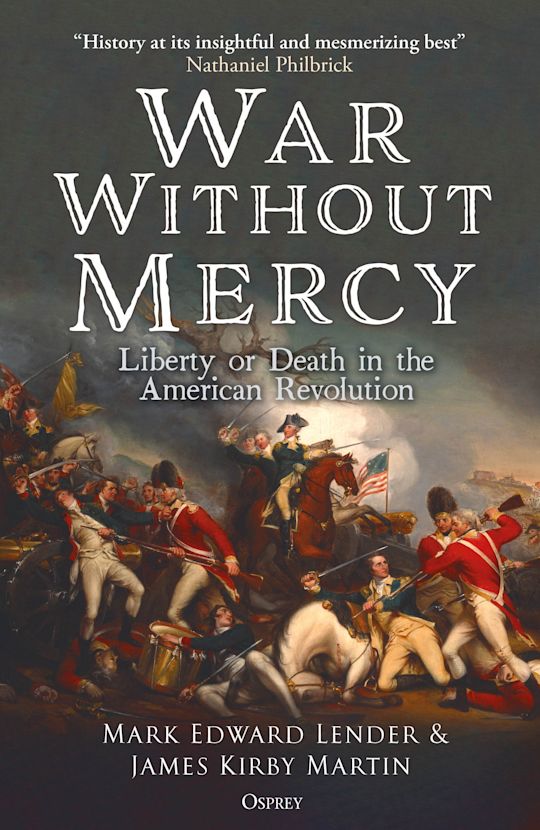
War Without Mercy: Liberty or Death in the American Revolution by Mark Edward Lender and the late James Kirby Martin is an enlightening and innovative look at violence and norms during the American Revolution. The authors waste no time getting to the point: they want to know why the war reached a point in which seemingly boundless levels of violence were embraced by all sides without regard to emerging standards of international law nominally intended to govern the use of force in warfare, collectively referred to as jus in bello, a Latin phrase essentially referring to the legal conduct of a war or justice in war. (Jus ad bellum refers to the legality of initiating a war. Collectively, they are key components of just war theory. Lender and Martin focus on jus in bello, particularly as it refers to legal or moral constraints on violence.)
War Without Mercy lays out the basic concepts of jus in bello as it was understood in the late 18thcentury. While historians often attribute the origins of modern international law to Hugo Grotius, Lender and Martin take Emer de Vattel’s landmark 1758 work “The Law of Nations” as the baseline text relevant to the American Revolution. Vattel offered limits on the conduct of military operations, clearly delineating concepts such as combatants, non-combatants, and proportionality. In general, he tried to narrow the scope of war so that it remained the domain of organized governments and outside the domain of broader society. Elites on both sides of the Atlantic had often read Vattel’s work, or were at least familiar with the ideas it contained, and War Without Mercy demonstrates that many of them sought to honor its principles, for moral, professional, and practical reasons.
That said, Lender and Martin argue that violence committed outside of the purview of elite-led revolutionary governments and the Continental Army (usually) characterized the war. The vast majority of fighting during the American Revolution occurred in small battles, skirmishes, and raids that resembled mob and gang violence directed at people out of uniform more than organized martial conduct. In that context, it routinely violated concepts of jus in bello. In addition to outlining earlier studies making that case, War Without Mercy examines the war in New Jersey, the western theater, the New York frontier, and the south. While those regions saw significant battles or campaigns, the day-to-day war was fought between small units of militia or irregulars with an occasional admixture of regulars or Continentals. In each case, Lender and Martin examine the escalation of events over the course of the war and the reasons each side tended toward “existential warfare,” essentially, war to the death in which the alternative to victory was total destruction. Given such high stakes, any constraints on means were self-defeating. No combatants could run the risk of losing the war by being charitable towards their enemies. Outrage sparked outrage. Thus, violence escalated like a ratchet as each side retaliated for perceived wrongs. It was a possibility several prominent patriots recognized before the fighting began. Indeed, James Lovell predicted it in his 1771 speech commemorating the Boston Massacre. War Without Mercy attributes the beginning of the cycle to the rebels, who quickly turned to intimidation, the threat of violence, and outright violence to silence loyalists and establish local political control as British colonial government collapsed.
One chapter examines Benedict Arnold’s raid on New London, CT. Lender and Martin consider the offensive and the Battle of Groton Heights, as the assault on Fort Griswold defending the River Thames was known, in the context of jus in bello. In general, despite the destruction of New London and the bloody results at Fort Griswold, they find the raid consistent with Vattel’s law of war. As a major privateering base, New London made itself a legitimate target of war and Arnold strove to limit damage to private property that did not contribute to the American war effort. The bloodletting at Fort Griswold was more the result of the fog of war, weak command and control, and the natural challenges of suddenly attempting to restrain men in the midst of intense combat. The New London raid, however, does demonstrate the blurring of lines between combatant and non-combatant, legitimate and non-legitimate objects of military operations, under the doctrine of jus in bello, as the war progressed and intensified. Lender and Martin liken it to the difficult decisions facing RAF Bomber Command during World War II, when it shifted from ineffective attempts to bomb specific targets to area bombing.
War Without Mercy is a must read. Revolutionary War library shelves are rife with biographies, battle studies, and political narratives. Fewer books place the American Revolution in the wider study of warfare and its evolution. By considering the war in the context of emerging principles of jus in bello and the rapid escalation to existential warfare, Lender and Martin are bringing a new analytical perspective to the study of the American Revolution. It’s a vital interpretation of the war’s nature.
Join us this Sunday at 7pm on our Facebook page as we welcome historian and author Gabe Neville back to Rev War Revelry. Gabe has just finished and published one of the most comprehensive Revolutionary War unit histories ever written. Focusing on the Eighth Virginia Regiment, Neville’s book titled “The Last Men Standing, The Eighth Virignia Regiment” is a must have for anyone’s library. We will talk with Gabe about his research, interesting tidbits of his book and what let him to this project.
This presentation witll be LIVE at 7pm on Sunday, August 24th. Tune in and share any thoughts or questions in the chat. Gabe is always a fun chat, so grab a drink and enjoy learning about his in depth research on the 8th Virginia Regiment.
On July 3, 1775 George Washington formally took command of the Continental Army in Cambridge, Massachusetts. Appointed Commander-in-Chief by the Second Continental Congress on June 15, 1775, Washington arrived in Cambridge on July 3, 1775 and assumed command of a disorganized and poorly supplied force besieging British troops in Boston. His leadership would begin the transformation of colonial militias into a unified fighting force capable of challenging British military power.
Washington’s assumption of command occurred at a time when the American colonies were transitioning from protest to open rebellion. The battles of Lexington and Concord in April 1775 had already ignited armed conflict, and the Battle of Bunker Hill in June had demonstrated that colonial forces could stand up to British regulars, though at great cost. Washington understood the gravity of his new role. In a letter to the President of Congress, he wrote humbly, “I am truly sensible of the high Honor done me in this Appointment… I do not think myself equal to the Command I am honored with.” This characteristic modesty was paired with a strong sense of duty and resolve.
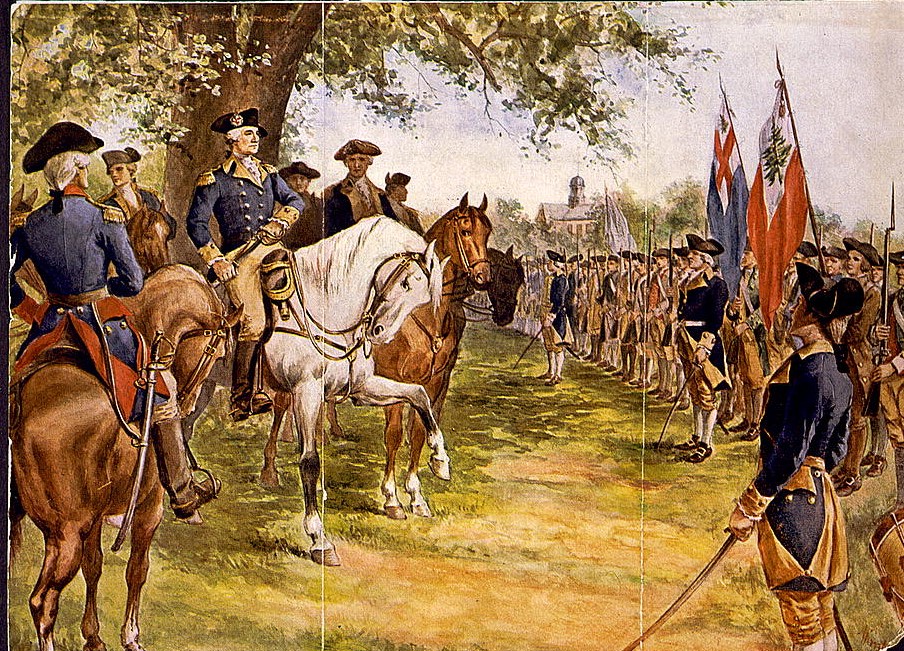
Washington assumes command at Cambridge, Courtesy Library of Congress
On July 3, Washington appeared before his troops on Cambridge Common, dressed in a blue coat with buff facings, signifying his Virginian roots. There is no official transcript of a speech he may have delivered that day, but contemporary accounts describe a solemn and determined atmosphere. One observer, Reverend William Emerson, noted in his diary, “General Washington… is a tall and noble-looking man, commanding the respect of all who see him.”
Washington immediately set to work imposing discipline, organizing supply chains, and creating a chain of command. Though former commander of the army, Major General Artemus Ward, worked hard on instilling discipline, he was not a man that instilled a lot of confidence. Washington was appalled by the state of the army, writing in frustration to Congress: “The Army… is in a very improper condition to carry on a vigorous War.” He introduced regular drills, uniform codes, and standardized procedures, striving to turn the disparate bands of militiamen into a functioning army. As historian David McCullough noted, “It was Washington’s presence alone that gave the army cohesion.”
Despite his military inexperience—Washington never commanded an army of this size—he brought a unifying vision and moral authority. His appointment was also politically astute, bridging the regional divide between New England and the southern colonies. A Virginian leading New England troops sent a clear message of unity in the face of British oppression.
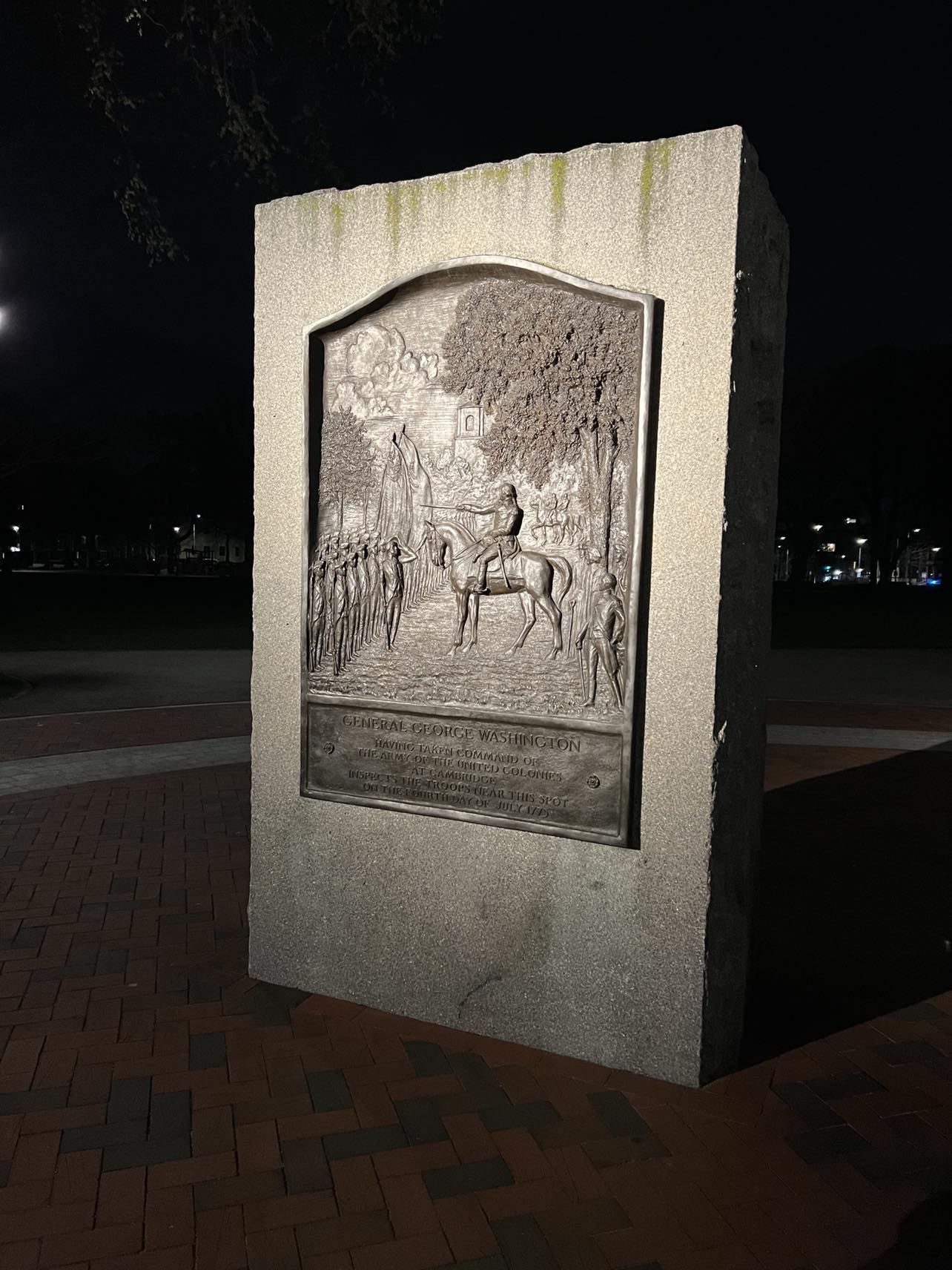
Marker commemorating Washington on the Cambridge Common, photo by William Griffith
The Cambridge encampment remained Washington’s headquarters until March 1776, when he successfully forced the British evacuation of Boston by fortifying Dorchester Heights with cannons brought from Fort Ticonderoga. This early strategic victory, achieved without major bloodshed, was a major morale boost and affirmed Congress’s faith in their commander.
In retrospect, July 3, 1775, was the beginning of an enduring legacy of leadership and a love of Washington by his men and officers. Through discipline, vision, and personal integrity, he began shaping a ragtag collection of volunteers into the Continental Army, laying the groundwork for American independence.
After years of political unrest between Great Britain and her North American colonies, tension finally boiled over into armed conflict on April 19, 1775, at Lexington and Concord. The British expedition to capture arms and munitions held by the colonists at Concord disintegrated into a panic-ridden retreat to Boston as local militias struck the column as it moved through the Massachusetts countryside. As often happens in war, seeds planted during a battle often sow the next.
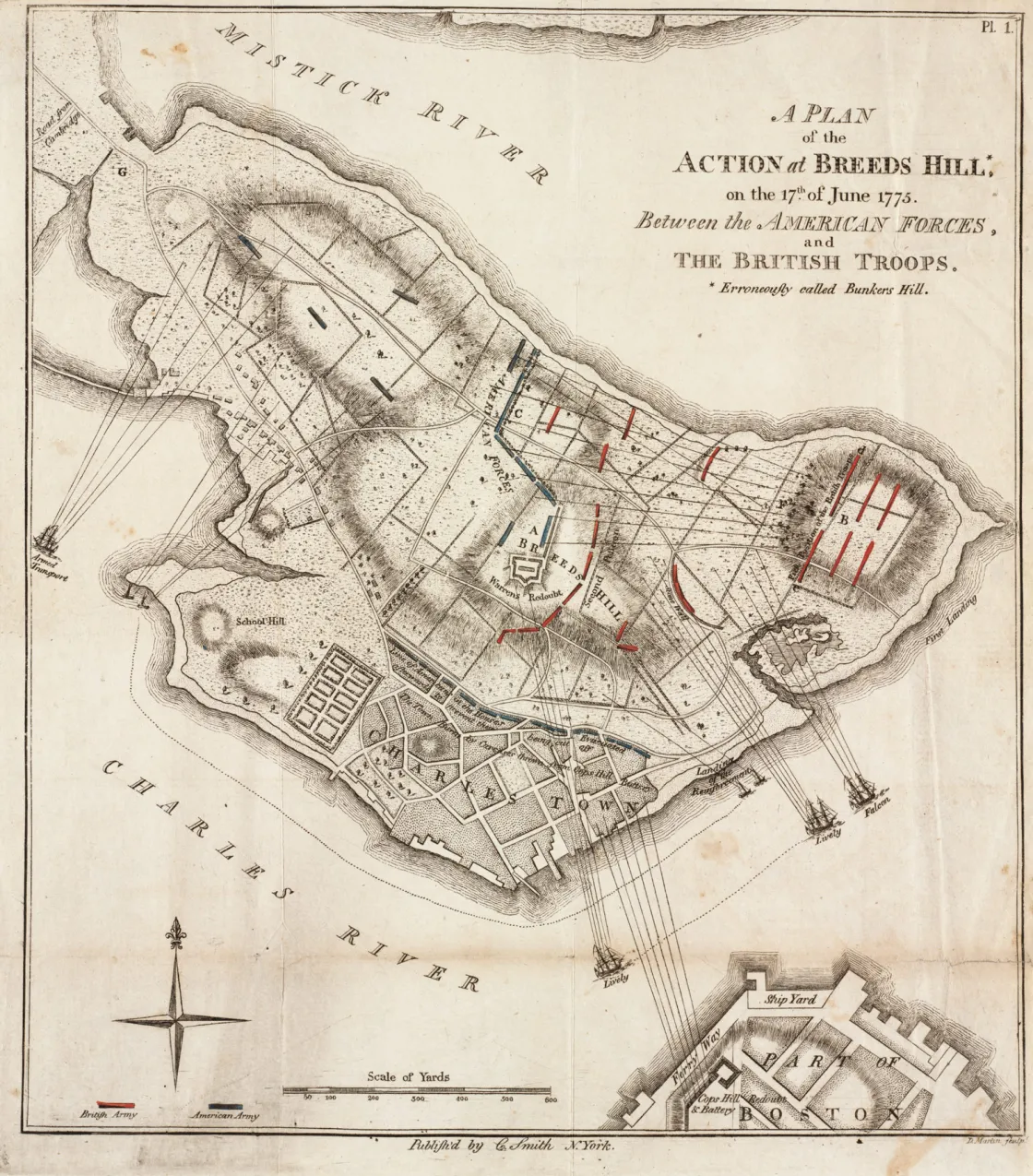
Rather than enter march through Boston Neck British officers diverted to Cambridge and proceeded to the Charlestown Peninsula. Bordered by the Charles and Mystic Rivers, the peninsula jutted out into Boston Harbor northeast of the city. As darkness settled in, exhausted British soldiers made their way onto 110-foot high Bunker Hill. This eminence, commanded Charlestown Neck, a narrow sliver of land connecting to the mainland, along with the surrounding landscape.
That night, Lt. Gen. Thomas Gage, the British Commander-in-Chief met with Vice Admiral Samuel Graves, head of the North Atlantic Squadron. Among other suggestions, Graves urged Gage to burn Charlestown and occupy Bunker Hill. Graves likely knew that his ships in the harbor could not elevate their artillery to reach the high ground. Additionally, Bunker Hill was out of range of the Copp’s Hill Battery located in the city’s North End.
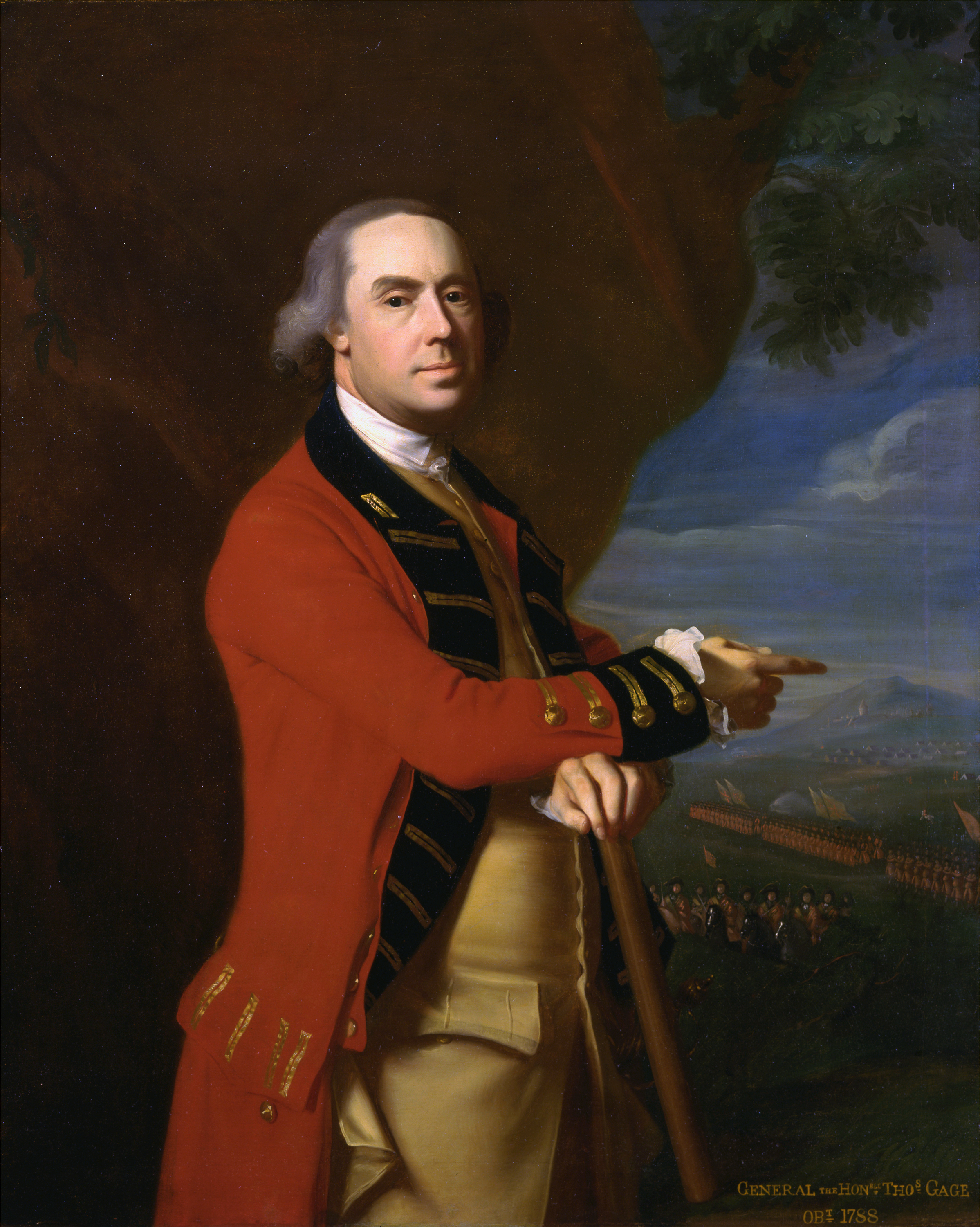
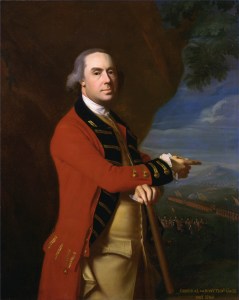
Thomas Gage
Gage recognized the long-simmering pot would eventually boil over with the colonists. “If you think ten thousand men sufficient, send twenty; if one million thought enough, give two; you save both blood and treasure in the end,” he wrote the previous fall to his superiors in London. Now, seemingly distant from the tactical situation on the ground, the survivor of the Monogahela rejected Graves’ proposal, claiming “the weakness of the army.” One must wonder if this was a decision Gage came to privately regret.
The arrival of reinforcements at the end of May, along with Maj. Gens. John Burgoyne, Henry Clinton, and William Howe may have buoyed Gage’s spirits. He soon began making plans to break out of Boston. In consultation with his subordinates, Gage formulated a plan to strike first across Boston Neck to capture Dorchester Heights, which commanded the southern end of the city. A second attack would capture Charlestown then move the three miles to Cambridge to hopefully destroy the Massachusetts army. The offensive was slated to take place on June 18.
Unfortunately, Boston leaked like a sieve and Gage failed to maintain what is known today as operational security. His plans were soon known in Cambridge where the Massachusetts Committee of Safety authorized their own effort to occupy Bunker Hill ahead of the British. On the night of June 16, colonial units led by Col. William Prescott marched out of Cambridge toward Charlestown. Rather than follow his orders, Prescott moved to the 60 foot high Breed’s Hill, located slightly to the southeast of Bunker Hill. Prescott’s decision remains one of the great mysteries surrounding the battle. His men began construction of a redoubt.
Another question surrounding the engagement rests with Henry Clinton. Sometime on the evening of June 16, Clinton wrote he conducted a reconnaissance and claimed he witnessed Provincial activity. He did not, however, explain where he went nor reported the type of actions he saw. Additionally, visibility would be difficult in the growing dusk. Clinton further stated he reported his findings to Gage and Howe but Gage elected to wait for daylight.
Sunrise revealed Prescott’s men atop Breed’s Hill, hard at work on the redoubt, which threatened the northern end of the city. Gage and his officers quickly convened at his headquarters at the Province House. Howe, the senior officer, would be in command. Some thought was given to sail up the Mystic to land on Charlestown Neck well in the rear of the redoubt. This plan was quickly nixed for fear the force could be isolated and cut off by reinforcements from Cambridge and militia on Breed’s Hill. It was eventually decided Howe would land below and out of range of the redoubt. Orders soon went out for the mustering of the “ten oldest companies” the flank and grenadiers, each – along with several regiments to prepare for the operation.
Each British regiment consisted of ten companies, eight line, with two flank and grenadier companies. The flank companies consisted of men who were often the shortest and fastest, who could operate in open order tactics, moving quickly to engage and skirmish with the enemy. The grenadiers, identified by their bear skin hats, were often the tallest men in the regiment and were used as the shock troops during an attack. By the time of the American Revolution, they were no longer carrying hand grenades but the name remained. Oftentimes these companies were separated from their regiments and placed in their own battalions.
Howe disembarked from Long Wharf, going over himself in the second wave, that afternoon. The British landed at Moulton’s Hill, near the modern Navy Yard. Stepping ashore, Howe observed his objective. “On first view it was clearly seen that the rebels were in forced and strongly entrenched upon their right in the Redoubt that had been seen from the town at daybreak,” he reported. “Their left and center were covered by a breastwork which reached from the Redoubt to the Mystick, the space from the Redoubt to that river being about 380 yards, and the whole extent they occupied about 600 yards”. The extent of the defenses compelled Howe to call for reinforcements.
Toward the middle of the day, the British launched their assault. Although Howe’s second in command, Brig. Gen. Robert Pigot was present and directed the left of the line, Howe also decided to take a stronger role and led the center himself on foot. Howe directed his light infantry to advance along the beach of the Mystic, likely with the hope in mind of getting behind the redoubt. This attack was met and repulsed by New Hampshire militia under Col. John Stark. So too were Howe’s and Pigot’s attacks. Watching his men come stumbling back after the failed attempt prompted Howe to later write “it was a moment I had not felt before.”
In the second assault, Howe attempted to further squeeze off the redoubt, pulling the light infantry from the beach to augment his center. At the same time, Pigot sent the 1st Marine Battalion and the 47th Regiment of Foot to get between Charlestown and the redoubt. During the assault, which also failed, the light infantry fired into the rear of the grenadiers, inflicting casualties.
Once again, the British lurched forward, determined to overwhelm the redoubt by a sheer force of numbers. This time, luck was with them as the militia were running out of ammunition. Francis, Lord Rawdon, an officer in the 5th Regiment of Foot who would go on to distinguish himself in the Southern Campaigns recalled “our men grew impatient, and all crying Push on, Push on, advanced with infinite spirit to attack the work with their small arms. As soon as the rebels perceived this, they rose up and poured in so heavy a fire upon us that the oldest officers say they never saw a sharper action. They kept up this fire until we were within ten yards of them…there are few instances of regular troops defending a redoubt till the enemy were in the very ditch of it.”
The British infantry swarmed into Prescott’s redoubt. Somewhere in the maelstrom was British lieutenant and adjutant of the 1st Marines, John Waller. “Nothing could be more shocking than the carnage that followed the storming of this work,” he wrote “We tumbled over the dead to get at the living who were crowding out of the gorge of the redoubt…’twas streaming with blood and strewed with the dead and dying men, the soldiers stabbing some and dashing out the brains of the others.” The colonials managed to retreat across Charlestown Neck, the British too exhausted to give chase.
Bunker Hill became the first of many pyrrhic victories for the British over the course of the American Revolution. Still, there were a number of shortcomings. Howe, rather than oversee the attacks from Moulton’s Hill, led the assaults himself. Perhaps he needed to inspire his men or he recognized the importance of the situation but he reverted to being a battalion commander. One must wonder whether the initial attacks could have been more effective had he delegated authority and used more of a guiding hand. Howe’s experience that day may have influenced him for the remainder of the war. Rather than rely on frontal assaults, he utilized flanking maneuvers such as those at Long Island and Brandywine. The friendly fire casualties can be attributed to inexperience amongst the ranks. Gage, along with his subordinates also share, the blame for not maintaining operational security and letting their plans slip out of Boston. Additionally, Gage failed to heed the advice of Graves and secure Charlestown Peninsula in April when he had the opportunity. The result nearly two months to the day resulted in over 1,000 British soldiers killed and wounded, a high cost of blood and treasure, in a war that would lead to the independence of the United States.
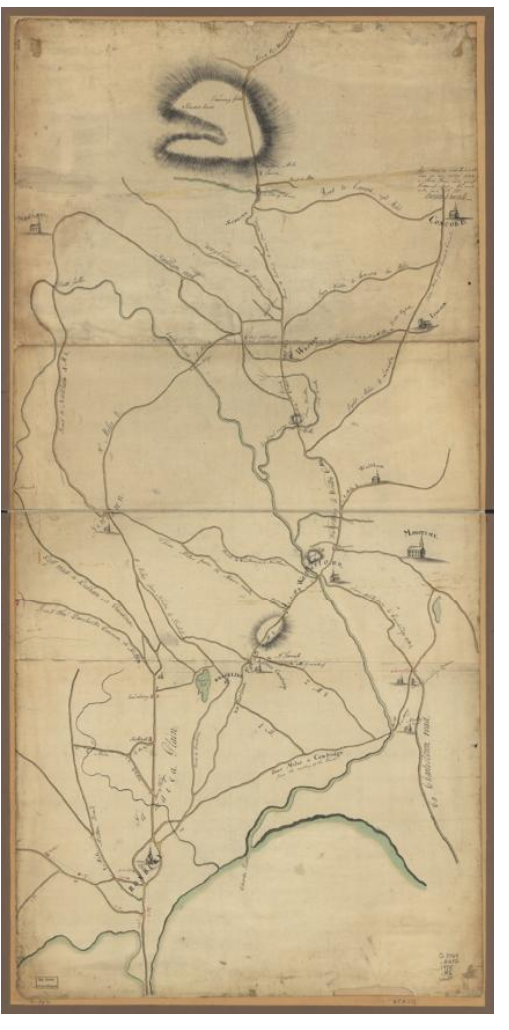
The spy network of Dr. Joseph Warren and the Sons of Liberty is well documented and written about. Few things happened in and around Boston that Warren, Paul Revere or Sam Adams were not aware of. In the winter of 1775, British General Thomas Gage also established a spy network (one of the more famous British spies was supposed “Patriot” Dr. Benjamin Church was not revealed as spy until October 1775). Gage was using all the resources at his disposal to figure out what the Whigs were doing and to find out where weapons (and four cannon that were stolen from the British in Boston) were located. On February 22nd, Gage sent out two officers, Captain John Brown and Ensign Henry De Berniere, to covertly ride out towards Worcester to locate stores and to map the road network for a possible British excursion. A few weeks later, on March 20th Gage sent out Brown and De Berniere again to map out routes towards Concord. Keeping in mind of potential geographic features that could endanger the future British column.
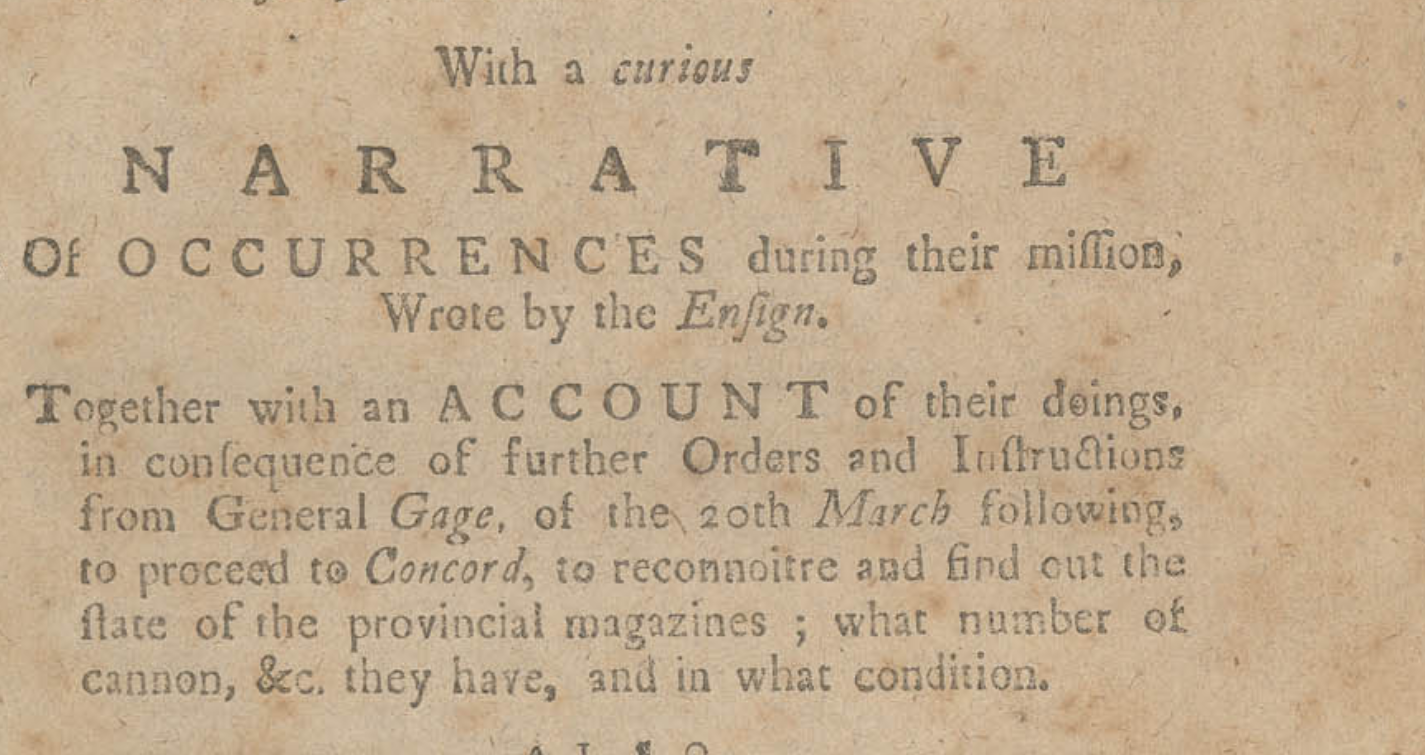
The following is an account of the March 20th mission by Ensign De Berniere. This account was found in Boston after the British evacuated and published by Boston printer J. Gill in 1779. Today it is located in the Massachusetts Historical Society. This mission was the precursor for the April 18-19th British raid to Concord that ignited the war.
Map, Roxbury to Concord. Roads & distances; by Brown and De Berniere, Library of Congress
Account of the proceedings of the aforesaid officers, in consequence of further orders and instructions from General Gage, of the 20th March following ; with occurrences during their mission.
Scan of the original print by J. GILL, in Court Street. 1779, Massachusetts Historical Society
THE twentieth of March Captain Brown and myself received orders to set out for Concord, and examine the road and situation of the town ; and also to get what information we could relative to what quantity of artillery and provi- sions. We went through Roxbury and Brookline, and came into the main road between the thirteen and four- teen mile-stones in the township of Weston ; we went through part of the pass at the eleven mile-stone, took the Concord road, which is seven miles from the main road. We arrived there without any kind of insult being offered us, the road is high to the right and low to the left, woody in most places, and very close and commanded by hills frequently. The town of Concord lies between hills that command it entirely ; there is a river runs through it, with two bridges over it, in summer it is pretty dry ; the town is large and co- vers a great tract of ground, but the houses are not close together but generally in little groups. We were informed that they had fourteen pieces of cannon (ten
iron and four brass) and two cohorns, they were mounted but in so bad a manner that they could not elevate them more than they were, that is, they were fixed to one elevation ; their iron cannon they kept in a house in town, their brass they had concealed in some place behind the town, in a wood. They had also a store of flour, fish, salt and rice ; and a magazine of powder and cartridges. They fired their morning gun, and mounted a guard of ten men at night. We dined at the house of a Mr. Bliss, a friend to government ; they had sent him word they would not let him go out of town alive that morning ; however, we told him if he would come with us we would take care of him, as we were three and all well armed, — he consented and told us he could shew us another road, called the Lexington road. We set out and crossed the bridge in the town, and of consequence left the town on the contrary side of the river to what we entered it. The road continued very open and good for six miles, the next five a little inclosed, (there is one very bad place in this five miles) the road good to Lexington. You then come to Menotomy, the road still good ; a pond or lake at Menotomy. You then leave Cambridge on your right, and fall into the main road a little below Cambridge, and so to Charlestown ; the road is very good almost all the way.
In the town of Concord, a woman directed us to Mr. Bliss‘s house ; a little after she came in crying, and told us they swore if she did not leave the town, they would tar and feather her for directing Tories in their road.
[Left in town by a British Officer previous to the evacua tion of it by the enemy, and now printed for the information and amusement of the curious.]
BOSTON Printed, and to be sold, by J. GILL, in Court Street. 1779.
We reshare a post from 2018 about the Salem Alarm also known as “Leslie’s Retreat.” As we approach the 250th anniversary of this important event (February 26, 1775), we will share primary source accounts of the event. This event set the kindling for the spark that lit a war in Lexington a month later.
As events quickly spiraled out of control in the winter and spring of 1774-1775 around Massachusetts, several armed confrontations between local “Patriots” and the British army heightened tensions. On many occasions, both sides adverted open confrontation and were able to diffuse the situation. Understanding these events and how they made an impression on both sides helps explain what happened on the Lexington Common on April 19, 1775.
As soon as British General Thomas Gage arrived in Boston in the spring of 1774, he set about enforcing the newly passed “Coercive Acts.” In response to these new laws that restricted many of the rights the people of Massachusetts had grown accustomed too, local groups began to arm themselves in opposition to British authority. Even though Gage was once popular in the colonies, he soon became an enemy to those around Boston who believed the Coercive Acts were an overstep of British authority. Continue reading ““If you Fire, You’ll all be dead men” The Salem Alarm”→
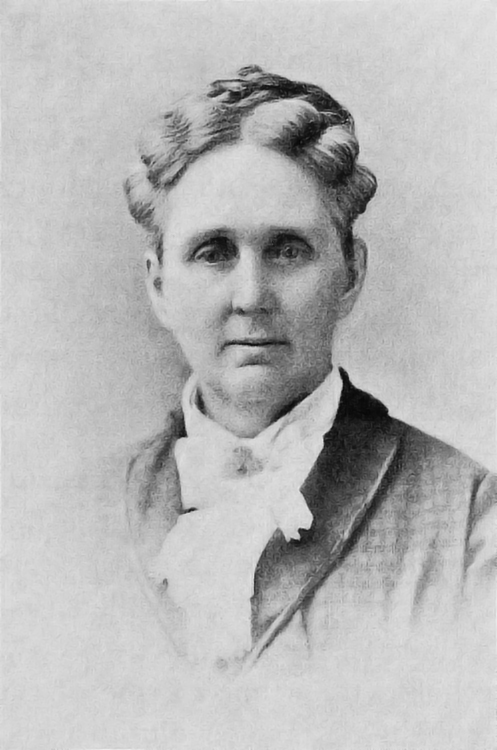
Valley Forge consists of acres of undulating countryside where General George Washington and some 11,000 Continental Army troops spent the winter of 1777-1778. Today, it is one of the nation’s most hallowed shrines. Few, if any, modern visitors recognize the woman who fought to save it, nor her heroic work as a nurse during the American Civil War.
Anna Morris Ellis was born in Muncy, Pennsylvania, on April 9, 1824. On September 26, 1848, she married William Hayman Holstein. At 38 years old, Anna became involved in the Union army’s war effort during the American Civil War after the battle of Antietam in September 1862. Her husband returning home after serving a 90-day enlistment, told of wounded men lying in barns and fields around Sharpsburg, Maryland because there weren’t enough medical corpsmen. Despite an overhaul to the Union Army of the Potomac’s Medical Department by Dr. Jonathan Letterman earlier that summer, the combined evacuation of the Virginia Peninsula from their failed late spring and summer campaigns and the Second Manassas campaign outside of Washington, D.C. in August had left this medical department in a state of chaos, confusion, and wholly unprepared to meet the medical needs of such another large scale engagement as Antietam. Anna and her husband William immediately left for the Antietam battlefield in response to the distressing scenes he had painted for her.
Anna Morris Ellis Holstein
The Holstein’s served for months around the Antietam battlefield, caring for the sick and wounded. Their role as post-battle caretakers continued just a month after the battle of Gettysburg when the large army field hospital of Camp Letterman opened just east of the borough on the York Road. This time, however, Anna was already numbed to the scenes of shattered limbs and the despondently ill wearied from disease. By this time her husband had secured a position with the U.S. Sanitary Commission which also setup at Gettysburg to aid the wounded and sick in the wake of the battle. That agency, along with the U.S. Christian Commission, offered supplies and personages to aid in the aftermath of not only Gettysburg, but other battles in the final years of the war.
Anna’s role for caring for those soldiers left behind by both armies was significant. She was made matron-in-chief of Camp Letterman by Dr. Cyrus Nathaniel Chamberlain, which, under her and Chamberlain’s care, attended to over 3,000 wounded soldiers. Anna continued to work at Camp Letterman until it closed on November 19, 1863. Later that day, both her and her husband sat on the platform near Abraham Lincoln while he delivered the Gettysburg Address. Following her work at Gettysburg, Anna continued to nurse the sick and wounded back to health. By the end of the Civil War in 1865 and into 1866, she worked as a matron in a hospital in Annapolis, Maryland, caring for returned prisoners of war that were sick or wounded.
In the post Civil War years, Anna turned to the preservation of the places and material culture from America’s first war for independence. She was no stranger to the importance of this era and the necessity of keeping the memory of those that served during that turbulent era alive for future generations. Anna’s great-grandfather was Capt. Samuel Morris. Morris was the captain of the First City Troop of Philadelphia when it served as George Washington’s body guard. Captain Morris was with Washington during the Ten Crucial Days and was on the field him at the battles of Trenton and Princeton. Morris even earned the sobriquet as leader of the “fighting Quakers.” Anna’s grandfather, Richard Wells, also served the American cause. He was commissioned to provision the U.S. fleet on the Delaware River during the revolutionary war.
One of her first missions was to save and restore George Washington’s Virginia estate, Mount Vernon. The home had fallen into significant disrepair, with the recent war years only aiding to its material decay. Both Anna and her husband, who also had strong ancestral ties to the War for Independence, were among the first to promote the struggles at Mount Vernon, the necessity for saving it, and the fundraising to back those plans. It was her skills in fundraising so successfully for Mount Vernon that led her to be named as regent for the Valley Forge Centennial and Memorial Association. Anna also was one of the founders, and also named regent as well, of the Valley Forge Chapter of the D.A.R.
By 1878, The Centennial and Memorial Association of Valley Forge, was incorporated in Montgomery County, Pennsylvania. Once incorporated, she led the charge as regent to save, acquire, restore and preserve General Washington’s Valley Forge Headquarters and surrounding acreage as parcels became available. Much needed funds for this charge would be needed, however. On June 19, 1878, to commemorate the 100th anniversary of the Continental Army marching out of Valley Forge, the Association held a large, organized event. With the funds generated from the anniversary commemoration, the Association was able to not only purchase General Washington’s Headquarters, but also additional acreage around the farm complex. They were also able to purchase original artifacts to place in the home, begin renovations to restore the home back to its 1777-78 appearance, and plant a tree from Washington’s Mt. Vernon on the property.
By 1893, when the Commonwealth of Pennsylvania assumed control of the camp sites and headquarters at Valley Forge, with Anna credited as the person “to whom the Nation is indebted more than any other” for her tireless efforts to ensure this national shrine was preserved and protected in perpetuity. Decades later, the National Park Service would assume ownership and operational leadership of the park from the state of Pennsylvania.
Anna and William’s home still stands in King of Prussia, Pennsylvania today at 211 Henderson Road. In 2021 the Pennsylvania Historical and Museum Commission placed a marker at the entrance drive to the home. Anna’s work at saving material culture from the Revolutionary War and ensuring the legacy of the veterans of that conflict lived on was vast. Hopefully this small summation of her activities inspires others to dig deeper into her efforts.



 Emerging Revolutionary War Era