Join Emerging Revolutionary War this Sunday, at 7p.m. EST on our Facebook page as we head, virtually, down to South Carolina to discuss the importance of that colony/state in the American Revolution.
Most are familiar with the larger engagements, such as Cowpens and Kings Mountain or maybe the massacre at the Waxhaws. How about the Siege of Charleston, or the battles of Ninety-Six, or the countless other engagements that made the Palmetto State (which got its nickname from this era) one of the most hotly contested areas of the entire conflict.
Joining the “Rev War Revelry” will be ERW historians Vanessa Smiley, former Chief of Interpretation and Education at the Southern Campaign of the American Revolution National Park Group, which includes Cowpens, Kings Mountain, and Ninety-Six and Bert Dunkerly, former park ranger at Kings Mountain and author of a few histories on South Carolina in the Revolutionary War topics.
We look forward to seeing you for our sojourn into the Southern Theater this Sunday. Oh, and remember to grab your favorite brew for the trip!
Battle of Lexington by Amos Doolittle, December, 1775
One of the most amazing parts of the events on April 19, 1775 is just how sophisticated the colonial information network was. As soon as Lt. Col. Francis Smith’s British Regulars began to move across the Charles River, riders fanned out from Boston and to neighboring towns. Each town then had more riders that spread out and soon dozens of men were riding through the New England countryside warning of the fighting that took place. Soon information spread to the mid-Atlantic colonies and Philadelphia on April 24th. In the age of no electricity, the complexities and speed that news traveled from Boston to the other colonies was pretty amazing. Stories grew from person to person and it would take months and even years to decipher truth from exaggeration. It was imperative for both the “Patriots” and General Thomas Gage to get their version of the events of April 19th out as fast as possible. Facts or not, the importance of the public relations was of utmost importance to both sides to win the hearts and minds of the other colonies.
As the news reached Virginia, the colony was already at a crossroads with their
Virginia Lt Governor, John Murray, 4th Earl of Dunmore
Governor. The last House of Burgesses that met in Williamsburg was dissolved in August 1774 over their vocal support of the people of Massachusetts after the Boston Port Act. The once popular Governor, John Murray, 4th Earl of Dunmore (Governor Dunmore), was angered over their overt support and ordered them dissolved and returned home. The legislature defied his orders and met soon after at the nearby Raleigh Tavern, thus constituting the “First Virginia Convention.” With questionable legal authority, the Convention called for solidarity and non-importation of British goods. They also agreed to meet again in the future. The “Second Virginia Convention” met in March of 1775 in Richmond, a safe distance from the Governor’s influence in Williamsburg. It was at this Convention that Patrick Henry made his famous “Give me Liberty or Give me Death” speech on March 23. Though considered radical at the time, the speech energized the Convention and set the tone. When the Governor learned of the Convention and especially Henry’s speech, he made a fateful decision to remove the gunpowder stored in the magazine in Williamsburg. Continue reading ““The Sword is Now Drawn…” The Powder Incident, Lexington and Concord moves Virginia to Revolution”→
This Sunday, April 26, at 7 p.m. EST, Emerging Revolutionary War invites you to click on and listen to the next installment of our “Rev War Revelry.” This week’s happy hour will focus on the most over-looked battle or engagement from the American Revolution. Each of the historians slated to participate will bring their pick for that category.
Feel free to chime in with yours in the comments here or on the Zoom call on Sunday. The feed will be live on ERW’s Facebook page. So, grab your favorite beverage and join us for a free-flowing conversation to toast off the weekend with.
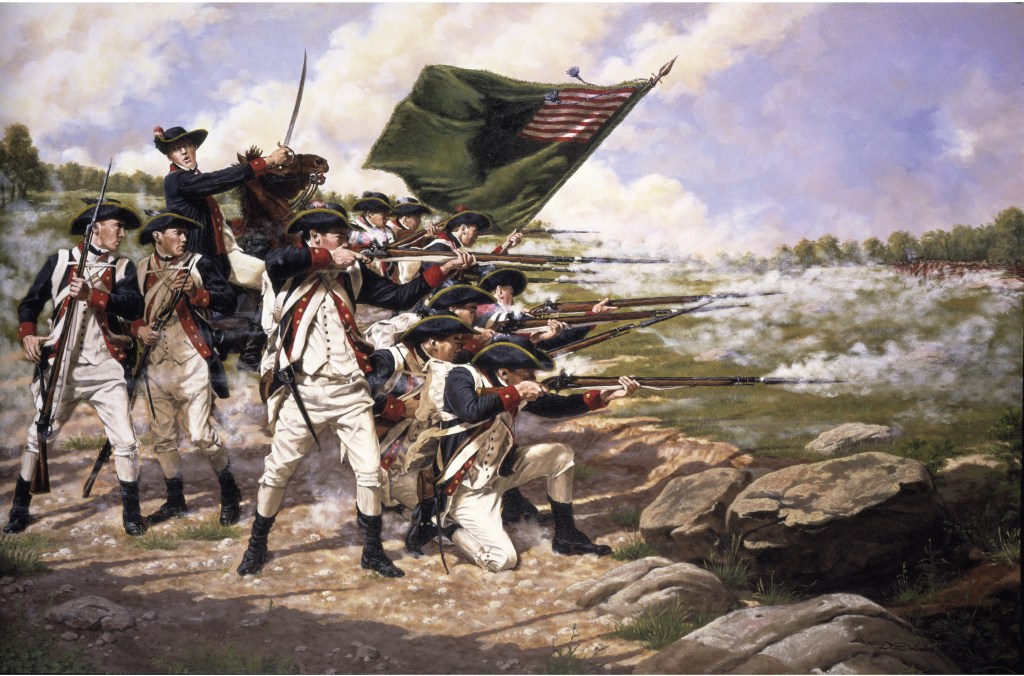
Delaware Regiment at the Battle of Long Island (Wikipedia)
Emerging Revolutionary War invites you to attend our “Rev War Revelry” tonight at 7 p.m. EST as we discuss the beginning of the American Revolution on April 19, 1775, 245 years ago today.
Yet, not only will Emerging Revolutionary War historians be on the call but we have a special guest historian joining us as well.
Stacey Fraser
Stacey Fraser is the Collections and Outreach Coordinator for the Lexington Historical Society. She has overseen new exhibits in the town and has assisted with the annual Patriots Day events. She will be on to share her expertise in this momentous day in American history and about what is happening, both virtually, and in the future with the Lexington Historical Society.
ERW looks forward to welcoming Stacey and all of you to our inaugural Zoom history call tonight!
Marquis de Lafayette was a French aristocrat serving in the French army, and recently married, when the Revolution broke out in America. He followed events with interst, and was motivated to come and fight with the Americans.
He arrived in March, 1777, nineteen years old and eager. He immediately formed a friendship with Washington, and was an aide on his staff. In the meantime British forces had invaded Pennsylvania, intent on capturing Philadelphia. Washington’s army took a position behind Brandywine Creek, and the British attacked on September 11, 1777. British troops had flanked the Americans, and reinforcements were rushed to the threatened sector, making a stand on Birmingham Hill.
Eager to get to the fighting, Lafayette and a group of French officers rode to the unfolding battle at Birmingham Hill, arriving as the action was at its hottest. Approaching from the south, they rode up the Birmingham Road, and turned to the left, coming in behind the brown-coated troops of General Thomas Conway’s Pennsylvania brigade.
Vale of Edale, Cresswell’s Home, the Beginning and End of His Adventures. (Photo by Atomviz, Wikimedia Commons)
Skirmish in New Jersey
Cresswell found cheap lodging in New York and reunited with Joseph Brewer, who had fled Philadelphia himself, leaving his wife behind. “The persecution against the friends of Gorvernment was too violent for a man of his warm temper to stay any longer amongst them with safety either of person or property.”[1] While in New York, he watched the buildup of forces that Howe would later take on the Philadelphia campaign, but his focus remained on securing passage home. It would take months, but Cresswell found ways to kill time, including watching a skirmish with the Americans he had so frequently cursed.
Emerging Revolutionary War welcomes historian Vanessa Smiley to the blog.
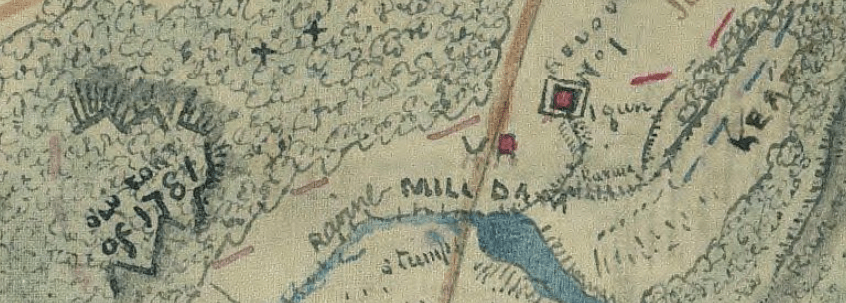
The thing about Ninety Six National Historic Site is that it’s unassuming exterior hides a wealth of history. It’s also nowhere near a major highway, meaning you have to want to get there if you’re thinking of visiting. And when you do get there, you will realize that there’s more history per acre than its demur entrance lets on. Located in the back country of South Carolina, Ninety Six has a history that speaks to the stories of Native Americans, the American frontier of the 18th century, and the American Revolution.
Entrance to the park (courtesy of Ninety Six NHS, NPS)
The site at Ninety Six holds a treasure trove of study on these subjects. Native American, mostly Cherokee, activity was heavy in the area long before European settlers arrived. One of the earliest backcountry trading posts, established by Robert Gouedy in 1759, made Ninety Six a hotbed of trading activity thanks to its location at the crossroads of twelve different roads and paths, linking the area to nearly all parts of the colonies.
Emerging Revolutionary War welcomes guest historian Jon-Erik Gilot. A short bio is attached at the bottom of this post.
Though perhaps more widely known as the birthplace of West Virginia during the Civil War, Wheeling and its environs retains several significant sites associated with the Revolutionary War. The name itself is translated from the Delaware language meaning “place of the skull,” legend having that the severed head of a white settler was placed on a pole by local Native Americans as a warning to others to stay away.
Betty Zane’s Run for Gunpowder during Second Battle of Fort Henry–1782 (image courtesy of Library of Congress)
Wheeling was founded in 1769 by Colonel Ebenezer Zane and his brothers Jonathan and Silas. Five years later in 1774 Fort Henry (originally called Fort Fincastle) was built overlooking the Ohio River to protect the growing numbers of settlers from attack. The fort was twice attacked during the Revolutionary War, first in 1777 and again on September 11 – 13, 1782, when a force of British loyalists (Butler’s Rangers) and Native Americans (under the command of outlaw Simon Girty) attacked the fort’s 47 defenders. The fort was besieged over two days, culminating in Betty Zane’s heroic run for gunpowder in a nearby cabin. The British and natives broke off the battle with the arrival of Virginia militia reinforcements. Fort Henry is acknowledged as one of the final battles of the Revolutionary War.
Emerging Revolutionary War welcomes guest historian Kevin Pawlak. A short bio follows the post below.
On May 25, 1775, the 62nd Regiment of Foot stood for review. The line of men, clad in their redcoats with buff facings, did not impress the reviewing officer. He called the regiment “very much drafted” and “very indifferent.” Despite the disparaging grade, in just over two years, the 62nd Foot commendably fought in one of the fiercest actions of the War for Independence.
John Anstruther courtesy of 62ndregiment.org
Scottish military man Lt. Col. John Anstruther led the 62nd Foot in the campaign of 1777. Anstruther faced no easy task; the 62nd was the junior British regiment in John Burgoyne’s army and most of its men were inexperienced in campaigning and battle. To make the situation even worse, roughly one-quarter of the 62nd Foot’s soldiers were German. Language barriers likely prevented complete cohesion within the unit. However, with a war on, nothing could be done to rectify the regiment’s defects as it marched south into New York.
Anstruther’s regiment was present for the operations around Fort Ticonderoga in early July 1777. After American forces abandoned the fort, the conglomerate and inexperienced 62nd remained behind to man Mount Independence overlooking Lake Champlain. As the rest of Burgoyne’s army continued campaigning, the men of the 62nd Foot spent time guarding themselves against rattlesnakes rather than the enemy. Their time came to rejoin the main army before the Battle of Saratoga commenced.
Just north of Greensburg, PA, about twenty five miles from Pittsburgh, is the site of the Westmoreland County Courthouse at Hanna’s Town. The settlement included a few log buildings and was a gathering point for militia throughout the Revolution.
Robert Hanna settled here in 1773 and the first county court for Westmoreland County met here that April. It is thought to be the first courthouse west of the Allegheny Mountains. The village that sprung up straddled the 1758 Forbes Road, built by British troops during the French and Indian War and now a major route for settlers to the region.