Along the wooded ridges of central Pennsylvania, a brutal war raged that was far removed from the orderly movements of large armies in the east. The attack on Phillip’s Rangers is a good example of this warfare.
Native Americans, supplied and encouraged by the British, raided far and wide on the frontier. These included Seneca, Shawnee, Delaware, and Mingo peoples. By the 1780s, many of these groups had been pushed out of their traditional homes to the east, and many viewed war with the Americans as the only way to protect what land they had left.
Billy Griffith, Kevin Pawlak, Rob Orrison and Mark Maloy at George Washington’s HQ in Newburgh, NY
Just over two weeks ago, ERW historians Billy Griffith, Phillip Greenwalt, Mark Maloy, Rob Orrison and Kevin Pawlak took a long weekend trip up to upstate New York. This was the fourth year that ERW authors have gotten together to take a “field trip” to see sites related to the French and Indian War and the American Revolution.
The trips not only serve as chances for research, but also to make new connections with public historians working in the American Revolution era. Along the way, we posted several videos from locations to give our followers an idea of some of the great places to visit out there. Again, our goal is to not just share this history, but to get people to visit these great sites.
Sites visited on the first day included the Stony Point Battlefield, where Americans under Gen. Anthony Wayne over ran a surprised British outpost. Reading about this action almost rings empty until you stand on the ground. Looking at the steep terrain that Wayne’s men climbed after traversing through a wetland, it is hard to imagine how the Continentals were able to take the British fort with so few casualties. Later that day we made a quick stop at George Washington’s headquarters in Newburgh. Here Washington lived from April 1782 to August 1783 and where he learned of the cease fire with the British, wrote his now famous circular letter to the colonial governors on his vision for the new government. Most importantly, here Washington responded to the Newburgh Conspiracy of his officers looking to possibly over throw the civil government. This site is also important in the history of the museum field as it is the first publicly owned historic site in the United States, opened in 1850 as a museum. A worthwhile nearby site, the New Windsor Cantonment site, preserves the camp site of the Continental Army during the 1782-1783 time period. Several of the buildings are rebuilt, including the Temple of Virtue, where Washington made his impassioned speech to his officers (with the assistance of his glasses) to diffuse their discontent with Congress.
The morning of the second day of the trip was spent visiting sites around Lake George, NY, including some much over looked French and Indian War sites. That afternoon sites along the upper Hudson including the site of the murder of Jane McCrea, Fort Edward and sites in Albany.
Park Interpreter Bob Hoar explains the terrain of the battlefield
Early Sunday morning, a quick trip to the Bennington Battlefield State Park was highlighted with a great personal tour by Bob Hoar. The battlefield is well preserved and interpreted. Bob also shared some of his research into reinterpreting the battlefield using first person accounts and the landscape. Again, understanding the landscape of these places creates such a better understanding.
The majority of the day on Sunday was spent at Saratoga National Historical Park, posting several Facebook Live videos from various points across the battlefield. Also a special visit to the surrender site in Schuylerville which was recently preserved and opened as a memorial by the Friends of Saratoga Battlefield. A great preservation victory that adds to the overall story of Saratoga.
One of the highlights of the trip took place on Monday, where we received a behind the
Curator Matthew Keagle gave a behind the scenes tour of Fort Ticonderoga’s amazing collection storage.
scenes tour by Fort Ticonderoga staff. We started by learning about the military interpretive program by Ron Vido, Military Programs Supervisor. Anyone who has visited Fort Ticonderoga knows about their quality interpretive staff and programs. Ron also shared with us their plans to slowly restore the Carillon Battlefield (1758), which will be a great addition to the understanding of North America’s bloodiest battle before the Civil War. That afternoon we were treated to a behind the scenes tour of Fort Ticonderoga’s collections storage by Curator Matthew Keagle. The Fort has been collecting 18th century items for nearly 100 years. Their collection is one of the largest collection of 18th century military artifacts in the United States. From a Continental knapsack to an original copy of Baron von Steuben’s drill manual, the collection on display is only a small portion of what the museum owns. Matt also shared the museum’s ongoing work to digitize their collection for the purpose of research. The day was capped off by a visit to one of the best preserved battlefields in the United States, Hubbardton. Fought as part of the Saratoga Campaign, this is Vermont’s only battlefield. The landscape at the foot of the Green Mountains is amazing and the viewsheds are near pristine. A nice state park and visitor center are there to help explain the events of July 7, 1777.
Thank you to all the people that assisted us in this trip and all the sites that were nice enough to host us. We will be posting more on the blog in the future focusing on some of the stories around these amazing sites. Again, we encourage you to take the time to visit all these places. History books are great, but there is no substitute for being in the footsteps of history
While the Second Continental Congress met
in the early summer of 1776, colonists in the far away backcountry of South
Carolina faced a threat from a perennial foe, the Cherokees. While delegates
debated a declaration of independence, war parties struck settlements between
the Broad and Saluda Rivers in the Ninety Six District. In response to these
raids, militia Major Andrew Williamson mustered his Ninety Six regiment.
Augmented by militia from the Carolinas and Virginia, he commenced a campaign
against the Cherokee villages along the eastern face of the Blue Ridge.
General Andrew Pickens of South Carolina
Williamson struck at Esseneca on August 1.
The colonials sustained twenty casualties but forced the warriors to abandon
the village. Over the course of the next week, Williamson moved further into
enemy territory. Rather than engage his force, the Cherokees retreated before
the advance. Williamson burned a number of towns including Oconee, Estatoe and
Toxaway.
The regiment reached Tamassee on August 12.
Once again, Williamson found the village abandoned. He decided to send out
scouting parties to examine the nearby hills. One of the patrols was led by a
company commander from the Long Canes region of South Carolina, Captain Andrew
Pickens. He took with him about sixty men. To cover more ground, Pickens
divided his group and continued on with thirty five militiamen.
Bonhomme Richard (Naval History and Heritage Command)
During the night of September 23/24, 1779, Captain John Paul Jones led his frigate, Bonhomme Richard, into its legendary fight with Serapis. In the midst of a battle that was not going well for the Americans, British Captain Richard Pearson asked if Jones was ready to strike his colors and surrender. Jones offered one of the most famous replies in American naval history: “I have not yet begun to fight!” Or did he? Continue reading ““I Have not Yet Begun to Fight!” or Words to that Effect (September 23, 1779)”→
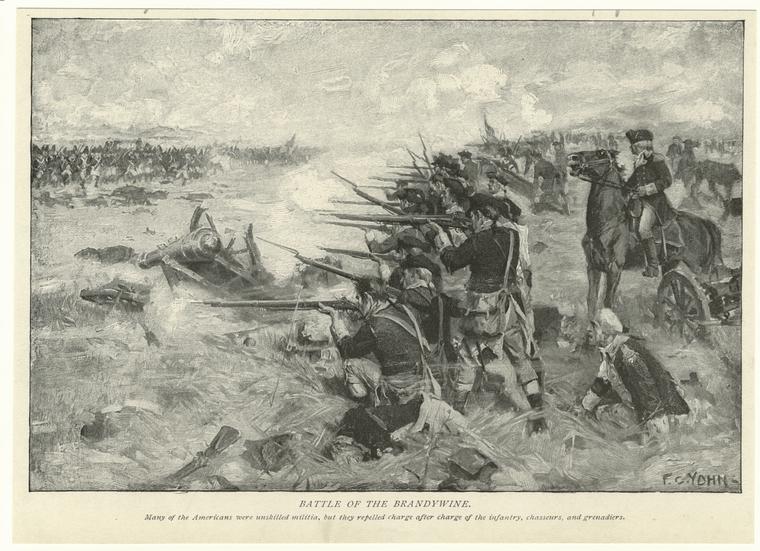
Before the horrific terrorist attacks that struck the United States on September 11, 2001, this date in American history saw the longest single day engagement with the highest number of combatants during the entire American Revolution fought in southeastern Pennsylvania.
Known to history as the Battle of Brandywine, approximately 30,000 soldiers were involved and 1,887 became casualties, the majority, 1,300 being Americans. One of those 1,300 individuals was Reverend or Chaplain Joab Trout, from New Hampshire.
Battle of Brandywine (courtesy of NYPL)
The night before the engagement, he gave the following sermon beat the evening call on the eve of battle. And 242 years later the words still echo with a sense of patriotism and stoicism for a cause that was worth fighting and dying for. Below is the full sermon:
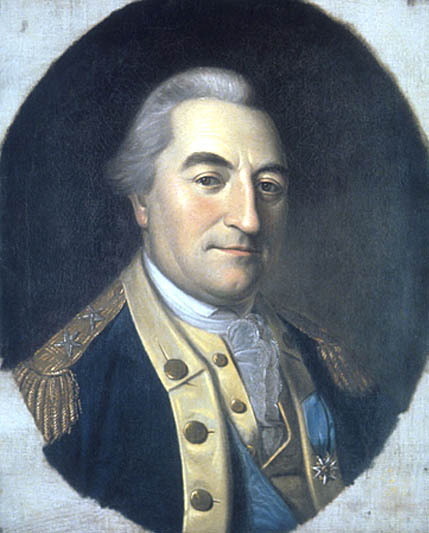
Sebastien Le Prestre de Vauban, Seigneur de Vauban, and finally Marquis de Vauban, as one of his biographies begins, is probably not a household name to many enthusiasts of American history. Especially since he died on March 30, 1707 and never set foot in the Western Hemisphere. However, he did have a nephew, Jacques Anne Joseph Le Prestre de Vauban who served as General Jean-Baptiste Rochambeau’s aide-de-camp during the war. So, there is a family connection.
Sébastien Le Prestre de Vauban (courtesy of Wikipedia)
Yet, he left his mark on places like Yorktown, Virginia, fought 74 years after his death and half-a-world away. French engineers, critical to eventual American victory in the American Revolutionary War, plied de Vauban’s craft and studied his text and learned from his exploits. Continue reading “Sébastien Le Prestre de Vauban”→
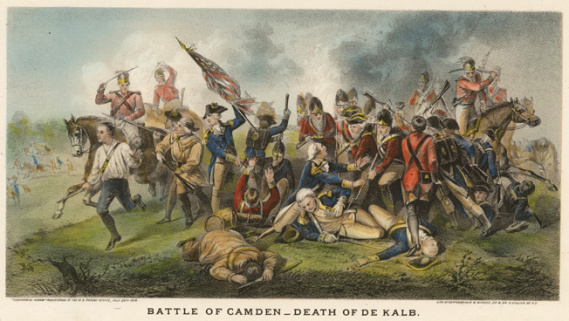
On this date in 1780, Johann von Robias, Baron de Kalb, died of wounds received three days earlier during the Battle of Camden, South Carolina.
de Kalb, born on June 19, 1721 in the Principality of Bayreuth, was in charge of the American right wing during the engagement at Camden, leading the premier units, the Delawareans and Marylanders, of General Horatio Gates’ Southern Army.
When the left and center of the American line disintegrated, de Kalb’s force had to beat a hasty retreat before becoming completely surrounded. During this juncture of the fighting, the Baron’s horse was shot out from under him and the German was thrown to the ground. Before he could gain his feet, he was hit with three musket balls and bayoneted multiple times by approaching British soldiers. The wounds would prove mortal. Continue reading ““De Kalb has died, as he has lived, the unconquered friend of liberty””→
Picking up the story of Camden from Thursday morning, we continue with Col. Otho
Gen. Gates believed his night march on August 15th would put his army in a great defensive position above Saunder’s Creek.
Holland Williams comments on the events on the evening of August 15th. As Gates’ army moved southward at night, a dangerous undertaking even with a professional army, notwithstanding an army mostly comprised of militia that had never fought as a cohesive unit. Williams documents the meals that the Americans ate that night before their march. When reading American accounts of Camden, most mention the impact on the evening August 15th meal had on the men and the army as a whole. Williams also mentions there is much criticisms of Gates’ plan, but no official opposition was brought to Gates. Reading Williams’ account gives us insight today into the events leading up to the disaster at Camden. When reading Williams’ narrative, it is not hard to believe that the Americans were marching to a defeat.
“Although there had been no dissenting voice in the council, the orders were no sooner promulgated than they became the subject of animadversion. Even those who had been dumb in council, said that there had been no consultation –that the orders were read to them, and all opinion seemed suppressed by the very positive and decisive terms in which they were expressed. Others could not imagine how it could be conceived, that an army, consisting of more than two -thirds militia, and which had never been once exercised in arms together, could form columns, and perform other manoeuvres in the night, and in the face of an enemy. But, of all the officers, Colonel Armand took the greatest exception. He seemed to think the positive orders respecting himself, implied a doubt of his courage –declared that cavalry had never before been put in the front of a line of battle in the dark–and that the disposition, as it respected his corps, proceeded from resentment in the general, on account of a previous altercation between them about horses, which the general had ordered to be taken from the officers of the army, to expedite the movement of the artillery though the wilderness. A great deal was said upon the occasion; but, the time was short, and the officers and soldiers, generally, not knowing, or believing any more than the general, that any considerable body of the enemy were to be met with out of Camden, acquiesced with their usual cheerfulness, and were ready to march at the hour appointed. As there were no spirits yet arrived in camp; and as, until lately, it was unusual for the troops to make a forced march, or prepare to meet an enemy without some extraordinary allowance, it was unluckily conceived that molasses, would, for once, be an acceptable substitute; accordingly the hospital stores were broached, and one gill of molasses per man, and a full ration of corn meal and meat, were issued to the army previous to their march, which commenced, according to orders, at about ten o’clock at night of the 15th. …. The troops of general Gates’ army, had frequently felt the bad consequences of eating bad provisions; but, at this time, a hasty meal of quick baked bread and fresh beef, with a desert of molasses, mixed with mush, or dumplings, operated so cathartically, as to disorder very many of the men, who were breaking the ranks all night, and were certainly much debilitated before the action commenced in the morning. …. “Continue reading ““Gentlemen, what is best to be done?” Gates Moves Towards Camden and Makes a Fateful Decision”→
Two hundred and thirty nine years ago today from his camp at Rugeley’s Mill, SC, American General Horatio Gates issued the following orders to his Southern Army to move on to the British post of Camden, SC.
“The sick, the extra artillery stores, the heavy baggage, and such quartermaster’s stores, as are not immediately wanted, to march this evening, under a guard, to Waxaws. To this order the general requests the brigadier generals, to see that those under their command, pay the most exact and scrupulous obedience. Lieutenant Colonel Edmonds, with the remaining guns of the park, will take post and march with the Virginia brigade, under General Stevens; he will direct, as any deficiency happens in the artillery affixed to the other brigades, to supply it immediately; his military staff, and a proportion of his officers, with forty of his men, are to attend him and await his orders. The troops will be ready to march precisely at ten o’clock, in the following order, Continue reading ““troops will observe the profoundest silence upon the march…” Gen. Gates’ Orders on August 15, 1780″→
From our friends at the American Revolution Round Table of Richmond
Tour Leader – Dr. Patrick H. (Pat) Hannum, Professor, Joint Forces Staff College, National Defense University, Lt Col USMC (Ret)
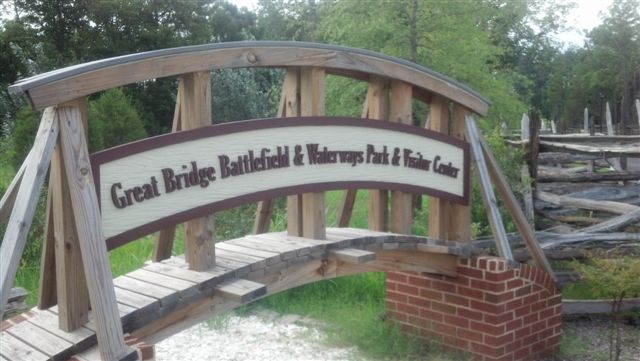
Great Bridge Battlefield (courtesy of Great Bridge Battlefield & Waterways History Foundation)
This tour will visit three critically important Revolutionary War sites, in the modern Cities of Norfolk, Virginia Beach and Chesapeake, in order to help inform the important events and explain how the Whig Government ousted the Royal Governor, Lord Dunmore, and British military forces from the State of Virginia. These events largely unfolded in the fall of 1775 and culminated with the destruction of the City of Norfolk in early 1776. Strategically important, these events led to near uncontested Whig control of the State of Virginia for three and one-half years. The British defeat at Yorktown in October 1781 traces its roots to the critical decisions and decisive actions of the Whig Governments of Virginia and North Carolina in the fall of 1775. We will visit: Continue reading “Southside Revolutionary Virginia 1775 Tour – October 12, 2019”→





 Emerging Revolutionary War Era