Tell me I am not the only one that randomly goes on a car ride to a random town in their home state to just “see what is there?”
Regardless, that is what I decided to do on a sunny late April Sunday afternoon. I ended up in Rockville, Maryland. The town astride I-270 today was also on a major thoroughfare during both the 18th and 19th centuries that brought armies from the area, like General Edward Braddock’s in 1755 or General Jubal Early’s in 1864.
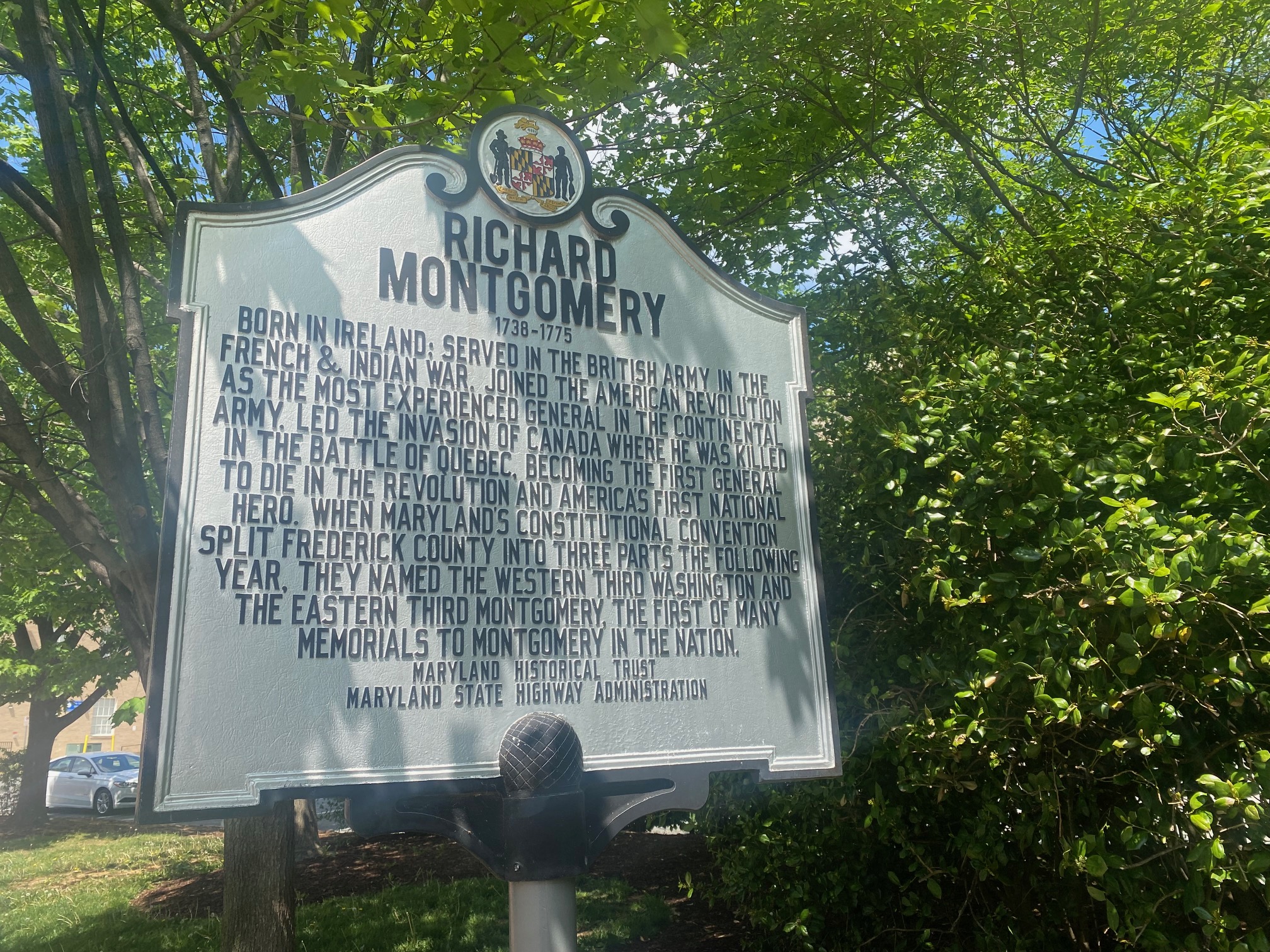
However, a different historical sign attracted my attention on this excursion.
I read the title and the first line, Richard Montgomery…Born in Ireland. Served..” Which was all I could read as I slowly drove by, since it is near the court house and county government buildings. Even though it was a Sunday still not wanting to speed through. So…Naturally, I pulled over, as evidenced by the vehicle you see in the background!
I knew Montgomery, as the sign reads, died at the Battle of Quebec in a futile attempt to take the city for the American cause. He was the first general–Continental–to die in the cause of American independence.
On September 6, 1776 Thomas Sprigg Wootton, who hailed from Rockville, introduced legislation in the Maryland Constitutional Convention to separate the Frederick County into three. The upper or most western half, to become Washington County, named in honor of George Washington and the lower half, or most eastern, to be named Montgomery, in honor of Richard Montgomery. The remaining middle portion would retain the name Frederick. This may be the first recorded instance in the rebellious British colonies of names of counties, towns, or cities that did not refer to something in British history or famous persons. Another act of defiance at the beginning of the American Revolution!
With a random Sunday excursion one never knows what one will find. History is all around us, beckoning to be explored.
This Sunday, join Emerging Revolutionary War as we explore the prelude to Fort McHenry and the actions in Maryland and Washington D.C. in the summer of 1814. Joining Emerging Revolutionary War will be the American Battlefield Trust’s Senior Education Manager, Dan Davis.
This historian happy hour will discuss the first part of the campaign that eventually led to the climactic Battle of Baltimore, which included both the unsuccessful British attempts at Fort McHenry and North Point. Before that success for American arms, the United States suffered through the defeat at Bladensburg and the capture of the nation’s capital.
We hope you can join us on our Facebook page, on Sunday, April 30th at 7 p.m. EDT .
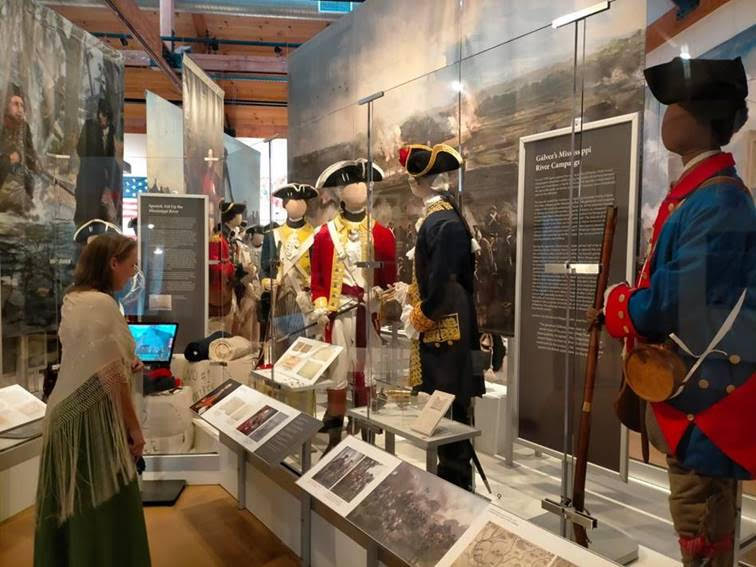
This conference will focus on the military, political, social and material culture history of the western theater of the American Revolutionary war, featuring scholars from across the U.S. and from Spain.
Location: The Sheraton Westport Plaza Hotel, St. Louis County, Missouri
Speakers and Topics:
Larry L. Nelson—”George Rogers Clark, the Illinois Campaign, and American Ambitions in the West”
Robert M. Owens – “Jean Baptiste Ducoigne, the Kaskaskias, and Pragmatic Patriotism in the Revolutionary Era”
José Manuel Guerro Acosta – “Spain and the Support for the American Revolution”
Friederike Baer – “’O, how the Mississippi is costing us many a good man!’: German Soldiers in West Florida, 1779-1781”
Frances Kolb Turnbell – “Indian Politics and the American Politics in the Lower Mississippi Valley”
Stephen L. Kling, Jr. – “An Opportunity to be Seized: The British Grand Plan to Conquer the Entire Mississippi River Valley”
Alexander S. Burns – “The Worst Looking Soldiers and the Drunkest Men to Ever Carry a Musket?: The 8th Regiment and the War in the West”
Kristine L. Sjostrom – “Valentía y Visión: Lt. Governor Fernando de Leyba and the Defense of St. Louis”
Kimberly Alexander – “O What Can These Things Tell Us: Material Culture at Revolutionary War St. Louis”
Jim Piecuch – “Fighting from Horseback: A Comparison of Revolutionary War Cavalry in the Eastern and Western Theaters”
Paul Douglas Lockhart – “For Want of a Good Musket and a Sharp Knife: Weaponry and Wilderness Warfare”
Evening Events: A cocktail reception will be held on Friday evening at 6:00pm at the Sheraton Westport Plaza Ballroom. A private party on Saturday evening at 6:30pm at the St. Charles County Heritage Museum will include a private tour of The American Revolutionary War in the West museum exhibit.
Registration: Conference registration cost including evening events: $75.00. Registration can be made through the St. Charles County Historical Society by 1) mailing a check to The St. Charles County Historical Society, 101 S. Main St., St. Charles, MO 63301, Attn: Joan Koechig; 2) credit card or PayPal by calling at (636) 946-9828 MWF, 10am-3pm; or 3) online at scchs.org. Registrations are limited and will be filled on a first come, first served basis. Questions, call Melissa at: (314)-561-5077. NOTE, online registration will be available starting April 19, 2023.
Emerging Revolutionary War welcomes guest historian Christopher of The British-American Historian blog.
Almost two years after debating a joint French-American assailment of Lord Cornwallis’ precarious position in Yorktown, Virginia over Washington’s grand plan to recapture New York long after being swept from the city and its environs as independence was officially declared in 1776, the implacable Washington prepared to reenter New York in triumph.
Eight years after making New York the center of the British war effort in the American Revolution, the massive garrison was greatly reduced and preparing for its final retirement from the new nation. The new commander in chief of North America, Sir Guy Carleton, arrived in New York on May 5, 1782[1] to relieve Sir Henry Clinton. Carleton won accolades for holding Quebec City when the Continental Army struck during a late night blizzard, an accomplishment that was all the more vaunted now that the British were losing territory that did not include Canada. Carleton lost no time in notifying Washington of his arrival in an affable letter sent on May 7th, 1782 in which Carleton wrote “if the like pacific disposition should prevail in this country, both my inclination and duty will lead me to meet it with the most zealous concurrence”[2].
A notable disruption in the growing amity was the unresolved Asgill Affair. Exasperated with wanton assailments of loyalists in New Jersey, a prominent rebel militia commander named Joshua Huddy was plucked from the provost in New York by an American member of the Associated Loyalists[3]. The Associated Loyalists were presided over by William Franklin, the loyalist son of Benjamin who had endured arduous captivity before being exchanged[4]. In response to the wanton execution of Joshua Huddy, Washington ordered a British officer to await reprise. Charles Asgill was selected, but pleas from the French along with Washington’s honorable disposition prevailed and the captain was spared[5].
The city and Long Island were swarming with thousands of loyal “Refugees” who had fled from every rebellious colony to seek the king’s protection. Ranging from itinerant tenant farmers to some of the largest landlords in America such as Beverly Robinson and Frederick Philipse, Carleton’s task of evacuating the troops could not be fulfilled until such persons were safely resettled in the empire. While many of the men joined provincial regiments that saw combat in the south (playing a pivotal role defending Savannah and being routed at Kings Mountain) and performed prodigious woodcutting on Lloyd Neck for the insatiable demand for firewood[6], flocks of women and children crowded the city. A subset of the refugees were former slaves who had flocked to the British cause for the promise of freedom under Dunmore’s Proclamation and the Philipsburg Proclamation, a promise Washington would vigorously contest in negotiations.
Emerging Revolutionary War welcomes guest historian Werther Young.
I’m Too Sexy for My…Bavarian Fly
By Werther Young
Of all of the unique things that have managed to make it to the internet, a concise history of colonial men’s pants flies is surprisingly not one of them.
Our story begins in the Renaissance in, where else, France. King Henry III of France eschewed the old-fashioned dress and hose and embraced a new fashion, culottes, now known as “knee breeches.”
Henry III in his dress and hose
Henry III in his tony new culottes.
The fly of Henry’s pants was a simple affair, a rectangular panel sewn to the left side with buttonholes that buttoned over the right. This simple and practical design became known as the “French fly” and became almost universal in Western Europe over the next 60 years.
Ann Bonny the pirate, in French fly trousers, ca. 1721.
Over time, Ann Bonny’s “long” French fly was perfected into the “short” French fly. Anne’s fly extends from the inseam to the waistband. By merely sewing a few inches of the front seam together, the fly can be made shorter, removing a buttonhole and button or two.
These fly designs apparently did not reach into Eastern Europe, where presumably leather pants were as expensive as wool ones but lasted much longer, because they were never washed. Translating the French Fly into leather posed some problems, and so these leather pants had a different fly, essentially a hole in the center front with a panel buttoned over it that flipped or dropped up and down as necessary. This design caught on in the Alpine areas of central Europe, and especially in Bavaria under the label of “Lederhosen,” which is German for “leather pants.”
“Short” French Fly Breeches, ca. 1750.
The Bavarian fly migrated further north, as in the Deutsches Museum in Berlin can be found a pair of enlisted trousers from the mid-1700s, with a half drop front fly; that is, it opens only the right side. This is essentially a cheaper fly, because it needs only one button to close, and does the same thing.
By the middle 1700s, the French fly had been around for over 150 years, and someone in France started a different fashion (and outdoing the Huns) by putting the two -opening Bavarian fly on culottes, thus making the culottes “a la Bavarois,” French for “like the Bavarians.” This was runway level high fashion for the time, and quickly spread among the well to do as the latest thing, with a new name, the “drop front” or “fall front” fly. Unfortunately, translating the design from leather, which does not unravel, to fabric, which does, made the Bavarian fly extremely complicated and therefore expensive. This of course added to its cachet, so much so that by 1775, it had reached the aristocracy even in the backwater of Colonial America.
Lederhosen
Colonial Williamsburg has a fabulous collection of high-status men’s pants from the 18th century. A survey thereof shows the number of French flies waning into the 1770s, and the number of Bavarian drop front flies waxing beginning in 1775, reaching a height about 1800. Unfortunately, these are all very high-status garments, such as a pair of “button front breeches of cream-colored silk velvet, with repeat of small pink and green flowers self-covered buttons, those at knee embroidered with metallic silver thread. Silver galloon strap at knee.” But did the states and Continent really issue enlisted soldiers what amounts to hand made Givenchy trousers? Of course not.
The false idea that they did partially comes from a series of paintings done by Charles M. Lefferts in the early 1900s, later published as Uniforms of the Armies in the War of the American Revolution, 1775–1783. in 1926.
A Lefferts rendering of trousers a la Bavarois, 2d Maryland 1777.
Measuring this man’s height against the known length of his musket makes him about 6’4 inches tall, the height of actors Clint Walker, Chuck Connors, Clint Eastwood, and the average NBA basketball player. If you look below the point of his vest, he is wearing drop front pants over his massive thighs. Curiously, he is also wearing a 1760s style skirted vest and long regimental coat. Are we to believe that Maryland issued its men old fashioned vests and coats, but high fashion breeches? Since Lefferts was born in 1873, he had no first-hand knowledge of his subject, we must look to period images.
Alas, these are of little help. It is difficult to discern whether any of the men in period paintings are wearing French Fly pants, Bavarian drop front pants, or anything else. The most informative images, the von German drawings, are unfortunately from the side, and of no help.
Von German “American Soldier” New York Hist Soc.
Amerikanische Scharfschutz, Brown University
Since information is so scarce, we must turn to the other reason we believe that rev war soldiers wore drop front pants. Klinger’s Sketchbook ’76. Page 9 shows a pair of Bavarian drop front breeches, based on George Washington’s uniform in the Smithsonian, and Lt. Col. Tench Tilghman’s uniform from the Maryland Historical Society. This is odd, because Washington’s uniform is from the 1794, 15 years after the war and at the height of the drop front craze. Tilghman was the scion of a blue blood family, owned half of Baltimore, was an aide to Washington, and hobnobbed with Lafayette. Even if his uniform can be dated to the war years, it is not only a high-status uniform, but one of the highest status possible in America at the time; his not wearing Bavarian trousers would be of greater note. Neither are evidence that any of the 13 colonies nor the Continent paid to make their enlisted men such high fashion trousers.
On Sketchbook page11, Klinger bases his Bavarian drop front overalls on unspecified plates in “Bernard’s History of England” and the images above. While these may establish Bavarian drop front flies supplied by the King George, it certainly does not necessarily mean that the colonies were doing so.
Surprisingly, two pairs of enlisted overalls are known to exist, mistakenly labelled as “Pantaloons,” and residing in the Metropolitan Museum of Art’s Costume Department. These are exquisitely made, and probably military examples, but unfortunately European, and from 1793 and later.
No credible evidence exists that any of the 13 colonies nor the Continent issued its troops Bavarian drop front pants. This makes sense, as that design is difficult to make, does the exact same thing as the simple French fly, and fashionable pants do not really contribute much extra to Liberty. Additionally, with all but the highest status clothiers making French fly pants, retraining them to cut out and make the new design would seriously impede production, even assuming that patterns and training could be somehow provided from Georgia to Vermont at a time when the men could barely be supplied a musket or shirt. In the War of the Revolution, the colonists were by all indications wearing French fly breeches and overalls, not drop front ones a la Bavarois.
Join us this Sunday, March 5, at 7:00 p.m. on our Facebook page for our latest installment of the Rev War Revelry series. This weekend’s chat will focus on the exploits of British General Benedict Arnold in Virginia during 1781, including the capture and burning of Richmond. We will be joined by Virginia historians John Pagano and Mark Wilcox, who will help bring to life the story of when Arnold turned his sword against the people he once called his comrades and countrymen. We hope to see you there!
My recent comments about Stacy Schiff’s The Revolutionary Samuel Adams got me thinking about some of John Adams’s thoughts about his second cousin. In particular, John shared a neat story about Sam’s secretiveness—a problem that has bedeviled biographers, including Schiff, because Sam didn’t leave behind a trove of documentary evidence the way other Founders did.
“I have seen him . . .” said John, “in Philadelphia, when he was about to leave Congress, cut up with his scissors whole bundles of letters, into atoms that could never be reunited, and throw them out at the window, to be scattered by the winds. This was in summer, when he had no fire. In winter he threw whole handfuls into the fire. As we were on terms of perfect intimacy, I have joked him, perhaps rudely, upon his anxious caution. His answer was, ‘Whatever becomes of me, my friends shall never suffer by my negligence.’”[1]
John admired Sam, 13 years his senior, a great deal. The two were hardly acquainted growing up, but as John started off his legal career in Boston, Sam—a great cultivator of talent—pegged him as someone to develop. As tensions in Boston grew between the Sons of Liberty, British officials, and far-off Parliament, Sam brought John into the inner circle because of John’s sharp legal mind. The decision paved John’s eventual path to national politics.
“Mr. Adams was an original,” John said of Sam, saying he was “born and tempered a wedge of steel. . . .”[2]
In his common appearance, he was a plain, simple, decent citizen, of middling stature, dress and manners. He had an exquisite ear for music, and a charming voice, when he pleased to exert it.—Yet his ordinary speeches in town meetings, in the house of representatives and in congress, exhibited nothing extraordinary; but upon great occasions, when his deeper feelings were excited, he erected himself, or rather nature seemed to erect him, without the smallest symptom of affectation, into an upright dignity of figure and gesture, and gave a harmony to his voice, which made a strong impression on spectators and auditors, the more lasting for the purity, correctness and nervous elegance of his style.[3]
John spoke on several occasions of Sam’s “an air of dignity and majesty.” He admired Sam’s “harmonious voice and decisive tone” and his “self-recollection, a self-possession, a self-command, a presence of mind that was admired by every man present. . . .”[4] He also listed “his caution, his discretion, his ingenuity, his sagacity, his self-command, his presence of mind, and his intrepidity” as traits that “commanded the admiration” of friend and foe alike—friends who applauded him and foes who could not help but respect Sam Adams’s considerable populist powers.[5]
It is little doubt why John later said, “Without the character of Samuel Adams, the true history of the American Revolution can never be written.”[6]
I’m currently reading Stacy Schiff’s new biography The Revolutionary Samuel Adams. It’s a snappy-to-read, deeply researched book—all the more challenging to write because Sam Adams made careful effort not to leave much of a paper trail about himself.
Schiff uses her introduction to sketch out this fundamental problem, and in doing so, she creates a compelling flash portrait of Adams that the rest of the book fleshes out. Adams the historiographical sphinx is well served by this portrait. Sam Adams simultaneously led from the front yet operated in the shadows, an apparent contradiction that Schiff nonetheless portrays fully and effectively.
As the book goes on, Schiff manages to pull from a deep well of primary sources, even if there’s not a mountain from Sam himself. She handles those sources adroitly and comfortably, plucking this bit from here and that bit from there the way a conductor works an orchestra.
The result is an admiring but not fawning portrait of Adams—a man without whom, said cousin John, “the true history of the American Revolution can never be written.”[1]
Troubling to me in the text is that, in the late 1760s and early 1770s, the Adams-led Sons of Liberty often employed mob violence—real and threatened—to achieve their aims. Propaganda efforts were often tethered to reality by only thinnest of meager threads, if at all. Men were intimidated, bullied, tarred and feathered, humiliated, assaulted, and run out of town for opposing or even just disagreeing with them. Houses were ransacked. Livelihoods destroyed. Reputations ruined. I could not help but think of the Klan in the Reconstruction-era South—a comparison no-doubt tantamount to sacrilege when talking about a group of Bostonians popularly and fondly remembered as patriots.
Yet Schiff merrily skates over such rough terrain, sharing vivid details about incidents without exploring the moral morass this tension suggests. Her hero acts in decidedly less-than-heroic ways, arguing that the ends justify the means. We as readers are left to ponder this ambiguity ourselves. Such work on the reader’s part isn’t a bad thing, but it does strike me as somewhat of an abdication on the biographer’s part when the rest of the narrative is so cheerfully pro-Adams.
Overall, The Revolutionary Samuel Adams is an excellent work so far, and I highly recommend it for anyone who wants a fuller understanding of how the wheels of Revolution started turning—and who started them.
Slathered on hamburgers across the United States of America. Added to coleslaw recipes. In Germany used to dip pomme frites, French fries into. This condiment or sauce is well-known throughout a large percentage of the globe. However, did you know that this white sauce has a tie to the French and Indian or Seven Years War?
Recently I was reading a book, Gibraltar: The Greatest Siege in British History by Roy and Lesley Adkins. When discussing some of the history leading up to the siege of Gibraltar from 1779-1783, the authors referenced an earlier siege, unrelated to Gibraltar actually, and had a note about the creation of mayonnaise.
Like any good historian, I decided to investigate the founding of this sauce that is used so predominantly in America. Below is what I found.
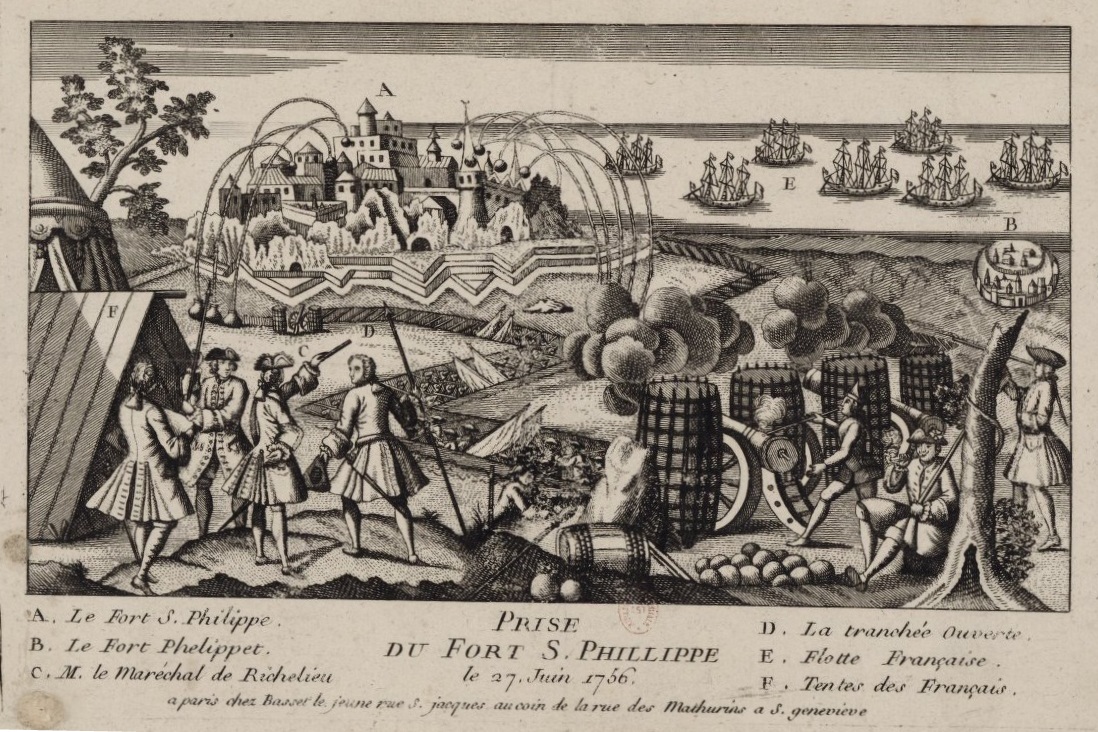
Created for a victory celebration after the French’s successful defeat of the British on the island of Minorca, also spelled Menorca which is the Catalan spelling. The siege and battle had lasted 70 days, from April 20 to June 29, 1756 and had cost the French approximately 3-4,000 casualties. The British loss around 400 men and one of the strategic defenses and the Mediterranean Sea. The French remained in control of the island until the end of the Seven Years’ War. The island recaptured by the Br was returned to the British at the end of the war, trading the island of Guadeloupe for it as part of the peace treaty signed in Paris.
Yet, after the British surrendered Fort St. Philip, in 1756, which protected the town and seaport of Mahon a large victory banquet was held. The French leader, the Duke de Richelieu instructed his chef to to create a feast that would honor the great victory. The island lacked the cream needed for the sauce the chef wanted to make so he invented the egg and oil dressing.
He named the concoction Mahon-aise, after the town he created the sauce in.
Hope you are reading this around lunchtime!
P.S. The author realizes that a few other accounts exist about the creation of the this sauce. Including that the chef of the French duke was told about the sauce by the inhabitants of the island who had already created it.
As 2022 winds down, Emerging Revolutionary War wanted to share one more round-up of what our good friends at Americana Corner were doing in this last month of the year. We hope to continue to partner with Americana Corner in the 2023 and bring new content and new enthusiasm for this critical period in American history to the forefront. To all our readers, thank you and we all at Emerging Revolutionary War hope you have a great ending to 2022 and a Happy New Year!
A few blog posts for light reading as you wind down December…
Washington Takes Command December 27, 2022
When it came to finding the right man to command the new Continental Army assembled around Boston, George Washington was the logical choice. John Adams quickly nominated Washington and Congress unanimously approved. As Adams stated, “This appointment will have a great effect in cementing and securing the Union of these colonies.”
George Washington Enters Politics December 20, 2022
As befitting a wealthy landowner in colonial Virginia, George Washington became active in the colony’s politics in the 1750s. He first ran for a seat representing Frederick County in the Virginia House of Burgesses in 1755 but lost the election. Interestingly, it was the only political race he would ever lose. Washington ran for that same seat in 1758 and was victorious, and he held this seat for seven years.
Martha Washington was our nation’s first First Lady and lived in the shadow of her larger-than-life husband George. However, most Americans do not realize that she was a very capable woman and, when given the opportunity, managed her own affairs quite well.
George Washington’s Life at Mount Vernon December 6, 2022
When George Washington resigned as Colonel and Commander of the Virginia Regiment in 1758, he returned to Mount Vernon to begin his life as a gentleman planter. Although in less than twenty years Washington would be called away by his country, his time between the French and Indian War and the American Revolution was a significant portion of this great man’s life.





 Emerging Revolutionary War Era