For those that write and research it can be a personal albeit lonely endeavor. Hours spent in libraries or archives, humped over your computer or pad and pencil taking copious notes. Eyes going bleary or cross-eyed trying to decipher 18th century handwriting or microfilmed pieces of primary data. But, at the same time, it is such a rewarding experience, is it not? Uncovering the past, shedding light on the personalities that comprise the fabric of American history. Maybe even finding overlooked accounts or information that changes the narrative or promotes a fuller picture?
For me, I enjoy finding quotes or descriptions that creates a better understanding of the world in which the soldiers and civilians of the American Revolutionary or American Civil War periods lived. Anything that humanizes them more I feel makes them relatable. Breathes life into who they were, instead of just what comes through in official dispatches, reports, or polished accounts they left behind. One way is to read the accounts of fellow officers or compatriots as they discuss or describe their fellow comrades-in-arms.
Or there is just Israel Putnam. The patriot general who on April 19, 1775 when hearing of the British march to Lexington and Concord famously left his plow in a half plowed farm field to rush from Connecticut to Massachusetts. In the process he rallied his militia and stuck around for the siege that followed the first shots of what would become the American Revolution.
Israel Putnam
That is where I picked up his tale. Researching an upcoming volume of the Emerging Revolutionary War Series. (Stay tuned for what that will be in the upcoming months. Yes, “vague booking” and self-promotion happening!) During the siege of Boston he was asked in a meeting of general officers about the “expediency of intrenching” as a few of the gathered were doubtful of its efficacy on the psyche of the volunteer militia.
Putnam’s response fit the mold mentioned above, of providing a human touch to the notes of that meeting and a bit of 18th century humor for added measure.
The general responded, “earnest in his advocacy of the measure” that,
“The Americans are not at all afraid of their heads, though very much afraid of their legs: if you cover these, they will fight for ever.”
Time and defensive tactics would uncover the truth of that statement.
In closing, what is a favorite line, anecdote that is not well known from the American Revolutionary period that resonates with you?
There are arguably many moments along the road towards war with England that greatly shaped that road’s trajectory. Perhaps among the top contenders on that list would be the Boston Tea Party. Join historian Benjamin Carp and ERW’s Dan Welch as we dig in with the author of one of the best books on that pivotal moment. Dr. Benjamin L. Carp is the author of The Great New York Fire of 1776: A Lost Story of the American Revolution, and Defiance of the Patriots: The Boston Tea Party and the Making of America (2010), which won the triennial Society of the Cincinnati Cox Book Prize in 2013; and Rebels Rising: Cities and the American Revolution (2007). His book, Defiance of the Patriots, will be the focus of Sunday’s book chat.
With Richard D. Brown, he co-edited Major Problems in the Era of the American Revolution, 1760-1791: Documents and Essays, 3rd ed. (2014). He has written about nationalism, firefighters, Benjamin Franklin, and Quaker merchants in Charleston. He has also written for Colonial Williamsburg, the Wall Street Journal and the Washington Post. He previously taught at the University of Edinburgh and Tufts University. He was born and raised in New York State and each of his parents earned two CUNY degrees. See you Sunday at 7 p.m. EDT on Emerging Revolutionary War’s Facebook page!
Henry Knox received much of the glory and distinction in the Knox family during the war years. Yet, his wife, Lucy Knox, had much to say to her husband regrading the future if the war effort turned out successfully for the colonies. Lucy, a daughter of loyalists who ultimately sailed for England at the start of war, remained in Boston, Massachusetts while her husband rode off to war and Washington’s army. Much of her correspondence to Henry during the war focused on events in and around Boston, news from the various battlefield fronts that had reached the city, the family business, and many other assorted topics. But, she also made sure to remind Henry that upon his return home, he would no longer be in command, nor have a generalship around the house; rather he would need to be willing to share “equal command” within the household.
The following letter, written on August 23, 1777, finds Lucy at home, slowly recuperating from a days-long illness. Wanting to hear more of her daily routine while he was gone, she obliged Henry’s request to write about the ebb and flow of her life at home each day. She notes her solitary lifestyle now that both her parents are gone as well as her husband but shares with him the comfort she finds when opportunity allows to spend time with friends. Lucy, like many other wives and families left behind on the homefront fears that she may be forgotten during his extended time with the army. Then, Lucy shifts to news from the war front and requests information regarding several in the army in which Henry might know. It is also evident, as the letter draws to an end, that inflation on goods, and subsequent supply thereof, has led her to need more money from her husband in which to purchase linen.
I wrote you a line by the last post just to lett you know I was alive which indeed was all I could then say with propriety for I [struck: then] had serious thoughts that I never should see you again – so much was I reduced by only four days illness but by help of a good constitution I am surprisingly better today – I am now to answer your three last letters in one of which you ask for a history of my life. it is my love so barren of adventures and so replete with repetition that I fear it will afford you little amusement – however such as it is I give it you – In the first place, I rise about eight in the morning (a lazy hour you will say – but the day after that, is full long for a person in my situation) I presently after sitt down to my breakfast, where a page in my book, and a dish of tea, employ me alternately for about an hour – when after seeing that family matters go on right, I [struck: repeair] repair to my work, my book, or my pen, for the rest of the forenoon – at two oclock I usually take my solitary dinner where I reflect upon my past happiness when I used to sitt at the window watching for my Harry – and when I saw him coming my heart would leap for joy – when he was all my own and never happy from me when the bare thought of six months absence would have shocked him – to divert these ideas I place my little Lucy by me at table – but the more engaging her little actions are so much the more do I regret the absence of her father who would take such delight in them. – in the afternoon I commonly take my chaise, and ride into the country or go to drink tea with one of my few [struck: acquaintance] [inserted: friends]. They consist of Mrs Jarviss Mrs Sears Mrs Smith Mrs Pollard and my Aunt Waldo – I have many acquaintance beside these whom I visit but not without ceremony – when with any of [inserted: the] former I often spend the evening – but when I return home – how shall describe my feelings to find myself intirely alone – to reflect that the only friend I have in the world is at such an imense distance from me – to think that [inserted: he] may [inserted: be] sick and I cannot assist him ah poor me my heart is ready to burst, you who know what a trifle would make me unhappy, can conceive what I suffer now. –
when I seriously reflect that I have lost my father Mother Brother and Sisters – intirely lost them – I am half distracted true I chearfully resigned them for one far dearer to me than all of them – but I am totaly deprived of him – I have not seen him for almost six months – and he writes me without pointing out any method by which I may ever expect to see him again – tis hard my Harry indeed it is I love you with the tenderest the purest affection – I would undergo any hardships to be near you and you will not lett me – suppose this campaign should be like the last carried into the winter – do you intend not to see me in all that time – tell me dear what your plan is –
I wrote you that the Hero Sailed while I was at Newburg – She did but has [jnserted: been] cruiseing about from harbour to harbour since – to get met – she is now here, and will sail in a day or two for france –
I wish I had fifty guinies to spare to send by her for necessarys – but I have not – the very little gold we have must be reserved for my Love in case he should be taken – for friends in such a case are not too common. – I am more distressed from the hott weather than any other fears – God grant you may not go farther south’ard – if you should I possitively will come too – I believe Genl Howe is a paltry fellow – but happy for as that he is so – are you not much pleased with the news from the Northard we think it is a great affair and a confirmation of StClairs villainy baseness – I hope he will not go unpunished – we hear also that Genl Gates is to go back to his command. – if so Master Schuyler, cannot be guiltless – it is very strange, you never mentioned that affair in any of your letters –
What has become of Mrs Greene, do you all live together – or how do you manage – is Billy to remain with you payless or is he to have a com[inserted: m]ission – if the former I think he had much better remained where he was – if he understood business he might without a capital have made a fortune – people here – without advanceing a shilling frequently clear hundreds in a day – such chaps as Eben Oliver – are all men of fortune – while persons – who have ever lived in affluence – are in danger of want – oh that you had less of the military man about you – you might then after the war have lived at ease all the days of your life – but now I don’t know what you will do – your being long acustomed to command – will make you too haughty for mercantile matters – tho I hope you will not consider yourself as commander in chief of your own house – but be convinced tho not in the affair of Mr Coudre that there is such a thing as equal command – I send this by CaptRandal who says he expects to remain with you – pray how many of these lads have have you – I am sure they must be very expensive – I am in want of some square dollars – which I expect from you to by me a peace of linen an article I can do no longer without haveing had no recruit of that kind for almost five years – girls in general when they marry are well stocked with those things but poor I had no such advantage –
little Lucy who is without exception the sweetest child in the world – sends you a kiss but where [inserted: shall] I take it from say you – from the paper I hope – but dare I say I sometimes fear [struck: what] [inserted: that] a long absence the force of bad example may lead you to forget me at sometimes – to know that it ever gave you pleasure to be in company with the finest woman in the world, would be worse that death to me – but it is not so, my Harry is too just too delicate too sincere – and too fond of his Lucy to admit the most remote thought of that distracting kind –away with it – don’t be angry with me my Love – I am not jealous of you affection – I love you with a love as true and sacred as ever entered the human heart – but from a diffidence of my own merit I sometimes fear you will Love me less – after being so long from me – if you should may my life end before I know it – that I may die thinking you wholly mine –
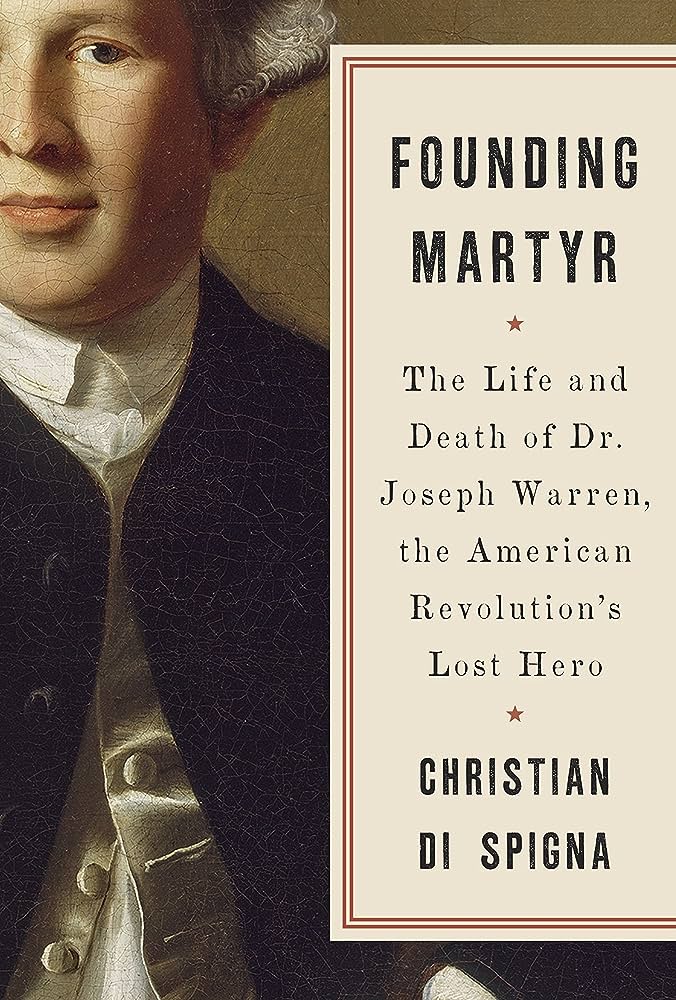
Dr. Joseph Warren is considered by many “the lost hero of the American Revolution.” Warren was the brainchild of the revolution movement in Boston. Warren was involved in almost every major insurrectionary act in the Boston area for a decade, from the Stamp Act protests to the Boston Massacre to the Boston Tea Party, and his incendiary writings included the famous Suffolk Resolves, which helped unite the colonies against Britain and inspired the Declaration of Independence.
Joining Emerging Revolutionary War will be historian and author Christian Di Spigna. He is the author of Founding Martyr: The Life and Death of Dr. Joseph Warren, the American Revolution’s lost hero. He is the Executive Director of the Dr. Joseph Warren Foundation and is the vice chairman for the Revolution 250 committee of Massachusetts Freemasons. He also serves on the board of the Bunker Hill Monument Association.
As we approach the 250th commemoration of the Boston Tea Party, we will focus on Warren’s life, his role in the Boston Tea Party and his lasting impact on the Revolution. Grab a drink and join us as we talk with author and historian Di Spigna about Warren, the patriot who once said…
“When Liberty is the prize, who would shun the warfare? Who would stoop to waste a coward thought on life?”
See you Sunday at 7 p.m. EDT on Emerging Revolutionary War’s Facebook page!
Emerging Revolutionary War welcomes guest historian Al Dickenson
Within the first few pages of his book, Brooklyn College professor Benjamin Carp illustrates all the key points about the 1776 burning of New York City. The points include how vital the city was to the war effort to both the rebels and Loyalists, a discussion on how the fire started (questioning if it was accidental or intentional, and if the latter, whose intention was it?), and furthermore, why has there never been a full investigation into the fire and its causes (Carp’s book is the first full-length work on the topic). In quick succession, readers understand what they will gain by reading this book, why the event in question is important for understanding the American Revolution, and Carp’s own thoughts on the matter.
Carp’s argument in The Great New York Fire of 1776 is that the rebels started the fire, and that the cause of the blaze was indeed arson, which previously had been in question (254). What Carp does not speak to, at least not without some speculation, is who precisely started the fire. While not totally disregarding George Washington’s potential involvement, Carp suggests the more likely culprits would be soldiers in Washington’s army. These men, and in many cases, boys, had yet to receive the disciple so desperately needed from Baron von Stueben’s efforts at Valley Forge, so it seems plausible they could start the inferno, which scorched up to a fifth of the city (244-245). As such, Carp puts his research skills to good use in this volume, sharing his thoughts on the possible origins of the fire and providing readers with a map of more than ten ignition points, illustrating how expansive the blaze was (104). Carp’s thesis is well supported by the primary material, which included letters, sermons, diaries, and other sources from the time.
Emerging Revolutionary War welcomes a guest post from historian Keith J. Muchowski. Keith is a librarian and professor at New York City College of Technology (CUNY) in Brooklyn. He blogs at thestrawfoot.com.
The plaque dedicated King Juan Carlos I in June 1976 today tucked in a corner of the visitor center. Courtesy Author
King Juan Carlos I arrived in Brooklyn’s Fort Greene Park on Saturday June 5, 1976 to great fanfare. The thirty-eight-year-old monarch had ascended to the Spanish throne just seven months previously, two days after the death of Francisco Franco. The new leader was determined to reform his nation after three and a half decades of strongman rule. Juan Carlos I’s ancestor, King Carlos III, had helped the colonists achieved their independence nearly two centuries previously with his supply of money, matériel, and men. Many of those Spaniards made the ultimate sacrifice; well over one hundred of them alone perished in British prison ships moored off Brooklyn Wallabout Bay during the war.[i] Now King Juan Carlos I was in the outer borough to recognize them, dedicate a tablet to his fallen countrymen, and help his American hosts celebrate the bicentennial of their independence. The entombed Spaniards were among the over 11,500 men commemorated by the Prison Ship Martyrs Monument. The king’s visit in the mid-1970s was the latest in a series of public commemorations of the prison ship dead dating back over a century and a half. Some of the institutions that did so much to recognize the martyrs, such as the Society of St. Tammany, are today long gone. Others however very much remain. The Society of Old Brooklynites, a civic organization founded in 1880 when Brooklyn was still an independent municipality, has been holding events since the late nineteenth century.
Major General Horatio Gates, “Hero of Saratoga” was tasked with saving the American effort in the south. Credit NPS
On August 15, Maj. Gen. Horatio Gates began to finalize his plans to move against Camden, SC. Gates, appointed as the new commander of the Southern Department the previous month, believed the British garrison in Camden was weak. Gates was receiving intelligence gathered by partisan commander Thomas Sumter who was acting in and around Camden. He informed Gates that the American army outnumbered the British post and that a large portion of the men at Camden were taken ill and not fit for duty (on this account, Sumter was correct). Sumter did not provide the intelligence that Lord Cornwallis was now in Camden with reinforcements and was taking personal command of the British force in Camden.
Modern day image of the area at Rugeley’s Mills, with modern day Flat Rock Road following the historic trace of the Great Wagon Road. Credit Rob Orrison
With this information, Gates felt confident in his ability to take on the British in Camden. He developed a plan that involved a three-part movement. He would leave his force south to Saunder’s Creek (about six miles north of Camden) and establish a strong defensive position. He also ordered Francis Marion and his men to the southeast. Gates wanted Marion to take command of the Williamsburg militia, watch the British movements, and destroy boats in the Santee River that a defeated Cornwallis might need to retreat from Camden to Charleston. The third prong he ordered a few days earlier on August 13. Gates, under the encouragement of Thomas Sumter, decided to send 100 Maryland Continentals and 300 Carolina militiamen (as well as two brass three pounders) to join Sumter and move down the western side of the Wateree. From this location Sumter could attack supplies and reinforcements going into Camden from Ninety Six to the west. Gates’s confidence was evident.
South Carolina militia Brig. Gen Thomas Sumter. Credit New York Public Library
As Gates made his final disposition to move south, Sumter’s militia along with his Continental detachment met some success west of Camden. The Wateree River flowed south just one mile west of Camden. Near the important Wateree Ferry that served the major route west from Camden, Loyalist Lt. Col. James Cary built a small fort on his farm near the ferry. Sumter was aware of the fort and decided to see if he could capture it. When Col. Thomas Taylor of Sumter’s command launched the attack, most of the defenders inside were asleep, and the others were deceived by Patriot militia dressed just like those occupying the fort. The Loyalists immediately surrendered. Sumter reported that his men killed 7 and captured 30 prisoners, including Cary. Also included in the loot were 38 wagons of supplies and nearly 300 head of cattle. After capturing Cary’s Fort, Sumter was also able to attack and capture a relief column from Ninety Six to Camden. Sumter’s spoils from this attack numbered nearly 70 prisoners and numerous wagons. Sumter also reaffirmed his earlier intelligence to Gates by writing that the British in Camden “do not exceed two thousand, and not as many as one thousand of the militia, who aregenerally sickly, and much dispirited.” Sumter’s intelligence, though not accurate, gave Gates encouragement on the upcoming movement toward Camden. At 10pm on August 15, Gates had his army on the road south towards Camden.
Gates was flush with optimism, at that same time Cornwallis had his army on the road north. Though the British forces were about half the size of Gates, they were more than Gates expected and consisted of some of the best men in the British army led by one of their most accomplished generals. Soon, due to a twist of fate, these two armies collided along the Great Wagon Road in the long life pine forest of South Carolina. The result was one of the worst days in the history of the United States Army.
Authors Rob Orrison and Mark Wilcox’s new book “All That Can Be Expected: The Battle of Camden and the British High Tide in the South, August 16, 1780” is due out August, 2023 and available at: https://www.savasbeatie.com/
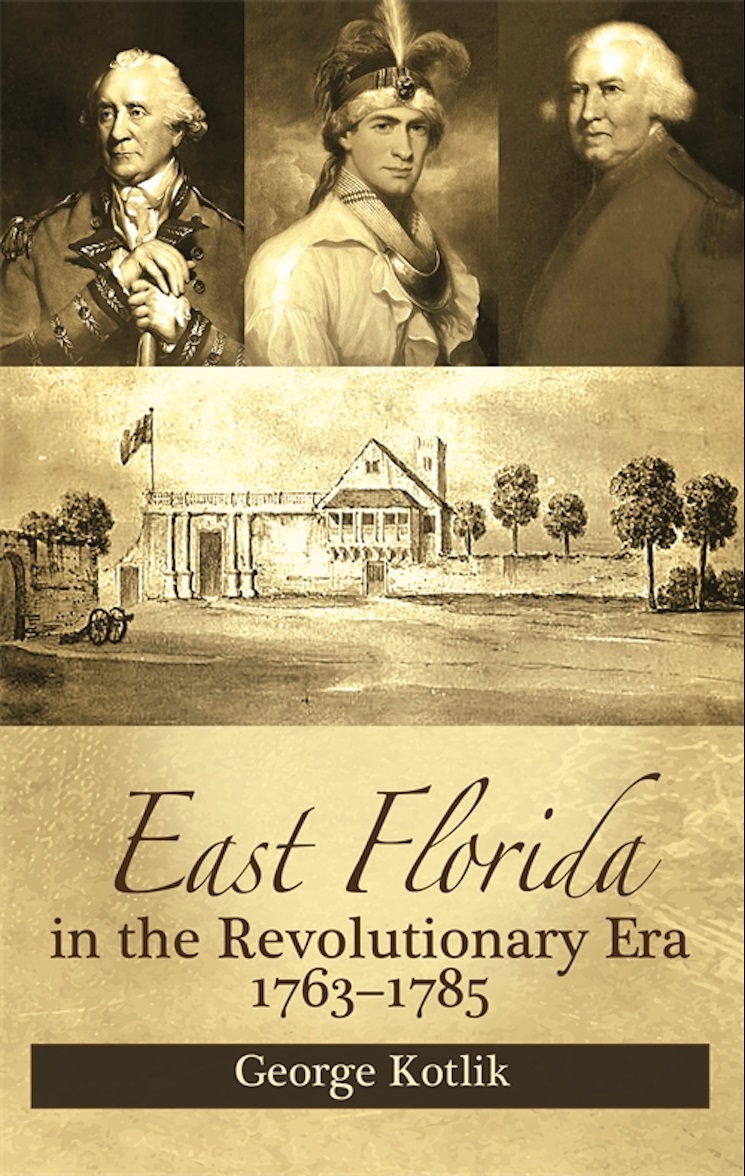
Thirteen of the Great Britain’s North American colonies moved toward independence in 1775, declaring the fact officially the following year with the issuance of the Declaration of Independence. Perched below these thirteen rebellious provinces was the colony of East Florida. Earned after the Seven Year’s War by Great Britain from Spain, the most populous city an oldest permanently established European metropolis was St. Augustine, which was also the capital of the colony. This colony, through the eight years of the American Revolutionary War, had a tenuous connection with their neighbors to the north. Largely forgotten in the pantheon of history describing this period, from the time of Britain gaining possession in 1763 through the end of the Revolutionary era in this historian’s estimation, in 1785.
Entitled, East Florida in the Revolutionary Era, 1763-1785 and penned by George Kotlik, a historian specializing in 18th century North American history, the publication offers “an accessible and detailed narrative of the East Florida during the American Revolution.” (pg. 8).
What ensues in the following pages is a brief yet complete overview of the military, political, social, and economic history within those years of East Florida. Some of the names in the pages are well known to enthusiasts of the American Revolutionary War era whereas others will be new names to add to the repertoire for further study. From Governor Patrick Tonyn, British general and last governor for England of East Florida to bringing attention to the William Augustus Bowles, a Maryland born Loyalist, sympathetic to the Muscogee Native Americans of East Florida who tried in vain from the last decade of the 18th century, to establish an independent state for the tribe, with British support. These are just two of the historical personas that Kotlik discusses in his narrative, the rest await you within the pages of the book!
Although no major military actions happened within the confines of the colony that does not mean the role of East Florida in relation to the American Revolution should not be marginalized. “Militias were raised, a general assembly was postponed, St. Augustine experienced a heightened British troop presence, planters between the St. Johns and St. Marys Rivers suffered at the hands of George raiding parties, and a constant threat of a Spanish or American invasion” all affected the psyches and lives of East Floridians. (pg. 104-105).
The hope from Kotlik is to provide the launching point for further discussion into the role of East Florida specifically and Florida in general during the revolutionary period. “Such a lack of coverage is a reminder for scholars to to emphasize East Florida’s presence in the war that made America.” (pg. 111). With this history in hand, Kotlik has provided the necessary overview for further exploration.
Publisher: NewSouth Books, University of Georgia Press, 2023 156 pages plus images
Lexington and/or Concord or both? Same question, Trenton or Princeton or both? Guilford Court House? Yorktown Battlefield? Ask any historian or history enthusiast of the American Revolutionary War period what their favorite battlefield is and you may get one of the places above. Or some other hallowed ground.
This Sunday, at 7 p.m. EDT, join Emerging Revolutionary War on our Facebook page for a panel discussion on our favorite battlefields of the American Revolution. Discussion will also include the successes, pitfalls, or failure of preservation and what one can see or not see at these sites. We look forward to a lively conversation and your comments on what is the battlefield of choice.
The summer of 1776 was tense on the Kentucky frontier. Since the spring, Shawnee raids from north of the Ohio had increased, with tribesmen raiding the white settlements with the intention of driving the settlers east, back across the mountains.
By the late spring, hardly more than 200 Americans remained in Kentucky, most forting up in the settlements south of the Kentucky River at Harrodsburg, Logan’s Station, and Boonesborough as war parties ranged nearby. Years later, an old settler remembered the rancid conditions of long confinements in “a row or two of smoky cabins, among dirty women and men with greasy hunting shirts.” By the summer, conditions in the forts were almost unbearable as supplies of salt and meat began to run low.
On the quiet Sunday afternoon of July 14, 1776, 13-year-old Jemima Boone, daughter of frontiersman Daniel Boone, slipped out of the log gates of Boonesborough with her friends Elizabeth (Betsy) and Frances (Fanny) Calloway. Tired of the confinement of the fort, the three girls untied the lone canoe of the settlement and pushed out into the Kentucky River for an old-style joy ride. Jemima would remember years later that her father had warned her to stay near the cabins and never cross to the other side of the river.
Betsy Calloway, 16, guided the canoe but it was soon caught up in the current and taken downstream toward the northern bank. A small mixed war party of Shawnees and Cherokees were watching the settlement from the woods across the river. They had been in the area for at least a week when they spotted the girls in the canoe. As the craft got close to the shore a warrior jumped into the river and grabbed the towline. Understanding immediately the danger they were in all three girls began to scream. The warriors brought the canoe to shore and quickly made signs to the girls of what would happen if they continued screaming. But the sounds had already alerted the settlers in the fort.
It was Sunday, the Sabbath and, as was his normal custom, Daniel Boone was lying down for his Sunday afternoon nap when he heard the commotion from out in the fort. Running out of his cabin in his bare feet, Boone joined with Richard Calloway, father of Betsy and Fanny, and several other men of the settlement as they eventually made their way to the opposite shore of the river and began tracking the war party as it made its way towards the crossing of the Licking River at the upper Blue Licks.
One of the Cherokee men in the party was named Scolacutta but known to the Americans as Hanging Maw. He knew Daniel Boone and his family and spoke a bit of English. He recognized Jemima as Boone’s daughter. Hanging Maw laughed at the joke they were playing on old Boone, Jemima remembered many years later, and confirmed they were headed for the Shawnee towns north of the Ohio. If the party managed to get across the big river, the rescue of the girls would most likely become impossible. As they were forced along the trail, the three girls dug their heels into the earth or dropped bits of material from their clothing; anything to give signs to anyone who may be following that they were on the right path.
By the morning of the second day, Boone and his party were roughly 10 miles behind the kidnappers. Now with a pretty good idea of where the war party was heading and understanding that, continuing to follow the tracks would slow them down considerably, Daniel Boone made the decision to break from the trail and speedily head for the Blue Licks. It was certainly a gamble but the men with Boone trusted his judgment. The Kentuckians moved out, setting a jogging pace.
As they got closer to the war party, the rescuers began finding the signs left for them by the kidnapped girls. They also came across muddled waters at a creek crossing, a dead snake along the trail and finally the carcass of a recently butchered buffalo calf. They knew they were getting close. Boone figured the warriors would stop to cook at the next water they came across. At a branch known today as Bald Eagle Creek, east of the current town of Sharpsburg, KY, the trail ended. Boone divided his party, with four men going up stream and four heading down.
After two days of hard travel with no sign of pursuit, the warriors began relax a bit. They would soon cross the Licking River and link up with other war parties so they began feeling confident. They made camp and began to roast the buffalo meat. The terrified girls were exhausted by being on the march. The camp was in a small, open glen. As the warriors lolled about the girls were sitting near the cook fire. Suddenly, Jemima Boone heard a noise in the brush. The sound caught the attention of one of the Shawnees who looked up but, seeing nothing, returned to his work. Glancing up along the nearby ridge, Jemima suddenly caught sight of her father. The girl remembered he was “creeping upon his breast like a snake.” Around 100 yards or so apart, the father and daughter locked eyes. Boone gave a quick signal for the girl to remain quiet.
The rest of Boone’s party were gathered up on the ridge when, in a fit of excitement, one of them fired his rifle down into the camp. Before she heard the shot, Fanny Calloway saw blood spurt from the chest of the warrior standing next to the campfire. He managed to hobble off into the brush. “That’s Daddy!” Jemima cried as she and the other girls hit the ground with shots filling the air from the rescue party above. Boone’s party rushed down into the camp among the startled warriors. Those tribesmen not hit by rifle fire managed to escape into the woods. All at once the terrible ordeal was over, for both father and daughter. “Thank Almighty Providence, boys,” Boone said, “for we have the girls safe. Let’s all sit down by them now and have a hearty cry.” Jemima Boone would long remember that “there was not a dry eye in the company.”
The story of the kidnapping and rescue would be retold in the Boone and Calloway families for generations. In the 19th century, historian Lyman Draper collected accounts of the story from at least forty people. This would become one of the most famous episodes in the life of Daniel Boone and provide the inspiration for author James Fenimore Cooper in his novel “The Last of the Mohicans”.







 Emerging Revolutionary War Era