Americana Corner

Emerging Revolutionary War checks in with Tom Hand and Americana Corner. Here is what has has been published on that blog for the month of September.

Heading to Kentucky on the Wilderness Road
September 6, 2022

The Wilderness Road, running from northeast Tennessee through the Cumberland Gap, was the main thoroughfare for Americans heading west into the new promised land of Kentucky from 1775 to about 1820. The pathway, blazed by Daniel Boone, was our nation’s first migration highway, but the trip was not for the faint of heart. Read More

The Early Life of Daniel Boone
September 13, 2022

One of the greatest American explorers from our founding era was Daniel Boone. A legendary woodsman, Boone helped to make America’s dream of westward expansion in the late 1700s a reality. Read More

The Legacy of Daniel Boone
September 20, 2022

Soon after the American Revolution began in 1775, Daniel Boone joined the Virginia militia of Kentucky County (later Fayette County) and was named a captain due to his leadership ability and knowledge of the area. Over the next several years, Boone would participate in numerous engagements. Read More

The Continental Army’s Largely Forgotten Invasion of Quebec
September 27, 2022

The first significant offensive operation of the American Revolution was the largely forgotten invasion of the Province of Quebec by American troops in 1775. It was the opening act of the greater Northern Campaign of 1775-1776 in which the American colonies tried to wrest control of Canada from England. Although it did not end well, there were moments of incredible bravery and perseverance that demonstrated the resolve of our founding generation. Read More

Furthermore, Tom Hand and Americana Corner are providing t-shirts to participants on the Second Annual Emerging Revolutionary War Bus Tour, this November 11-13, 2022. A few tickets remain, so click the link above titled “2022 Bus Tour” to secure your ticket and one of these shirts! Thank you Tom for you support.

“Rev War Revelry” Battle of North Point

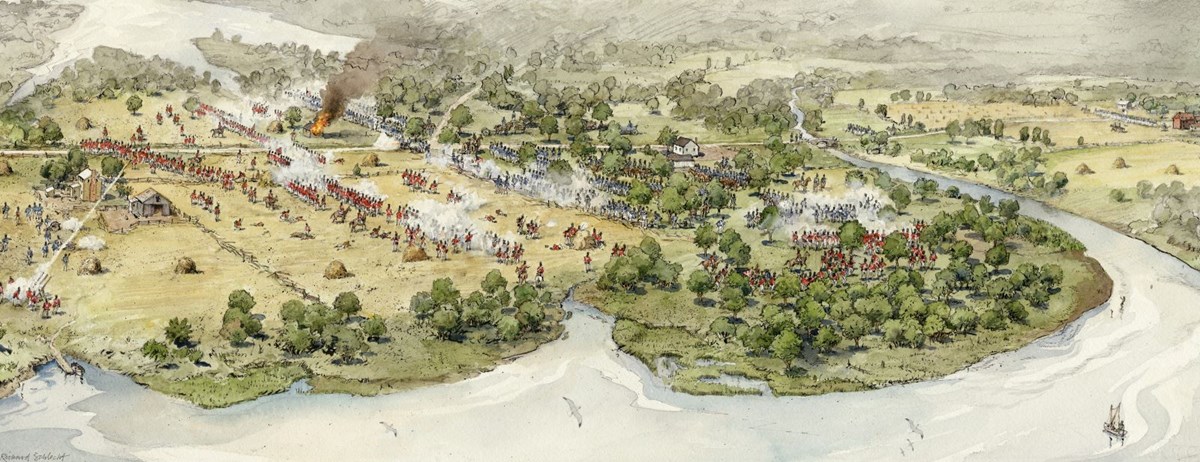
On September 12, 1814, approximately 4,700 soldiers, a mix of British infantry and marines, were landed on the North Point peninsula, a jut of land between the Back and Patapsco River and on a direct line of march toward Baltimore. While the infantry and marines advanced toward the city, the British Navy’s task was to subdue the American fortifications in Baltimore harbor. The latter was foiled by the stout defense of Fort McHenry which served as the backdrop for the future national anthem, the Star-Spangled Banner.

Less is known about the accompanying land engagement, fought at North Point between the British and American militia. That battle, which cost the life of Major General Robert Ross, the British commander, saw the American militia retreat, but in order, and stymied the initial approach of the British toward Baltimore. Furthermore, the battle gave the Americans more time to add to their defenses.

To shed light on this aspect of the Battle of Baltimore, Emerging Revolutionary War will be joined by two historians, both of who have worked on volunteered at Fort McHenry National Monument and Historic Shrine.

Jim Bailey is now the Chief of Visitor Services and Education at Manassas National Battlefield Park but is a former park ranger at Fort McHenry. The other guest historian is Chris Boyle who has been a National Park Service volunteer at Fort McHenry National Monument & Historical Shrine since 2005 in both the Fort McHenry Guard living history program and as an historical interpreter focusing on the Fort’s history from the War of 1812 through the Civil War. While not a native Baltimorean, he has called the city home for the last 20 years.

We hope you can join us on Sunday at 7 p.m EDT on our Facebook page for this historian happy hour.

2022 Symposium Speaker Spotlight: Liz Williams

This week we interview our Symposium co-host, Liz Williams! Like all of our speakers, we asked Liz to answer a few questions about her passion for history. We appreciate Liz partnering with us for the third year to put on a great program. Liz is the Director of Gadsby’s Tavern Museum in Alexandria, VA and has been with the Office of Historic Alexandria, part of the City of Alexandria, since 2004. She has a passion for history and having fun at work (as shown by her photo!).

Liz is a graduate of Mary Washington College in Fredericksburg, Virginia, where she earned her B.A. in Historic Preservation. She went on to receive her graduate degree at The George Washington University in Washington, D.C., where she earned an M.T.A. in Tourism Administration, concentrating on heritage tourism.

She is a Superfan of the musical “1776” and educates everyone she knows about the famous ride of Caesar Rodney, one of her home state’s epic Rev-War stories.

What first attracted you to the study of early American history? What keeps you involved in the study of this history? Do you find these things are the same or different?

It is all my Dad’s fault. Summer family vacations to historic sites embedded history deep into my soul at an early age. I think what attracted me then still attracts me now, just refined by time. I always connected with the people of the past and how they got from Point A to Point B. However, in my older age, I understand those decisions were not so cut and dry like I once thought they were.

Why do you think it is important for us to study the Revolutionary Era?                         

So many of our traditions, things we celebrate as “America,” stem from this era. It helps us all understand how we got to 2022.

What do you think was the most significant foreign impact on the American Revolution?

Other nations using our revolution as a model and inspiration for their own. Imitation is the highest form of flattery, right? Perhaps…

What are some of the important lessons of the American Revolution do you think are still relevant today?

Envision Barbra Streisand singing “People…” People are complex. How the revolution began, ended, and everything in between is rooted in humanity—choices made for a variety of reasons. Recognizing this human dimension is essential to understanding both the past and the present.

What was it about the American Revolution that elicited such global interest?

We defeated the big bad British (with the help of France, but I digress). It was David vs. Goliath. Of course people across the globe wanted to stay up-to-date on all the ins and outs of this action packed tale – from start to finish to the next chapter. We tell that next chapter story at Gadsby’s. We won the Revolution – Yippie! What do we do now? Those across the globe watched as we made choices to build and create what we now know as the United States of America.

Join us for our Third annual Emerging Revolutionary War Symposium on September 24, 2022. Emerging Revolutionary War is excited to continue our partnership with Gadsby’s Tavern Museum and The Lyceum of Alexandria, VA to bring to you a day-long Symposium focusing on the American Revolution.

Registration fee is now only $60 per person and $50 for OHA members and students. If you feel more comfortable attending virtually, the fee is $30 to register visit: https://shop.alexandriava.gov/EventPurchase.aspx

2022 Symposium Speaker Spotlight: Norman Desmarais

We are happy to welcome Norman Desmarais to our Third Annual Symposium on the American Revolution, co-hosted with Gadsby’s Tavern Museum, The Lyceum and Emerging Revolutionary War. This year’s theme is “The World Turned Upside: The American Revolution’s Impact on a Global Scale. We asked Norm to answer a few questions about their talk and their passion for history.

Mr. Desmarais is the author of The Guide to the American Revolutionary War series (six volumes about the war on land and seven volumes about the war at sea and overseas), as well as America’s First Ally: France in the American Revolutionary War and Washington’s Engineer: Louis Duportail and the Creation of an Army Corps. He is the former editor-in-chief of The Brigade Dispatch, the Journal of the Brigade of the American Revolution.

Norm translated the Gazette Françoise, the French newspaper published in Newport, Rhode Island by the French fleet that brought the Comte de Rochambeau and 5,800 French troops to America in July 1780. He also translated and annotated Louis-François-Bertrand du Pont d’Aubevoye, comte de Lauberdière’s journal, published as The Road to Yorktown: The French Campaigns in the American Revolution, 1780-1783 (Savas Beatie 2021). He has also completed the translation and annotation of Journal of a French Quartermaster on the March to Yorktown June 16—October 6, 1781 which hopefully will find a publisher before the conference.

Norm was inducted into the American French Genealogical Society French-Canadian Hall of Fame in 2015 and received the Albert Nelson Marquis Lifetime Achievement Award in 2019 and 2020.

What first attracted you to the study of early American history?

Watching the Walt Disney television miniseries The Swamp Fox and Davy Crockett with Fess Parker and Buddy Ebsen as a youngster captured my interest. Later, during the nation’s bicentennial, I attended some reenactments and my interest blossomed in a different direction.

When I was going through a period of writer’s block and looking for a project for my first sabbatical, I was speaking with one of my friends who suggested I consider following one of my interests and that brought me into the Revolutionary Era.

What keeps you involved in the study of this history?

Continually learning about our nation’s history. The best way to learn is by doing, so I’m involved with reenacting which feeds my research and gives me opportunities to share my knowledge with the public and other historians. It’s an educational experience like no other.

Do you find these things are the same or different?  

I think they’re different, but they are related.  They use the same sources in different ways for different objectives—sort of a repurposing of information.

Why do you think it is important for us to study the Revolutionary Era? 

People today go to great effort to do their family genealogy to discover their roots.  Going back to the Revolutionary Era is sort of like doing our national genealogy and going back to our national roots. If we don’t know where we come from, we can’t understand where we’re going as family members or as a nation.

What do you think was the most significant foreign impact on the American Revolution? 

The entry of France in the war. France began providing covert aid to support the war effort right from the beginning. However, once she officially entered the war, she could provide military assistance along with a lot of materiel the Continental Army needed so badly.  French artillery helped win the battle of Saratoga which was key to France joining the war.  Without French involvement, we could not have won at Yorktown. Three quarters of the allied force at Yorktown was French (army and navy).

What are some of the important lessons of the American Revolution do you think are still relevant today?

Logistics: Supplying and maintaining an army across an ocean is extremely difficult. Consider our experience in Vietnam, Syria and Afghanistan among others.

Morale: An army that has a will to fight for its independence, homeland or whatever can sometimes defeat a better supplied and trained army that has a lesser will to fight.

National support: Think of this as morale on the home front.  If the populace of a nation doesn’t support the war effort, it’s going to be very difficult to win.  Consider our experience in Vietnam and what Russia is experiencing in the Ukraine.

What was it about the American Revolution that elicited such global interest? 

First of all, it was inspired by the ideological principles of the Enlightenment which introduced some novel ideas and ways of thinking that inspired Europeans.

Second, there was great resentment about the increasing expansion of the British empire and its dominance in world politics and economy.

Third, Britain pretty much controlled the trade routes between Europe and the West and East Indies, in other words, the lucrative sugar trade and the tea and spice trade. The rest of Europe wanted to minimize Britain’s power and to obtain a share of that trade. Then there were the lucrative fishing rights off the coast of North America.

Fourth, People began to realize that the power of the monarchy resided in the willingness of the people to be governed by the monarchy. As they realized this and acted upon it, there arose a series of revolutions for independence and changes of government.

Join us for our Third annual Emerging Revolutionary War Symposium on September 24, 2022. Emerging Revolutionary War is excited to continue our partnership with Gadsby’s Tavern Museum and The Lyceum of Alexandria, VA to bring to you a day-long Symposium focusing on the American Revolution.

Registration fee is now only $60 per person and $50 for OHA members and students. If you feel more comfortable attending virtually, the fee is $30. To register visit: https://shop.alexandriava.gov/EventPurchase.aspx

Emerging Revolutionary War checks in with Tom Hand and Americana Corner. Here is what has has been published on that blog for the month of August.

America Looks Westward
August 30, 2022

Americans have always had a yearning to move west and discover new lands. Along the way, our ancestors had to overcome many daunting natural barriers, the first of which was the Appalachian Mountains. The Wilderness Road through the Cumberland Gap was our nation’s first pathway through this formidable range.
Read More

The Legacy of Ben Franklin
August 23, 2022

The Constitutional Convention adjourned on September 17, 1787, and would be Benjamin Franklin’s last moment in the spotlight of American history. It was a fitting finale for this man who had done so much to shape the nation in which he lived. Franklin was 81 years old, in poor health, and hoped for a well-deserved rest.
Read More

Ben Franklin’s Sage Advice Influences Constitutional Convention
August 16, 2022

In 1785, Franklin, his work done in France, was recalled to America by Congress. He arrived in Philadelphia that September, revered as one of our nation’s greatest patriots. Despite his need for a well-deserved rest, he was kept continually busy receiving dignitaries, wrapping up loose ends from his eight-year diplomatic mission, and with what would prove to be one final opportunity to help his country.
Read More

Ben Franklin Becomes America’s Top Diplomat
August 9, 2022

Congress declared America’s independence from England on July 4, 1776, but the most crucial step still lay ahead and that was to secure what we had declared. Delegates knew that to have a real chance at success, the United States needed the assistance of one or more European powers.
Read More

Ben Franklin Works Toward Independence
August 2, 2022

Partly due to Benjamin Franklin’s testimony before the House of Commons, the Stamp Act, which taxed items such as newspapers and legal documents, was repealed by Parliament on March 18, 1766. Unfortunately, this conciliatory measure was immediately undone when Parliament enacted the Declaratory Act which reasserted that all laws passed by that legislative body were binding on the colonies, including those related to taxes.
Read More

2022 Symposium Speaker Spotlight: Eric Sterner

We are happy to welcome Eric Sterner to our Third Annual Symposium on the American Revolution, co-hosted with Gadsby’s Tavern Museum, The Lyceum and Emerging Revolutionary War. This year’s theme is “The World Turned Upside: The American Revolution’s Impact on a Global Scale. We asked Eric to answer a few questions about their talk and their passion for history.

Eric Sterner is a writer focusing on American history, particularly the Revolutionary War and Civil War.  He writes frequently for the Journal of the American Revolution (http://allthingsliberty.com)  and blogs regularly at the Emerging Revolutionary War Era (http://emergingrevolutionarywar.org) in addition to contributing to other publications over the years.  Westholme Publishing released his book: Anatomy of a Massacre: The Destruction of Gnadenhutten, 1782 in 2020.  He is currently working on a micro history of the Crawford Campaign (1782) and a survey of George Rogers Clark’s Illinois Campaign (1778-1779).

In his prior life, Eric worked in the fields of national security and aerospace, holding senior staff positions for two different Congressional committees and serving at the Department of Defense and NASA.  In the private sector, he worked in the fields of national security policy analysis and telecommunications and then held fellowships at the George C. Marshall Institute and the American Foreign Policy Council.  At both places, his work focused on national security, cyber-power, and space policy and appeared in the academic, trade, and popular media.  He also taught graduate courses in cyber power at Missouri State University, Georgetown, and George Washington University.  He holds a Bachelor’s Degree in Soviet and International Studies and

What first attracted you to the study of early American history? What keeps you involved in the study of this history? Do you find these things are the same or different?  

I was born in the Land of Lincoln, but as a kid, we often visited our grandparents outside Philadelphia, touring the local sites.  My great-grandfather sometimes took us on walks through Valley Forge and the memories stuck.  History became a hobby after that, but stories about real people and events always held more fascination than fiction.  So, when the opportunity came later in life to pursue that interest with intensity, it was only natural to take it.  

Why do you think it is important for us to study the Revolutionary Era?  

We still wrestle with many of the same questions as the founding generation: what conditions warrant rebellion, how to prevent the abuse of power, how to secure individual liberty, how to determine and enact the majority’s will, etc.  Despite their limitations, that generation’s answers to those questions are still relevant and illuminating.  

What do you think was the most significant foreign impact on the American Revolution? 

France’s declaration of war and alliance with the United States, followed by Spain’s declaration of War on Great Britain, transformed the Revolution into a global struggle.  The stakes grew exponentially from an imperial and philosophical perspective and Britain immediately had to change its strategy.  

What are some of the important lessons of the American Revolution do you think are still relevant today?

Warfare always exacerbates a tendency towards extremism, dehumanization, and excess, often reducing people to the most base instincts.  Somehow, the Revolutionary War generation managed to overcome—in the main—the disastrous effects of these tendencies.  While they failed to adhere to their ideals in many ways, principally by in leaving the institution of slavery in tact, the the fact that they managed to bridge differences, compromise, and create a republic in the aftermath of a war with so many facets is remarkable.  Understanding how they did that and what it might require of us would serve the United States well 250 years later.

What was it about the American Revolution that elicited such global interest? 

It is easy to focus on the effects of a colonial rebellion on European states with colonies all over the world.  Clearly, a successful rebellion had implications for those colonies.  But, Enlightenment ideas also popular in Europe ranged from the rationalization and efficiency of government institutions to more well-known and celebrated concepts of human individuality and the sources of sovereign authority.  In many ways, the American Revolutionary Era was the first real-world test of those ideas.  Thus, whether one opposed the Revolution for imperial reasons or supported it for philosophical ones, it could not help but fascinate the world.  

Join us for our Third annual Emerging Revolutionary War Symposium on September 24, 2022. Emerging Revolutionary War is excited to continue our partnership with Gadsby’s Tavern Museum and The Lyceum of Alexandria, VA to bring to you a day-long Symposium focusing on the American Revolution.

Registration fee is now only $60 per person and $50 for OHA members and students. If you feel more comfortable attending virtually, the fee is $30. To register visit: https://shop.alexandriava.gov/EventPurchase.aspx

Honoring Baron de Kalb and Baseball

On August 19, 1780 the United States lost one of the most influential foreign officers that fought for the new nation during the American Revolution. Johann von Robais, Baron de Kalb migrated to the United States along with the Marquis de La Fayette in 1777. A Prussian born solider who fought in the Seven Years War, de Kalb quickly became a respected leader. In the summer of 1780, de Kalb was commanding the Maryland and Delaware Continental Line in Maj. Gen. Horatio Gates’ southern army. One of the best trained and disciplined units in the Continental Army, de Kalb commanded the left of Gates’ line at the Battle of Camden on August 16, 1780. The battle was more of a rout, as the British rolled up the Virginia and North Carolina militia on the field, leaving the Continentals in a desperate fight for survival. After being shot three times and bayoneted several times, de Kalb was taken from the battlefield to Camden. His wounds were mortal and he died three days later.

Baron de Kalb monument in Annapolis, MD

The reaction to his death was immediate and the respect everyone had for him was evident. Cornwallis and other British officers showed great respect for de Kalb and gave him a proper military burial.  Washington, Gates and other Continental officers mourned the loss of the Prussian officer. Soon after the war a movement began to move de Kalb’s remains to another place in Camden with a larger monument. In 1825, Lafayette laid the cornerstone for a new monument above his new interment in front of the Bethesda Presbyterian Church. This memorial was designed by Robert Mills, a noted architect of the time.

De Kalb grave site in Camden, SC

Maryland especially took an interest in remembering de Kalb. His command of the Maryland Line and his bravery leading the men at Camden were important to Marylanders after the war. In 1780, Congress authorized a monument to be built in Annapolis to honor de Kalb, but it was not until 1886 that it was finally constructed on the grounds of the Maryland state house. In the early 20th century, the Daughters of the American Revolution placed a memorial stone on the Camden battlefield marking de Kalb’s death (supposedly marking the spot but this is still debated today). Recently in 2021, Camden unveiled a new statue to de Kalb at the new Revolutionary War Visitor Center.

The memory of de Kalb extended beyond memorials and monuments. In the late 18th century and early 19th century, states started to honor de Kalb naming counties and towns after him. A total of six counties in the United States are named after Baron de Kalb, located in Alabama, Georgia, Illinois, Indiana, Missouri and Tennessee. There are six towns/cities in the United States named for de Kalb located in Illinois, Mississippi, Missouri, New York, Ohio, Texas and West Virginia.

New statue to de Kalb at the Revolutionary War Visitor Center in Camden, SC

But one of the most recognizable memorials to de Kalb and his Maryland Continentals is one that most people don’t even know as a memorial. In southern Baltimore where the large railroad yards were located, many of the streets were named after battles and individuals in the Southern Campaign of the American Revolution. Streets such as Washington, Lee, Howard, Eutaw and Camden. The large rail yard in this area was known as Camden Yards. In 1992, the Baltimore Orioles opened their new baseball stadium in the area of the old railyards next to the old B and O Railroad warehouse. The name was hotly debated, but then Maryland Governor William Donald Schaefer wanted to keep “Camden Yards” in the stadium name and eventually won out. The stadium today is called Oriole Park at Camden Yards, but most people now refer to it as “Camden Yards.” Though de Kalb would not recognize the game being played, he would recognize the name of the stadium and the state that was the home of so many of the men that followed him into battle at Camden. So next time you watch a baseball game at Camden Yards, think of de Kalb and those men at the Battle of Camden.

Oriole Park at Camden Yards

“Rev War Revelry” Nathanael Greene, Quartermaster

In March 1778, Major General Nathanael Greene finally consented to become the quartermaster for the Continental army then encamped at Valley Forge. He was loathe to give up his position as a line commander in charge of a division of infantry but with reassurances from General George Washington that he would retain his place and that his expertise was absolutely needed to revitalize the quartermaster department the Rhode Islander agreed.

His work over the next two plus years paid huge dividends. On Sunday, August 21, at 7p.m. EDT join Emerging Revolutionary War on our Facebook page for the next “Rev War Revelry.” Joining ERW will be the American Battlefield Trust’s Senior Education Manager, historian and author Dan Davis.

In reference to Greene’s role as quartermaster general at Valley Forge, Davis said, “Primarily remembered for his actions during the Southern Campaign, Nathanael Greene’s efforts at Valley Forge were critical in sustaining the Continental Army during a crucial period of its history.”

We look forward to a great discussion and hope you can join us for this historian happy hour!

One artist’s depiction of what the encampment at Valley Forge looked like

2022 Symposium Speaker Spotlight: Kate Egner Gruber

We are happy to welcome Kate Egner Gruber to our Third Annual Symposium on the American Revolution, co-hosted with Gadsby’s Tavern Museum, The Lyceum and Emerging Revolutionary War. This year’s theme is “The World Turned Upside: The American Revolution’s Impact on a Global Scale. We asked Kate to answer a few questions about their talk and their passion for history.

Kate Egner Gruber is the acting director of curatorial services for the Jamestown-Yorktown Foundation, where she works with a team to grow the collection and broaden the interpretation of early American history at Jamestown Settlement and the American Revolution Museum at Yorktown. Kate is a graduate of the University of Mary Washington’s Historic Preservation program, where she focused on archaeology and material culture, and holds her masters degree in early American history from the College of William and Mary.

What first attracted you to the study of early American history? What keeps you involved in the study of this history? Do you find these things are the same or different?   

I never know how to answer this question. The past has always been a presence in my life—whether I was digging up holes in my mom’s backyard looking for buried treasure (sorry, Mom), enthralled with the stories behind the old things in my grandmother’s upstairs room, or lost in my imagination about the landscape I called home.

I like to say that history doesn’t change—but our relationship to it does. This is what keeps me involved in the study of history of today. There’s always something new to learn, new perspectives to consider, new lenses through which to view the past. This is what keeps me motivated and eager to keep diving in.

Why do you think it is important for us to study the Revolutionary Era?  

What we learn about the past helps us better understand our present and create a more perfect union for the future.

What do you think was the most significant foreign impact on the American Revolution? 

As someone who studies both 17th and 18th century history, my perspective on this question is flipped—I think the most significant impact on the American Revolution was the colonies’ shared 17th history in the growing English and (later) British empire.

What are some of the important lessons of the American Revolution do you think are still relevant today?

From England’s Glorious Revolution to America’s Glorious Cause, we’re still negotiating our rights to life, liberty, and the pursuit of happiness—or in the words of John Locke, life, liberty, and property!

What was it about the American Revolution that elicited such global interest

Some of the founders saw their American Revolution through the lens of the English Civil Wars and Glorious Revolution, all of which had global consequences. The American Revolution isn’t just American history—it’s world history! 

Join us for our Third annual Emerging Revolutionary War Symposium on September 24, 2022. Emerging Revolutionary War is excited to continue our partnership with Gadsby’s Tavern Museum and The Lyceum of Alexandria, VA to bring to you a day-long Symposium focusing on the American Revolution.

Registration fee is now only $60 per person and $50 for OHA members and students. If you feel more comfortable attending virtually, the fee is $30. To register visit: https://shop.alexandriava.gov/EventPurchase.aspx
Americana Corner

Emerging Revolutionary War checks in with Tom Hand and Americana Corner. Here is what has has been published on that blog for the month of July.

Ben Franklin Enters Politics
July 26, 2022

Benjamin Franklin retired from an active role in his printing business in 1748 at the age of 42. His work had made him a wealthy man, and he decided to devote the remainder of his life to civic improvements and governmental affairs. Franklin became a member of the Philadelphia City Council that same year, beginning a period of more than four decades of involvement in American politics and statecraft.

Read More

Virginia’s House of Burgesses, British America’s First Elected Legislature
July 19, 2022

The Colony of Virginia was established at Jamestown by the Virginia Company in 1607 as a for-profit venture by its investors. To bring order to the province, Governor George Yeardley created a one-house or unicameral General Assembly on July 30, 1619.

Read More

How Colonial America Was Governed
July 12, 2022

When the English began to settle North America in the 1600’s, the leaders of the various colonies had different motives. While all colonies exercised their authority in the King’s name, they were not created in the same mold, and some had more autonomy than others. In fact, there were three different types of colonies: royal, self-governing, and proprietary.

Read More

Ben Franklin, America’s First Man of Science
July 5, 2022

Benjamin Franklin was one of the world’s foremost inventors and scientists in the 1700s. His creative genius and inventiveness led to many significant discoveries that made living life easier for all. Moreover, he was proof positive that brilliant minds existed in British America, despite its backwoods reputation in Europe.

Read More