Join us this Sunday night at 7pm as we welcome Glenn F. Williams, PhD to our popular Sunday night Rev War Revelry! Glenn will examine the political and economic causes of the American Revolution beginning at the end of the Seven Years War / French and Indian War through the resistance movements. He will dispel or clarify some of the popular beliefs about the grievances that eventually led the thirteen colonies to break with the Mother Country. This will be a timely discussion as we approach the 250th anniversary of the Boston Tea Party. Glenn Williams is a retired U.S. Army officer that until recently also enjoyed a “second career” as a military historian. He retired as a senior Historian after 18 years at the U.S. Army Center of Military History and 3 1/2 years as the historian of the American Battlefield Protection Program of the U.S. National Park Service.
Grab your favorite drink and tune in, we will be live so feel free to drop your questions in the live chat. If you are not able to tune in on Sunday, the video will be placed on our You Tube and podcast channels.
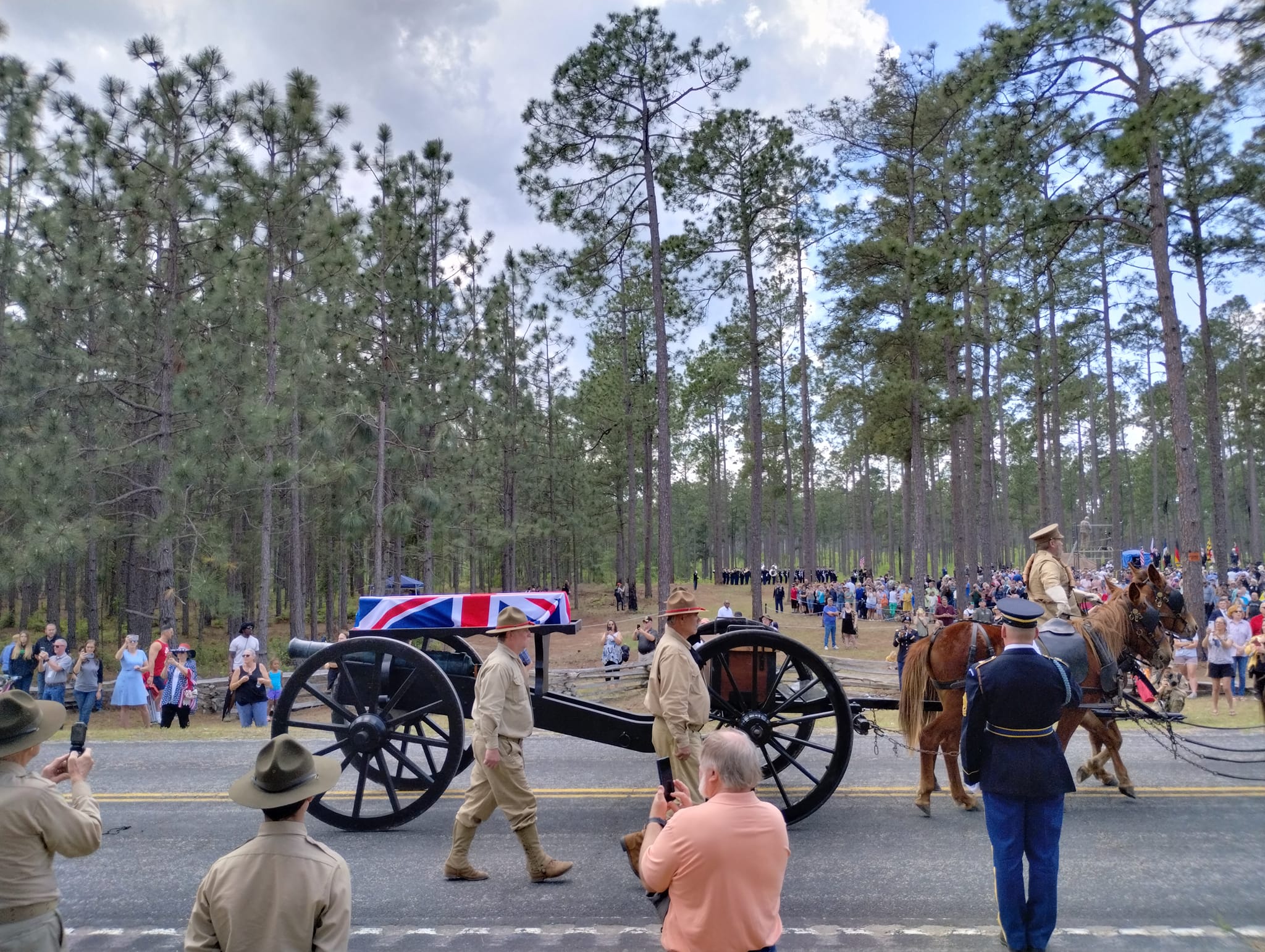
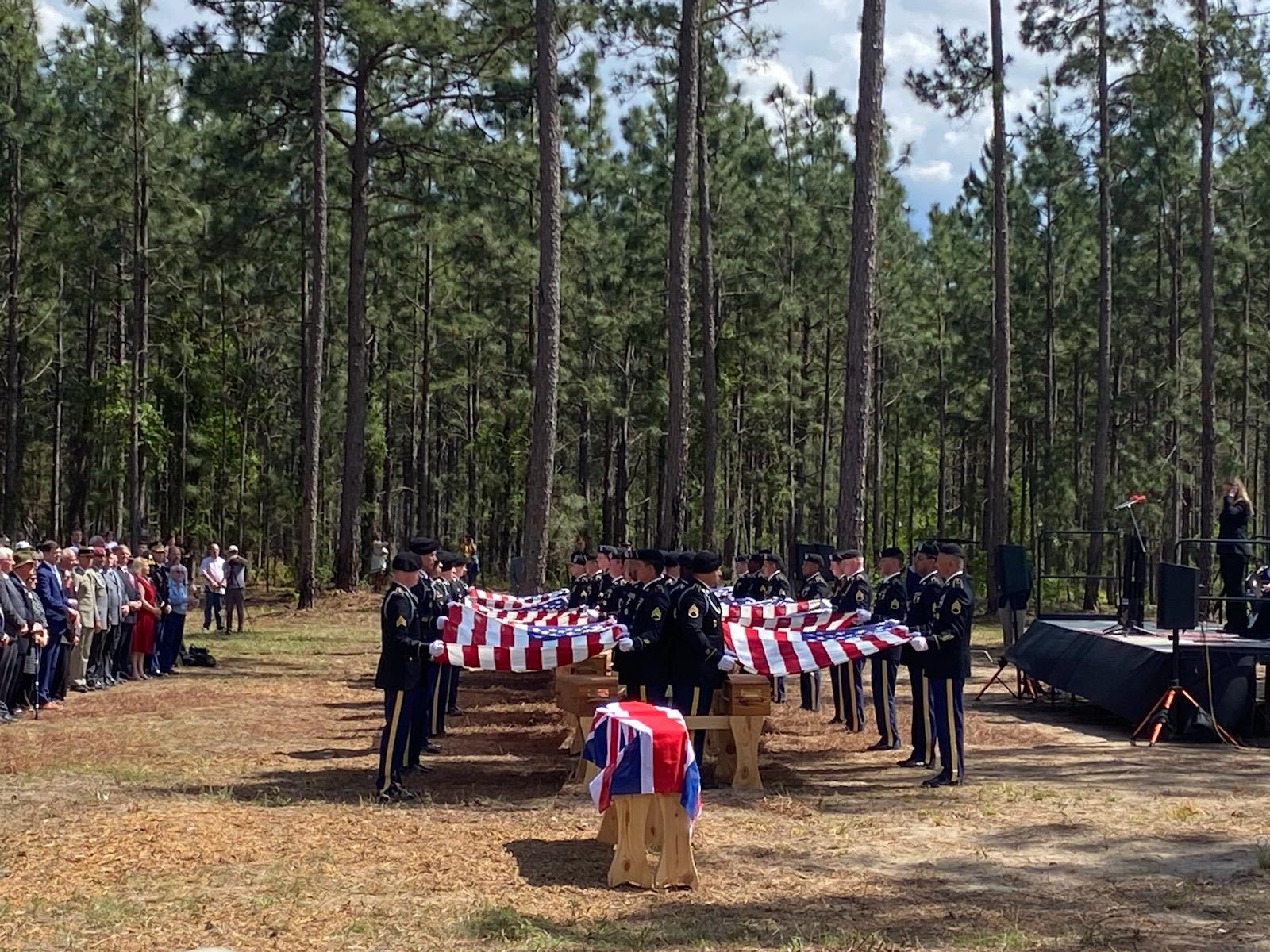
Join us as we discuss the excavation and successful recovery of the remains of 14 veterans of the August 16, 1780, Battle of Camden with James Legg and Steven Smith, Ph.D., the lead archeologists of the Camden Re-Burial Project which began in September 2022. We will discuss the indepth research conducted and the precise archaeological work that was done on the battlefield. Also learn about the reburial ceremony and where the soldiers were finally laid to rest.
This is a great opportunity to learn about a rare discovery on a American Revolutionary War battlefield. The Camden battlefield is a great archaeological site that is revealing multiple stories and helping historians piece together a better understanding of the battle. Grab a drink and join us on our Facebook page for a great evening of archaeology and history!
This Sunday, August 6th at 7pm join ERW series editor Dan Welch and authors Rob Orrison and Mark Wilcox as they discuss one of the worst defeats in American history, the Battle of Camden. How did the hero of Saratoga end up the scapegoat in the south? Learn how a coincidence led to a great British victory. And how did the Patriots recover from such a large defeat and find a path to victory a year later? Orrison and Wilcox will also discuss their upcoming book “All That Can be Expected, The Battle of Camden”. Grab a drink and join us to learn more about the Battle of Camden!
All Rev War Revelries can be found LIVE on our Facebook page, or a week later on our You Tube and Spotify channels.
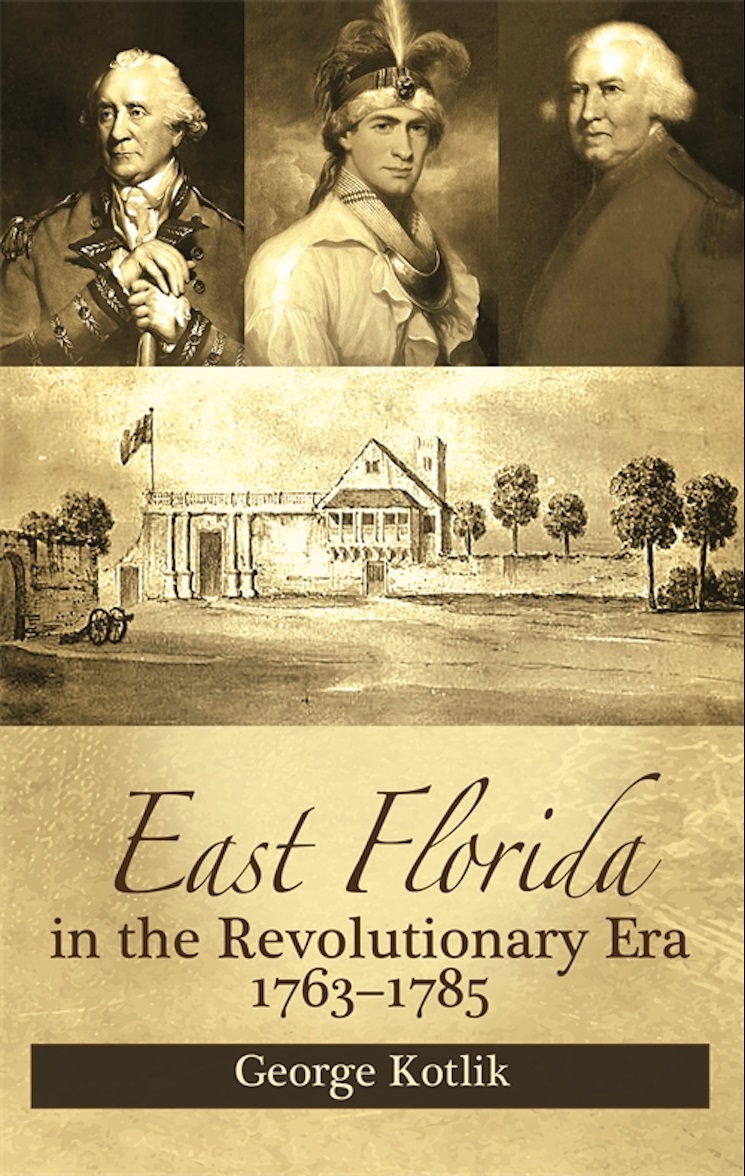
Thirteen of the Great Britain’s North American colonies moved toward independence in 1775, declaring the fact officially the following year with the issuance of the Declaration of Independence. Perched below these thirteen rebellious provinces was the colony of East Florida. Earned after the Seven Year’s War by Great Britain from Spain, the most populous city an oldest permanently established European metropolis was St. Augustine, which was also the capital of the colony. This colony, through the eight years of the American Revolutionary War, had a tenuous connection with their neighbors to the north. Largely forgotten in the pantheon of history describing this period, from the time of Britain gaining possession in 1763 through the end of the Revolutionary era in this historian’s estimation, in 1785.
Entitled, East Florida in the Revolutionary Era, 1763-1785 and penned by George Kotlik, a historian specializing in 18th century North American history, the publication offers “an accessible and detailed narrative of the East Florida during the American Revolution.” (pg. 8).
What ensues in the following pages is a brief yet complete overview of the military, political, social, and economic history within those years of East Florida. Some of the names in the pages are well known to enthusiasts of the American Revolutionary War era whereas others will be new names to add to the repertoire for further study. From Governor Patrick Tonyn, British general and last governor for England of East Florida to bringing attention to the William Augustus Bowles, a Maryland born Loyalist, sympathetic to the Muscogee Native Americans of East Florida who tried in vain from the last decade of the 18th century, to establish an independent state for the tribe, with British support. These are just two of the historical personas that Kotlik discusses in his narrative, the rest await you within the pages of the book!
Although no major military actions happened within the confines of the colony that does not mean the role of East Florida in relation to the American Revolution should not be marginalized. “Militias were raised, a general assembly was postponed, St. Augustine experienced a heightened British troop presence, planters between the St. Johns and St. Marys Rivers suffered at the hands of George raiding parties, and a constant threat of a Spanish or American invasion” all affected the psyches and lives of East Floridians. (pg. 104-105).
The hope from Kotlik is to provide the launching point for further discussion into the role of East Florida specifically and Florida in general during the revolutionary period. “Such a lack of coverage is a reminder for scholars to to emphasize East Florida’s presence in the war that made America.” (pg. 111). With this history in hand, Kotlik has provided the necessary overview for further exploration.
Publisher: NewSouth Books, University of Georgia Press, 2023 156 pages plus images
Lieutenant General Henry Clinton, New York Public Library
With the Charleston in British hands, Clinton believed that all he had to do was establish outposts in South Carolina stationed with British regulars. This be believed would put down what was left of the rebellion in the state. These posts assisted the recruitment and training of the thousands of Loyalist troops he believed would now rally around the King’s Colors. To take the best advantage of his Regular troops, Clinton determined to establish three major outposts in the South Carolina backcountry. Clinton established these posts at Augusta (Georgia), Ninety-Six, and Camden. While these posts were to be centers for the British army, the local Loyalist militias were to serve as the pacification forces in South Carolina while the main British force was freed up for larger strategic goals.
To recruit, enlist, and train the large, expected influx of Loyalist militia, Clinton named Maj. Patrick Ferguson as Inspector of Militia. Ferguson was ordered to enlist younger men, preferably unmarried, into companies that would form battalions. He was instructed to recruit from Georgia to North Carolina and offer short enlistments if necessary. Clinton believed that having the colonists maintain their own law and order (via Great Britain’s authority) would cause less apprehension with those that were mostly undecided about to whom they should throw their support, the Patriots or the British.
By mid-May, the British army set out for their destinations in the back country. Clinton’s second in command, Lieut. Gen. Charles Lord Cornwallis, marched to Camden while Ferguson moved to Ninety-Six. Without much resistance, Clinton’s plan to conquer South Carolina was working perfectly. Patriot leaders scrambled to find ways to organize their resistance. The only organized Continental force remaining in South Carolina was a small force of Virginians under Col. Abraham Buford that was on its way to Charleston when the city surrendered. Ordered by Brig. Gen Isaac Huger to reverse course and make his way north toward Hillsborough, North Carolina. There along with the North Carolina militia, he could be the core of American defense in North Carolina.
On May 27, Cornwallis ordered Lieut. Col. Banastre Tarleton with 300 of his dragoons and mounted infantry in pursuit of Buford. Tarleton’s British Legion was mostly composed of Loyalist recruits, so many in his force were from America. Tarleton pushed him men and horses hard, many horses falling out along the way. Buford was aware of a possible British pursuit but underestimated the speed in which Tarleton closed the gap. On May 29, Tarleton caught up with Buford in a region near the South and North Carolina border called the “Waxhaws.”
Lieutenant Colonel Banastre Tarleton, New York Public Library
The events that took place next are still debated today. Tarleton under a flag of truce tried to get Buford to surrender. Writing to Buford, Tarleton wrote “Resistance being vain, to prevent the effusion of human blood, I make offers which can never be repeated.” Tarleton was already creating an image of himself as an aggressive and brutal fighter. Buford, however, refused, replying, “I reject your proposals, and shall defend myself to the last extremity.” With that, Buford continued his march north towards North Carolina as did Tarleton’s pursuit. Around 3:00 p.m. the lead elements of Tarleton’s force wiped out Buford’s small rearguard, forcing Buford to stop and deal with Tarleton.
Buford decided to create a single battle line east of the Rocky River Road. Tarleton, ever the aggressive commander, ordered his horsemen to charge the Virginians. Here, Buford made what would be a devastating blunder. He ordered his men to not fire until the British cavalry was within ten yards of the American line. This would not allow the Americans a chance to fire another volley before the British charge was upon them. The Virginians fired, taking out some of the British dragoons and horses (Tarleton himself became briefly trapped under his horse), but most charged through Buford’s line, wielding their sabers and cutting down the Virginians. Total chaos ensued, and many of Buford’s men attempted to flee. Some tried to surrender by throwing their arms to the ground, but American accounts state that the British were offering “no quarter” and killing everyone that tried to surrender. Other accounts report that Buford sent a white flag to Tarleton, but probably because he was injured, it was never received, and the fighting continued. Accounts differ widely between the Americans and British on the fighting, but the fact cannot be argued that Buford’s command was destroyed.
Waxhaws Grave and Monument, photo and flags courtesy of the author
American casualties were estimated at 350, 113 men killed, 147 wounded, 50 captured, and 2 six-pound artillery pieces and 26 wagons captured. Buford himself was able to escape the field. Tarleton only suffered 5 killed and 12 wounded, a complete victory. What has become known as “Buford’s Massacre” was not referred to as a massacre at all in many period accounts. Tarleton himself blamed the “slaughter” on the fact that his men thought he was killed in the battle and sought revenge. The disparity in numbers and the reports of indiscriminate British slaughter of Americans led to the creation of “Tarleton’s Quarter.” Patriot leaders quickly pounced on this and began to spread stories about Tarleton’s brutal tactics. This proved to be a public relations coup for the Patriot cause, as it energized their side and led to a more robust recruitment of militia and partisan forces to take on the British who now faced no organized opposition in South Carolina or Georgia.
Stay Tuned for the Emerging Revolutionary War Series newest book releases “To the Last Extremity: The Battles for Charleston, 1776-1782” by Mark Maloy and “All That Can Be Expected: The Battle of Camden and the British High Tide in the South, August 16, 1780” by Rob Orrison and Mark Wilcox to learn more abou the 1780 Southern Campaign. Both releases are published by Savas Beatie Publshing: https://www.savasbeatie.com/american-revolution/
The Battle of Waxhaws, fought on May 29, 1780, was a lopsided British victory by Lieutenant Colonel Banastre Tarleton’s British cavalry over American Colonel Abraham Buford’s Continental forces in Waxhaws South Carolina. Buford lost 316 of 350 men with the British losing less than 20. Known popularly as “Buford’s Massacre,” Continental leaders used the battle as a propaganda tool against the Crown forces in the south. But, was it really a massacre?
Join us as we welcome historian and author Dr. Jim Piecuch as we discuss his research and theory about the Battle of Waxhaws and its aftermath. Dr. Piecuch has written several books on the Southern Campaign of the American Revolution including his book “Blood Be Upon Your Head: Tarleton and the Myth of Buford’s Massacre.” This Rev War Revelry will be pre-recorded and posted on May 28th at 7pm. Grab a drink and a good seat and enjoy this great presentation on one of the most controversial battles of the American Revolution.
On January 17, 1781, General Daniel Morgan and his mixed force of Continental soldiers and militia defeated the British under the command of Lieutenant Colonel Banastre Tarleton. This victory for the patriots in northwestern South Carolina had major implications on the southern theater and the main British force under General Lord Charles Cornwallis. The battle, named after the use of the fields in which it was fought, Cowpens, also included one of the only instances in American history of a successful double envelopment.
On Sunday, at 7 p.m. EDT, Emerging Revolutionary War will be joined by American Battlefield Trust’s Kristopher White, Deputy Director of Education and Daniel Davis, Education Manager, in a discussion about the history and preservation of the Battle of Cowpens.
Round out your January weekend by joining us on our Facebook page for this live historian happy hour.
Emerging Revolutionary War welcomes guest historian Sean Chick
On October 7, 1780, Britain’s attempt to regain at least part of the rebellious North American colonies was dealt a major blow at King’s Mountain. The rebels rejoiced, since it was their first major victory since 1777 and it came after the twin disasters at Charleston and Camden. Thomas Jefferson, then governor of Virginia, considered it the decisive battle of the war. Years later, Theodore Roosevelt echoed that sentiment. In 1930, when the site was set to become a national park, Herbert Hoover gave a speech. For the embattled president, it was an attempt to shore up his falling support and vindicate his strategy to peel southern states away from the Democratic Party. Hoover said “This is a place of inspiring memories. Here less than a thousand men, inspired by the urge of freedom, defeated a superior force entrenched in this strategic position. This small band of Patriots turned back a dangerous invasion well designed to separate and dismember the united Colonies.”
Hoover, understandably, never mentioned the atrocities committed. Many were executed after the battle. Nor did he mention that King’s Mountain was not a contest between redcoats and rebels, but brother against brother. The only British man present was Major Patrick Ferguson. His command was made up entirely of Loyalists. His second in command, Captain Abraham de Peyster, was from New York City.
Joseph Galloway (courtesy of NYPL)
Few groups in American history are as forgotten as the Loyalists and few were as complex. They were a varied lot, often making up the highest in colonial society, including wealthy merchants and colonial officials. They often included the very lowest in the society, such as recent immigrants, slaves, indigenous, and subsistence farmers. Their ideology was in many ways not radically different from those who rebelled. They were generally not in favor of absolute monarchy or the supremacy of Parliament but simply favored union with Britain and slow reform. A few, such as Joseph Galloway, were part of early protests against British colonial policy, but were unwilling to jump into the chasm of revolution. Some, such as South Carolina merchant David Fanning, were merely aggrieved and sought to settle scores. Others were on the margins of society and saw the colonists, or at least the revolutionary colonial elite, as their real oppressors.
The Loyalists were at first spurned by the British high command. Major General William had over 30,000 men under his command in 1776 and Loyalists would have added to the logistical strain. He also thought a soft war policy that he hoped would induce the colonies to return, and therefore it was reasonable to avoid civil war. Yet, by 1777 the British were using some Loyalist regiments. They would fight in John Burgoyne’s ill-fated drive on Albany and served as rangers at Brandywine.
Did the Battle of Moores Creek Bridge help keep the British away from the southern colonies during the first half of the war?
Months before its colonies officially adopted their Declaration of Independence, the British army was reaching a critical juncture in its war strategy: with the colonies in rebellion, where should they focus their attentions? The war was picking up steam and the British were looking for a stronghold in the colonies that would gain them resources such as men and supplies. They turned their eyes south.
The general impression of the southern colonies was that they were poorer and weaker than their sister colonies in the north. They also had been receiving word of heavy Loyalist sympathies in both the backcountry of South Carolina and the coastal areas of North Carolina, where large populations of German and Scottish immigrants had settled. Indeed, by the fall of 1775, Loyalist recruitment seemed to be quite successful. One evidence of this was at the First Battle of Ninety Six in November 1775, when nearly 2,000 Loyalists met a paltry force of not quite 600 patriots. Though this first Revolutionary War battle south of New England ended in a truce, British confidence was high.
The Royal Governor of South Carolina, Lord William Campbell, had fled the colonies by September 1775, leaving the colony mostly in the hands of the Patriots. That made the ultimate goal at this point in the southern colonies to capture the wealthy and strategic port of Charleston, South Carolina. Meanwhile, the Royal Governor of North Carolina, Josiah Martin, convinced British commanders to target key points along their route through his colony as they advanced on their mission. And as 1775 turned into 1776, plans were set in motion.
On January 10, Martin issued a proclamation calling on all subjects loyal to the Crown to take up arms against the rebellion in the colony. Authority was given to Loyalist leaders throughout the colony to recruit militia and gather all necessary provisions to muster in Brunswick, NC.
A copy of Josiah Martin’s Proclamation from January 10, 1776. Library of Congress.
By mid-February, a contingent of several thousand loyalists was gathered at Cross Creek, NC, preparing to march towards their goal. Among those recruited were the famed Scotch Highlanders. Though not all joined the Loyalist cause, the Highlanders’ reputations as fierce warriors preceded the impending war in the colonies. This reputation may have stemmed from the Jacobite rebellion in the 1740s as well as British assumptions at the time that the HIghlands were a lawless land due their clan-based culture.
Loyalists weren’t the only militias stirring along the Carolina coast. Patriot militias had begun forming at the first news of Loyalists gathering as early as August 1775. In fact, some of those militias formed in Wilmington, NC became the foundation of the 1st North Carolina Regiment of the Continental Army and in February 1776, they were led by Colonel James Moore. At that time, they were joined by additional militiamen from the surrounding area, led by Alexander Lillington and Richard Caswell. Their goal was two-fold: protect Wilmington and prevent the Loyalist forces from reaching the coast.
By February 20, 1776, a clash between the British and Patriot forces was inevitable. British commander Donald MacDonald began to move his 1,600 men from Cross Creek towards his rendezvous point at Brunswick, only to find his way impeded along the Black River by Caswell’s blockade. On February 25, MacDonald had managed to get across the river and Caswell moved his 1,000 Patriots back to Moores Creek Bridge. There they set up defensive earthworks, prepped their two artillery pieces, and prepared for battle.
A map of the Moores Creek campaign, February 1776. NPS/Moores Creek National Battlefield.
At 1:00 am on February 27, 1776, MacDonald’s second-in-command, Donald McLeod, led the British troops on their march towards the Patriot position. Arriving at an abandoned camp on the west side of the bridge around 5:00 am, a brief exchange of fire alerted the Loyalists to the Patriot sentries guarding the bridge, and ultimately, the Patriot forces lying in wait.
McLeod with 50 men attempted to cross the bridge and attack the Patriot defensive position, but the attempt was futile and disastrous. Heavy musket fire coupled with a barrage of two artillery units killed 30 almost immediately, including McLeod. The remaining Loyalists quickly retreated and the battle was over almost as quickly as it had begun.
Bill Ballard’s drawing of the decisive moment during the Battle of Moores Creek Bridge. NPS/Moores Creek National Battlefield.
So how important were these three approximate minutes of battle? This Patriot victory struck a huge blow to Loyalist recruitment in North Carolina – so much so that two months later, North Carolina’s delegates to Continental Congress were the first to vote for independence. And it created a rippling effect throughout the southern colonies, as one by one the royal governors were displaced and revolution took hold.
No longer could the British see the Carolinas as easy targets. They abandoned this initial southern strategy to focus their resources on the war in the northern colonies. For the next three years, significant battles and events that we learn about today took place, thanks in part to the dominating Patriot showing at the Battle of Moores Creek Bridge.
If you’re interested in learning more about the Battle of Moores Creek Bridge, I strongly encourage you to visit Moores Creek National Battlefield’s website as well as their very active Facebook page. Both offer a wealth of information and additional resources for folks to explore.
When thirteen North American colonies rebelled against the British crown, the future state of Florida was not part of that movement. In fact, the settled part of the future 27th state of the United States was partitioned into East and West Florida. Both colonies also declined an invitation to send delegates to the Continental Congress.
East & West Florida colonies
West Florida, spanned from slightly east of Pensacola, which was the capital, across to Louisiana and included parts of modern Alabama, Louisiana, Florida, and Mississippi. East Florida, spanned the rest of northern Florida from the Apalachicola River to the Atlantic seaboard and down the peninsula. The capital was located at St. Augustine, founded in 1565 by the Spanish.
During the American Revolution, both East and West Florida would play a role as the rebellion spread into a world conflict, bringing into the fighting the European nations of France and Spain. In East Florida, St. Augustine would send north British soldiers to assist in operations in Georgia and South Carolina and also house American prisoners, including three Signers of the Declaration of Independence; Arthur Middleton, Edward Rutledge, and Thomas Heyward, Jr. Other prisoners, both Americans and French were also confined to the town too.







 Emerging Revolutionary War Era