Part Three (click here for first two installments)
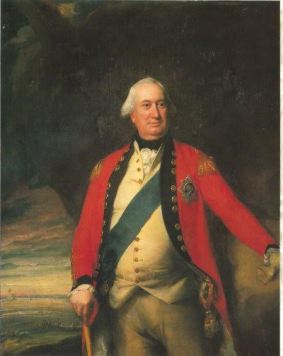
Determined to avenge his embarrassing defeat at Cowpens, Lt. Gen. Charles Lord Cornwallis set his army out in a determined pursuit of the American army. Knowing that he was too weak to face Cornwallis in a pitched battle, Maj. Gen. Nathanael Greene, the Southern Department commander, retreated northeastward from Salisbury, North Carolina toward the Virginia state line, where he hoped that additional militia troops would reinforce his army and he would receive supplies. The British chased Greene to the Dan River, near the Virginia border, but Greene wisely put the river between his army and the enemy. Cornwallis and his weary soldiers arrived at the rain-swollen river on February 15, too late to catch Greene’s army, which had finished crossing earlier that day. Frustrated, Cornwallis withdrew to Hillsborough, North Carolina.
Lord Charles Cornwallis
After receiving both the expected supplies and reinforcements, and after an opportunity to rest his command, Greene soon marched back into North Carolina to face Cornwallis’ tired and poorly supplied army, which now numbered less than 2000 men. After several weeks of skirmishing with Loyalist militiamen and a great deal of maneuvering Greene assumed a defensive position around Guildford Courthouse (near modern Greensboro, North Carolina) on March 14, 1781. Greene had more than 4000 Continentals, militiamen and cavalry, meaning that his army outnumbered Cornwallis’ by more than twice their strength. Continue reading “Defense in Depth as a Revolutionary War Battlefield Tactic”→
Emerging Revolutionary War is honored to share the post below by guest historian Kerry Mitchell
Thomas Jefferson, George Washington, Richard Henry Lee, George Mason, Patrick Henry…when thinking about the period before and during the American Revolution these names come up as some of the great Virginians who were involved in the founding of our nation. While these men were great on their own accounts, there were other Virginian men who helped shaped our nation. Thomas Blackburn of Prince William County is one of these who history tends to glance over even though during the 1760s and 1770s, he was an important figure in American history.
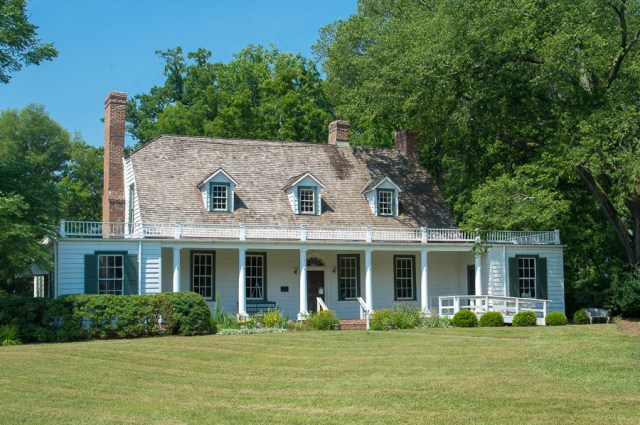
Rippon Lodge in Prince William County, Virginia, home of Colonel Thomas Blackburn
Thomas was born in Prince William County around 1742 to Richard and Mary (nee Watts) Blackburn. Richard Blackburn was a native from Ripon, England who came over in the early 1700s and settled in Gloucester County, Virginia before moving to Prince William County in 1733. In addition to being a carpenter and farmer, Richard was involved in Prince William County politics and served as a Justice of the Peace. Not much is known about Thomas’s early childhood. He inherits his family home and farm, Rippon Lodge in 1760. That same year he marries Christian Scott with whom he has six children with. By 1762, Thomas receives a captain’s commission from the governor. With the French and Indian War ending it is unclear to what extent he served. We do know that in September 1766 he was serving as a Justice of the Peace for Prince William County. In 1772, Thomas was elected to be one of the Prince William representatives to the House of Burgesses.
A photo of the interior of one of the rooms of Rippon Lodge
Thomas’s election to the House coincided with the brewing unrest brewing between the colonists and Great Britain. After the Boston Tea Party and Britain’s passage of the intolerable Acts, Thomas was amongst the group of members who drafted the resolution that would call for a day of prayer and fasting for the people of Boston. Lord Dunmore believed the resolution was an insult to King George III and he dissolved the House on My 26th. Thomas was among the 22 ex-members who met at Raleigh Tavern and decided they would support a continental boycott of British goods. He went back to Prince William County to have the resolution passed by county leaders (which they did on June 6th). From 1774-1776, Thomas served in the first four Virginia conventions and involved himself in many committees dealing with the unrest. He was part of the committee offering George Washington the command of Virginia’s militia and as well as the committee with George Mason and Henry Lee II raising troops to defend Virginia. In the spring of 1776, Thomas lost his seat to attend the 5th Virginia Convention to Cuthbert Bullitt.
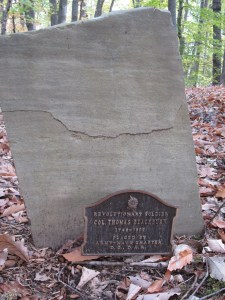
Gravestone and D.A.R. marker for Colonel Thomas Blackburn
After losing his seat to Bullitt, Thomas was appointed as a Lt. Colonel of the 2nd Virginia State Regiment. After being passed over for a promotion, Thomas gave in his resignation on June 10, 1777. While he was out of the army officially, Thomas did not stay out of the fight for long. He rejoined the Virginia Militia as a volunteer. He fought at the battle of Germantown, Pennsylvania in October 1777. During this battle, he was wounded in the leg which ended his military career. He returned to Rippon Lodge in Woodbridge, Virginia to continue farming and entertaining his many friends. This included George Washington whom Thomas became related to through marriage when his daughter, Julia Ann, married George’s nephew, Bushrod Washington. On July 7, 1807, Thomas passed away at Rippon Lodge where he is buried in the family cemetery.
Thomas Blackburn Obituary, Virginia Gazette, August 29, 1807
*Originally from New York, Kerry Mitchell is currently the Historic Interpreter at Rippon Lodge Historic Site, part of Prince William County’s Historic Preservation Division. She has a B.A. in Historic Preservation from the University of Mary Washington, a M.A. in American History from George Mason University and a graduate certificate in Museum Collection Care and Management from The George Washington University. She has previously worked at the National Museum of the Marine Corps, Reston Historic Trust, and the Fire Island National Seashore.*
On Wednesday, June 8, a signing ceremony marked the beginning of an agreement between First Parish in Concord, owner of the Wright Tavern, and the Concord Museum. Starting this fall, the Concord Museum will provide educational programming to school groups in the Wright Tavern and open the historic building to the public for commemorative events in October and April each year. On hand for the signing were representatives of the Concord Museum and First Parish as well as members of the Wright Tavern Exploratory Committee (WTEC), appointed last fall to develop a sustainable, strategic plan to showcase the Wright Tavern as a National Historic Landmark.
Plaque on the Wright Tavern (ERW collection photo)
“Opening the historic Wright Tavern to public and educational access will provide a true sense of place when learning about the historical events of the American Revolution,” said Mel Bernstein, member of WTEC and Chairman of the American Revolution Round Table of the Minute Man National Historical Park.
No building in this historic community was of greater consequence to the beginnings of the American Revolution than the Wright Tavern, built in 1747. The First Provincial Congress met in Concord at the Wright Tavern in October 1774, electing John Hancock as the Congress’s president and making provision for the collection of taxes. The Second Provincial Congress met there again in March and April 1775. Presided over by John Hancock with Samuel Adams and Dr. Joseph Warren in attendance, the Provincial Congress met in defiance of Royal and Parliamentary authority — creating a Massachusetts army, raising taxes, and performing other roles necessary to form its own government, independent of British authority. Then, in the early hours of April 19, 1775, Concord’s Minute Men assembled in the Wright Tavern before setting off to repel the advancing British troops at the North Bridge.
Since 1886, First Parish in Concord has owned and maintained this historic structure. “The Wright Tavern is certainly one of the most important Revolutionary War-era buildings in Concord,” explained Tim Jacoby, Chair of the First Parish Trustees of Parish Donations. “Although the building is owned by the church, we truly feel it belongs to the people of Concord and to the American people. This agreement with the Concord Museum will establish greater public accessibility to the Tavern.”
In 1961, the Wright Tavern was designated a National Historic Landmark by U.S. Secretary Fred Seaton, declaring it “an historical site of exceptional value in commemorating and illustrating the history of the United States.”
Margaret Burke, Executive Director of the Concord Museum, said: “The Museum is thrilled with this partnership to bring the importance of the Wright Tavern to the fore. Concord is home to invaluable historical and cultural resources, and this is a wonderful example of how organizations within the town are working together to promote this history and make it relevant to residents and visitors.”
Leah Walczak, the Concord Museum’s Director of Education and Public Programs, explained the role the Wright Tavern will play in educating visiting school groups: “The Museum currently provides specialized programming to over 10,000 school children each year. Along with hands-on history education using objects from the Museum’s collections, this agreement will allow us to provide programs within the setting of one of the finest historic buildings in Concord.”
This partnership was brought about through the work of the Wright Tavern Exploratory Committee, which convened from September 2015 through January 2016. Members included: John Boynton, Chair of the Exploratory Committee and a First Parish Trustee; Doug Baker, Sacristan and Curator of First Parish; Mel Bernstein, Chair of the American Revolution Round Table of Minute Man National Historical Park; Jim Cunningham, Project Manager for Barrett Farm Restoration, and Treasurer of Save Our Heritage; Sue Gladstone, Director of Development for the Concord Museum; Jayne Gordon, Public Historian for Robbins House, Thoreau Farm, and the Concord Museum; Tim Jacoby, Chair of the First Parish Trustees; Bob Morris, Chair of the Friends of Minute Man National Historical Park; and Tom Wilson, First Parish Treasurer.
A generous gift to the Museum from John and Johanna Boynton is funding this historic partnership.
*About the Concord Museum The Concord Museum is where all of Concord’s remarkable past is brought to life through an inspiring collection of historical, literary, and decorative arts treasures. Renowned for the 1775 Revere lantern and Henry Thoreau’s Walden desk, the Concord Museum is home to a nationally significant collection of American decorative arts, including clocks, furniture, and silver. Founded in 1886, the Museum is a gateway to historic Concord for visitors from around the world and a vital cultural resource for the town and the region. Visit www.concordmuseum.org.*
*For More Information, contact:
Barbara Rhines, Director of Marketing and Public Relations
978-369-9763, ext. 229
Email: brhines@concordmuseum.org
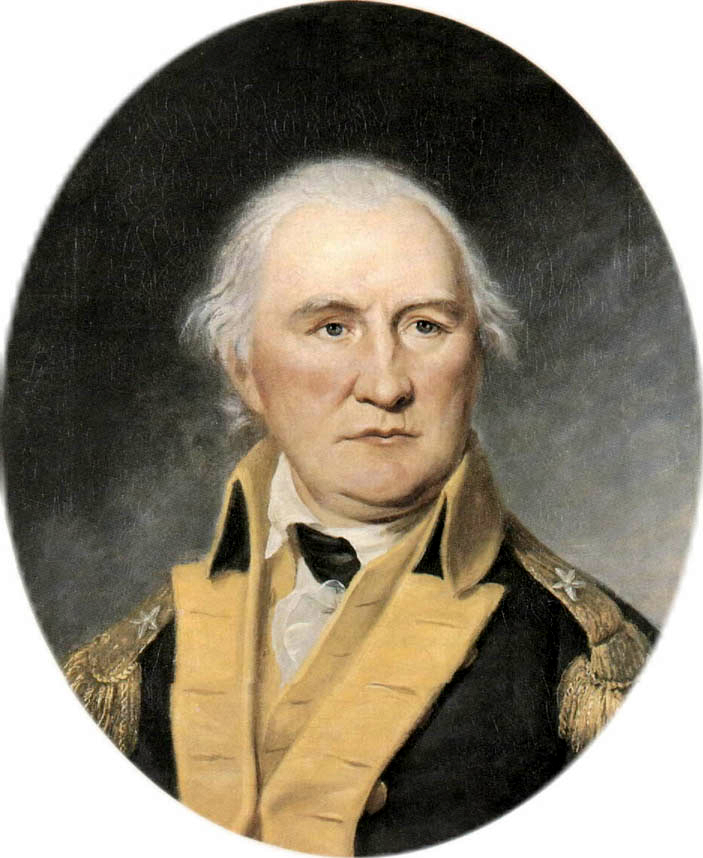
Brig. Gen. Daniel Morgan, the “Old Wagoner,” as he was known, commanded a light infantry corps assigned to Maj. Gen. Nathanael Greene’s southern army. Morgan met with Greene in Charlotte, North Carolina on December 3, 1780. Implementing a Fabian strategy, Greene split his army to harass the British while buying time to recruit additional soldiers. Greene ordered Morgan to use his 600-man command to forage and harass the enemy in the back country of South Carolina while avoiding battle with Lt. Gen. Charles Lord Cornwallis’ British army.
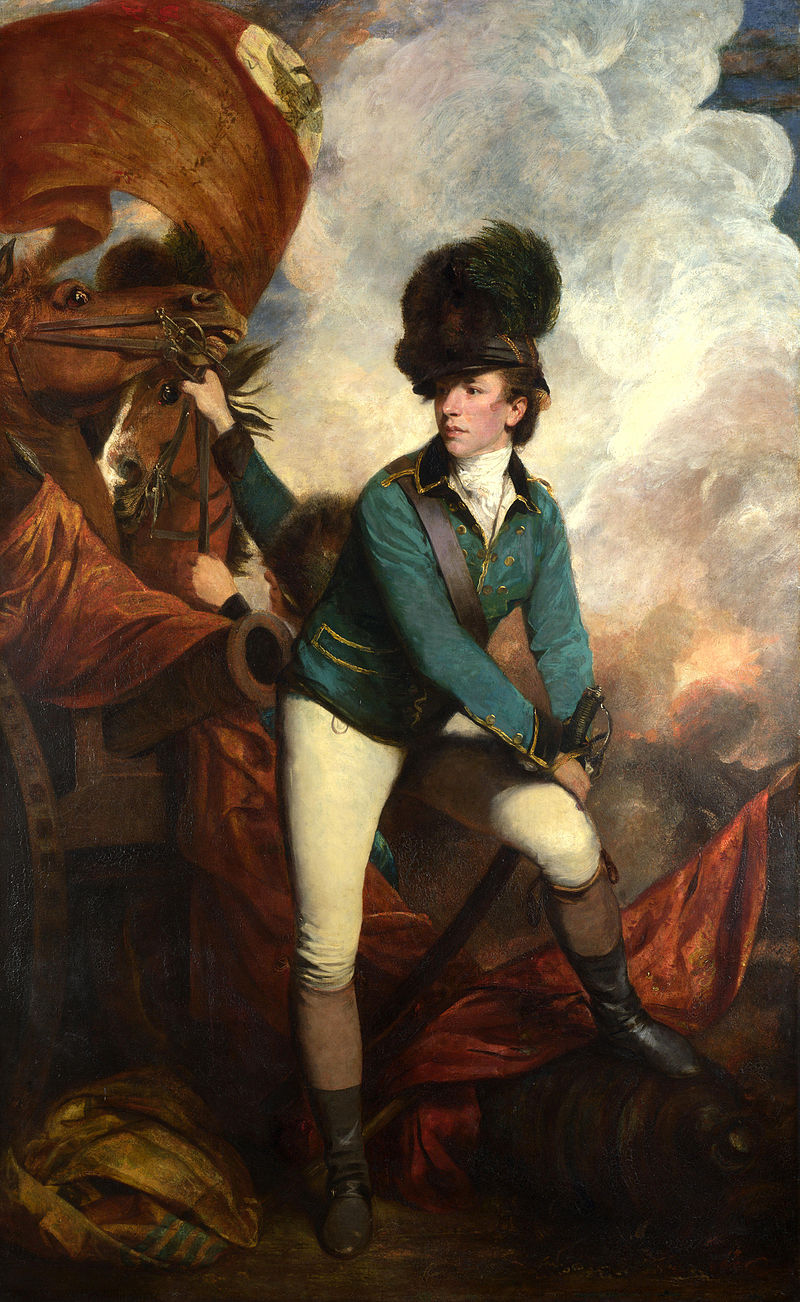
Once Cornwallis realized what was going on he dispatched Lt. Col. Banastre Tarleton’s British Legion to track down Morgan’s command and bring it to battle. Tarleton commanded a combined force of Loyalist American troops. The Legion consisted of fast-marching light infantry and dragoon units. At its peak strength, the Legion numbered approximately 200 infantry and 250 dragoons. It was known for its rapid movements and for its ruthless policy of giving the enemy no quarter. Patriot forces feared Tarleton and his Legion, and for good reason.
By January 12, Tarleton’s scouts had located Morgan’s army in the South Carolina back country, and Tarleton began an aggressive pursuit. Morgan hastily retreated to a position at the Cowpens, a prominent crossroads and pasturing grounds for cattle. The field was about 500 yards long and about as wide, dotted with trees, but devoid of undergrowth, which served as a food source for grazing battle.
Once Morgan learned that Tarleton was pursuing him, he spread the word for local militia units to rendezvous with him at the Cowpens. Through the night, South Carolina militiamen drifted into camp. Morgan visited their camps, encouraging them to stand and fight. Morgan’s words were particularly effective; the grizzled veteran knew how to motivate these men. They would need to be prepared, because they faced a stern task the next day.
January 17, 1781 dawned clear and very cold. After his scouts reported Tarleton’s approach, Morgan rode among his men, crying out, “Boys, get up! Benny’s coming!” Morgan designed a defense in depth that was intended to draw the British Legion in and then defeat them by pouncing on their exposed flanks. He knew that his militia had a reputation of being unreliable, and his ability to maneuver was limited, so he elected to design and implement a defense in depth that took advantage of the terrain features of the Cowpens.
Banastre Tartleton, British commander at Cowpens
Tarleton was overconfident. He believed that Morgan’s command was hemmed in by the nearby Broad River and also believed that the cleared fields of the Cowpens were ideal ground for his dragoons, and concluded that Morgan must be desperate to fight in such a place.
Morgan had prepared three defensive positions. Selected sharpshooters out front and hiding behind trees manned the first line. They picked off a number of Tarleton’s dragoons as they advance, specifically targeting officers. Traditional accounts indicate that they downed 15 of Tarleton’s dragoons this way. Confused, the dragoons retreated.
Having accomplished their initial goal, the sharpshooters then fell back about 150 yards or so to join the second line, which consisted of Brig. Gen. Andrew Pickens’ militiamen. Morgan asked these men to stand long enough to fire two volleys, after which they were to fall back to the third—and main line—manned by Col. John Eager Howard’s Continentals, another 150 yards or so in the rear of the second line. Thus, Morgan had designed a textbook example of a defense in depth.
Andrew Pickens, commanded some of the South Carolina militia at Cowpens
Some of the militia got off two volleys and then most of the militia fell back to a spot behind the third line. Tarleton orders his dragoons to pursue the retreating militiamen, and as the dragoons bore down on them with their sabres drawn, Col. William Washington’s Continental cavalry suddenly thundered onto the field, seemingly from nowhere. They routed the surprised Loyalist dragoons, who fled the field with heavy losses.
The infantry then engaged. With their drums beating and their fifes shrilling, the British infantry advanced at a trot. Recognizing that the moment of crisis had arrived, Morgan cheered his men on, rode to the front and rallied the militia, crying out, “form, form, my brave fellows! Old Morgan was never beaten!”
William Washington, commander of American cavalry at Cowpens and a distant relation to George Washington
Tarleton’s 71st Highlanders, a veteran unit made of Scotsmen, which had been held in reserved, now charged the Continental line, their skirling bagpipes adding to the cacophony of battle. Howard ordered his right flank to face slight right to counter a charge from that direction, but in the noise and chaos, was misunderstood as a call to retreat. As other companies along the line began to pull out, Morgan rode up to ask Howard if he had been beaten. Howard pointed at the orderly ranks of his retreat and assured Morgan that they had not been beaten. Morgan then put spurs to his horse and ordered the retreating units to face about and, on his order, to fire in unison. Their deadly volley dropped numerous British soldiers, who, sensing victory, had broken ranks in a determined charge. The combination of this volley and a determined bayonet charge by the Continentals turned the tide of battle in favor of the Americans.
At the moment, the rallied and re-formed militia and Washington’s cavalry attacked, leading to a double envelopment of the British, who began surrendering in masses. Tarleton and some his men fought on, but others refused to obey orders and fled the field in a panic. Finally, Tarleton realized that he had been badly beaten and fled down the Green River Toad with a handful of his men. Racing ahead of his cavalry, William Washington dashed forward and engaged Tarleton and two of his officers in hand-to-hand combat. Only a well-timed pistol shot by his young bugler saved Washington from the upraised saber of one of the British officers. Tarleton and his remaining forces escaped and galloped off to Cornwallis’ camp to report the bad news.
And bad news it was: Tarleton’s Legion lost 110 dead, over 200 wounded and 500 captured. By contrast, Morgan lost only 12 killed and 60 wounded. His perfectly designed and perfectly implemented defense had worked even beyond the Old Wagoner’s wildest dreams and highest hopes.
Knowing that Cornwallis would pursue him, Morgan buried the dead and then withdrew to the north to live and fight another day. Morgan reunited with Greene’s army and the combined force headed for North Carolina. Morgan, whose health was fragile, soon retired from further duty in the field, but he had left his mark. Cowpens was his finest moment, and set a precedent for Greene to follow two months later at Guilford Courthouse.
Battle of Cowpens (Courtesy of Campaign 1776/CWT)
*Suggestions for additional reading: for a superb book-length microtactical treatment of the Battle of Cowpens, see Lawrence E. Babits, A Devil of a Whipping: The Battle of Cowpens (Chapel Hill: University of North Carolina Press, 1998). This book is the primary resource consulted in drafting this article.
Robert Morris explaining the recent archaeological investigations at Parker’s Revenge along Battle Road.
Recently, ERW members Phil Greenwalt and Rob Orrison spent the 241st anniversary of the opening of the American Revolution in the outskirts of Boston in Concord, Massachusetts. It was a whirlwind trip of research, photos and most importantly meeting the stakeholders in historic preservation and public history in the region. We already knew how active Concord was in promoting and preserving its history, but each time you visit you are blown away by their efforts and their appreciation for their past.
While in Concord, our more than gracious host was Jayne Gordon. Jayne has been involved in almost every public history project or initiative in the Concord area. A native of the area, everyone in Lexington and Concord knows Jayne. Jayne took the time to introduce us to many people and organizations in the area. I wanted to focus on two organizations that are doing great work in the region to promote local history with a national impact.
The Robbins House
Formerly the Drinking Gourd Project, The Robbins House is introducing people to the story of African Americans in the region. The all-volunteer board and staff are breaking new ground. Facing misconceptions of slavery in 18th century Concord head on, Robbins House President Maria Madison has led the charge to change the narrative.
The Robbins House is an early 19th century house that was inhabited by the first generation
The Robbins House
of descendants of formerly enslaved African America Revolutionary War veteran Caesar Robbins. Using the story of Caesar Robbins as a base, Maria and her fellow volunteers interpret the role of African Americans in 18th and 19th century Concord. Most forget that 18th century Massachusetts was a colony that supported and practiced slavery. The Robbins House also interpret stories of how literary icons, such as Ralph Waldo Emerson and David Henry Thoreau, dealt with slavery and prejudice. Again, most visitors (including me!) have their preconceived notions challenged. The Robbins House also provides exhibits on other aspects of African American history of Concord, as well as lectures, programs and self-guided tours of Concord.
The Robbins House’s location next to the famous North Bridge provides an interesting juxtaposition on freedom and liberty. Just a few hundred yards away the dream of American freedom and independence began and the Robbins House is filling the void of how that liberty equated to a large portion of the American population. On your next visit to Concord, it is a worth your time and support. I really enjoyed my time meeting with Maria and look forward to future conversations and visits. Visit their website at for more information www.robbinshouse.org.
Friends of Minuteman National Park
Many of our readers are aware of the recent “Parker’s Revenge” project and preservation project with the Civil War Trust’s “Campaign 1776.” Also, I bet all of our readers are aware of Minuteman National Historical Park, but how many know about the great efforts of the Friends of Minuteman National Historical Park? I must admit, until my recent visit I include myself if that “unknowing” category. Jayne introduced us to Robert Morris, President of the “Friends,” and Bob spent a morning going over the organization and their recent efforts to promote new historic research, archaeology and restoration of the area known as “Parker’s Revenge” along the Battle Road.
This ridge is now considered where Capt. Parker and his Lexington militia attacked the British on their retreat back to Boston
“Parker’s Revenge” occurred on the afternoon of April 19, 1775 along the road between Concord and Lexington. Captain Parker, who earlier that day confronted the British on the Lexington Green, regrouped his militia and prepared for an attack on the British column as it made its way back to Boston. As they marched through Lincoln and approached Fiske Hill, Parker’s men opened up a deadly fire from behind rocks. Up until last year, historians have always interpreted the event to take place along the Battle Road next to the modern Minuteman National Historical Park Visitor Center. But now, thanks to fundraising and manpower efforts of the “Friends”, the history of “Parker’s Revenge” is being rewritten. With new archaeology, the area of “Parker’s Revenge” will be reinterpreted a few hundred yards west of the current location. Bob and his team of volunteers also plan to work with the National Park Service to assist in restore the historic landscape in the area.
The “Friends” also fundraise to support interpretation projects, grounds projects, and support the large volunteer corps at the park. One of the most important tasks for the organization is advocating on behalf of the national park. My morning spent with Bob and Jayne walking the newly discovered “Parker’s Revenge” battlefield was a highlight of my trip. Being one of the first people to walk the “new” battlefield and hear how the project developed was a special treat.
I highly recommend you follow along the many projects the “Friends” have on going to support Minuteman National Historic Park. They are always looking for new members, no matter where you may live. Visit their website at www.friendsofminuteman.org
Again, I cannot thank Jayne Gordon enough for showing me around Concord and sharing her passion for history. I appreciated my short time with Maria Madison of the Robbins House and Robert Morris of the Friends of Minuteman National Park. Both are breaking new ground and supporting preservation and interpretation of the events surrounding spring 1775. These are the people on the front lines and that meshes well with one of the established goals of Emerging Revolutionary War is to share and promote these public history organizations. They are instrumental in telling the story of the American Revolution.
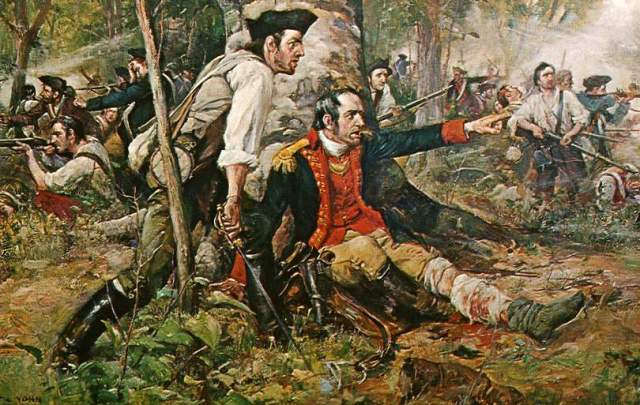
Sitting under a tree in north-central New York, suffering from a painful and mortal leg wound, yet still managing a successful defense after a powerful ambush, is a characteristic of a great military leader. All the while nonchalantly smoking his pipe!
General Nicholas Herkimer (courtesy of the NPS/Fort Stanwix and Oneida County (NY) Historical Society)
Nicholas Herkimer was the epitome of a successful militia commander. The Battle of Oriskany was a turning point. Herkimer, sitting on a once innocuous hillside, was a major reason why.
Even George Washington recognized the importance of Herkimer and made mention of his decision to not seek a commission in anything more than the militia of his home state. Not only that simple fact of service recognized by the commander-in-chief, but also his pivotal role in the Northern campaign of 1777.
“It was Herkimer who first reversed the gloomy scene of the Northern campaign. The hero of the Mohawk Valley served from love of Country, not for reward. He did not want a Continental command or money.”
Herkimer would succumb to the mortal leg wound ten days after the battle, but his role in what was described as “one of the bloodiest battles of the war” solidified his place in the category of “greatest leaders of the American Revolution you have never heard of.”
Born in the Mohawk Valley of New York to Palatinate immigrants, Nicholas was described as a slender built, dark complexioned, dark haired individual. When he was finished growing, he stood near six feet tall, a rather tall height in 18th century Colonial America. He could also boast of being multilingual, fluently speaking English, German, and Iroquois.
He saw action in the French and Indian War, helping to repel the French and Native American attack on German Flatts, New York on November 12, 1757. Although a disastrous day for the German community, as many were taken prisoner by the French and Native Americans, Herkimer’s role led to his promotion to captain in the militia within two months of the fighting on January 5, 1758. Thirty-years after his promotion to captain the town would be renamed “Herkimer” for the actions of this New Yorker during the subsequent war.
In April of 1758, Herkimer was present and assisted in the successful repulse of the French and Indian force.
With peace established in 1763, Herkimer looked toward personal matters, building a house on the south side of the Mohawk River in 1764. He married two ladies, both named Maria. One died and the other would remarry and move north of the border to Canada, after Herkimer’s death in 1777.
With tensions increasing in the 1770s between Great Britain and the colonies, Herkimer led the Tryon County, New York Committee of Safety and was elected colonel of the local militia. The Provincial Congress on September 5, 1776 promoted him to brigadier general of the militia. One of his first roles was to meet with Joseph Brant, a Mohawk military and political leader in an effort to try and keep the Native Americans neutral in the conflict between the colonies and Great Britain. He was unsuccessful.
During the Northern Campaign of 1777, with the thrust southward by British General John Burgoyne being the main column on its way to its destiny at Saratoga, a secondary column entered the Mohawk Valley under British General Barrimore”Barry” St. Leger. The combined British, German, Loyalist, and Native American force laid siege to Fort Stanwix, in present-day Rome, New York.
Herkimer heard about this and marched his militia to help raise the siege. His force was ambushed on August 6, as they were nearing Fort Stanwix. After the initial surprise, in which Herkimer received his wound, the militia responded well and a drawn out battle ensued.
Part of the reason that the majority of the militia recovered from the shock and endured the ensuing bloody carnage was directly related to the inspired leadership of Colonel Samuel Campbell who led one of the militia regiments in the force and Herkimer himself.
Herkimer, after having his horse shot and receiving his mortal wound in the opening shots of the engagement asked to be propped under a tree on the hillside his forces had utilized for their defensive stand He then calmly lit a pipe and with a continued cool demeanor directed the rest of the engagement.
Famous painting depicting the mortally wounded General Nicholas Herkimer directing his militia from his position seated under a tree, during the Battle of Oriskany on August 6, 1777. (Painting by Frederick C. Yohn)
After the day-long battle, Herkimer ensured he was the last to leave the field, after all the wounded that could be collected had been removed.
Although his wound was dressed on the field, the injury became infected and amputation was the only course of action. In the woods of western New York, the surgeon doing the operation was inexperienced and the wound bled tremendously. Herkimer would succumb to the wound on August 16, at the age of 49. He was buried near Little Falls, where he had built his home in the 1760s. The cemetery today is known as the “Herkimer Home Burial Ground.”
*Nicholas Herkimer’s role in the war and the Battle of Oriskany and the St. Leger campaign is described wonderfully by Michael O. Logusz in Volume 2 of “With Musket and Tomahawk” published by Savas Beatie LLC in March 2012.*
Debuting yesterday, the Campaign 1776, an initiative by the Civil War Trust, released an animated map that covers the “entirety of the American Revolution,” according to Civil War Trust Communications Manager Meg Martin.
At eighteen minutes in length, the video is a “succinct and engaging” access to gaining an overview of the entirety of the American Revolution, from the first shots in Massachusetts at Lexington and Concord to the culmination of the Siege of Yorktown in 1781. The video even includes a segment entitled “The Twilight Years” which explains the two years the war continued on after the victory at Yorktown; from 1781 to 1783. One can also jump to different parts, as the video has subheadings at the bottom to break the eighteen minute video into segments.
The video combines modern photography,with “live-action footage, 3-D animation, and in-depth battle maps” to give the viewer a sense of what the American Revolution, the pivotal event that “shaped America” was like.
Furthermore, “The Revolutionary War” animated map is part of a larger series of animated battle maps of battles on Civil War battles, which can be found here.
This animated map may be the first in the series of American Revolution and War of 1812 battles that the Campaign 1776 and Civil War Trust team is contemplating doing. We will all have to stay tuned and find out.
Yet, this animated map, of the entire American Revolution, is a great beginning introduction, so sit back, dedicate eighteen minutes, and learn about this defining moment in American history.
*Emerging Revolutionary War would like to thank Meg Martin of the Civil War Trust for the information about this release.*
On this date, 241 years ago, the first salvo of what would become the American Revolutionary War, was fired on Lexington Green and North Bridge in Concord.
Historian John Galvin once wrote about the Battles of Lexington and Concord that they were the “least known of all American battles.” I never really understood what Galvin meant, as I had read extensively about April 19, 1775 and thought I understood the details of that day in history.
Yet, until this past weekend, when I spent the better part of four days touring the sites and walking the trails, talking to the historians around the towns, I did not realize how much more there is to what actually happened on that April day.
For starters, did you realize that Paul Revere did not go town-to-town calling out, “The British are Coming” to homesteads and roadside taverns? Instead, he was the catalyst that started a chain reaction of messengers and runners to different towns throughout the countryside that cast the alarm in a wide net.
He also would have told farmsteads and meetinghouses along the way that the “Regulars are Coming,” since the colonists still thought of themselves as British.
Or that the unofficial birth of the United States Army is attributed to the militia that followed Colonel James Barrett and Colonel John Buttrick down the hill toward the British at the North Bridge?
The field where the militia under Colonel James Barrett and Colonel John Buttrick began their advance from toward the North Bridge. The militia would be coming toward us to descend toward the span.
That was the first time that men, formed in regiments with officers, made an advance against what they perceived as an enemy force, and did so in a “very military manner.”
What prompted the various militia companies, which came from other towns than just Concord, to sally forth from the hill toward the now infamous North Bridge? The main reason was what was happening in Concord was the mistaken reason behind the smoke emanating from the town?
In the town, the British were burning military supplies and the wooden gun carriages found in the hamlet. Sparks landed one of the nearby dwellings and British soldiers actually put down their muskets to form a bucket brigade, with civilians, to help put out the flames. The smoke that billowed from the doused fires is what prompted the militia and minutemen response.
With water being dumped on the flames, smoke billowed up, which prompted milita Adjutant Joseph Hosmer to ask the officers; “Will you let them burn the town down?” That prompted the forward movement of the militia down the hill and against the British.
Or did you realize that some of the militia, from the nearby town of Acton, suffered some of the first casualties at North Bridge, including their militia captain, Isaac Davis, who was one of the first killed in the engagement?
View of the Old Manse, built in 1770 for Reverend William Emerson. View from the Concord River/North Bridge direction.
Somewhere in the midst of the action in Concord was Reverend William Emerson, the grandfather of Ralph Waldo Emerson who would later write that the action on April 19, would be known as the “shot heard round the world” years later.
These are just a few of the interesting tidbits that I picked up this past weekend. Altogether, they reinforce the historic events that I knew unfolded on this day in American History. However, along with reflecting on what transpired in my visit to Massachusetts, these new tidbits of valuable information underscore the important stories and accounts that shape this spring day that are beckoning to be told.
There is so much to be gained by walking the grounds, talking to the historians and historical enthusiasts of the area, and just taking time to appreciate what this day, April 19th, meant to the future of the United States and the era it was leaving behind as part of the British Empire.
We welcome back guest historian Scott Patchan as he continues his series on Daniel Morgan.
When the situation deteriorated to outright rebellion against the crown, Morgan raised a regiment of crack riflemen from Frederick County, and marched them to Boston in twenty-one days to take part in the siege of Boston. There, he served under his former commander from the French and Indian War, General George Washington. Morgan learned the hard way that orders must be followed. He once allowed his riflemen to exceed orders in firing upon British positions at Boston. Washington called Morgan on the disobedience, and Daniel thought that he would be cashiered from the army. Washington, however, relented the next day, but Morgan had learned a valuable lesson about following orders.
Daniel Morgan in the American Revolution
In the fall of 1775, Washington sent Morgan as commander of three companies of Continental riflemen on a mission to capture Quebec from the British. Morgan’s command marched with the column of Colonel Benedict Arnold. They traversed the Maine wilderness, rowing up stream to the “Great Carrying Place,” where carried their canoes and bateaux for great distances overland to another series of streams and lakes that took them to Quebec. As the cold weather set in, sickness and hunger overtook the column and Arnold sent those unfit for duty back to the rear. After covering 350 miles, the American arrived in front of Quebec in early November, surprising the British.
Although Morgan wanted to attack immediately and utilize the element of surprise, he was overruled and the small American force besieged Quebec, waiting for another column under General Richard Montgomery to arrive from the Hudson Valley. When a British party sallied forth and captured one of Morgan’s riflemen on November 18, Arnold believed the British would come out and fight in the open. As such, Arnold drew up his army in front of the fortifications to meet them. They declined his offer and instead looked down on the ragamuffin Americans from the ramparts and exchanged taunts and catcalls. The overall situation frustrated the irascible Morgan, and when his men complained that Arnold was not giving the riflemen their fair share of rations, the “Old Wagoner” violently argued with Arnold, and nearly came to blows with the future traitor. Morgan departed Arnold, leaving him with angry warning about poor treatment of the riflemen. From that time forward, Morgan’s command always received their fair share of the army’s rations.
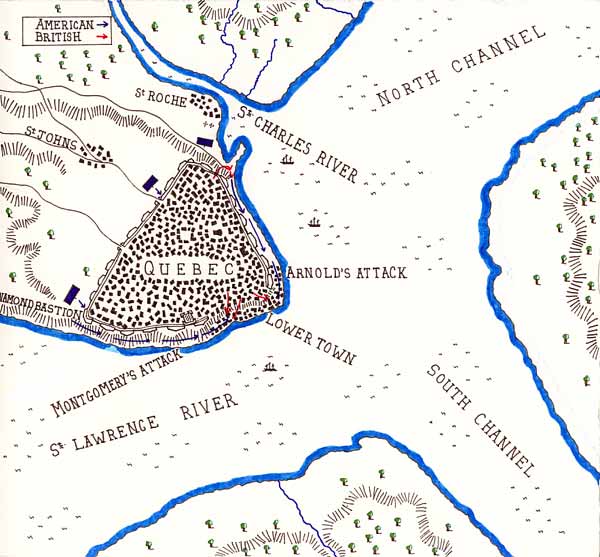
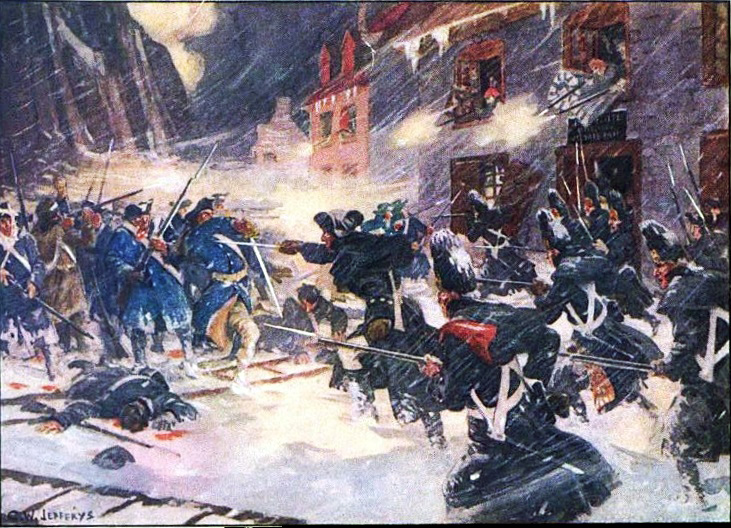
Montgomery’s column arrived on December 5, and the Americans commenced setting up his mortars and artillery outside of Quebec. The Americans finally attacked during a snowstorm in the early morning darkness of December 31, but their force numbered only 950 men. Arnold’s column came under fire as it moved toward the ramparts of Quebec, and a musket ball struck Arnold taking him out of action. Although Morgan was not the senior officer, the others insisted that he take command, having seen actual combat which they had not. Morgan later noted that this “reflected credit on their judgment.” At Morgan’s order, his riflemen rushed to the front, armed with both their Pennsylvania rifles and a spontoon for the assault while some carried ladders to storm the walls. They quickly drove a small force of British away and closed in on the walls.
Map of Battle of Quebec, 1775 (courtesy of British Battles)
Morgan ordered the men up the ladders and first one gingerly began the climb. Morgan sensed his hesitancy, pulled him down and scaled it himself, shouting, “Now boys, Follow me!” The men instantly complied, and Morgan reached the top of the wall where a volley of musketry exploded, knocking him back to the snow-covered ground. The burst burnt his hair and blackened his face; one ball grazed his cheek and another pierced his hat; but Morgan was otherwise unhurt. Stunned he laid motionless on the ground for a moment, and the attack stopped, his men thinking him dead. But he soon stirred and clambered up the ladder to the cheers of his men who followed suit. This time he stopped before reaching the top, and hurtled himself over the rampart into the midst of the enemy. He landed on a cannon and injured his back and found British bayonets levelled at him from all directions. While the British focused on Morgan, his riflemen poured over the wall and came to his rescue, driving off Morgan’s would-be impalers. Morgan kept up a close pursuit of the British who offered weak resistance to the attacking riflemen. Although Morgan had broken into Quebec, the main body of Arnold’s division failed to follow the riflemen over the wall and exploit the opportunity at hand. Morgan captured much of the lower portion of Quebec with only two companies of his riflemen. He later described the breakdown that occurred:
“Here, I was ordered to wait for General Montgomery, and a fatal order it was. It prevented me from taking the garrison, as I had already captured half of the town. The sally port through the (second) barrier was standing open; the guard had left it, and the people were running from the upper town in whole platoons, giving themselves up as prisoners to get out of the way of the confusion which might shortly ensue. I went up to the edge of the upper town with an interpreter to see what was going on, as the firing had ceased. Finding no person in arms at all, I returned and called a council of war of what few officers I had with me; for the greater part of our force had missed their way, and had not got into the town. Here I was overruled by sound judgment and good reasoning. It was said in the first place that if I went on I should break orders; in the next, that I had more prisoners than I had men; and that if I left them they might break out and retake the battery we had just captured and cut off our retreat. It was further urged that Gen. Montgomery was coming down along the shore of the St Lawrence, and would join us in a few minutes; and that we were sure of conquest if we acted with caution and prudence. To these good reasons I gave up my own original opinion, and lost the town.”
Montgomery never arrived; he had been killed in the first blast of musketry against his column, and his command broke. As time went on, the British regained their composure and pushed back against Morgan’s command. Morgan went back and brought up 200 New Englanders who joined the riflemen as they attempted to renew the attack. Now, the previously undefended point, was well manned, and daylight illuminated the paucity of Morgan’s numbers. Nevertheless, Morgan pressed them back further into the town to an interior fortification. A brave British officer led a counterattack, but Morgan personally shot him dead and disrupted the assault. Nevertheless, the time for action had passed. The British had become aware that Morgan’s was the only active American force in the city and closed in around him. In the meanwhile, additional British forces reoccupied the gates Morgan had initially taken and trapped him in the city. Morgan had no choice but to surrender his small command.
One artist’s depiction of the Battle of Quebec, 1775. Both forces are wearing blue overcoats. (courtesy of British Battles)
Morgan and the other officers enjoyed a liberal captivity with generous quarters in a seminary. The British officers visited them often and remained on friendly terms with the Americans. Morgan developed a dislike for some of his fellow officers whom he regarded as dishonest and scheming, and his fighting skills were brought to bear on at least one occasion when several men teamed up against big Dan Morgan. The imprisonment ended when the British returned the American officers on September 24, 1776, in New Jersey. Morgan returned to his wife and two daughters at his home outside of Battletown or Berryville, where he awaited his proper exchange. While there, he named his home “Soldier’s Rest,” as he recuperated from the trials of the taxing expedition to Quebec. The war was still young, and the Continental Army would soon be calling upon his services again. A special command of riflemen was being organized and Morgan would be its commander.
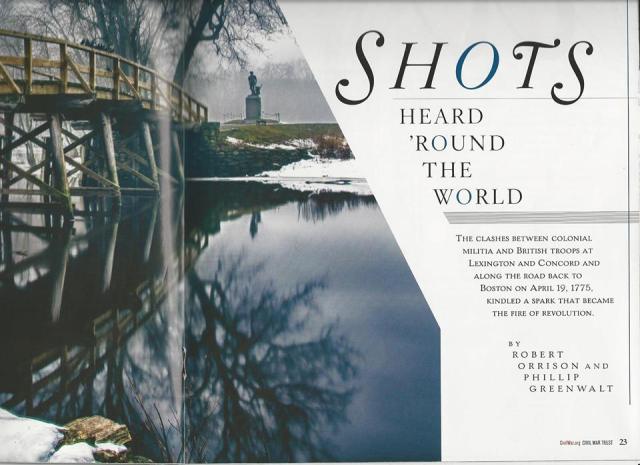
Recently Emerging Revolutionary War Era authors Phillip Greenwalt and Rob Orrison were featured in Hallowed Ground, the Civil War Trust’s quarterly magazine. Their article “Shots Heard Around the World” focuses on the events surrounding Lexington and Concord in 1775. As CWT President Lighthizer writes “the journey towards the stillness at Appomattox began with a shot heard ’round the world at Concord.”
As many of you know, the Civil War Trust has launched a new initiative called “Campaign 1776”, to preserve American battlefields that relate to the American Revolution and the War of 1812. Part of that initiative is funding the archaeology and preservation of land around the area known as “Parker’s Revenge.” Here, on the afternoon of April 19, 1775, Minutemen met the returning British column on its way from Concord to Boston. The Minutemen under Capt. John Parker, severely bloodied the British, in a “revenge” from their earlier meeting on the Lexington Green.
Also in the same issue of Hallowed Ground, ERW contributors Drew and Kate Gruber write about the how the American Revolution was on the minds of those who fought in the Civil War. Their article “So Doth History Repeat Itself” covers the “ancestral connection” that both sides had to the patriots of the revolution.
Be sure to check out Hallowed Ground and if you are not already a member of the Civil War Trust, be sure to join today. Their work in preserving American battlefields is unparalleled. We thank the staff of Hallowed Ground for including us in their latest issue. Look for more exciting ventures from Emerging Revolutionary War Era soon!










 Debuting yesterday, the Campaign 1776, an initiative by the Civil War Trust, released an animated map that covers the “entirety of the American Revolution,” according to Civil War Trust Communications Manager Meg Martin.


 Emerging Revolutionary War Era