Last year I came across Dr. John Knight’s account of the torture and execution of Colonel William Crawford by members of the Delaware Indian tribe in 1782. It was a vicious execution, but not unheard of in the wars on the American frontier, where violence and brutality from both sides were common.
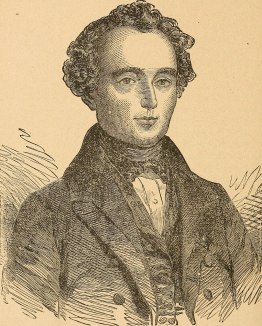
Crawford at about 40, twenty years before his execution (Wikimedia Commons)
Born in 1722, Crawford was a long-time business partner of George Washington, particularly in the acquisition of land in the Ohio River valley. A veteran of frontier conflicts, during the Revolution he had served as the Lieutenant Colonel of the 5th Virginia Regiment, commanded the 7th Virginia in the east, and then returned to the Pittsburgh area to raise the 13th Virginia. Sidelined during the war’s last years, he commanded local Pennsylvania militia and was largely retired by 1782. For years, settlers in the Ohio Valley had agitated for punitive raid against the Ohio Tribes along the Sandusky River in today’s northwestern Ohio. Their goal was to retaliate for Indian raids across the Ohio and spoil future raids. By the spring of 1782, they could not be restrained. After the militia massacred defenseless Christian Indians at Gnadenhutten in March, Brigadier General William Irvine, the Continental Commander at Pittsburgh, arranged for Colonel Crawford to lead the inevitable militia expedition, likely in hopes that Crawford could prevent a repeat. (Crawford had taken no part in the Gnadenhutten Massacre).
Love brought Dr. Samuel Prescott, a practicing physician, to the town of Lexington on the night of April 18, 1775. The young doctor was courting Ms. Lydia Mulliken, when the alarm of the British soldiers marching from Boston went out to the local militia. Lydia’s brother was one of those called to gather.
Love. That emotion also drew Dr. Prescott back toward his hometown of Concord—this time to alert friends, neighbors, and family members of the urgent news of the evening. En route, Dr. Prescott along with Paul Revere and William Dawes, alerted the countryside of the moving British troops. After being vetted and vouchsafed as a true friend of liberty, Dr. Prescott rode posthaste to his hometown, where his word carried greater weight.
A artist’s interpretation of Paul Revere’s (or maybe William Dawes or Dr. Samuel Prescott)’s ride to warn the Massachusetts countryside. (courtesy of VFW)
As British General Thomas Gage and his American Whig (or Patriot) antagonists squared off in Boston and the surrounding towns, information gathering became the key to success. Both sides had created networks of spies, but the advantage was clearly in favor of the Whigs. During the winter 1774-1775, groups such as the Sons of Liberty had established a complex spy network within Boston comprised of a system of riders that spread information and “alarms’ quickly. The Committee of Safety and the Massachusetts Provincial Congress relied on this network to stay informed of what was going on in Boston and the British intentions. Continue reading “Two Riders….Gage Gathers Information”→
“the Country was an amazing strong one; full of Hills, Woods, stone Walls, & c., which the Rebels did not fail to take advantage of, for they were all lined with People who kept an incessant fire upon us…”
From the diary of Lieutenant Frederick Mackenzie who was part of the 23rd Regiment–the Royal Welch Fusiliers that survived the ordeal of April 19, 1775. He would keep a diary until the early 1790’s and chronicled his experiences in the American Revolutionary War. His account on April 19, of the retreat from Concord is most descriptive. The British did not just take the brunt of the firing as the marched hurriedly back toward Boston and safety, but;
“as we did too upon them, but not with the same advantage, as they were so concealed there was hardly any seeing them: in this way we marched between 9 and 10 miles, their numbers increasing from all parts…”
The column was led by Lieutenant Colonel Francis Smith and had been tasked by General Thomas Gage, British military leader in North America, to root out the military supplies being stored in Concord by the colonials. The mission, albeit supposedly secretive, did not remain so for long, and the colonials got word out to the countryside. After initial firing at Lexington Green and then at the North Bridge in Concord, the British had to march back through the countryside, facing arriving militia and minute men.
“while ours was reducing by deaths, wounds, and fatigue; and we were totally surrounded with such an incessant fire as it is impossible to conceive; our ammunition was likewise near expended.”
Modern-day view along Battle Road, the route the British column retreated back toward Boston on (author collection)
Luckily, for Mackenzie and the other struggling British officers and rank-and-file, on a rise in the ground, outside the town of Menotomy, was a relief column, ready to provide a few moments’ respite.
With British soldiers pouring into the fort, Colonel Ledyard ordered a ceasefire, and prepared to surrender Fort Griswold to the victorious British. However, the British disregarded the ceasefire and continuing pouring fire into the American garrison, killing or wounding nearly all of the fort’s defenders. “I believe there was not less than five or six hundred men of the enemy on the parade in the fort,” claimed American soldier Rufus Avery. “They killed and wounded nearly every man in the fort as quick as they could.”
Maj. Stephen Bromfield, the ranking British officer after Montgomery fell, called out, “Who commands this fort?” Ledyard stepped forward and responded, “I did, sir, but you do now.” Another American, Jonathan Rathbun, watched Bromfield run Ledyard through the heart and lungs with Ledyard’s own sword:
“…the wretch who murdered him [Ledyard], exclaimed, as he came near, “Who commands this fort?” Ledyard handsomely replied, “I did, but you do now,” at the same
moment handing him his sword, which the unfeeling villain buried in his breast! Oh, the
hellish spite and madness of a man that will murder a reasonable and noble-hearted officer, in the act of submitting and surrendering!”
Emerging Revolutionary War is honored to welcome back historian Katie Turner Getty. Biography of Ms. Getty is below the post.
On April 19, 1775, the placid farm of fifty-eight-year-old Jason Russell of Menotomy erupted into carnage when he, along with eleven other Americans, were shot and bayonetted by British soldiers in his home and yard.
Jason Russell House (author collection)
As American militia and minutemen poured in from surrounding towns, the British—fatigued yet furious—found themselves under increasingly heavy musket fire. As they pulled back from Concord and retreated to Boston, the main column passed near Russell’s house which stood near the battle road. Russell had just returned home after secreting his family at a nearby farm. Unbeknownst to him, American minutemen and British soldiers would soon converge upon his property and a desperate battle would occur within the walls of his own house.
Earlier that day, twenty-six-year-old Gideon Foster had set off from Danvers with a company of minutemen. The men had set a scorching pace and made the sixteen mile journey to Menotomy in four hours, running half the way.[1] Upon arriving, Foster’s men joined others from Lynn, Beverly, Salem, Dedham, and Needham.[2] Some took cover behind trees and others in Russell’s yard, where a breastwork was constructed out of shingles.
The Fight at the Jason Russell House, bicentennial painting by Ruth Linnell Berry (1974). Appearing with permission from the Arlington Historical Society.
The men focused their attention on the approaching main column of British troops and fired upon them. Capt. Israel Hutchinson, a seasoned French and Indian War veteran, warned that flank-guards would likely be traversing the fields alongside the road[3], helping the main column to pass unmolested. But before the men could reconsider their position or move to a more defensible location, the flank-guard was upon them, trapping the men against the main column.
In a frantic search for cover, many of the men bolted into Russell’s house. Jason Russell, too, attempted to dash inside but was slowed by his lame leg.[4] He was shot twice and fell on his doorstep. The soldiers tore inside the house in hot pursuit of the men, bayonetting Jason Russell’s body eleven times as they passed.
Once inside the house, the Americans had no choice but to fight for their lives in rooms with no egress, in very close quarters, against raging, bayonet-wielding soldiers. It was a bloodbath. With two rooms on the bottom floor, a narrow stairwell, and two rooms on the top floor, Jason Russell’s house offered very little refuge. Soldiers outside the house hailed musket fire into the windows.
Sign depicting what happened at the Jason Russell House on April 19, 1775
With nowhere else to go, several men rushed into the cellar. What at first would seem to be an ill-advised hiding spot turned out to be the only sanctuary that Russell’s home could offer. Taking position near the bottom of the stairs, the men raised their muskets and shot dead the first soldier who descended.[5] Any other soldiers who attempted to follow were met with blazing musket fire. Holes left by musket balls are still visible in the stairwell, attesting to the firestorm.
Soon, the house grew quiet. All of the men who had sought safety in the house had been killed, with the exception of the men who took refuge in the cellar. The British ransacked the house then left.[6]
In 1835, sixty years after the bloodbath at Russell’s house, a memorial was erected in Danvers to commemorate the townsmen who lost their lives in Menotomy that day. Danvers lost the second highest number of men, after Lexington[7], and all of them at Jason Russell’s house. Foster, the commander of the company of minutemen who had ran halfway to Menotomy, was by then the last surviving Danvers veteran of the war. Aged eighty-six, he addressed the crowd assembled for the dedication of the monument and recounted the events of April 19th:
On that morning, more than one hundred of my townsmen hastened to the field of battle…ready to offer their lives on the altar of their liberties. Seven of those who thus started in the prime of life and vigor of manhood, ere that day’s sun descended in the west, were numbered with the dead.[8]
Foster called the dedication of the memorial “One of the happiest days and most pleasing events of my life.”[9]
In total, twelve Americans were killed at Jason Russell’s house. Jason’s wife, Elizabeth, returned home to find her husband dead. He and the other fallen Americans, their bodies riddled with musket balls and slashed by bayonets, had been laid out on the floor in the kitchen, the blood from their wounds pooling around them. Elizabeth later said that “the blood in the room was almost ankle deep”.[10]
Musket ball damage to the staircase of the Russell House
*Biography: Katie Turner Getty is a lawyer, history enthusiast, and lifelong resident of Boston. She holds an A.A. from Bunker Hill Community College in Charlestown, Massachusetts, a B.A. in History from Wellesley College, and a J.D. from New England Law Boston. She can often be found exploring historic sites both on and off the Freedom Trail.
Emerging Revolutionary War is pleased to welcome back historian Bert Dunkerly, who is the co-author (with Irene B. Boland) of the upcoming book; “Eutaw Springs; The Final Battle of the American Revolution’s Southern Campaign” slated to be released this month.
Part One
The weather was warm and the men had been marching for days, but their morale was high. They had been through a lot recently: caught off guard and defeated at Hobkirk’s Hill, a month of grueling siege work – and for naught, at Ninety Six. Not to mention the engagements that many of them had fought in previously: Kings Mountain, Cowpens, Guilford Courthouse, and dozens of smaller battles.
Yet the army that General Nathanael Greene led forward on the morning of September 8, 1781, was confident and ready to come to grips with its adversary. Everyone from the private in the ranks on up to the commanding general knew that ahead lay an opportunity.
Battles in the Revolution were, in fact, rare opportunities for commanders. Engagements were the short, pulse-pounding events that broke up the monotony of marching and maneuvering. An army spent most of its time in garrison, in camp, or on the road. In battle the infrequent opportunity came to crush an opponent and influence the outcome of a campaign, or the war. These chances were few and far between.
“Eutaw Springs” by Benson Lossing
Both commanders at Eutaw Springs appreciated this fact. General Nathanael Greene’s forces had experienced a series of close calls at Guilford Courthouse, Ninety Six, and Hobkirk’s Hill. The American army fought well in all of these engagements, save Hobkirk’s Hill, yet they met defeat in every one. Greene hoped Eutaw Springs would put the finishing touches on his South Carolina campaign, and end it with a clear cut victory.[i]
Eutaw Springs was a rare chance for Greene to pick the time and place of engagement, array his forces to his choosing, and initiate the battle, and control its \tempo. It was the only set engagement of the campaign, other than Guilford Courthouse, in which Greene chose the ground and initiated the battle. Commanders do not often have this luxury, and Greene earnestly hoped to make the most of it. Continue reading “Eutaw Springs”→
A special thanks to Stacey Fraser at the Lexington Historical Society for the update on the new exhibit described below.
If one asked what a buzzword for 21st century communication would be today, what would be your answer?
Text? Tweet? Snap?
(courtesy of Lexington Historical Society)
What if the follow up question was that some of the same buzzwords of the 21st century could describe the 18th century? Thanks to the Lexington Historical Society at Buckman Tavern, you can see the similarities yourself.
Opening on April 8th, the interactive exhibit is part of the admission ticket to the tavern. Titled #Alarmed! 18th Century Social Media “explores how news went viral 250 years ago” in addition to letting “visitors imagine how colonials might have made use of modern media tools to kick start a revolution. Continue reading “#Alarmed”→
The town meeting held on the night of December 16, 1773 at the Old South Meeting House was no ordinary meeting. Boston was well known for its public meetings, but this one was different. Frequently city leaders called town meetings to discuss important political, economic and social decisions facing the city or colony. The town meeting was a foundation of the political process for Massachusetts and much of the New England colonies. Royal authorities had watched these meetings more closely since the 1760s during the opposition to the Stamp Act. Colonial Whigs (anti Royal leaders) had used these meetings to protest British policies that they saw as threats to their liberties.
This town meeting was a follow up assembly to previous meetings held in November originally called for Faneuil Hall. The large turnout, however, required the crowd to move to the more spacious Old South Meeting House. Nearly 5,000 people attended the meeting to discuss the city and colony’s response to a new tax on tea and more directly, the ships in the harbor that held tea from the East India Company. The colonial Whigs did not want the cargo unloaded but the captain of the ships could not leave the harbor with the tea unless they had approval from the Governor. Governor Thomas Hutchinson did not believe he had the authority to allow the ships to leave without unloading the tea. Adding to that decision, Hutchinson was more than frustrated with those who had rejected Royal authority over the years. Thus, a legal and theoretical standoff ensued. That night, the people of Boston took the matter into their own hands.
On the surface, the Tea Act of 1773 was rooted in helping pay off the debt of the British Empire, caused in part by fighting the Seven Year War (French and Indian War) with France. Also, the revenue raised would pay British officials in the colonies, thus making them more loyal to Parliament and the British Crown. The Tea Act was one of many Parliamentary laws or “Acts” passed to raise revenue in the colonies. More importantly, the underlying purpose was for Parliament to display their authority to pass laws that were binding on the British colonies. Due to colonial opposition and resistance, many of these acts were repealed. However, the Tea Act, passed in 1773, sparked an immediate response throughout the colonies.
The Tea Act was also seen as a mode for saving a British held company, the British East India Company. Before 1773, the company had to sell its tea in London and was subject to duties. The company had collected large quantities of tea in warehouses in London and was looking for a way to disperse the tea at a bargain. The Tea Act allowed the company to sell directly to American ports without paying the duties. This also forced American buyers to only purchase their tea from the East India Company, which was subject to a tax. The good news was the price of tea was reduced because the Company no longer had to pay the duties in London. Colonists resisted the notion that Parliament could force them to buy tea from the East Indian Company (many made a good living off of smuggled tea sales) and that they were required to pay a tax on the tea.
The popular notion, “taxation without representation,” had been around since the 1750’s and became well-known in 1764 in response to the highly unpopular Sugar Act and Stamp Act. Colonial Whigs believed they had no representation in Parliament because they did not elect representatives to Parliament. British political theory and law believed in the model of “virtual representation” which meant the colonists did not vote for individual members of Parliament though that body, as a whole acted in the best interest for all British subjects. Colonial leaders, who for decades were allowed to vote for their representative bodies in their respective colony, did not accept this theory. The opposing views on representation began to open opposition to British authority over colonial matters.
Though passed in May 1773, the Tea Act did not impact the people in the colonies until fall. Seven ships of tea were sent to four American ports, Boston, New York, Philadelphia and Charleston. Meanwhile, colonial Whig leaders began to organize a resistance to the East India Tea that was en route. In fact, in every other city but Boston the tea was refused and forced to either be returned to England or confiscated by local officials. It was in Boston that a determined governor and history of Royal opposition led to a signal event in American history.
On November28th, the ship Dartmouth arrived loaded with tea. British law gave ships with imports twenty days to pay the duties or the local custom officials could confiscate the cargo. Hutchinson, when petitioned, would not allow the ship to leave the port without paying the duty. His sons, who acted as the Tea Consignees (authorized to receive the tea and see to its distribution) for Boston, also refused to back down and resign their positions, which happened in other American ports. Soon two more ships arrived in the harbor with the unwanted tea. Unable to return the tea to England and without being able to unload the tea due to the threats of local groups such as the Sons of Liberty, the captains of the ships were in a tight and dangerous spot.
On the night of December 17th, one of the largest public meetings in Boston convened at the Old South Meeting House. Speeches by Sam Adams, John Hancock, Joseph Warren and other Boston Whig leaders called for the return of the tea to England. Later in the evening, word came that a last minute plea to Governor Hutchinson to let the ships return was refused. Sam Adams announced publicly, “This meeting can do nothing further to save the country.”
The events that happened next have been debated since 1773, soon men arrived outside the Meeting House disguised as Mohawk Indians. Whether or not these men were signaled to move towards the ships with tea is unknown. As the “Mohawks” marched down Milk Street towards Griffin’s Wharf where the three ships of tea were docked, the thousands gathered inside the Old South Meetinghouse began to pour out of the building. Chants of “Boston a Teapot Tonight” and “Hurrah for Griffin’s Wharf” were reportedly heard. Some people followed the “Mohawks”, others continued to protest in the streets, while still others headed home believing that a confrontation was about to take place.
Many details remain unknown about who exactly the “Mohawks” were that marched on Griffin’s Wharf that night. The men used lamp soot and red ochre to disguise their faces and carried a wide assortment of weapons. As they made their way to the wharf, they yelled and “whooped” as Indians in a war party. If they had coordinated the timing with leaders in the Old South Meetinghouse, it is still unknown. The identities of most of these men either were never recorded or are lost to history; that is how tight their veil of secrecy was coupled with their sophisticated organization. As they made their way to the ships, the Whig leaders inside the Old South Meetinghouse stayed behind and were never directly part of what happened next.
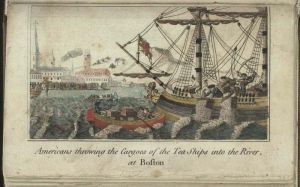
The men, with a crowd behind them, approached the wharf. There they divided into three different groups, one for each of the ships, Dartmouth, Beaver and Eleanor. Being a port city, most of the men knew where to find the cargo they were looking for and how to operate on a ship. Respectively, most of the other cargo and private property on the ships were not touched. They were only after the tea. Hauling the chests to the deck, they were broken open and dumped into Boston Harbor. Some of the men watched to make sure no one was trying to steal any of the tea that they were dumping. The group of approximately 150 men worked quickly as the crowd of spectators grew.
The American Revolution did not just “happen.” It was the culmination of various events and acts that individually did not guarantee separation. As a collective, one can retroactively see how the accumulation of these events led to the inevitable. The Boston Tea Party was one of these events. This time it was different; this time Great Britain would respond in a way it never had before. The Tea Party gave the tinder box of revolution in America more fuel and many believed a small incident would cause a spark leading to open war between colonies and mother country. The spark would come on April 19, 1775 in the Massachusetts countryside.





 The town meeting held on the night of December 16, 1773 at the Old South Meeting House was no ordinary meeting. Boston was well known for its public meetings, but this one was different. Frequently city leaders called town meetings to discuss important political, economic and social decisions facing the city or colony. The town meeting was a foundation of the political process for Massachusetts and much of the New England colonies. Royal authorities had watched these meetings more closely since the 1760s during the opposition to the Stamp Act. Colonial Whigs (anti Royal leaders) had used these meetings to protest British policies that they saw as threats to their liberties.
 India Company. Before 1773, the company had to sell its tea in London and was subject to duties. The company had collected large quantities of tea in warehouses in London and was looking for a way to disperse the tea at a bargain. The Tea Act allowed the company to sell directly to American ports without paying the duties. This also forced American buyers to only purchase their tea from the East India Company, which was subject to a tax. The good news was the price of tea was reduced because the Company no longer had to pay the duties in London. Colonists resisted the notion that Parliament could force them to buy tea from the East Indian Company (many made a good living off of smuggled tea sales) and that they were required to pay a tax on the tea.
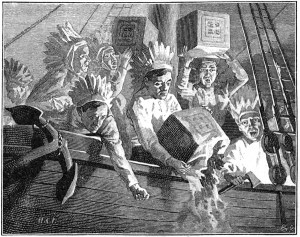 Many details remain unknown about who exactly the “Mohawks” were that marched on Griffin’s Wharf that night. The men used lamp soot and red ochre to disguise their faces and carried a wide assortment of weapons. As they made their way to the wharf, they yelled and “whooped” as Indians in a war party. If they had coordinated the timing with leaders in the Old South Meetinghouse, it is still unknown. The identities of most of these men either were never recorded or are lost to history; that is how tight their veil of secrecy was coupled with their sophisticated organization. As they made their way to the ships, the Whig leaders inside the Old South Meetinghouse stayed behind and were never directly part of what happened next.
 Emerging Revolutionary War Era