Part of an ongoing series about the Continental Army in Morristown, New Jersey. To read previous posts, click here.
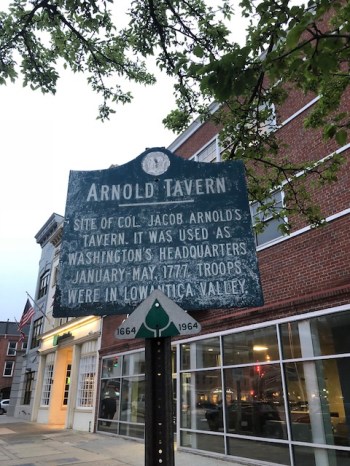
All that remains is a historical marker, on the side of North Park Place across the street from Morristown Green. For a few months, between January 1777 and May 1777, in this location, the headquarters of the Continental Army was located. Within that headquarters, obviously, was George Washington.
Although no specific date of construction exists, it is believed that Arnold’s Tavern was built by Samuel Arnold between 1735 and 1750. By the time of the American Revolution owned by the son, Colonel Jacob Arnold. The structure was three stories high, with a wide hallway that bisected the building, a front and back parlor, barroom, dining room, and kitchen. Continue reading “Uncovering the Continental Army in Morristown”→
Emerging Revolutionary War welcomes back guest historian Michael Aubrecht
John Trumbull
John Trumbull’s paintings represent some of the most familiar depictions from the time of the American Revolution. Trumbull was a graduate of Harvard University and the gifted son of the Governor of Connecticut. As a child, Trumbull showed a remarkable talent for an attention to detail. This aptitude set his drawings apart from his contemporaries. Trumbull traveled to London in 1784 to study painting under the master Benjamin West. It was then that he started painting some of his most notable pieces. There he honed his expertise for realistic painting. A year later later Trumbull traveled to the City of Paris to do commissioned artworks. He later did portraits of George Washington, John Adams, Alexander Hamilton and Thomas Jefferson. In 1816, he was selected as the president of the American Academy of the Fine Arts where he would serve for 20 years. Emphasizing classic traditions Trumbull attempted to teach the skills he had acquired while overseas. Following his death in 1843 at the age of 87, Trumbull was buried beneath the Art Gallery at Yale University which he had designed. In 1867, his collection of artworks were displayed at the Street Hall building on the same grounds. He and his wife’s remains were later re-interred and buried on the grounds of that building. Trumbull’s approach to painting has been studied by art students around the world. Today Trumbull’s paintings remain some of the most cherished ever to be painted by an American artist. Continue reading “The Brush of John Trumbull”→
When writing a book, one of the most important initial aspects is picking a title. The author needs one that is expressive, attracts attention, but has some overall tie-in that provides a fitting capture of the essence of the book.
One of the advantages of writing history is the use of quotes. Let the participants, combatants, or witnesses of the event provide the context for a title. When one resonates, go with it!
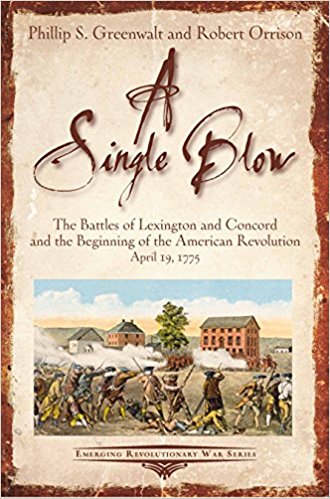
With the recent publication, the co-author, Robert Orrison and myself bounced various potential titles off each other. Then we had a list of our favorites included in the initial information sheet sent to Ted Savas, of Savas Beatie, LLC, the publisher. Yet, one continued to stand out, as it was written in a diary by a British junior officer slightly more than a month before the Battles of Lexington and Concord.
The entire inscription is below:
“It is certain both sides were ripe for it, and a single blow would have occasioned the commencement of hostilities.” —Lieutenant Frederick Mackenzie, Royal Welch Fusiliers, March 6, 1775.
Mackenzie’s uncanny foresight predicted the exact outcome of the fighting that erupted on April 19, 1775. With casualties suffered by both sides, the war of words and near-misses became a war of shot and shell.
Hostilities had commenced and we had a title. A Single Blow: The Battles of Lexington and Concord and the The Beginning of the American Revolution.
Love brought Dr. Samuel Prescott, a practicing physician, to the town of Lexington on the night of April 18, 1775. The young doctor was courting Ms. Lydia Mulliken, when the alarm of the British soldiers marching from Boston went out to the local militia. Lydia’s brother was one of those called to gather.
Love. That emotion also drew Dr. Prescott back toward his hometown of Concord—this time to alert friends, neighbors, and family members of the urgent news of the evening. En route, Dr. Prescott along with Paul Revere and William Dawes, alerted the countryside of the moving British troops. After being vetted and vouchsafed as a true friend of liberty, Dr. Prescott rode posthaste to his hometown, where his word carried greater weight.
A artist’s interpretation of Paul Revere’s (or maybe William Dawes or Dr. Samuel Prescott)’s ride to warn the Massachusetts countryside. (courtesy of VFW)
“the Country was an amazing strong one; full of Hills, Woods, stone Walls, & c., which the Rebels did not fail to take advantage of, for they were all lined with People who kept an incessant fire upon us…”
From the diary of Lieutenant Frederick Mackenzie who was part of the 23rd Regiment–the Royal Welch Fusiliers that survived the ordeal of April 19, 1775. He would keep a diary until the early 1790’s and chronicled his experiences in the American Revolutionary War. His account on April 19, of the retreat from Concord is most descriptive. The British did not just take the brunt of the firing as the marched hurriedly back toward Boston and safety, but;
“as we did too upon them, but not with the same advantage, as they were so concealed there was hardly any seeing them: in this way we marched between 9 and 10 miles, their numbers increasing from all parts…”
The column was led by Lieutenant Colonel Francis Smith and had been tasked by General Thomas Gage, British military leader in North America, to root out the military supplies being stored in Concord by the colonials. The mission, albeit supposedly secretive, did not remain so for long, and the colonials got word out to the countryside. After initial firing at Lexington Green and then at the North Bridge in Concord, the British had to march back through the countryside, facing arriving militia and minute men.
“while ours was reducing by deaths, wounds, and fatigue; and we were totally surrounded with such an incessant fire as it is impossible to conceive; our ammunition was likewise near expended.”
Modern-day view along Battle Road, the route the British column retreated back toward Boston on (author collection)
Luckily, for Mackenzie and the other struggling British officers and rank-and-file, on a rise in the ground, outside the town of Menotomy, was a relief column, ready to provide a few moments’ respite.
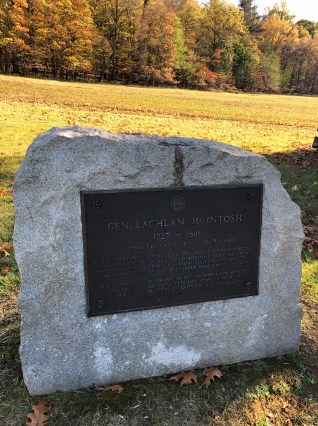
On a recent trip to Valley Forge National Historical Park I came across the monument to featured below, of a general that did not initially ring a bell in my memory. So I did a little investigating. The first name was intriguing. His story even more so. Especially how he came to spend the winter at Valley Forge.
Lachlan McIntosh Monument, Valley Forge National Historical Park (author collection)
Born near Raits, Badenoch, Scotland on March 17, 1725 and at the age 11, Lachlan, along with his family and approximately 100 other Scottish immigrants, landed in Georgia where they founded the town of New Iverness. Out of all the cruelties that could visit a family eking out a future on the frontier, the calamity that claimed Lacklan’s younger brother would have been far down the list. While swimming in the Altamaha River in 1737, Lewis McIntosh was killed by an American alligator. Continue reading “Lachlan McIntosh”→
A few years ago I had the opportunity to visit Yorktown National Battlefield. This evening I was scrolling through my cache of American Revolution photos on an external hard drive, when I came across the picture below.
A simple monument to three luminaries of the American Revolution. Three brilliant young men, one of which, John Laurens, would fall in one of the last small engagements of the war.
Could you imagine the conversation between the three that fateful October evening of 1781?
With autumn just around the corner, cooler weather on the horizon, and the holidays quickly approaching. Some stores in the local area have Halloween, Thanksgiving, and Christmas decorations all for sale currently, Emerging Revolutionary War wanted to bring your attention to a few different Revolutionary War Era happenings to mark on your calendars. Continue reading “Upcoming Lectures, Talks, and/or Events”→
With the start of the work week, some folks loath logging onto the computer to check work email, news, and updates. If you are one of those folks, keep reading, as the news we are about to share is positive and exciting.
This past Thursday, July 27, 2017, Campaign 1776, the initiative of the Civil War Trust, announced the preservation of 184 acres at two sites in New York state. One tract of land was pivotal to the United States success in the Saratoga Campaign in 1777 and where a U.S. fleet was saved during the War of 1812.
The Battle of Fort Ann, fought on July 8, 1777 was a four-hour affair and was influential in the course of the larger Saratoga Campaign as it affected the British’s attempt to secure the strategically important Hudson River Valley. The delay around Fort Ann and every delay on the route of General John Burgoyne’s push south aided the Patriot cause tremendously.
Fast-forward to the War of 1812 and Sackets Harbor, New York provided as safe-haven for the United States fleet operating on the Great Lakes. Horse Island and the harbor that gained prominence during the May 29, 1813 offensive by the British, is where 24 acres were saved by Campaign 1776. The battlefield, which was one of 19 sites that benefited from $7.2 million in grants announced earlier in July and the first War of 1812 site anywhere in the country to be awarded money since the National Park Service expanded the grant opportunities in 2014.
Not just one success, but two for this Monday morning! For the full report, courtesy of our friends at Civil War Trust, click here.
Happen to be around Boston this weekend? Or live within traveling distance? Check out the special event happening this weekend from Sunday, July 23rd through Monday, July 24th at the U.S.S. Constitution Museum and Charlestown Navy Yard.
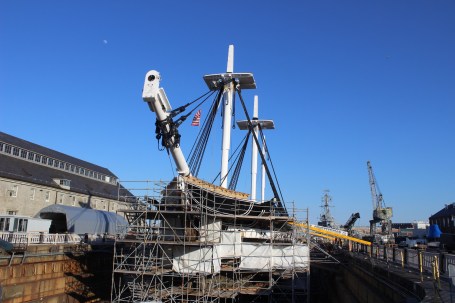
The U.S.S. Constitution, the oldest commissioned naval vessel still afloat will set sail again. Launched in 1797 and named by President George Washington, the vessel is a wooden-hulled, three-masted heavy frigate. She has been dry-docked since May 18, 2015 but will return to the water on July 23rd.
“Old Ironsides” the U.S.S. Constitution, photo taken April 2016 (author collection)
The event, co-sponsored with the National Parks of Boston will have a full-plate of free, family-fun events starting at 4:00 p.m. on Sunday and continuing into the morning hours of Monday.
For a full-listing of these events, including information about the museum, and answers to a few frequently answered questions, click here.
For those that cannot make it live to the re-launch, the event will be live on Facebook video streams at 4:00 p.m. and 6:00 p.m. along with live video streams throughout the night of the major events. Check out the Facebook site for the museum by clicking here.






 This past Thursday, July 27, 2017, Campaign 1776, the initiative of the Civil War Trust, announced the preservation of 184 acres at two sites in New York state. One tract of land was pivotal to the United States success in the Saratoga Campaign in 1777 and where a U.S. fleet was saved during the War of 1812.