Emerging Revolutionary War welcomes back guest historian Drew Palmer. He is the founder of Revolutionary Maryland; click here to learn more about that blog.
(Vallejo Image Galleries)
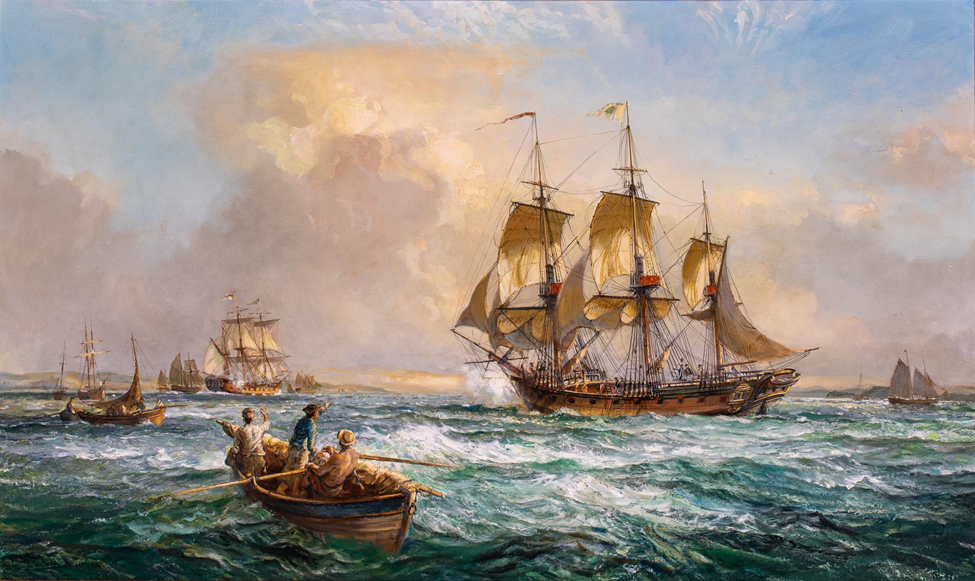
In the early evening of March 5, 1776, two armed boats left Annapolis to patrol the Chesapeake Bay. Captain John Pitt and Joseph Middleton were patrolling to prevent any British ships nearby from entering Maryland’s waters. As they patrolled, they discovered an alarming sight: three British warships heading directly towards Annapolis. Middleton and Pitt rushed off to the Maryland Council of Safety’s chambers in Annapolis to report the startling news.1 In the coming days, Maryland was tested for the first time in the growing Revolutionary conflict.
The American rebellion had become a full-scale war by the spring of 1776. In early March, the siege of British-held Boston was about to end. Hundreds of miles south in Philadelphia, the Declaration of Independence was only four months away. In Maryland, politicians worked hard to maintain Maryland’s isolation from the worst of the conflict. In Virginia, a raiding war had already begun. Only two months before, the town of Norfolk, Virginia, was bombarded, leading to the destruction of the town. Along with Norfolk’s destruction, British attacks and raids were carried out throughout the lower Chesapeake Bay, along with a blockade. 2
Participating in British operations in the lower Chesapeake was Captain Mathew Squire of the British Royal Navy. For several months, Squire’s vessel, the Otter, served as the headquarters of the exiled Virginia Governor, Lord Dunmore. From the Otter, British attacks and raids were launched on Patriot strongholds in the lower Chesapeake. By March, Squire had gained a reputation as a competent officer and ruthless raider of American shipping.3 Squire was heavily involved in the bombardment of Norfolk and an attempted attack on Hampton, Virginia. Though Squire’s area of operation had been centered on the lower Chesapeake, new intelligence pulled him northward into Maryland.
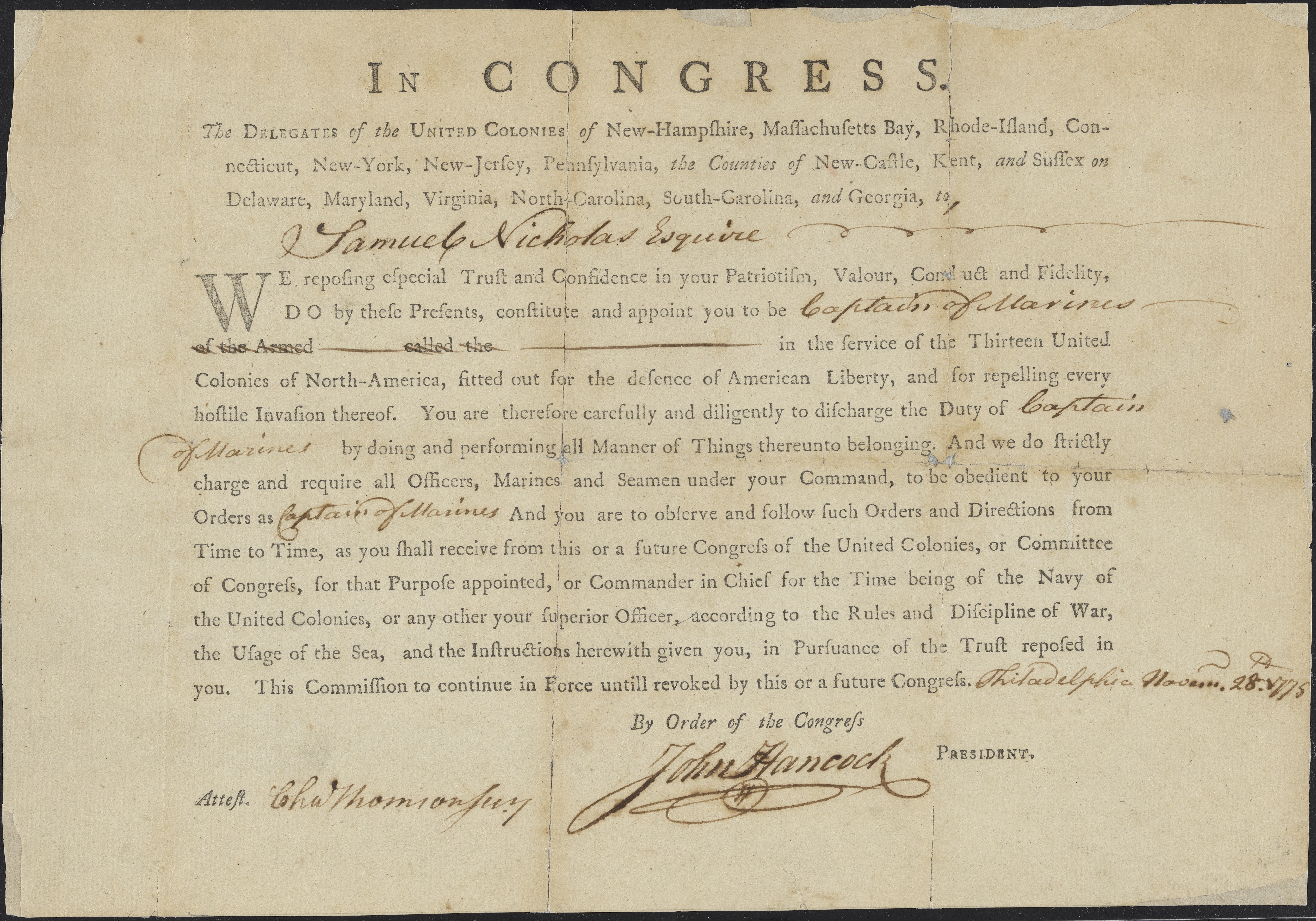
The Commission of Captain Samuel Nicholas, the first American Marine. (USMC)
Today marks the 250th birthday of the Marine Corps. November 10, 1775 was a milestone in the creation of American naval power, but the birthday story is a little more complicated.
The Continental Congress resolved to create a navy under its auspices on October 13, 1775, but much work remained to build American naval power to a point where it might serve a strategic purpose. Individual colonies had already begun creating naval forces and George Washington had leased ships under the army’s authority. Thus, the resolution served as more of milestone on a long road, rather than a fresh beginning.
On October 30, the Continental Congress considered the reports of its naval committee and confirmed recommendations for two vessels of 14 and 10 guns. Moreover, it resolved to add two more ships to its burgeoning navy, one of 20 guns and one carrying up to 36 guns. It also added four new members to the naval committee, bringing it to a total of seven. Stephen Hopkins (RI), Joseph Hewes (NC), Richard Henry Lee (VA), and John Adams (MA) joined John Langdon (NH), Silas Deane (CT), and Christopher Gadsden (SC).[1] On November 2, Congress gave the naval committee authority to call on the treasury for up to $100,000 to acquire a navy and delegated to the committee the authority to recruit officers and seamen, offering them prize money in the amount of one-half the value of all warships and one-third the value of transports made prizes.[2] It also took up a petition from a Committee of Safety in Passamaquoddy, Nova Scotia to join the association represented by the Continental Congress. Naturally, Congress appointed a committee—Silas Deane, John Jay, Stephen Hopkins, John Langdon, and John Adams to consider the matter. The naval expansion and Passamaquoddy petition sparked a new round of thinking about American naval power.
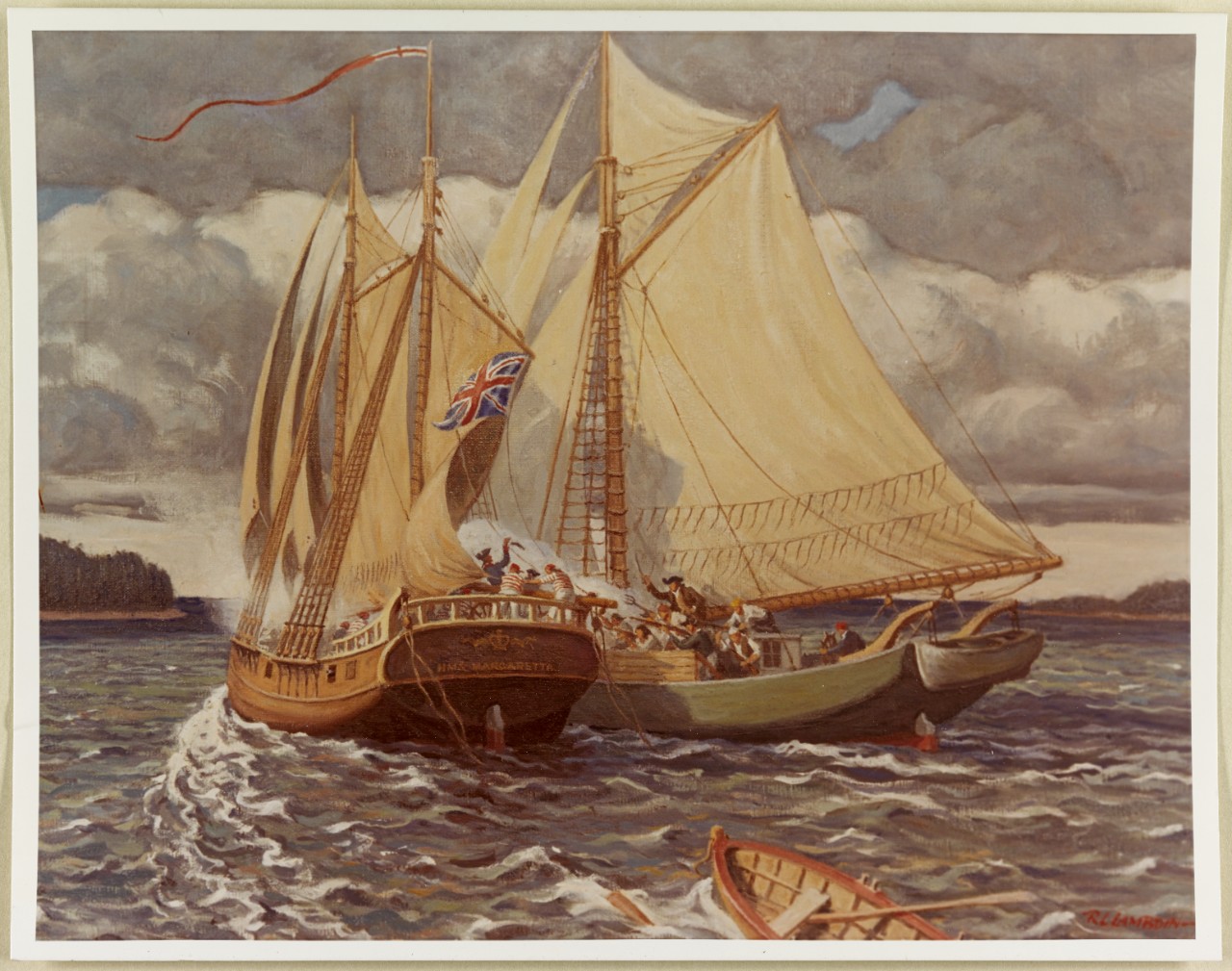
Unity vs. Margaretta, 12 June 1775 by Robert Lambdin (Naval History and Heritage Command). Margaretta was a Royal Navy vessel captured off Machias, then part of Massachusetts but now in Maine. The image illustrates the relatively small sizes of vessels involved in creating the early American navy.
During the first six months of the American rebellion, the colonies inched toward some means of dealing with Britain’s naval superiority. Over the summer the Americans had already waged a sort of whaleboat war among the estuaries and islands around Boston, mainly to deprive the British army couped up there of forage and fodder. Efforts escalated as the war continued. A confrontation between small Royal Navy vessels and the Massachusetts town of Machias over the summer serendipitously resulted in a small Massachusetts Navy created by capture in June 1775.[1] In June, Rhode Island’s General Assembly voted to charter two ships and outfit them for naval operations to protect the colony’s trade, essentially by contesting the Royal Navy’s control of Narragansett Bay.[2] In September, Colonel John Glover in the Continental Army offered his fishing schooner, Hannah, as a charter to wage war on the sea. George Washington naturally accepted, limiting its operations to capturing unarmed supply ships serving the British army.[3] The army had essentially created its own navy out of necessity.
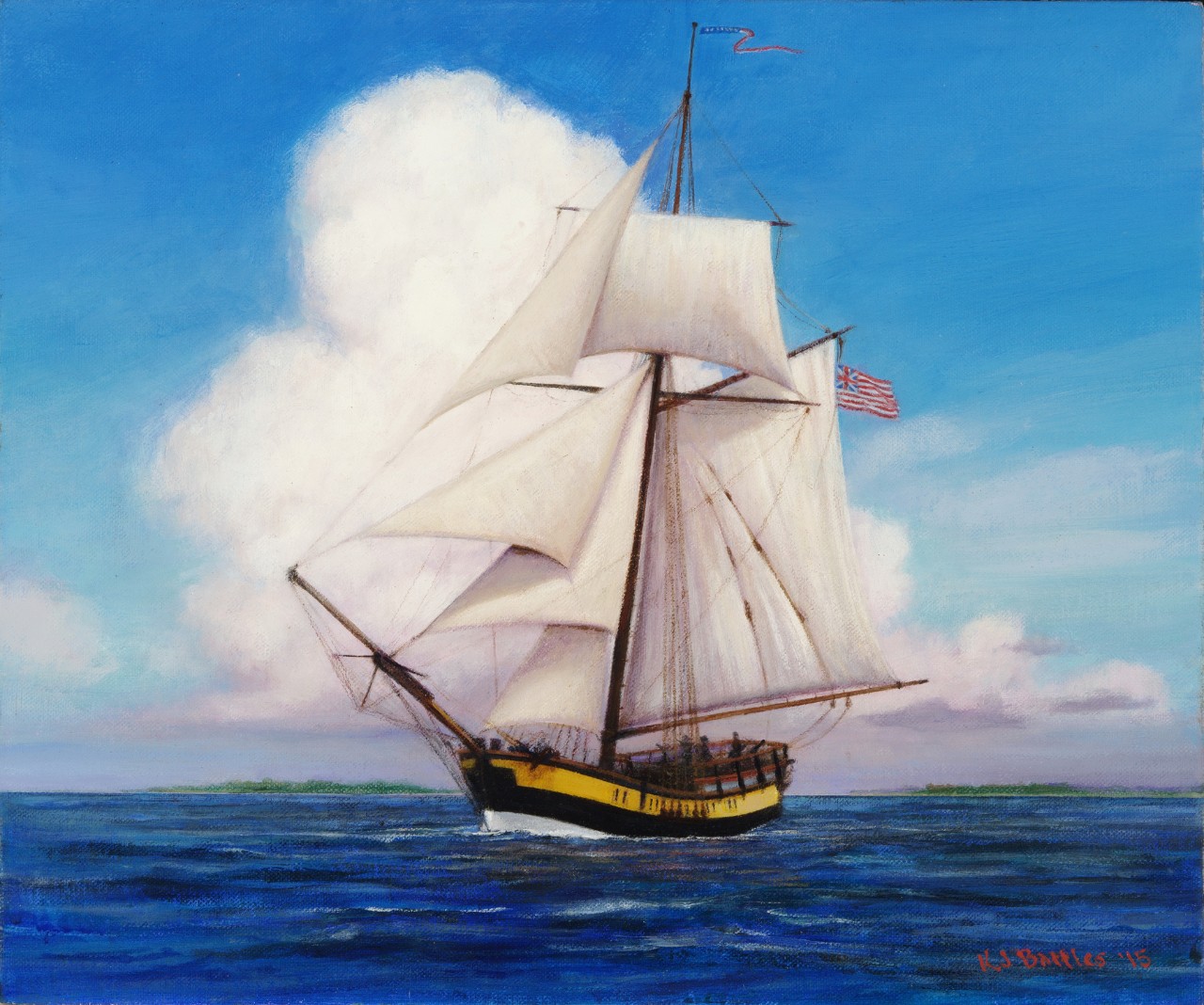
Katy in her later service as the Continental Navy ship Providence. “Sloop Providence under Sail by Kristopher Battles” (Naval History and Heritage Command)
Since his brief visit in November 1774 and his longer term stay commencing in December, Captain James Wallace of the British ship Rose (20 guns), had patrolled Narragansett Bay to enforce the Coercive Acts and prevent Britain’s rebellious colonies from importing gunpowder and armaments. Loyalists had taken heart and rebels had been frustrated with his presence. Not only were his patrols interfering with local commerce by seizing ships and their cargos—his main mission—but he created a more visible symbol of Britain’s ability and willingness to force its colonists to comply with Parliament’s laws.
One of the loyalists encouraged by the Royal Navy presence in Narragansett Bay was a Newport merchant named George Rome. Wallace had visited Rome and was dining with him when a breathless messenger warned the captain that a mob was out to tar and feather him back in December, 1774. In the moment, nothing came of it, but Governor Joseph Wanton warned Wallace that the town was not safe for British officers, sailors, or loyal subjects. Things remained at a low simmer that winter and spring, including the initial weeks after the Lexington and Concord. Tensions, however, could not help but rise. Diarist Ezra Stiles, recorded on May 23 that some 90 Rhode Island soldiers under the command of Captains [John] Topham and [Thomas] Tew marched from the Newport courthouse and through town beating up volunteers to join the nascent American Army. Wallace was dining in town that day and no doubt heard the racket.[1] Stiles wrote, “The Tories were greatly mortified to see the daring Boldness of the Rebels as they called them. The Tories had said that the Men o’War would fire the To[wn] if any Soldiers were raised in it. But there was no Molestation.” From Stiles’ version of events, the march appears as nothing less than a provocation to determine whether the rumored threat of Wallace and his ships to Newport proper was a bluff. The lack of an immediate response may have demonstrated that it was. In truth, a significant portion of Newport’s population opposed the rebels and voluntarily supplied Wallace and contracted for grain to provide to the British army.
Following the initial skirmishes at Lexington and Concord on April 19, 1775, colonial militias from throughout New England converged around Boston, with the area of Cambridge and Roxbury serving as the epicenters of the camps. These New England militia effectively layed siege to the city where British General Thomas Gage concentrated after April 19th. The British, cut off from the countryside, relied heavily on supplies brought in by sea. At the same time, American forces were eager to secure resources and deny the British any additional supplies from nearby coastal areas.
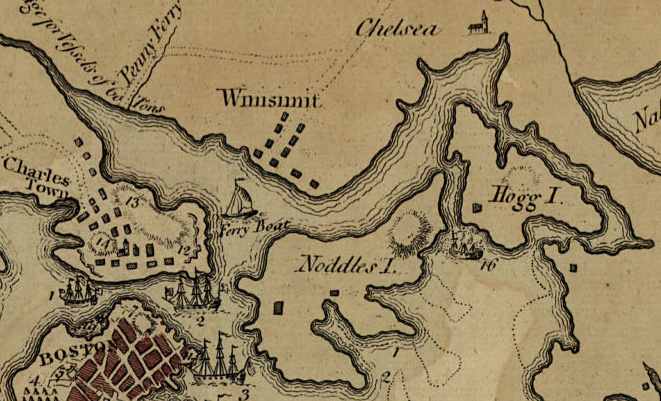
The location of the HMS Diana is marked with “16” on the map
One such resource-rich area was Noddle’s Island and Hog Island both located in Boston Harbor. These islands contained valuable livestock and hay, which the British had been attempting to secure to feed their troops and horses. American intelligence reported that the British were planning to remove these resources, prompting a proactive operation by the colonial forces to beat them to it.
In early May, Dr. Joseph Warren led a group inspecting the islands and recognized their imporance. As part of the Massachusetts Committee of Safety, Warren led the effort for a reslolution to be passed to either capture or destroy the supplies on the islands. On May 14th, the Committee stated “Resolved, as their opinion, that all the live stock be taken from Noddle’s Island and Hog Island, and from that part of Chelsea near the sea coast, and be driven back; and that the execution of this business be committed to the selectmen of the towns of Medford, Malden, Chelsea, and Lynn, and that they be supplied with such a number of men, as they shall need, from the regiments now at Medford.” Soon the commander of the New England army around Boston, General Artemas Ward, put a plan in motion to quickly strike both islands.
The American expedition was led by Colonel John Stark and Colonel Israel Putnam, both future generals in the Continental Army. The colonial forces, primarily composed of New Hampshire and Massachusetts militias, planned a nighttime amphibious raid to remove the livestock and destroy hay supplies that might benefit the British. On the night of May 27, colonial forces quietly moved onto Hog Island and began driving off livestock and burning haystacks. British forces, stationed in Boston and alerted to the colonial activity, responded by dispatching marines and the British schooner HMS Diana, a lightly armed but maneuverable vessel well-suited for operations in the shallow waters of the harbor.
As the colonists worked to transport livestock to the mainland, they encountered resistance from British marines who had landed on Noddle’s Island and began advancing toward their position. A sharp skirmish ensued, during which the American militia used the terrain to their advantage, fighting from behind trees, stone walls, and other natural cover. The colonial forces managed to repel the British marines, inflicting casualties and forcing a retreat.
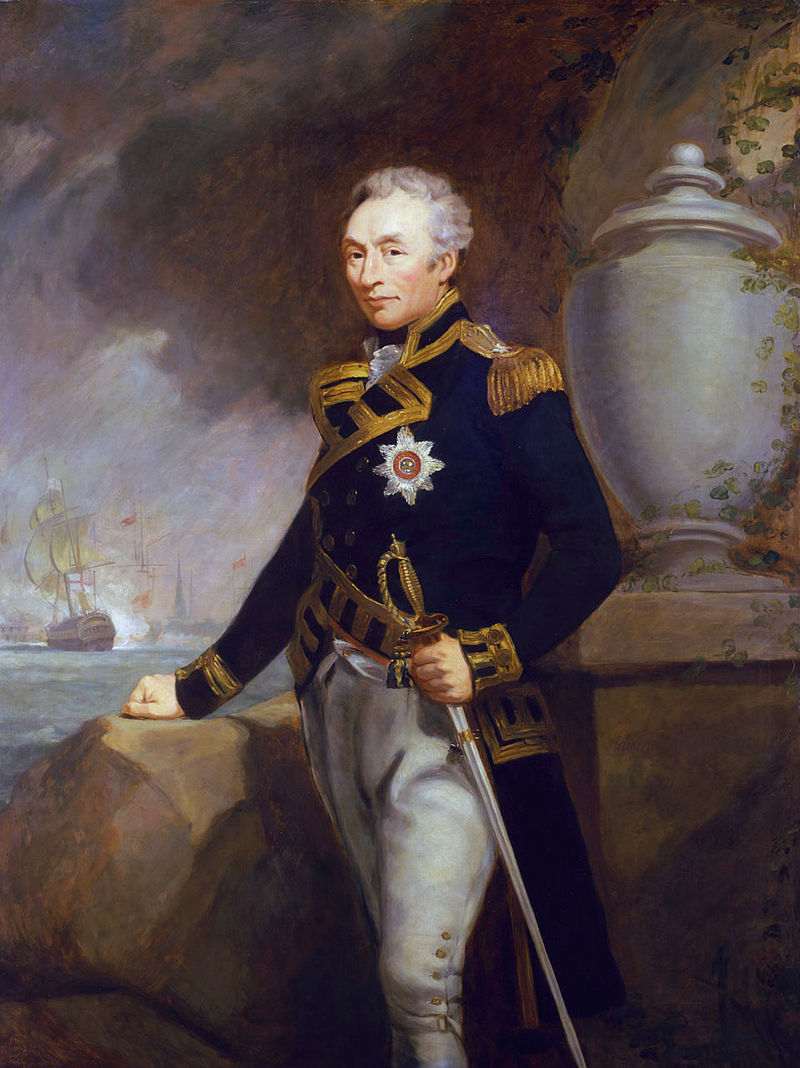
Lieutenant Thomas Graves (nephew of Vice Admiral Samuel Graves) commander of the HMS Diana. Shown in his rear admiral uniform in ca. 1801. Often confused with Lord Thomas Graves, British commander during the Battle of the Capes
The turning point of the engagement came with the involvement of the HMS Diana. The schooner attempted to support the marines by moving up the narrow Chelsea Creek to engage the colonial militia and cut off their withdrawal. However, as the tide receded and the ship ventured too far inland, it became grounded in the shallow, muddy waters.
Seeing an opportunity, the colonists brought up field artillery from shore and opened fire on the stranded vessel. Over the course of the battle, they subjected the Diana to intense musket and cannon fire. Unable to refloat the ship due to the falling tide and increasing colonial pressure, the British crew was forced to abandon it. American forces quickly boarded the vessel, stripped it of usable supplies, weaponry and its 76 foot mast, and then set it ablaze, destroying the schooner completely.
The Battle of Chelsea Creek resulted in a clear American victory, both strategically and psychologically. The destruction of the HMS Diana marked the first loss of a Royal Navy vessel in the Revolutionary War, dealing a symbolic blow to British morale. For the colonists, it was a tangible demonstration of their ability to challenge British authority not only on land but at sea.
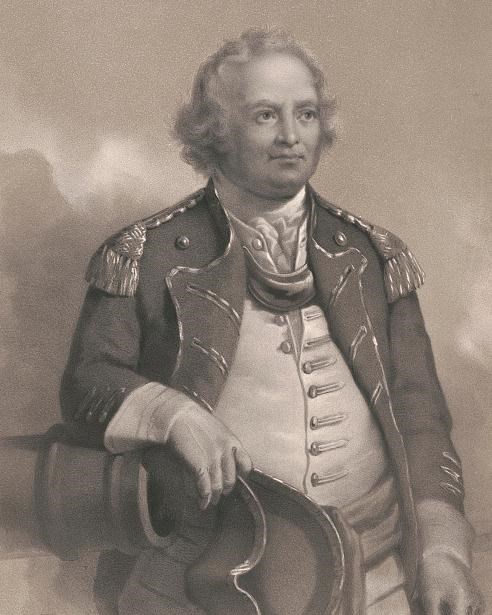
Major General Israel Putnam said after the fight on Chelsea Creek “I wish we could have something of this kind to do every day,”
Tactically, the victory helped to solidify American control of the Boston-area islands and limited the British army’s ability to forage for supplies. This contributed to the worsening conditions inside besieged Boston and increased pressure on General Gage. The morale boost for the colonial militias was significant; it reinforced the notion that British troops and naval forces were not invincible and that well-coordinated militia operations could succeed.
In addition, the battle was notable for showcasing early instances of American military ingenuity and leadership. Figures like Israel Putnam and John Stark went on to distinguish themselves in later battles, and the ability of the militia to effectively coordinate a land-sea operation foreshadowed the more sophisticated tactics that would develop over the course of the war. A few months later on August 1st, the mast of the HMS Diana was raised on Prospect Hill as a liberty pole. A symbol that was seen by not just the Americans around Cambridge but also the British in Boston. This location was also where legend states that George Washington ordered the first American flag, the Grand Union, to be raised on January 1, 1776.
While over shadowed by Lexington, Concord, or Bunker Hill, the Battle of Chelsea Creek played a crucial role in the early war. It helped secure the outer perimeter of the Siege of Boston, denied the British critical supplies, and emboldened the colonial cause at a time when confidence was still fragile. The success of the operation, including the destruction of the Diana, offered a dramatic image of colonial resistance and ingenuity that resonated beyond New England.
Today, the location of Noddle’s and Hog Island are gone. Nineteenth century and modern infill has completely reshaped the area from mudflats and tidal marshes to buildable land. Modern day East Boston, Winthrop and Logan Airport cover the area. The community of Somerville contines to commemorate the raising of the Grand Union flag on January 1 Diana‘s mast with a flag raising ceremony. Though mostly forgotten, the fighting along Chelsea Creek continued to embolden men like Joseph Warren and Israel Putnam and encourage their agressiveness a few weeks later on the Charlestown peninsula.
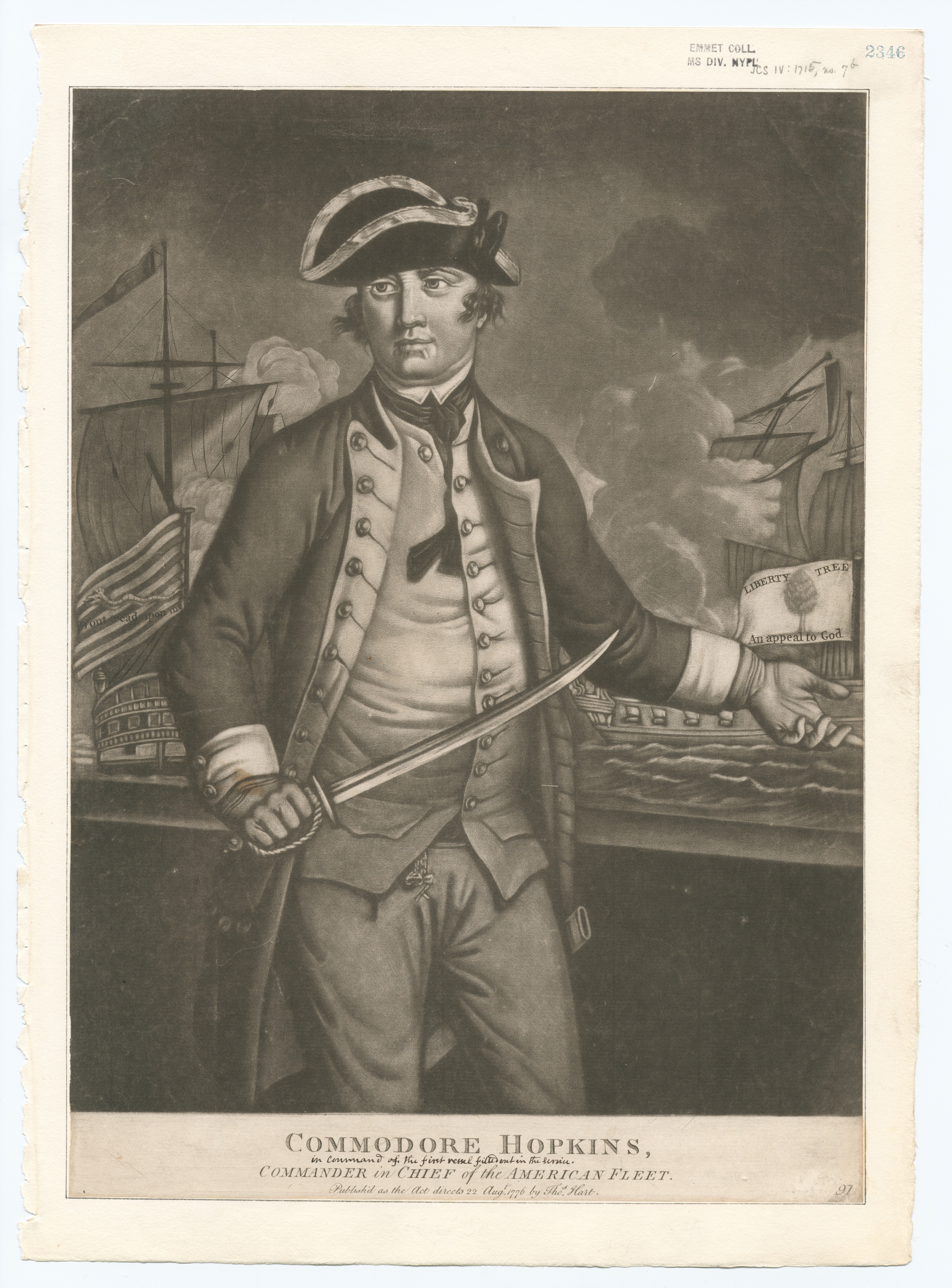
In March, 1776 Commodore Esek Hopkins led the bulk of the Continental Navy on a raid to the Bahamas, where it occupied the town of New Providence on Nassau Island for two weeks. Hopkins and his captains were drawn by a report of gunpowder stored in the town, which the patriot cause desperately needed.[1] Unfortunately for Hopkins, the colony’s governor had spirited away some 150 barrels the night before the American flotilla’s arrival. Not all was lost as the Marines quickly demanded and received the surrender of two small forts defending the town and its harbor. With those in hand, Hopkins and his men quickly got to work removing artillery, military stores, and other useful supplies.
While the American Marines and sailors managed to recover just 24 casks of powder, their haul in sizeable artillery pieces and mortars was impressive: 88 cannon ranging from 9- to 36-pounders; 15 mortars from 4-11 inches; 5,458 shells; 11,071 roundshot; 165 chain & double shot, plus fuses, rams, sponges, carriage trucks, mortar beds, copper hoops, and various stores not required for artillery.[2] It was a boon to be sure. The curious part of Hopkins’ inventory of captured war material, however, is that he sent it to Connecticut Governor Jonathan Trumbull, not a representative of the Naval Committee that had issued his orders. To John Hancock, president of the Continental Congress, he sent a report of his mission, but only mentioned “I have taken all the Stores onboard the fleet.”[3] Indeed, his report of the armaments aboard the British schooner Hawke, which the fleet captured on its return to American waters, was more complete. It took another day, until April 9, for Hopkins to forward the inventory of seized cannon. Congress merely resolved that an extract of his letter should be published for delegates to peruse.[4] Perhaps inadvertently, Hopkins exacerbated regional political conflicts and undermined his own command.
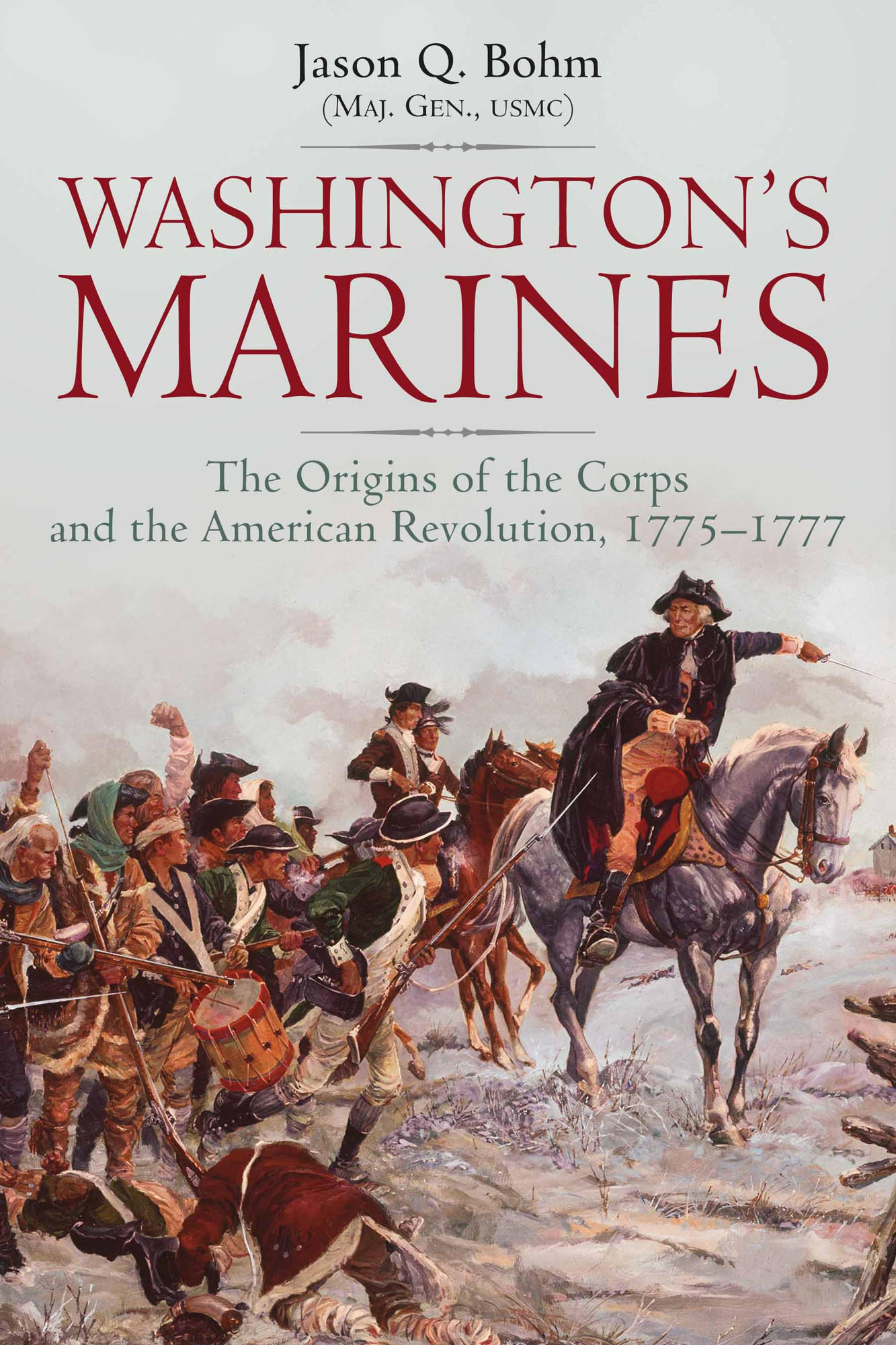
Join author Jason Bohm for a discussion of his new book published by Savas Beatie, Washington’s Marines: The Origins of the Corps and the American Revolution, 1775-1777, on Sunday night, August 20, 2023, at 7 pm. Bohm’s book examines the Marine Corps’ humble beginnings and what it achieved during the early years of the American Revolution. Jason Bohm’s eye-opening Washington’s Marines tells of the Corps’ origins and achievements in the early years of the Revolutionary War.
Grab a drink and join us to learn more about the early history of the United States Marine Corps!
All Rev War Revelries can be found LIVE on our Facebook page, or a week later on our YouTube and Spotify channels.
Major General Jason Q. Bohm is a Marine with more than 30 years of service. An infantryman by trade, he has commanded at every level from platoon commander to commanding general in peacetime and war. Bohm also served in several key staff positions, including as a strategic planner with the Joint Chiefs of Staff, Director of the Marine Corps Expeditionary Warfare School, House Director, Marine Corps Office of Legislative Affairs, U.S. House of Representatives, and Chief of Staff of U.S. Naval Striking and Support Forces, NATO. Bohm has a bachelor’s degree in marketing, a master’s degree in military studies, and a master’s degree in national security studies. Jason has written several articles for the Marine Corps Gazette and won various writing awards from the Marine Corps Association. He is the author of From the Cold War to ISIL: One Marine’s Journey (Naval Institute Press, 2019).
Peter Kiteridge was born into slavery in Boston, Massachusetts and worked in the household of the Kittredge family, from Andover, Massachusetts. Although slavery is most often associated with the southern colonies, and later the southern states, it was an established institution across the the thirteen original colonies at the time of the American Revolution. Despite being born into the institution legalized in the colony in which he lived, African American Peter Kiteredge cast his lot with those fighting for the cause of independence. The Kitteridge family had as well. Many in the extended family of Kittredges were physicians, and Dr. Thomas Kittredge went on to serve as as surgeon for Colonel James Frye’s regiment (Essex County Regiment) that was raised in Andover. In May 1775, the regiment became part of the Army of Observation. During the war, Peter Kittredge served in Captain William H. Ballard’s company of Colonel James Frye’s regiment. Peter joined the army in 1775 or 1776, according to his memory over thirty years later, and served for five years in the army before later becoming a sailor.
By the early 1800s, Peter Kiteridge was struggling both with his finances and his health. In this letter dated April 26, 1806, he noted that he is a freeman and in need of financial assistance. This document reveals much more about Peter, including the time between when he was a slave and when he went into military service. But the heart of Kiteridge’s letter was his request for assistance from the Selectmen of the town of Medfield. Due to a “complaint” that he had suffered since the war, perhaps the lingering effects of a disease contracted during his time in the service, Peter was unable to continue to work, and he asked for help to support his wife and four children. Because he later signed this petition with an “X” we can assume that his years as a slave left him illiterate. By the turn of the century, however, he was not the only veteran of the Revolutionary War that needed financial assistance. As this generation of servicemen aged, a growing demand for what later became known as veteran pensions increased. Today, veteran pension records, and petitions for assistance such as this, provide scholars a wealth of information on those that lived and served during this turbulent period.
Below you will find the full petition of the Medfield Selectman of April 26, 1806 courtesy of the Gilder Lehrman Collection.
“Gentlemen
I beg leave to state to you my necessitous circumstances, that through your intervention I may obtain that succour, which suffering humanity ever requires. Borne of African parents & as I apprehend in Boston, from whence while an infant I was removed to Rowley and from thence again to Andover into the family of Doct. [Thom] Kiteridge, with whom as was then the lot of my unfortunate race, I passed the best part of my life as a slave. [struck: At the age of twenty five] In the year of our Lord 1775 or 6 & in the twenty fifth of my age I entered into the service of the U.S. as a private soldier where I continued five years [inserted: and] where I contracted a complaint from which I have suffered in a greater or less degree ever since & with which I am now afflicted. After leaving the army to become a sailor for two years; when I quited the sea & resided for some time in Newtown, from whence I went to Natick where I remained for a short time & then removed to Dover where I [struck: remained] [inserted: carried] as a day labourer during the period of seven years. Eight years past I removed to the place where I now live, & have untill this time, by my labor, assisted by the kindness of the neighbouring inhabitants been enabled to support myself and family. At present having arrived [2] at the fifty eight year of my life and afflicted with severe and as I apprehend with incurable diseases whereby the labour of my hands is wholly cut off, and with it the only means of my support. – My family at this time consists of a wife and [struck: three] four children, three of whome are so young as to be unable to support themselves and the time of their mother [struck: has] is wholy occupied in taking cair [sic] of myself & our little ones – thus gentlemen, in this my extremity I am induced to call on you for assistance; not in the character of an inhabitant of the town of Westfield, for I have no such claim, but as a stranger accidently fallen within your borders, one who has not the means of subsistence, & in fact, one, who must fail through want & disease unless sustained by the fostering hand of your care.
I am Gentlemen your mos obedient, most humble servant.
Peter Kiteredge His X Mark
Attent. Ebenezer Clark Paul Hifner
To the policemen Selectmen of the Town of Medfield. [docket] Medfield 26 April 1806 [docket] Peter Kittridge application – [address] To the gentlemen Select [Men] of the Town of Medfield – “
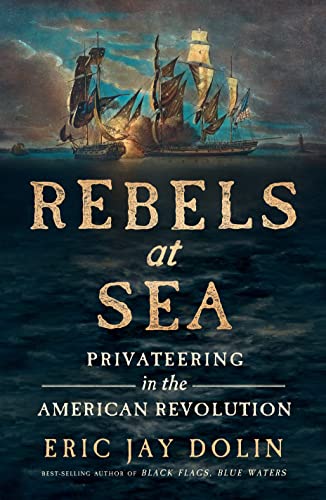
“Many believed then and have believed since that privateering was a sideshow in the war” Furthermore, “privateering has long been given short shrift in general histories of the conflict, where privateers are treated as a minor theme if they are mentioned at all” [pg. xviii].
Best-selling maritime historian Erica Jay Dolin penned the two lines above in his introduction to his latest publication, Rebels at Sea, Privateering in the American Revolution. Building on previous works that covered specific aspects of “do succeed in showing how it [privateering] contributed to the American victory. But none of these books offers a comprehensive picture of the full extent of privateering” [xviii].
A bold statement to make, crafting a comprehensive picture “of the full extent of privateering” but that is exactly what Dolin does in his work. Starting with how individual colonies then states moved to outfitting vessels to begin preying on British maritime trade and on occasion Royal British Navy ships. The best tabulation of how much British maritime trade was affected during the American Revolution comes from John Bennett Jr. first secretary of Lloyd’s of London, the largest insurance marketplace at that time. He concluded that 3,386 British vessels were captured, only a 1,002 were recaptured or ransomed, which leaves a net gain of 2,384 that remained in enemy or American hands [pgs. 161-162].
Impactful.
The ensuing chapters after the introduction pivot the reader through the life of a privateersman, including the travails faced. He circles back to this in another chapter detailing the British response, including what imprisonment looked like; either in a British land jail or on the infamous Jersey prison ship in Wallabout Bay, New York. Keeping the narrative flowing, Doulin gives snippets on some of the greatest triumphs of American privateersman and some of the greatest tragedies to befall these sailors on the high seas. Tidbits of interesting information, for example, did you know that the future dentist of George Washington cut his teeth as a privateer? (Okay, pun intended).
Sandwiched in between is the role of the French, America’s steady ally, after 1777, and how that country and its ports helped American vessels. Lastly one of the other admirable additions to this text is the plethora of pictures Doulin was able to find and include. Having the visuals certainly enhances the public history side of this publication.
Overall, this is a great read on a lesser viewed subject of the American Revolution. However, what the privateers did enabled eventual American independence. As John Lehman, the secretary of the navy under President Ronald Reagan once wrote.
“From the beginning of the American Revolution until the end of the War of 1812, America’s real naval advantage lay in its privateers. It has been said that the battles of the American Revolution were fought on land, and independence was won at sea. For this we have the enormous success of American privateers to thank even more than the Continental Navy” [pg. xviii].
Individuals come to life in this narrative. The cat-and-mouse of life on the high seas comes to life in this book. Join Doulin in an adventure on the high seas and understand the role of privateers in securing American independence in the process. Enjoy!
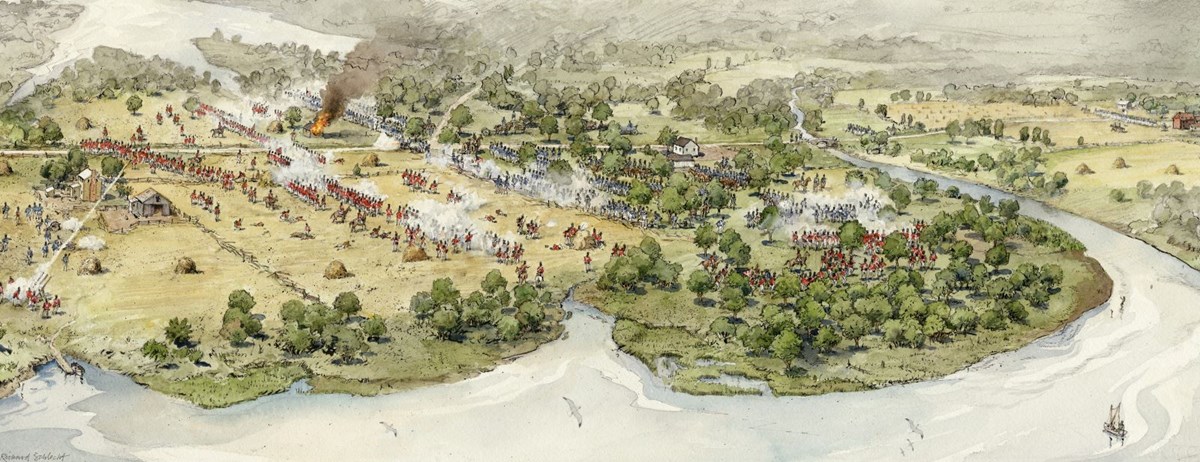
On September 12, 1814, approximately 4,700 soldiers, a mix of British infantry and marines, were landed on the North Point peninsula, a jut of land between the Back and Patapsco River and on a direct line of march toward Baltimore. While the infantry and marines advanced toward the city, the British Navy’s task was to subdue the American fortifications in Baltimore harbor. The latter was foiled by the stout defense of Fort McHenry which served as the backdrop for the future national anthem, the Star-Spangled Banner.
Less is known about the accompanying land engagement, fought at North Point between the British and American militia. That battle, which cost the life of Major General Robert Ross, the British commander, saw the American militia retreat, but in order, and stymied the initial approach of the British toward Baltimore. Furthermore, the battle gave the Americans more time to add to their defenses.
To shed light on this aspect of the Battle of Baltimore, Emerging Revolutionary War will be joined by two historians, both of who have worked on volunteered at Fort McHenry National Monument and Historic Shrine.
Jim Bailey is now the Chief of Visitor Services and Education at Manassas National Battlefield Park but is a former park ranger at Fort McHenry. The other guest historian is Chris Boyle who has been a National Park Service volunteer at Fort McHenry National Monument & Historical Shrine since 2005 in both the Fort McHenry Guard living history program and as an historical interpreter focusing on the Fort’s history from the War of 1812 through the Civil War. While not a native Baltimorean, he has called the city home for the last 20 years.
We hope you can join us on Sunday at 7 p.m EDT on our Facebook page for this historian happy hour.




 Emerging Revolutionary War Era