After a circuitous journey, from Paris, France across the Atlantic Ocean and then into Pennsylvania, an eager participant trekked to join the American effort. After an introduction to the Continental Congress this European officer headed toward the Continental army encampment. Baron Frederich William Ludolf Gerhard Augustin von Steuben, 47-years old, rode into camp drawn by horses and relaxing, as much as one can on the roads of Pennsylvania during 1770s, in a sleigh, with a Russian wolfhound dog strolling beside the wooden vehicle. On this date, 244 years ago, General George Washington, his staff, and any inquiring eyes around camp saw von Steuben for the first time.
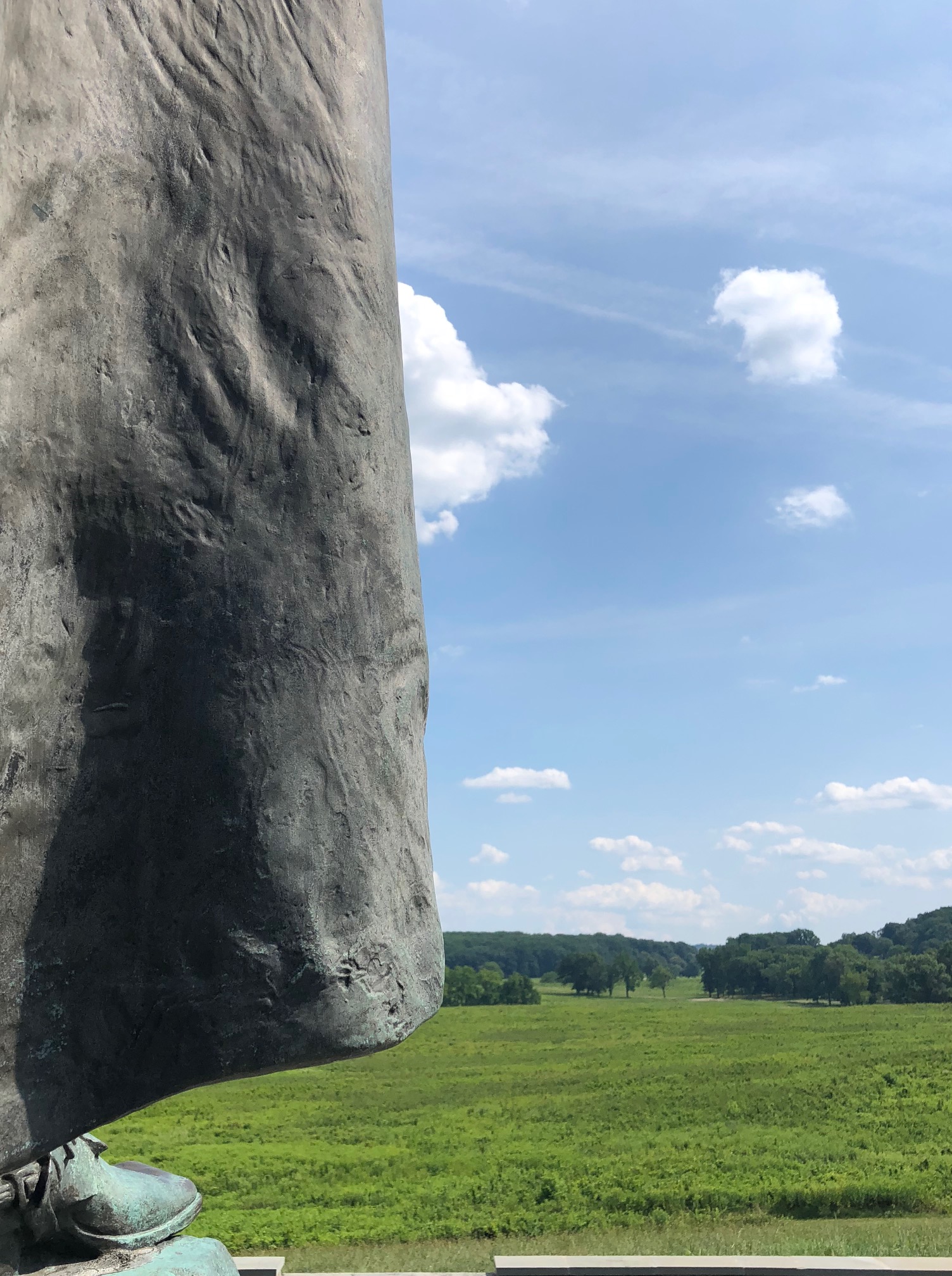
Baron von Steuben Statue, Valley Forge NHP
Although Christmas was almost two months in the past, von Steuben became a late blessing for Washington and his Continental army. Through an adaptation of a military training regimen from continental Europe which became a manual known as the “Blue Book” (this guide was used to train United States Army recruits for decades into the future as well), von Steuben began to morph the rank-and-file and junior officer corps of the Continental army into an actual army that knew how to follow commands and change formations. This training aided the Continentals in the battles of 1778, from a small engagement in May at Barren Hill to the last major fighting in the northern theater at Monmouth in June and into other theaters of the conflict.
Today, the field in which he trained the first model company is preserved by the National Park Service within the boundary of Valley Forge National Historical Park.
This November, during the second annual Emerging Revolutionary War bus tour, attendees will see the field and stand at the foot of the statue to von Steuben, looking over the same ground he first saw on this date, February 23, 1778. To secure your tickets, click the link on the header bar above titled “2022 Bus Tour.”
In the throes of the winter of 1778, spent at Valley Forge, General George Washington and his staff formulated a mountain of paperwork to multiple recipients of the American cause. On February 16, 1778, Alexander Hamilton composed a letter for the commander-in-chief of the Continental army to a gentleman who had moved from the military to the political ranks; George Clinton of New York.
George Clinton
He had seen service in the Hudson Highlands and had been commissioned a brigadier general in the Continental army on March 25, 1777. Later that same year both governor and lieutenant governor of New York, formally resigning the latter and accepting the former on July 30, 1777. In that capacity, he received the letter, excerpts below, from Valley Forge.
“It is with great reluctance, I trouble you on a subject, which does not properly fall within your province; but it is a subject that occasions me more distress, than I have felt, since the commencement of the war; and which loudly demands the most zealous exertions of every person of weight and authority, who is interested in the success of our affairs.”I mean the present dreadful situation of the army for want of provisions and the miserable prospects before us, with respect to futurity. It is more alarming, than you will probably conceive, for to form a just idea, it were necessary to be on the spot.2 For some days past, there has been little less, than a famine in camp. A part of the army has been a week, without any kind of flesh & the rest three or four days.3 Naked and starving as they are, we cannot eno⟨ugh⟩ admire the incomparable patience and fidelity of the soldiery, that they have not been, ere this, excited by their sufferings, to a general mutiny and dispersion. Strong symptoms however of discontent have appeared in particular instances; and nothing but the most active effort⟨s⟩ every where, can long avert so shocking a catastrophe.
Washington then asks for any help or supplies that Clinton can send his way, even though the army is outside the state lines of New York. Washington’s mindset is that the cause of the army in Pennsylvania is the cause of American independence and that Clinton, who had served would recognize that and do his utmost to provide what he can.
“I am calling upon all those, whose stations and influence enable them to contribute their aid upon so important an occasion, and from your well known zeal, I expect every thing within the compass of your power, and that the abilities and resources of the state over which you preside, will admit. I am sensible of the disadvantages it labours under, from having been so long the scene of war, and that it must be exceedingly drained by the great demands to which it has been subject, But though you may not be able to contribute materially to our relief, you can perhaps do something towards it; and any assistance, however trifling in itself, will be of great moment, at so critical a juncture, and will conduce to keeping the army together, ’till the Commissary’s department can be put upon a better footing, and effectual measures concerted to secure a permanent and competent supply. What methods you can take, you will be the best judge of; but if you can devise any means to procure a quantity of cattle or other kind of flesh, for the use of this army, to be at camp in the course of a month, you will render a most essential service to the common cause.“
Not only did Clinton receive this missive from Washington, dated February 16, but the following day Gouverneur Morris from a camp committee established by the Continental Congress also sent the New York governor a letter asking for any assistance he could provide for the army at Valley Forge.
These letters underscore the seriousness of the plight of the army encamped at Valley Forge as the winter slowly turned to spring. The action at Washington’s headquarters and from the camp committee helped create a path forward through that pivotal winter. To learn more about what transpired during those six months from December 1777 to June 1778, follow the link above to the “2022 Bus Tour” and join Emerging Revolutionary War on our second annual bus tour November 11-13, 2022.
The entire letter from Washington (Hamilton) to George Clinton can be found here.
On Sunday, January 23, Emerging Revolutionary War will journey, virtually, into the heart of the Mohawk Valley of New York in a discussion with Brian Mack of the Fort Plain Museum and Historical Park.
Established in 1961 the museum and park now encompasses over 75 acres and includes the site of Fort Plain/Fort Rensselaer, the foundation of a Revolutionary era bridge, the Fort Rensselaer Redoubt and works constructed by British forces, along with sites of colonial farmsteads, industry, and settlement. The museum also covers a wide era of the history of the area.
Mack lives out his passion for his family & for history in everything he does. A family vacation always includes a stop to a historic site or two. He is involved with the Fort Plain Museum & Historical Park as a member of their Board of Trustees, a Board member with The Stone Arabia Preservation & Battlefield, and a Board Member with The Mohawk Country Association. Most recently, he joined the Board with the Dr. Joseph Warren Foundation.
We look forward to a great discussion about the American Revolution in the Mohawk Valley of New York with Brian this Sunday, at 7 p.m. on Emerging Revolutionary War’s Facebook page.
244 years ago this week is when the Continental army, under the command of George Washington, marched into what would become their winter encampment as the year turned from 1777-1778. Recently, Phillip S. Greenwalt, one of the Emerging Revolutionary War historians was a “talking head” on a documentary about the Valley Forge encampment and what the soldiers and civilians faced during the ensuing six-month cantonment.
The documentary which features historians and park rangers is airing on Fox News Nation, the streaming service that is part of the Fox News network. Below is a screen shot of Phillip, who is also the author of Winter that Won the War, the Winter Encampment at Valley Forge, 1777-1778, which is part of the Emerging Revolutionary War Series published by Savas Beatie LLC.
So, if you need a break from the holiday specials that are airing, tune in for your history fix and learn more about the history at Valley Forge. If you want to dive even deeper into this period of the American Revolution, check out the link above labeled “2022 Bus Tour” and secure your tickets to join ERW at our second annual bus tour next November, which will include Valley Forge.
On both banks of the Hudson River, in 1776, sat two forts the patriots hoped would stop any British excursions up the waterway. Named for the top two military leaders of the Continental army–George Washington and Charles Lee–the fortifications both fell to the British by late November of that same year.
Join Emerging Revolutionary War this Sunday, at 7 p.m. EDT on our Facebook page as the forts become the focal point for this week’s “Rev War Revelry.” Joining ERW will be Charlie Dewey who will help break down and discuss the implications of these actions in November 1776.
Dewey, an officer in the New York Army National Guard and a graduate of the Virginia Military Institute has been a museum educator and special events coordinator for Fort Lee Historic Park since May 2018. He has been publishedin the Journal of the American Revolution along with being the author of various other scholarly articles on the Revolutionary time period.
Fort Washington, the last toehold of the Americans on Manhattan Island that fell and Fort Lee, the beginning of the long trek by Washington’s army across New Jersey late in 1776 have a unique part in American Revolutionary history. We look forward to you joining us this Sunday for this historian happy hour.
In June 1778, the Continental army marched out of their winter encampment in Valley Forge, Pennsylvania and headed toward New Jersey in pursuit of the retreating British army. The past six months, from December 1777 to June 1778, ushered in a period of suffering, renewal, and change.
Valley Forge is imprinted into the psyche of Americans as the the toughest winter of the entire American Revolution. In fairness, it was one of many tough winters that the Continental army survived. However, the reasons why this winter stands out will be part of the discussion of this Sunday evening’s “Rev War Revelry” which can be found on Emerging Revolutionary War’s Facebook page at 7 pm. EDT.
This week’s historian happy hour includes a discussion with Philip S. Greenwalt author of the recently released Emerging Revolutionary War Series title, The Winter that Won the War. This is the fourth volume in the series, with previous ones covering Lexington and Concord, Trenton and Princeton, and Monmouth.
Greenwalt will discuss how the Valley Forge winter was the intersection of various issues and how the decisions made and the determination of survival by the army made this the winter that won the war.
Tune in as well to hear how you can purchase a copy of this book to take with you as you plan that summer trip to Valley Forge and the Philadelphia area!
On this date, in 1778, the Continental army, under the command of General George Washington broke winter camp and began the spring campaign. Their objective was to catch the British army, under Sir Henry Clinton, retreating across New Jersey to the safety of New York City.
Nine days later, in the last major action in the northern theater, Washington’s forces would engage their adversary in the Battle of Monmouth. The army that fought this engagement in one of the hottest recorded days of any battle in American history, was a much improved military organization. Not perfect but much improved from the force that marched into Valley Forge six months prior.
During that half-year, from December 19 to June 19, the army saw an improved quartermaster department, the formation of a military handbook and tactical training, and the news that a powerful European nation had agreed to become allies in the quest for American independence.
Much is made of turning points or the critical importance of an event so I do not want to retread that argument here. However, what happened at Valley Forge was significant in the path to eventual American victory and the formation of the United States of America.
There is an old saying that even the greatest fiction writers cannot envision a story that is unbelievable as actual events can be. Or to sum it up more succinctly, a coincidence. After delays due to the pandemic, the latest volume of the Emerging Revolutionary War Series was released, in time for the 243rd anniversary of the end of the winter cantonment at Valley Forge.
The book is authored by yours truly and can be found via the publisher’s website by clicking here or through your favorite bookseller or by emailing Emerging Revolutionary War.
Then follow in the footsteps of Washington’s forces to Monmouth.
On this date in 1775, an early victory was secured for the American cause along the western shore of Lake Champlain in New York. Led by Colonel Benedict Arnold and Ethan Allen, over eighty men surprised and overwhelmed Fort Ticonderoga’s garrison, capturing the strategic stronghold and much needed supplies and cannon for the Americans. On May 22, the Pennsylvania Packet reported on the news received from the north:
On Wednesday evening last arrived here, John Brown, Esq; from Ticonderoga, express to the General Congress, from whom we learn, that on the beginning of this instant, a company of about fifty men, from Connecticut, and the western part of Massachusetts, and joined by upwards of one hundred from Bennington, in New-York government, and the adjacent towns, proceeded to the eastern side of Lake Champlain, and on the night before the 11th current, crossed the Lake, with 85 men, (not being able to obtain craft to transport the rest,) and about daybreak invested the fort, whose gate, contrary to expectation, they found shut, but the wicker open, through which, with the Indian war whoop, all that could, entered one by one, others scaling the wall on both sides of the gate, and instantly secured and disarmed the sentries, and pressed into the parade, where they formed the hollow square; but immediately quitting that order, they rushed into the several barracks on three sides of the fort, and seized on the garrison [commanded by Captain William Delaplace], consisting of two officers, and upwards of forty privates, whom they brought out, disarmed, put under guard, and have since sent prisoners to Hartford, in Connecticut. All this was performed in about ten minutes, without the loss of a life, or a drop of blood on our side, and but very little on that of the King’s troops.
In the fort were found about thirty barrels of flour, a few barrels of pork, seventy odd chests of leaden ball, computed at three hundred tons, about ten barrels of powder in bad condition, near two hundred pieces of ordnances of all sizes, from eighteen pounders downwards, at Ticonderoga and Crown Point, which last place, being held only by a corporal and eight men, falls of course into our hands.
By this sudden expedition, planned by some principal persons in the four neighboring colonies, that important pass is now in the hands of the Americans, where we trust the wisdom of the Grand Continental Congress, will take effectual measures to secure it….
The story of the capture of Fort Ticonderoga is as confusing as it is epic. Arnold, a Connecticut man, held a colonel’s commission to take the fort from the Massachusetts Committee of Safety, but he rode ahead to be part of the action without the men he was ordered to raise for the expedition; and Ethan Allen and his Green Mountain Boys of the Hampshire Grants were anti-New York and in search of their own glory after being asked to join a separately organized assault on the fort by Colonel Edward Mott sanctioned by Connecticut.
Ethan Allen demands the surrender of Fort Ticonderoga in this dramatized illustration. NYPL
The irony of all of this is that each plan formulated by those involved was done entirely without the advice or consent of New York, the very colony whose boundaries the fort was within. This occurred all during the commencement of the Second Continental Congress when New York was still weary of escalating hostilities with the King. Regardless of the awkward and unconcerted circumstances, it is undeniable that the fort’s capture helped secure victory for the Americans during the siege of Boston when fifty-eight pieces of ordnance were transported to assist General Washington in driving the British out of the city. Whether or not Allen heroically demanded Capt. Delaplace to surrender, “In the name of the Great Jehovah and the Continental Congress!” as is remembered (he almost definitely did not), is an entirely different question.
During the winter encampment at Valley Forge, as thousands of men huddled around drafty wooden cabins, with dwindling supplies, and battled boredom and disease, a relief effort was organized hundreds of miles away.
George Washington, ensconced at the Potts House in the heart of the Valley Forge encampment, was very aware of the dire straights that his forces were exposed to. Throughout the winter he sent missives, directly and through intermediaries, discreetly asking for more aid, for supplies, for changes to military bureaucracy. He even consented to a delegation of congressmen to visit Valley Forge and see first-hand the situation in the winter of 1777-1778.
In a proverbial sense, he did not leave any stone unturned to try and ease the plight of his forces or continue to stay abreast of British designs, less than twenty-miles away in Philadelphia, Pennsylvania.
After hearing of the contributions of the Oneidas and Tuscaroras at the Battle of Oriskany in New York, Washington sent a letter of invitation for the Native Americans to visit his army. Approximately 50 warriors along with supplies made the few hundred mile journey from upstate New York to eastern Pennsylvania. They left their villages on April 25 and arrived on May 15,1778 in Valley Forge. The leaders of the Oneida party dined with Washington. Five days later some of the warriors participated in the engagement at Barren Hill under the Marquis de Lafayette. Six of the warriors gave their life in service to their ally.
In 2007 historian Joseph T. Glatthaar published a book about the Oneidas and their contributions to the American victory in the war. The title, in part, is Forgotten Allies. A fitting testament to the service and sacrifice this tribe underwent in their partnership with the fledgling American nation.
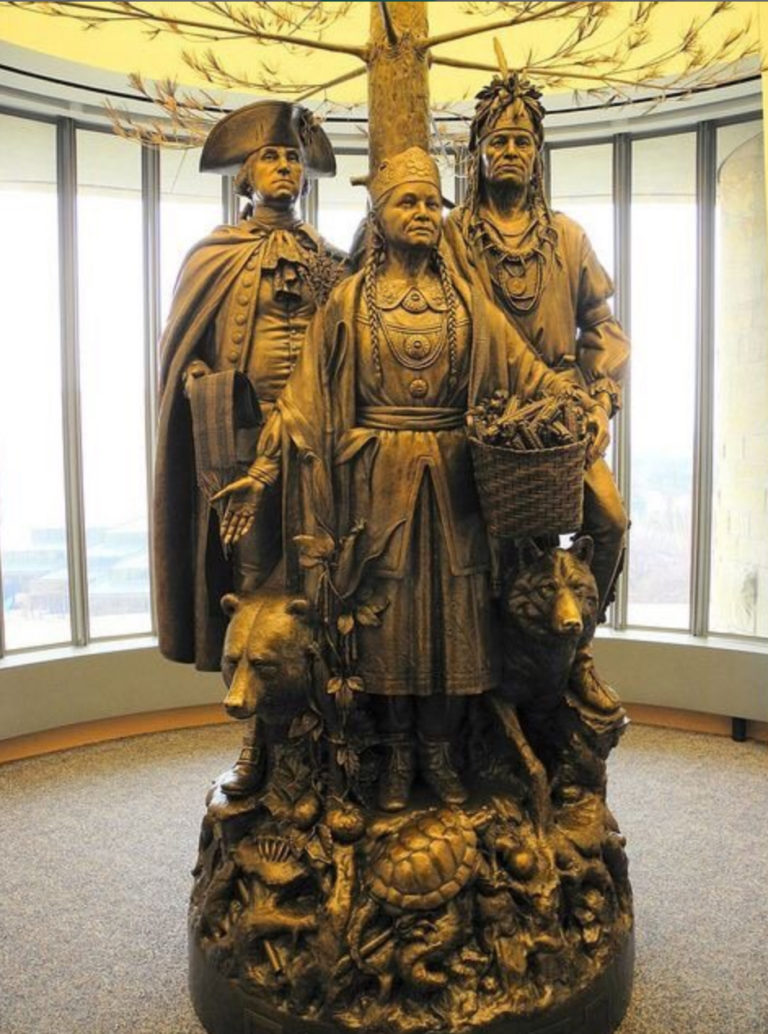
In 2004 a sculpture was completed of Polly Cooper, Chief Skenandoah, and George Washington (courtesy of King of Prussia Historical Society)
If the Oneidas were the “forgotten allies” than in the winter encampment at Valley Forge there was a forgotten woman that tramped south with her fellow Oneidas. Her name was Polly Cooper.
Along with the warriors, whom Washington wanted to serve as scouts, the Oneidas brought much needed supplies, including bushels of white corn. While the leaders dined at the Potts House, Cooper established a de-facto cooking show. She handed out the white corn to the soldiers and taught them how to use husks to make soup and ground grain to make it palatable.
This much needed food sources, along with an improved supply chain under quartermaster Nathanael Greene rounded out the bleak winter with the glimmer of hope for better supplies in the upcoming campaign season.
The Oneida, including Polly Cooper for her services, refused any and all payment. Friends help friends in need is what the Oneida told Washington and his officers. However, a tradition exists in the history of the Oneida nation. That story, passed down orally from generation to generation, highlights that Marth Washington, in her gratitude for what Polly Cooper did for the rank-and-file of the Continental army, presented the Oneida heroine with a shawl and bonnet.
Another account reads that Cooper was gifted a black shawl that she saw for sale in a store window. The Continental Congress appropriated the money for the clothing item and gifted it as their thanks to her. This shawl is still in the ownership of her descendants and has been loaned to the Oneida cultural center from time to time.
The black shawl that Polly Cooper received for her services to the Continental Army at Valley Forge (courtesy of the Oneida Indian Nation http://www.oneidaindiannation.org)
Emerging Revolutionary War welcomes guest historian Sean Chick
On October 7, 1780, Britain’s attempt to regain at least part of the rebellious North American colonies was dealt a major blow at King’s Mountain. The rebels rejoiced, since it was their first major victory since 1777 and it came after the twin disasters at Charleston and Camden. Thomas Jefferson, then governor of Virginia, considered it the decisive battle of the war. Years later, Theodore Roosevelt echoed that sentiment. In 1930, when the site was set to become a national park, Herbert Hoover gave a speech. For the embattled president, it was an attempt to shore up his falling support and vindicate his strategy to peel southern states away from the Democratic Party. Hoover said “This is a place of inspiring memories. Here less than a thousand men, inspired by the urge of freedom, defeated a superior force entrenched in this strategic position. This small band of Patriots turned back a dangerous invasion well designed to separate and dismember the united Colonies.”
Hoover, understandably, never mentioned the atrocities committed. Many were executed after the battle. Nor did he mention that King’s Mountain was not a contest between redcoats and rebels, but brother against brother. The only British man present was Major Patrick Ferguson. His command was made up entirely of Loyalists. His second in command, Captain Abraham de Peyster, was from New York City.
Joseph Galloway (courtesy of NYPL)
Few groups in American history are as forgotten as the Loyalists and few were as complex. They were a varied lot, often making up the highest in colonial society, including wealthy merchants and colonial officials. They often included the very lowest in the society, such as recent immigrants, slaves, indigenous, and subsistence farmers. Their ideology was in many ways not radically different from those who rebelled. They were generally not in favor of absolute monarchy or the supremacy of Parliament but simply favored union with Britain and slow reform. A few, such as Joseph Galloway, were part of early protests against British colonial policy, but were unwilling to jump into the chasm of revolution. Some, such as South Carolina merchant David Fanning, were merely aggrieved and sought to settle scores. Others were on the margins of society and saw the colonists, or at least the revolutionary colonial elite, as their real oppressors.
The Loyalists were at first spurned by the British high command. Major General William had over 30,000 men under his command in 1776 and Loyalists would have added to the logistical strain. He also thought a soft war policy that he hoped would induce the colonies to return, and therefore it was reasonable to avoid civil war. Yet, by 1777 the British were using some Loyalist regiments. They would fight in John Burgoyne’s ill-fated drive on Albany and served as rangers at Brandywine.






 Emerging Revolutionary War Era