

When the idea was formulated, back in April, to do a Sunday evening Zoom/Facebook live type history hour, the emphasis behind this “happy hour” was to style it as a more informal chat. Our goal was to create a virtual adaptation of what would occur if the same historians met at a tavern/bar/pub to casually chat about American history.
Speed up to this Sunday, June 7th, Emerging Revolutionary War will welcome three guest historians, who all have a connection to a historic tavern to join co-founder Rob Orrison on a talk about 18th century taverns. Yes, a “tavern talk about taverns.”
Joining Orrison on the hour-long happy hour chat will be:
Liz Williams, Executive Director of Gadsby’s Tavern in Alexandria, Virginia, part of The Office of Historic Alexandria, in which she has been employed with since 2004. She is a graduate of Mary Washington College in Fredericksburg, Virginia with a degree in Historic Preservation and a graduate degree in Tourism Administration from George Washington University. She has also worked at various historic sites in the Virginia and Washington D.C. area.
An ERW favorite and returning to the “Rev War Revelry” is Stacey Fraser, the Collections and Outreach Manager with Lexington (MA) Historical Society. One of the sites she oversees the collection of is Buckman Tavern, which played a role in the April 19, 1775 engagements that rolled through Lexington and Concord, Massachusetts.
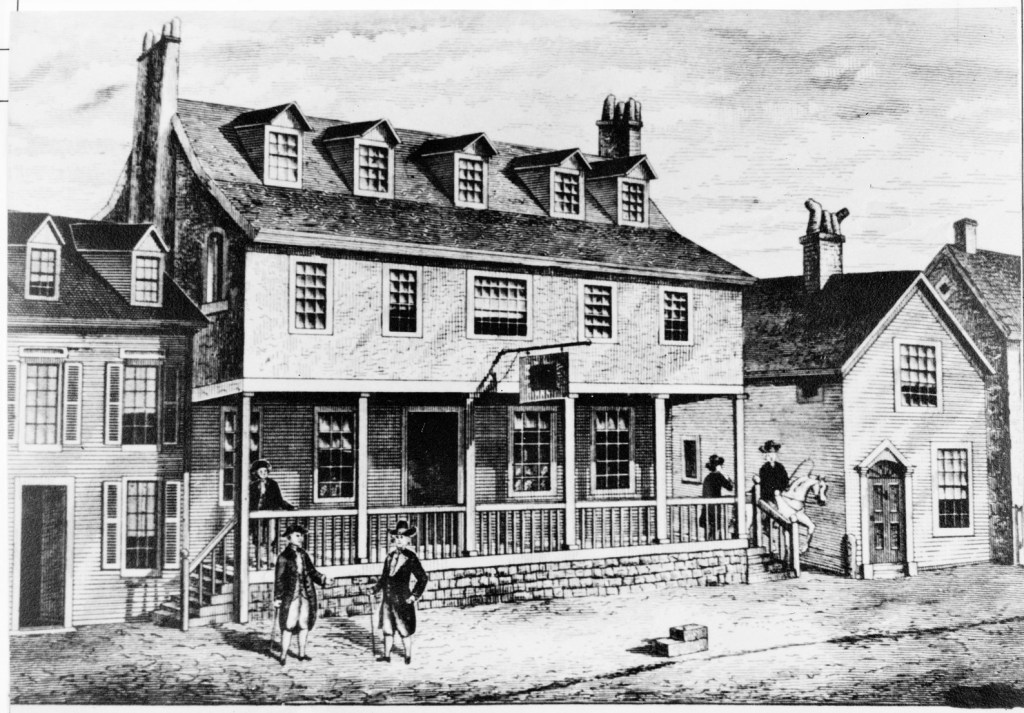
The third guest historian is Sarah Kneeshaw, the Education and Public Programs Coordinator at Fraunces Tavern Museum. The tavern was built in 1719 in New York City by the De Lancey family. She joined the staff at the downtown New York City site (which is directly across from Federal Hall where George Washington was inaugurated president in April 1789) in 2016. Sarah holds a bachelor’s degree in Anthropology from Fordham University and also attained a graduate degree in Museum Studies from John Hopkins University. She is a native of Staten Island.
Thus, this Sunday, set a side an hour-ish, starting at 7pm EST, to hear these four historians discuss taverns, their importance, and roles in the 18th century social, military, and political history of the burgeoning United States. With your preferred drink, be it an 18th century tavern concoction or not, in hand, we look forward to your questions, comments and insights.
 Most people with an interest in the American Revolutionary War have heard of the Boston Massacre, in which Captain Thomas Preston of the 29th Regiment of Foot, commanding a contingent of British soldiers, fired into a crowd, or a mob depending on one’s point of view, harassing/threatening a guard outside the Customs House. Both sides in the growing dispute between Britain and its colonies rapidly turned the event, which occurred 250 years ago, to their political ends. Several books have been written about the massacre and tried to sort fact from propaganda, at least in the context of revolutionary Boston. In their latest book, John Adams Under Fire: The Founding Father’s Fight for Justice in the Boston Massacre Murder Trial, Dan Abrams and David Fisher tackle the trials of Captain Preston and his soldiers that followed.


 Emerging Revolutionary War Era