Emerging Revolutionary War is honored to welcome back historian Katie Turner Getty.
“Mr. Malcom, I hope you are not going to strike this boy with that stick.”[1]
George Robert Twelves Hewes portrait, entitled “The Centenarian” by Joseph G. Cole, 1835.
The speaker was 31-year-old Boston shoemaker and Tea Party participant, George Robert Twelves Hewes. Hewes had been walking along Fore Street in Boston on the afternoon of January 25, 1774 when he came across 50-year-old Loyalist and Customs officer, John Malcom, furiously shaking a large, heavy cane at the head of a small boy.
Five weeks earlier, on December 16, 1773, Hewes had “dressed [himself] in the costume of an Indian, painted [his] face and hands with coal dust in the shop of a blacksmith”[2] and participated in the Tea Party. Appointed boatswain, he and his company boarded one of the three ships and proceeded to soak 342 chests of East India Company tea in Boston Harbor. After dumping the tea that night, the men “quietly retired to [their] several places of residence… No disorder took place… and the stillest night ensued that Boston had enjoyed for many months.”[3]
Hewes had encountered no trouble when destroying the tea that night. But on this frigid Tuesday afternoon in January, trouble had found him—and was brandishing a cane.
Malcom turned his attention from the small boy to the shoemaker and exclaimed, “You are an impertinent rascal! It is none of your business!”[4]
Undeterred, five-foot, one-inch Hewes further protested Malcom’s rough treatment of the boy. Malcom called Hewes a “vagabond” and further declared that Hewes “should not speak to a gentleman in the street.”[5]
Hewes replied that he was “neither a rascal nor a vagabond, and though a poor man, was in as good credit in town as [Malcom] was.”[6] The exchange between the two men became even more heated.
Malcom called Hewes a liar and Hewes then retorted, “be that as it will, I never was tarred and feathered any how.”[7]
Malcom, overcome with fury, then struck Hewes in the head with his heavy cane, opening a bloody gash in the shoemaker’s forehead and causing him to fall to the ground unconscious.
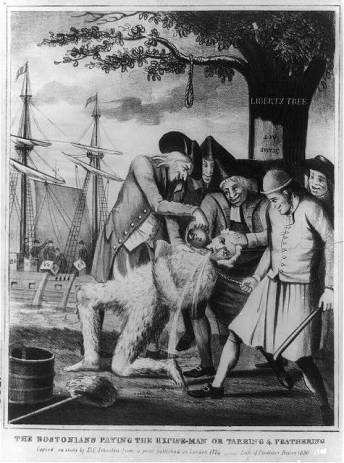
John Malcom was one of the few people in the American colonies who had been tarred and feathered. Before this night was through, he would earn the dubious distinction of having been tarred and feathered twice.
“A New Method of Macarony Making, as Practised at Boston”, 1774.
Malcom’s first encounter with a sticky suit of tar and feathers was in October of 1773 in Falmouth (now Portland, Maine). While working as a Customs officer, Malcom had overzealously seized a ship called the Brothers for not having a register. Once aboard the ship, he “heartily damned the sailors, menaced the mate, [and] threatened to sheath his sword in the bowels of any one who dared dispute his authority.”[8]
So enraged were local sailors by Malcom’s behavior, that he was “disarm’d of Sword, Cane, Hat & Wig”[9], tarred and feathered over his clothes, and paraded through the streets for about an hour before being released.
This episode was common knowledge in Boston. In a letter to the Earl of Dartmouth, Massachusetts Governor Thomas Hutchinson indicated that Malcom had complained to him on several occasions of “being hooted at in the Streets for having been tarred and feathered”[10] Clearly, the Boston populace was not sympathetic to Malcom. And after his assault on Hewes, they would become even less so.
When Hewes regained consciousness, he found himself surrounded by a crowd of onlookers who urged him to visit the prominent Boston physician, Dr. Joseph Warren, to have his wound treated. In the meantime, Malcom had “contrived to get a weapon in his hand and keep [the crowd] at bay, till he could flee to his house”[11] on Cross Street.
When Hewes visited Dr. Warren at his office on Hanover Street, the doctor made a cheerful comment relating to the fortuitous thickness of Hewes’s skull. He said, “you are the luckiest man I know of, to have such a skull—nothing else could have saved you.”[12]
Word of Malcom’s assault on Hewes had quickly spread through Boston and people had started gathering outside his house. Far from being cowed by the unfriendly crowd, Malcom “bullied the people”[13], slinging verbal taunts and threats. In response to jeers, Malcom shouted “You say I was tarred and feathered, and that it was not done in a proper manner, damn you let me see the man that dare do it better!”[14]
Even 243 years later, Malcom’s defiance of the crowd is astonishing. From inside his house, he ran his sword out through the window and inflicted a flesh wound on an unlucky bystander named Waddel. He threatened the crowd with pistols and proclaimed that he would receive a thirty pound reward for every person he killed[15]. The formidable Malcom was eventually removed from his house “amidst the huzzas of thousand[s]”[16] He was dragged on a sled to King Street, site of the Boston Massacre, and was stripped of his clothes.
In Falmouth, during his first tar and feathering in 1773, the tar was splashed onto his clothes. This time, Malcom’s clothing was torn off, exposing him to the frigid winter air. The tar was poured over his bare flesh. He was then transferred to a cart and gleefully hauled to various points across town.
Sixty years later, Hewes reflected upon the event in his biography. “Then they drove to Liberty Tree—to the gallows on the Neck—back to the Tree—to Butcher’s Hall again—to Charlestown Ferry—to Copp’s Hill—flogging the miserable wretch at every one of these places.”[17] Four hours later, he was unceremoniously deposited at the doorstep of his house, frostbitten and senseless.
The reader may feel a slight twinge of disappointment, or perhaps even a grudging respect, upon learning that throughout his ordeal, John Malcom comported himself with “Great Fortitude and Resolution”.[18] Malcom’s recovery was lengthy. When frostbite caused his tarred and feathered flesh to peel off in strips, Malcom packed the skin in a box to preserve it and present to the King as proof of his service and sufferings.[19]
In May, 1774 Malcom sailed for England (presumably with his box of tarred flesh and feathers). Once in England, Malcom embarked on a letter-writing campaign to request redress for all of the suffering and expense he endured in America in furtherance of his service to the King.
In 1776, Malcom wrote a letter to the Lords of the Treasury. In referencing the altercation with Hewes in Boston and his subsequent tarring and feathering, Malcom stated that in “endeavoring to do my Duty in getting the Tea landed, [he] was barbarously and inhumanely treated…[and] was obliged to quit America”.[20]
Also in the letter, he accused his former Customs supervisor in Falmouth, Francis Waldo, of various misdeeds. Waldo had strongly disagreed with Malcom’s seizure of the Brothers and the two had never reconciled.
Waldo’s ire is still palpable 240 years later as, in response, he meticulously dismantles Malcom’s claims in a letter to the Lords of the Treasury, point by painstaking point:
“Mr Malcom went to Boston and brought upon himself a second Taring [sic] and Feathering…which happened some time after the India Companys Teas were destroyed and was occasioned by his beating a Boy in the Street in such a manner as to raise a Mob”[21]
Many factors probably contributed to the second tarring and feathering of Malcom, but any efforts he might have made to land the tea were not among them. As Waldo pointed out, the tea had been destroyed over a month before Malcom was tarred. Malcom was already unpopular in town due to objectionable past actions such as the Brothers seizure. He was a particularly overzealous and aggressive Customs officer. And the man he assaulted was a Patriot and tea party participant.
“Bostonian’s Paying the Excise-Man, or Tarring and Feathering”, attributed to Philip Dawe, London, 1774.
Additionally, Bostonians felt a simmering resentment toward the authorities. When some men tried to persuade the crowd to stop tormenting Malcom, they refused to relinquish him.[22] They believed the government would fail to punish him for his wrongs—assaulting the boy and Hewes, threatening the populace, and sticking Waddel with his sword. Instead, the crowd chose to maintain possession of Malcom and mete out the justice that they believed the government would not.
Malcom was in England barely a year before he demonstrated a desire to return to Boston. In a petition to the King, Malcom states that he “long[s] to be sent out to my Family in Boston and to my Business in the Customs in the Boston Government…I would Humbly Implore your Majesty let Me be soon sent from London to Boston…”[23]
In the end, Malcom was assigned to the Independent Company of Invalids at the Plymouth Garrison. He penned several more letters and petitions asking for additional compensation from the British government.
In 1782, the Commissioners on American Loyalist Claims reviewed his case and decided to allow him another 60 pounds per year on account of his having been tarred and feathered, but in no small part because “he appears to be in some degree insane.”[24]
Malcom lived out the rest of his days in England, passing away in 1788 at age 65. He never went back to Boston, nor ever saw his wife or children again.
Hewes lived to be 98 years old. In 1775, after war broke out, he escaped from Boston in a fishing boat and went to Wrentham, Massachusetts. He served in the militia until the end of the war. Eventually he moved to upstate New York. He was married for 70 years until his wife, Sally, passed away at the age of 87. By all accounts, he was lively and spry until the end. On the 4th of July, 1840, he was preparing to attend a celebration as a special veteran guest. On that day, George Robert Twelves Hewes stumbled while stepping into a carriage and suffered a serious injury. He died that November.
*Sources
[1]Boston-Gazette and Country Journal, 31 January 1774. The Annotated Newspapers of Harbottle Dorr Jr., Massachusetts Historical Society http://www.masshist.org/dorr/volume/4/sequence/522 Hereinafter cited as Boston-Gazette.
[2] A Citizen of New York [James Hawkes], A Retrospect of the Boston Tea-Party, with a Memoir of George R. T. Hewes, a Survivor of- the Little Band of Patriots Who Drowned the Tea in Boston Harbour in 1773 (New York: S. Bliss, printer, 1834), 38. https://archive.org/details/retrospectofbost00hawk Hereinafter cited as Hawkes.
[8] Boston-Gazette and Country Journal, 14 February 1774, quoted in Frank W.C. Hersey, Tar and Feathers: The Adventures of Captain John Malcom, reprinted from the Transactions of the Colonial Society of Massachusetts, volume XXXIV, (Boston: D.B. Updike, The Merrymount Press, 1943), 440.
[9] Boston-Gazette and Country-Journal, 15 November 1773, quoted in Hersey, 440.
[10] Governor Thomas Hutchinson letter to Earl of Dartmouth, 28 January 1774, quoted in Hersey, 448.
[11] A Bostonian [Benjamin Bussey Thatcher], Traits of the Tea Party; Being a Memoir of George R. T. Hewes, One of the Last of Its Survivors; With a History of That Transaction; Reminiscences of the Massacre, and the Siege, and Other Stories of Old Times (New York: Harper & Brothers, 1835), 128. https://archive.org/details/traitsteapartyb00thatgoog Hereinafter cited as Thatcher.
[18] John Rowe, Anne Rowe Cunningham, Edward Lilly Pierce, Letters and diary of John Rowe: Boston merchant, 1759-1762, 1764-1779, (Boston: W.B. Clark Co., 1903), 261.
The town meeting held on the night of December 16, 1773 at the Old South Meeting House was no ordinary meeting. Boston was well known for its public meetings, but this one was different. Frequently city leaders called town meetings to discuss important political, economic and social decisions facing the city or colony. The town meeting was a foundation of the political process for Massachusetts and much of the New England colonies. Royal authorities had watched these meetings more closely since the 1760s during the opposition to the Stamp Act. Colonial Whigs (anti Royal leaders) had used these meetings to protest British policies that they saw as threats to their liberties.
This town meeting was a follow up assembly to previous meetings held in November originally called for Faneuil Hall. The large turnout, however, required the crowd to move to the more spacious Old South Meeting House. Nearly 5,000 people attended the meeting to discuss the city and colony’s response to a new tax on tea and more directly, the ships in the harbor that held tea from the East India Company. The colonial Whigs did not want the cargo unloaded but the captain of the ships could not leave the harbor with the tea unless they had approval from the Governor. Governor Thomas Hutchinson did not believe he had the authority to allow the ships to leave without unloading the tea. Adding to that decision, Hutchinson was more than frustrated with those who had rejected Royal authority over the years. Thus, a legal and theoretical standoff ensued. That night, the people of Boston took the matter into their own hands.
On the surface, the Tea Act of 1773 was rooted in helping pay off the debt of the British Empire, caused in part by fighting the Seven Year War (French and Indian War) with France. Also, the revenue raised would pay British officials in the colonies, thus making them more loyal to Parliament and the British Crown. The Tea Act was one of many Parliamentary laws or “Acts” passed to raise revenue in the colonies. More importantly, the underlying purpose was for Parliament to display their authority to pass laws that were binding on the British colonies. Due to colonial opposition and resistance, many of these acts were repealed. However, the Tea Act, passed in 1773, sparked an immediate response throughout the colonies.
The Tea Act was also seen as a mode for saving a British held company, the British East India Company. Before 1773, the company had to sell its tea in London and was subject to duties. The company had collected large quantities of tea in warehouses in London and was looking for a way to disperse the tea at a bargain. The Tea Act allowed the company to sell directly to American ports without paying the duties. This also forced American buyers to only purchase their tea from the East India Company, which was subject to a tax. The good news was the price of tea was reduced because the Company no longer had to pay the duties in London. Colonists resisted the notion that Parliament could force them to buy tea from the East Indian Company (many made a good living off of smuggled tea sales) and that they were required to pay a tax on the tea.
The popular notion, “taxation without representation,” had been around since the 1750’s and became well-known in 1764 in response to the highly unpopular Sugar Act and Stamp Act. Colonial Whigs believed they had no representation in Parliament because they did not elect representatives to Parliament. British political theory and law believed in the model of “virtual representation” which meant the colonists did not vote for individual members of Parliament though that body, as a whole acted in the best interest for all British subjects. Colonial leaders, who for decades were allowed to vote for their representative bodies in their respective colony, did not accept this theory. The opposing views on representation began to open opposition to British authority over colonial matters.
Though passed in May 1773, the Tea Act did not impact the people in the colonies until fall. Seven ships of tea were sent to four American ports, Boston, New York, Philadelphia and Charleston. Meanwhile, colonial Whig leaders began to organize a resistance to the East India Tea that was en route. In fact, in every other city but Boston the tea was refused and forced to either be returned to England or confiscated by local officials. It was in Boston that a determined governor and history of Royal opposition led to a signal event in American history.
On November28th, the ship Dartmouth arrived loaded with tea. British law gave ships with imports twenty days to pay the duties or the local custom officials could confiscate the cargo. Hutchinson, when petitioned, would not allow the ship to leave the port without paying the duty. His sons, who acted as the Tea Consignees (authorized to receive the tea and see to its distribution) for Boston, also refused to back down and resign their positions, which happened in other American ports. Soon two more ships arrived in the harbor with the unwanted tea. Unable to return the tea to England and without being able to unload the tea due to the threats of local groups such as the Sons of Liberty, the captains of the ships were in a tight and dangerous spot.
On the night of December 17th, one of the largest public meetings in Boston convened at the Old South Meeting House. Speeches by Sam Adams, John Hancock, Joseph Warren and other Boston Whig leaders called for the return of the tea to England. Later in the evening, word came that a last minute plea to Governor Hutchinson to let the ships return was refused. Sam Adams announced publicly, “This meeting can do nothing further to save the country.”
The events that happened next have been debated since 1773, soon men arrived outside the Meeting House disguised as Mohawk Indians. Whether or not these men were signaled to move towards the ships with tea is unknown. As the “Mohawks” marched down Milk Street towards Griffin’s Wharf where the three ships of tea were docked, the thousands gathered inside the Old South Meetinghouse began to pour out of the building. Chants of “Boston a Teapot Tonight” and “Hurrah for Griffin’s Wharf” were reportedly heard. Some people followed the “Mohawks”, others continued to protest in the streets, while still others headed home believing that a confrontation was about to take place.
Many details remain unknown about who exactly the “Mohawks” were that marched on Griffin’s Wharf that night. The men used lamp soot and red ochre to disguise their faces and carried a wide assortment of weapons. As they made their way to the wharf, they yelled and “whooped” as Indians in a war party. If they had coordinated the timing with leaders in the Old South Meetinghouse, it is still unknown. The identities of most of these men either were never recorded or are lost to history; that is how tight their veil of secrecy was coupled with their sophisticated organization. As they made their way to the ships, the Whig leaders inside the Old South Meetinghouse stayed behind and were never directly part of what happened next.
The men, with a crowd behind them, approached the wharf. There they divided into three different groups, one for each of the ships, Dartmouth, Beaver and Eleanor. Being a port city, most of the men knew where to find the cargo they were looking for and how to operate on a ship. Respectively, most of the other cargo and private property on the ships were not touched. They were only after the tea. Hauling the chests to the deck, they were broken open and dumped into Boston Harbor. Some of the men watched to make sure no one was trying to steal any of the tea that they were dumping. The group of approximately 150 men worked quickly as the crowd of spectators grew.
The American Revolution did not just “happen.” It was the culmination of various events and acts that individually did not guarantee separation. As a collective, one can retroactively see how the accumulation of these events led to the inevitable. The Boston Tea Party was one of these events. This time it was different; this time Great Britain would respond in a way it never had before. The Tea Party gave the tinder box of revolution in America more fuel and many believed a small incident would cause a spark leading to open war between colonies and mother country. The spark would come on April 19, 1775 in the Massachusetts countryside.
Emerging Revolutionary War is honored to welcome guest historian Katie Turner Getty. A short biography is at the bottom of the post.
In terms of historical significance, few American cities rival Boston, where shades and shadows of the Revolution can be found around every corner. By walking the city’s famous Freedom Trail, one can follow in the literal footsteps of the inhabitants who left such an indelible mark on the city. Indeed, many heroes of revolutionary Boston—Revere, Adams, Otis—lie in their eternal repose in burying grounds mere steps from busy thoroughfares.
The presence of those revolutionaries still looms large in Boston and many of their old stomping grounds still stand. Several buildings located on the Freedom Trail played unforgettable parts in the revolution. From the fiery speeches at Old South Meeting House on the eve of the tea party to the blood shed by those massacred outside the Old State House*, these sites are popular and are frequently visited.
But there is one site not located on the Freedom Trail that is yet imbued with great historical import. Indeed, it is the site of the 1768 arrival of British warships in Boston Harbor and the troops who first took those fateful steps into Boston for the purposes of occupying the city.
East-facing view of Long Wharf and John Hancock’s office and counting house, built in 1763, and now the Chart House restaurant.
The name of this site, so often overlooked, is Long Wharf.
Long Wharf has stretched into the Atlantic from Boston for 300 years, serving as the world’s great doorway to the city. It was the longest wharf in Boston, extending 1,586 feet into the deep water of the harbor allowing up to 50 ships to dock at one time[1]. It would have been a place of great bustle—the loading and unloading of cargo by longshoremen, transporting of such cargo to the busy warehouses and shops that lined the wharf, and then the purchase of such goods by local people.
West-facing view toward Boston, from the end of Long Wharf. The Town House (now known as the Old State House), built in 1713, is in the distance.
On Friday, September 30, the Beaver, the Senegal, the Martin, the Glasgow, the Mermaid, the Romney**, the Launceston, and the Bonetta anchored in the harbor. On board the ships were “the 14th and 29th Regiments, a detachment from the 59th regiment, and an artillery train”.[2] The next day, Bostonians warily watched as “the war ships maneuvered closer to the town and ranged themselves as if for a siege.”[3] Then, carried off the warships by small boats, British troops stepped onto Long Wharf and into American history.
These ships and troops had arrived in the port of Boston as a response to colonial opposition to the Townshend Acts which were enacted by Parliament in 1767 in an effort to enforce their sovereignty over the colonies and raise revenue. The Townshend Acts imposed a tax on imports such as tea, glass, paper, and paints, as well as instituted a Customs board to help enforce British trade regulations and deter smuggling activity. Many Bostonians were opposed to the Townshend Acts and protested by gathering in mobs and harassing officials.
View of the Atlantic Ocean from the very end of Long Wharf.
Paul Revere immortalized the landing of the troops in an engraving entitled “A View Of Part of the Town of Boston In New England And Brittish [sic] Ships of War Landing Their Troops! 1768”. The image depicts the eight British ships of war arrived in the harbor, with smaller boats carrying red-coated soldiers to Long Wharf. Some troops are already amassed on the wharf, gathering into formation.
“A View of Part of the Town of Boston In New England And Brittish [sic] Ships of War Landing Their Troops! 1768” (courtesy of American Antiquarian Society http://www.americanantiquarian.org/Inventories/Revere/b2.htm )Revere’s engraving also shows many buildings running along the north side of Long Wharf in an uninterrupted line toward the town. They were warehouses, counting houses, shops, and dwellings. One of these buildings was John Hancock’s Counting House, which still stands on Long Wharf today. Currently incarnated as a restaurant called the Chart House, it is the oldest extant building on Long Wharf, built in 1763. John Hancock’s original wall safe is actually still set in the red brick wall of the second floor dining room. The safe is not off-limits; visitors may freely open and close the safe’s inner and outer doors or even run a hand over the smooth metal.
John Hancock’s original safe, still fixed in the wall of his Counting House.
When standing at the wall safe, take a few steps to the right and look out the front windows of the building. Look down to the ground level to see the path of the troops as they passed right by Hancock’s Counting House, “with insolent parade, drums beating, fifes playing, and colours flying, up King Street” as they headed down the wharf and into the town. The soldiers were marching to the Town House, at the base of King Street. And beyond that, to Boston Common.
View out a second floor window of Hancock’s Counting House, a few steps from the wall safe. The viewer is looking down at Long Wharf where the British troops marched past on October 1, 1768.
Long Wharf at the time (as it is today) was really just an extension of King Street, which ran all the way from the Town House (later to become the site of the Boston Massacre), down to the shoreline, then continued along in the form of a wharf, out into the harbor. After the Revolution, King Street was (perhaps appropriately) renamed State Street and is known by that decidedly more American moniker today.
The soldiers’ route may be traced today by any perambulating history enthusiast. Walk out past Hancock’s Counting House, to the terminus of Long Wharf and stand where the British soldiers disembarked. As you gaze out across the cold gray Atlantic, feel the stiff sea breeze rolling in off the water just as they did. Then turn your gaze away from the Atlantic and look back toward the city. The view is the same as in 1768—the Town House will be in your direct line of sight. As the soldiers marched down the wharf in a straight line, they too would have seen the Town House quite clearly.
A pamphlet published by the Boston Redevelopment Authority in the 1980s reveals that although the wooden timbers of Long Wharf are experiencing decay, the 17th and 18th century granite bulkheads beneath the wharf are still intact.[4] It is a thrill for any revolutionary history enthusiast to walk out to the end of Long Wharf, knowing that deep beneath his or her feet are the very same granite blocks, impervious to time and history, that bore silent witness to the arrival of the British soldiers who stepped onto Long Wharf and into history when they came to occupy Boston.
*The building known today as the Old State House was known in the 1770s as the Town House.
**The Romney actually arrived in Boston Harbor in May 1768 to help enforce customs and discourage the flouting of trade regulations, attempting to seize John Hancock’s ship, Liberty.
*Katie Turner Getty is a lawyer, history enthusiast, and lifelong resident of Boston. She holds an A.A. from Bunker Hill Community College in Charlestown, Massachusetts, a B.A. in History from Wellesley College, and a J.D. from New England Law Boston. She can often be found exploring historic sites both on and off the Freedom Trail.
[2] Paul Revere, A View of Part of the Town of Boston in New England and Brittish [sic] Ships Landing Their Troops! 1768, circa 1770, engraving, 26 x 40.5 cm, American Antiquarian Society, Worcester, Massachusetts http://www.americanantiquarian.org/Inventories/Revere/b2f1.jpg
[3] Richard Archer, As If An Enemy’s Country (Oxford: Oxford University Press 2010), xiv.
His name might not be too familiar, but he has the distinction of signing three of the most important documents of the American Revolutionary period; the petition to King George III of 1774, the Declaration of Independence, and the United States Constitution. His name?
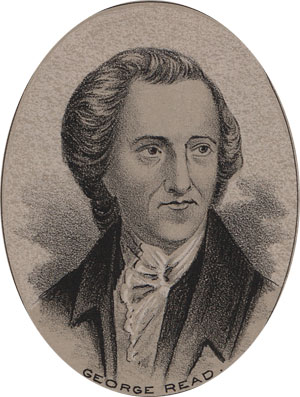
George Read.
Born in the colony of Maryland on September 18, 1733 in the county of Cecil, the young Read was shortly thereafter on the move. His family, while George was an infant, resettled in New Castle, Delaware. When of school age, he attended Reverend Francis Allison’s Academy in New London, Pennsylvania, and one of his classmates was Thomas McKean, a future Signer of the Declaration of Independence as well. George moved on to study law in Philadelphia under the tutelage of John Moland. In 1753, George was admitted to the bar and the next year had settled back in New Castle, Delaware to practice. Continue reading “Six Signers Signing”→
August 8, 2016—James and Dolley Madison at Montpelier, the Madisons’ home in Orange County, Virginia. Cast in bronze, the lie-sized statues were sculpted by Brooklyn-based artist Ivan Schwartz and unveiled May 27, 2009. Madison sits on one end of a bench that gives visitors room to sit next to him for a photo op.
Part Three (click here for first two installments)
Determined to avenge his embarrassing defeat at Cowpens, Lt. Gen. Charles Lord Cornwallis set his army out in a determined pursuit of the American army. Knowing that he was too weak to face Cornwallis in a pitched battle, Maj. Gen. Nathanael Greene, the Southern Department commander, retreated northeastward from Salisbury, North Carolina toward the Virginia state line, where he hoped that additional militia troops would reinforce his army and he would receive supplies. The British chased Greene to the Dan River, near the Virginia border, but Greene wisely put the river between his army and the enemy. Cornwallis and his weary soldiers arrived at the rain-swollen river on February 15, too late to catch Greene’s army, which had finished crossing earlier that day. Frustrated, Cornwallis withdrew to Hillsborough, North Carolina.
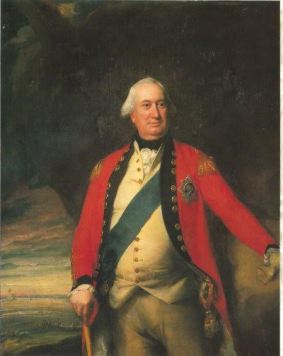
Lord Charles Cornwallis
After receiving both the expected supplies and reinforcements, and after an opportunity to rest his command, Greene soon marched back into North Carolina to face Cornwallis’ tired and poorly supplied army, which now numbered less than 2000 men. After several weeks of skirmishing with Loyalist militiamen and a great deal of maneuvering Greene assumed a defensive position around Guildford Courthouse (near modern Greensboro, North Carolina) on March 14, 1781. Greene had more than 4000 Continentals, militiamen and cavalry, meaning that his army outnumbered Cornwallis’ by more than twice their strength. Continue reading “Defense in Depth as a Revolutionary War Battlefield Tactic”→
I handed over a couple of one dollar bills to pay for my coffee. The image of George Washington caught my eye, and I smiled. It would be nice to relax for a moment and pick-up Valiant Ambition by Nathaniel Philbrick, the Revolutionary War history book I was reading. Settling into a comfortable chair, I soon immersed myself in the drama of the Battle of Princeton. Guided by the book’s text, my imagination created a vivid image of the unfolding conflict. George Washington – looking splendid on a large horse – galloped along, leading his men and shouting “It’s a fine fox-chase, my boys.”[i]
Startled, I closed the book. It seemed too difficult to accept that the “Father of His Country”, the dignified George Washington, and the reserved and diplomatic leader of the 1790’s could be riding recklessly, shouting in a full, commanding voice, and – on other occasions – struggling to keep his temper controlled when dealing with difficult subordinates. Then I felt foolish. My image of George Washington was based on the Gilbert Stuart presidential painting from 1797 that we’d studied in high-school art class!
The past few months of John Champe’s life were probably the most memorable. In the fall he was asked to go on a mission to capture the recent traitor Benedict Arnold. The mission was ordered by George Washington himself and only known to Washington and “Lighthorse” Harry Lee. Champe, a trusted member of Lee’s Legion, was promised a promotion for undertaking the daring mission. He successfully fled from the American camp, gained the trust of British General Sir Henry Clinton and Arnold and was given a commission in Arnold’s Loyalist regiment. He worked with patriots in New York and recruited others to help him in his plan to kidnap Arnold. Now it was December and the next day was the day to kidnap Arnold and return him to Washington.
Then the day before the kidnapping was planned, Clinton set into motion a plan to finally use Arnold militarily. Arnold would take his Loyalist troops and some British regulars and invade the Virginia Capes. Virginia had largely dodged the hardships of war and Clinton believed this would be a great opportunity for Arnold to prove himself. With only Virginia militia located in the colony, Arnold should have no problem wreaking havoc on the Commonwealth.
These new developments ruined Champe and Lee’s plans. When Arnold got orders from Clinton, he moved his headquarters – one day before Champe was to carry out his plan. Furthermore, Champe was also moved to another part of New York and was not able to get word to Lee that the plan was off. Lee and his dragoons waited and waited at Hoboken with no sight of Champe. Soon Lee returned to camp without any word on what happened to Champe. Lee and Washington worried that the worst had happened and Champe was “discovered.”[i]
Grave at John Champe, Prickett Cemetery, Fairmont, WV
Champe soon found himself on a transport in New York harbor with Arnold’s “American Legion.” The destination was unknown to most of the men. Soon though Champe learned that he was to be part of an invasion force against his native state! The thoughts that must have gone through his mind; he had risked everything to capture Arnold – labeled a deserter and now he would have to go into battle against his fellow Virginians. The two week trip to the Virginia Capes must have afforded Champe plenty of time to ponder how close he was coming to succeeding and now what he was called upon to do.
Champe was involved in most of Arnold’s campaign against Virginia. He was part of the force that captured Richmond and found himself in several battles and skirmishes against his fellow Virginians. Arnold was replaced by Gen. William Philips and soon Cornwallis’s army joined Philips in Virginia in May 1781. Sometime after this, Champe was able to “escape” the British army and headed west to the Blue Ridge Mountains. Champe then worked his way south and finally by July he was back with Lee who was then with Nathaniel Greene’s army in the Carolinas. Lee was delighted to see his devoted cavalryman. Surely Champe and Lee had a lot to discuss.
Though Champe was promised a promotion, it was believed by Lee and Washington that it would be too dangerous for Champe to take the field again. If he was captured, the British would surely execute him as a spy. Champe was offered an unknown sum for a reward and headed back home to Loudoun County. His legendary adventure was over.
Sergeant Major John Champe Memorial, Aldie, VA
After the war, Champe did not seek fortune or fame from his exploits. He led a simple life and was a middle class farmer. He struggled to support his family and continuously looked for cheaper and more fertile land to the west. It was due to his desire for new land that he was on a trip looking at land near Morgan Town (modern day Morgantown, WV) in 1798 where he became ill and died. Washington did not forget Champe. In 1798 Washington was appointed by President John Adams commander of the American army in preparation for war with France. Washington called on Champe to be an officer in his army, only finding out that he had recently died.[ii]
Though Champe disappeared mostly from the history books in 1781, his family fought for nearly 100 years to gain the compensation that was due to Champe. Champe was never paid a pension nor given bounty lands that were owed to him for his service. Plus, his promised promotion was never given and they argued that the owed pension should be based off of the rank that was promised him personally by Washington. Unfortunately, the mission was so secret, that very few could confirm it. In petitions filed with Congress in 1818 and 1839, Champe’s widow was finally given a life time pension, though in an amount not reflecting his rank. Finally in 1847, a Congressional act provided for compensation in the amount of $1,200 to the heirs of John Champe and granted him the promotion that was promised to him by Washington. [iii]
Champe has remained a local hero in Loudoun County. In 1861, a local Confederate unit went off to war as the “Champe Rifles” (8th VA Infantry). In the early 20th century, the location of his home was marked with a small obelisk (reportedly made by stone from the foundation of the home). Today the monument sits on the south side of Route 50 a few miles west of Aldie.
In 2001, his grave was finally properly marked with a head stone and a full ceremony. Most recently Champe has been bestowed the highest honor a local hero can be given, a high school in his honor. John Champe High School was opened in Aldie in 2012 and one hopes that his name and legacy will be no longer be forgotten.
Lyrics from Sergeant Champe, ca. 1781
Come sheathe your swords! My gallant boys, And listen to the story, How Sergeant Champe, one gloomy night, Set off to catch the tory
[i]The Revolutionary War Memoirs of General Henry Lee; DeCapo Press, 1998, 409.
The rectitude of the decision John Champe made on that October night to “desert” his men and “join” the British must have weighed heavily on his mind as he approached the Hudson River. The mission, offered by “Lighthorse” Harry Lee, to capture the traitor Benedict Arnold was a serious one. The only hesitation Champe felt was how his reputation and honor would be injured by his desertion. No one but Lee and Washington could know the truth, the success of the mission counted on secrecy.[i]
As Champe reached the Paulus Hook area of the Hudson River, the details are murky. Some accounts have Champe jumping into a boat along the shore and pushing off into the river and rowing to a British war ship. Other claims have Champe clearing a British patrol along the river and escorted by the patrol to a nearby ship. [ii] Either way, Champe eluded his American pursuers and accomplished the first goal of his mission, to reach the British lines.
Lee, already having established a spy network, lined up a system of couriers to communicate with Champe. By October 25th, Lee had heard from Champe and wrote to Washington that “my friend got safe to New York; he was before Sir Henry Clinton and has passed all the forms of the garrison; he accidentally met General Arnold in the street which has paved a natural way for further acquaintance; the party entertains high hope of success…”[iii]
Clinton and Arnold expected many other American officers to be inspired by Arnold and
Sir Henry Clinton
join the British army. Champe, a modest officer in a fabled unit was just the kind of man that Clinton wanted to attract. The fact that Champe was fleeing his own men who were in hot pursuit of him made the deception complete. Clinton questioned Champe about the condition of the American army and morale. Champe informed Clinton that other officers were sure to desert and Washington’s ranks were thinning with men heading home. Clinton soon trusted him to be a deserter and attached him to a unit of Loyalists that Arnold was raising.[iv]
Champe became close to Arnold and spent a lot of time with him. Champe spent a lot of time at Arnold’s headquarters at the King’s Arms Tavern on Broadway in New York City. He would take the next several weeks to study Arnold and his habits. Champe also watched for other deserters joining the British army in New York. The fear by Washington was that Arnold was acting with other American officers in defecting. Soon Champe realized that Arnold had acted alone in his treason.
Finally in early December Champe informed Lee that his plan was to kidnap Arnold one night as Arnold took his nightly walk in a garden next to his headquarters. Champe was even able to recruit fellow patriots to assist him in the kidnapping of Arnold. On the selected night, Champe would have a boat waiting for him at a nearby landing. He also had loosened some of the fence boards around the garden area so he could sneak Arnold out of the garden. After getting Arnold onto the boat, Champe would take him to Hoboken (western side of the Hudson River). There Lee and three of his dragoons would wait for Champe and his cargo. Washington insisted to Lee and then to Champe that Arnold was not to be harmed. Champe was sure of his success and spent days and weeks in planning the capture of Arnold. [v]
As the evening approached, everything was in place. He had earned the confidence of Clinton and Arnold. He was now a sergeant in the British army and spent countless hours preparing and making the necessary connections to fellow patriots in New York. The boat was prepared and waiting, Lee would be at Hoboken with his dragoons. Everything was in place to bring home the traitor Arnold.
[i]The Revolutionary War Memoirs of General Henry Lee; DeCapo Press, 1998, pg. 399.
[ii] “Sergeant John Champe and Certain of His Contemporaries”, William and Mary College Quarterly, April 1937, pg. 153.




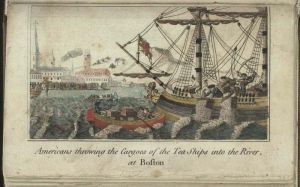 The town meeting held on the night of December 16, 1773 at the Old South Meeting House was no ordinary meeting. Boston was well known for its public meetings, but this one was different. Frequently city leaders called town meetings to discuss important political, economic and social decisions facing the city or colony. The town meeting was a foundation of the political process for Massachusetts and much of the New England colonies. Royal authorities had watched these meetings more closely since the 1760s during the opposition to the Stamp Act. Colonial Whigs (anti Royal leaders) had used these meetings to protest British policies that they saw as threats to their liberties.
 India Company. Before 1773, the company had to sell its tea in London and was subject to duties. The company had collected large quantities of tea in warehouses in London and was looking for a way to disperse the tea at a bargain. The Tea Act allowed the company to sell directly to American ports without paying the duties. This also forced American buyers to only purchase their tea from the East India Company, which was subject to a tax. The good news was the price of tea was reduced because the Company no longer had to pay the duties in London. Colonists resisted the notion that Parliament could force them to buy tea from the East Indian Company (many made a good living off of smuggled tea sales) and that they were required to pay a tax on the tea.
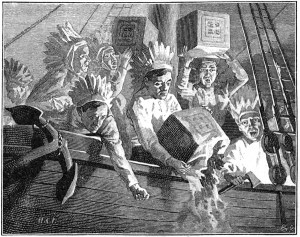 Many details remain unknown about who exactly the “Mohawks” were that marched on Griffin’s Wharf that night. The men used lamp soot and red ochre to disguise their faces and carried a wide assortment of weapons. As they made their way to the wharf, they yelled and “whooped” as Indians in a war party. If they had coordinated the timing with leaders in the Old South Meetinghouse, it is still unknown. The identities of most of these men either were never recorded or are lost to history; that is how tight their veil of secrecy was coupled with their sophisticated organization. As they made their way to the ships, the Whig leaders inside the Old South Meetinghouse stayed behind and were never directly part of what happened next.




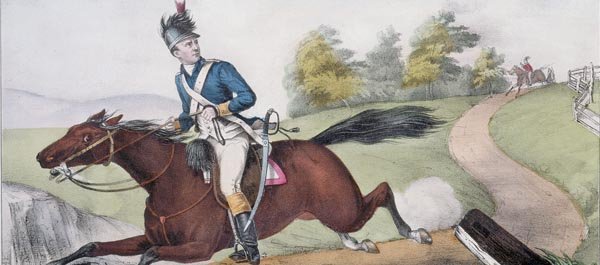


 went off to war as the “Champe Rifles” (8th VA Infantry). In the early 20th century, the location of his home was marked with a small obelisk (reportedly made by stone from the foundation of the home). Today the monument sits on the south side of Route 50 a few miles west of Aldie.

 Emerging Revolutionary War Era
