Book Review: Steven P. Locke, War Along the Wabash: The Ohio Indian Confederacy’s Destruction of the U.S. Army, 1791 (Havertown, PA: Casemate Publishers, 2023).

The frontier is inextricably tied to the early development of the United States under its 1789 Constitution.  In The Treaty of Paris ending the Revolution, Britain legally ceded its territories north of the Ohio and east of the Mississippi Rivers up to the borders of Canada to the United States—the very same territory it had claimed from France at the end of the Seven Years War.  While European states might redraw borders, they did not consult the people actually living in the area.  Congress proclaimed the area the Northwest Territory and in the following years, native people, particularly the Native nations living in modern Ohio, Indiana, and Michigan fought a lengthy war with the new Unites States, inflicting one of its worst defeats on the United States Army and coming closer than any other Native American coalition to halting, or at least slowing, the spread of white society beyond the Appalachians.

            Steven P. Locke, in his new book, War Along the Wabash, chronicles the first major campaign of the United States Army in what has become known as the War of the Northwest Territory.  In 1791, frustrated by Indian attacks on frontier settlements that had not stopped after the American Revolution, Congress authorized the Washington Administration to raise an army and conduct a campaign against the Ohio Indians, the Miami, Seneca/Cayuga, Shawnee, Wyandot, Odawa, Ojibwe, Potawatomi, and Delaware.  Major General Arthur St. Clair, a veteran of the Revolutionary War, was Governor of the Northwest Territory and took personal command of the army created for the campaign.  His objective was simple enough, to launch his army from Fort Washington in modern Cincinnati to Kekionga, a cluster of Native American villages at the portage between the Maumee and Wabash Rivers in modern Fort Wayne.  Presumably, Americans ensconced in such a fort would be able to readily overawe the local tribes in their homes, force a Native American recognition of American “ownership” of the Ohio Country, and stop Indian raids along and across the Ohio River.  St. Clair received command on March 4, 1791 and was expected to march out of Fort Washington by July 10, hardly sufficient time to recruit, organize, train, and equip an army large enough for the task before him, particularly on the sparsely populated frontier.   Federal troops and supplies had to come all the way from the east coast by way of Pittsburgh and the Ohio River, while Kentucky provided militia and filled out some provisional levies. 

            Despite his intimate experience with the connection between military operations and logistical support, Secretary of War Henry Knox pressed St. Clair all summer to get his troops moving.  St. Clair, of course, could not.   The Americans had already launched mounted raids into Native American territory, which generally resulted in burned villages and despoiled crops.  According to Locke, the speed with which those raids proceeded highlights the cross-purposes under which St. Clair’s campaign would take place.  He could either move quickly with a largely mounted force over existing trails or take a more deliberate, plodding approach through the wilderness by building a road, which necessitated infantry and engineers.  St. Clair chose the latter, but the pressure from Knox and President Washington never ceased.  St. Clair responded by marching the army out of Fort Washington in September and slowly moving northward, building a road, camps, and forts as it moved a little over two miles a day, even before the army had fully assembled at Fort Washington. Indeed, in the first month, St. Clair was not usually with the army, consumed by logistical duties as he shuttled back and forth from Fort Washington or Kentucky gathering supplies and militia and then moving them forward over the newly built, yet still primitive, road. 

            By November 3, 1791, St. Clair had rejoined his army and reached the headwaters of the Wabash River with one regular infantry regiment, two levy regiments, and assorted militia, artillery, dragoons, teamsters, and camp followers.  Altogether, it was about 1,400 men.  Mistakenly believing he was closer to Kekionga than was the case and that the Indians would not attack, he did not build breastworks that night, but deployed his army in two lines with some militia thrown across a creek and various outposts scattered around his position.  He had detached his best federal regiment and sent it back down the trail to escort a supply train coming up to feed the army.  Thus, the United States Army was at its weakest point during the campaign when the Indians of the emerging Ohio Indian Confederacy struck early the next morning.  

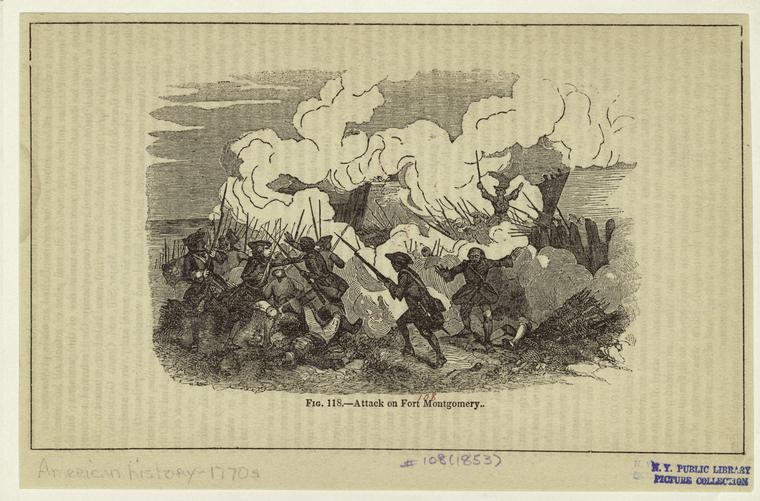
            The Confederacy force of 1,100 warriors applied traditional tactics, quickly routing the forward militia and then moving along the flanks to the rear, essentially surrounding St. Clair and then pressing ever tighter.  Sniping from cover, the Indians seemed immune to American fire while inflicting heavy losses on the defenders.   St. Clair launched two bayonet charges to restore his lines.  As usual, the Native Americans gave way to the bayonet charges and then moved around the charging unit’s flanks as it separated from the main army, bringing each under a withering cross-fire.  In a sense, St. Clair carved up his own army and dished out pieces for the Confederacy to consume.  By the time St. Clair launched a third bayonet charge to clear his route of retreat, his army had collapsed.   He escaped with 500 men, leaving 900 dead, dying, or wounded on the battlefield, including dozens of women and children among his camp followers.  (Estimates of American losses vary widely among historians.)  The disaster was worse than General Braddock’s defeat on the Monongahela in 1755, or Custer’s in 1876.  War Along the Wabash is at its strongest when relating and analyzing the battle.  

            Locke tells the entire tale well, discusses the difficulties of raising an army from virtually nothing, includes small biographies of major “characters” as he introduces them, pays careful attention to logistics, which are often overlooked in campaign histories and were critical in the unfolding of St. Clair’s campaign, analyzes decisions and strategies, and discusses the fallout after St. Clair returned to Philadelphia to defend his decision-making.  While most of the story is from the American perspective, which is better documented, Locke makes a serious effort to address Native American perspectives and experiences as they assembled and fought the American army.  

All that said, he lapses into odd, avoidable errors from time to time.  In my Kindle edition, Locke writes on page 397 that there were approximately 400 commissioned officers in the army (nearly 1 in 3 of the total force) at the beginning of the battle, just 150 of whom remained at the end, meaning 250 commissioned officers were killed during the battle.  Yet, on page 429 he notes 69 out of 124 commissioned officers being killed or wounded during the three-hour battle.  Collectively—and there are more eyebrow-raising moments—such errors or inconsistencies distract from the book’s overall strengths, which are considerable.  

In 1793, during his campaign against the Ohio Indian Confederacy, Major General Anthony Wayne led his army up St. Clair’s trace and built a fort near the battlefield, identifiable by the large number of human remains and camp detritus, which he named Fort Recovery.  A town, still named Fort Recovery, grew up there, and the site of the battle largely lies under Wayne Street.   (Museums and parks around town commemorate both St. Clair’s defeat and Wayne’s subsequent campaign).  War Along the Wabash is an excellent starting point to understand St. Clair’s campaign and the defeat that often bears his name.  It will not be the last word, but it sets a high bar that future historians will have to work hard to surpass.  

Rev War Revelry: Old South Meeting House and the Boston Tea Party

Join us this Sunday, October 15th at 7pm as we welcome Matthew Wilding, Director of Education and Interpretation at Revolutionary Spaces. Revolutionary Spaces manages the Old South Meeting House and the Old State House in historic Boston. We will discuss the history of the Old South Meeting House and its important role in the revolutionary movement in Boston (especially during the Boston Tea Party). We will also cover their plans for the 250th anniversary of the Boston Tea Party, including their new exhibit on the destruction of property in public protests.

Grab a drink and follow along as we start to gear up for the 250th anniversary of the Boston Tea Party with Emerging Revolutionary War!

October 1, 2023 Rev War Revelry: The Camden Re-Burial Project: Discussion with Archeologists and Scholars James Legg & Steven Smith, Ph.D

Join us as we discuss the excavation and successful recovery of the remains of 14 veterans of the August 16, 1780, Battle of Camden with James Legg and Steven Smith, Ph.D., the lead archeologists of the Camden Re-Burial Project which began in September 2022. We will discuss the indepth research conducted and the precise archaeological work that was done on the battlefield. Also learn about the reburial ceremony and where the soldiers were finally laid to rest.

This is a great opportunity to learn about a rare discovery on a American Revolutionary War battlefield. The Camden battlefield is a great archaeological site that is revealing multiple stories and helping historians piece together a better understanding of the battle. Grab a drink and join us on our Facebook page for a great evening of archaeology and history!

Tidbits of Research…

For those that write and research it can be a personal albeit lonely endeavor. Hours spent in libraries or archives, humped over your computer or pad and pencil taking copious notes. Eyes going bleary or cross-eyed trying to decipher 18th century handwriting or microfilmed pieces of primary data. But, at the same time, it is such a rewarding experience, is it not? Uncovering the past, shedding light on the personalities that comprise the fabric of American history. Maybe even finding overlooked accounts or information that changes the narrative or promotes a fuller picture?

For me, I enjoy finding quotes or descriptions that creates a better understanding of the world in which the soldiers and civilians of the American Revolutionary or American Civil War periods lived. Anything that humanizes them more I feel makes them relatable. Breathes life into who they were, instead of just what comes through in official dispatches, reports, or polished accounts they left behind. One way is to read the accounts of fellow officers or compatriots as they discuss or describe their fellow comrades-in-arms.

Or there is just Israel Putnam. The patriot general who on April 19, 1775 when hearing of the British march to Lexington and Concord famously left his plow in a half plowed farm field to rush from Connecticut to Massachusetts. In the process he rallied his militia and stuck around for the siege that followed the first shots of what would become the American Revolution.

Israel Putnam

That is where I picked up his tale. Researching an upcoming volume of the Emerging Revolutionary War Series. (Stay tuned for what that will be in the upcoming months. Yes, “vague booking” and self-promotion happening!) During the siege of Boston he was asked in a meeting of general officers about the “expediency of intrenching” as a few of the gathered were doubtful of its efficacy on the psyche of the volunteer militia.

Putnam’s response fit the mold mentioned above, of providing a human touch to the notes of that meeting and a bit of 18th century humor for added measure.

The general responded, “earnest in his advocacy of the measure” that,

“The Americans are not at all afraid of their heads, though very much afraid of their legs: if you cover these, they will fight for ever.”

Time and defensive tactics would uncover the truth of that statement.

In closing, what is a favorite line, anecdote that is not well known from the American Revolutionary period that resonates with you?

With Lucy Knox on the Home Front

Henry Knox received much of the glory and distinction in the Knox family during the war years. Yet, his wife, Lucy Knox, had much to say to her husband regrading the future if the war effort turned out successfully for the colonies. Lucy, a daughter of loyalists who ultimately sailed for England at the start of war, remained in Boston, Massachusetts while her husband rode off to war and Washington’s army. Much of her correspondence to Henry during the war focused on events in and around Boston, news from the various battlefield fronts that had reached the city, the family business, and many other assorted topics. But, she also made sure to remind Henry that upon his return home, he would no longer be in command, nor have a generalship around the house; rather he would need to be willing to share “equal command” within the household.

Read more: With Lucy Knox on the Home Front

The following letter, written on August 23, 1777, finds Lucy at home, slowly recuperating from a days-long illness. Wanting to hear more of her daily routine while he was gone, she obliged Henry’s request to write about the ebb and flow of her life at home each day. She notes her solitary lifestyle now that both her parents are gone as well as her husband but shares with him the comfort she finds when opportunity allows to spend time with friends. Lucy, like many other wives and families left behind on the homefront fears that she may be forgotten during his extended time with the army. Then, Lucy shifts to news from the war front and requests information regarding several in the army in which Henry might know. It is also evident, as the letter draws to an end, that inflation on goods, and subsequent supply thereof, has led her to need more money from her husband in which to purchase linen.

The following letter is courtesy of The Gilder Lehrman Institute of American History.

Boston August 23rd 1777 –

My Dearest Friend –

I wrote you a line by the last post just to lett you know I was alive which indeed was all I could then say with propriety for I [struck: then] had serious thoughts that I never should see you again – so much was I reduced by only four days illness but by help of a good constitution I am surprisingly better today – I am now to answer your three last letters in one of which you ask for a history of my life. it is my love so barren of adventures and so replete with repetition that I fear it will afford you little amusement – however such as it is I give it you – In the first place, I rise about eight in the morning (a lazy hour you will say – but the day after that, is full long for a person in my situation) I presently after sitt down to my breakfast, where a page in my book, and a dish of tea, employ me alternately for about an hour – when after seeing that family matters go on right, I [struck: repeair] repair to my work, my book, or my pen, for the rest of the forenoon – at two oclock I usually take my solitary dinner where I reflect upon my past happiness when I used to sitt at the window watching for my Harry – and when I saw him coming my heart would leap for joy – when he was all my own and never happy from me when the bare thought of six months absence would have shocked him – to divert these ideas I place my little Lucy by me at table – but the more engaging her little actions are so much the more do I regret the absence of her father who would take such delight in them. – in the afternoon I commonly take my chaise, and ride into the country or go to drink tea with one of my few [struck: acquaintance] [inserted: friends]. They consist of Mrs Jarviss Mrs Sears Mrs Smith Mrs Pollard and my Aunt Waldo – I have many acquaintance beside these whom I visit but not without ceremony – when with any of [inserted: the] former I often spend the evening – but when I return home – how shall describe my feelings to find myself intirely alone – to reflect that the only friend I have in the world is at such an imense distance from me – to think that [inserted: he] may [inserted: be] sick and I cannot assist him ah poor me my heart is ready to burst, you who know what a trifle would make me unhappy, can conceive what I suffer now. –

when I seriously reflect that I have lost my father Mother Brother and Sisters – intirely lost them – I am half distracted true I chearfully resigned them for one far dearer to me than all of them – but I am totaly deprived of him – I have not seen him for almost six months – and he writes me without pointing out any method by which I may ever expect to see him again – tis hard my Harry indeed it is I love you with the tenderest the purest affection – I would undergo any hardships to be near you and you will not lett me – suppose this campaign should be like the last carried into the winter – do you intend not to see me in all that time – tell me dear what your plan is –

I wrote you that the Hero Sailed while I was at Newburg – She did but has [jnserted: been] cruiseing about from harbour to harbour since – to get met – she is now here, and will sail in a day or two for france –

I wish I had fifty guinies to spare to send by her for necessarys – but I have not – the very little gold we have must be reserved for my Love in case he should be taken – for friends in such a case are not too common. – I am more distressed from the hott weather than any other fears – God grant you may not go farther south’ard – if you should I possitively will come too – I believe Genl Howe is a paltry fellow – but happy for as that he is so – are you not much pleased with the news from the Northard we think it is a great affair and a confirmation of StClairs villainy baseness – I hope he will not go unpunished – we hear also that Genl Gates is to go back to his command. – if so Master Schuyler, cannot be guiltless – it is very strange, you never mentioned that affair in any of your letters –

Catharine Littlefield Greene – Courtesy Telfair Museums

What has become of Mrs Greene, do you all live together – or how do you manage – is Billy to remain with you payless or is he to have a com[inserted: m]ission – if the former I think he had much better remained where he was – if he understood business he might without a capital have made a fortune – people here – without advanceing a shilling frequently clear hundreds in a day – such chaps as Eben Oliver – are all men of fortune – while persons – who have ever lived in affluence – are in danger of want – oh that you had less of the military man about you – you might then after the war have lived at ease all the days of your life – but now I don’t know what you will do – your being long acustomed to command – will make you too haughty for mercantile matters – tho I hope you will not consider yourself as commander in chief of your own house – but be convinced tho not in the affair of Mr Coudre that there is such a thing as equal command – I send this by CaptRandal who says he expects to remain with you – pray how many of these lads have have you – I am sure they must be very expensive – I am in want of some square dollars – which I expect from you to by me a peace of linen an article I can do no longer without haveing had no recruit of that kind for almost five years – girls in general when they marry are well stocked with those things but poor I had no such advantage –

little Lucy who is without exception the sweetest child in the world – sends you a kiss but where [inserted: shall] I take it from say you – from the paper I hope – but dare I say I sometimes fear [struck: what] [inserted: that] a long absence the force of bad example may lead you to forget me at sometimes – to know that it ever gave you pleasure to be in company with the finest woman in the world, would be worse that death to me – but it is not so, my Harry is too just too delicate too sincere – and too fond of his Lucy to admit the most remote thought of that distracting kind –away with it – don’t be angry with me my Love – I am not jealous of you affection – I love you with a love as true and sacred as ever entered the human heart – but from a diffidence of my own merit I sometimes fear you will Love me less – after being so long from me – if you should may my life end before I know it – that I may die thinking you wholly mine –

Adieu my love
LK

“Rev War Revelry” Founding Martyr Dr. Joseph Warren

Dr. Joseph Warren is considered by many “the lost hero of the American Revolution.” Warren was the brainchild of the revolution movement in Boston. Warren was involved in almost every major insurrectionary act in the Boston area for a decade, from the Stamp Act protests to the Boston Massacre to the Boston Tea Party, and his incendiary writings included the famous Suffolk Resolves, which helped unite the colonies against Britain and inspired the Declaration of Independence.

Joining Emerging Revolutionary War will be historian and author Christian Di Spigna. He is the author of Founding Martyr: The Life and Death of Dr. Joseph Warren, the American Revolution’s lost hero. He is the Executive Director of the Dr. Joseph Warren Foundation and is the vice chairman for the Revolution 250 committee of Massachusetts Freemasons. He also serves on the board of the Bunker Hill Monument Association.

As we approach the 250th commemoration of the Boston Tea Party, we will focus on Warren’s life, his role in the Boston Tea Party and his lasting impact on the Revolution. Grab a drink and join us as we talk with author and historian Di Spigna about Warren, the patriot who once said…

“When Liberty is the prize, who would shun the warfare? Who would stoop to waste a coward thought on life?”

See you Sunday at 7 p.m. EDT on Emerging Revolutionary War’s Facebook page!

Rev War Revelry: New Book on the Battle of Camden “All That Can be Expected: The Battle of Camden and the British High Tide in the South”

This Sunday, August 6th at 7pm join ERW series editor Dan Welch and authors Rob Orrison and Mark Wilcox as they discuss one of the worst defeats in American history, the Battle of Camden. How did the hero of Saratoga end up the scapegoat in the south? Learn how a coincidence led to a great British victory. And how did the Patriots recover from such a large defeat and find a path to victory a year later? Orrison and Wilcox will also discuss their upcoming book “All That Can be Expected, The Battle of Camden”. Grab a drink and join us to learn more about the Battle of Camden!

All Rev War Revelries can be found LIVE on our Facebook page, or a week later on our You Tube and Spotify channels.

Visiting Historic Kenmore: A Preserved Patriot’s Home in Fredericksburg Virginia

Emerging Revolutionary War welcomes back guest historian Kate Bitely.

In the heart of Fredericksburg, Virginia, you will find a well-preserved, Georgian-style home that once belonged to Betty Washington Lewis, the sister of George Washington. Historic Kenmore, as the home is known today, was constructed in the 1770s and originally sat on 861 acres near downtown Fredericksburg. Today, the historic house museum is open for daily tours where guests can explore the gardens, the main living floor of the home, several historic structures on the priority, and a visitor center filled with riveting artifacts and information. 

Nearly 290 years ago, Betty Washington was born at Pope’s Creek in Westmoreland County, Virginia. As a young child, she lived in a few properties owned by the Washington family before relocating to Ferry Farm, located in Stafford County, Virginia, where Betty, George and their siblings grew up. On February 22, 1750, Betty married Fielding Lewis, a widowed distant cousin, and a father of two young children. In 1752, the family purchased 1300 acres in the Fredericksburg area and allocated a portion of the land as the future site for their home Millbrook, which was eventually renamed to Kenmore in the 1800’s. In total, Betty and Fielding welcomed eleven children, but only six survived to adulthood.

Fielding Lewis was a well-known member of his community. He built his wealth initially as a merchant, but was later elected as a member of the House of Burgesses and served as a colonel in the Revolutionary War. During the war, however, Lewis used his finances to personally pay for munitions and supplies for Patriot troops which ultimately drained much of the family’s resources.

The Lewis family were staunch Patriots. In 1775, when the Lewis’s were moving into their home, the spirit of independence was strong throughout the colonies. Given the Washington’s status, heritage and devotion to service, Betty and her family would become one of the biggest supporters for the Patriot cause, willing to risk their home, finances, reputation, and their safety in favor of breaking away from England. The impressive residence served as a visual representation of their wealth, which became significantly more important during the Revolutionary War.

Continue reading “Visiting Historic Kenmore: A Preserved Patriot’s Home in Fredericksburg Virginia”

Review: “East Florida in the Revolutionary Era, 1763–1785” by George Kotlik

Thirteen of the Great Britain’s North American colonies moved toward independence in 1775, declaring the fact officially the following year with the issuance of the Declaration of Independence. Perched below these thirteen rebellious provinces was the colony of East Florida. Earned after the Seven Year’s War by Great Britain from Spain, the most populous city an oldest permanently established European metropolis was St. Augustine, which was also the capital of the colony. This colony, through the eight years of the American Revolutionary War, had a tenuous connection with their neighbors to the north. Largely forgotten in the pantheon of history describing this period, from the time of Britain gaining possession in 1763 through the end of the Revolutionary era in this historian’s estimation, in 1785.

Entitled, East Florida in the Revolutionary Era, 1763-1785 and penned by George Kotlik, a historian specializing in 18th century North American history, the publication offers “an accessible and detailed narrative of the East Florida during the American Revolution.” (pg. 8).

What ensues in the following pages is a brief yet complete overview of the military, political, social, and economic history within those years of East Florida. Some of the names in the pages are well known to enthusiasts of the American Revolutionary War era whereas others will be new names to add to the repertoire for further study. From Governor Patrick Tonyn, British general and last governor for England of East Florida to bringing attention to the William Augustus Bowles, a Maryland born Loyalist, sympathetic to the Muscogee Native Americans of East Florida who tried in vain from the last decade of the 18th century, to establish an independent state for the tribe, with British support. These are just two of the historical personas that Kotlik discusses in his narrative, the rest await you within the pages of the book!

Although no major military actions happened within the confines of the colony that does not mean the role of East Florida in relation to the American Revolution should not be marginalized. “Militias were raised, a general assembly was postponed, St. Augustine experienced a heightened British troop presence, planters between the St. Johns and St. Marys Rivers suffered at the hands of George raiding parties, and a constant threat of a Spanish or American invasion” all affected the psyches and lives of East Floridians. (pg. 104-105).

The hope from Kotlik is to provide the launching point for further discussion into the role of East Florida specifically and Florida in general during the revolutionary period. “Such a lack of coverage is a reminder for scholars to to emphasize East Florida’s presence in the war that made America.” (pg. 111). With this history in hand, Kotlik has provided the necessary overview for further exploration.

Publisher: NewSouth Books, University of Georgia Press, 2023
156 pages plus images

“Let’s All Sit Down Now and Have a Hearty Cry”

The summer of 1776 was tense on the Kentucky frontier. Since the spring, Shawnee raids from north of the Ohio had increased, with tribesmen raiding the white settlements with the intention of driving the settlers east, back across the mountains.

By the late spring, hardly more than 200 Americans remained in Kentucky, most forting up in the settlements south of the Kentucky River at Harrodsburg, Logan’s Station, and Boonesborough as war parties ranged nearby. Years later, an old settler remembered the rancid conditions of long confinements in “a row or two of smoky cabins, among dirty women and men with greasy hunting shirts.” By the summer, conditions in the forts were almost unbearable as supplies of salt and meat began to run low.

On the quiet Sunday afternoon of July 14, 1776, 13-year-old Jemima Boone, daughter of frontiersman Daniel Boone, slipped out of the log gates of Boonesborough with her friends Elizabeth (Betsy) and Frances (Fanny) Calloway. Tired of the confinement of the fort, the three girls untied the lone canoe of the settlement and pushed out into the Kentucky River for an old-style joy ride. Jemima would remember years later that her father had warned her to stay near the cabins and never cross to the other side of the river.

Betsy Calloway, 16, guided the canoe but it was soon caught up in the current and taken downstream toward the northern bank. A small mixed war party of Shawnees and Cherokees were watching the settlement from the woods across the river. They had been in the area for at least a week when they spotted the girls in the canoe. As the craft got close to the shore a warrior jumped into the river and grabbed the towline. Understanding immediately the danger they were in all three girls began to scream. The warriors brought the canoe to shore and quickly made signs to the girls of what would happen if they continued screaming. But the sounds had already alerted the settlers in the fort.

It was Sunday, the Sabbath and, as was his normal custom, Daniel Boone was lying down for his Sunday afternoon nap when he heard the commotion from out in the fort. Running out of his cabin in his bare feet, Boone joined with Richard Calloway, father of Betsy and Fanny, and several other men of the settlement as they eventually made their way to the opposite shore of the river and began tracking the war party as it made its way towards the crossing of the Licking River at the upper Blue Licks.

One of the Cherokee men in the party was named Scolacutta but known to the Americans as Hanging Maw. He knew Daniel Boone and his family and spoke a bit of English. He recognized Jemima as Boone’s daughter. Hanging Maw laughed at the joke they were playing on old Boone, Jemima remembered many years later, and confirmed they were headed for the Shawnee towns north of the Ohio. If the party managed to get across the big river, the rescue of the girls would most likely become impossible. As they were forced along the trail, the three girls dug their heels into the earth or dropped bits of material from their clothing; anything to give signs to anyone who may be following that they were on the right path.

By the morning of the second day, Boone and his party were roughly 10 miles behind the kidnappers. Now with a pretty good idea of where the war party was heading and understanding that, continuing to follow the tracks would slow them down considerably, Daniel Boone made the decision to break from the trail and speedily head for the Blue Licks. It was certainly a gamble but the men with Boone trusted his judgment. The Kentuckians moved out, setting a jogging pace.

As they got closer to the war party, the rescuers began finding the signs left for them by the kidnapped girls. They also came across muddled waters at a creek crossing, a dead snake along the trail and finally the carcass of a recently butchered buffalo calf. They knew they were getting close. Boone figured the warriors would stop to cook at the next water they came across. At a branch known today as Bald Eagle Creek, east of the current town of Sharpsburg, KY, the trail ended. Boone divided his party, with four men going up stream and four heading down.

After two days of hard travel with no sign of pursuit, the warriors began relax a bit. They would soon cross the Licking River and link up with other war parties so they began feeling confident. They made camp and began to roast the buffalo meat. The terrified girls were exhausted by being on the march. The camp was in a small, open glen. As the warriors lolled about the girls were sitting near the cook fire. Suddenly, Jemima Boone heard a noise in the brush. The sound caught the attention of one of the Shawnees who looked up but, seeing nothing, returned to his work. Glancing up along the nearby ridge, Jemima suddenly caught sight of her father. The girl remembered he was “creeping upon his breast like a snake.” Around 100 yards or so apart, the father and daughter locked eyes. Boone gave a quick signal for the girl to remain quiet.

The rest of Boone’s party were gathered up on the ridge when, in a fit of excitement, one of them fired his rifle down into the camp. Before she heard the shot, Fanny Calloway saw blood spurt from the chest of the warrior standing next to the campfire. He managed to hobble off into the brush. “That’s Daddy!” Jemima cried as she and the other girls hit the ground with shots filling the air from the rescue party above. Boone’s party rushed down into the camp among the startled warriors. Those tribesmen not hit by rifle fire managed to escape into the woods. All at once the terrible ordeal was over, for both father and daughter. “Thank Almighty Providence, boys,” Boone said, “for we have the girls safe. Let’s all sit down by them now and have a hearty cry.” Jemima Boone would long remember that “there was not a dry eye in the company.”

The story of the kidnapping and rescue would be retold in the Boone and Calloway families for generations. In the 19th century, historian Lyman Draper collected accounts of the story from at least forty people. This would become one of the most famous episodes in the life of Daniel Boone and provide the inspiration for author James Fenimore Cooper in his novel “The Last of the Mohicans”.