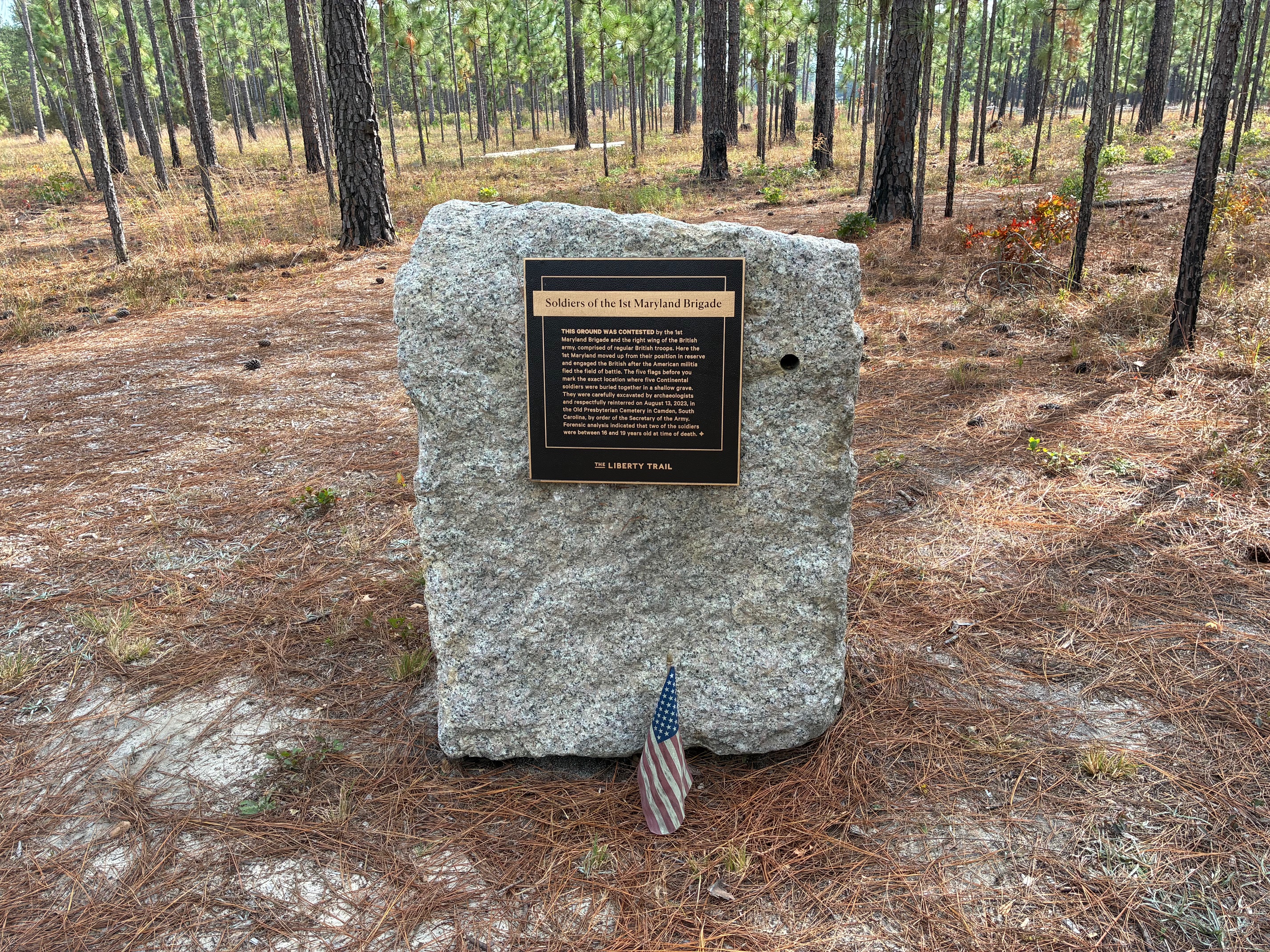
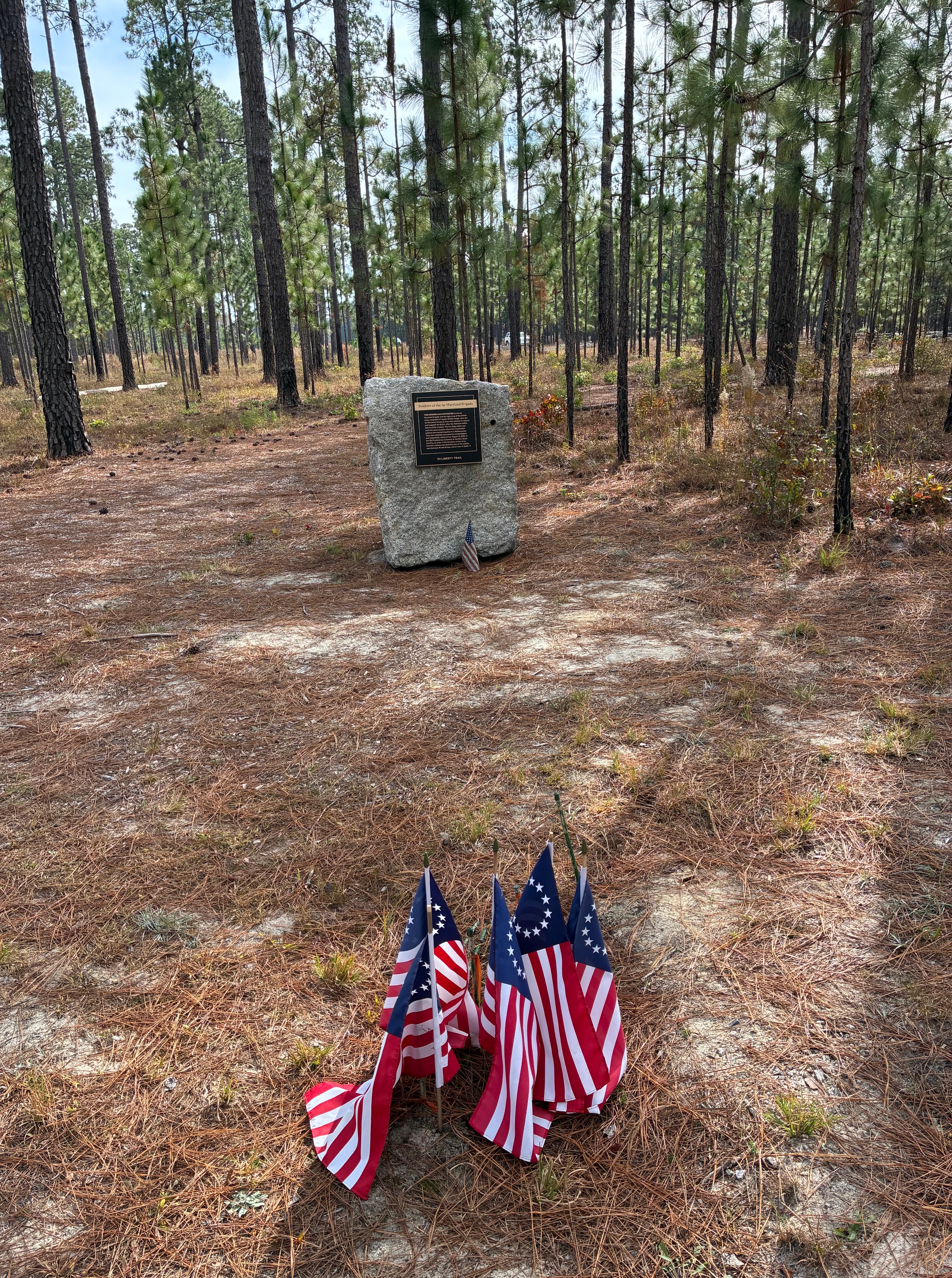
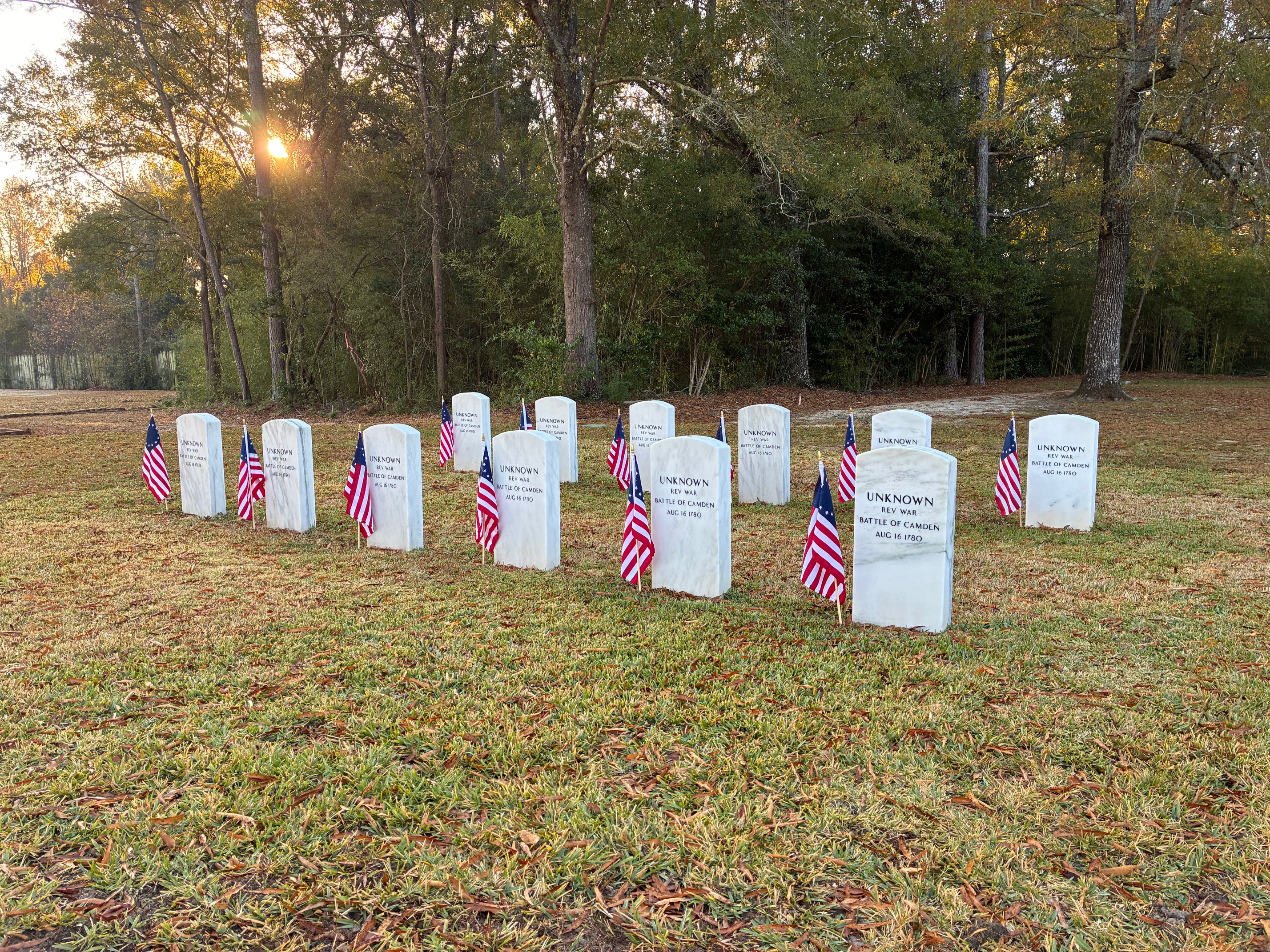
On Veteran’s Day in 2022, the American Battlefield Trust published the following article on their website “Archaeologists, Historians Unearth Remarkable Discovery at Camden Battlefield.” The Battle of Camden, fought in South Carolina on August 16, 1780, was a disastrous defeat for the American army, which suffered 1,900 casualties out of 3,700 engaged. Among those 1,900 approximate casualties were 5 Marylanders of the 1st Maryland Brigade. Over 242 years later, these five soldiers’ remains were found on the battlefield in a shallow grave. Another nine were found buried in other sites on the hallowed ground of Camden.
With forensic analysis and other research done in the ensuing months, a few facts about who these men were came to light. One of the most poignant discoveries was the age of two of the fallen Marylanders. Their ages were 16 to 19 years of age.
Although I have studied, lectured, and written about numerous engagements in two American wars, the simple fact of how young these soldiers were, as I read the memorial bronze plaque on the boulder monument, gives a deeper sense of sadness. Wars kill people of all ages, bullets don’t differentiate.
As we enter the holiday season and gather with friends and family, young and old, the fact that one of these soldiers, as young as 16, possibly, sacrificed his life, still name unknown, and lost to history for over 242 years. A family never knew what happened to their relation.
It is why it is invaluable that history continues to be studied. Archaeology is still important. And preservation of hallowed ground, like Camden, is worth preserving and interpreting. As you spend your holidays in the fashion that suits you, take a moment to think about a fallen soldier at Camden, in August 1780, sacrificed at sixteen.
Monument to the MarylandersThe flags mark the location of the five remainsGravestones of nine American soldiers, their remains found on the Camden Battlefield, now in the Revolutionary War Memorial outisde Quaker Cemetery in Camden, SC.
Join us this Sunday, December 14th at 7pm as we return LIVE for this Rev War Revelry on the Canadian Campaign of 1775. We will discuss Arnold, Montgomery, Morgan and others on America’s attempt to capture Montreal, Quebec and create a “14th state.” From Arnold’s arduous march to Quebec through the wilds of Maine to Montgomery’s capture of Montreal, our historians Alex Cain and Mike Cecere will cover the entire campaign and answer the question “was the capture of Canada possible?”
This fall and winter mark the 250th anniversary of the campaign and the battles of Montreal and Quebec, and both of our speakers have taken part in the commemorative events. Grab a drink and watch live on our Facebook page, also add questions in the chat.
There is a lot of anticipation on the upcoming Ken Burns’ documentary on the American Revolution. The series will run on PBS starting this Sunday at 8pm and running through Friday. Emerging Revolutionary War invites you to join us each night at 10pm on our Facebook page as we recap each episode with our Emerging Revolutionary War historians. These will be live streams, so join in on the discussion via the chat.
We have seen various previews of the documentary and we are excited about the potential this series might have on generating more public interest in the American Revolution and the 250th anniversary events over the next six years.
Be sure to join us and we hope to see you at 10pm on Sunday night!
Emerging Revolutionary War welcomes back guest historian Evan Portman
Most historians credit Ann Pamela Cunningham with kickstarting the historic preservation movement with her purchase of Mount Vernon in 1858. However, preservation of historic sites began long before the Mount Vernon Ladies’ Association. In fact, the storied walls of Fort Ticonderoga became the object of a preservation movement 38 years before the Ladies’ Association purchased George Washington’s ancestral home.
Fort Ticonderoga—known as the Gibraltar of North America—played an integral role in both the French and Indian War and the American Revolution. The fort was originally constructed by the French in 1755 on a portage known to the Iroquois as ticonderoga, meaning a “land between two waters.” Fort Carillon, as it was known to the French, stood strategically between Lake Champlain and Lake George, thereby controlling both the Hudson River Valley and St. Lawrence River Valley. On July 8, 1758, an outnumbered French army successfully defended the fort against British forces in the bloodiest battle of the French and Indian War.[1] However, the following year British General Jeffery Amherst captured the fort and renamed it Fort Ticonderoga.[2]
By the American Revolution, the fort had fallen into disrepair but was still guarded by a small British garrison. In 1775, it was the scene of one of the most famous dramas in American history. On May 10, Col. Benedict Arnold and Col. Ethan Allen led a combined force of the Green Mountain Boys and Massachusetts and Connecticut militiamen across Lake Champlain to capture the fort. “Come out you old Rat!” Allen famously cried to the fort’s commander, Capt. William Delaplace, and demanded he surrender the garrison “in the name of the Great Jehovah and the Continental Congress.”[3] Delaplace agreed, and Ticonderoga quickly fell into American hands.
Starting on Sunday, November 16, 2025 PBS will air the much anticipated “The American Revolution” documentary. The 12 hour documentary will run every night from 8pm-10pm, Sunday through Friday (November 21st). Years in the making, the documentary coincides with the 250th anniversary of the American Revolution and the birth of our nation.
We are excited to announce that every night during the documentary at 10pm, Emerging Revolutionary War will live stream a discussion on our Facebook page with ERW historians discussing that night’s episode. You can join in via the online chat to ask questions and respond to our reviews of each episode. There will be different historians on each night, so tune in and join the lively discussion!
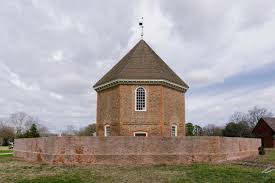
Powder Magazine, Colonial Williamsburg, VA in 2025
Today marks the 250th anniversary of the Virginia Powder Alarm in Williamsburg, VA. To commemorate the anniversary, join us this Sunday, April 27th at 7pm on our Facebook page as we welcome ERW historians Rob Orrison, Mark Maloy with Maureen Wiese and J. Michael Moore to discuss the events leading up to the April 21, 1775 Powder Incident in Williamsburg, VA. A few days after Lexington and Concord (unknown to the Virginians at the time), Governor Lord Dunmore removed powder from the magazine in Williamsburg. This event led Patrick Henry to lead militia towards Williamsburg and possible standoff with the Governor. As news arrived on April 28 of the bloodshed outside of Boston, tensions rose even higher.
Join us as we discuss another 250th anniversary event that led to the beginning of the American Revolution. This podcast will be recorded and posted on our Facebook page on April 27th at 7pm. Then it will be posted to your You Tube and Spotify pages.
ERW Welcomes Matt Beres, Executive Director of the Arlington Historical Society
On the morning of April 19, 1775, the first shot of America’s War for Independence was fired on the Lexington Green. Later that morning, Major John Buttrick, commanding the local Provincial forces, gave the order to fire on the British Regulars at the North Bridge. This act would later be remembered as the “Shot Heard ‘Round the World,” a phrase immortalized by Ralph Waldo Emerson.
As Lt. Col. Smith’s British Regulars began their retreat back to Boston, Governor Thomas Gage sent a relief column of Regulars, led by General Hugh Percy. Meanwhile, Provincial militias and minute companies from surrounding towns marched toward the conflict, firing on both sides of the main road leading back to Boston. The Battle was just beginning.
While Lexington is famous as the site of the “first shot” and Concord for the “Shot Heard ‘Round the World,” Menotomy (present-day Arlington) is known as the site of the largest battle of the day, where fierce fighting erupted between the retreating British forces and the growing Provincial forces. The following stories are from this Battle.
David Lamson
Earlier that day, a convoy of provisions and supplies, protected by a detachment of British Regulars, arrived behind the main force heading toward Lexington and faced difficulties crossing the Brighton Bridge. Before their arrival, the Committee of Safety had removed the planks, and the combination of heavy wagons and repairs to the bridge caused the convoy to become separated from the main force, rendering it vulnerable.
An alarm rider from Cambridge alerted locals, prompting men from the ‘exempt’ or ‘alarm’ list—those unfit for regular Militia or Minute companies—to gather at Cooper’s Tavern to plan to capture the convoy. Among them was David Lamson, a biracial French and Indian War veteran, whose experience and bravery made him a natural leader. The group quickly appointed him as their Commanding Officer.
According to a story derived from Lamson himself, they positioned themselves behind a stone wall near the First Parish Meeting House. As the convoy approached, they ordered it to surrender. When the drivers urged their horses forward, Lamson’s men fired, killing the driver and several horses, and wounding two Regulars. In panic, the remaining six Regulars fled toward Spy Pond, and discarded their weapons.
It is said they then surrendered to an old woman, Mother Bathericke, who was in the field picking flowers. The old woman forced them to the house of Ephraim Frost, Captain of the Menotomy Militia, and stated, “… you tell King George that an old woman took six of his grenadiers prisoners.”
Samuel Whittemore
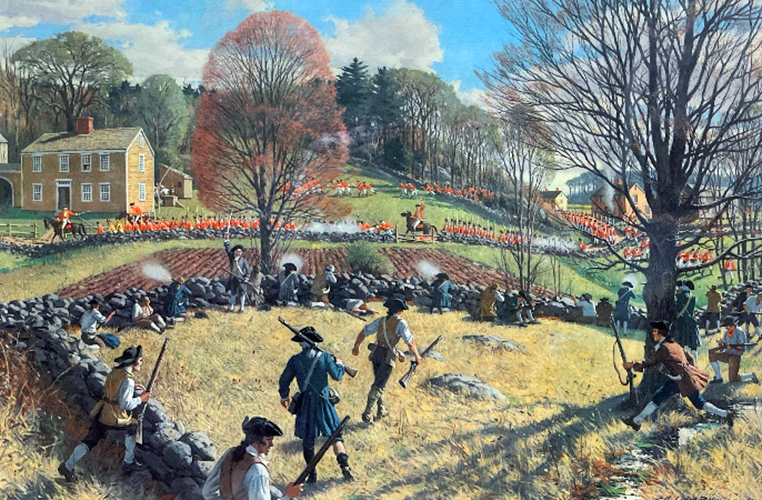
Aiden Lassell Ripley (1896-1969), Retreat from Lexington at the Foot of the Rocks. A.2.509. Arlington Historical Society Collections
Around 4:00 pm, the retreating British Regulars arrived at the village Menotomy. It was here where Samuel Whittemore, the oldest known combatant of the Revolutionary War, earned his fame. During the conflict, Whittemore took cover behind a stone wall. He reportedly fired at five soldiers but was soon overwhelmed. He suffered a gunshot wound to the cheek and a bayonet stab wound. When the Regulars continued their retreat, the locals carried him to Cooper’s Tavern, where Dr. Tufts of Medford treated his injuries.
Remarkably, Whittemore survived for another 18 years after suffering these life-threatening wounds. He lived long enough to see the birth of a new and independent nation.
Jason Russell
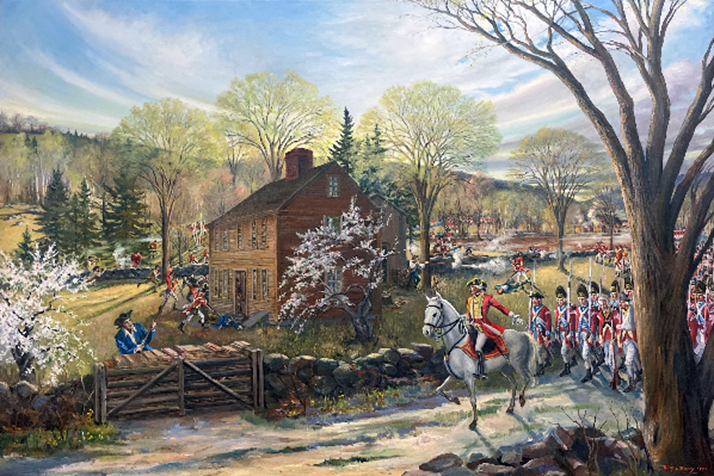
Later during their retreat, Gen. Percy ordered his men to enter the residences along Concord Road (now Massachusetts Avenue) to eliminate the Provincials who were firing from inside these houses. One notable example was the site of Jason Russell House.
Ruth L. Berry, 1975. Jason Russell House in Battle With British Soldiers 1990.19.1. Arlington Historical Society Collections
Jason Russell was a middle-aged farmer who reportedly had a leg disability. He barricaded his property and refused to leave, asserting, “An Englishman’s house is his castle.”
As British Regulars surrounded his home, several Provincials from different towns sought refuge inside. Tragically, Jason Russell and several others lost their lives on his property.
Today, the c. 1740 house, still bearing musket ball holes in the remaining structure from the fight, is at the heart of the Arlington Historical Society’s regional history museum, offering guided tours and engaging exhibits that highlight the lasting impacts of the American Revolution and Arlington’s broader history.
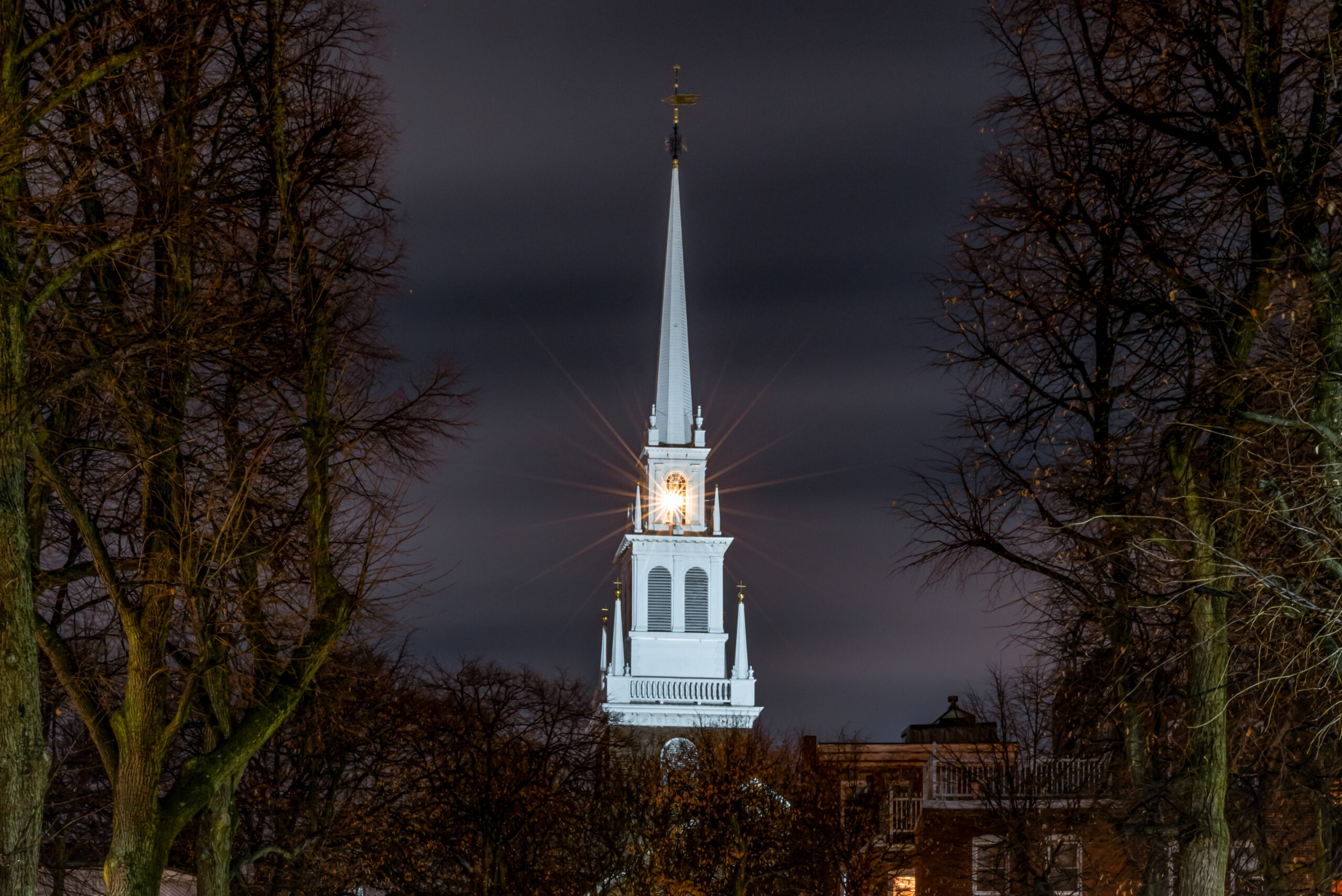
“He said to his friend, “If the British march By land or sea from the town to-night, Hang a lantern aloft in the belfry arch Of the North Church tower as a signal light,– One, if by land, and two, if by sea;”
These famous words from Henry Wadsworth Longfellow’s poem about Paul Revere’s ride recount the important role the Old North Church played in the events leading up to the first shots of the Revolutionary War. Join us just a few weeks before the 250th anniversary as we sit down with Emily Spence, Director of Education at Old North Church in Boston. We’ll discuss the history of the church, what occurred on April 18, 1775 and what happened during the war. We’ll also discuss the exciting events the Old North Church will be doing on the 250th anniversary. This will be a pre-recorded video and you will be able to watch it when we post it at 7 p.m. on our Facebook page.
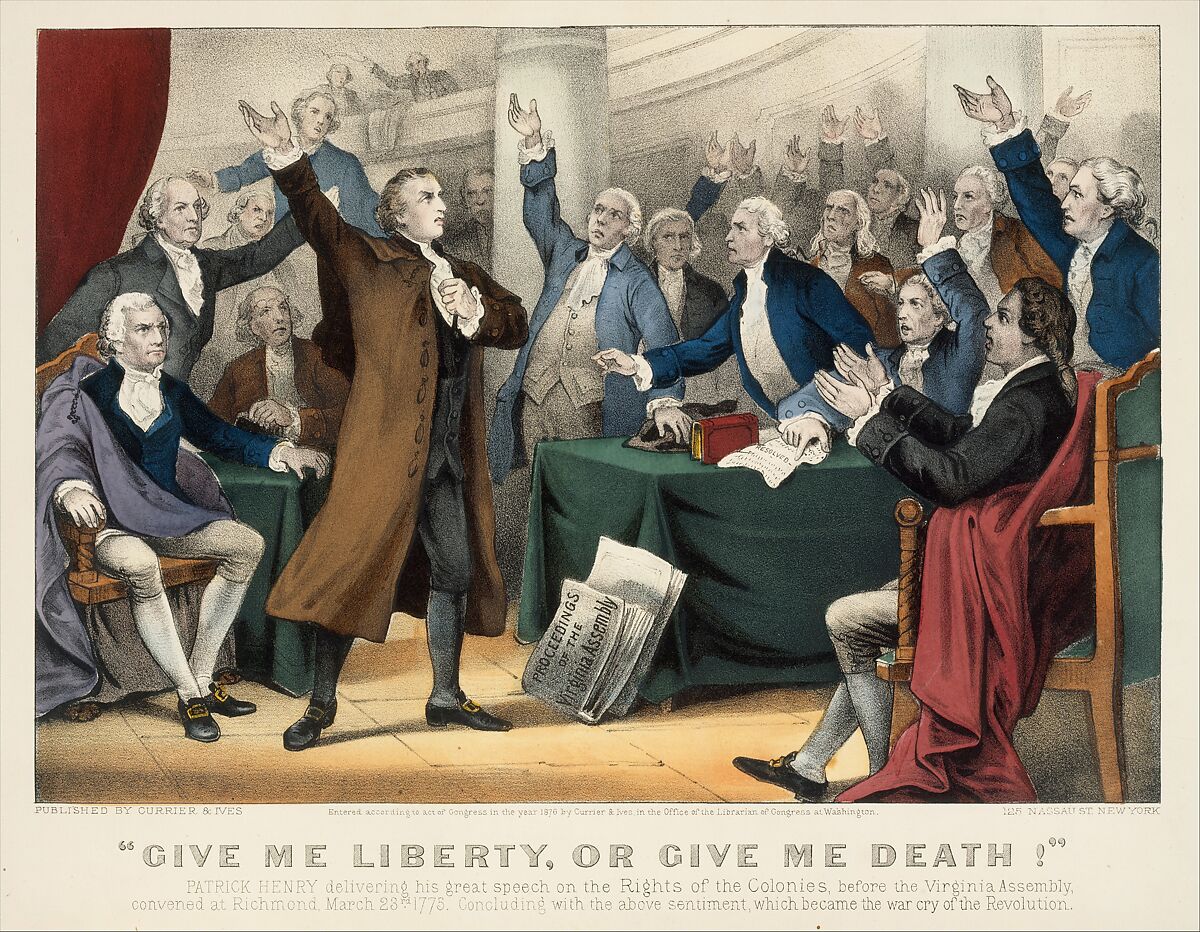
Patrick Henry’s famous speech, delivered on March 23, 1775, before the Virginia Convention at St. John’s Church in Richmond, has become one of the most iconic calls to action in American history. His fiery declaration—“Give me liberty, or give me death!”—was a passionate plea for resistance against British tyranny and a rallying cry for colonial unity in the face of increasing oppression. While Patrick Henry’s speech electrified the American colonies and inspired many to embrace the revolutionary cause, Great Britain’s response to such sentiments, and to the broader colonial rebellion, was both dismissive and aggressive. The British government’s approach to colonial dissent during this period sheds light on their underestimation of the revolutionary movement and the rigidity of their imperial policies.
At the time of Henry’s speech, tensions between Great Britain and its American colonies had been escalating for over a decade. Following the French and Indian War (1754–1763), Britain sought to tighten its control over its colonies and recover war debts by imposing taxes such as the Stamp Act (1765) and the Townshend Acts (1767). These measures were deeply unpopular among colonists, who argued that taxation without representation was a violation of their rights. The colonies’ resistance to British authority—through boycotts, protests, and the formation of groups like the Sons of Liberty—was met with increasing hostility from Britain. By 1775, the situation had deteriorated to the brink of open conflict.
From the British perspective, Patrick Henry’s speech, and similar revolutionary rhetoric, would have been seen as treasonous and inflammatory. The British government viewed the colonies not as equal partners in the empire but as subordinate territories meant to serve the interests of the Crown. Henry’s call to arms was a direct challenge to this hierarchical structure, and British officials were likely to dismiss it as the rantings of a radical minority. However, the speech also highlighted the growing unity and resolve among the colonists, which British leaders largely failed to grasp. This underestimation of colonial sentiment was one of the key reasons why Britain’s response to the American Revolution was ultimately ineffective. Loyalist James Parker wrote ““You never heard anything more infamously insolent than P. Henry’s speech: he called the K—— a Tyrant, a fool, a puppet, and a tool to the ministry,”
The British response to colonial dissent, including the sentiments expressed in Henry’s speech, was characterized by a combination of punitive measures and military force. In the years leading up to the speech, Britain had already implemented harsh policies, such as the Coercive Acts (1774), known in the colonies as the Intolerable Acts. These laws were designed to punish Massachusetts for the Boston Tea Party and to reassert British authority over the colonies. Instead of quelling dissent, these measures only served to galvanize colonial resistance and unify the colonies against British rule.
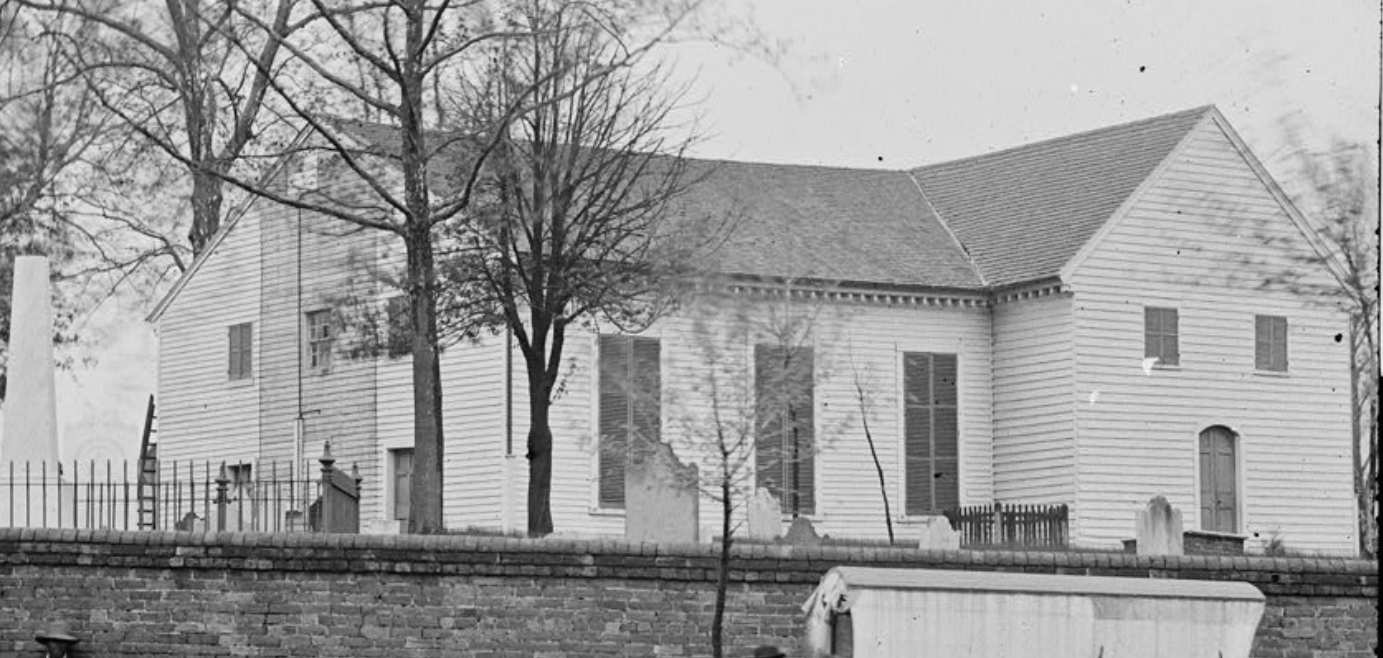
St. John’s Church, ca 1865 – courtesy Library of Congress
After Henry’s speech, Britain’s strategy remained focused on suppressing the rebellion through force rather than addressing the colonies’ grievances. By April 1775, just weeks after Henry’s address, British troops marched to Lexington and Concord to seize colonial military supplies, leading to the first battles of the Revolutionary War. This military action demonstrated Britain’s refusal to engage in meaningful dialogue with the colonies and its commitment to maintaining control through coercion. Though considered by many as a spark of revolution, Henry’s motion and speech did not reach Great Britain until after the fighting broke out at Lexington and Concord. Though combined, hearing Virginia’s martial push with rebellion in New England proved this was not a localized issue.
One of the reasons Britain failed to adequately respond to the ideological challenge posed by Henry’s speech was its inability to understand the depth of colonial dissatisfaction. British officials often dismissed colonial leaders as self-interested agitators and underestimated the widespread support for revolutionary ideas. This miscalculation led to a reliance on military solutions, which further alienated the colonies and made reconciliation increasingly unlikely.
In addition to military measures, Britain attempted to divide the colonies and weaken their resolve. Propaganda campaigns and offers of pardons were used to sway public opinion and encourage loyalty to the Crown. However, these efforts were largely unsuccessful, as revolutionary leaders like Patrick Henry were able to inspire unity and resilience among the colonists.
Ultimately, Britain’s response to the sentiments expressed in Patrick Henry’s “Give me liberty, or give me death” speech reflected a broader pattern of misjudgment and inflexibility. By dismissing the legitimate grievances of the colonies and relying on punitive measures and military force, Britain failed to address the underlying causes of the American Revolution. Henry’s speech symbolized the growing determination of the American colonies to fight for their independence, and Britain’s inability to adapt to this reality ensured that conflict was inevitable. In the end, Henry’s passionate plea for liberty became a rallying cry for a new nation, while Britain’s response marked the beginning of its eventual loss of the American colonies.
The spy network of Dr. Joseph Warren and the Sons of Liberty is well documented and written about. Few things happened in and around Boston that Warren, Paul Revere or Sam Adams were not aware of. In the winter of 1775, British General Thomas Gage also established a spy network (one of the more famous British spies was supposed “Patriot” Dr. Benjamin Church was not revealed as spy until October 1775). Gage was using all the resources at his disposal to figure out what the Whigs were doing and to find out where weapons (and four cannon that were stolen from the British in Boston) were located. On February 22nd, Gage sent out two officers, Captain John Brown and Ensign Henry De Berniere, to covertly ride out towards Worcester to locate stores and to map the road network for a possible British excursion. A few weeks later, on March 20th Gage sent out Brown and De Berniere again to map out routes towards Concord. Keeping in mind of potential geographic features that could endanger the future British column.
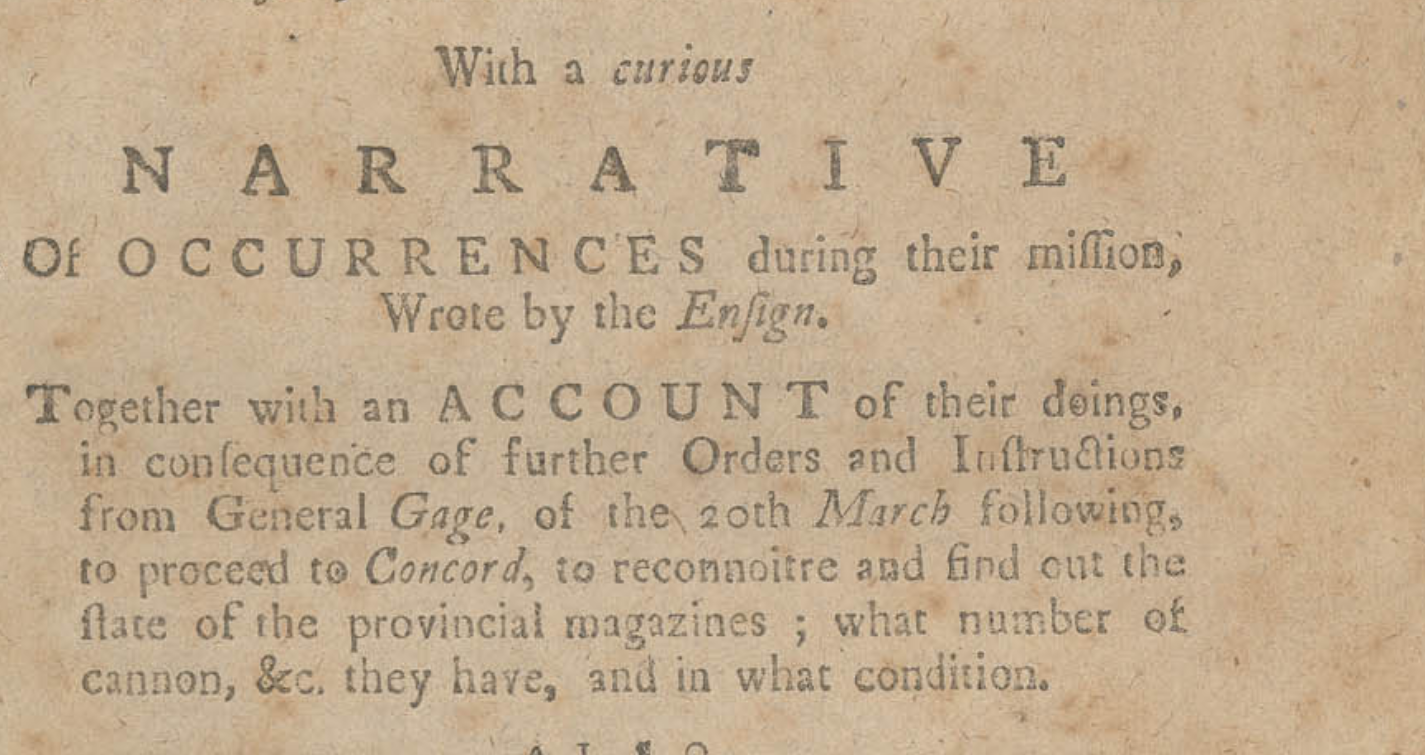
The following is an account of the March 20th mission by Ensign De Berniere. This account was found in Boston after the British evacuated and published by Boston printer J. Gill in 1779. Today it is located in the Massachusetts Historical Society. This mission was the precursor for the April 18-19th British raid to Concord that ignited the war.
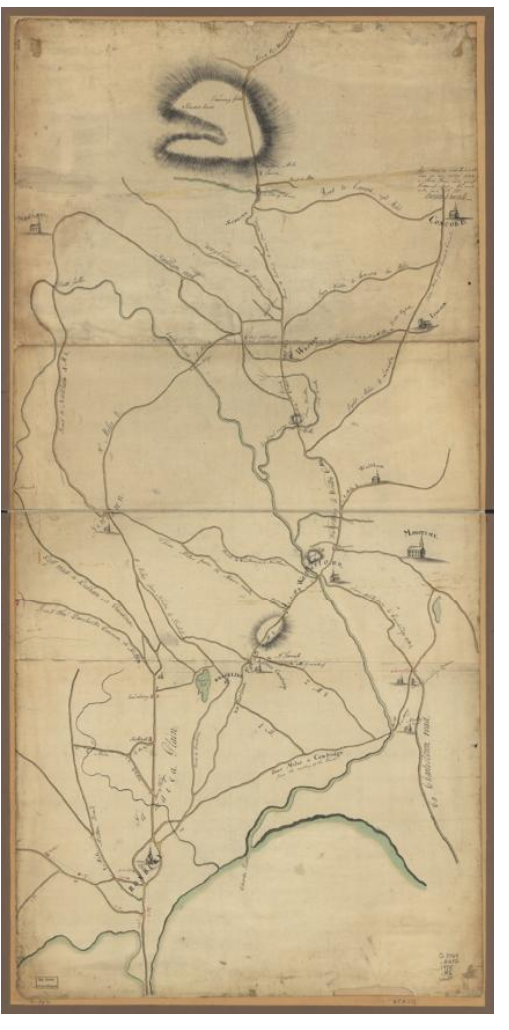
Map, Roxbury to Concord. Roads & distances; by Brown and De Berniere, Library of Congress
Account of the proceedings of the aforesaid officers, in consequence of further orders and instructions from General Gage, of the 20th March following ; with occurrences during their mission.
Scan of the original print by J. GILL, in Court Street. 1779, Massachusetts Historical Society
THE twentieth of March Captain Brown and myself received orders to set out for Concord, and examine the road and situation of the town ; and also to get what information we could relative to what quantity of artillery and provi- sions. We went through Roxbury and Brookline, and came into the main road between the thirteen and four- teen mile-stones in the township of Weston ; we went through part of the pass at the eleven mile-stone, took the Concord road, which is seven miles from the main road. We arrived there without any kind of insult being offered us, the road is high to the right and low to the left, woody in most places, and very close and commanded by hills frequently. The town of Concord lies between hills that command it entirely ; there is a river runs through it, with two bridges over it, in summer it is pretty dry ; the town is large and co- vers a great tract of ground, but the houses are not close together but generally in little groups. We were informed that they had fourteen pieces of cannon (ten
iron and four brass) and two cohorns, they were mounted but in so bad a manner that they could not elevate them more than they were, that is, they were fixed to one elevation ; their iron cannon they kept in a house in town, their brass they had concealed in some place behind the town, in a wood. They had also a store of flour, fish, salt and rice ; and a magazine of powder and cartridges. They fired their morning gun, and mounted a guard of ten men at night. We dined at the house of a Mr. Bliss, a friend to government ; they had sent him word they would not let him go out of town alive that morning ; however, we told him if he would come with us we would take care of him, as we were three and all well armed, — he consented and told us he could shew us another road, called the Lexington road. We set out and crossed the bridge in the town, and of consequence left the town on the contrary side of the river to what we entered it. The road continued very open and good for six miles, the next five a little inclosed, (there is one very bad place in this five miles) the road good to Lexington. You then come to Menotomy, the road still good ; a pond or lake at Menotomy. You then leave Cambridge on your right, and fall into the main road a little below Cambridge, and so to Charlestown ; the road is very good almost all the way.
In the town of Concord, a woman directed us to Mr. Bliss‘s house ; a little after she came in crying, and told us they swore if she did not leave the town, they would tar and feather her for directing Tories in their road.
[Left in town by a British Officer previous to the evacua tion of it by the enemy, and now printed for the information and amusement of the curious.]
BOSTON Printed, and to be sold, by J. GILL, in Court Street. 1779.


 Emerging Revolutionary War Era