In April, 1782 local leaders, in particular David Williamson, petitioned Irvine to lead a punitive raid to the Sandusky River aimed at the Wyandot and Hopocan’s Delaware.[i] While he could provide no material support or leadership, Irvine approved the attack and laid down several conditions: that the expedition operate under laws governing the militia, that their purpose not extend beyond protecting the border, that the force assembled be large enough to accomplish the task, that the raiders equip and sustain themselves on horseback at their own expense, and that the expedition conduct the raid on behalf the United States with an eye toward bringing honor to the United States. Perhaps he had the brutality of the Gnadenhutten raid in mind and sought to avoid a repeat.[ii]
This Sandusky raid did not reflect Irvine’s strategy of either reducing Detroit or bringing the tribes to battle; it was simply another American raid on Indian towns, which would likely be abandoned by the time the expedition arrived. Irvine informed Washington that the expedition was going forward and did not seek permission. Indeed, he may not have had the power to stop it given the restlessness of the local population on the frontier. Rather that departing in early August, this raid would leave in late May, before the summer heat dried out the countryside. Speed and surprise would be important, perhaps explaining Irvine’s requirement that every man be mounted, that the expedition dispense with artillery, and that it limit baggage and supplies to 30 days’ worth.[iii] Irvine wrote Washington, “If their number exceeds three hundred, I am of opinion they may succeed, as their march will be so rapid they will probably in a great degree effect a surprise.”[iv] But, it would be a risky enterprise. Continue reading “The Crawford Campaign, 1782: Birth of an Expedition”→
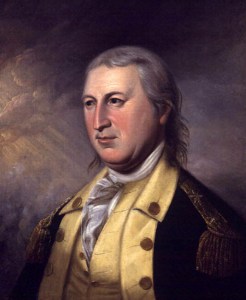
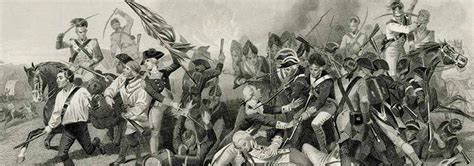
238 years ago today the United States military suffered one of its worst defeats. The Battle of Camden, fought on August 16, 1780 just a few miles north of Camden, SC was a total defeat for the American “Grand Army” under popular General Horatio Gates. The British under Lord Cornwallis inflicted nearly 1,900 casualties (out of 4,000) at a loss of only 300. One of the biggest losses was the death of General Baron Johann de Kalb, a popular foreign general in the American army. Though a strategic defeat for Gates, it was the retreat that would lead to Gates’ demise. As the militia broke and ran, Gates was caught up in the panic and fled the field as half of his army was still fighting.
Writing several days later from Hillsborough, NC Gates submitted his account of the battle to Congress. Already, reports of cowardice were starting to spread about Gates’ conduct during the battle. Gates decision to fight and his decision to leave the field during the battle have been debated ever since that August day in 1780. Below is a portion of Gates’ letter.
“In the deepest distress and anxiety of mind, I am obliged to acquaint your excellency with the defeat of the troops under my command. I arrived with the Maryland line, the artillery, and the North-Carolina militia, on the 13th instant at Rugeley’s, thirteen miles from Camden; and took post there, and was the next day joined by General Stevens, with seven hundred militia from Virginia…. Having communicated my plan to the general officers in the afternoon of the 15th, it was resolved to march at ten at night, to take post in a very advantageous situation, with a deep creek in front, seven miles from Camden; the heavy baggage, &c. being ordered to march immediately by the Waxhaw road. At ten the army began to march in the following order: Colonel Armand’s legion in front, supported on both flanks by Colonel Porterfield’s regiment, and the light infantry of the militia; the advanced guard of infantry, the Maryland line, with their artillery, in front of the brigades, the North-Carolina militia, the Virginia militia, the artillery, &c. and the rear guard. Having marched about five miles, the legion was charged by the enemy’s cavalry, and well supported on the flanks, as they were ordered, by Colonel Porterfield, who beat back the enemy’s horse, and was himself unfortunately wounded; but the enemy’s infantry advancing with a heavy fire, the troops in front gave way to the first Maryland brigade, and a confusion ensued, which took some time to regulate. At length the army was ranged in line of battle, in the following order: General Gist’s brigade upon the right, with his right close to a swamp, the North-Carolina militia in the center, and the Virginia militia, with the light infantry and Porterfield’s corps, on the left; the artillery divided to the brigades; and the first Maryland brigade as a corps de reserve, and to cover the can non in the road, at a proper distance in the rear. Colonel Armand’s corps were ordered to the left, to support the left flank, and oppose the enemy’s cavalry. At daylight the enemy attacked and drove in our light party in front, when I ordered the left to advance and attack the enemy; but to my astonishment, the left wing and North -Carolina militia gave way. General Caswall and myself, assisted by a number of officers, did all in our power to rally the broken troops, but to no purpose, for the enemy coming round the left flank of the Maryland division, completed the rout of the whole militia, who left the continentals to oppose the enemy’s whole force. I endeavoured, with General Caswall, to rally the militia at some distance, on an advantageous piece of ground, but the enemy’s cavalry continuing to harass their rear, they ran like a torrent, and bore all before them. Hoping yet, that a few miles in the rear they might recover from their panic, and again be brought into order, I continued my endeavour, but this likewise proved in vain. The militia having taken the woods in all directions, I concluded, with General Caswall [sic], to retire toward Charlotte.”
So, vacation time rolls around again and this year my family and I had an opportunity to travel to Paris, France for a few days. Riding into the city from Charles de Gaulle Airport, our taxi driver, by chance, took us past an old, green-corroded bronze statue, set in the middle of a little flowered square. From my vantage, I could only see the bottom portion of the statue; what appeared to be the lower portion of a man in buckled shoes, seated in a wooden chair, atop a marble pedestal. My wife happened to be in the right spot in the vehicle as we quickly drove by. “Looks like Benjamin Franklin, I think.” she said, and with those words, she sent me on a journey to find that statue again and, hopefully, other sites in Paris associated with Mr. Franklin.
Unlike his colleague from New England, John Adams, who was from good, plain Puritan stock, the pulse of a city like Paris, with its decadence, opulence and social intrigue, fit Benjamin Franklin like a glove. As ambassador to France after the signing of the Declaration of Independence, Franklin was instrumental in helping to obtain for our fledging nation the financial and military support necessary for bringing our war for independence to a happy conclusion. To the people of Paris, he was somewhat of a celebrity, due to his experiments with electricity. He spoke French and endeared himself to the people by displaying, in his dress and speech, what they considered his “rustic” demeanor. In a word, they were charmed by Benjamin Franklin. The fur cap he was fond of wearing only added to his disguise of “homespun rusticity”. So, finding a monument to him in this city was not much of a surprise. Continue reading “Another American in Paris”→
Part of an ongoing series of about the Continental Army in Morristown, New Jersey. For the first post, click here.
Across the street from the Ford Mansion, the elegant home of the Jacob Ford, Jr. and his family, and the headquarters for George Washington during the winter encampment of 1779-1780, sits a small boulder with a iron plaque plastered on the side.
Erected in 1932 by the Tempe Wicke Society Children of the American Revolution, the monument commemorates the Life Guards that served as Washington’s headquarters command during the American Revolution. Although the unit went by different names and reorganized at least twice, including once during the winter encampment at Morristown, the company, numbering approximately 150 men, would be around for the duration of the war. Continue reading “Uncovering the Continental Army in Morristown”→
Emerging Revolutionary War welcomes back guest historian Michael Aubrecht
September 24 of each year is the anniversary date of the Judiciary Act of September 24, 1789. It also means that the United States Marshals Service is a year older. Along with the first federal law enforcement agency in the United States, President George Washington signaled the start of the entire federal judicial system with his signature on that date. It was a broad document covering many positions from judges to prosecutors. Sections 27 and 28 were specific to the U.S. Marshal’s roles and responsibilities. A segment of Section 27 specifically outlines their general powers. It states:
And be it further enacted, That a marshal shall be appointed in and for each district for a term of four years, but shall be to attend the district and circuit courts when sitting therein, and also the Supreme Court in the district in which that court sit. (b) And to execute throughout the district, all lawful precepts directed to him, and issued under the authority of the United States, and he shall have the power to command all necessary assistance in the execution of his duty, and to appoint as shall be occasion, one or more deputies…Continue reading “Washington’s Marshals”→
Nestled in Hanover County, VA, near where modern residential communities meet farm fields that have been worked for centuries, is the site of a colonial-era plantation home called Studley. It was here on this site that Patrick Henry, the “Voice of the Revolution”, was born.
A 600-acre tobacco plantation, Studley was built in the 1720’s for its original owner, Colonel John Syme and his bride, Sarah, the former Sarah Winston. The surrounding community, as it does today, took its name from the site. (By the mid-19th century, the Studley area was called Haws Shop, after a nearby blacksmith shop. In the latter part of May, 1864, Union and Confederate cavalry units fought a dismounted action here just prior to the battle of Cold Harbor. Prominent among the Union commanders engaged was Brig. Gen. George Armstrong Custer.)
Part of an ongoing series about the Continental Army in Morristown, New Jersey. To read previous posts, click here.
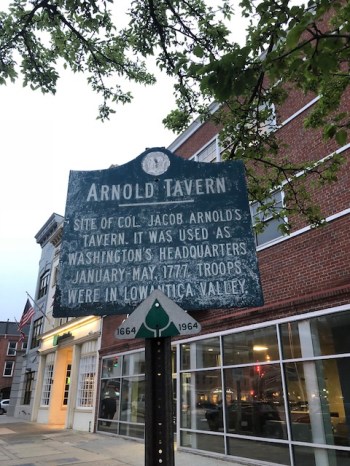
All that remains is a historical marker, on the side of North Park Place across the street from Morristown Green. For a few months, between January 1777 and May 1777, in this location, the headquarters of the Continental Army was located. Within that headquarters, obviously, was George Washington.
Although no specific date of construction exists, it is believed that Arnold’s Tavern was built by Samuel Arnold between 1735 and 1750. By the time of the American Revolution owned by the son, Colonel Jacob Arnold. The structure was three stories high, with a wide hallway that bisected the building, a front and back parlor, barroom, dining room, and kitchen. Continue reading “Uncovering the Continental Army in Morristown”→
Part of an ongoing series of about the Continental Army in Morristown, New Jersey. For the first post, click here.
“The smallpox has made such head in every quarter that I find it impossible to keep it from spreading thro’ the whole army the natural way.” General George Washington wrote in February 1777.
By the time the Continental Army was encamped in Morrristown, Washington had become a firm believer in the inoculations for smallpox for the entire army. The inoculation process would entail the following: Continue reading “Uncovering the Continental Army in Morristown”→
Emerging Revolutionary War wishes everyone a happy and safe Memorial Day remembrance.
Beginning with the sacrifices of the soldiers in the American Revolution to the present day, let us take a moment for all those who made that ultimate sacrifice and whose remains lay in unknown graves scattered throughout the country and globe.
Grave of an American Revolutionary War veteran in Hanover County, Virginia (photo courtesy of M. Wilcox)
In conclusion, John Stark, former general in the American Revolution, in a written announcement commemorating the anniversary of the Battle of Bennington wrote;
“Live free or die; Death is not the worst of evils.”
Thank you to all those who have fallen so we can have the chance to live free.
*Grave of an American Revolutionary War veteran in Hanover County, Virginia. (photo courtesy of M. Wilcox)
Approximately one month ago, I took a temporary detail assignment to Morristown National Historical Park. The national park preserves the winter cantonments of the Continental Army during the American Revolution; including the harshest winter, weather-wise, of the entire war, in 1779-1780.
For parts of multiple winters and even during the campaigning season, Washington’s forces would come to Morristown, situated behind the Watchung Mountains, which provided safety but also a perch to monitor the British in the New York City.
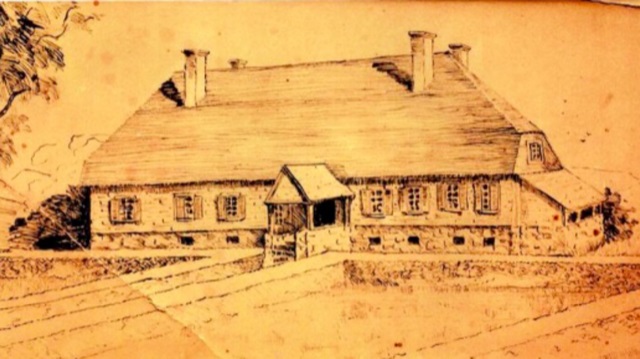
The town still bears witnesses to this rich legacy of housing soldiers, with historic buildings and signs dotted around the spiraling town. On a walk the other day, I came across the house below, with a small plaque situated on the front of the dwelling.
The home saw soldiers use it for their encampments throughout the majority of the war years. On his return to the United States the Marquis de Lafayette was welcomed with a reception in the building as well, which is in the photo below.
Morristown is filled with tidbits of history from the American Revolution and I as spend the next few months there as a park ranger, I will share what I come across. So, stay tuned as I uncover the history of the place that “Saved America” according to the park’s unofficial slogan.




 So, vacation time rolls around again and this year my family and I had an opportunity to travel to Paris, France for a few days. Riding into the city from Charles de Gaulle Airport, our taxi driver, by chance, took us past an old, green-corroded bronze statue, set in the middle of a little flowered square. From my vantage, I could only see the bottom portion of the statue; what appeared to be the lower portion of a man in buckled shoes, seated in a wooden chair, atop a marble pedestal. My wife happened to be in the right spot in the vehicle as we quickly drove by. “Looks like Benjamin Franklin, I think.” she said, and with those words, she sent me on a journey to find that statue again and, hopefully, other sites in Paris associated with Mr. Franklin.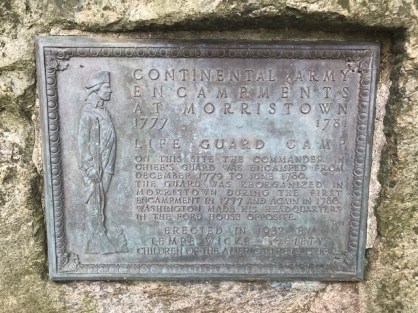



 Emerging Revolutionary War Era