Emerging Revolutionary War is pleased to share the following information from our friends at Campaign 1776 managed by the Civil War Trust.
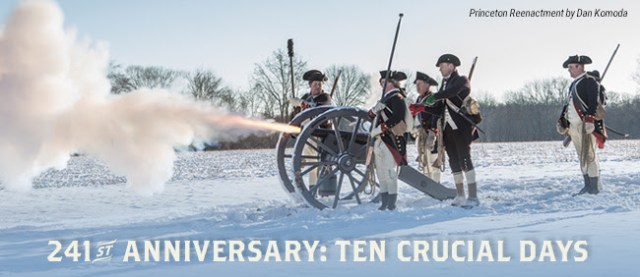
“As many of you may know, this winter marks the 241st anniversary of the American victories at the battles of Trenton and Princeton. The Continental Army’s triumphs in the Ten Crucial Days campaign proved instrumental to rekindling Patriot morale and keeping the cause for American independence alive in the wake of early defeats.Continue reading “From Campaign 1776: Ten Crucial Days”→
Emerging Revolutionary War welcomes guest historian Paige Gibbons Backus to the blog. This Weekend marks the 244th anniversary of the Boston Tea Party.
We all know the holidays are some of the heaviest travelled times of the year and over my Thanksgiving holiday, I had the opportunity visit Boston for a day. When in the city for only one day, what do we go and see? Do you go to the U.S.S. Constitution, Bunker Hill, Faneuil Hall, or the Paul Revere House? Do you go to the colonial meetinghouses, the historic cemeteries, or just walk around the historic sections of the city? One of the sites that I decided to visit was the Boston Tea Party Ships & Museum. I heard many good things about it from online reviews and professional colleagues about the interactive exhibits and experiences available there. Working at an immersive historic site myself, I was definitely curious to see what they had done to make their history exciting to audiences, and despite the museum’s shortcomings, make it interesting they did.
One of the highlights of the Boston Tea Party Ships is that they did a decent job creating an interactive experience for visitors. After purchasing tickets outside, visitors receive an identity card and a feather, and are then invited into a room meant to replicate the South Meetinghouse. From there, first-person actors serving as tour guides take visitors through the planning, implementation, and effects of the Boston Tea Party. For example, Sam Adams rallied the crowd weaving in the events leading to the Boston Tea Party, even teaching visitors how to show approval or displeasure in a public setting, (to which I was hissing before it was cool). He even called on visitors with various identity cards to voice their opinion, bringing in interesting, albeit reluctant, audience participation. After the visitors were riled up, we donned our feathers in our hair and were lead onto the ships to commence tossing the tea. Continue reading “Emerging Revolutionary War Weekender: The Boston Tea Party Ships & Museum”→
From all of us here at Emerging Revolutionary War, we want to wish you and yours a “Happy Thanksgiving.” Below is the official proclamation by President George Washington dedicating a day of “public thanksgiving.” in 1789.
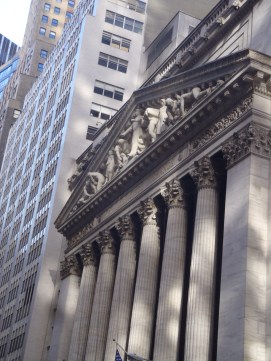
Federal Hall, New York City, where George Washington was sworn in as president in 1789.
By the President of the United States of America. a Proclamation.
Whereas it is the duty of all Nations to acknowledge the providence of Almighty God, to obey his will, to be grateful for his benefits, and humbly to implore his protection and favor—and whereas both Houses of Congress have by their joint Committee requested me “to recommend to the People of the United States a day of public thanksgiving and prayer to be observed by acknowledging with grateful hearts the many signal favors of Almighty God especially by affording them an opportunity peaceably to establish a form of government for their safety and happiness.”
Now therefore I do recommend and assign Thursday the 26th day of November next to be devoted by the People of these States to the service of that great and glorious Being, who is the beneficent Author of all the good that was, that is, or that will be—That we may then all unite in rendering unto him our sincere and humble thanks—for his kind care and protection of the People of this Country previous to their becoming a Nation—for the signal and manifold mercies, and the favorable interpositions of his Providence which we experienced in the course and conclusion of the late war—for the great degree of tranquillity, union, and plenty, which we have since enjoyed—for the peaceable and rational manner, in which we have been enabled to establish constitutions of government for our safety and happiness, and particularly the national One now lately instituted—for the civil and religious liberty with which we are blessed; and the means we have of acquiring and diffusing useful knowledge; and in general for all the great and various favors which he hath been pleased to confer upon us.
and also that we may then unite in most humbly offering our prayers and supplications to the great Lord and Ruler of Nations and beseech him to pardon our national and other transgressions—to enable us all, whether in public or private stations, to perform our several and relative duties properly and punctually—to render our national government a blessing to all the people, by constantly being a Government of wise, just, and constitutional laws, discreetly and faithfully executed and obeyed—to protect and guide all Sovereigns and Nations (especially such as have shewn kindness unto us) and to bless them with good government, peace, and concord—To promote the knowledge and practice of true religion and virtue, and the encrease of science among them and us—and generally to grant unto all Mankind such a degree of temporal prosperity as he alone knows to be best.
Given under my hand at the City of New-York the third day of October in the year of our Lord 1789.
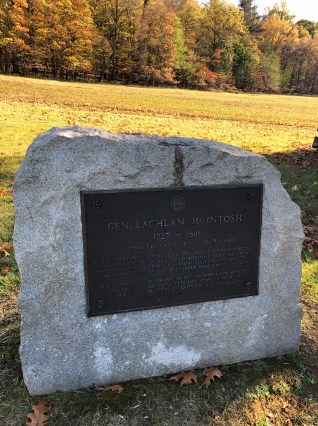
On a recent trip to Valley Forge National Historical Park I came across the monument to featured below, of a general that did not initially ring a bell in my memory. So I did a little investigating. The first name was intriguing. His story even more so. Especially how he came to spend the winter at Valley Forge.
Lachlan McIntosh Monument, Valley Forge National Historical Park (author collection)
Born near Raits, Badenoch, Scotland on March 17, 1725 and at the age 11, Lachlan, along with his family and approximately 100 other Scottish immigrants, landed in Georgia where they founded the town of New Iverness. Out of all the cruelties that could visit a family eking out a future on the frontier, the calamity that claimed Lacklan’s younger brother would have been far down the list. While swimming in the Altamaha River in 1737, Lewis McIntosh was killed by an American alligator. Continue reading “Lachlan McIntosh”→
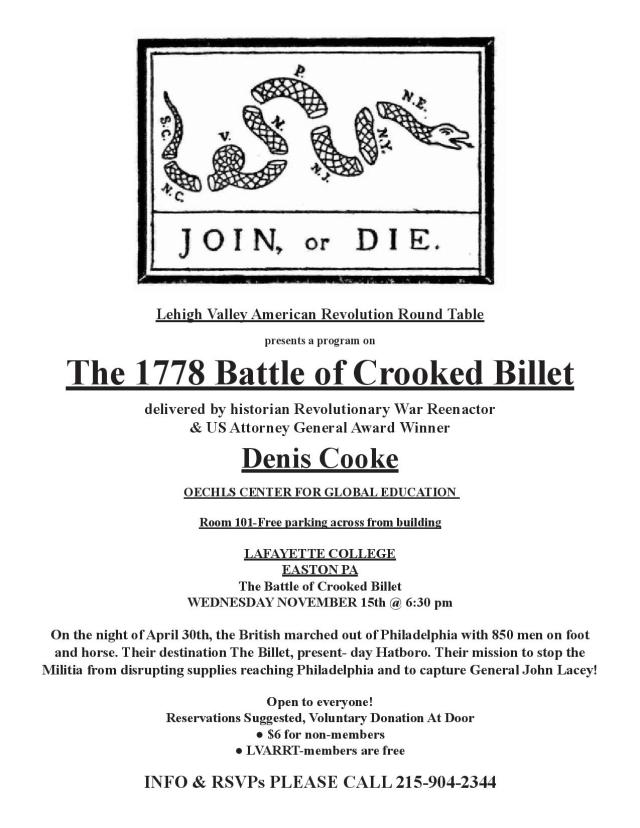
Join our friends at the Lehigh (PA) Valley American Revolution Round Table on Wednesday, November 15, 2017 at 6:30 p.m. at the Oechls Center for Global Education at Lafayette College in Eastern, Pennsylvania. The topic is the battle mentioned above.
Noted historian, reenactor, and U.S. Attorney General Denis Cooke will be the speaker. See flyer below for further details.
The stacks of books reflect Knox’s role as a bookseller before the war.
If you have not made a trip to the new American Revolution Museum at Yorktown (the former Yorktown Victory Center) then you are missing out. Not only does the museum great exhibits on the causes of the war and the events leading up to Yorktown (with great technology), there is a changing exhibit gallery that allows for short term exhibits. The first exhibit opened in June and features the lives of four prominent Revolutionaries after the American Revolution. Continue reading “AfterWARd, the new exhibit at the American Revolution Museum at Yorktown. A visit with Curator Kate Gruber”→
A few years ago I had the opportunity to visit Yorktown National Battlefield. This evening I was scrolling through my cache of American Revolution photos on an external hard drive, when I came across the picture below.
A simple monument to three luminaries of the American Revolution. Three brilliant young men, one of which, John Laurens, would fall in one of the last small engagements of the war.
Could you imagine the conversation between the three that fateful October evening of 1781?
With autumn just around the corner, cooler weather on the horizon, and the holidays quickly approaching. Some stores in the local area have Halloween, Thanksgiving, and Christmas decorations all for sale currently, Emerging Revolutionary War wanted to bring your attention to a few different Revolutionary War Era happenings to mark on your calendars. Continue reading “Upcoming Lectures, Talks, and/or Events”→
With British soldiers pouring into the fort, Colonel Ledyard ordered a ceasefire, and prepared to surrender Fort Griswold to the victorious British. However, the British disregarded the ceasefire and continuing pouring fire into the American garrison, killing or wounding nearly all of the fort’s defenders. “I believe there was not less than five or six hundred men of the enemy on the parade in the fort,” claimed American soldier Rufus Avery. “They killed and wounded nearly every man in the fort as quick as they could.”
Maj. Stephen Bromfield, the ranking British officer after Montgomery fell, called out, “Who commands this fort?” Ledyard stepped forward and responded, “I did, sir, but you do now.” Another American, Jonathan Rathbun, watched Bromfield run Ledyard through the heart and lungs with Ledyard’s own sword:
“…the wretch who murdered him [Ledyard], exclaimed, as he came near, “Who commands this fort?” Ledyard handsomely replied, “I did, but you do now,” at the same
moment handing him his sword, which the unfeeling villain buried in his breast! Oh, the
hellish spite and madness of a man that will murder a reasonable and noble-hearted officer, in the act of submitting and surrendering!”
If you follow Campaign 1776, the initiative by our friends at Civil War Trust, you are familiar with the saga over the Princeton Battlefield. Now you have a chance to help as well.
Battle of Princeton, Death of Mercer by Trumbull (courtesy of Yale University)






 Emerging Revolutionary War Era