ERW Weekender: Battle of King’s Mountain

On October 7, 1780, one of the most pivotal battles of the American Revolution fought in the South occurred on a hillside in northwest South Carolina.The engagement brought militia from both sides; those loyal to the British and those adhering to the independence movement against each other. In fact, only one regular British soldier was present on that autumn day; the British commander Major Patrick Ferguson.

How did Ferguson and his militia end up on King’s Mountain? This was due to the campaign being waged by British General Lord Cornwallis in the Southern colonies.

Ferguson’s role was to protect the flank of Cornwallis’ force as it turned north from South Carolina. After issuing a call of bravado, where Ferguson gave Patriot militia an ultimatum; lay down your weapons or suffer the consequences, the British officer began to move through the South Carolina countryside. This decree emboldened the Patriot militia, some of which would come from across the Appalachian Mountains–or “Overmountain”–to join in the fight against Ferguson. This combined force would gather around Sycamore Shoals in present day Tennessee.

Word quickly reached Ferguson near Gilbert Town, North Carolina by way of deserters that a large force of Virginia, Carolinas, and militia from the area of Tennessee had arrived and were planning to march toward his encampment.

Still showing a high degree of disdain for the Patriot militia, Ferguson did not act immediately on the intelligence. Three days later, the Loyalist militia and the British officer started their retrograde movement toward Charlotte and Lord Cornwallis’s main army.

By October 4, 1780 now joined by a sprinkling of Georgia militia, the Patriots had reached Ferguson’s old encampment site. Two days later the militia forced marched through the Cowpens of South Carolina, which had not witnessed the hard hand of battle yet. Just a day’s march ahead was Ferguson’s forces.

SANYO DIGITAL CAMERA
Colonial Road trace near Kings Mountain (author collection)

At this juncture, Ferguson made a fateful decision. Instead of continuing his retreat and he was less than a full-days march away from the main British army, the British officer held up his forces on a forested hill just inside South Carolina and laid out his camp on the highest point; Kings Pinnacle.

Realizing that time was of the essence, the Patriot force, now numbering 900 men, found plentiful horseflesh to mount up and close the gap between the two sides. Riding through the rain and darkness of the night of October 6, the fifteen-mile gap between forces was erased and by late morning the Patriot militia was reining up within striking distance of Kings Mountain.

By mid-afternoon, at approximately 3:00 p.m. the fighting erupted. The Patriot militia broke into smaller commands, numbering between 100-200 men and started to ascend the slopes. Luckily for the Patriots, Ferguson had not detected just how close the enemy was and had also neglected to fortify his encampment. His force though, outnumbered the Patriots by approximately 200 men.

Some of the Loyalist militia did not realize that the enemy had arrived until the Patriot militia came hollering and yelling up the slope of the hillside. With the conglomerate of various militia, there was no unified command of the Patriot forces and the fight quickly boiled down to independent maneuvering and fighting. Using the terrain, the Patriot militia fired from behind trees and boulders. Answering this tactic, Ferguson ordered a bayonet charge down the hill. This caused the Patriot force to retreat to the base of the hill as most of the men were carrying rifles which did not accommodate the bayonet.

Virginia militia Colonel William Campbell and North Carolinian militia Colonel John Sevier helped rally the militia that had broken and sent the force back up the hillside. This back and forth would happen a few more times; Ferguson’s force charging down hill with bayonets, the militia backtracking, than reforming, and charging back up after the Loyalist momentum had waned.

Finally, after an hour of combat the Patriot militia forced their way to the crown of the hill and was able to flank the Loyalist force and attack in rear of their position. This maneuver forced the Loyalists back into their encampment where numbers of them began to surrender.

SANYO DIGITAL CAMERA
Marker to the memory of Major Patrick Ferguson (author collection)

Ferguson sensing the tide turning against the Loyalists, tried to rally his troops, supposedly yelling, “Hurrah,brave boys, the day is ours!” Gathering a few stalwarts, Ferguson made a desperate move to fight his way out of the encircling Patriot militia. A volley from Colonel Sevier’s militia force unhorsed Ferguson who fell entangled in his stirrups. Unfortunately, the horse, spooked with the musketry and smell of gunpowder dragged Ferguson through the Patriot line. After getting untangled from the straps on the horse, Ferguson lay prone on the ground, where a Patriot officer demanded his surrender. Still with some fight in him, Ferguson shot and killed the man. Other Patriot militia responding to the scene fired a collective volley at the downed British officer, killing Ferguson.

Some of the Patriot militia were opposed to accepting the Loyalist surrender, as they remembered the massacres and atrocities committed to their brethren in arms by the infamous Banastre Tarleton. Cooler heads prevailed and the firing died down.

By the time the second white flag was sent out by Captain Abraham DePeyster, Patriot militia officers were finally able to reign in their commands and over 600 Loyalist soldiers surrendered.

Within the one-hour and five minute engagement, Ferguson’s force ceased to exist. Total casualties for the Loyalist force was 290 killed, 163 wounded, and 668 captured. The Patriots suffered a total of 87 casualties; 29 killed and 58 wounded.

The Patriots, with the close proximity of Cornwallis’s forces, who the day after the battle would finally get the request for reinforcements from his slain subordinate, quickly retreated back into the safety of the South Carolina countryside.

However, the Battle of Kings Mountain would become a critical turning point, not only in the Southern Campaign of the American Revolution, but in the entire war itself. The victory, which demolished the Loyalist militia force covering his flank, forced Cornwallis to altere his strategy for the campaign. He would be forced to return to South Carolina, giving up advancing further than Charlotte into North Carolina in order to re-solidify control of territory in his rear. When Cornwallis finally returned to the Tar Heel State the following year, he would suffer eventually suffer a Pyrrhic victory at Guilford Court House in March 1781.

All that was in the future and so is your visit to this battlefield of the American Revolution.
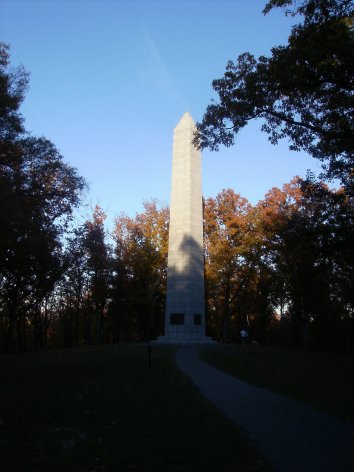
SANYO DIGITAL CAMERA
Kings Mountain Battle Monument commemorating the Patriot victory (author collection)

On March 3, 1931, Kings Mountain National Military Park was formed by an act of Congress and placed under the control of the United States War Department. Two years later, in March 1933, the property was transferred to the National Park Service by an executive order. At this juncture, the entire land mass of the park was comprised of 40 acres that had been originally donated by the Kings Mountain Battlefield Association. The park has grown since that time and now preserves slightly under 4,000 acres.

For further details on how to visit the battlefield, which includes trails, a visitor center, exhibits, and a bookstore, click here. The park is open daily 9:00 a.m. to 5:00 p.m. with extended hours on the weekend between Memorial and Labor Days. Even better there is no fee to access this national military park!

*All the photos taken for this post was done by the author during a visit to the battlefield in autumn.*



The Battle of Kings Mountain, From Those Who Were There

Emerging Revolutionary War welcomes back historian Bert Dunkerly. The accounts below come from Mr. Dunkerly’s book on the battle.

9e68818e-8f86-4871-83ad-e24e9f58afb9
“The Battle of Kings Mountain, Eyewitness Accounts” by Bert Dunkerly  (Acadia Publishing)

The battle of Kings Mountain was an intense, one-hour battle fought just below the North Carolina-South Carolina border.  The October 1780 engagement pitted about 900 American militia from five states (Virginia, the two Carolinas, Georgia, and modern-day Tennessee) against 1,100 Loyalists under Maj. Patrick Ferguson.  With Ferguson’s wounding late in the action, command fell to his subordinate, Captain Abraham DePeyster.  As the Americans closed in, the Loyalists surrendered.

Eyewitness accounts provide details of the battle, especially its lesser known aspects like the conclusion of the battle and subsequent Loyalist surrender.  Here are a few detailed accounts, presented with original spelling and grammar.

Virginia militiaman Leonard Hice had quite an experience in the battle, being wounded four times.  He would spend two years recovering:

“I was commanded by Captain James Dysart where I was dreadfully wounded, I received two bullets in my left arm and it was broken.  We were fighting in the woods and with the assistance of my commander who would push my bullets down, I shot 3 rounds before I was shot down.  I then received a bullet through my left leg.  The fourth bullet I received in my right knee which shattered the bone by my right thigh and brought me to the ground.  When on the ground I received a bullet in my breast and was bourne off the ground to a doctor.”

Andrew Cresswell was a militiaman from Virginia who found himself too far in front during the final phase of the battle.  He also was fortunate to witness the surrender and provided one of the only accounts of Captain Abraham DePeyster surrendering to Colonel William Campbell.  His account also speaks to the brutal nature of the fighting between Loyalist and Whig.

“I saw the smoke of their guns and as I saw but one man further round than myself I  spoke to him and told him we had better take care least we might make a mistake.  I retreated about ten paces where I discharged my gun. About that moment they began to run.  I waited for nobody.  I ran without a halt till I came to the center of their encampment at which moment the flag was raised for quarters.  I saw Capt. DePeyster start from amongst his dirty crew on my right seeing him coming a direct course towards me.  I looked round to my left I saw Col. Campbell of Virginia on my left DePeyster came forward with his swoard hilt foremost.  Campbell accosted him in these words “I am happy to see you Sir.  DePeyster, in answer swore by his maker he was not happy to see him under the present circumstances at the same time delivered up his sword – Campbell received the sword, turned it round in his hand and handed it back telling him to return to his post which he received.  Rejoining these words, God eternally damn the Tories to Hell’s Flames and so the scene ended as to the surrender.”

Lt Anthony Alliare was a New York Loyalist in Ferguson’s command.  He recounts the experience of the New York detachment, which launched a series of unsuccessful bayonet charges early in the battle.  His reference to the “North Carolina regiment” refers to local Loyalist troops fighting alongside his men.

“The action continued an hour and five minutes, but their numbers enabled them to surround us.  The North Carolina regiment seeing this, and numbers being out of ammunition, gave way, which naturally threw the rest of the militia into confusion.  Our poor little detachment, which consisted of only seventy men when we marched to the field of action, were all killed and wounded by twenty, and those brave fellows were soon crowded as close as possible by the militia.’

Ensign Robert Campbell of Virginia also witnessed the close of the battle, and recounts a white flag being raised.

“It was about this time that Colonel Campbell advanced in front of his men, and climbed over a steep rock close by the enemy’s lines to get a view of their situation and saw they were retreating from behind the rocks that were near to him.  As soon as Captain Dupoister observed that Colonel Ferguson was killed, he raised flag and called for quarters.  It was soon taken out of his hand by one of the officers on horseback, and raised so high that it could be seen by our line, and the firing immediately ceased.  The Loyalists, at the time of their surrender, were driven into a crowd, and being closely surrounded, they could not have made any further resistance.”

Isaac Shelby, from the Carolina frontier (modern Tennessee) was a militia commander in the battle.  He also provides insights in the battle’s final moments.

“They were ordered to throw down their arms; which they did, and surrendered themselves prisoners at discretion.  It was some time before a complete cessation of the firing, on our part, could be effected. Our men, who had been scattered in the battle, were continually coming up, and continued to fire, without comprehending in the heat of the moment, what had happened; and some, who had heard that at Buford’s defeat the British had refused quarters to many who asked it, were willing to follow that bad example.  Owing to these causes, the ignorance of some, and the disposition of other to retaliate, it required some time, and some exertion on the art of the offices, to put an entire stop to the firing.  After the surrender of the enemy, our men gave spontaneously three loud and long shouts.”

In one hour, the entire Loyalist force of 1,100 was killed, wounded, or captured.  October 7 marks the anniversary of this battle which, in the words of Thomas Jefferson, was the “turn of the tide of success.”

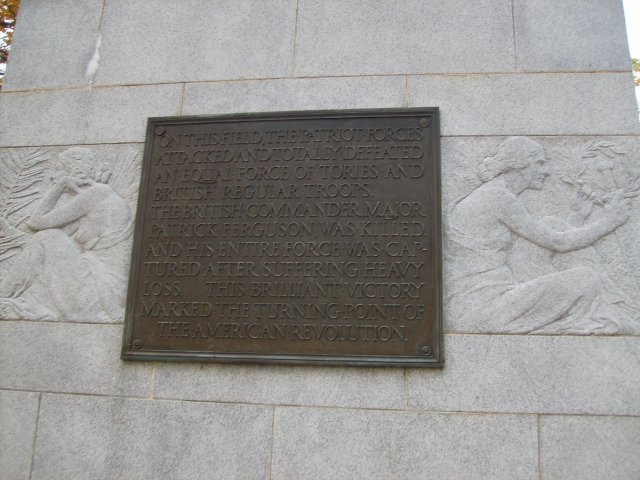
SANYO DIGITAL CAMERA
Plaque at Kings Mountain National Military Park


Robert M. Dunkerly (Bert) is a historian, award-winning author, and speaker who is actively involved in historic preservation and research. He holds a degree in History from St. Vincent College and a Masters in Historic Preservation from Middle Tennessee State University. He has worked at nine historic sites, written eleven books and over twenty articles. His research includes archaeology, colonial life, military history, and historic commemoration. Dunkerly is currently a Park Ranger at Richmond National Battlefield Park. He has visited over 400 battlefields and over 700 historic sites worldwide. When not reading or writing, he enjoys hiking, camping, and photography.

1st Maryland’s 2nd Last Stand

I was recently reading the superb book by Patrick O’Donnell on Washington’s Immortals, which brought me back to a talk I did about the same Marylanders in the American Revolution a few years back. Below is an excerpt of that talk and highlights the second last stand for a regiment with a tradition of being steadfast when deadly duty called.

On March 15, 1781, approximately 20 men stood in the 1st Maryland Continental Regiment staring at the an eerie and familiar scene. It must have seemed that history was cruelly repeating itself once again. These men had survived the forlorn assault in New York in 1776, the ugly repulse at Camden in 1780, and now stood on third line of General Nathanael Greene’s defense at Guilford Court House.

Battle of Guiliford Courthouse 15 March 1781.jpg
Famous painting of the 1st Maryland at the Battle of Guilford Court House by H. CHarles McBarron, Jr. 

Besides the 20 men who could be traced back to that fateful day in New York, the men that shouldered muskets in line with them were all veterans of indefinite periods of service as well.

The 1st Maryland and the men they confronted, 2nd Guards Battalion of Guards, were very similar, according to historian Lawrence Babits, who states that “the 1st Maryland was arguably one of the finest regiments produced by the Continental Army.

What ensued next was the defining moment of the battle and in essence the campaign. As the Guards officers gathered their men into a new line, the Marylanders came on at a rush. The Guards responded largely without specific commands…facing the oncoming Continentals, who fired several platoon volleys as they came. At a range of less than 12 yards, both lines fired again, so close that muzzle flashes overlapped into a wide sheet of flame and the heat from the volley could be felt.

Casualties mounted and at close range the musket balls shattered bone and even passed through the bodies of their targets.

SANY2634.JPG
Modern view from the location of Greene’s Third Line which the 1st Maryland held. Coming up the slight rise toward the photo was how the British approached. 

The two sides then resorted to the bayonet and Williams recounted “the first Regiment embraced the opportunity…bayoneted and cut to pieces a great number of the British.”

Although the melee only lasted a few minutes, the Marylanders had checked the advance and with the dragoons of William Washington, allowed for Greene to begin to pull back and start the retreat. In another important position, Williams helped lead the rear-guard away from Guilford C.H. The Marylanders lost 15 killed, 42 wounded and 97 missing. Most of the missing could have came from the 2nd Maryland which broke in disorder on the left flank of the 1st Maryland.

Not only did the Marylanders suffer on that fateful March day in 1781, they did so with a lack of, well, everything. According to one inventory report, the entire regiment, numbering little over 300 men had not a single jacket, two-thirds were without proper footwear, and every man was destitute of a full complement of clothing. In addition, the men had served, fought courageously, and bled tremendously, without receiving one cent as pay.

A remarkable “band of brothers” that “held the line for independence.”

Which, in case you were wondering, was the name of the talk.


*Guilford Court House National Military Park is now preserved by the National Park Service, to plan your visit, click here.

*For information on Mr. O’Donnell’s book, click here.

ERW Weekender: Brandywine & Valley Forge

Emerging Revolutionary War is honored to welcome guest historian Daniel Welch to the blog. A brief biography of Mr. Welch is at the bottom of the post. 

Several weeks ago I decided to take my usual weekend off of visiting American Civil War battlefields to take a moment to explore some American Revolutionary War historic sites just several hours down the road. Since it was a rather last minute decision, I was not completely prepared before visiting other than some basic historical context and a vague idea of operating hours and things to do while at these historic sites. So, if you want to follow the Continental Army during their experiences in the fall and winter of 1777-1778 read on to help plan a great weekend day trip.

Battle of Brandywine

IMG_1356
Sandy Hollow, Brandywine Battlefield

If you want to follow these events as they happened, and in chronological order, began your day at the Brandywine Battlefield Park Associates site. Walking the site is free, but there is a charge if you want to go through the museum or on a tour of one of two historic homes on the property. Their hours are constantly changing so make sure you check their website. (click here), before you plan your visit. To go on a house tour, view the film, and go through the museum there is an $8.00 charge; the museum and film alone is $5.00. I would suggest, if you have the time, to take in the film and museum. The film lasts approximately twenty minutes while a thorough look of the museum could take one an additional forty minutes. Between the film and museum, a firm foundation to the events of September 11, 1777 will be in place before you head out to other locations associated with the battle.  The house tour is a guided tour through Washington’s headquarters on the property and is conducted by a volunteer at the site. The tour took over an hour and a half, and considering that the home had burned to the ground nearly 100 years ago and has been rebuilt and filled with modern reproductions, your time would be better spent going to other sites associated with the battle.

IMG_1351
Birmingham Friend’s Meeting House plaque

Before leaving, make sure you pick up driving directions from the employees at the counter to get to Birmingham Friend’s Meeting House, and Sandy Hollow, the American’s second line of defense during the battle. Also, make sure to purchase the driving tour map of the battle of Brandywine. This map will take you to numerous other historic sites and homes within the Brandywine Valley that witnessed the events of that day. The cost is a mere $2.95. Plan an additional three to four hours to complete the driving tour.

Ultimately the battle proved to be an American defeat. Although he was defeated on the field, Washington and his generals were able to get large portions of the army to the rear through Polish General Pulaski’s assistance in covering the retreat. Despite the best maneuvers to save his army, Washington was unable to save Philadelphia and the city fell to the British just two weeks later on September 26, 1777. The British remained until June 1778.

Lunch

By now a late lunch would be in order.  A great spot is the Black Powder Tavern. A tavern since 1746, it has a great Revolutionary War history, including a supposed visit by Washington himself. The restaurant’s name is related to a historical legend that none other than Von Steuben had ordered the tavern turned into a secret black powder magazine during the army’s pivotal winter at Valley Forge. The food here was great, as was the service and beer selection.

Valley Forge National Historical Park

Following the defeat at Brandywine in September, and another engagement at White Marsh in early December, General Washington looked to put his army into a more secure camp for the coming winter. Active military campaigning for 1777 in Pennsylvania was over.  Just twenty miles northwest of Philadelphia, the Continental Army faced numerous challenges here including a lack of food and shelter. Disease also spread during their time at Valley Forge.  By February 1778, approximately 2,500 soldiers had perished.

IMG_1397
General Anthony Wayne Statue, Valley Forge National Historical Park

To begin your visit here, start at the visitor center. The museum has its challenges. There is no discernible narrative to the exhibits; rather, numerous cases with laminated pieces of paper hanging on the side with corresponding images and item descriptions.  Although there are some unique items on display, if it is busy you could wait at a particular case for the laminated cards to know what you are looking at. After a perusal of the museum, take in the free film. Although it is rather dated it provides a great overview of the winter encampment, its challenges, and outcomes. Between the film and museum, plan on spending an hour at the visitor center.

If you have additional time, take in the one and only National Park Service Ranger program offered. It is a rather short program, in length and walking distance, from the visitor center to the reconstructed Muhlenberg Hut sites. The program also echoes what is presented in the film. Before leaving the visitor center, I recommend getting the auto tour cd, as well as any updates on road closures. The park is currently under a significant amount of construction that has closed some roads and altered the driving tour route. The suggested driving tour cd is two hours in length. This would be a time allotment for those visitors who do not stop at each site, get out of the car, and explore all the stops along the route. You will want to get out and explore monuments such as those to the New Jersey troops, National Memorial Arch, von Steuben, and Patriots of African American Descent. You will also want to explore the several historic homes within the park that were used during the encampment, such as Varnum’s Quarters, Washington’s Headquarters, and the Memorial Chapel.  My explorations, coupled with the driving tour cd, lasted nearly five hours.

IMG_1421
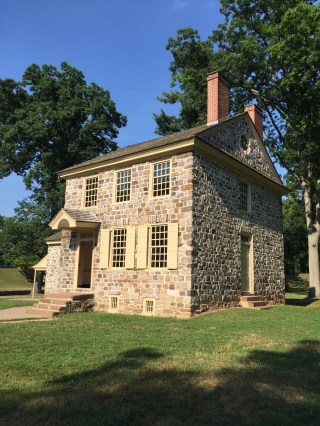
George Washington’s Headquarters (Isaac Potts House) at Valley Forge National Historical Park

Although it would be a long day, it can be done in one; however, if you wish to slow the pace of your visit, each site could be done on a separate day during your weekend. There is plenty of lodging in the area to accommodate this schedule. By visiting both of these historic areas and learning about the events of the fall through early spring 1777-1778, a greater picture can be viewed gleaned of military situation during the time period, as well as the tough composition of the Continental Army despite their defeats.


*Dan Welch currently serves as a primary and secondary educator with a public school district in northeast Ohio.  Previously, Dan was the education programs coordinator for the Gettysburg Foundation, the non-profit partner of Gettysburg National Military Park, as well as a seasonal Park Ranger at Gettysburg National Military Park for six years. During that time, he led numerous programs on the campaign and battle for school groups, families, and visitors of all ages.

Welch received his BA in Instrumental Music Education from Youngstown State University where he studied under the famed French Hornist William Slocum, and is currently finishing his MA in Military History with a Civil War Era concentration at American Military University. Welch has also studied under the tutelage of Dr. Allen C. Guelzo as part of the Gettysburg Semester at Gettysburg College. He currently resides with his wife, Sarah, in Boardman, Ohio.


Six Signers Signing

Part Three of Six

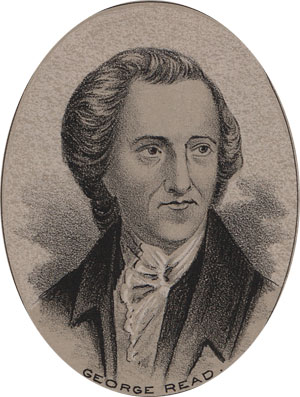
His name might not be too familiar, but he has the distinction of signing three of the most important documents of the American Revolutionary period; the petition to King George III of 1774, the Declaration of Independence, and the United States Constitution. His name?

George Read.read


Born in the colony of Maryland on September 18, 1733 in the county of Cecil, the young Read was shortly thereafter on the move. His family, while George was an infant, resettled in New Castle, Delaware. When of school age, he attended Reverend Francis Allison’s Academy in New London, Pennsylvania, and one of his classmates was Thomas McKean, a future Signer of the Declaration of Independence as well. George moved on to study law in Philadelphia under the tutelage of John Moland. In 1753, George was admitted to the bar and the next year had settled back in New Castle, Delaware to practice. Continue reading “Six Signers Signing”

A Tribute to Robert Treat Paine

The city of Boston, Massachusetts is steeped in American Revolutionary War history. The city has designed an entire trail–the “Freedom Trail”–a footpath that leads interested visitors around the city to the areas of most importance.

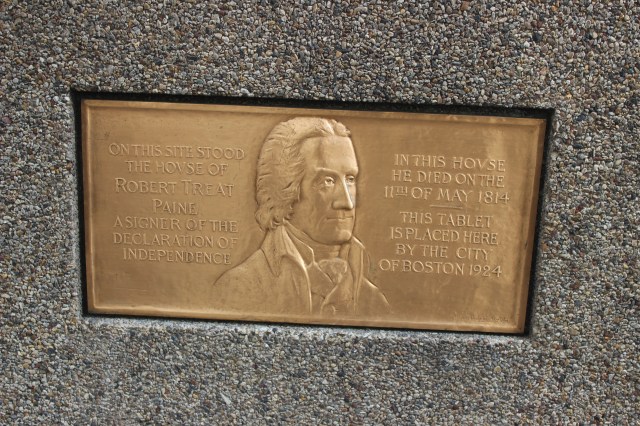
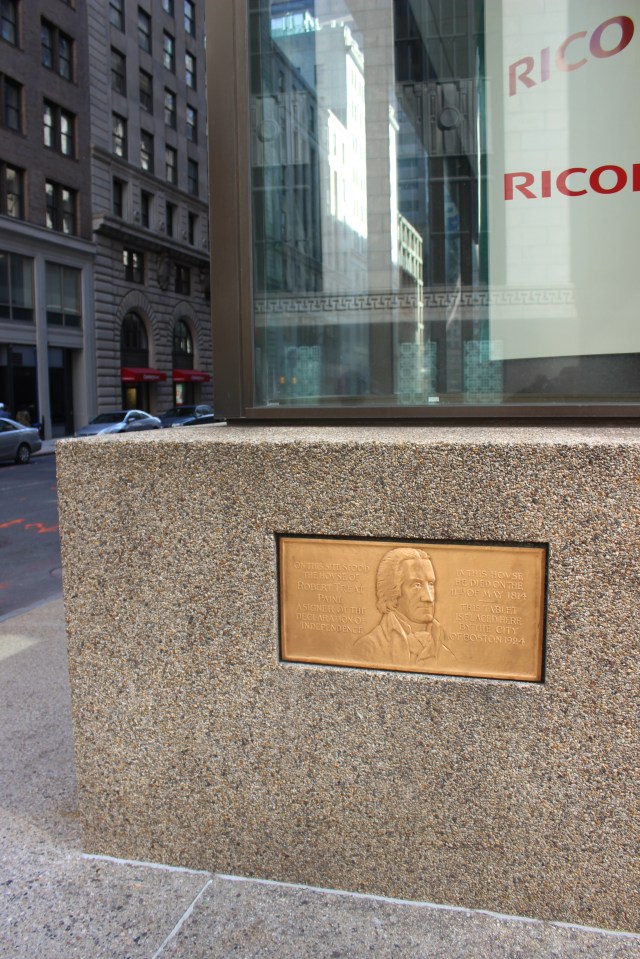
Yet, some history, is just, literally, stuck right on the walls of Boston. On the side of a modern office building, is situated the plaque below:

IMG_7075

One of the 56 men that affixed his signature to the Declaration of Independence, Paine was born in Boston on March 11, 1731 and was actually given a middle name, a family tribute. His family legacy was well-established in the colonies and Paine himself was counted as an early advocate for the patriotic cause.

Yet, like the more famous John Adams, Paine also was a lawyer and dedicated to the law and order. He was the second attorney, along with the aforementioned Adams, to represent the British soldiers in the “Boston Massacre” trial. He continued to hope for reconciliation, hoping when he ventured to the Second Continental Congress, that the resolve of the colonies would bring the British Parliament to negotiate. On that same vein, Paine also put his signature on the Olive Branch Petition–the final attempt by the colonies to reach King George III and give their side of the story. When the king outright rejected the petition and did not even lay eyes on the document, Paine saw there was no hope and firmly planted himself in the camp of those clamoring for independence.

He became a vocal and valuable member of the Continental Congress and signed the Declaration of Independence on August 2, 1776. Returning to Massachusetts near the end of 1776, he became the Speaker of the Massachusetts House of Representatives the following year. In 1780 he was a member of the committee that drafted the state constitution and as attorney general he prosecuted members of Shays’ Rebellion in 1787.

His last public role was a justice of the Massachusetts Supreme Court from 1790 until his retirement in 1804. He was 83 years old when he died in the house that the plaque mentions. He was buried in the Granary Burying Ground in his native Boston, Massachusetts.

Another great patriot of the American cause, whose last house where his last days were spent, has a lasting memorial for those to discover. So, many historical treasures are just hanging there, waiting to be discovered in Boston.

IMG_7076
Another view of the Robert Treat Paine plaque in Boston

Continue reading “A Tribute to Robert Treat Paine”

Defense in Depth as a Revolutionary War Battlefield Tactic

Part Three (click here for first two installments)

Determined to avenge his embarrassing defeat at Cowpens, Lt. Gen. Charles Lord Cornwallis set his army out in a determined pursuit of the American army. Knowing that he was too weak to face Cornwallis in a pitched battle, Maj. Gen. Nathanael Greene, the Southern Department commander, retreated northeastward from Salisbury, North Carolina toward the Virginia state line, where he hoped that additional militia troops would reinforce his army and he would receive supplies. The British chased Greene to the Dan River, near the Virginia border, but Greene wisely put the river between his army and the enemy. Cornwallis and his weary soldiers arrived at the rain-swollen river on February 15, too late to catch Greene’s army, which had finished crossing earlier that day. Frustrated, Cornwallis withdrew to Hillsborough, North Carolina.

LC
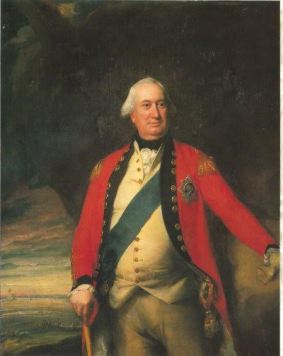
Lord Charles Cornwallis

After receiving both the expected supplies and reinforcements, and after an opportunity to rest his command, Greene soon marched back into North Carolina to face Cornwallis’ tired and poorly supplied army, which now numbered less than 2000 men. After several weeks of skirmishing with Loyalist militiamen and a great deal of maneuvering Greene assumed a defensive position around Guildford Courthouse (near modern Greensboro, North Carolina) on March 14, 1781. Greene had more than 4000 Continentals, militiamen and cavalry, meaning that his army outnumbered Cornwallis’ by more than twice their strength. Continue reading “Defense in Depth as a Revolutionary War Battlefield Tactic”

Finding The “Correct” Image of General Washington

I handed over a couple of one dollar bills to pay for my coffee. The image of George Washington caught my eye, and I smiled. It would be nice to relax for a moment and pick-up Valiant Ambition by Nathaniel Philbrick, the Revolutionary War history book I was reading. Settling into a comfortable chair, I soon immersed myself in the drama of the Battle of Princeton. Guided by the book’s text, my imagination created a vivid image of the unfolding conflict. George Washington – looking splendid on a large horse – galloped along, leading his men and shouting “It’s a fine fox-chase, my boys.”[i]

Startled, I closed the book. It seemed too difficult to accept that the “Father of His Country”, the dignified George Washington, and the reserved and diplomatic leader of the 1790’s could be riding recklessly, shouting in a full, commanding voice, and – on other occasions – struggling to keep his temper controlled when dealing with difficult subordinates. Then I felt foolish. My image of George Washington was based on the Gilbert Stuart presidential painting from 1797 that we’d studied in high-school art class!

Photo 1 Continue reading “Finding The “Correct” Image of General Washington”

News Release: The British Are Coming!

*From our friends at Civil War Trust and Campaign 1776*

If you have been following the ongoing saga regarding the Institute of Advanced Study’s plans to build 15 faculty houses on the historically hallowed ground of Princeton Battlefield, there is another update to track.

“The British Are Coming.”

17th Regiment of Foot Reenactors
Living historians portraying the British 17th Regiment of Foot at the Battle of Princeton. The 17th Regiment, under Lt. Col. Charles Mawhood, bore the brunt of General George Washington’s famous counterattack during the January 3, 1777 Battle of Princeton. Image taken March 2016. (Source: US Civil War Trust).

Continue reading “News Release: The British Are Coming!”

“The whole story soon became known to the corps” The Unknown Legend of John Champe

Part I of III

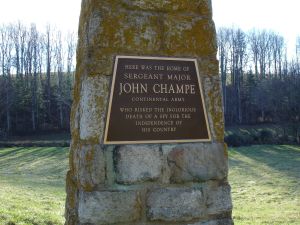
Sergeant Major John Champe Monument

Along Route 50, west of Aldie, Virginia is a small obelisk in the middle of a cow pasture. Thousands of car drive by the marker, not knowing what it is or who it is for. Most people that come to this area of Virginia for history are interested in the American Civil War. In this region of Virginia the legendary John S. Mosby operated behind Union lines for two years. Also here were the hard fought cavalry battles that preluded the Battle of Gettysburg.  But this monument doesn’t refer to anything in the Civil War.  This monument commemorates a local American Revolutionary War hero.  A man that has been mostly forgotten until recently.

John Champe was born in ca. 1755 from a family that was well established on Virginia’s Northern Neck. His family owned substantial land in King George, Stafford and Prince William Counties. At some point, his family moved to the Aldie region of Loudoun County, where John was born. The men of the Champe family were involved in the local militia and civil office as road builders. Though the family had substantial land holdings and slaves, John was one of many siblings and sought out his future with the military at the outbreak of the American Revolution.

John Champe enlisted as a private in the 1st Regiment, Virginia Light Dragoons in December 1776. Champe’s abilities were quickly noticed and saw himself promoted to corporal by 1778 and then a sergeant by 1779. Champe’s abilities were quickly noticed by his commander, Major “Lighthorse” Harry Lee. Lee described Champe as “rather above the common size – full of bone and muscle; with a saturnine countenance, grave, thoughtful and taciturn – of tried courage and inflexible perseverance.” [i] Though Champe might have quickly risen in the non-commissioned ranks, he desired more.  His opportunity for promotion and a date with history came on September 27, 1780 at West Point, NY.

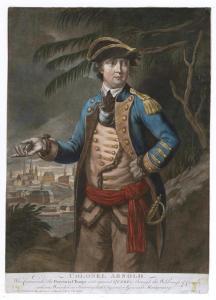
The treachery that took place on September 24th at West Point by once beloved American General Benedict Arnold is well documented.  Arnold planned on turning over the fortress at West Point to the British (thus giving up the vital Hudson River).  Arnold, receiving command of the post at West Point in August 1780, quickly reduced the viability of the fortifications by neglecting repairs and sending troops away from the post.  Arnold’s treachery was not exposed until British officer, Major John Andre was captured, carrying on him copies of letters and Arnold’s plans.  Luckily for Arnold, he learned on the morning of September 24th of Andre’s capture and he quickly fled to the HMS Vulture then on to safety in New York City.

Benedict_Arnold_1colorWashington also learned of Arnold’s treason on September 24th during his planned visit to West Point.  Washington reportedly took the news calmly and began to investigate the depth of treason in his officer corps.  Maj. Lee assisted Washington in his investigation, and both found no evidence of other American officers involved in the plot.  Washington then turned to the capture of Arnold, and that is where our “hero” comes into the story.

In October of 1780, Washington looked to Lee to find someone in his talented cavalry command that could “defect” to the British and carry out an elaborate plan to capture Arnold. Calling Lee to his headquarters, Washington and Lee discussed the proposition of capturing Arnold and how to carry out such a plan.  Lee was tasked with finding someone in his command that could successfully carry out the plan. Lee soon wrote to Washington that he had two men in mind, but his top choice was a sergeant in his cavalry unit

“The chief of the two persons is a sergeant in my Cavalry; to him I have promised promotion…if your Excellency approves of what is done, the sergeant will desert from us tomorrow; the sergeant is a very promising youth of uncommon taciturnity and inflexible perseverance…I have incited his thirst for fame by impressing on his mind the virtue and glory of the act.” [ii]

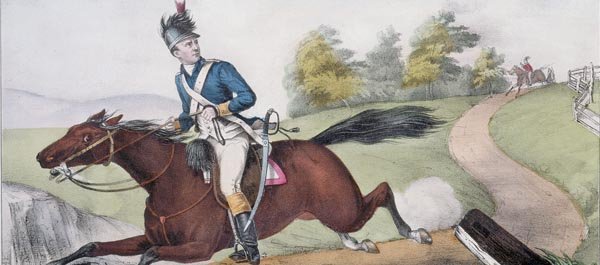
Washington quickly responded and agreed to Champe’s terms of promotion and soon the mission was hatched. Champe would desert to the British and only Lee and Washington would know about it.  He would be labeled a traitor and his family name tarnished.  If he was captured by the Americans, he would be executed and if he was exposed as an American spy to the British, he would also be executed.  Champe accepted the risk and on the night of October 21st, Champe mounted his horse and made way for the Hudson River where he hoped to find either a British picket line or ship. With him Champe carried his orderly book, saddle bags and five guineas (provided to him by Lee).

Quickly Champe was challenged by an American patrol and he quickly fled,.  This is exactly what Champe and Lee wanted, for the British to believe him, his desertion had to seem real.  Soon the patrol reported to Lee about Champe’s departure.  Lee delayed the pursuit, by first inquiring with other patrol members.  Surely a man of Champe’s stature was not defecting. Soon though Lee knew he had to order a pursuit, he just hoped Champe had put enough distance between him and the Americans to make his escape.

H-Lee-10_11_07-600
“Light Horse” Harry Lee


Though Lee’s delay allowed Champe some time, it was not enough to break away cleanly. As Champe was making his way to the Hudson River, the American patrol was on his heels and calling for his halt. In front of him were British warships in the Hudson River and a British patrol on the banks for the river.  Now was the time of decision, he could be shot dead by the British or captured and executed by the Americans.  The plan to capture Arnold and punish the traitor was already at its first “Rubicon.”


[i] The Revolutionary War Memoirs of General Henry Lee; DeCapo Press, 1998, pg. 396.

[ii] “Sergeant John Champe and Certain of His Contemporaries”; William and Mary College Quarterly, April 1937, pg. 153.