On September 20, 1777 an American force under General Anthony “Mad Anthony” Wayne was surprised and routed by British forces under General Charles Grey. Wayne’s entire division was put to flight losing nearly 300 men (with the British losing just a dozen). Called by many the “Massacre at Paoli”, the fight was one of many that was part of the 1777 Philadelphia Campaign.
Join ERW on Sunday, April 14th at 7pm on our Facebook page as we welcome back historian and author Michael C. Harris, expert on the Philadelphia Campaign, we will discuss the battle, its role in the campaign, the personalities and the myths around Paoli. Harris is now working on his third volume in his much acclaimed Philadelphia Campaign trilogy, that will include the Battle of Paoli. If you can not make the livestream, the Revelry will be posted to our You Tube and Spotify channels.
Approximately 5,000 African-American or Black soldiers fought for the patriot cause in the American Revolution. Some joined state militias, some joined the Continental Army, and some sailed the seas with the fledgling navies of the United Colonies. William and Benjamin Frank were two of those 5,000. Both were free Blacks from Rhode Island who enlisted in the 2nd Rhode Island Regiment in 1777. Their father was a veteran of the French and Indian War, so the family was well-established in military tradition.
The 2nd Rhode Island fought and defended Fort Mercer during the campaigns of 1777 and survived harsh winters at Valley Forge and Morristown before returning to Rhode Island to literally defend the hearth and home from the British. Author and historian Dr. Shirley L. Green, adjunct professor at the University of Toledo, a 26-year veteran of the law enforcement community, and current Director of the Toledo Police Museum in Ohio, “takes the reader on a journey based on her family’s history, rooted in its oral tradition.”
Her book Revolutionary Blacks, Discovering the Frank Brothers, Freeborn Men of Color, Soldiers of Independence was published by Westholme Publishing in November 2023.
Furthermore, Dr. Green puts “together the pieces of the puzzle through archival research, interviews, and DNA evidence” to authenticate and expand the family history. The end result is a very readable and needed addition to the historiography of the American Revolution. Her ability to tell “a complex account of Black life during the Revolutionary Era demonstrates that free men of color…demonstrates that free men of color shared with white soldiers the desire to improve their condition in life and to maintain their families safely in postcolonial North America.”
Emerging Revolutionary War looks forward to an engaging and informative discussion with Dr. Green, this Sunday, at 7 p.m. EDT on our Facebook page. We hope you can tune in for this next episode of Emerging Revolutionary War’s “Rev War Revelry.”
For more information about the book and to order a copy, click here.
Emerging Revolutionary War welcomes guest historian Eric Wiser to the blog.
This is a brief story of my first and memorable visit to the Camden Battlefield in South Carolina this September past. I am a husband and father living in the suburbs of Chicago. I make my living as an accountant. As rewarding as my career has been, it’s my strong interest in early American history that stirs my imagination. My pilgrimage to Camden was part of a visit to my friend Phil Kondos who moved to eastern Georgia with his family over a decade ago. Phil is a gifted musician and wonderful father and happens to share a mutual love of history. This narrative of our visit will hopefully inspire others to place Camden Battlefield on their bucket list.
My interest in the Battle of Camden mostly derives from having a Patriot ancestor who fought there. Pvt. Michael Wiser, a 23-year-old grist miller from Frederick County, Maryland, was with the First Maryland Brigade and captured by the British at Camden.[i]
“Given the order to defend the American withdrawal from Long Island, the Maryland Line saved the Continental Army from annihilation in the first major battle of the war.” wrote historian Ryan Polk.
Tench Tilghman, staff officer to George Washington and a native Marylander wrote about his fellow soldiers, “bore the palm…by behaving with as much Regularity as possible.”
Furthermore, if you Google “Battle of Guilford Court House” the image used by Wikipedia depicts an artist’s rendition of the 1st Maryland defending Nathanael Greene’s last line during the March 1781 engagement. The particular image is below.
The Continental Maryland Line was one of the preeminent stalwarts of the American army, both in the northern and southern theaters of the war. Join Emerging Revolutionary War historians in a discussion about the men from the Old Line State and their military acumen during the American Revolutionary War. The discussion will also highlight their memory and memorialization. We hope you can join us Sunday at 7 p.m. EST on the Facebook page of Emerging Revolutionary War.
The Battle of Bunker Hill is routinely mentioned in the pantheon of memorable American military victories. Although myths of the engagement have obscured some of the history, much like the smoke of battle, the patriot victory on June 17, 1775, was another pivotal moment in the early stages of what became the American Revolutionary War.
To discuss the engagement, ramifications, and interpretation of the battle, Emerging Revolutionary War welcomes historian Dr. Paul Douglas Lockhart, Professor of History at Wright State and author of “The Whites of Their Eyes, Bunker Hill, the First American Army, and the Emergence of George Washington.” A full biography of Dr. Lockhart, including his other works, is at the bottom of this post.
As a teaser, this may be the first time in “Rev War Revelry” history that we mention Artemas Ward, who according to Dr. Lockhart is the “unsung hero of the battle (and indeed of 1775).” Come hear why! And full disclosure, I agree.
We hope you can join us on Sunday, January 21 at 7 p.m. EDT on Emerging Revolutionary War’s Facebook page for the next installment of the popular “Rev War Revelry.” Be ready to ask questions as you sip your favorite beverage during this historian happy hour.
Biography of Dr. Lockhart
“Paul Douglas Lockhart is Professor of History at Wright State University in Dayton, Ohio, where he has taught since earning his PhD in 1989. A native of Poughkeepsie, New York, Lockhart completed the PhD at Purdue University, where he studied military history with the late Gunther Rothenberg, the renowned Napoleonic scholar, and early modern European history with Charles Ingrao. He has seven single-author books to his credit. Four of them deal with the history of Scandinavia during the “Age of Greatness,” including Denmark, 1513-1660: The Rise and Decline of a Renaissance Monarchy, published by Oxford University Press in 2007. He is probably better known for his books on military history: The Drillmaster of Valley Forge: The Baron de Steuben and the Making of the American Army (2008), The Whites of Their Eyes: Bunker Hill, The First American Army, and the Emergence of George Washington (2011), and most recently his study of the parallel evolution of warfare and firearms: Firepower: How Weapons Shaped Warfare (2021). Wright State has awarded him the Brage Golding Distinguished Professorship and the Trustees’ Award for Faculty Excellence, the University’s highest academic honor. The Ohio Academy of History named him Distinguished Historian for 2020-21, and in 2021 he was elected to membership in The Royal Society for Danish History for his contributions to the history of Denmark, an honor rarely accorded to foreigners. He lives in Centerville, Ohio, with his family.”
Welcome to the first “Rev War Revelry” of 2024! To kick off the new year, Emerging Revolutionary War is joined by Tom Hand, author, historian, and founder of Americana Corner. However, in the later stages of 20234, Tom added published book author to his lengthy list of accomplishments. His book, American Triumph is now available via his website.
The book, “masterly blends the personal experiences and historic milestones” of three luminaries of the early Republic, Benjamin Franklin, George Washington, and John Adams. The book, with a plethora of graphics, sidebars, and informational tidbits aims to provide a “captivating collection of stories” for the “everyday American.”
We look forward to a lively and friendly discussion with Tom. Hope you can tune in, to Emerging Revolutionary War’s Facebook page at 7 p.m. EDT this Sunday, January 7th.
Join us this Sunday evening at 7:00 p.m. on our Facebook page for an author interview with Jack Kelly to discuss his new book, God Save Benedict Arnold: The True Story of America’s Most Hated Man.
Benedict Arnold committed treason― for more than two centuries, that’s all that most Americans have known about him.
Yet Arnold was much more than a turncoat―his achievements during the early years of the Revolutionary War defined him as the most successful soldier of the era. GOD SAVE BENEDICT ARNOLD tells the gripping story of Arnold’s rush of audacious feats―his capture of Fort Ticonderoga, his Maine mountain expedition to attack Quebec, the famous artillery brawl at Valcour Island, the turning-point battle at Saratoga―that laid the groundwork for our independence.
Arnold was a superb leader, a brilliant tactician, a supremely courageous military officer. He was also imperfect, disloyal, villainous. One of the most paradoxical characters in American history, and one of the most interesting. GOD SAVE BENEDICT ARNOLD does not exonerate him for his treason―the stain on his character is permanent. But Kelly’s insightful exploration of Arnold’s career as a warrior shines a new light on this gutsy, fearless, and enigmatic figure. In the process, the book offers a fresh perspective on the reasons for Arnold’s momentous change of heart.
As we move towards to the 250th anniversary of the Boston Tea Party, we at ERW have gotten a lot of questions with a central theme…” why was it tea that led to revolution?” Was tea so central to colonial life that it was worth risking war or was it something else? The answer is somewhere in the middle and as with most history, there is nuance to the story (and yes, tea WAS a big part of everyday live in British America).
On May 10, 1773, Parliament passed the Tea Act, this act was a way for the British government to help bail out a major corporation, the British East India Company. The British East India Company was one of the largest global companies and faced immense debt and financial trouble. Furthering their troubles, they held a large amount of tea stored in warehouses in London. The British East India Company sought a way to offload this tea, which was considered some of the best tea in the world. The company’s success was directly tied to Great Britain’s international strategy, as the company spread British influence across the globe especially in India where they basically managed the British colony. The Tea Act reduced the cost on the tea (cutting out the “middleman” in Great Britain), and now the colonists could buy the tea directly from the British East India Company.
The British colonies in North America consumed on average of 1.2 million pounds of black tea annually. In 1773, about 1/3 of the population drank tea at least twice a day. It was a common luxury among most middle- and upper-class colonists. They preferred black tea but also drank green tea. Black tea varieties included Bohea, Congou and Souchong and common green tea varieties included Singlo and Hyson. All the tea that the British East India Company sold was grown and imported from China. Tea from China was preferred by most for better flavor, but it tended to be more expensive. The North American colonies consumed a lot of smuggled tea from the Dutch, the quality of the tea was not the same but much cheaper. A large market grew for smuggled tea with most British port officials looking the other way. All of this changed when the Tea Act was passed.
Nineteenthcentury lithograph depicting a tea plantation in Qing China
Many in Parliament believed the colonists would have little opposition to this new act. They could now purchase their preferred tea for a cheaper price than the smuggled tea from the Netherlands. Unfortunately for Royal leaders, this was not the case. As word reached the colonies Whig leaders such as Samuel Adams called it nothing more than a British authorized monopoly of the tea market, cutting into the pockets of colonial merchants (though their tea smuggling business was illegal to begin with). The Tea Act also highlighted a British policy that the colonists opposed for many years, the Townshend Acts. The Townshend Acts imposed duties on imported lead, glass, paper, paint, and tea. This “tax” was payable at ports and funded the salaries of colonial judges, governors, and other government officials. This angered many colonial leaders for two reasons. First, it levied another tax on the colonists without having their own representation in Parliament. Secondly, it made the government officials more beholden to the British government (and the tax) than the colonial governments.
Whig groups like the Sons of Liberty used local taverns as places for their meetings. The most famous being the Green Dragon Tavern in Boston. It no longer stands today.
As the news of the Tea Act reached the colonies, the reaction was mixed. Whig leaders in major cities such as Charleston, New York, Philadelphia and Boston saw it as a way to reinvigorate their cause of opposing British rule. Recently things were mostly quiet with little interest by the public for protest. But now the Whig spin machine went into full affect. The Tea Act was a direct affront to colonial self-rule and economic interest. The taxes paid for the tea went to British officials in the colonies and the cheaper priced (and better quality) tea would put many American merchants out of business. Whigs were able to control the message that the Tea Act was just another way for Parliament to make money off the colonists, who did not have representation in Parliament.
As part of the Tea Act, consignees were appointed to oversee the sale of tea and the collection of the taxes on behalf of the British East India Company. As the tea began to arrive in colonial ports, public pressure was put on consignees to resign. This pressure was successful in New York, Philadelphia and in Charleston. Each of these cities were able to either stop the tea from being offloaded or, as in the case of Charleston, they confiscated the tea and didn’t allow any duties to be paid on it. All of these were direct affronts to the law but the events in Boston proved to be the most dramatic.
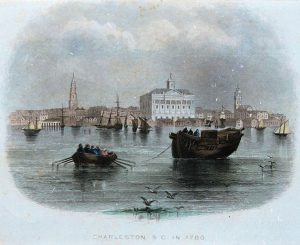
Ca, 1780 view of Charleston Harbor, and the Exchange Building where the confiscated tea was locked away by Whig leaders.
Unlike in other port cities, the consignees in Boston refused to resign. Richard Clarke, leading merchant in Boston and one of consignees faced a mob at his warehouse trying to pressure him and the other consignees to resign. Encouraged by the Massachusetts Governor Thomas Hutchinson (who had two sons serving as tea consignees) to stand their ground, the consignees refused to resign. Soon news arrived that the first ship carrying the tea, the Dartmouth, was arriving in Boston soon.
Hosting several town meetings, some hosting thousands of people, Whig leaders such as Samuel Adams, Dr. Joseph Warren and John Hancock were able to organize a strong opposition to the tea. Of course, Boston was already a tinderbox due to the “Boston Massacre” in 1770 and the large contingent of British regular troops stationed in Boston. Bostonians were reminded daily of Royal influence. The Whigs protested to the Governor to order the ships to return to England, but Hutchinson refused to do so and claimed he didn’t have that authority. Many historians believed Hutchinson, who recently had resigned as Governor and was awaiting his replacement, had grown tired and frustrated with the likes of the Whigs and Sons of Liberty in Boston and was trying to press the issue.
On November 28, the Dartmouth arrived in Boston Harbor. Captain James Hall was turned away at the first wharf he sailed too and was redirected to Griffins Wharf. Everyone knew that once a ship entered the harbor, the captain had twenty days to unload the cargo and pay the custom duties. Soon two more ships arrived at Griffins Wharf with more tea. With the Governor refusing to allow the ships to leave the harbor and local patrols watching the ships to make sure the tea was not offloaded, the stage was set for December 16th, the last day the ship’s captains had to unload their cargo.
Joseph Galloway is best known as one of the preeminent and prominent Loyalists who remained in the American colonies through the majority of the American Revolution. Prior to the colonies declaring independence, especially during the First Continental Congress, Galloway was active in the debates that decided the path forward. Besides attending and being active in the discussions in Philadelphia he penned a pamphlet entitled A Candid Examination of the Mutual Claims of Great Britain and the Colonies.
Within the pages, he called African American slavery “the dangerous enemy within” and the “natural weakness” of the soon-to-be Southern states. If a division ensued, Galloway predicted that,
“If the colonies happen to vie and try their reciprocal strength with each other, the political force of the Northern Colonies will soon destroy the opulent force of the Southern.”
Furthermore, Galloway pointed to the colonies/states of Georgia, Maryland, North and South Carolina, and Virginia as vulnerable because of the institution of slavery. In a conflict without the overarching guidance by Great Britain, the division between Northern and Southern colonies/states would lead to a domestic civil war and the possibility that African American slaves would join the Northern effort in vanquishing their former owners.
Although Galloway was writing to prop support for remaining loyal to the British crown he foreshadowed accurately the rift that plagued the independent United States. In laying out his views, Galloway quite succinctly predicted what would happen in 78 years after independence was won by the United States.
Galloway left Philadelphia when the British evacuated the city in 1778 and left for England where he would position himself in a leading role for loyalists in exiles. He never returned to the United States. His succinct prediction of the future though proved eerily accurate.
Sources:
Disunion Among Ourselves, The Perilous Politics of the American Revolution by Eli Merritt
University of Michigan, Evans Early American Imprint Collection, click here for the link.
We are excited to announce our 2024 (fourth annual!) bus tour location will be Lexington and Concord on October 11-13, 2024. Join historians Phillip Greenwalt, Rob Orrison and Alex Cain as we tour the sites associated with the beginning of the American Revolution on April 19, 1775. The tour will cover events in Lexington, Concord and sites along the “Battle Road.” Tickets are $250 per person and includes a Friday night lecture, all day tour on Saturday and half day tour on Sunday (bus tour transportation and Saturday lunch included in cost).
Join us for our FOURTH annual tour as we take on the beginning of the American Revolution just a few months before the 250th anniversary. Learn about the dramatic events that led to the first shots for the Revolution and the bloody aftermath. We will visit Lexington Green, Buckman’s Tavern, North Bridge in Concord, Battle Road including Merriam’s Corner, Parker’s Revenge and the Jason Russell House. There is no better way to experience history than to stand in the footsteps of where it happened!








 Emerging Revolutionary War Era