While delegates to the Second Continental Congress debated the matter of Independence in 1776, the British brought the war to Charleston, South Carolina. Defense of the city focused on Fort Sullivan, on Sullivan’s Island at the northern mouth of Charleston Harbor. Major General Henry Clinton, commanding an Army expedition against the Americans, was determined to exploit the fort’s vulnerabilities. He ultimately failed, but his effort, or lack thereof, prompted a British newspaper to craft a little ditty taunting the poor general.
In December 1776, the American Cause for independence was at an all-time low. After losing New York to the British, General George Washington’s Continental army limped into eastern Pennsylvania broken and on the verge of defeat. Against all odds, Washington chose to attack the garrison at Trenton on December 26. The crossing of the Delaware River and victory that followed are widely recognized as having saved the American Revolution. What is less known are the events that occurred in Burlington County, New Jersey that affected this battle.
Between December 21-23, 1776, Hessian detachments under the command of Colonel Carl von Donop were busy prodding the countryside south of Bordentown. American Colonel Samuel Griffin, with a force of 600 mixed units (more than half no older than 15 years old), established a foothold at Mount Holly. Two days of harassment at Petticoat Bridge (Mansfield Township) convinced von Donop that rumors of an American force of 3,000 at Mount Holly were true. On his own authority, the Hessian colonel moved his force of 2,400 on the morning of December 23. What transpired were a series of firefights at Petticoat Bridge, the Mount (along Woodlane Road) and finally at Iron Works Hill on the southside of the Rancocas Creek. The American forces retreated to Moorestown, leaving Mount Holly fully occupied by the Hessian forces. Instead of returning to Bordentown, von Donop stayed. Why? Our answer comes in the journals of Burlington resident Margaret Hill Morris and Hessian Jager Captain Johann Ewald. Both write of a “beautiful young widow” who kept von Donop occupied for three days. The Hessians remained at Mount Holly, more than a day’s march from Trenton. On December 26, a bugler rode into town delivering the news of Washington’s victory. Had Colonel von Donop remained or returned to Bordentown prior to the attack, he would have been readily available to reinforce Colonel Johann Rall at Trenton, likely changing the outcome of the battle.
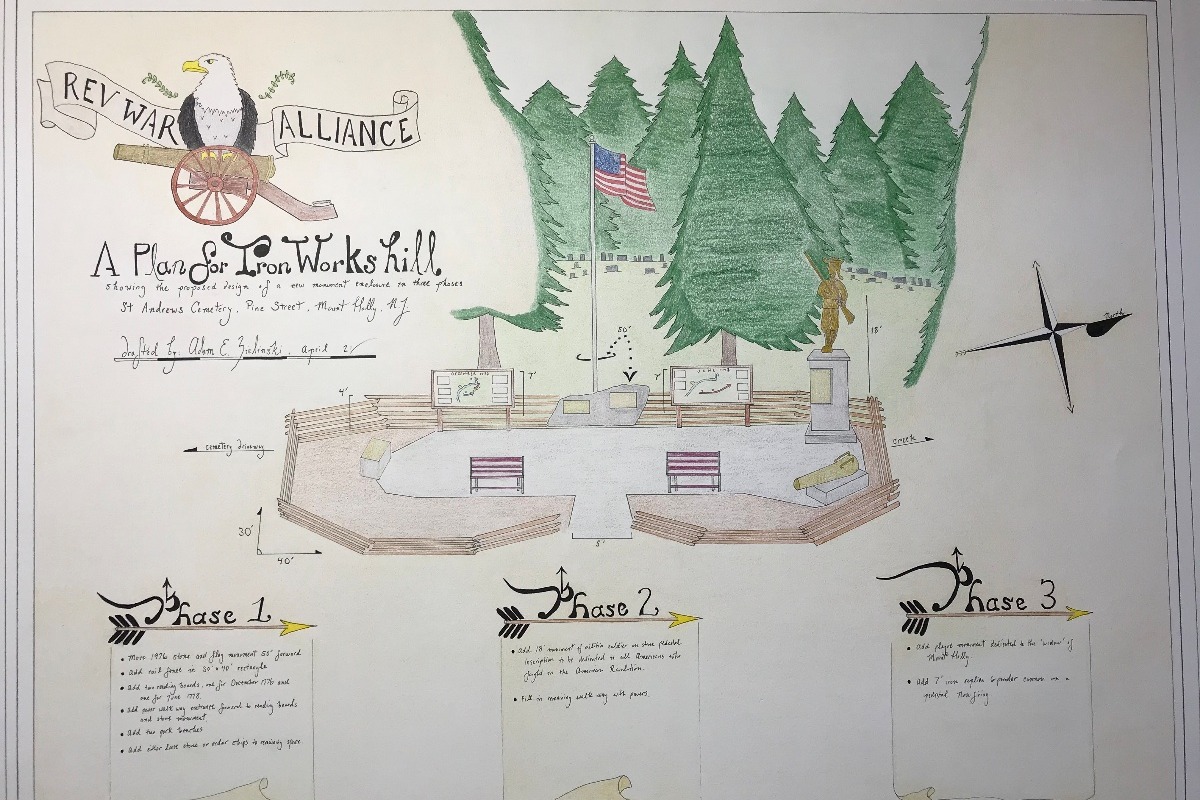
In 1976, a stone monument was erected at St. Andrew’s Cemetery on Pine Street in Mount Holly to honor the events that took place in December 1776. While this monument has served its purpose, we, the Rev War Alliance of Burlington County, feel the time has come to enhance the visitor experience with a new monument project. To coincide with the coming 250th of American Independence, we have received permission to add/build to the existing monument along Pine Street.
The provided sketch/plan is broken down into three phases with Phase 1 being the purpose of this fundraiser.
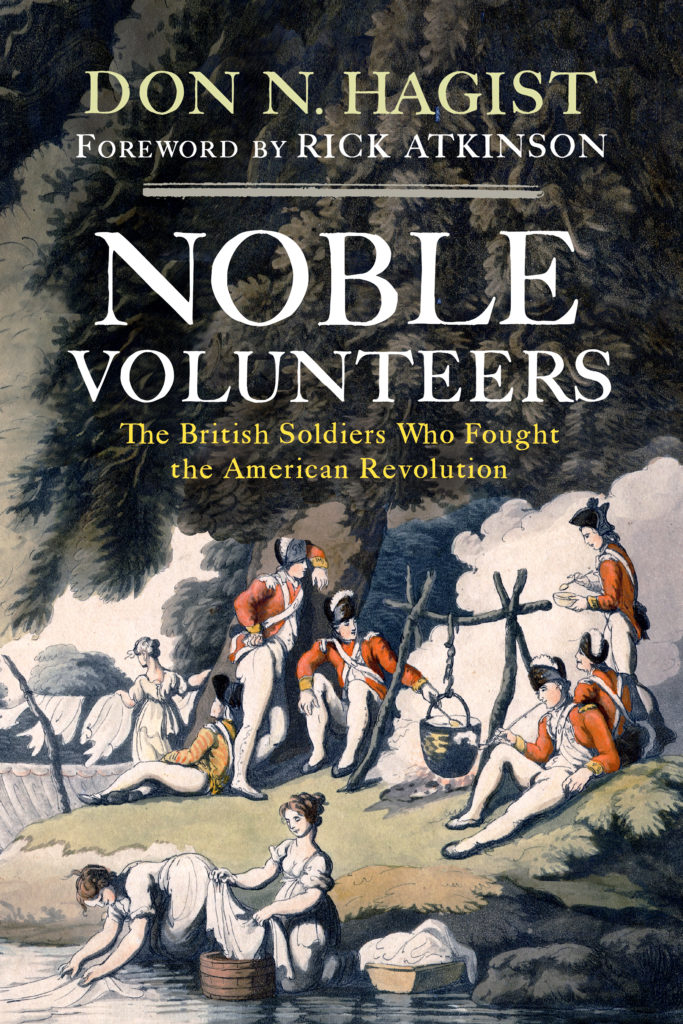
Don Hagist is one of our foremost American authorities on the common British soldier during the American Revolution. His latest book, Noble Volunteers: The British Soldiers Who Fought the American Revolution, is an institutional portrait of the British army that fought the American Revolution. Hagist has walked this ground before, most notably in British Soldiers, American War, which dedicated a chapter to a specific individual as a way of illustrating the experience of the common soldier. Noble Volunteers extrapolates on that, using soldier accounts, regimental paybooks, muster rolls, pension applications, and any other available material to give us an integrated picture of the entire army and how it functioned. It’s an extraordinarily valuable book.
Almost fifty years ago, the United States celebrated its Bicentennial, treating July 4, 1976 as the 200th anniversary of its founding. (The next “major” milestone will be the semi-quincentennial, which doesn’t quite roll of the tongue). For just over two years, from July 4, 1974 through October 1976, every night CBS Television broadcast a very short monologue by some public personality, ranging from actors and directors to writers and politicians. (Oddly, I don’t recall any historians, but one hopes with more than 750 episodes at least one made it on camera.) They were a minute long, give or take a few seconds, and served as miniature history lessons (or a long commercial), each timed to an anniversary of some specific event on that day. In some ways, they were “on-this-day-in-history” lessons. So, for example, on May 7, 1976 movie director Otto Preminger described Thomas Jefferson’s May 7, 1776 departure from Monticello to return to the Continental Congress. Similarly, on June 4, 1976 Senator Fritz Hollings very briefly described the first arrival of British ships near Charleston as a prelude to their attack on June 28, 1776. Each began with a musical flourish that told you what was coming and was integrated with some still images, a set, or a location that looked “historical” in the background. The series turned out to be relatively popular and was even nominated for two Emmys in 1975 and 1977.
We often think of re-enacting as a modern phenomenon. Those of us familiar with the hobby can attest that re-enacting has evolved greatly since the 1960s and 70s. In those decades participants often made their own clothing and accoutrements, with varying degrees of accuracy. It was not uncommon to see jeans and modern military gear mixed in with poor copies of historic clothing.
Today there is a thriving reenactment community and an industry to support it. Various suppliers offer reproduction clothing, weapons, gear, camping supplies, food, and every imaginable item for nearly every time period.
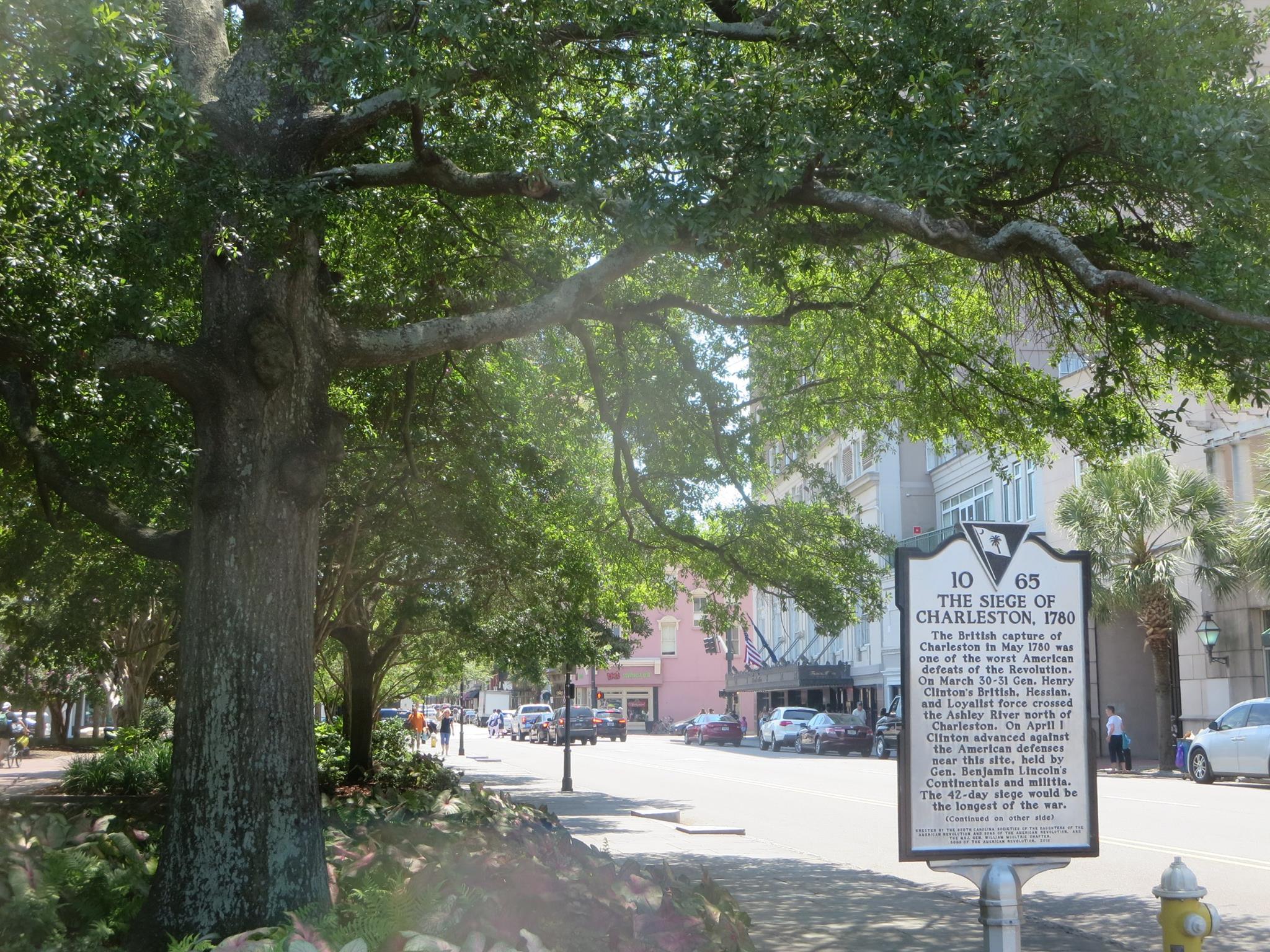
On May 12, 1780, around noon, the Southern Continental Army formed up in the tabby Hornwork (near present-day Marion Square), marched out of the fortifications and laid down their weapons between their main defensive line and the Hornwork. Their flags were cased and they were forced to play a Turkish march on their drums. This was humiliating to the Patriot defenders. British and Hessian grenadiers entered the Hornwork and the British flag was raised over the American fortifications. Charleston, South Carolina had officially fallen.
Today a state historic marker marks the location of where the Americans surrendered.
During the surrender ceremony, the British Army lined up to watch the American Continentals surrender their arms. They were amazed to see the wretched condition of the American soldiers. They noted their clothes were ragged and torn and many had no shoes. Despite this, they were extremely disciplined and professional. One British officer noted that it was “admirable that these people still fight for the chimerical freedom of America with such ardor.” Many Continental soldiers were too sick to march out and lay down their arms. Seeing how small a force was surrendering, some of the British were amazed that so few had “made a gallant defense.”
Over the course of the 42 day siege leading up to the surrender, the Americans had lost 89 men killed and 138 wounded. The British had lost 99 killed and 217 wounded. The British were successful in capturing the city, but more importantly than the city, the British had captured the entire Southern Continental Army: 5,618 men, 400 cannon, 15 stands of flags, and 5,000 muskets. Of the men captured 3,465 were hardened Continental veterans who were irreplaceable to Americans. In one swoop, the Continental lines of Virginia, North Carolina, and South Carolina ceased to exist.
Among the prisoners were three signers of the Declaration of Independence: Arthur Middleton, Edward Rutledge and Thomas Heyward. This was the largest defeat the American cause would suffer in the Revolutionary War. The next time America surrendered a larger force to a foreign enemy was at the surrender of Bataan in World War II.
In Philadelphia, John Adams wrote simply that “This is the severest blow we ever received.”
Over the following two years, a bloody civil war erupted throughout the backcountry of South Carolina. As British General Lord Cornwallis marched into the wilderness to subdue the Patriots in the interior of the state, he met initial success, but eventual failure, and ultimately total defeat at Yorktown, Virginia in October of 1781.
The road to Yorktown began at Charleston on May 12, 1780.
Early histories of the American Revolution in the west relied on oral tradition, local lore, legend, and even a bit of inventive myth-making as a young United States spread beyond the Appalachians and sought to develop its own, new identity. Considerable effort, but not always the most rigorous methodology, often went into combining these sources into a narrative and telling an integrated story of how events in Boston, New York, Philadelphia, Charleston or London eventually affected communities “over the mountains.” The first historians overlapped with the Revolutionary generation. Often, the writers were children in the early 1800s and heard stories from veterans and settlers themselves (or their relations, descendants, and neighbors) in their old age.
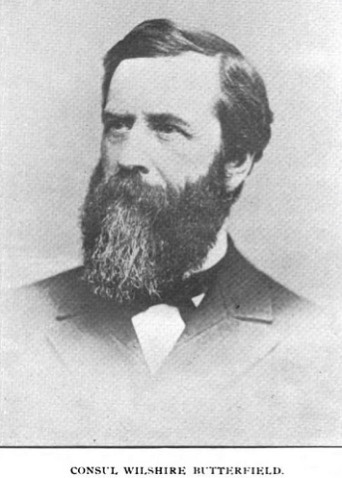
A second generation came along in the mid-19th century. The most notable was Lyman Draper. He set out to write the definitive history of the war on the frontier, but ended up amassing the definitive archive. While working on his never-published history, Draper crossed paths with Consul Wilshire Butterfield, who had moved to Madison, Wisconsin in part because of Draper’s success building libraries in the city and state. Like many of his contemporaries, including Draper, Butterfield did not start as a professional historian. Born in Oswego, NY, he moved with his family as a boy to Seneca County, Ohio in 1834, briefly attended school in Albany, and then took a brief tour of Europe in 1846. The following year, he wrote a history of Seneca County, which was published in 1848, the same year he was elected the county’s Superintendent of Schools. The job didn’t last long as he set out for California during the Gold Rush. Rather than becoming a “Forty-Niner” he ran for Superintendent of State Schools, but narrowly lost. Then it was back to Ohio, where he studied law, served briefly as Secretary of a Railway Company, and eventually opened a legal practice in Bucyrus, Ohio. Along the way, Butterfield, who lacked much in the way of formal education but was clearly adept at learning, took the time to publish a book on punctuation. Then, in 1873, the Cincinnati publisher Robert Clarke & Company issued Butterfield’s An Historical Account of the Expedition Against Sandusky Under Col. William Crawford, in 1872. (The campaign’s climatic battle took place about 20 miles from Butterfield’s law practice.) The book was a hit and the transplanted Ohio lawyer changed careers.
It is well known that the French ardently assisted the Americans during the Revolution, and we often remember names like Lafayette, Rochambeau, de Grasse, and others. It is not so well known how the Spanish aided the American cause, nor the dedication of one person in particular.
Over the next few months, we will be highlighting the speakers and topics for our 2021 Symposium, Hindsight is 2020: Revisiting Misconceptions of the Revolution, taking place on May 22nd. Due to the COVID 19 pandemic, the Symposium will be virtual. Today we highlight historian and author Michael Harris, who will be covering the misconceptions around the role of John Sullivan at the Battle of Brandywine.
Michael C. Harris is a graduate of the University of Mary Washington and the American Military University. He has worked for the National Park Service in Fredericksburg, Virginia, Fort Mott State Park in New Jersey, and the Pennsylvania Historical and Museum Commission at Brandywine Battlefield. He has conducted tours and staff rides of many east coast battlefields. Michael is certified in secondary education and currently teaches in the Philadelphia region. He lives in Pennsylvania with his wife Michelle and son Nathanael. He is the author of two books on the Philadelphia Campaign (Brandywine: A Military History of the Battle that Lost Philadelphia but Saved America, September 11, 1777 & Germantown: A Military History of the Battle for Philadelphia, October 4, 1777) and is currently working on a third volume to cover the final months of the campaign. He will be presenting his talk “John Sullivan and the Battle of Brandywine” at the May symposium.
Doyou believe the study of Loyalists in the American Revolution has been overlooked and why?
I think at one time that was true, but over the last couple of decades historians have been digging deeper into the role the Loyalist population played in the Revolution and I feel that pattern of neglect has been corrected. I think Loyalists were often overlooked because historians of the “Struggling to Overcome” theme of American Revolution historiography were more focused on the patriot struggle than the complicated role the non-patriot population played.
What first attracted you to the study of early American history? What keeps you involved in the study of this history? Do you find these things are the same or different?
While I always had an interest in early American history, my professional career began as a Civil War historian at Fredericksburg Battlefield. The shift to took place when I was hired to work at Daniel Boone’s birthplace and then later the Brandywine Battlefield. While I currently teach at the high school level, my study of history continues due to my love of wanting to tell the military story of the Revolution and striving to dispel the many myths out there about the battles of the Philadelphia region.
What is the biggest myth about the role Loyalists played in the war, and how did it come about?
While this is not my area of expertise, I would say that there is some thought that thousands of Loyalists flocked to the British standard to help put down the rebellion. At least that is what British leadership hoped would happen. That myth, then and now, drove British decision making. While a limited number of Loyalists did support the British cause militarily, it was never in the numbers believed now or in the numbers the British hoped for then.
Do you think there are common misconceptions of the era of the American Revolution among the American people? If so, what are they and have they ever affected your work?
I think a lot of us were taught bad history growing up. You know, the George Washington chopped down a cherry tree stuff. We grew up believing those things and trusting the “traditional” histories of the Revolution. Then, you get a job at one of these sites, and you starting digging into the primary documents yourself. All of sudden, you realize this was a lie and that was a myth. That is when I realized I had to write the Brandywine book and that effort continued with my Germantown book.
Why do you think it is important for us to study the Revolutionary Era?
There was a real struggle by the patriot population during the years of the American Revolution. There is no denying that. But that story cannot be told in a vacuum. That story is interwoven with the story of the British Crown to put down the rebellion and the story of the Loyalist & Neutral populations of North America. I don’t think that interconnected story has been told well and needs to continue to be explored.
Join us for our SECOND annual Emerging Revolutionary War Symposium, co-hosted by Gadsby’s Tavern Museum, speakers and topics include:
Michael Harris on Misconceptions of Battle of Brandywine Vanessa Smiley on Myths of the Southern Campaigns Travis Shaw on American Loyalists John U Rees on African American Continental Soldiers Mark Maloy on myths of the Battle of Trenton
Our registration fee is now only $40 per person and $20 for students. This will allow us to broaden our audience with the virtual program. We hope that 2022 will allow us to come together again in Alexandria for our third annual symposium. To register, visit: https://shop.alexandriava.gov/Events.aspx
In August 1777, a British army under the command of Lieutenant Colonel Barry St. Leger surrounded and attempted to subdue American-held Fort Stanwix in New York’s Mohawk River Valley. “It is my determined resolution,” the garrison’s commander, Peter Gansvoort told St. Leger, “…to defend this fort and garrison to the last extremity.” Despite this resolve, the Americans desperately needed support in order for the siege to be lifted.
“A sketch of the siege of Fort Schuyler [Stanwix].” New York Public Library Digital Collections.
Further east, help was approaching. Leading a column of over 800 men, Major General Benedict Arnold hastily made his way to Stanwix. By August 20, Arnold was at German Flatts (modern-day Herkimer, New York), roughly thirty miles away. From his headquarters he penned a proclamation directed towards the British, their Native American allies, and the region’s loyalist population.
The version of this proclamation below was republished in The Derby Mercury in Great Britain on November 14, 1777. It is a reminder, that before he donned the scarlet jacket of a British general, Arnold was a fiery Patriot devoted to the cause of liberty. Notice that a word or two describing King George III were censored out for publication:
By the Hon, BENEDICT ARNOLD, Esq; Major-General and Commander in Chief of the Army of the United States of America, on the Mohawk River.
WHEREAS a certain Barry St. Leger, a Brigadier-General in the Service of — George of Great-Britain, at the Head of a Banditti of Robbers, Murderers, and Traitors, composed of Savages of America, and more Savage Britons, (among whom is a noted Sir John Johnson, John Butler, and Daniel Claus) have lately appeared in the Frontiers of this State, and have threatened Ruin and Destruction to all the Inhabitants of the United States. They have also, by Artifice and Misrepresentation, induced many of the ignorant and unwary Subjects of these States, to forfeit their Allegiance to the same, and join with them in their atrocious Crimes, and Parties of Treachery and Parricide.
Humanity to those poor deluded Wretches, who are hastening blind-fold to Destruction, induces me to offer them, and all others concerned (whether Savages, Germans, Americans, or Britons) PARDON, provided they do, within ten Days from the Date hereof, come in and lay down their Arms, sue for Protection, and swear Allegiance to the United States of America.
But if still blind to their own Interest and Safety, they obstinately persist in their wicked Courses, determined to draw on themselves the first Vengeance of Heaven, and of this exasperated Country, they must expect no Mercy from either.
B. Arnold, M. G.
Given under my Hand, Head Quarters, German Flats, 20th August, 1777





 Emerging Revolutionary War Era