Often the study of history can ground us and make us feel less “unique.” This allows us to hopefully put our own experiences into perspective and be able to hopefully learn from lessons of the past. Many today complain about how print and social media can distort facts to support a particular agenda. This is not a modern phenomenon. Many in the Sons of Liberty (such as Paul Revere) used print media to their advantage to promote resistance to and then independence from Great Britain.
Many pro-Patriot newspapers printed nothing less than propaganda pieces after the battles of April 19, 1775. Here is part of what was printed by the Massachusetts Spy on May 3, 1775.
“Americans! forever bear in mind the BATTLE of LEXINGTON! where British Troops, unmolested and unprovoked wantonly, and in a most inhuman manner fired upon and killed a number of our countrymen, then robbed them of their provisions, ransacked, plundered and burnt their houses! nor could the tears of defenseless women, some of whom were in the pains of childbirth, the cries of helpless, babes, nor the prayers of old age, confined to beds of sickness, appease their thirst for blood! – or divert them from the DESIGN of MURDER and ROBBERY!”
Obviously a historic study of the events on April 19, 1775 disputes much of what is claimed by the Massachusetts Spy. But when you have a point to make, an agenda to promote and a local population to rally to a cause…why should truth get in the way?! We have come a long way since 1775, but in many ways not much has changed.
The prints by Amos Doolittle of the events on April 19, 1775 did a lot to promote the Patriots cause in their “media war” war against the British.
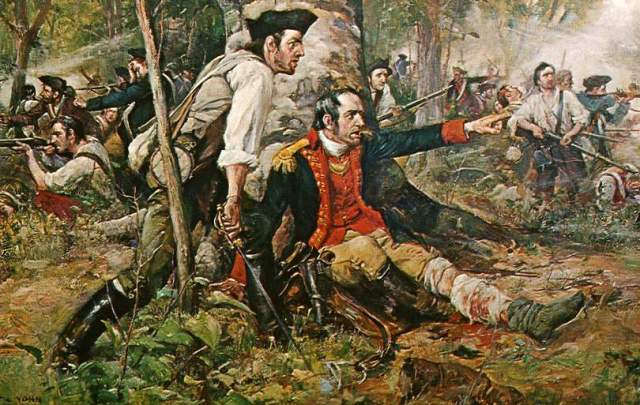
Sitting under a tree in north-central New York, suffering from a painful and mortal leg wound, yet still managing a successful defense after a powerful ambush, is a characteristic of a great military leader. All the while nonchalantly smoking his pipe!
General Nicholas Herkimer (courtesy of the NPS/Fort Stanwix and Oneida County (NY) Historical Society)
Nicholas Herkimer was the epitome of a successful militia commander. The Battle of Oriskany was a turning point. Herkimer, sitting on a once innocuous hillside, was a major reason why.
Even George Washington recognized the importance of Herkimer and made mention of his decision to not seek a commission in anything more than the militia of his home state. Not only that simple fact of service recognized by the commander-in-chief, but also his pivotal role in the Northern campaign of 1777.
“It was Herkimer who first reversed the gloomy scene of the Northern campaign. The hero of the Mohawk Valley served from love of Country, not for reward. He did not want a Continental command or money.”
Herkimer would succumb to the mortal leg wound ten days after the battle, but his role in what was described as “one of the bloodiest battles of the war” solidified his place in the category of “greatest leaders of the American Revolution you have never heard of.”
Born in the Mohawk Valley of New York to Palatinate immigrants, Nicholas was described as a slender built, dark complexioned, dark haired individual. When he was finished growing, he stood near six feet tall, a rather tall height in 18th century Colonial America. He could also boast of being multilingual, fluently speaking English, German, and Iroquois.
He saw action in the French and Indian War, helping to repel the French and Native American attack on German Flatts, New York on November 12, 1757. Although a disastrous day for the German community, as many were taken prisoner by the French and Native Americans, Herkimer’s role led to his promotion to captain in the militia within two months of the fighting on January 5, 1758. Thirty-years after his promotion to captain the town would be renamed “Herkimer” for the actions of this New Yorker during the subsequent war.
In April of 1758, Herkimer was present and assisted in the successful repulse of the French and Indian force.
With peace established in 1763, Herkimer looked toward personal matters, building a house on the south side of the Mohawk River in 1764. He married two ladies, both named Maria. One died and the other would remarry and move north of the border to Canada, after Herkimer’s death in 1777.
With tensions increasing in the 1770s between Great Britain and the colonies, Herkimer led the Tryon County, New York Committee of Safety and was elected colonel of the local militia. The Provincial Congress on September 5, 1776 promoted him to brigadier general of the militia. One of his first roles was to meet with Joseph Brant, a Mohawk military and political leader in an effort to try and keep the Native Americans neutral in the conflict between the colonies and Great Britain. He was unsuccessful.
During the Northern Campaign of 1777, with the thrust southward by British General John Burgoyne being the main column on its way to its destiny at Saratoga, a secondary column entered the Mohawk Valley under British General Barrimore”Barry” St. Leger. The combined British, German, Loyalist, and Native American force laid siege to Fort Stanwix, in present-day Rome, New York.
Herkimer heard about this and marched his militia to help raise the siege. His force was ambushed on August 6, as they were nearing Fort Stanwix. After the initial surprise, in which Herkimer received his wound, the militia responded well and a drawn out battle ensued.
Part of the reason that the majority of the militia recovered from the shock and endured the ensuing bloody carnage was directly related to the inspired leadership of Colonel Samuel Campbell who led one of the militia regiments in the force and Herkimer himself.
Herkimer, after having his horse shot and receiving his mortal wound in the opening shots of the engagement asked to be propped under a tree on the hillside his forces had utilized for their defensive stand He then calmly lit a pipe and with a continued cool demeanor directed the rest of the engagement.
Famous painting depicting the mortally wounded General Nicholas Herkimer directing his militia from his position seated under a tree, during the Battle of Oriskany on August 6, 1777. (Painting by Frederick C. Yohn)
After the day-long battle, Herkimer ensured he was the last to leave the field, after all the wounded that could be collected had been removed.
Although his wound was dressed on the field, the injury became infected and amputation was the only course of action. In the woods of western New York, the surgeon doing the operation was inexperienced and the wound bled tremendously. Herkimer would succumb to the wound on August 16, at the age of 49. He was buried near Little Falls, where he had built his home in the 1760s. The cemetery today is known as the “Herkimer Home Burial Ground.”
*Nicholas Herkimer’s role in the war and the Battle of Oriskany and the St. Leger campaign is described wonderfully by Michael O. Logusz in Volume 2 of “With Musket and Tomahawk” published by Savas Beatie LLC in March 2012.*
Debuting yesterday, the Campaign 1776, an initiative by the Civil War Trust, released an animated map that covers the “entirety of the American Revolution,” according to Civil War Trust Communications Manager Meg Martin.
At eighteen minutes in length, the video is a “succinct and engaging” access to gaining an overview of the entirety of the American Revolution, from the first shots in Massachusetts at Lexington and Concord to the culmination of the Siege of Yorktown in 1781. The video even includes a segment entitled “The Twilight Years” which explains the two years the war continued on after the victory at Yorktown; from 1781 to 1783. One can also jump to different parts, as the video has subheadings at the bottom to break the eighteen minute video into segments.
The video combines modern photography,with “live-action footage, 3-D animation, and in-depth battle maps” to give the viewer a sense of what the American Revolution, the pivotal event that “shaped America” was like.
Furthermore, “The Revolutionary War” animated map is part of a larger series of animated battle maps of battles on Civil War battles, which can be found here.
This animated map may be the first in the series of American Revolution and War of 1812 battles that the Campaign 1776 and Civil War Trust team is contemplating doing. We will all have to stay tuned and find out.
Yet, this animated map, of the entire American Revolution, is a great beginning introduction, so sit back, dedicate eighteen minutes, and learn about this defining moment in American history.
*Emerging Revolutionary War would like to thank Meg Martin of the Civil War Trust for the information about this release.*
Spring has not get touched the tree-covered hills to the east of Elmira, New York, but the Chemung River sparkles in quiet anticipation as it flows between them. The Newtown Battlefield State Park won’t open for another few days or so—it operates seasonally May through October—but I have stopped nonetheless to see what might be here.
“I am very apprehensive our Expedition will not appear in History,” wrote Lt. Obadiah Gore, Jr., of the Continental Army.
And indeed Gore’s worries seem to have played out just that way. I know almost nothing about this Revolutionary War battle, although I have driven by the battlefield for decades. In fact, for two full years not so long ago, as I was doing my Ph.D. at Binghamton University, I drove through the battlefield four times a week on my way from and to Saint Bonaventure University, where I work. I really need to stop sometime, I kept telling myself.
For years, the old State Route 17 passed through the battlefield with little more than a sign telling motorists they were passing through and an arrow pointing up a road that could have been someone’s driveway. The expansion of Route 17 into Interstate 86 now gives motorists the chance to whisk right on by even faster, giving even less notice, despite signs that still say I am passing through.
On this date, 241 years ago, the first salvo of what would become the American Revolutionary War, was fired on Lexington Green and North Bridge in Concord.
Historian John Galvin once wrote about the Battles of Lexington and Concord that they were the “least known of all American battles.” I never really understood what Galvin meant, as I had read extensively about April 19, 1775 and thought I understood the details of that day in history.
Yet, until this past weekend, when I spent the better part of four days touring the sites and walking the trails, talking to the historians around the towns, I did not realize how much more there is to what actually happened on that April day.
For starters, did you realize that Paul Revere did not go town-to-town calling out, “The British are Coming” to homesteads and roadside taverns? Instead, he was the catalyst that started a chain reaction of messengers and runners to different towns throughout the countryside that cast the alarm in a wide net.
He also would have told farmsteads and meetinghouses along the way that the “Regulars are Coming,” since the colonists still thought of themselves as British.
Or that the unofficial birth of the United States Army is attributed to the militia that followed Colonel James Barrett and Colonel John Buttrick down the hill toward the British at the North Bridge?
The field where the militia under Colonel James Barrett and Colonel John Buttrick began their advance from toward the North Bridge. The militia would be coming toward us to descend toward the span.
That was the first time that men, formed in regiments with officers, made an advance against what they perceived as an enemy force, and did so in a “very military manner.”
What prompted the various militia companies, which came from other towns than just Concord, to sally forth from the hill toward the now infamous North Bridge? The main reason was what was happening in Concord was the mistaken reason behind the smoke emanating from the town?
In the town, the British were burning military supplies and the wooden gun carriages found in the hamlet. Sparks landed one of the nearby dwellings and British soldiers actually put down their muskets to form a bucket brigade, with civilians, to help put out the flames. The smoke that billowed from the doused fires is what prompted the militia and minutemen response.
With water being dumped on the flames, smoke billowed up, which prompted milita Adjutant Joseph Hosmer to ask the officers; “Will you let them burn the town down?” That prompted the forward movement of the militia down the hill and against the British.
Or did you realize that some of the militia, from the nearby town of Acton, suffered some of the first casualties at North Bridge, including their militia captain, Isaac Davis, who was one of the first killed in the engagement?
View of the Old Manse, built in 1770 for Reverend William Emerson. View from the Concord River/North Bridge direction.
Somewhere in the midst of the action in Concord was Reverend William Emerson, the grandfather of Ralph Waldo Emerson who would later write that the action on April 19, would be known as the “shot heard round the world” years later.
These are just a few of the interesting tidbits that I picked up this past weekend. Altogether, they reinforce the historic events that I knew unfolded on this day in American History. However, along with reflecting on what transpired in my visit to Massachusetts, these new tidbits of valuable information underscore the important stories and accounts that shape this spring day that are beckoning to be told.
There is so much to be gained by walking the grounds, talking to the historians and historical enthusiasts of the area, and just taking time to appreciate what this day, April 19th, meant to the future of the United States and the era it was leaving behind as part of the British Empire.
Although it’s been nearly 250 years since America’s founding, the Revolutionary era continues to capture people’s imaginations. To explore that story even further, the editors of Emerging Revolutionary War have partnered with publisher Savas Beatie, LLC, for a new book series that will highlight the key events, people, and stories of America’s foundational experience.
The Emerging Revolutionary War Series will offer overviews of battles, politics, and biographies aimed at general audiences. Each book will be supplemented with dozens of original photos and all-new maps.
“These books are modeled after our highly popular Emerging Civil War Series,” explains publisher Theodore P. Savas. “The books are reader-friendly, and offer the perfect introductory-level chance to explore some great stories.”
Emerging Revolutionary War is dedicated to promoting the continued learning and interest in the American Revolutionary War era. Starting this month, the blog will highlight one American Revolutionary War Round Table. So, continue to check back for a round table, historical society, and/or history study group near your neck of the woods.
Founded in 2004 with a “magnificent seven” men that were interested in visiting the hallowed fields of the American Revolution and having a forum to discuss the events that unfolded on those grounds.
However, unlike the majority, if not all, of military round tables around the country, the Southern Campaigns American Revolutionary War Roundtable (SCARWRT) does not have the traditional “dinner-speaker” setup for their meetings. Their meeting happens semi-annually at historic sites in Georgia and the Carolinas and constitutes an all-day Saturday gathering with numerous speakers and a field trip to sites to conclude.
There are no member dues, by-laws, or even a round table constitution and one can be a novice student in the era of American history or a life-long enthusiast. More information can be found on the Southern Campaigns of the American Revolution website; http://www.southerncampaigns.org.
One caveat, the website mentioned above does not belong to the SCARWWT but there has been a strong connection over the years between the two.
Check the website above or the “American Revolutionary War Round Table” link at the top of this page to get in contact with the SCARWRT.
This 1778 sword Washing carried at Yorktown. (Mount Vernon)
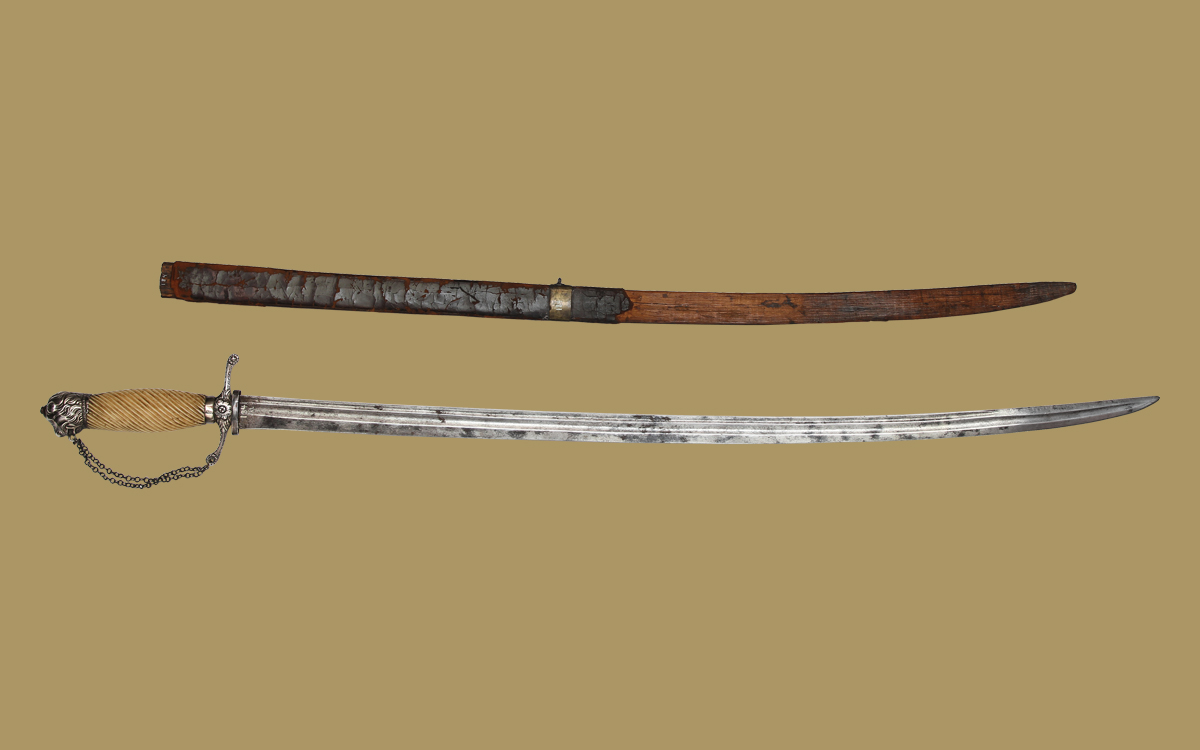
If you get a chance in the next month, go to George Washington’s Mount Vernon and see the temporary exhibit on Washington’s swords. On display are two of George Washington’s swords he used during the Revolutionary War. One, a green ivory hilted sword that he acquired in 1778 and likely carried at Yorktown, is on loan from where it is usually exhibited, the Smithsonian’s National Museum of American History. But even more interesting is the only known Washington sword in private hands. This bone hilted sword is on generous display by an anonymous donor. The sword was made in Philadelphia and acquired by Washington in 1770, as tensions were rising between Great Britain and the colonies. Historians believe this sword to be the one Washington carried in the early years of the Revolutionary War, and is therefore likely to be the sword on his side when he crossed the Delaware River on Christmas night in 1776 and through the Ten Crucial Days campaign.
This sword and scabbard Washington acquired in 1770 and is likely the one he carried at Trenton and Princeton. (Mount Vernon)
Washington’s swords are so humbling to gaze upon because of the virtuousness of the cause in which they were raised and the greatness of the man who carried them. No sword of Napoleon Bonaparte or Julius Caesar can match it. While Washington’s military conquests pale in comparison to these men, the ideas Washington fought for and the impacts of his victories would mean much, much more. It is amazing to imagine what these swords saw when they were drawn in combat, but even more inspiring because of what they represented when they were sheathed. At his military zenith at the end of the Revolution, Washington returned his sword to its scabbard and resigned his commission, an act for which he should always be remembered. In his Last Will and Testament, when he made provisions for giving these swords to his nephews, Washington included an important passage: “These swords are accompanied with an injunction not to unsheathe them for the purpose of shedding blood, except it be for self defence, or in defence of their Country and its rights; and in the latter case, to keep them unsheathed, and prefer falling with them in their hands, to the relinquishment thereof.”
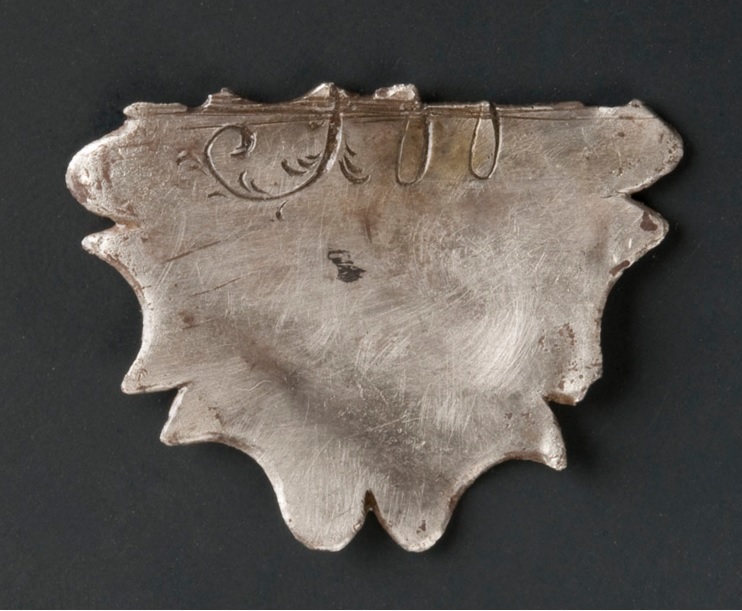
Included in the display are the sword scabbards and also a small silver medallion about the size of a quarter. The piece of silver was found in an archaeological dig just outside of the mansion recently. It was discovered that “GW” was engraved on it, and Mount Vernon archaeologists determined it was an ornament from one of Washington’s sword scabbards. They believe it was discarded after Washington’s death and it is now on display in the case with the original scabbards.
This scabbard ornament was found in an archaeological dig outside the mansion house.
Frederick Douglass, the famous 19th century abolitionist, once reflected on these kinds of important artifacts, including Washington’s sword. He wrote that “there are some things and places made sacred by their uses and by the events with which they are associated,” and this included “the sword worn by Washington through the war of the Revolution.” He noted that items like the sword “stir in the minds of men peculiar sensations.” Go and see what he was talking about.
An excellent time to see this exhibit would be on the weekend of April 30 and May 1. That same weekend Mount Vernon will be hosting hundreds of Revolutionary War reenactors from around the country, including yours truly.
The swords will be on display at Mount Vernon until May 30, 2016.
For the last nineteen years, the Civil War Trust has done their own sort of “spring cleaning.” On the first weekend of April, the Trust has promoted clean-up at various battlefields and historic sites across the nation. Officially called “Park Day” this year’s date is April 2nd.
This year, the Civil War Trust is expanding their park clean up day to include American Revolution and War of 1812 battlefields, as part of their “Campaign 1776” initiative. Hallowed ground such as Guilford Court House and River Raisin Battlefield are just two of the battlefields on the list.
Volunteer activities include everything from picking up trash to building trails to painting. All ages are welcome and even groups, such as Boys Scout packs, Lions Club members, and like-minded groups are encouraged to seek out the opportunities close to their home.
In return for volunteering, a free t-shirt commemorating your work in Park Day along with the chance to hear local historians describe the history that unfolded on that sacred ground.
For more information on participating in this “annual hands-on preservation event” and to find a historic site and/or battlefield near you, click the link below.
When a historian, author, or student of the American Revolutionary War mentions the following three words, “Green Mountain Boys” there is usually one name that comes to the forefront.
Seth Warner is usually not that name. Yet, he is one of the two names that should be forever linked with the great history of the “Green Mountain Boys.”
For those that are drawing a blank, the other name usually associated with this famous unit is Ethan Allen.
Warner, born in hilly Woodbury, Connecticut on May 17, 1743, the fourth of ten children to Dr. Benjamin Warner and Silence Hurd Warner. The young Seth was a product of the western frontier, growing up on the fringes of the English world, and thus learning from an early age to live and survive in the woods, rivers, and hills of Connecticut and what would become Vermont.
He did attend what limited schooling was available and from his father, rudimentary medical practice. In an 18th century biography, Warner was remembered to have vast information on the nature and uses of indigenous plants.
During the French and Indian War, Warner served two summers fighting in the cause of the British and would serve as a captain in the “Green Mountain Boys” following the French and Indian War. One biography states that Warner was part of the famous ranger outfit known as Major Roger’s Rangers, yet there is no primary evidence that supports this biographical claim.
With war on the horizon following the action at Lexington and Concord, Warner was elected third in command, with Ethan Allen being elected in top command, on May 8, 1775 for the task of capturing Fort Ticonderoga in western New York.
Born where Native American still threatened the westward-minded colonists, with the training during two summers in the last major war on the American Continent, Warner would now play a major role in the upcoming American Revolution.
With that, Seth Warner and the “Green Mountain Boys” marched off to help make the dream of American independence a reality. Following Ethan Allen, Warner found himself embroiled in the first campaign outside the environs of Boston when on May 10, 1775 he took part in the American capture of Fort Ticonderoga in western New York. Following up the next day, Warner, serving as second-in-command, attacked and captured the British garrison at Crown Point, approximately 13 miles away from Fort Ticonderoga. When news broke of the exploit, the “Green Mountain Boys” and subsequently Warner quickly became a household name for the patriot cause.
With the turn of the season to summer, Allen and Warner appeared in Philadelphia to appeal directly to the Continental Congress. Their aim was to achieve recognition as a regiment for the “Green Mountain Boys.” On June 23, 1775, the day the two men appeared in front of the governing body of the American cause, the Congress agreed and sent the endorsement to the state of New York. After some debate in provincial Congress of the Empire State, the endorsement was finally agreed upon.
With the ensuing vote of officers, surprisingly, Allen was not elected as commander, but Warner survived in an officer capacity, garnering 41 of 46 votes for lieutenant colonel. No reason or notes from this convention, held on July 6, 1775 has ever surfaced.
Before 1775 was out, Warner, who would lead the command, found themselves on the way to Canada. Initially stationed along the St. Lawrence River on the way to Montreal and near the end of October, Warner’s men repulsed an amphibious landing and attack by Sir Guy Carleton, the British Governor-General of Canada. With the repulse, at the Battle of Longeuill led to the surrender of Fort St. John on November 3, 1775.
Ten days later Montreal fell to the American forces and Warner and his “Green Mountain Boys” entered the fallen city later that same day. The American commander, General Richard Montgomery wanted this crack unit to continue with him by canoe to Quebec but because of the lack of winter clothing, the command was forced to head south, for supplies.
Not to stay in a support role for long, Warner’s men marched north shortly after the turn of the year in January 1776 to reinforce the Americans laying siege to Quebec. While there Warner showed the depth of his concern for the welfare of his men. With the smallpox epidemic ravaging the American ranks–in fact more American soldiers would die of that disease than any single other cause–Warner allowed his men to be inoculated, which was not not akin to what inoculations are like today.
Click this link, courtesy of Mount Vernon, on what smallpox inoculation was like in Colonial America.
After the return from Canada, on July 5, 1776, Warner was elevated to the rank of colonel and tasked with raising another regiment from the New Hampshire Grants (the area now comprising Vermont). Yet, it was one year and one day later that Warner showed how valuable his role as a general officer was.
During the Battle of Hubbardton, Warner oversaw the rearguard of General Arthur St. Clair’s retreating American forces. Outside this frontier settlement, Warner’s men suffered more casualties and eventually yielded the field to the British, but the toll extracted from the British (over 200 killed, wounded, and captured) was high enough to cause the British to stop their pursuit of the retreating American army.
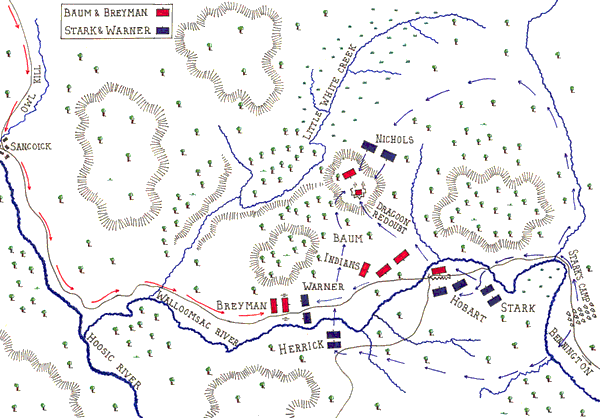
A month later, on August 16, 1777, Warner played another critical role in the American victory at Bennington. Under the overall command of General John Stark–another of the fiery, yet competent, and overlooked American general officers–Warner provided invaluable assistance because of his familiarity with the region. His home was a scant few miles from where the engagement would unfold.
Warner would oversee the left wing of the American assault and have as his goal the “Tory Redoubt” that fell on the east side of the Walloomsac River, which would be a dominant feature in the ensuing battle.
Battle of Bennington (courtesy of British Battles)
The Americans routed the German, British, and Loyalist forces, even halting a 600-man reinforcement column under German Lieutenant Colonel Heinrich Breymann who arrived on the field in the latter stages.
Stark reported to Congress that Warner showed “superior skill in the action.”
Unbeknownst to Warner at the time, the campaign that culminated with British General John Burgoyne’s surrender at Saratoga, was the defining moment in Warner’s American Revolutionary War career. Warner would stay in the service, reaching the rank of brigadier general, bestowed upon him in 1778 by the new state of Vermont courtesy of the state legislature. That made him the only brigadier general in the newly formed state. On September 6, 1780 Warner received his only wound of the war, in an ambush by Native Americans outside Fort George in New York.
Unfortunately for the old “Green Mountain Boys” commander, the years after his retirement in 1780 were not kind. He fell out of favor with his former commander, Ethan Allen which led Warner to confront him in 1781 about contact with the British when Allen was a prisoner-of-war. This was all in conjunction with some contact Vermont had with British Canada about possible negotiations in reunifying Vermont with the British Empire. The extent of the negotiations and the seriousness of the idea has been in question by historians ever since.
Regardless, Warner, in failing health in 1784, returned to Woodbury, where he died on December 26, 1784, at the age of 41. Warner’s remains lay in Roxbury, Connecticut.
*For more information on the campaigns of New York in which Warner played a role in, consult Michael O. Logusz’s two-volume “With Musket and Tomahawk” series published by Savas Beatie LLC. at http://www.savasbeatie.com*


 Often the study of history can ground us and make us feel less “unique.” This allows us to hopefully put our own experiences into perspective and be able to hopefully learn from lessons of the past. Many today complain about how print and social media can distort facts to support a particular agenda. This is not a modern phenomenon. Many in the Sons of Liberty (such as Paul Revere) used print media to their advantage to promote resistance to and then independence from Great Britain.

 Debuting yesterday, the Campaign 1776, an initiative by the Civil War Trust, released an animated map that covers the “entirety of the American Revolution,” according to Civil War Trust Communications Manager Meg Martin.
 Spring has not get touched the tree-covered hills to the east of Elmira, New York, but the Chemung River sparkles in quiet anticipation as it flows between them. The

 Although it’s been nearly 250 years since America’s founding, the Revolutionary era continues to capture people’s imaginations. To explore that story even further, the editors of Emerging Revolutionary War have partnered with publisher



 Emerging Revolutionary War Era