Join us this Washington’s Birthday (Observed) weekend on Sunday, February 16 at 7 p.m. EST on our Facebook page as we sit down with the curatorial staff of the National Museum of the United States Army to discuss the upcoming new special exhibition to commemorate the U.S. Army’s 250th birthday in 2025, and our nation’s declaration of independence in 2026. This new landmark exhibit will include a rare collection of Revolutionary War artifacts from the original colonies, England, France and Canada, accompanied by Soldier stories of our nation’s first veterans. Check out this preview: https://www.youtube.com/watch?v=4vNXR3XWw9I
Can’t join us on Sunday? Check out the discussion later on our YouTube page or listen to the audio on our podcast! Emerging Revolutionary War is your home for America’s 250th!
Emerging Revolutionary War welcomes guest historian Paul F. Soltis
250 years ago in 1775 John Wallace of Philadelphia was preparing to move. Born in Scotland in 1718, John was the youngest son of the minister of the Church of Scotland at Drumelizer in the Scottish Lowlands south of Glasgow and Edinburgh. While his eldest brother William would take over the ministry in the Kirk following their father’s death, John emigrated from Scotland to the colonies of British North America. Like many Scottish emigrants, Mr. Wallace entered the merchant trade, first in Newport, Rhode Island and eventually in Philadelphia where he met and married Mary Maddox of an established Philadelphia family.
At the opening of the Revolutionary War in 1775, John Wallace purchased 95 acres on the Raritan River in Somerset County, New Jersey from the Rev. Jacob Rutsen Hardenbergh, minister to the Dutch Reformed Churches of the upper Raritan River Valley. At this country estate he called “Hope Farm” Mr. Wallace built the largest home constructed in New Jersey during the Revolutionary War, perhaps “hoping” to escape the revolutionary ferment of Philadelphia. Midway between the British garrison at New York and the Continental Congress in Philadelphia, John Wallace instead found himself at the Crossroads of the American Revolution.
In the fall of 1778, the Continental Army arrived to this region of Somerset County where the Middle Brook flows into the Raritan River for the Middlebrook Cantonment of 1778-79. Nathanael Greene, Quartermaster General of the Continental Army, wrote on October 18, “Middle Brook is situate in a plentyful Country, naturally strong and difficult of access and surrounded with a great plenty of Wood. Great security will also be given to this Camp by the militia of the Country.” Col. Sidney Berry, a deputy quartermaster to Gen. Nathanael Greene, arranged with Mr. Wallace for use of the Wallace House at Hope Farm, a few miles west of the village of Middlebrook, as headquarters for George Washington.
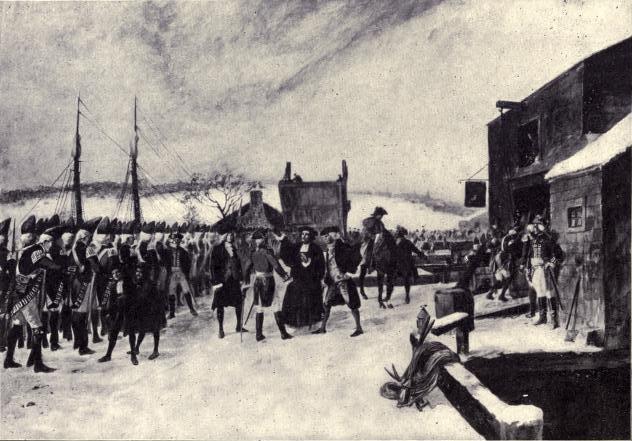
We reshare a post from 2018 about the Salem Alarm also known as “Leslie’s Retreat.” As we approach the 250th anniversary of this important event (February 26, 1775), we will share primary source accounts of the event. This event set the kindling for the spark that lit a war in Lexington a month later.
As events quickly spiraled out of control in the winter and spring of 1774-1775 around Massachusetts, several armed confrontations between local “Patriots” and the British army heightened tensions. On many occasions, both sides adverted open confrontation and were able to diffuse the situation. Understanding these events and how they made an impression on both sides helps explain what happened on the Lexington Common on April 19, 1775.
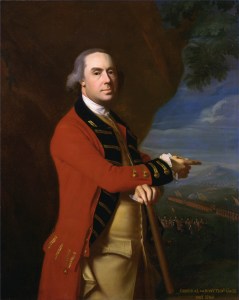
As soon as British General Thomas Gage arrived in Boston in the spring of 1774, he set about enforcing the newly passed “Coercive Acts.” In response to these new laws that restricted many of the rights the people of Massachusetts had grown accustomed too, local groups began to arm themselves in opposition to British authority. Even though Gage was once popular in the colonies, he soon became an enemy to those around Boston who believed the Coercive Acts were an overstep of British authority. Continue reading ““If you Fire, You’ll all be dead men” The Salem Alarm”→
Emerging Revolutionary War welcomes back guest historian Eric Olsen. Eric is a historian with the National Park Service at Morristown National Historical Park. To learn more about the site, click here.
The following obituary of a Revolutionary War veteran appeared in a Marietta, Ohio newspaper in 1830.“Saturday, July 24, 1830
Casualty – On Saturday evening last, Mr. Bazil Norman of Roxbury township, a man of color, left his house to go to watch a deer lick, and not returning in the course of the night, the next day a search was commenced under the belief that some accident had befallen him; after a diligent search by his family and neighbors, he was found dead having fallen from a precipice about twelve feet. From appearances he had been to the lick and stayed the usual time, and late in the evening attempted to return, by the aid of a torch-light; having a narrow pass to descend between some rocks about a half mile from his house, he missed his way a few yards, fell, and broke is neck. Mr. Norman was aged about 73 – was a soldier in the revolutionary war, and at the time of his death received a pension from the United States.” -American Friend & Marietta Gazette, July 24, 1830.
Bazabeel Norman was an African American private in the Maryland Line of the Continental Army and most likely part of the 1779-1780 encampment at Jockey Hollow. I haven’t been able to find any muster rolls or service records to confirm this, but fortunately Norman did apply for a veteran’s pension in 1818 in which he summarized his military service.
“ enlisted in fall of the year 1777 into the company of Capt. Richard Anderson as a private soldier in the regiment commanded by Col. John Gumby in the Maryland line and served my Country against the common enemy until the close of the war…I was in the battles of Monmouth, Camden, Cowpens, Guilford Courthouse & Eutaw Springs. I am now 67 years old…”
In 1818 the only veterans who could apply for a pension were for men who were infirm or indigent. Bazabeel Norman apparently fit the requirements and was granted a pension. But too many men were granted pensions and Congress suspected that undeserving men were cheating the system. In 1820 veterans who had been granted pensions in 1818 were now required to make a list of their possessions and prove they were needy. In his July 25, 1820 application, Norman summarized his family life.
“As to my family I have none at home but my wife, one son & a Grand child, an orphan. My wife is 63 years of age & very infirm, my son wants only about a month of being 21 years of age. My Grandchild is a Girl about eight years old & very weakly. The rest of my children are of age & doing for themselves. I am by occupation a farmer but owing to age & infirmity I am unable to do very little toward supporting myself.”
After his death in 1830 his wife “Fortune” applied for and obtained a widow’s pension [W 5429]. In her application, she mentioned that they were married before the end of the war but did not provide any more interesting information.
The only reason I was able to research Bazabeel Norman was because of an email from Michael Shaver, Acting Chief of Interpretation of Morristown NHP & Thomas Edison NHP. I’m quoting from his email, because frankly I never heard of the person he makes reference to and it easier than rewriting his email. Michael wrote, “A few weeks ago on the PBS series, Finding Your Roots, one of the genealogies that Henry Louis Gates was exploring was that of actress, Rebecca Hall. Hall, the daughter of Sir Peter Hall, founder of the Royal Shakespeare Company, and Maria Ewing, an American-born opera star of the 1970s and 1980s. Hall has appeared in Iron Man 3 and last year’s King Kong movie, along with a host of highly acclaimed independent films. What prompted her appearance on the program was her directorial debut of the Netflix film, Passing. Hall now lives in Brooklyn and the Hudson Valley…
At about 30 minutes in, Gates is taking Hall back into the earlier generations of her family. He closes out with the discovery of Bazabeel “Basil” Norman, a free black from Maryland at about 36 minutes who was discovered through documentation of a veteran’s land grant in Ohio in 1818.
Basil Norman came from Frederick County, Maryland joined the 7th Regiment in the fall of 1777, under the command of Colonel John Gumby, in the company commanded by Captain Richard Anderson “and served my country against the common enemy until the close of the war under the continental establishment and discharged under a general order.
So Norman was probably hung his hat in Jockey Hollow.”
A big shout out/thank you to Michael for the tip which has revealed another African American soldier from Jockey Hollow.
Sources:
American Friend & Marietta Gazette, July 24, 1830, page 3, column 1, Ancestry online
Pension Application of Bazabeel Norman and his widow Fortune Norman, W5429, National Archives, Fold 3, Ancestry Online.
We are excited to welcome historian and author J.L. Bell. Few know more about the events around Boston in 1775 than Bell. His blog, Boston 1775 (https://boston1775.blogspot.com/ ) is the most detailed and researched source on everything Boston 1775 (and before and after 1775). As we approach the 250th anniversary of Lexington and Concord, we will continue our on going discussion about the events leading up to the first shots at Lexington. Topics will include the military build up in Massachusetts including cannon (especially four stolen cannon), creation of minute companies and Gage’s military response. Leslie’s expedition to Salem in February as well as the newly created Provincial Congress and Dartmouth’s orders for Gage.
We have a lot to cover, so grab a drink and join us LIVE on our Facebook page on Sunday, February 2nd at 7pm. This will not be one you want to miss!
How was George Washington spending his January 29th, 250 years ago, today?
Being a homebody!
“[Jan] 29 [1775]. At home all day. Ditto. Mr. & Mrs. Custis went to Pohick Church & from thence to Colo. Masons.”[1]
[1] “[Diary entry: 29 January 1775],” Founders Online, National Archives, https://founders.archives.gov/documents/Washington/01-03-02-0005-0001-0029. [Original source: The Diaries of George Washington, vol. 3, 1 January 1771–5 November 1781, ed. Donald Jackson. Charlottesville: University Press of Virginia, 1978, p. 305.]
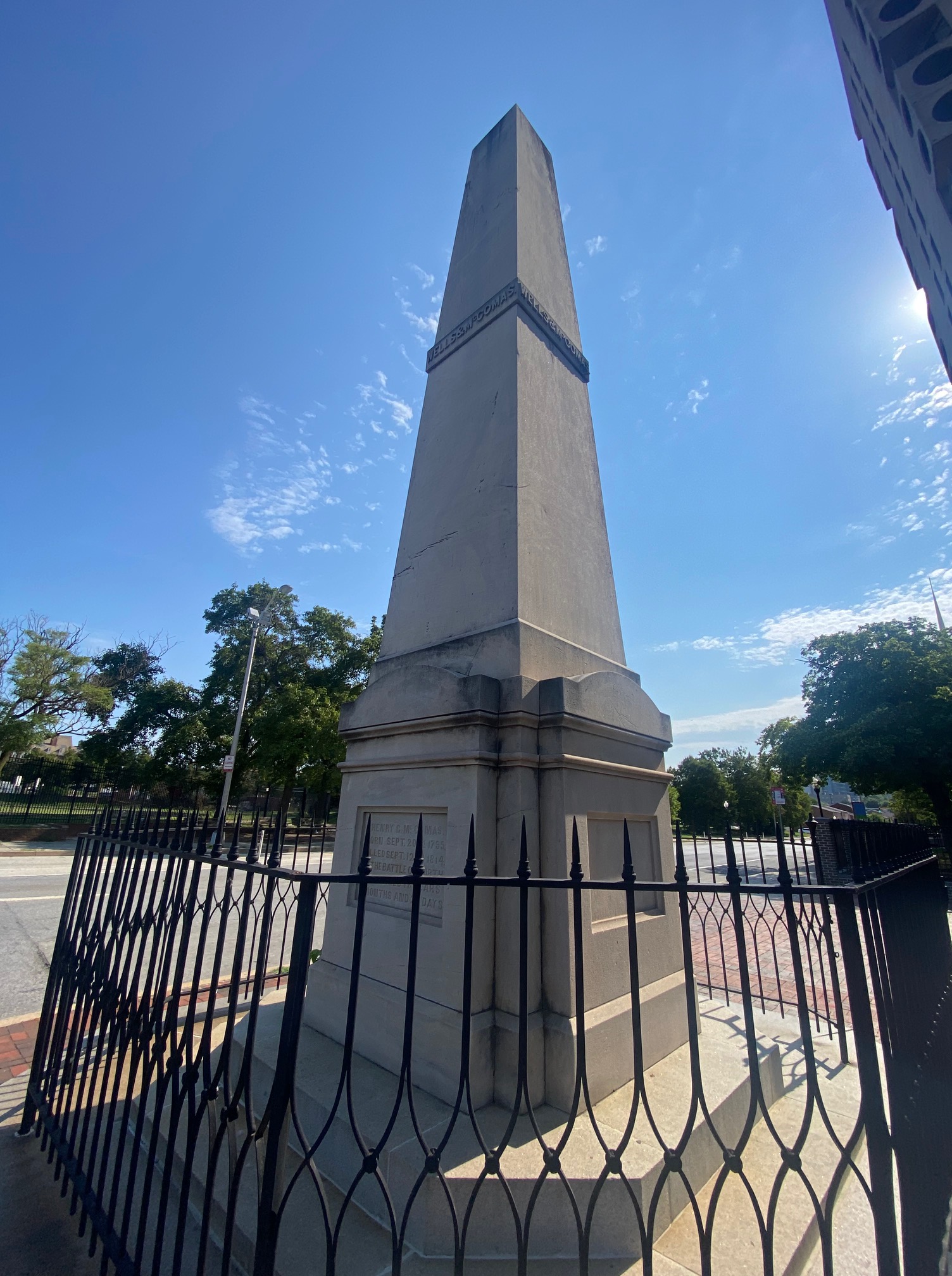
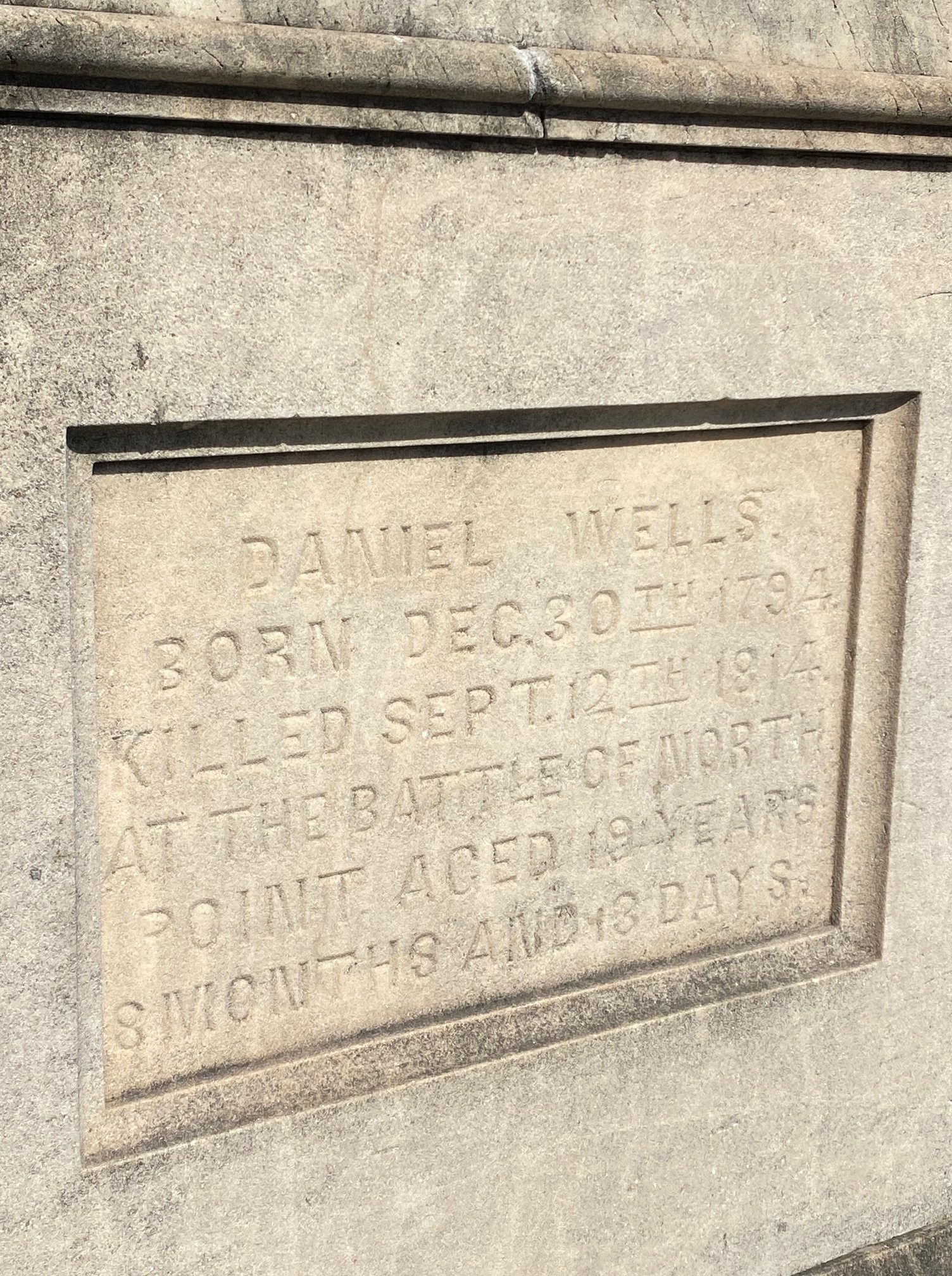
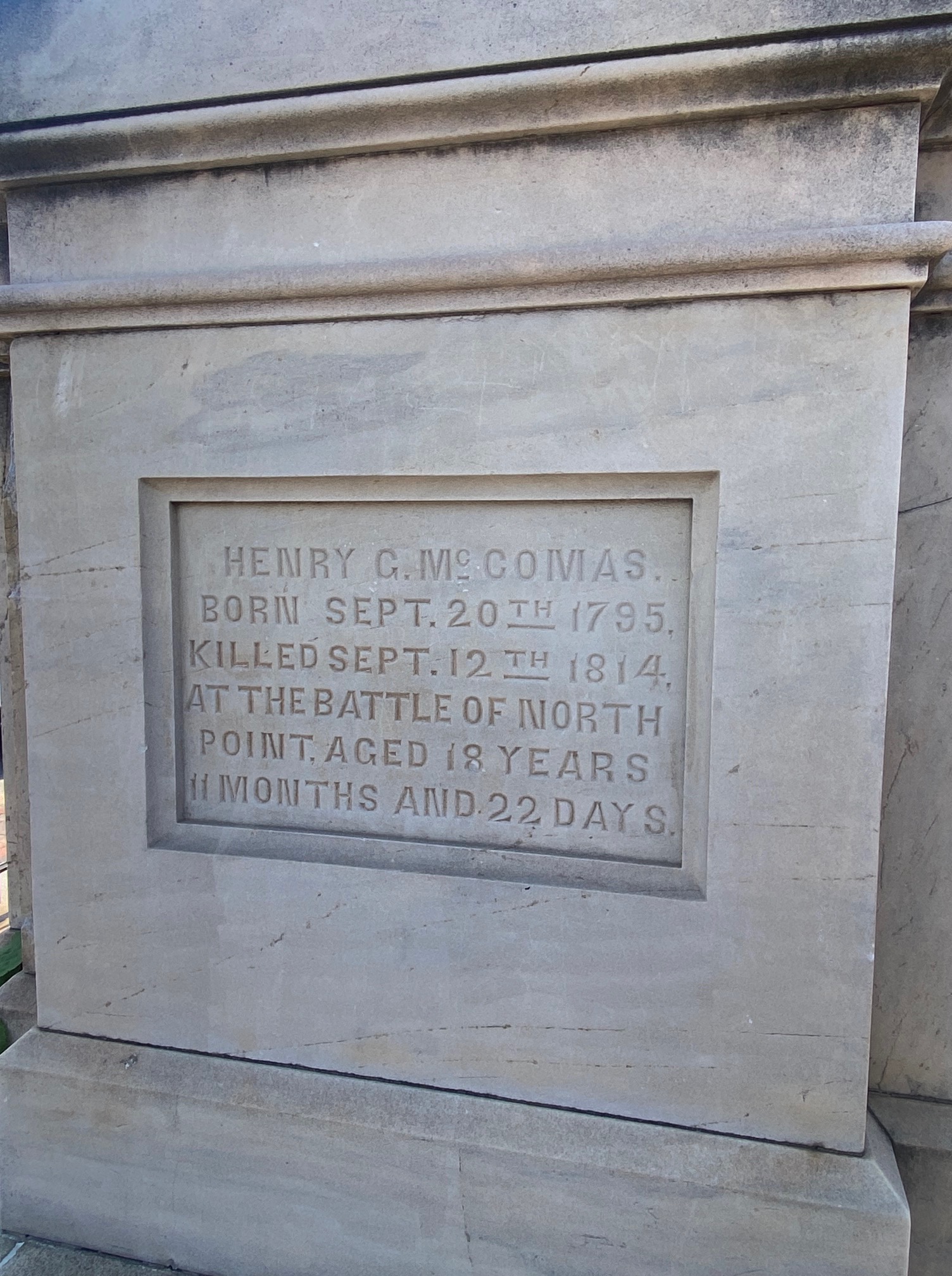
Situated along East Monument Street is a stone monument surrounded by a black iron fence. A wayside informational marker is placed right outside the fence. Underneath this monument rests the remains of Daniel Wells and Henry McComas. On September 12, 1814, one of their firearms changed the entire scope of the Battle of North Point, part of the Chesapeake Bay Campaign during the War of 1812.
Both young militia members, sent to the frontlines to skirmish and harass the approaching British infantry, fired a musket round that slammed through the left elbow and into the chest of Major General Robert Ross, British land commander, mortally wounding him. Both Wells and McComas, aged 19 and 18 respectively, would be killed during the day’s fighting. A third soldier, Aquila Randall, also slain that day, has his own small monument and crediting him with firing the fateful shot.
Although most historians credit either Wells or McComas. Both soldiers were reinterred here, the second time their remains had been moved, in 1858 when the monument was completed and a funeral song and dramatic play rounded out the day’s commemoration.
The site is part of the Star-Spangled Banner National Historic Trail. To learn more about the trail, click here.
Emerging Revolutionary War welcomes back guest historian Eric Olsen. Eric is a historian with the National Park Service at Morristown National Historical Park. Click here to learn more about this site.
Visitors always want to know, “How much did “that” cost back then?” We used to tell them because of inflation and the conversion from pounds to dollars it was really hard to give a definitive answer. It is even harder to figure during the American Revolution when the value of the dollars changed dramatically just over the course of a few months. There are all sorts of fancy conversion sites on the internet today but since math was not my strong point, I don’t know how accurate they are.
One book tried another approach to explain 18th century vs. modern prices. “A person today, purchasing the same product made the same way out of materials made the same way, will pay roughly the same percentage of their wages for the product as a person of equal economic status in the past would have. For comparison, at the present time [1997 book] an average shop rate runs thirty-five dollars an hour for labor. If you make ten dollars an hour, this costs you three and a half hours of work, and the same ratio applied to a craftsman making thirty pounds a year or two pence per hour.” Makes sense but seems a bit too complicated.
However, I did find one primary source that can give a clue to the relative value of items. It comes from Theophile Cazenove, a Dutchman who traveled through New Jersey and Pennsylvania in 1794 looking for investment opportunities for Dutch bankers. At his various stops in Morris County, Cazenove recorded the prices of farms, livestock, and even labor.
Sometimes the prices were in pounds, other times they were in dollars. When he included both prices for one item, I did some very simple math and found that it took eight shillings to make one dollar, and that $2.50 equaled one pound. According to the online conversion applications, one pound in 1790 equaled 167.58 pounds today. One dollar in 1790 equaled 32.20 dollars in today’s money.
But without doing any math or conversions if we look at the prices Cazenove listed we can see what items were more expense than other ones. From that we can also assume the more expensive items were more highly valued.
Keep in mind, on the local level in 18th century America, it was not a cash driven economy. Specie, Hard Money or coins, made of valuable metals such as silver and gold were in short supply in North America and used infrequently. Paper Money was rarely used, appearing briefly during periods of war when armies needed a large source of money to buy goods and services.
By the evening of January 6, 1781, much of the small town of Richmond, newly appointed capital of Virginia, was in flames. Brig. Gen. Benedict Arnold and his force of British regulars and loyalist provincial troops, to the tune of around 800, were east of the city, heading toward Westover Plantation, in Charles City County. It was the home of Mary Willing Byrd, widow of the late William Byrd III. She was also a cousin to Arnold’s wife, Peggy Shippen Arnold. The British transports had landed at Westover back on January 4 and it was there that Arnold finished planning his march on Richmond, 25 miles away.
Westover Plantation
With the arrival of Arnold’s forces at Portsmouth, on the Virginia coast, Gov. Thomas Jefferson believed the target of the raid was Williamsburg. Baron Friedrich von Steuben, the Continental Army’s military commander in the area, believed Petersburg was at risk. Both men were surprised when Arnold landed at Westover, showing his target clearly to be Richmond. Caught off guard, Jefferson nevertheless swung into action, calling out local militia companies. Von Steuben, likewise, sent Continental forces he had on hand to the north side of the James River, to relieve the capital. With a price on his head, the traitor Benedict Arnold couldn’t afford to linger too long in the area. Were he to be captured, he knew it would mean the gallows for him. After spending a mere 24 hours in the city, destroying Westham Foundry, located six miles above Richmond, burning public buildings & filling 42 small craft with tobacco, rum, and any other commodity worth cash money he could find, he gave the order to return to Westover and his troop transports.
Arriving there on January 7, the bulk of Arnold’s troops immediately bivouacked & began cooking rations. With Jefferson’s call, though, Patriot militiamen from the lower counties had been gathering throughout the area of Charles City. Many were seen on the high ground in back of Westover Plantation. Arnold became desperate for intelligence. Among his provincial forces were the Queen’s Rangers, Lt. Col. John Graves Simcoe, commanding. Made up mostly of loyalists from New York, the Queen’s Rangers were comprised of well trained and equipped light infantry and cavalry troops. Back on January 5th, it had been Simcoe who had led the troops who destroyed Westham Foundry. Born in England, Simcoe had served throughout the war, beginning with the siege of Boston back in 1775. He was a very competent officer who would go on after the war to serve as the first lieutenant governor of Upper Canada & to be elected a member of Parliament. He kept a journal throughout the war which he first published in 1787. In this journal Simcoe described the action in Charles City, after the raid on Richmond.
Lt. Col. John Graves Simcoe
Gen. Arnold ordered him to lead a patrol, he said, “to be made on the night of the eighth of January towards Long Bridge (on the Chickahominy River) in order to procure intelligence.” Simcoe detached 40 of his cavalrymen for the patrol. For the most part, he said, his men were “badly mounted, on such horses as had been picked up in the country.” The patrol had not proceeded beyond 2 miles on the main road, presumably the River Road (Modern Virginia State Route 5) before Simcoe’s vidette, a Sergeant Kelly, was challenged by two Patriot militiamen. Kelly kept up a friendly demeanor until he came close, then he rushed the Patriot scouts. He captured one while the other fled. Along with one prisoner, Simcoe said he also freed “a Negro who had been taken on his way to the British army.” From the rebel prisoner he learned that Patriot general Thomas Nelson, Jr had a large party of militiamen encamped at Charles City Courthouse, about 6 miles to the east. The corps of militiamen that had been seen at Westover were an advance party, the captured Patriot had said, and numbered around 400.
Upon learning this, Simcoe says he immediately ordered his troopers to the “right about”, off the road. A Lt. Holland, “who was similar in size to the vidette who had been taken” led the Ranger’s advance. The African American man Simcoe liberated offered to guide his force to the courthouse by an obscure pathway, off the main road. Simcoe’s intention was to attack or, in his words, “beat up” the main body of militia at the courthouse, believing their guard would be lowered owing to the presence of the large advance party on the main road. If repulsed, he planned to retreat along the same path. If successful against the main body, though, he knew he had the option of attacking that advance party of 400 men.
Charles City Courthouse, built ca 1730
As they moved to the east that evening, Simcoe wrote that the patrol “passed through a wood”, where it halted “to collect”. They had scarcely resumed their march on this back road when the column was immediately challenged by a Patriot picket or vidette. Answering the challenge, Lt. Holland, riding in the van, immediately called out… “A friend”; he then gave the countersign for the challenge which the Patriot prisoner had told them. “It is I, me, Charles.”, which apparently was the name of the Patriot militiamen whom Lt. Holland was impersonating. Holland continued leading the column, past the first picket. Riding beside him was the irrepressible Sergeant Kelly, who immediately grabbed the militiaman. Holland himself lunged for a second militiaman who was sitting his horse nearby, but Simcoe said, grabbing hold of him the man was too strong and got free. That second man whirled and, “presented, and snapped his carbine.” For Lt. Holland it was a lucky misfire. The militiaman then galloped off a distance, re-primed his piece & fired off a warning shot.
Simcoe’s patrol had been spotted; the element of surprise was now lost. He gave the immediate order to advance as rapidly as possible and very quickly his force reached the grounds of the courthouse where several companies of Patriot militiamen were encamped. To these men, this had always been a place of safety; where men of Charles City County came to join the militia and, many years later, this is where many old veterans would file their depositions in hopes of obtaining a pension for their service. Now, they were under attack. According to militiaman William Seth Stubblefield, his company was “taken on surprise” about midnight. Simcoe said his men rushed on and immediately a confused and scattered fire began, on all sides. His troopers, attacking from out of the darkness, were nonetheless heavily outnumbered. Thinking quickly, however, Simcoe used his cunning.
Queen’s Rangers
He immediately sent his two “bugle horns”, buglers, men he called French and Barney, over towards his right. They had orders to “answer his challenging, and sound when he ordered.” The night air was quickly becoming filled with lead as both sides exchanged fire. As a ruse, Simcoe called out in a loud voice for the “Light Infantry to form”; then he gave the order to “sound the advance”. The buglers on the right responded, and sounded their horns. In a matter of seconds, the Patriot militiamen, caught off guard and now apparently fooled into thinking they were outnumbered and being flanked, immediately started falling back. As John Graves Simcoe described it, “the enemy fled on all sides, scarcely firing another shot.” And just like that, the skirmish was over. But the night was dark, and the Queen’s Rangers were unfamiliar with the country. Some of the Patriots were captured while others were wounded. Simcoe said a few of the fleeing militiamen drowned in a nearby mill dam. In his 1833 pension application, militiaman Irby Phillips likewise referenced men “drowning in a mill pond”. Simcoe said that he himself stepped in to save three armed Patriots from “the fury of the soldiers (Rangers)”. He said the militiamen were frightened and presented their loaded pieces, directly at his breast. In their agitated state, they easily could have pulled the triggers, but, luckily for Simcoe, they didn’t.
From these three prisoners he learned that he had earlier been deceived; that he had fallen for a ruse himself. The story he had been told of the 400-man Patriot advance party near the main road was false; there was no advance party. What Simcoe had been calling the main party consisted of between 150 and 200 militiamen, all encamped with cookfires going. General Nelson was not among them but, apparently, was in camp some miles away, back towards Williamsburg with a force of around 700 or 800. Many of the fleeing militiamen headed in that direction.
Simcoe ordered his troopers to mount immediately. Many of them wanted to search the buildings and homes near the courthouse, where several of the militiamen had fled, but were not permitted. Simcoe wrote that his troopers were “plainly distinguished by the fires which the enemy had left.” Silhouetted in this way, the commander believed his small numbers could have easily been discerned, possibly inviting a dangerous counter attack.
In this brief action, the Queen’s Rangers lost one man, a Sergeant Adams, who was mortally wounded. Simcoe described the sergeant’s last moments: “This gallant soldier, sensible of his situation, said: ‘My beloved Colonel, I do not mind dying, but for God’s sake, do not leave me in the hands of the rebels.” French, one of the buglers, and two other troopers were wounded in the engagement and about a dozen of his horses had been captured. The Patriots, in Simcoe’s estimation, suffered around 20 or so casualties, including several captured.
The Rangers left Charles City Courthouse and headed west, back towards Westover, with their prisoners. Simcoe said the enemy made no threat against his rear. The patrol arrived at Westover the next morning, January 9. There, Sergeant Adams died and was buried with honors. On January 10, Benedict Arnold’s transports shoved off into the James River and began their trip back towards Portsmouth.
By 1781, Virginia was a major supply depot and logistical hub for the Southern American army operating in the Carolinas. While Arnold’s strategic strike against Richmond was brief, it was yet overwhelmingly successful. Ironically though, the final chapter of this event wasn’t written in Richmond at all but, rather, in Charles City. The old county courthouse, which still stands today along historic and scenic Virginia State Route 5, was a witness to it all.
“No taxation without representation” was one of the political cries of American colonists before the American Revolution. While the slogan inspired colonial enmity of the British Parliament and spearheaded efforts by prominent Americans and Britons to achieve some form of representation in the British government, it fell on deaf ears of common British citizens, including one correspondent of The Newcastle Chronicle, published in Newcastle upon Tyne, Tyne and Wear, England.
250 years ago today, this unknown correspondent’s opinion of the matter was printed for British citizens to read and consider:
When we consider (says a correspondent) in our present dispute with America, that there are large manufacturing towns in England, who, though they have no direct representative, yet pay the same taxes as those who have; thatthere are many thousands of merchants, manufacturers and others in Britan, who never had a vote for a representative, and therefore cannot be said to have consented to the taxes imposed upon them by the constituent powers of the legislature; and when we consider that the people of the Isle of Man, who once had superior privileges to any province in America, are deprived of all trade but with Britain, and obliged to pay taxes by British acts, without having one representative in the British Parliament. When we consider these things, how ill grounded must the complaints of the Americans appear to every man of feafe, and how necessary does it become to exact that obedience from their fears, which is neither to be hoped from their gratitude nor from their justice.






 Emerging Revolutionary War Era