In July 2024, Minute Man National Historical Park announced the discovery of five musket balls fired at Concord’s North Bridge on April 19, 1775. Park Ranger Jarrad Fuoss will join Emerging Revolutionary War on Sunday, January 5, 2025, at 7 pm, for a behind-the-scenes look at how the bullets were unearthed and will also provide a preview of the park’s 250th-anniversary events this April.
Join us on Sunday evening as we welcome historian and author Gary Ecelbarger to discuss his new two volume study of George Washington between July 4, 1777 and July 4, 1778. During this momentous year, Washington faced the British army at major engagements at Brandywine, Germantown, and Monmouth. He also spent the winter at Valley Forge. Ecelbarger breaks down this year into two volumes. The first volume, which covers the July to December of 1777 is available now.
This will be pre-recorded and posted to the Emerging Revolutionary War Facebook page: https://www.facebook.com/emergingrevwar at 7 p.m. on Sunday, December 22.
Everyone has heard of the “shot heard round the world” at the North Bridge, or the first shots of the war on the early morning of April 19, 1775 at the Lexington Green. But few people know about events that transpired in New Hampshire four months before Lexington and Concord. The events at Fort William and Mary on December 13 and 14 1774 were just as critical to the step toward war as the September Powder Alarm or the later Salem Alarm in February 1775.
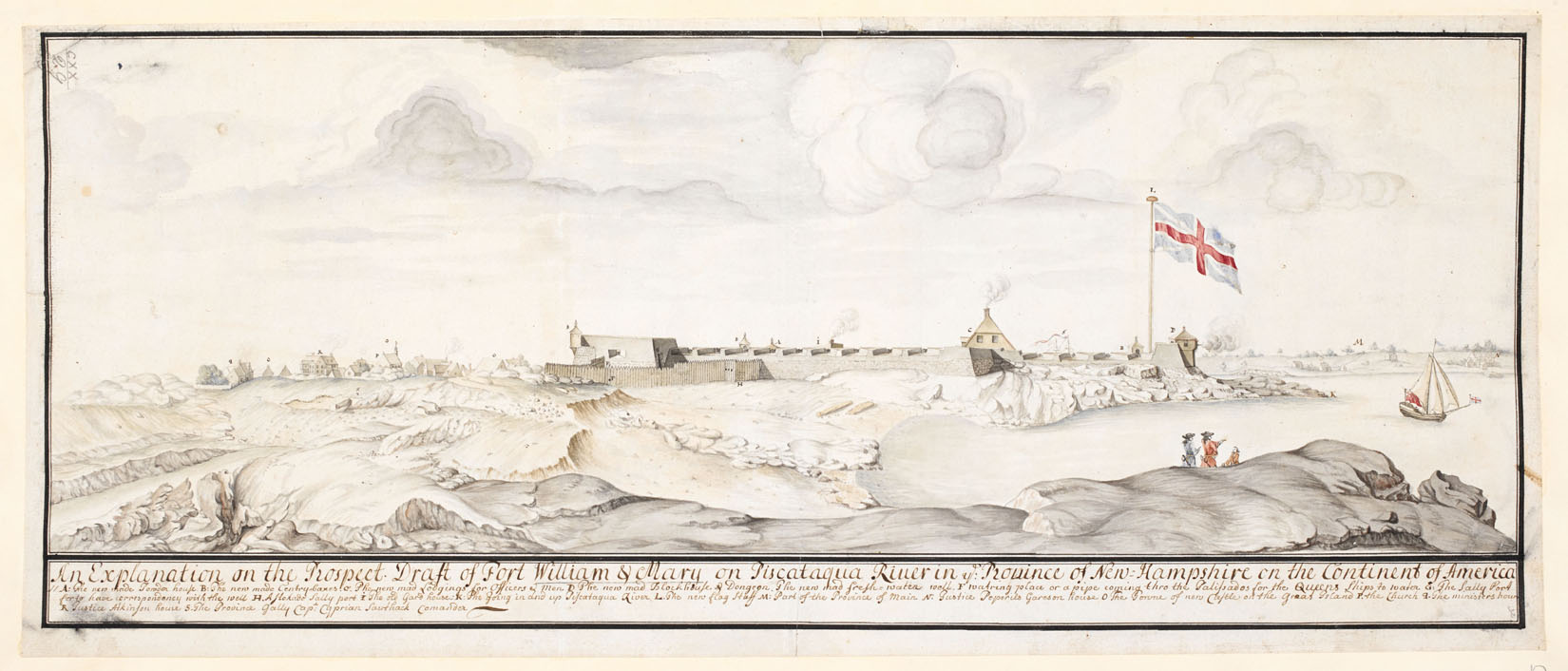
Fort William and Mary, ca. 1705 by Wolfgang William Romer
In response to the Massachusetts Powder Alarm in September 1774, colonial Whig leaders in nearby colonies began to make plans to “capture” local and colonial powder supplies. The crux was the issue of who really owned the gunpowder. Whig leaders believe they owned the power, the colonial militias. Royal leaders, Gen. Gage specifically, believe the powder was the “King’s Powder.” So any attempt to take the powder, was theft and treason. On December 3, 1774 the Rhode Island Assembly ordered the removal of cannons and powder from Fort George in Newport. On December 9, local militia carried out the order without any incident. Gage began to look at larger powder supplies that he believe were vulnerable. One large such supply was located at Fort William and Mary, located near Portsmouth, New Hampshire. This fort was isolated on the island of New Castle, at the mouth of the Piscataqua River. Located here was a small garrison of six men, guarding the fort and its supply of gunpowder.
Paul Revere and his other Patriot leaders in Boston became expert spies and soon received word that Gage was to send a contingent of British marines to Fort William and Mary. On December 13, Revere set out from Boston to Portsmouth to warn them of the coming expedition. Though the British navy was active in the area off of Portsmouth, Gage ironically made no plans to send an expedition to the fort. That would matter little in what happened next.
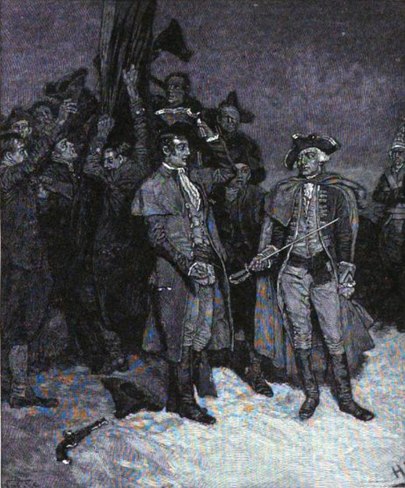
Surrender of Fort William and Mary by Howard Pyle
As Revere arrived in Portsmouth that afternoon, he gave the news of the supposed British expedition to the local Committee of Correspondence. Soon the local militia organized and, on the next day, nearly 400 militiamen assaulted the fort. The six-man British contingent inside the fort refused to surrender. They even fired three of their cannon at the attacking militiamen. For the first time, colonists were in open combat against British troops. The contingent eventually surrendered, having suffered a few injuries but no fatalities. That afternoon, the militia hauled away nearly 100 barrels of gunpowder. The next day nearly a thousand militiamen led by John Sullivan, arrived in Portsmouth due to the rider notification system. With no British to fight, these men assisted in going back to the fort to carry away muskets and cannon. Gage got word of Revere’s presence in Portsmouth and soon sent a small force from Boston to Portsmouth via the British navy. This force arrived the next week and at that point, there was nothing left of substance in Fort William and Mary.
The events at Portsmouth led Gage to be more aggressive in establishing a more coordinated spy network. As the new year began, Gage’s communications with England forced British officials to realize that this opposition was not like those in years past. The Patriots were arming themselves and establishing their own government in an affront to British authority. Former Prime Minister William Pitt, now sitting as a member of the House of Lords, knew the colonies well. He was well liked by the colonists, and he sought a compromise. He predicted the colonials would not back down and soon war would erupt between Great Britain and its colonies. Pitt proposed to remove British troops from Boston to lessen the tensions and to repeal the Coercive Acts. Both ideas were rejected overwhelmingly by Parliament.
In response to the news that the Continental Congress convened, Parliament on February 9, 1775, declared: “We find, that a part of your Majesty’s subjects in the province of the Massachusetts Bay have proceeded so far to resist the authority of the supreme legislature, that a rebellion at this time actually exists within the said province.” Now there was no doubt how the “Patriots” were viewed by Parliament and the King; they were rebels.
The events at Fort William and Mary were part of a succession of tense encounters between British authorities and local Whig leaders. Each one built on the tension from the previous. It is amazing that the “attack” by the New Hampshire militia on the fort, attacking the King’s troops, did not lead directly to war then. It would take four more months before another armed conflict sparked a revolutionary war.
To read more about the events leading up to Lexington and Concord, visit the Savas Beatie website to purchase “A Single Blow: The Battles of Lexington and Concord and the Beginning of the American Revolution” by Phillip S. Greenwalt and Rob Orrison
Many have heard of Paul Revere’s ride to Lexington and the shot heard round the world at Concord (and Lexington) but few know about the December 1774 raid and skirmish at Fort William and Mary in New Castle, New Hampshire. Here, inspired by news from Paul Revere, local militia attacked and captured a small British garrison at Fort William and Mary. Join us as we welcome Dr. Dr. Cynthia Hatch to discuss this much over looked action leading up the American Revolution.
Dr. Hatch is an Oklahoma State University Institute of Technology instructor specializing in Revolutionary War history. With a PhD in History, she explores the intricate political, social, and cultural dynamics of the 18th century, with a particular focus on the colonial legal system and the pivotal role of local narratives in shaping historical interpretations during the Revolutionary Era.
Join us as we discuss the events leading up and during the raid of Fort William and Mary and learn, were these the FIRST shots of the American Revolution? This Rev War Revelry will be pre-recorded and posted to our Facebook page at 7pm on Sunday, December 8th.
May it please your Excellency [General Washington]
My last of the 20th ultimo from Point aux Trembles, advising of my retiring from before Quebec, make no Doubt your Excellency has received. I continued at Point aux Trembles until the 3rd Instant, when to my great Joy General Montgomery joined us with Artillery and about 300 Men. Yesterday we arrived here, and are making all possible Preparation to attack the City, which has a wretched motley Garrison of disaffected Seamen, Marines & Inhabitants, the Walls in a ruinous Situation, & cannot hold out long. Inclosed is a Return of my Detachment amounting to 675 Men, for whom, I have received Cloathing of General Montgomery. I hope there will soon be Provision made for paying the Soldiers Arrearages, as many of them have Families, who are in Want. A continual Hurry has prevented my sending a Continuation of my Journal. I am with very great Respect Your Excellency’s Most obedient humble servant
Benedict Arnold
“To George Washington from Colonel Benedict Arnold, 5 December 1775,” Founders Online, National Archives, https://founders.archives.gov/documents/Washington/03-02-02-0445. [Original source: The Papers of George Washington, Revolutionary War Series, vol. 2, 16 September 1775 – 31 December 1775, ed. Philander D. Chase. Charlottesville: University Press of Virginia, 1987, p. 495.]
The 27-year-old from Thetford, Norfolk, England native had a long journey before he even sailed across the Atlantic Ocean for the colonies. Although receiving an education until age 13, and an apprenticeship with his father until age 19, both uncommon among his peers, Thomas Paine started his professional career as a privateer. It did not suit him for long, he returned to Britain in 1759. Paine then became a staymaker, and within several years, opened his own store in Sandwich, Kent. By the end of the same year, Paine had married.
Life seemed to be set for the young couple, but tragedy after tragedy ultimately led Paine to the American colonies. Paine’s shop ran into financial challenges not long after his nuptials, and although offset by the joy of pregnancy, a relocation to a new town may have been too much on Mary. She went into early labor, and both mother and child tragically died during the delivery. A series of moves, career changes, and troubles dotted the next dozen years.
A supernumerary, Excise Officer, staymaker, schoolteacher, were all ahead of time. Charges of fraud and dismissal were as well. By the age of 31, in 1768, Paine’s next professional endeavor took him to Lewes in Sussex. Over the ensuing years in Lewes, a town with a long history of opposition to the monarchy and republican sentiments, Paine became a member of the Court Leet and parish vestry, worked as a tobacconist and grocer, and married for the second the time.
Thomas Paine
By 1772, Paine wrote his first political piece. His time in his home country was now on the clock. By the spring of 1774, following his political priorities and ideologies, Paine had all but abandoned his post as an excise officer and was essentially fired. He next separated from his second wife, Elizabeth, and moved to London. It was while in London that Paine met Benjamin Franklin who suggested he emigrate to Philadelphia. Paine did exactly that.
His journey through life was turbulent, even more so during the first half of the 1770s, just like his voyage across the Atlantic on his to Philadelphia in the Pennsylvania colony. The water supplies aboard the ship were dreadful, and typhoid raged across the decks of the vessel. Paine was barely alive by the time the ship reached Philadelphia. He was so ill he was unable to leave the docked boat under his own power, Benjamin Franklin sending his personal physician to the ship and have him carried off. Yet, on this date, November 30, 250 years ago, Thomas Paine had arrived to the American colonies. After six weeks of recovery his new journey, a journey shared by all those that were to be swept up in the American Revolution, began.
Less than two years after landing in Philadelphia, Paine published his work Common Sense. Coupled with a series of works entitled The Crises, Paine, “ignited a nation to help the failing cause of the Revolution.”
George Washington issued the first Presidential Thanksgiving Proclamation on October 3, 1789, designating Thursday, November 26, 1789, as a day of public thanksgiving and prayer. This was the first national Thanksgiving proclamation under the new Constitution, and it reflected Washington’s deep belief in the importance of gratitude to God for the blessings enjoyed by the new nation.
Here is the full text of his proclamation:
George Washington’s Thanksgiving Proclamation (1789)
By the President of the United States of America, a Proclamation:
Whereas it is the duty of all Nations to acknowledge the providence of Almighty God, to obey his will, to be grateful for his benefits, and humbly to implore his protection and favor, and whereas both Houses of Congress have by their joint Committee requested me “to recommend to the People of the United States a day of public thanksgiving and prayer to be observed by acknowledging with grateful hearts the many signal favors of Almighty God especially by affording them an opportunity peaceably to establish a form of government for their safety and happiness.”
Now therefore I do recommend and assign Thursday the 26th day of November next to be devoted by the People of these States to the service of that great and glorious Being, who is the beneficent Author of all the good that was, that is, or that will be—That we may then all unite in rendering unto him our sincere and humble thanks—for his kind care and protection of the People of this Country previous to their becoming a Nation—for the signal and manifold mercies, and the favorable interpositions of his Providence which we experienced in the course and conclusion of the late war—for the great degree of tranquillity, union, and plenty, which we have since enjoyed—for the peaceable and rational manner in which we have been enabled to establish constitutions of government for our safety and happiness, and particularly the national One now lately instituted—for the civil and religious liberty with which we are blessed; and the means we have of acquiring and diffusing useful knowledge; and in general for all the great and various favors which he hath been pleased to confer upon us.
And also that we may then unite in most humbly offering our prayers and supplications to the great Lord and Ruler of Nations and beseech him to pardon our national and other transgressions—to enable us all, whether in public or private stations, to perform our several and relative duties properly and punctually—to render our national government a blessing to all the People, by constantly being a Government of wise, just, and constitutional laws, discreetly and faithfully executed and obeyed—to protect and guide all Sovereigns and Nations (especially such as have shown kindness unto us) and to bless them with good government, peace, and concord—To promote the knowledge and practice of true religion and virtue, and the increase of science among them and us—and generally to grant unto all mankind such a degree of temporal prosperity as he alone knows to be best.
Given under my hand at the City of New York the third day of October in the year of our Lord 1789.
—George Washington
This proclamation set a tone of humility, gratitude, and recognition of divine providence that continues to influence the American tradition of Thanksgiving. We with Emerging Revolutionary War hope everyone have a safe and enjoyable Thanksgiving.
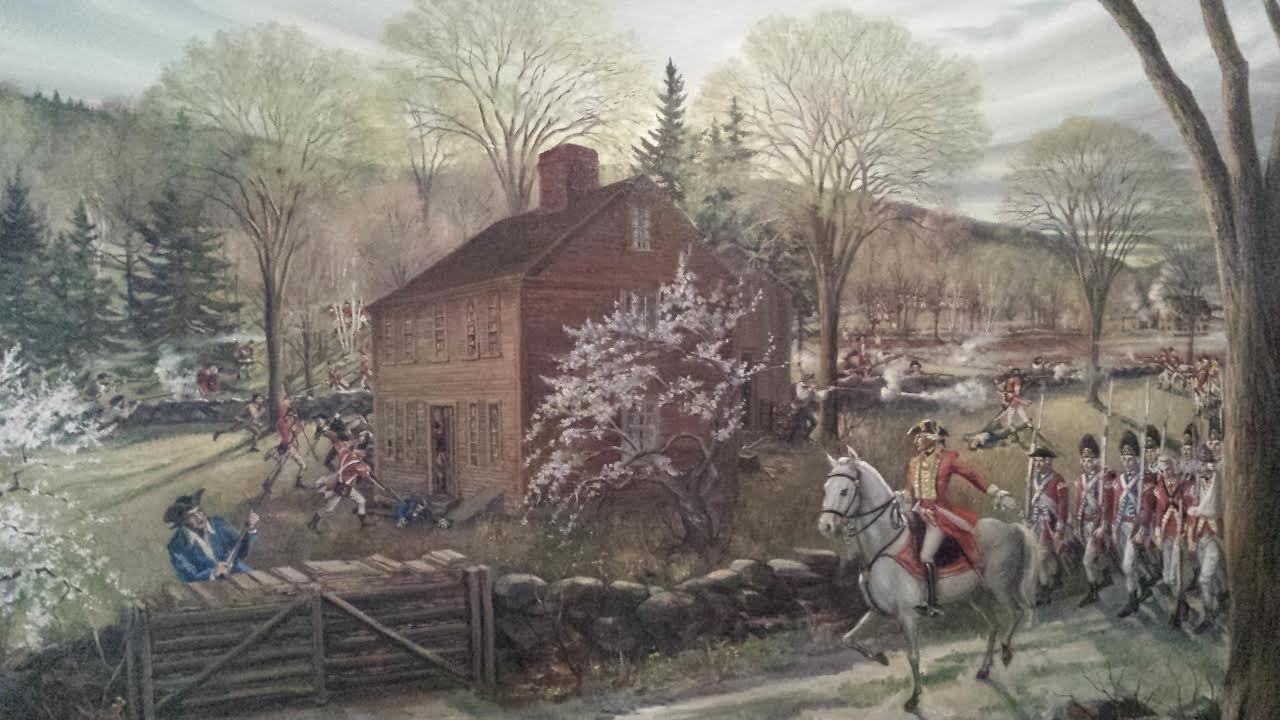
The Fight at the Jason Russell House, bicentennial painting by Ruth Linnell Berry (1974). Appearing with permission from the Arlington Historical Society.
Though the American Revolution started on the green at Lexington and North Bridge in Concord, the bloodiest part of April 19, 1775 took place in the community of Menotomy (modern day Arlington). Join us as we welcome Matt Beres from the Arlington Historical Society. We will discuss the viciousness of the fighting on the afternoon of April 19th along the road back to Boston, including stories like the Jason Russell House, Cooper Tavern and more. Join us as we talk about the much overlooked part of April 19th, 1775 as we move towards the 250th anniversary. This episode is pre-recorded and will be posted on Sunday, November 24th at 7pm on our You Tube and Facebook pages.
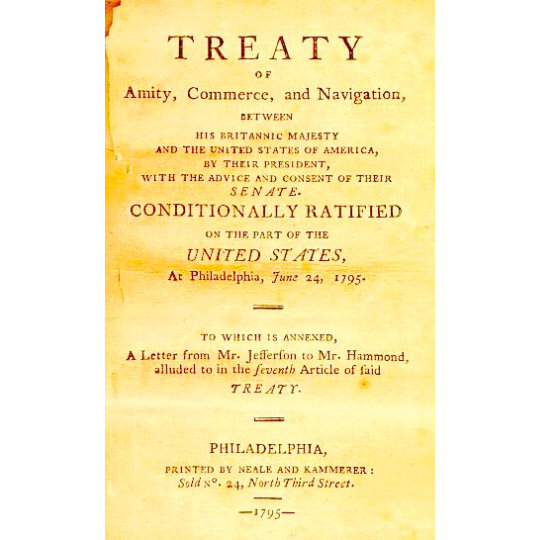
On November 19, 1794, John Jay, representing George Washington’s administration, affixed his signature to a document bearing his name in history. The Jay Treaty. Although the official name of the pact was “The Treaty of Amity, Commerce, and Navigation, Between His Britannic Majesty and the United States of America.”
The treaty’s aim was to resolve outstanding issues from the conclusion of the American Revolutionary War and facilitate economic trade. Although some of the clauses were not fulfilled completely and another war, the War of 1812, erupted because of it, the treaty did serve a purpose. The agreement ushered in a decade of trade between the two countries and gave the fledgling nation a chance to gain footing, a major concern for George Washington, as first president. The treaty also cemented the promise that Great Britain would vacate the forts in the Northwest Territory and agreed to arbitration on the boundary between Canada and the United States and the pre-American Revolutionary War debt.
Yet, the treaty was divisive. Even Jay remarked that he could find his way in the dead of night by the illumination of his own effigy. The treaty angered the French as that country was amid its revolutionary throes, and bitterly divided the nation. Out of it came the separation into two political parties, the Federalists, who supported the treaty, and the Democratic-Republicans who stood opposed to it.
The treaty was ratified by the Senate on June 24, 1795, with an exact two-thirds majority, 20 to 10 along with being passed by William Pitt the Younger, prime minister of Great Britain and his government, and took effect on February 29, 1796.
Historian Joseph Ellis wrote that the Jay Treaty was “a shrewd bargain for the United States” and “a precocious preview of the Monroe Doctrine.” As one of Washington’s most fervent wishes, the treaty “postponed war with England until America was economically and politically more capable of fighting one.”
Among America’s Founding Fathers, Thomas Jefferson is among the most well-known. Author of the Declaration of Independence, Governor of Virginia, Minister to France, and the third President of the United States, Jefferson’s public career is familiar to many Americans. Of his many accomplishments, his authorship of the Statute of Virginia for Religious Freedom is perhaps less well-known among the public, but was one of which he was supremely proud. In Thomas Jefferson and the Virginia Statute for Religious Freedom: Faith & Liberty in Fredericksburg, Michael Aubrecht expertly delivers the story of the creation of this remarkable document and its relationship to the city in which it was written.
The Virginia Statute for Religious Freedom was written in Fredericksburg, Virginia in January 1777. Jefferson and four other men had been appointed to a Committee of Revisors tasked to examine Virginia’s existing laws and redraft them as necessary for the newly independent Commonwealth. Jefferson’s Statute, originally known simply as Bill 82, was only one of more than a hundred bills cataloged by the committee, but its significance has certainly been profound. Aubrecht’s narrative goes beyond telling how Jefferson wrote the document, however. Indeed, historians are not sure as to when exactly that occurred during the week that the committee met at Weedon’s Tavern in Fredericksburg. Instead, Aubrecht expertly places the story of the document’s creation within the context of the time and place it was written.
Each of the book’s thirteen chapters is essentially a vignette, concisely covering the man who wrote the statute, his and the nascent country’s views towards religion and religious practice, and the city and tavern in which it was written. The author also covers topics related to statute’s legacy, including its commemoration, and civic organizations, such as the Jefferson Institute, that perpetuate that legacy. Thus, while the story of the writing of the Virginia Statute for Religious Freedom can be and, indeed has been, quickly and effectively described on interpretive signs and monuments, Aubrecht effectively focuses on the sentiments and character of the man and locations that shaped the document.
Thomas Jefferson was not a one dimensional figure and Aubrecht does not whitewash his chief character. Jefferson was a man with many virtues and talents, but also possessed his share of faults. Aubrecht, like many other historians of the Colonial and Early Republican eras, observes and notes the contradiction between Jefferson’s views on liberty and the fact that his way of life was entirely dependent on slavery. Such objectivity only serves to strengthen the credibility of Aubrecht’s work.
Aubrecht’s work is masterfully researched. As is the case with any effective work of history, the work is truly based on extensive primary source research, chiefly the papers and correspondence of Jefferson. Scholars examining topics relating to religion in Colonial and Early America will find value in mining Aubrecht’s bibliography. Michael Aubrecht’s Thomas Jefferson and the Virginia Statute for Religious Freedom: Faith & Liberty in Fredericksburg will be of interest to anyone interested in Early American history and is a must read for scholars researching religious attitudes during this fascinating and complex period.






 Emerging Revolutionary War Era