During the recent ERW road trip to Massachusetts for the 250th events, I saw the newly marked Parker’s Revenge site at Minute Man National Historical Park. Some of our readers may know that recently the National Park Service conducted archaeology here and discovered the site of part of the April 19, 1775 battle. It was wonderful to see this site now marked and interpreted.
A marker now indicates the site of Parker’s Revenge. Author photo.
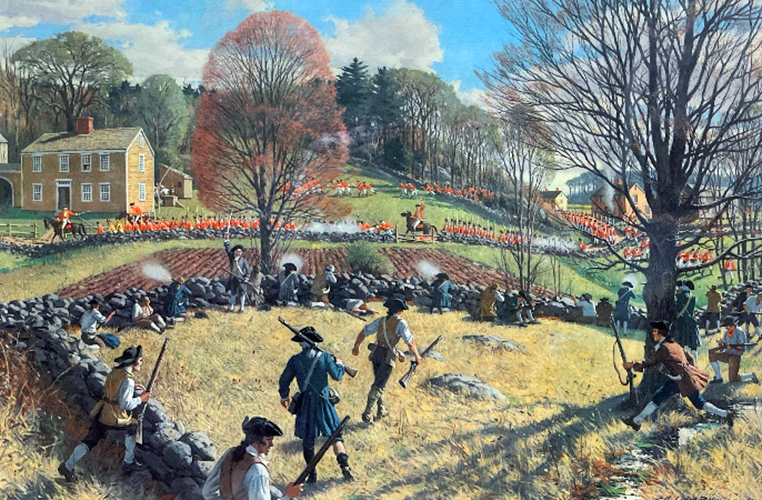
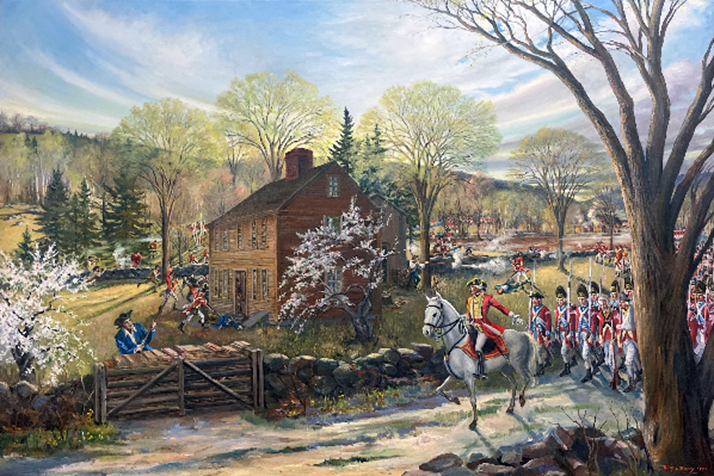
Captain John Parker commanded the Lexington militia who confronted the British early that morning. Suffering eight killed and ten wounded, they fled in confusion from the Lexington green. Regrouping later that morning, they joined in the counterattack on the British column as it moved back towards Boston, the site being named Parker’s Revenge.
Nathan Munroe, a veteran of the clash, remembered fifty years later, “About the middle of the forenoon Captain Parker having collected part of his company, I being with them, determined to meet the regulars on their retreat from Concord. We met the regulars in the bounds of Lincoln. We fired on them and continued so to do until they met their reinforcement in Lexington.”
While park staff had a general idea of where this occurred, recent archaeology confirmed the location. Not far from a section of the road, behind the Minute Man Visitor Center, there is a large rocky outcrop that for decades had been thought to be the site of this phase of the battle. Yet there was little evidence to support this theory.
The site of the ambush. Author photo.
A multi-year historical and archaeological investigation funded by the Friends of Minute Man National Park and the American Battlefield Trust, allowed archaeologists and volunteers to investigate the area. Finding musket balls and military artifacts, they could accurately determine troop positions.
The investigators searched the woods just north of the outcrop in the hopes of finding evidence of the British flankers, who moved ahead of and around the main body to protect it. Archaeologists found evidence of their position, as well as of the militia.
A second marker has an illustration of the fighting. Author photo.
Today there is a maker identifying the site and discussing the recent archaeology. Another nearby provides an illustration to help envision the fighting here. These new markers are a good reminder that we are still learning and often do not have all the answers, even for a well preserved and well documented event like this.
In the aftermath of the April 19, 1775 fighting at Lexington, Concord, Menotomy, and the road back to Boston, militia swarmed from across New England to surround the British forces in Boston. With fighting now underway, a wave of enthusiasm swept through the region, with a decade of tension now broken by actual combat.
On Friday, April 21, 1775, word arrived in New Haven, Connecticut, regarding the fighting at Lexington and Concord. The Revolutionary War had begun, and thousands of militiamen from Massachusetts and the surrounding colonies in New England were converging around Boston to lay siege to the British army bottled up in the city. The next day, New Haven’s militia unit, the Governor’s Second Company of Guards, or Second Company, Governor’s Foot Guards, prepared to march to Cambridge.
Garbed in “A scarlet coat of common length, the lapels, cuffs and collars of buff and trimmed with plain silver wash buttons, white linen vest, breeches and stockings, black half leggins and small, fashionable and narrow ruffled shirt,” the Foot Guards made for quite the appearance. At the head of the 65-man-strong company was Captain Benedict Arnold, a leading member in revolutionary New Haven.
Arnold, 34-years-old at the outbreak of the war, had not stood pat during the decade leading up to April 1775. He was a member of the Sons of Liberty, and on multiple occasions, led mobs against the pro-monarchy members of the community. His leadership and zeal were recognized in March 1775 when he was elected captain of the militia. Like so many other patriots throughout the colonies, the shots fired at Lexington and Concord on April 19 would catapult Arnold onto a path to glory, and unfortunately for the country, later treason.
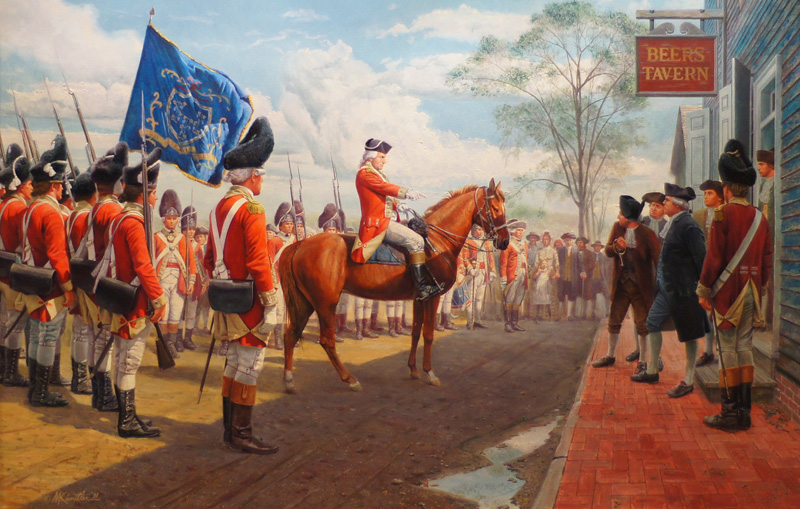
When the news arrived in town the evening of April 21, fifty-eight members of the Foot Guards voted to march to the assistance of their New England brethren. The next morning, Captain Arnold assembled the men on the New Haven Green, where the powder house was located. The doors were locked, and the keys to the stores in possession of New Haven’s Selectmen. Just off the green, at the intersection of College and Chapel Streets, stood Beers Tavern, where the Selectmen were gathered and discussing the town’s response to the recently received news.
The Foot Guards positioned themselves outside the building, while Arnold banged on the door demanding the keys to the powder house. The Selectmen refused to turn them over until official orders arrived. “None but the Almighty God shall prevent my marching,” Arnold passionately assured them. His forceful persuasion worked. The storehouse was opened, and the militia retrieved the necessary ammunition, flints, and powder. Once equipped, Arnold led his men out of New Haven and began a three-day march to Cambridge to join the fight.
Benedict Arnold Demands the Powder House Key by Mort Künstler
Idleness was not in Benedict Arnold’s nature, and upon arriving within the army’s camp, he approached the Massachusetts Committee of Safety with a proposal to lead an expedition against the British-held Ford Ticonderoga situated between Lake George and Lake Champlain in New York. The fort helped defend the crucial waterway system running north-south from Canada and housed cannon that could be vital to the patriot cause. The committee’s chairman, Dr. Joseph Warren, backed the plan and it was approved. On May 3, Arnold was promoted to colonel in the service of Massachusetts (not Connecticut) and was ordered to raise a force in western New England to accomplish the mission. The future hero of Saratoga and traitor to American liberty spurred his horse out of Cambridge and set his sights on taking “America’s Gibraltar.”
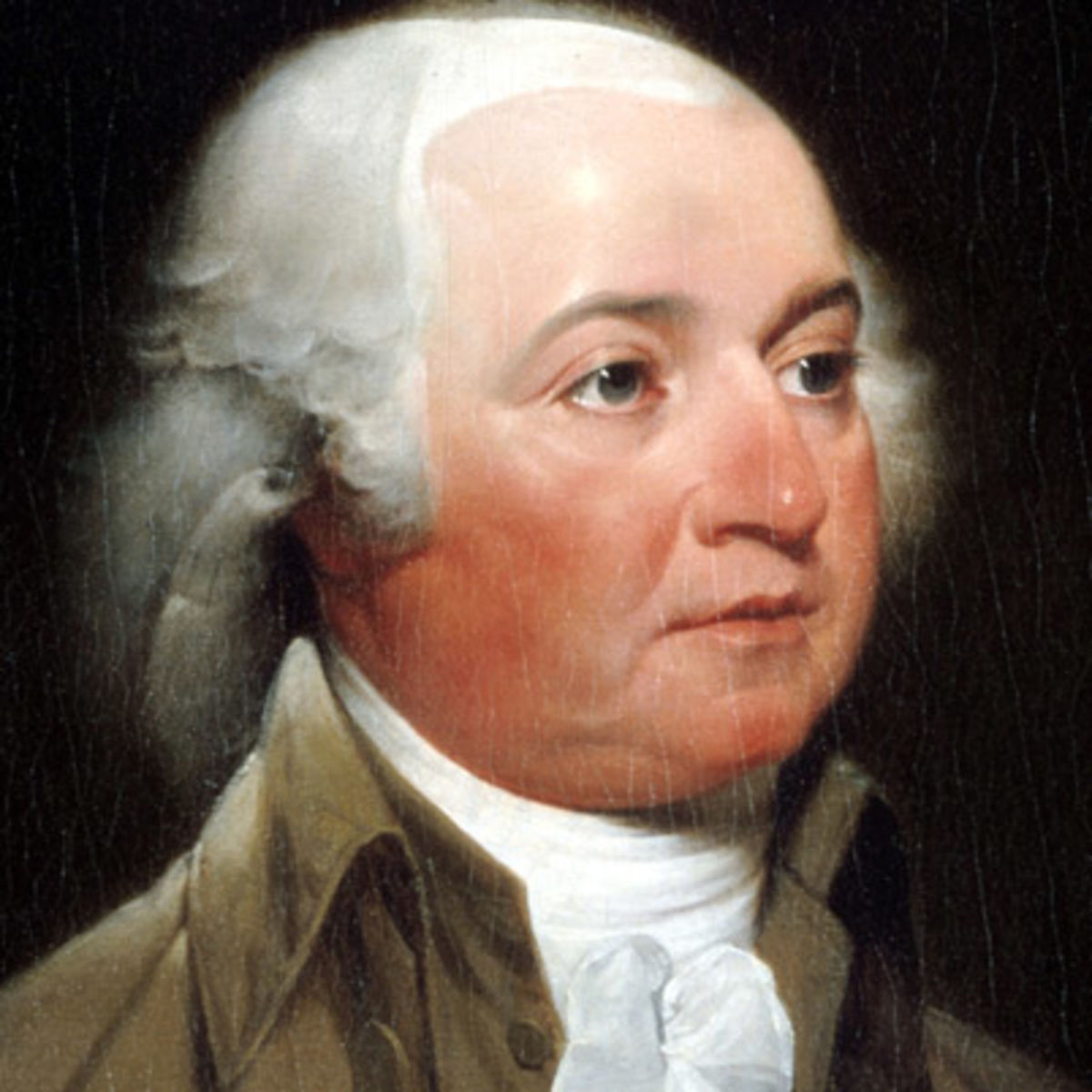
“[T]he Battle of Lexington on the 19th of April, changed the Instruments of Warfare from the Penn to the Sword,” John Adams wrote years after the event. He was well acquainted with the pen as an instrument of warfare. By the spring of 1775, he was twelve letters into a thirteen-letter volley that would become known as the “Novanglus letters”—a series that appeared in the Boston Gazette starting January 23.[1]
The final of those letters appeared, by happenstance, on April 19—the same day as the battles of Lexington and Concord. The thirteenth letter of the series never appeared because of the suspension of printing in Massachusetts following the battle.[2]
Adams was, at the time of the battle, preparing to return to Philadelphia for the next session of the Continental Congress. Before his departure, however, he resolved to ride out to the battlefield so he could see with his own eyes the results of the bloodshed that had occurred. He felt it would make him a more reliable witness when he reported on the event to Congress.
On April 22, Adams rode by horseback from his home in Quincy to Cambridge, where the local militia had concentrated. There, Adams met with military leaders, generals Artemis Ward, William Heath, and Joseph Warren. He also informally inspected the troops, “the New England Army,” as he characterized them.[3]
“There was great Confusion and much distress,” Adams recounted: “Artillery, Arms, Cloathing were wanting and a sufficient Supply of Provisions not easily obtained. Neither the officers nor Men however wanted Spirits or Resolution.”
But how long would such spirit and resolve last, Adams wondered? This questions would inform his strategy when he eventually arrived in Philadelphia.
From Cambridge, Adams rode west toward “Lexington and along the Scene of Action for many miles. . . .” Rubble from the battle still laid strewn along the road from Concord to Lexington and from Lexington back into Boston—a route Adams traced in reverse. He did not write down details of what he saw, but they made a deep impression, as would soon become evident in his attitudes about independence.
To help make sense of what he saw, he “enquired of the Inhabitants” about “the Circumstances” of the battle. “These were not calculated to diminish my Ardour in the Cause,” he admitted. “They on the Contrary convinced me that the Die was cast, the Rubicon passed, and as Lord Mansfield expressed it in Parliament, if We did not defend ourselves they would kill Us.”
Just after his visit to the battlefield, illness debilitated Adams, which delayed his departure for Congress. He did manage to catch up to his fellow delegates en route. Along the way, they saw first-hand how the events at Lexingon and Concord had galvanized public opinion, although it would yet be some months before Congress itself followed public opinion.
But for Adams, events had indeed crossed the Rubicon. He began his unceasing, inexorable push toward independence.
Yet it was a two-pronged approach for Adams, who not only operated on that larger existential level but also on a more immediate, pragmatic one. After all, the sword, not the pen, was now the main weapon. He began advocating for measures that would transform “the New England Army” into a Continental one. His nomination of George Washington to lead the fledgling force, for example, was a masterful stroke to diversify the army and, thus, ensure more colonies had skin in the game.
Congress’s slow pace toward independence would frustrate Adams almost to no end over the fifteen months that would follow. However, the bloodshed of Lexington and Concord made an impression on Adams that would drive him onward, inexorably, toward July 1776 and beyond.
[3] Quote from Adams come from John Adams autobiography, part 1, “John Adams,” through 1776, sheet 18 of 53 [electronic edition]. Adams Family Papers: An Electronic Archive. Massachusetts Historical Society. http://www.masshist.org/digitaladams/
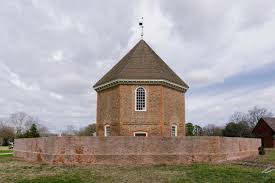
Powder Magazine, Colonial Williamsburg, VA in 2025
Today marks the 250th anniversary of the Virginia Powder Alarm in Williamsburg, VA. To commemorate the anniversary, join us this Sunday, April 27th at 7pm on our Facebook page as we welcome ERW historians Rob Orrison, Mark Maloy with Maureen Wiese and J. Michael Moore to discuss the events leading up to the April 21, 1775 Powder Incident in Williamsburg, VA. A few days after Lexington and Concord (unknown to the Virginians at the time), Governor Lord Dunmore removed powder from the magazine in Williamsburg. This event led Patrick Henry to lead militia towards Williamsburg and possible standoff with the Governor. As news arrived on April 28 of the bloodshed outside of Boston, tensions rose even higher.
Join us as we discuss another 250th anniversary event that led to the beginning of the American Revolution. This podcast will be recorded and posted on our Facebook page on April 27th at 7pm. Then it will be posted to your You Tube and Spotify pages.
Yesterday marked the 250th anniversary of the first battles of the American Revolution. The Battles of Lexington and Concord were brutal and vicious. More than 40 American colonists were killed in the fighting. These were the first martyrs in the cause for American liberty. Here are the stories of some of those men who shed their blood on that fateful day for our freedom.
Jonathan Harrington was one of the few dozen men in the Lexington militia who stood on the Lexington Green when the first British troops arrived at sunrise on April 19, 1775. He lived with his wife and child in a home that was located on the Green. After a shot was fired, the British soldiers opened fire on the American militiamen. As they were dispersing, Harrington was shot through the chest. He crawled towards his house and died within sight of his home. Local legend says he crawled to his own doorstep and died at the feet of his wife and child.
Sign on the Harrington house which still stands in Lexington, MA today.
Isaac Davis was the captain of the Acton minutemen. The Acton minutemen marched more than 5 miles to Concord in the early morning hours of April 19. After seeing smoke from the town, the minutemen marched down towards the North Bridge and the British soldiers guarding the opposite side fired a volley at the minutemen. This volley was high and may have been a warning shot. The next volley was fired into the minutemen. Private Abner Hosmer was shot through the head and killed. Davis was shot through the chest, his blood splattering the men around him. Seconds later the American colonists were given the command to fire on British soldiers for the very first time.
The Acton Monument stands over the graves of Isaac Davis, Abner Hosmer, and James Hayward.
James Hayward was part of the Acton company that joined in the running battle back towards Boston. During the battle soldiers from both sides stopped to get water at local wells. At one point a British soldier went to the well by the Fiske house to get a drink of water. At the same time, Hayward was heading there too. The two saw each other and raised their muskets. The British soldier said, “You are a dead man!” Hayward replied, “So are you.” They both fired at the same time. The British soldier was killed instantly. Hayward was hit, with splinters of his powder horn going into his side. He died not long after.
The site of the Fiske well, where James Hayward and a British soldier died.
Jason Russell was a 58-year-old man living in the village of Metonomy (present day Arlington, Massachusetts) and was preparing to defend his home on the road back to Boston. People were telling him to leave the area, but Russell refused and exclaimed “An Englishman’s home is his castle!” As the British column came down the road, Russell and a dozen militiamen began to fire into redcoats. Unfortunately for Russell and the other militiamen, the British had deployed flankers to clear out many of the houses along the road. The colonists were taken by surprise and retreated into the house. Russell was unable to run and was bayonetted to death by the British troops on his front doorstep. The British entered the house and hand to hand fighting occurred inside the house. Two British soldiers and eleven militiamen were killed.
A painting depicting the death of Jason Russell at the Jason Russell House (Arlington Historical Society)
Jason Winship and Jabez Wyman decided to sit in the Cooper Tavern and have a drink. The fighting in Metonomy became extremely brutal. Even unarmed civilians got caught up in the carnage. As British arrived at the Cooper Tavern, the tavern owners fled into a cellar. Winship and Wyman did not stand a chance. The owners noted that: “the King’s regular troops under the command of General Gage, upon their return from blood and slaughter, which they had made at Lexington and Concord, fired more than one hundred bullets into the house where we dwell, through doors, and windows,…The two aged gentlemen [Winship and Wyman] were immediately most barbarously and inhumanly murdered by them, being stabbed through in many places, their heads mangled, skulls broke, and their brains out on the floor and walls of the house.”
Samuel Whittemore was a 78-year-old man who lived in Menotomy. He prepared to fight the British troops marching along the road. He carried a musket, two pistols and a sword. As some British soldiers moved to get Whittemore, he shot one with his musket, then killed two with his pistols and then drew his sword to fight them. The British soldiers shot off part of his face off, clubbed him and bayoneted him fourteen times, leaving him for dead. Amazingly, he survived and live for another eighteen years, dying at the ripe age of 96.
A monument for Smauel Whittemore in Arlington, MA.
One of the last people to die that day was 65-year-old militiaman James Miller. As the British were making it back to Charlestown, James Miller and some men fired into the retreating soldiers. British soldiers ran towards the militia. Miller’s compatriots fled and entreated him to do the same. Miller replied, “I am too old to run.” The British opened fire and killed Miller.
Today the remains of the men who were killed on Lexington Green now lie there under a monument that was erected in 1799, not long after the successful conclusion of the Revolutionary War. The epitaph on that monument still speaks to the heroism and valor of these first Americans to fall in the Revolutionary War:
“The Blood of these Martyrs, In the cause of God & their Country, Was the Cement of the Union of these States, then Colonies; & gave the spring to the spirit. Firmness And resolution of their Fellow Citizens. They rose as one man to revenge their brethren’s Blood and at the point of the sword to assert & Defend their native Rights. They nobly dar’d to be free!!”
“LISTEN, my children, and you shall hear Of the midnight ride of Paul Revere, On the eighteenth of April, in Seventy-five”
Henry Wadsworth Longfellow penned the poem, “Paul Revere’s Ride” in 1860. Now as America moves toward celebrating the 250th anniversary of Paul Revere’s famous ride, which happened on this date in 1775, another literary work has hit the market on this very topic.
Published on March 25 by Kostya Kennedy, Chief of Premium Publishing at Dotdash Meredith, with a lengthy career in writing, teaching, and journalism. The book reads like Revere’s ride, a fast-paced, descriptive overview of the man, events, and memories around the night of April 18, 1775. For those who have read David Hackett Fischer’s book, published in 1994, you may not find anything groundbreaking or new. However, that is not the point I feel in this book.
Kennedy pens this to get the reader hooked. Sets of rhetorical questions, “what-if” scenarios, and descriptive writing make the reader feel that they are in the environs of Boston or on the routes to Lexington traversed by Revere. Oh, and Kennedy does not forget Dawes, Prescott, and others who also played prominent roles in April 1775.
History enthusiasts and content experts may find a few shortcomings and errors, such as Kennedy continuing to use “Royal” when discussing the British Army. Since the English Civil War, the British Army has lost the right to use “Royal” in front of it. A few times, he labels the “British” as coming when the colonists would have used “Regulars” or “Redcoats.” Lastly, falling into the ag-old myth that Lexington had minutemen and a militia, the town just had the latter. Trivial things that do not impact the flow of the narrative.
A highlight to me, though, is the final sections about the memory of that day. Including a great insert of an interview with the direct descendant of Paul Revere and a comical anecdote about Paul Revere III being pulled over for speeding in Lexington, Massachusetts one year on April 18.
The book is a great read on the anniversary of Paul Revere’s Ride. Take it from me, I read the book in a day! Descriptive, vivid, and convince you that if you have not been, a trip to Boston and the Massachusetts countryside should be in your near future.
Published by: St. Martin’s Press, March 25, 2025 Images, sources, 282 pages
ERW Welcomes Matt Beres, Executive Director of the Arlington Historical Society
On the morning of April 19, 1775, the first shot of America’s War for Independence was fired on the Lexington Green. Later that morning, Major John Buttrick, commanding the local Provincial forces, gave the order to fire on the British Regulars at the North Bridge. This act would later be remembered as the “Shot Heard ‘Round the World,” a phrase immortalized by Ralph Waldo Emerson.
As Lt. Col. Smith’s British Regulars began their retreat back to Boston, Governor Thomas Gage sent a relief column of Regulars, led by General Hugh Percy. Meanwhile, Provincial militias and minute companies from surrounding towns marched toward the conflict, firing on both sides of the main road leading back to Boston. The Battle was just beginning.
While Lexington is famous as the site of the “first shot” and Concord for the “Shot Heard ‘Round the World,” Menotomy (present-day Arlington) is known as the site of the largest battle of the day, where fierce fighting erupted between the retreating British forces and the growing Provincial forces. The following stories are from this Battle.
David Lamson
Earlier that day, a convoy of provisions and supplies, protected by a detachment of British Regulars, arrived behind the main force heading toward Lexington and faced difficulties crossing the Brighton Bridge. Before their arrival, the Committee of Safety had removed the planks, and the combination of heavy wagons and repairs to the bridge caused the convoy to become separated from the main force, rendering it vulnerable.
An alarm rider from Cambridge alerted locals, prompting men from the ‘exempt’ or ‘alarm’ list—those unfit for regular Militia or Minute companies—to gather at Cooper’s Tavern to plan to capture the convoy. Among them was David Lamson, a biracial French and Indian War veteran, whose experience and bravery made him a natural leader. The group quickly appointed him as their Commanding Officer.
According to a story derived from Lamson himself, they positioned themselves behind a stone wall near the First Parish Meeting House. As the convoy approached, they ordered it to surrender. When the drivers urged their horses forward, Lamson’s men fired, killing the driver and several horses, and wounding two Regulars. In panic, the remaining six Regulars fled toward Spy Pond, and discarded their weapons.
It is said they then surrendered to an old woman, Mother Bathericke, who was in the field picking flowers. The old woman forced them to the house of Ephraim Frost, Captain of the Menotomy Militia, and stated, “… you tell King George that an old woman took six of his grenadiers prisoners.”
Samuel Whittemore
Aiden Lassell Ripley (1896-1969), Retreat from Lexington at the Foot of the Rocks. A.2.509. Arlington Historical Society Collections
Around 4:00 pm, the retreating British Regulars arrived at the village Menotomy. It was here where Samuel Whittemore, the oldest known combatant of the Revolutionary War, earned his fame. During the conflict, Whittemore took cover behind a stone wall. He reportedly fired at five soldiers but was soon overwhelmed. He suffered a gunshot wound to the cheek and a bayonet stab wound. When the Regulars continued their retreat, the locals carried him to Cooper’s Tavern, where Dr. Tufts of Medford treated his injuries.
Remarkably, Whittemore survived for another 18 years after suffering these life-threatening wounds. He lived long enough to see the birth of a new and independent nation.
Jason Russell
Later during their retreat, Gen. Percy ordered his men to enter the residences along Concord Road (now Massachusetts Avenue) to eliminate the Provincials who were firing from inside these houses. One notable example was the site of Jason Russell House.
Ruth L. Berry, 1975. Jason Russell House in Battle With British Soldiers 1990.19.1. Arlington Historical Society Collections
Jason Russell was a middle-aged farmer who reportedly had a leg disability. He barricaded his property and refused to leave, asserting, “An Englishman’s house is his castle.”
As British Regulars surrounded his home, several Provincials from different towns sought refuge inside. Tragically, Jason Russell and several others lost their lives on his property.
Today, the c. 1740 house, still bearing musket ball holes in the remaining structure from the fight, is at the heart of the Arlington Historical Society’s regional history museum, offering guided tours and engaging exhibits that highlight the lasting impacts of the American Revolution and Arlington’s broader history.
We are just days away from the events in Lexington and Concord. Be sure to follow ERW here on our blog and social media pages. We will have blog content and live videos from Boston, Lexington and Concord from April 18-20, 2025. ERW will be at all the sites and events commemorating the 250th anniversary of the events leading up to and including the first shots of the war.
Also be sure to follow our good friends Alex Cain and J.L. Bell on their blogs as well, https://www.historicalnerdery.com/ and https://boston1775.blogspot.com/ These two great historians have a wealth of information on Boston, Lexington, Concord and all the events of 1775.
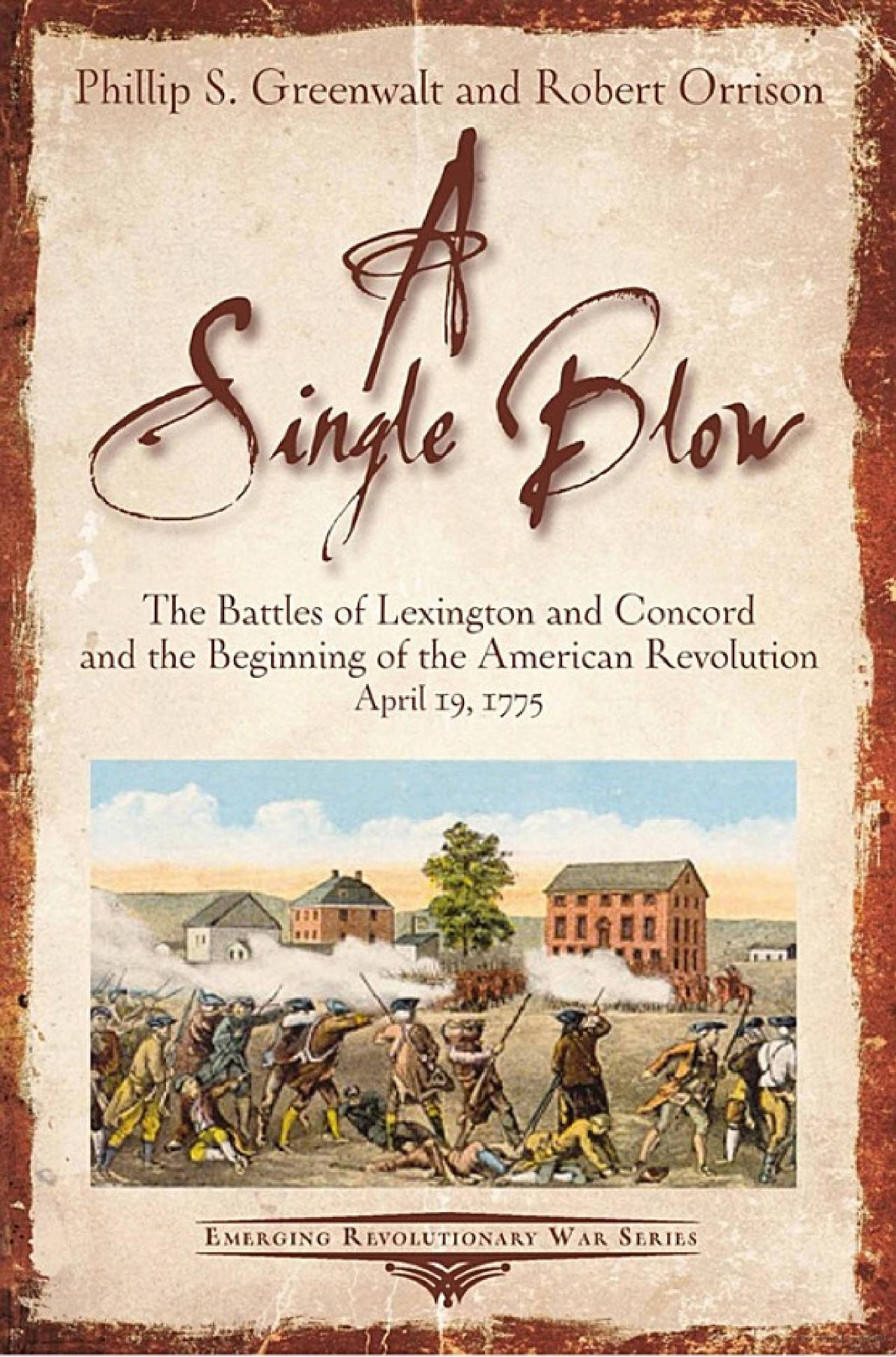
If you havent already, pick up a copy of our first ERW title, “A Single Blow: The Battles of Lexington and Concord and the Beginning of the American Revolution” by Phillip Greenwalt and Rob Orrison. Published by Savas Beatie (https://www.savasbeatie.com/a-single-blow-the-battles-of-lexington-and-concord-and-the-beginning-of-the-american-revolution-april-19-1775/ ), this book not only accounts the events of 1775 but also provides several tour guides for you to visit these locations. ERW fully believes that the best place to learn the history is where it took place.
We look forward to bringing you some great content this weekend…be prepared to have some behind the scenes looks, some guest historians and over all a fun time learning more about our great shared history.
As we approach the 250th anniversary of Lexington and Concord, on April 14, 2025 another 250th anniversary is taking place but one that is much overlooked. When we think about the fight to end slavery in the United States, names like Frederick Douglass, Harriet Tubman, and William Lloyd Garrison often come to mind. But America’s organized abolitionist movement actually began decades earlier—with a quiet but powerful group of reformers in Philadelphia.
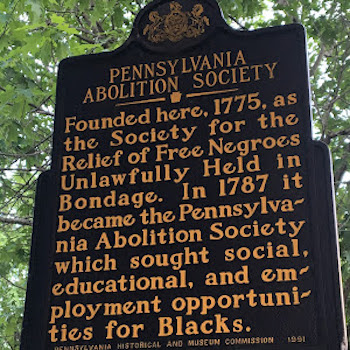
Historic marker located near the intersection of Front and Ionic Streets in the “old city” section of Philadelphia. Close to the original location of Tun Tavern.
In 1775 the American colonies were on the verge of war with Great Britain, calling for freedom and independence. But even as they demanded liberty, many Americans—including some of the nation’s founders—continued to own slaves. Amid this contradiction, a small group of Philadelphia Quakers stepped up to challenge the injustice of slavery. On April 14, 1775 in Philadelphia, they formed what would become the first formal abolitionist organization in America, the Society for the Relief of Free Negroes Unlawfully Held in Bondage.
The name was long, but its mission was clear. This group was determined to help free Black people who were illegally enslaved or kidnapped into bondage. Their founding was quiet, overshadowed by the Revolutionary War, but it planted the seeds of a movement that would eventually reshape the nation.
At the heart of the Society were the Quakers (17 of the original 24 members were Quakers) formally known as the Religious Society of Friends. Quakers believed deeply in the equality of all people and had long spoken out against slavery. Many had already freed the people they once enslaved, and by the mid-1700s, anti-slavery had become central to their faith.
So in April 1775, a group of these Quakers, joined by a few like-minded allies, came together to create the Society. Their initial goal was modest but critical: to protect the rights of free Black people and prevent them from being illegally sold into slavery. This was not uncommon at the time, especially in cities like Philadelphia where Black communities—both free and slave—lived side by side. However, the outbreak of war later that year put much of the Society’s early work on hold. But their mission didn’t die.
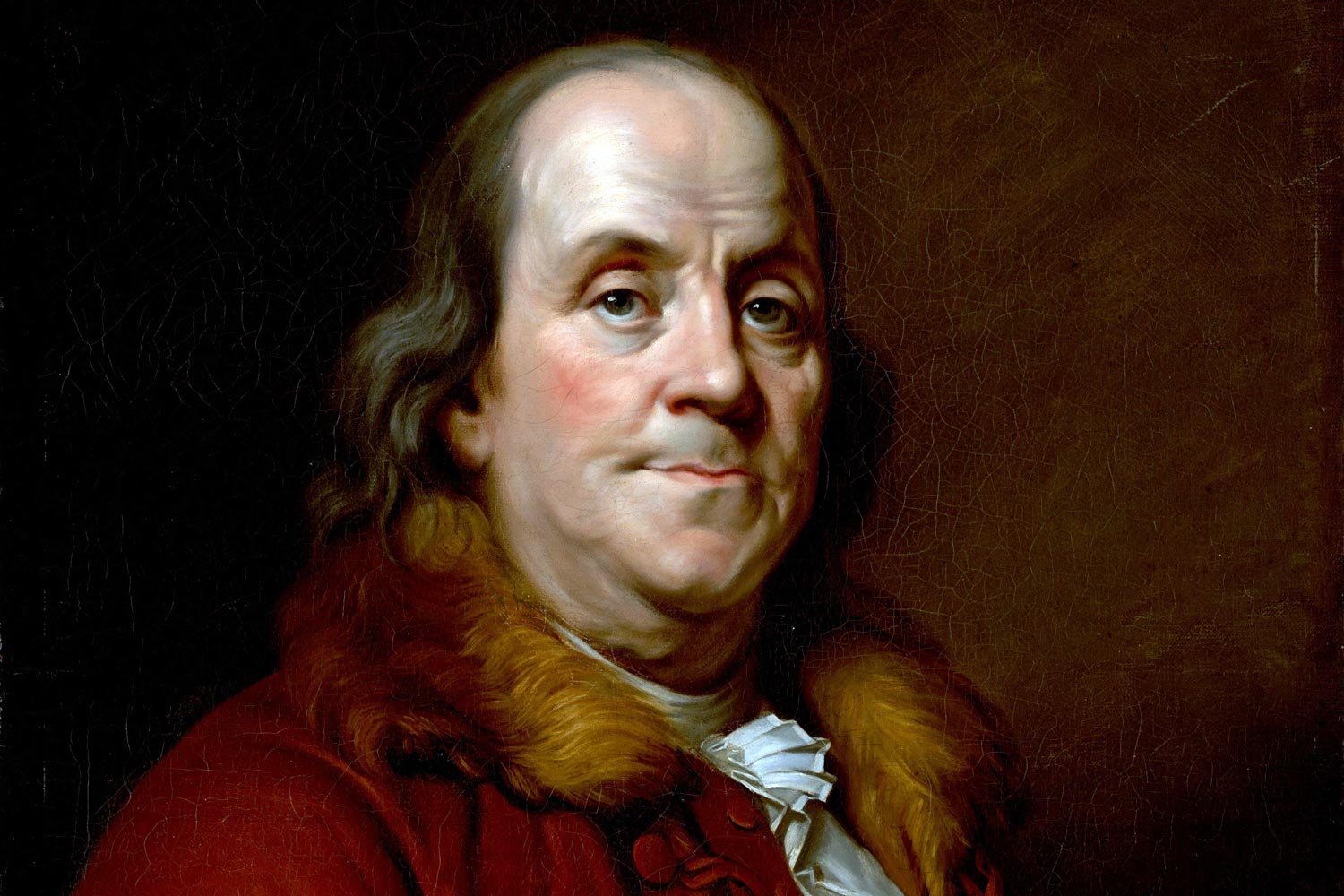
After the war, in 1784, the Society was revived with renewed energy and purpose. It was renamed the Pennsylvania Society for Promoting the Abolition of Slavery and the Relief of Free Negroes Unlawfully Held in Bondage—still a mouthful, but a more expansive vision. Benjamin Franklin, one of America’s most celebrated founding fathers, became the Society’s president in 1787. Franklin had once owned slaves himself, but his views evolved over time. By the end of his life, he was a vocal critic of slavery and used his influence to support the Society’s goals.
This time, they weren’t just focused on defending free Black people—they were actively working to end slavery altogether. Their efforts were both legal and educational. The Society hired lawyers to defend kidnapped individuals, lobbied lawmakers, and even began promoting schools for Black children.
The Society’s work helped inspire real change. Pennsylvania became the first state to pass a gradual abolition law in 1780, a huge step forward. While the Society didn’t write the law, many of its members pushed hard for its passage and later worked to ensure it was enforced.
Still, the road was far from easy. The Society operated in a world where slavery was deeply entrenched—not just economically, but socially and politically. In the South, slavery was expanding. Even in the North, racism was widespread, and support for abolition was often lukewarm.
Despite these challenges, the Society’s model paved the way for the much larger abolitionist movements of the 19th century. It showed that legal advocacy, public education, and grassroots organizing could make a difference. It also helped define Philadelphia as a hub of anti-slavery activism that would later become home to figures like Frederick Douglass and Sojourner Truth.






 Emerging Revolutionary War Era