April 19, 2025 is a date many of us have been looking forward to for a long time. Those involved in the planning and execution of all the events and programming have put in countless hours preparing for America to commemorate its beginning in the towns of Lexington and Concord. As we are a week away from the commemoration, join us as we also celebrate our FIVE year anniversary of our Rev War Revelry podcast. On Sunday, April 13th at 7pm we welcome a host of historians and experts as we talk about the history and memory of f April 19, 1775. This Rev War Revelry will run LIVE on our Facebook page. Join in on the live chat with questions and comments.
Then on April 18-20, join ERW on our Facebook page as we will regularly post live videos from locations such as the Paul Revere House, Old North Church, Charlestown, Warren Tavern (a favorite of ERW!), Lexington, Concord, Arlington and many others. We plan on following Revere from Old North to Lexington over night April 18-19 so feel free to stay up with us as we commemorate this momentous occasion in our history.
Students of the American Revolution face a wealth of opportunities at the end of May with two conferences in Virginia and New York. Although they overlap, they’re far enough apart geographically to cater to people from New England through the Mid-Atlantic down to the South.
National Museum of the United States Army Symposium
Events marking the 250th anniversary of the American Revolution are well underway and ERW is along for the ride to bring them to a wider audience. With that in mind, we’re pleased to draw attention to The National Museum of the United States Army, which is opening a new exhibit titled “Call to Arms: The Soldier and the Revolutionary War” and kicking off events with a Symposium on the war’s early years. (https://www.thenmusa.org/symposium2025/)
The Symposium starts virtually in the evening of May 29 with a panel discussion on commemoration before moving to both virtual and in-person talks on Friday, May 30. Panelists include:
David Preston: “The Roots of Conflict.”
Holly Mayer: “The Formation of the Continental Army.”
Michael Cecere: “The Early was in the South.”
Panel: “Revolutionary War Leadership,” with Christian McBurney, Joyce Lee Malcolm, and Ricardo Herrera.
Mark Lender: “Washington’s Campaigns, 1776-1777.”
Those attending in-person will have a sneak peak at the “Call to Arms” exhibit. On May 31, John Maass will lead a group on a walking tour of George Washington’s Alexandria, Virginia.
The conference and walking tour are free, but do require registration as space is limited.
Fort Plain Museum and Historical Park Conference
The same weekend, Fort Plain Museum and Historical Park is holding its annual Revolutionary War Conference in Johnstown, NY with an equally auspicious lineup of speakers and presentations. Events begin with a bus tour of Lexington and Concord on May 29 and then recommence with a full series of speakers in the afternoon of May 30, all day on May 31, and a series of presentations on the morning of June 1.
Some of the featured speakers include Pulitzer Prize winning author Rick Atkinson, previewing his forthcoming book “The Fate of the Day: The War for America, Fort Ticonderoga to Charleston, 1777-1780,” Don Hagist discussing his groundbreaking work on British soldiers in the war, and Major General Jason Bohm, USMC (ret) on his book about the founding of the Marine Corps during the Revolution and its earliest operations.
Emerging Revolutionary War welcomes guest historian Tom Elmore. Brief bio is at the bottom of the post.
When Walt Disney’s Disneyland anthology series, featuring shows inspired by the themes of the park’s sections, debuted in 1954 it ended the television season at #6 in the Nielsen television ratings and improved to #4 the next season. Much of that success was due to the Davey Crocket episodes, one of the first major television phenomena.[1]
But the series dropped to #14 in the third season and was out of the top twenty in the fourth and fifth seasons. The American Broadcasting Company (ABC) which carried the program, renamed Walt Disney Presents, pressured Disney to come up with another Crockett and more westerns which made up most of the top 20.[2]
Disney later complained that “I found myself in a straightjacket. I no longer had the freedom of action…They kept insisting that I do more and more westerns and my show became loaded…with every western myth.” Consequently, relations between Disney and ABC became strained.[3]
Disney turned to one of his passions, American history, to create a series based on the partisan leader, General Francis Marion, “the Swamp Fox,” who harassed British troops in South Carolina during the American Revolution.[4]
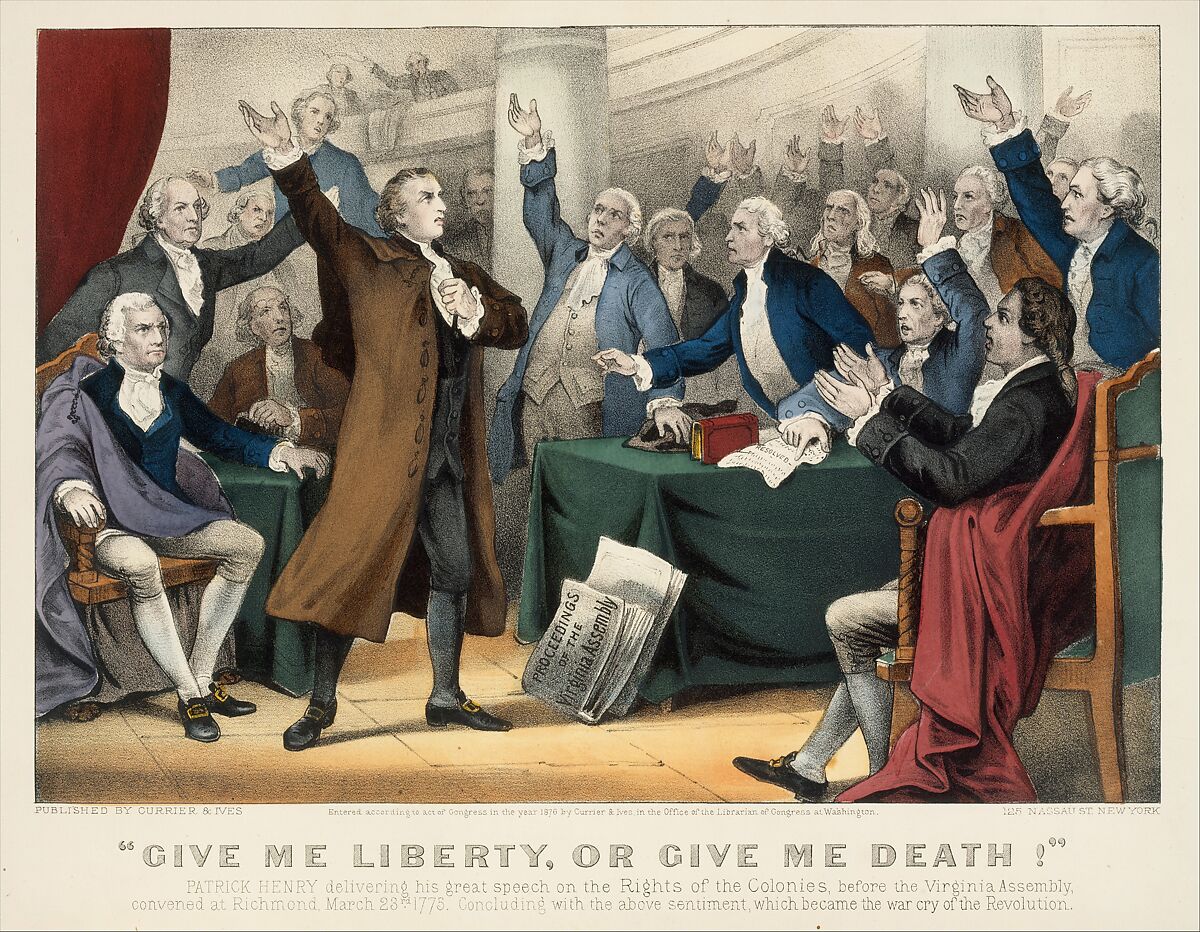
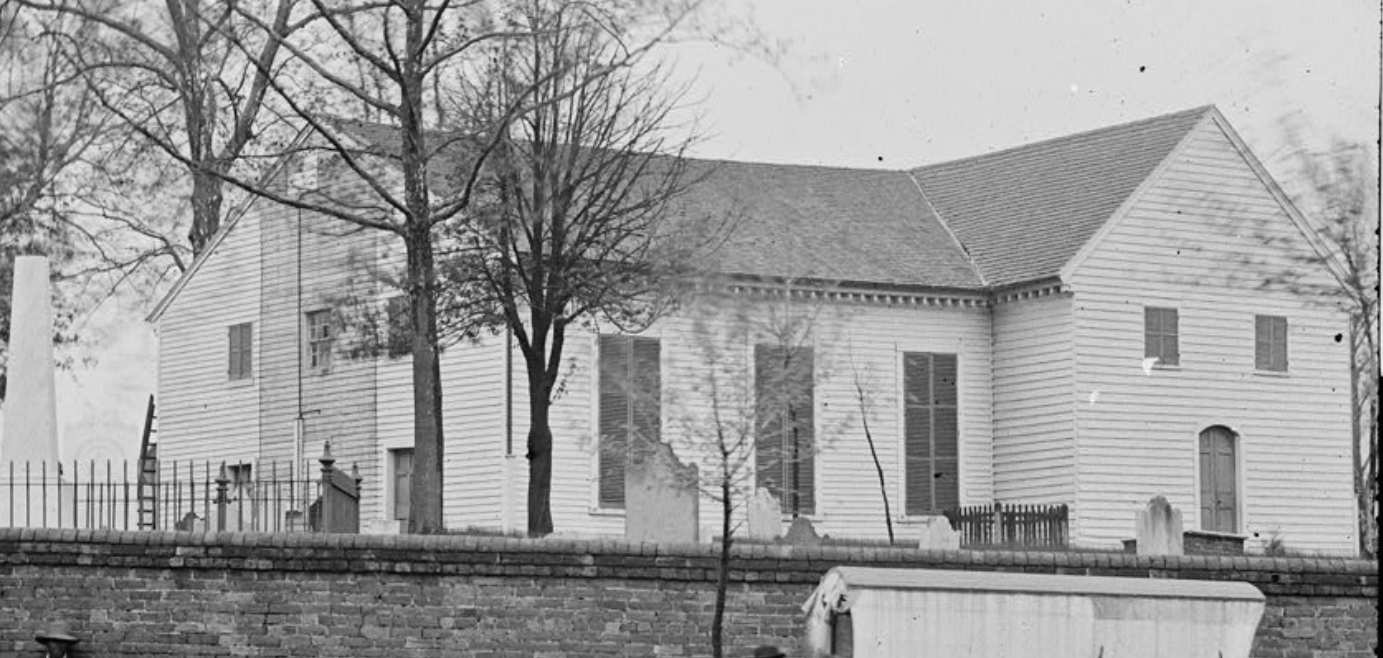
Momentum for the 250th Anniversary is really picking up steam, as seen with recent special events in Virginia. On Sunday, March 23, St. John’s Church in Richmond observed the 250th anniversary of Patrick Henry’s “Liberty or Death” speech.
The church held three reenactments of the meeting of the Second Virginia Convention, each sold out. In attendance at the 1:30 showing (thought to be about the time of the actual meeting), were filmmaker Ken Burns and Virginia Governor Glenn Youngkin. Outside the church, reenactors greeted visitors, and representatives from several area historic sites had displays, including Mount Vernon, Wilton House Museum, Red Hill, the VA 250 Commission, Richmond National Battlefield Park, Tuckahoe Plantation, and the Virginia Museum of History and Culture. Mark Maloy, Rob Orrison, Mark Wilcox, and Bert Dunkerly of ERW were all present.
St. John’s Church. Author photo
That afternoon park rangers from Richmond National Battlefield Park gave a special walking tour through the neighborhood focused on Henry’s speech and the concepts of liberty and citizenship through time.
That evening Richmond’s historic Altria Theater hosted the very first public premiere of Ken Burns’ new documentary, The American Revolution. A sellout crowd of over 3,000 saw snippets of the video, along with a panel discussion with Burns and several historians. The documentary will air nationwide starting on November 15.
Then, Monday, Tuesday, and Wednesday, Colonial Williamsburg hosted a gathering focused on 250th planning called, A Common Cause To All. The event featured about 600 representatives from historic sites, museums, and state 250 commissions. In all forty states were represented. Attendees discussed event planning, promotion, upcoming exhibits, educational opportunities, and more.
In his speech on March 23, 1775, Patrick Henry noted that “the next gale that sweeps from the north will bring to our ears the clash of resounding arms.” True enough, just a few weeks after his speech, word arrived of the fighting at Lexington and Concord. And soon, our readers will hear about the special events commemorating this anniversary in Massachusetts.
“He said to his friend, “If the British march By land or sea from the town to-night, Hang a lantern aloft in the belfry arch Of the North Church tower as a signal light,– One, if by land, and two, if by sea;”
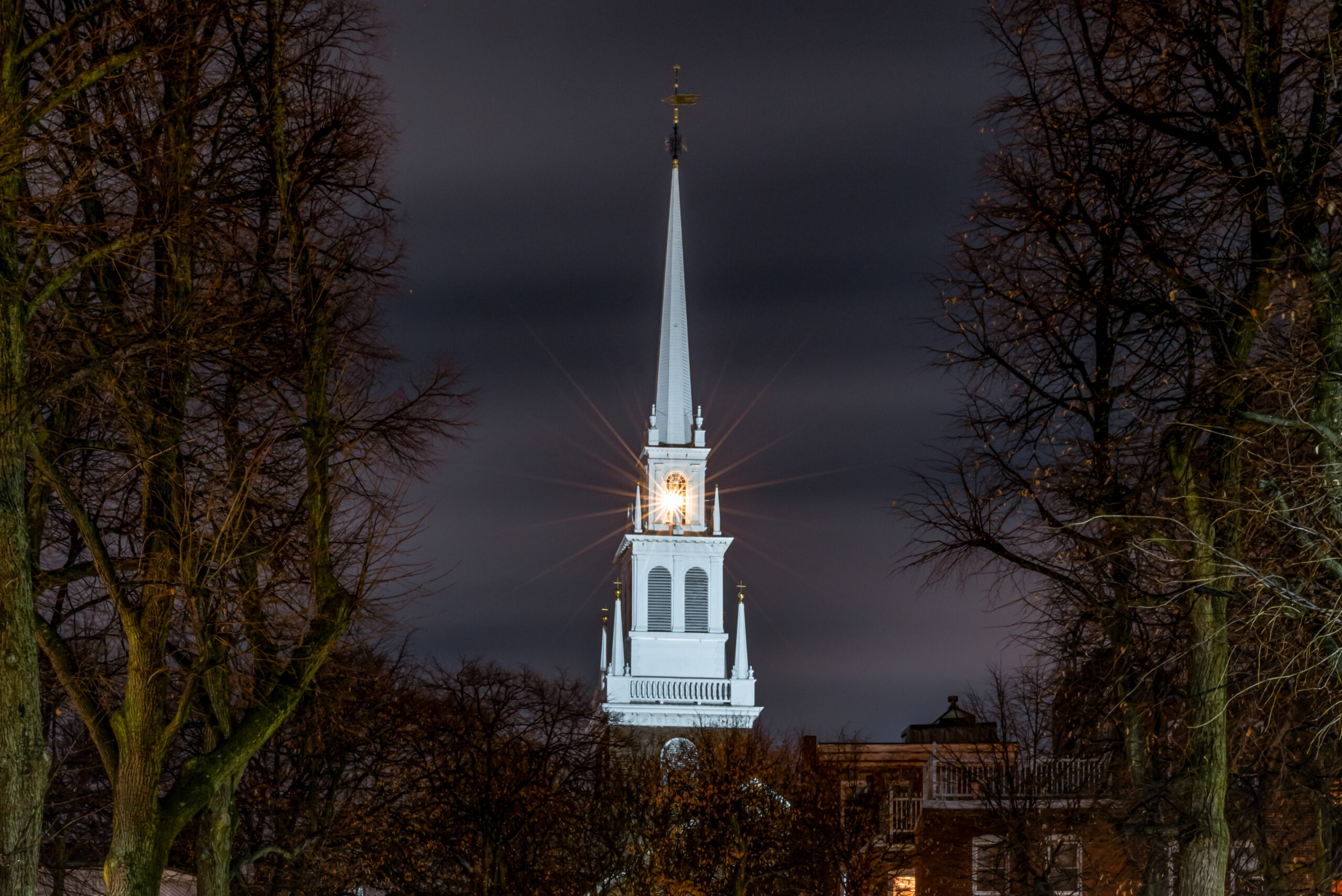
These famous words from Henry Wadsworth Longfellow’s poem about Paul Revere’s ride recount the important role the Old North Church played in the events leading up to the first shots of the Revolutionary War. Join us just a few weeks before the 250th anniversary as we sit down with Emily Spence, Director of Education at Old North Church in Boston. We’ll discuss the history of the church, what occurred on April 18, 1775 and what happened during the war. We’ll also discuss the exciting events the Old North Church will be doing on the 250th anniversary. This will be a pre-recorded video and you will be able to watch it when we post it at 7 p.m. on our Facebook page.
Patrick Henry’s famous speech, delivered on March 23, 1775, before the Virginia Convention at St. John’s Church in Richmond, has become one of the most iconic calls to action in American history. His fiery declaration—“Give me liberty, or give me death!”—was a passionate plea for resistance against British tyranny and a rallying cry for colonial unity in the face of increasing oppression. While Patrick Henry’s speech electrified the American colonies and inspired many to embrace the revolutionary cause, Great Britain’s response to such sentiments, and to the broader colonial rebellion, was both dismissive and aggressive. The British government’s approach to colonial dissent during this period sheds light on their underestimation of the revolutionary movement and the rigidity of their imperial policies.
At the time of Henry’s speech, tensions between Great Britain and its American colonies had been escalating for over a decade. Following the French and Indian War (1754–1763), Britain sought to tighten its control over its colonies and recover war debts by imposing taxes such as the Stamp Act (1765) and the Townshend Acts (1767). These measures were deeply unpopular among colonists, who argued that taxation without representation was a violation of their rights. The colonies’ resistance to British authority—through boycotts, protests, and the formation of groups like the Sons of Liberty—was met with increasing hostility from Britain. By 1775, the situation had deteriorated to the brink of open conflict.
From the British perspective, Patrick Henry’s speech, and similar revolutionary rhetoric, would have been seen as treasonous and inflammatory. The British government viewed the colonies not as equal partners in the empire but as subordinate territories meant to serve the interests of the Crown. Henry’s call to arms was a direct challenge to this hierarchical structure, and British officials were likely to dismiss it as the rantings of a radical minority. However, the speech also highlighted the growing unity and resolve among the colonists, which British leaders largely failed to grasp. This underestimation of colonial sentiment was one of the key reasons why Britain’s response to the American Revolution was ultimately ineffective. Loyalist James Parker wrote ““You never heard anything more infamously insolent than P. Henry’s speech: he called the K—— a Tyrant, a fool, a puppet, and a tool to the ministry,”
The British response to colonial dissent, including the sentiments expressed in Henry’s speech, was characterized by a combination of punitive measures and military force. In the years leading up to the speech, Britain had already implemented harsh policies, such as the Coercive Acts (1774), known in the colonies as the Intolerable Acts. These laws were designed to punish Massachusetts for the Boston Tea Party and to reassert British authority over the colonies. Instead of quelling dissent, these measures only served to galvanize colonial resistance and unify the colonies against British rule.
St. John’s Church, ca 1865 – courtesy Library of Congress
After Henry’s speech, Britain’s strategy remained focused on suppressing the rebellion through force rather than addressing the colonies’ grievances. By April 1775, just weeks after Henry’s address, British troops marched to Lexington and Concord to seize colonial military supplies, leading to the first battles of the Revolutionary War. This military action demonstrated Britain’s refusal to engage in meaningful dialogue with the colonies and its commitment to maintaining control through coercion. Though considered by many as a spark of revolution, Henry’s motion and speech did not reach Great Britain until after the fighting broke out at Lexington and Concord. Though combined, hearing Virginia’s martial push with rebellion in New England proved this was not a localized issue.
One of the reasons Britain failed to adequately respond to the ideological challenge posed by Henry’s speech was its inability to understand the depth of colonial dissatisfaction. British officials often dismissed colonial leaders as self-interested agitators and underestimated the widespread support for revolutionary ideas. This miscalculation led to a reliance on military solutions, which further alienated the colonies and made reconciliation increasingly unlikely.
In addition to military measures, Britain attempted to divide the colonies and weaken their resolve. Propaganda campaigns and offers of pardons were used to sway public opinion and encourage loyalty to the Crown. However, these efforts were largely unsuccessful, as revolutionary leaders like Patrick Henry were able to inspire unity and resilience among the colonists.
Ultimately, Britain’s response to the sentiments expressed in Patrick Henry’s “Give me liberty, or give me death” speech reflected a broader pattern of misjudgment and inflexibility. By dismissing the legitimate grievances of the colonies and relying on punitive measures and military force, Britain failed to address the underlying causes of the American Revolution. Henry’s speech symbolized the growing determination of the American colonies to fight for their independence, and Britain’s inability to adapt to this reality ensured that conflict was inevitable. In the end, Henry’s passionate plea for liberty became a rallying cry for a new nation, while Britain’s response marked the beginning of its eventual loss of the American colonies.
The spy network of Dr. Joseph Warren and the Sons of Liberty is well documented and written about. Few things happened in and around Boston that Warren, Paul Revere or Sam Adams were not aware of. In the winter of 1775, British General Thomas Gage also established a spy network (one of the more famous British spies was supposed “Patriot” Dr. Benjamin Church was not revealed as spy until October 1775). Gage was using all the resources at his disposal to figure out what the Whigs were doing and to find out where weapons (and four cannon that were stolen from the British in Boston) were located. On February 22nd, Gage sent out two officers, Captain John Brown and Ensign Henry De Berniere, to covertly ride out towards Worcester to locate stores and to map the road network for a possible British excursion. A few weeks later, on March 20th Gage sent out Brown and De Berniere again to map out routes towards Concord. Keeping in mind of potential geographic features that could endanger the future British column.
The following is an account of the March 20th mission by Ensign De Berniere. This account was found in Boston after the British evacuated and published by Boston printer J. Gill in 1779. Today it is located in the Massachusetts Historical Society. This mission was the precursor for the April 18-19th British raid to Concord that ignited the war.
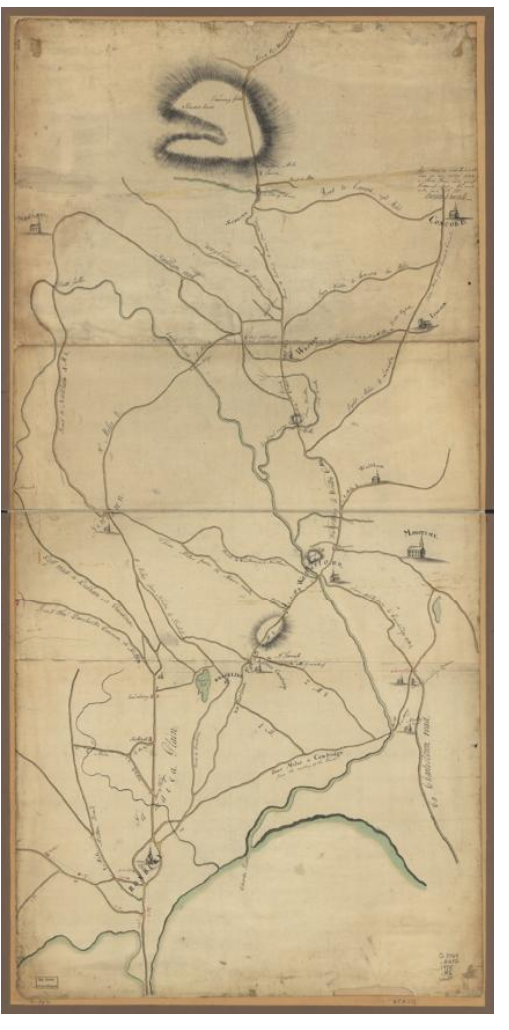
Map, Roxbury to Concord. Roads & distances; by Brown and De Berniere, Library of Congress
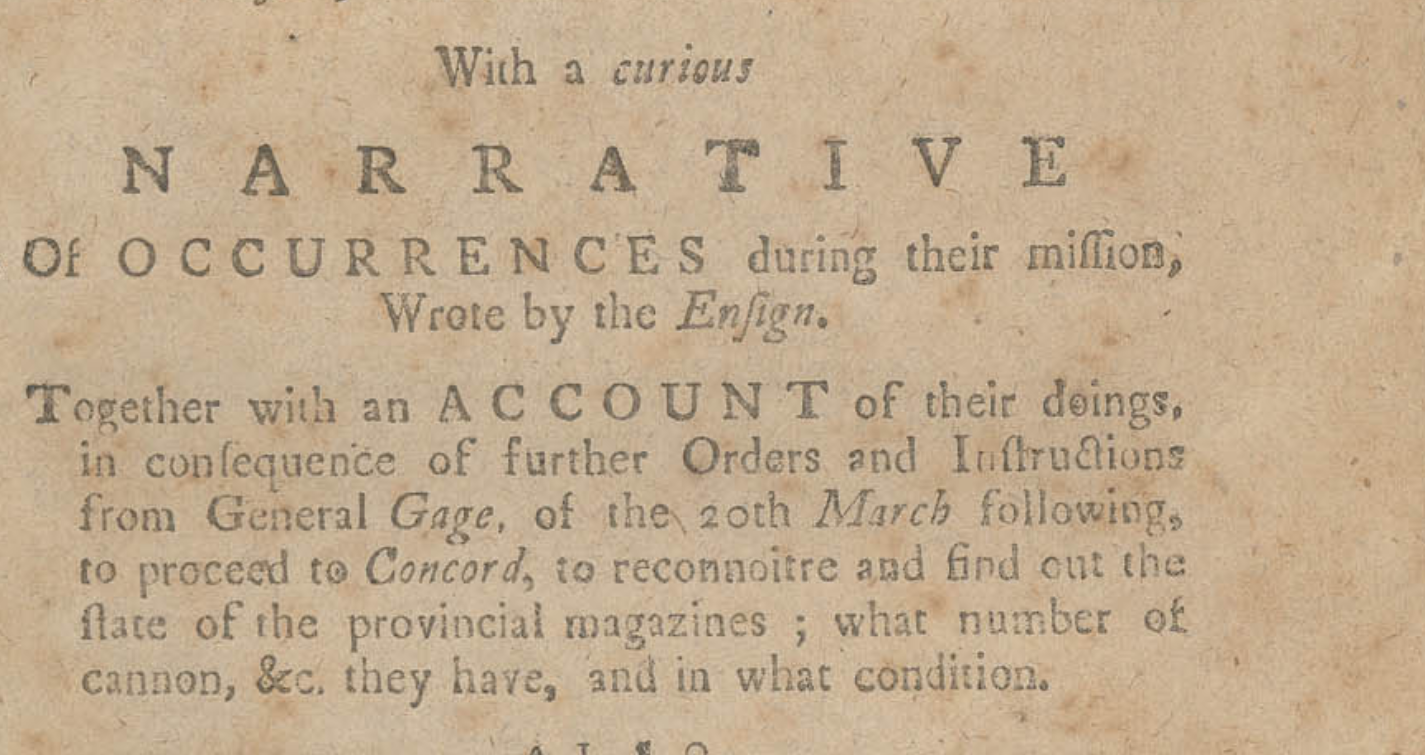
Account of the proceedings of the aforesaid officers, in consequence of further orders and instructions from General Gage, of the 20th March following ; with occurrences during their mission.
Scan of the original print by J. GILL, in Court Street. 1779, Massachusetts Historical Society
THE twentieth of March Captain Brown and myself received orders to set out for Concord, and examine the road and situation of the town ; and also to get what information we could relative to what quantity of artillery and provi- sions. We went through Roxbury and Brookline, and came into the main road between the thirteen and four- teen mile-stones in the township of Weston ; we went through part of the pass at the eleven mile-stone, took the Concord road, which is seven miles from the main road. We arrived there without any kind of insult being offered us, the road is high to the right and low to the left, woody in most places, and very close and commanded by hills frequently. The town of Concord lies between hills that command it entirely ; there is a river runs through it, with two bridges over it, in summer it is pretty dry ; the town is large and co- vers a great tract of ground, but the houses are not close together but generally in little groups. We were informed that they had fourteen pieces of cannon (ten
iron and four brass) and two cohorns, they were mounted but in so bad a manner that they could not elevate them more than they were, that is, they were fixed to one elevation ; their iron cannon they kept in a house in town, their brass they had concealed in some place behind the town, in a wood. They had also a store of flour, fish, salt and rice ; and a magazine of powder and cartridges. They fired their morning gun, and mounted a guard of ten men at night. We dined at the house of a Mr. Bliss, a friend to government ; they had sent him word they would not let him go out of town alive that morning ; however, we told him if he would come with us we would take care of him, as we were three and all well armed, — he consented and told us he could shew us another road, called the Lexington road. We set out and crossed the bridge in the town, and of consequence left the town on the contrary side of the river to what we entered it. The road continued very open and good for six miles, the next five a little inclosed, (there is one very bad place in this five miles) the road good to Lexington. You then come to Menotomy, the road still good ; a pond or lake at Menotomy. You then leave Cambridge on your right, and fall into the main road a little below Cambridge, and so to Charlestown ; the road is very good almost all the way.
In the town of Concord, a woman directed us to Mr. Bliss‘s house ; a little after she came in crying, and told us they swore if she did not leave the town, they would tar and feather her for directing Tories in their road.
[Left in town by a British Officer previous to the evacua tion of it by the enemy, and now printed for the information and amusement of the curious.]
BOSTON Printed, and to be sold, by J. GILL, in Court Street. 1779.
Join us this Sunday at 7pm, for this pre-recorded Rev War Revelry where we chat with historian and author Robert Dunkerly about the role that women played in the Southern Campaigns. Most of us know about the story of Molly Pitcher but the women of the Southern Campaigns have been mostly over looked. Grab a drink and listen in as we uncover many untold stories and little known events that show the complexity of the American Revolution. The podcast will run on our Facebook page at 7pm on Sunday, March 16th. Then will be placed on our You Tube and Spotify channels.
Emerging Revolutionary War welcomes back guest historian Eric Olsen. Eric is a historian with the National Park Service at Morristown National Historical Park. Click here for more information about the site.
Years ago, while I was looking at a list of disabled Revolutionary War veterans from Rhode Island I noticed some curious things. The list didn’t provide much information. It just gave the name and age of the veteran, their disability and how they were injured. At first, I was excited because I found a couple of guys who were wounded at the battle of Springfield in June 1780. But then I noticed a number of other men whose information seemed a little odd.
Several men were listed as having lost toes. Those same men had all lost their toes at a place called Oswego. Their wounds had all occurred in February 1783. A couple of the men even had the same unusual name of “Prince.” For me this raised several questions which required more research.
Fort Ontario at Oswego in 1759
Where in the World is Oswego?
It turns out Oswego is a town in New York state on the eastern shore of Lake Ontario where it connects with the Oswego River. The name “Oswego” comes from the Iroquois word meaning “pouring out place” which is appropriate since it is where the Oswego River flows out into Lake Ontario. Heading inland, the Oswego River connects with the Oneida River which flows out of Oneida Lake.
In the 18th century lakes and rivers were the interstate highways of the day. Boats traveling on water could travel faster and carry heavier loads than wagons could on dirt roads. As a result, settlements developed along waterways and forts were built at strategic points where waterways connected.
The British originally established Oswego as a trading post on the northwest side of the mouth of the Oswego River. It was first fortified in 1727 and was known as the Fort of the Six Nations or Fort Oswego. By 1755 Fort Ontario was built on the opposite side of the river to bolster the area’s defenses during the French and Indian War. That fort was destroyed by the French in 1756 and rebuilt by the British in 1759. During the Revolutionary War, the fort was the starting point for St. Leger’s march against Fort Stanwix in 1777. Later the fort was abandoned by the British and destroyed by the Americans in 1778. The British returned and rebuilt the fort in 1782.
“To-morrow an oration is to be delivered by Dr. [Joseph] Warren,” Samuel Adams wrote on March 5, 1775, the fifth anniversary of the infamous Boston Massacre. “It was thought best to have an experienced officer in the political field on this occasion, as we may possibly be attacked in our trenches.”
Around every anniversary of the Boston Massacre, the people of the city and surrounding countryside sat to reflect on the events of that frigid March night and the current situation between themselves and their mother country. Chosen to deliver the 1775 commemorative oration, his second time doing so, was one of Boston’s most prominent physicians and chairman of the committee of safety, Dr. Joseph Warren. Because March 5 fell on a Sunday, the event was held the following day.
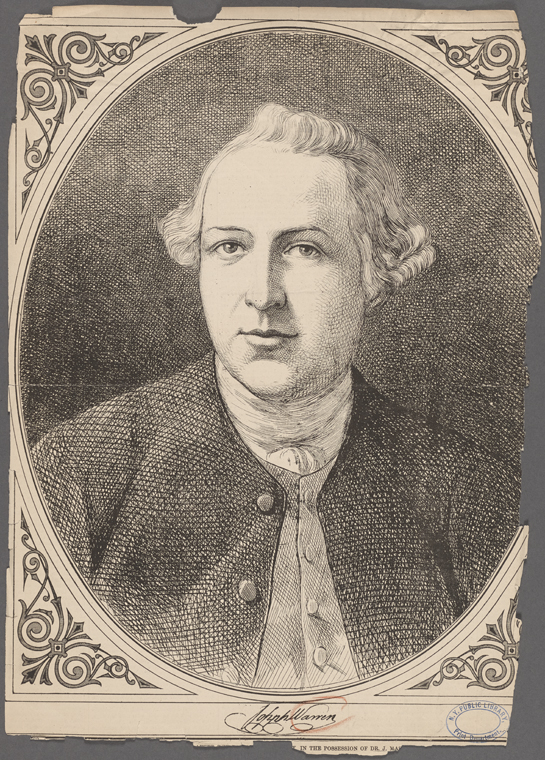
Dr. Joseph Warren. NYPL.
Warren was known to be a passionate and fiery speaker, able to invoke the raw emotion necessary to drive his listeners to action. The political climate surrounding that year’s event was never more incendiary. While no one could have known it at the time, though many anxiously anticipated something coming, the first shots of the Revolutionary War at Lexington and Concord were only a little more than a month in the future. The events on March 6 within the walls of the Old South Meeting House did nothing to ease those anxieties.
Accounts vary on the numbers and makeup of the attendees, but thousands flocked to the commemoration, including a large group of British Army officers garrisoned in the city. The presence of His Majesty’s soldiers was a sure sign that the building would be thick with rigid tension. The sight of the scarlet-coated men seated and standing around the pulpit did not deter the organizers. John Adams showed civility towards the officers, while his cousin Samuel saw an opportunity to enflame sentiments.
Old South Meeting House, Boston, MA. Courtesy of Robert Orrison.
Dr. Warren, 33 years old in March 1775, took the stage garbed in a toga, a symbol of the free men of Rome. His oration only touched upon the events five years prior, but the remainder oozed with patriotic fervor and a call to resist Great Britain’s rule until grievances were met. “I mourn over my bleeding country,” Warren lamented. “With them I weep at her distress, and with them deeply resent the many injuries she has received from the hands of cruel and unreasonable men.” As if a premonition of his own demise in battle at Bunker Hill several months later, he declared, “Our liberty must be preserved. It is far dearer than life.” The speech in its entirety can be read here.
Met with some low hisses and sighs of disapproval from the front rows, Warren’s oration was nonetheless received with emotion and the admiration of his fellow colonists. It was not until he stepped down from the pulpit that pandemonium began to ensue. Samuel Adams rose to appoint a speaker for next year’s commemoration. In doing so he also took the opportunity to reinforce the belief that the events on March 5, 1770 were not an accident, but a “Bloody Massacre.” Even Warren had refused to use this rhetoric. In response, the British officers began to jeer, shouting “Fie! Fie!” and “To Shame!” The already uneasy crowd mistook the shouts as “Fire! Fire!” and many began rushing for the windows, scrambling down the outside gutters and walls. As if this was not enough, the 43rd Regiment of Foot, returning from exercise, happened to be marching by with fife and drum. Their presence threw the crowd “into the utmost consternation,” who may have believed another “bloody massacre” was about to unfold.
Cooler heads prevailed, and any serious confrontation was avoided. Had it not been, one officer attested that it “wou’d in all probability have proved fatal to [John] Hancock, Adams, and Warren, and the rest of those Villains, as they were all up in the Pulpit together.”
March 6, 1775, proved to be another example of the swiftly deteriorating climate in Massachusetts. The influence of the “rebel” leaders continued to grow, while the image of a tyrannical monarch and his blood-thirsty soldiers was reinforced. Open hostilities seemed inevitable. Any day could bring bloodshed. As history exited the Old South Meeting House that day, it continued its accelerated journey down the road from Boston and on to Lexington Green.







 Emerging Revolutionary War Era