On September 14, 1814, United States forces defending Fort McHenry in Baltimore repelled the British attempt to capture the city. Flying defiantly over the brick parapets was a 30 x 42 -foot the following day, clearly seen by the British and one captive American, Francis Scott Key. Over 100 years later the poem Key began writing on September 15 became the national anthem of the United States of America. But, what about the flag that the military commander of Fort McHenry, Major George Armistead had made? Well, this iconic flag became a part of the Armistead family for almost the next century as well.
Now, historian Tom McMillan, who has written on another member of the Armistead family, returns with his latest publication, Our Flag Was Still There: The Star-Spangled Banner that Survived the British and 200 Years–and the Armistead Family Who Saved It. This fascinating read, tracing the flag and its intertwined connection with the Armistead family, will be the subject of this week’s “Rev War Revelry.” McMillan gave a bit of a teaser to entice you to listen in on Emerging Revolutionary War’s Facebook page Sunday at 7 p.m. EDT.
“OUR FLAG WAS STILL THERE details the improbable two-hundred-year journey of the original Star-Spangled Banner — from Fort McHenry in 1814, when Francis Scott Key saw it, to the Smithsonian in the 21st century – thanks to three generations of an enduring military family, the Armistead’s, who defended, kept, hid, and ultimately donated the most famous flag in American history.”
We hope you grab your favorite beverage and tune in. The book is now available for purchase and Tom will have details on how to attain a copy!
We interact with history at a personal level in many ways. We enjoy careers in the field, read, tour locations, work as living historians (or interact with them), dig through archives, trace our roots, visit museums, or simply stumble across some connection in the course of living our daily lives. But, a fortuitous bit of family history struck on a recent weekend, just shy of the 241st anniversary of a battle.
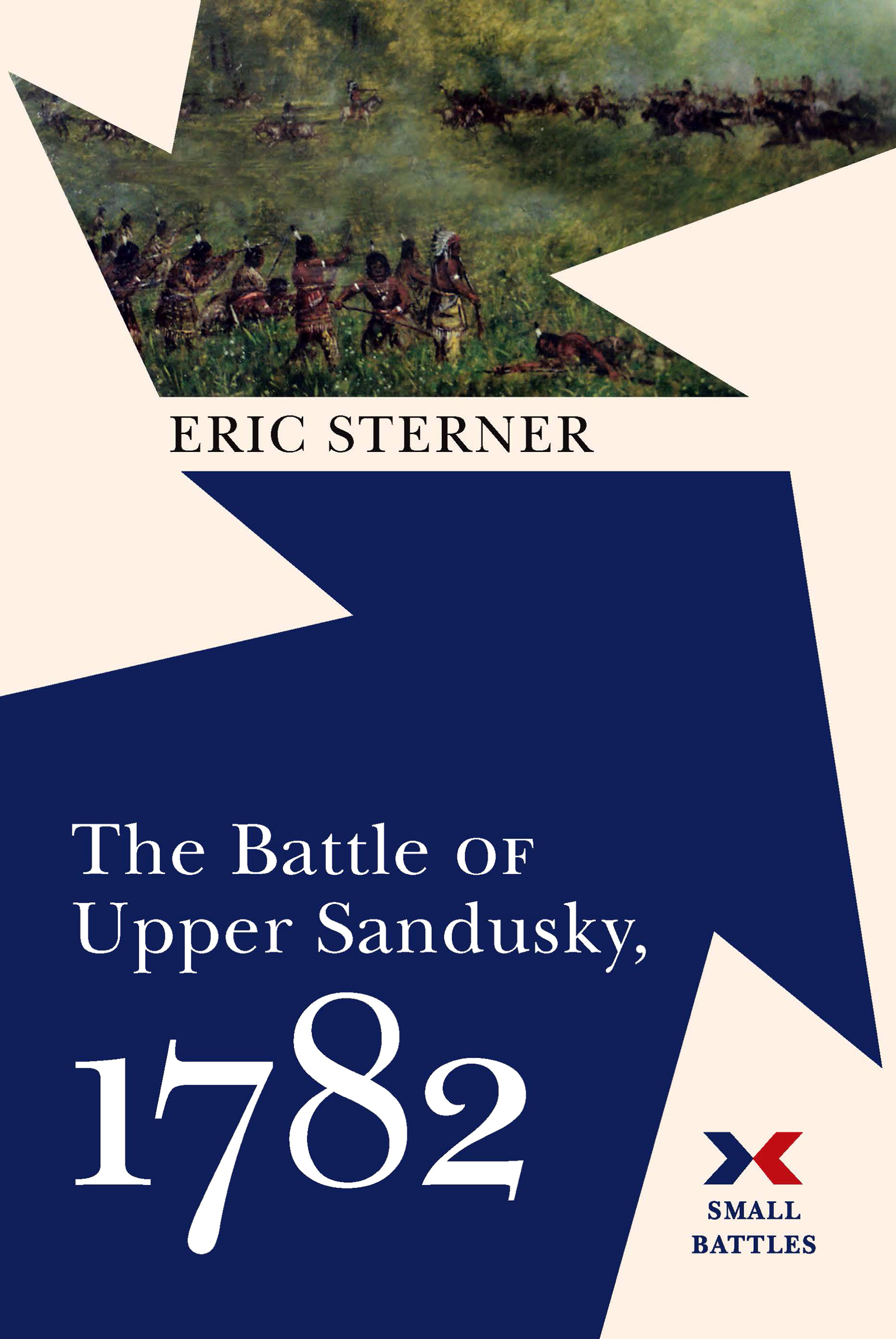
My wife and oldest daughter spent a Sunday morning with my in-laws to visit and record some family stories and memories. They came back with a box of material. The first document they perused was a 19thcentury application for membership in the Daughters of the American Revolution. I was in a different room and suddenly heard yelling as my wife came to find me. I assumed a snake had gotten into the house or we’d won the lottery without playing. It turned out that the DAR applicant, a direct forebear of both my wife and daughter, was descended from Nicholas Dawson, who had fought in the Crawford Campaign, which happened to be the subject of my second book, The Battle of Upper Sandusky, 1782. (Shameless bit of self-promotion: it just went on sale). Talk about coincidence.
Many volunteer actions on the frontier during the American Revolution lacked troop rosters. But, to stimulate volunteering for the Crawford campaign the county lieutenants for Pennsylvania’s Washington and Westmoreland counties offered to count the time on campaign against a volunteer’s legal militia obligations. So, they created rosters, some of which partially survived. The Pennsylvania Archives published that material. Sure enough, Nicholas Dawson shows up as a miscellaneous volunteer, meaning only that the roster didn’t include his company assignment. The ever-helpful Fold3 database also holds pension debt certificates issued to Dawson on January 18and 20, 1785.
Lieutenant General Henry Clinton, New York Public Library
With the Charleston in British hands, Clinton believed that all he had to do was establish outposts in South Carolina stationed with British regulars. This be believed would put down what was left of the rebellion in the state. These posts assisted the recruitment and training of the thousands of Loyalist troops he believed would now rally around the King’s Colors. To take the best advantage of his Regular troops, Clinton determined to establish three major outposts in the South Carolina backcountry. Clinton established these posts at Augusta (Georgia), Ninety-Six, and Camden. While these posts were to be centers for the British army, the local Loyalist militias were to serve as the pacification forces in South Carolina while the main British force was freed up for larger strategic goals.
To recruit, enlist, and train the large, expected influx of Loyalist militia, Clinton named Maj. Patrick Ferguson as Inspector of Militia. Ferguson was ordered to enlist younger men, preferably unmarried, into companies that would form battalions. He was instructed to recruit from Georgia to North Carolina and offer short enlistments if necessary. Clinton believed that having the colonists maintain their own law and order (via Great Britain’s authority) would cause less apprehension with those that were mostly undecided about to whom they should throw their support, the Patriots or the British.
By mid-May, the British army set out for their destinations in the back country. Clinton’s second in command, Lieut. Gen. Charles Lord Cornwallis, marched to Camden while Ferguson moved to Ninety-Six. Without much resistance, Clinton’s plan to conquer South Carolina was working perfectly. Patriot leaders scrambled to find ways to organize their resistance. The only organized Continental force remaining in South Carolina was a small force of Virginians under Col. Abraham Buford that was on its way to Charleston when the city surrendered. Ordered by Brig. Gen Isaac Huger to reverse course and make his way north toward Hillsborough, North Carolina. There along with the North Carolina militia, he could be the core of American defense in North Carolina.
On May 27, Cornwallis ordered Lieut. Col. Banastre Tarleton with 300 of his dragoons and mounted infantry in pursuit of Buford. Tarleton’s British Legion was mostly composed of Loyalist recruits, so many in his force were from America. Tarleton pushed him men and horses hard, many horses falling out along the way. Buford was aware of a possible British pursuit but underestimated the speed in which Tarleton closed the gap. On May 29, Tarleton caught up with Buford in a region near the South and North Carolina border called the “Waxhaws.”
Lieutenant Colonel Banastre Tarleton, New York Public Library
The events that took place next are still debated today. Tarleton under a flag of truce tried to get Buford to surrender. Writing to Buford, Tarleton wrote “Resistance being vain, to prevent the effusion of human blood, I make offers which can never be repeated.” Tarleton was already creating an image of himself as an aggressive and brutal fighter. Buford, however, refused, replying, “I reject your proposals, and shall defend myself to the last extremity.” With that, Buford continued his march north towards North Carolina as did Tarleton’s pursuit. Around 3:00 p.m. the lead elements of Tarleton’s force wiped out Buford’s small rearguard, forcing Buford to stop and deal with Tarleton.
Buford decided to create a single battle line east of the Rocky River Road. Tarleton, ever the aggressive commander, ordered his horsemen to charge the Virginians. Here, Buford made what would be a devastating blunder. He ordered his men to not fire until the British cavalry was within ten yards of the American line. This would not allow the Americans a chance to fire another volley before the British charge was upon them. The Virginians fired, taking out some of the British dragoons and horses (Tarleton himself became briefly trapped under his horse), but most charged through Buford’s line, wielding their sabers and cutting down the Virginians. Total chaos ensued, and many of Buford’s men attempted to flee. Some tried to surrender by throwing their arms to the ground, but American accounts state that the British were offering “no quarter” and killing everyone that tried to surrender. Other accounts report that Buford sent a white flag to Tarleton, but probably because he was injured, it was never received, and the fighting continued. Accounts differ widely between the Americans and British on the fighting, but the fact cannot be argued that Buford’s command was destroyed.
Waxhaws Grave and Monument, photo and flags courtesy of the author
American casualties were estimated at 350, 113 men killed, 147 wounded, 50 captured, and 2 six-pound artillery pieces and 26 wagons captured. Buford himself was able to escape the field. Tarleton only suffered 5 killed and 12 wounded, a complete victory. What has become known as “Buford’s Massacre” was not referred to as a massacre at all in many period accounts. Tarleton himself blamed the “slaughter” on the fact that his men thought he was killed in the battle and sought revenge. The disparity in numbers and the reports of indiscriminate British slaughter of Americans led to the creation of “Tarleton’s Quarter.” Patriot leaders quickly pounced on this and began to spread stories about Tarleton’s brutal tactics. This proved to be a public relations coup for the Patriot cause, as it energized their side and led to a more robust recruitment of militia and partisan forces to take on the British who now faced no organized opposition in South Carolina or Georgia.
Stay Tuned for the Emerging Revolutionary War Series newest book releases “To the Last Extremity: The Battles for Charleston, 1776-1782” by Mark Maloy and “All That Can Be Expected: The Battle of Camden and the British High Tide in the South, August 16, 1780” by Rob Orrison and Mark Wilcox to learn more abou the 1780 Southern Campaign. Both releases are published by Savas Beatie Publshing: https://www.savasbeatie.com/american-revolution/
Thomas Paine wrote the line used as the title for this post in his pamphlet titled “American Crisis” in 1776. Most people recognize the opening lines that Paine penned in that same essay.
“These are the times that try men’s souls: The summer soldier and the sunshine patriot will, in this crisis, shrink from the service of their country; but he that stands it now, deserves the love and thanks of man and woman.”
However, on this Memorial Day, while reading through his essay, I was struck by the line I used for the title. Furthermore, by the far too numerous men who served in the militia and Continental service that lay in unknown or unmarked graves throughout the eastern United States. To them that gave the ultimate sacrifice in pursuit of the principles they held most dear, we remember on this day. To them and the thousands that came after and paid with their lives so others can have “life, liberty, and the pursuit of happiness” we also remember today on this Memorial Day.
One of the main objectives of Emerging Revolutionary War is to visit the sites attributed to the American Revolutionary War era and to provoke interest and expand learning on the people, places, and history. That includes remembering those that lay in these unmarked graves “known only to God.”
The Battle of Waxhaws, fought on May 29, 1780, was a lopsided British victory by Lieutenant Colonel Banastre Tarleton’s British cavalry over American Colonel Abraham Buford’s Continental forces in Waxhaws South Carolina. Buford lost 316 of 350 men with the British losing less than 20. Known popularly as “Buford’s Massacre,” Continental leaders used the battle as a propaganda tool against the Crown forces in the south. But, was it really a massacre?
Join us as we welcome historian and author Dr. Jim Piecuch as we discuss his research and theory about the Battle of Waxhaws and its aftermath. Dr. Piecuch has written several books on the Southern Campaign of the American Revolution including his book “Blood Be Upon Your Head: Tarleton and the Myth of Buford’s Massacre.” This Rev War Revelry will be pre-recorded and posted on May 28th at 7pm. Grab a drink and a good seat and enjoy this great presentation on one of the most controversial battles of the American Revolution.
The Mary Ball Washington Monument and grave site, Fredericksburg, VA
Happy Mother’s Day to all the moms out there! In honor of Mother’s Day, Emerging Revolutionary War welcomes will be welcoming historians and staff from the Washington Heritage Museums to tonight’s Rev War Revelry. WHM manages and operates the home and grave site of Mary Ball Washington, the mother of George Washington located in Fredericksburg, VA.
The relationship between George Washington and his mother has been of interest in historians. Their relationship was complicated and much debated by Washington contemporaries and historians today. Mary never remarried when her husband passed (rare for the time period) and mostly lived on her own in Fredericksburg. She also was not afraid to complain about her lack of resources and once applying to the Virginia General Assembly for financial support (to much frustration from George Washington). We will cover many of the myths and interpretations of Mary and her relationship with her son.
So grab a drink and join us as we discuss Mary Ball Washington, her relationship with her son George and what the Washington Heritage Museums are doing today to interpret and preserve her story. Our revelry tonight is previously recorded so we could spend time with the mom’s in our life, but as always we will respond to any comments and questions posted.
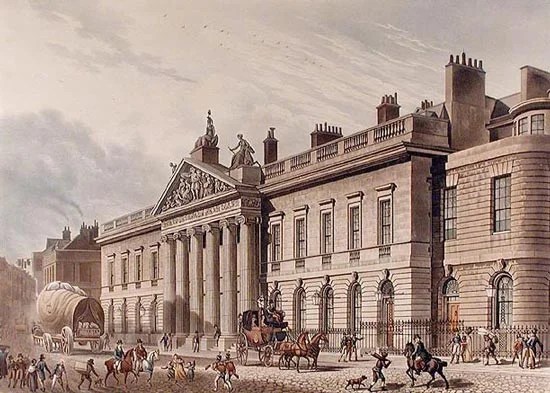
May 10, 2023 marks the 250th anniversary of the passing of the infamous Tea Act. Though a seemingly innocuous Parliamentary action, it had dire impacts in the British North American colonies. Parliament was known to enact various laws to provide guidance and management of her colonies across the globe. Some like the Stamp Act led to direct protest and eventual repeal. But the Tea Act was something totally different. It focused on the North American colonies and was meant to benefit a single entity, the East India Company. These two variables, plus the on going strife in North America over British influence led to various protests in the American colonies. This ultimately resulted in the Boston Tea Party on December 16, 1773 (and other lesser known “tea parties” in Charleston, Philadelphia and other port cities).
East India House in London, ca 1800
The East India Company was a joint stock company founded in 1600 and became one of the largest companies in the world. Tea was not their only commodity, however as they also traded spices, sugar, indigo, silk and much more. Parliament was heavily vested in the company’s success and began to enact laws that benefited the company. This included the Tea Act of 1773, passed to help the company divest itself of an over abundance of tea stored in its warehouses. The Crown and Parliament was worried that the prices of tea and the large supply would lead to serious financial strain on the company. The Tea Act also aimed to clamp down on the massive amounts of “illegal” tea that was being smuggled into the colonies. Some historians argued that men like John Hancock, who was deeply involved in smuggling, saw the Tea Act as his “rubicon” towards independence. He believed the act would impact his revenues via his smuggling. Now the American colonies were forced to purchase East India Company Tea (that could directly ship to the colonies) and which was taxed. Many colonial leaders saw this is as a backwards way to impose a tax without their consent and to force them to prop up a struggling East India Company
The road to revolution in the American colonies does not have a single starting point, but one could argue that 250 years ago the Tea Act was the last straw. It led to direct and open opposition (and destruction) of British rule and property in several ports along the Atlantic. These brazen “parties”, mainly the Boston Tea Party, led Parliament to pass the Coercive (Intolerable) Acts, which in turn united the various colonies like never before. Open armed conflict with Great Britain was just a year away.
Tell me I am not the only one that randomly goes on a car ride to a random town in their home state to just “see what is there?”
Regardless, that is what I decided to do on a sunny late April Sunday afternoon. I ended up in Rockville, Maryland. The town astride I-270 today was also on a major thoroughfare during both the 18th and 19th centuries that brought armies from the area, like General Edward Braddock’s in 1755 or General Jubal Early’s in 1864.
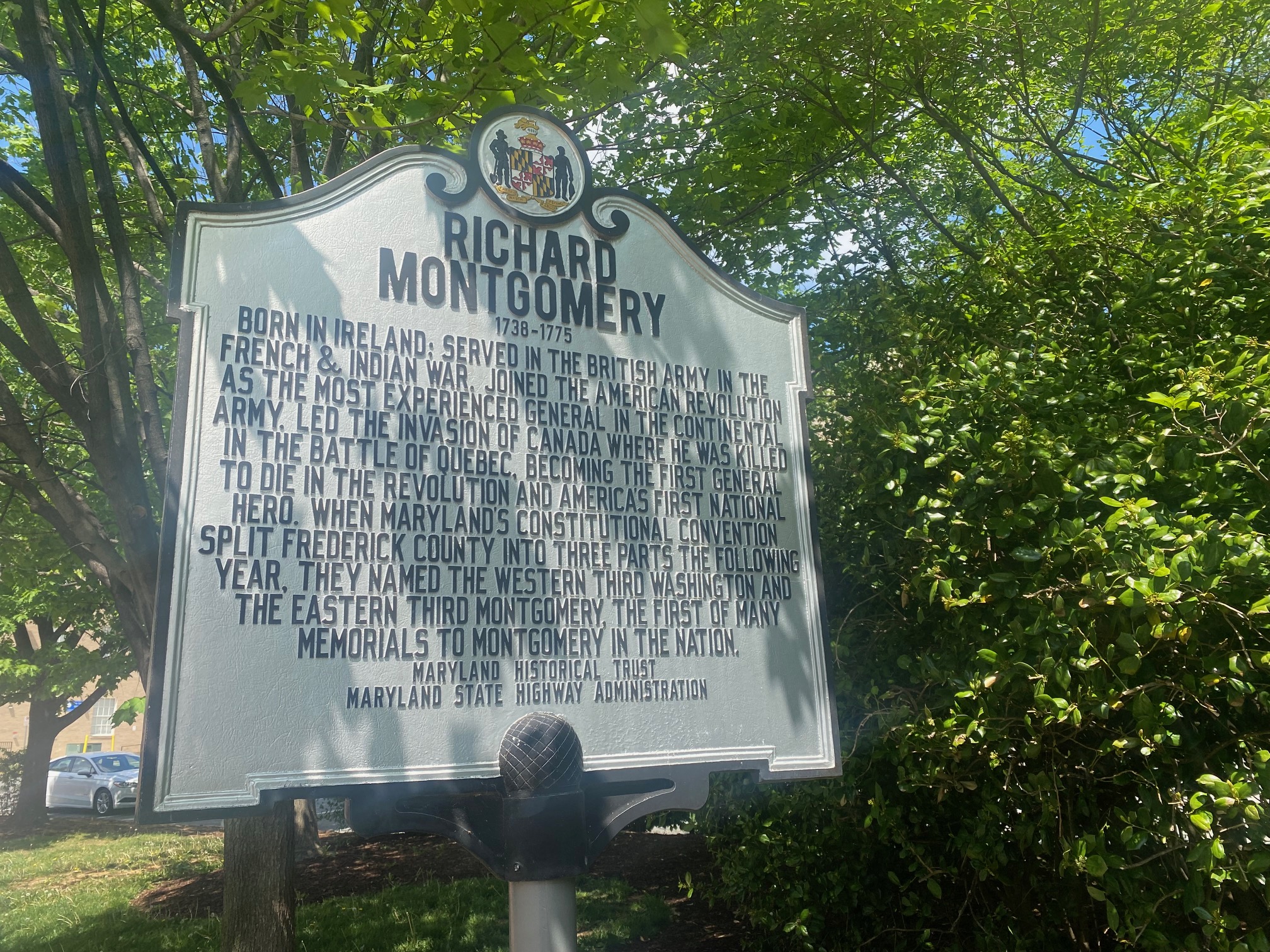
However, a different historical sign attracted my attention on this excursion.
I read the title and the first line, Richard Montgomery…Born in Ireland. Served..” Which was all I could read as I slowly drove by, since it is near the court house and county government buildings. Even though it was a Sunday still not wanting to speed through. So…Naturally, I pulled over, as evidenced by the vehicle you see in the background!
I knew Montgomery, as the sign reads, died at the Battle of Quebec in a futile attempt to take the city for the American cause. He was the first general–Continental–to die in the cause of American independence.
On September 6, 1776 Thomas Sprigg Wootton, who hailed from Rockville, introduced legislation in the Maryland Constitutional Convention to separate the Frederick County into three. The upper or most western half, to become Washington County, named in honor of George Washington and the lower half, or most eastern, to be named Montgomery, in honor of Richard Montgomery. The remaining middle portion would retain the name Frederick. This may be the first recorded instance in the rebellious British colonies of names of counties, towns, or cities that did not refer to something in British history or famous persons. Another act of defiance at the beginning of the American Revolution!
With a random Sunday excursion one never knows what one will find. History is all around us, beckoning to be explored.
Emerging Revolutionary War thanks historian Christian Di Spignafor the picture.
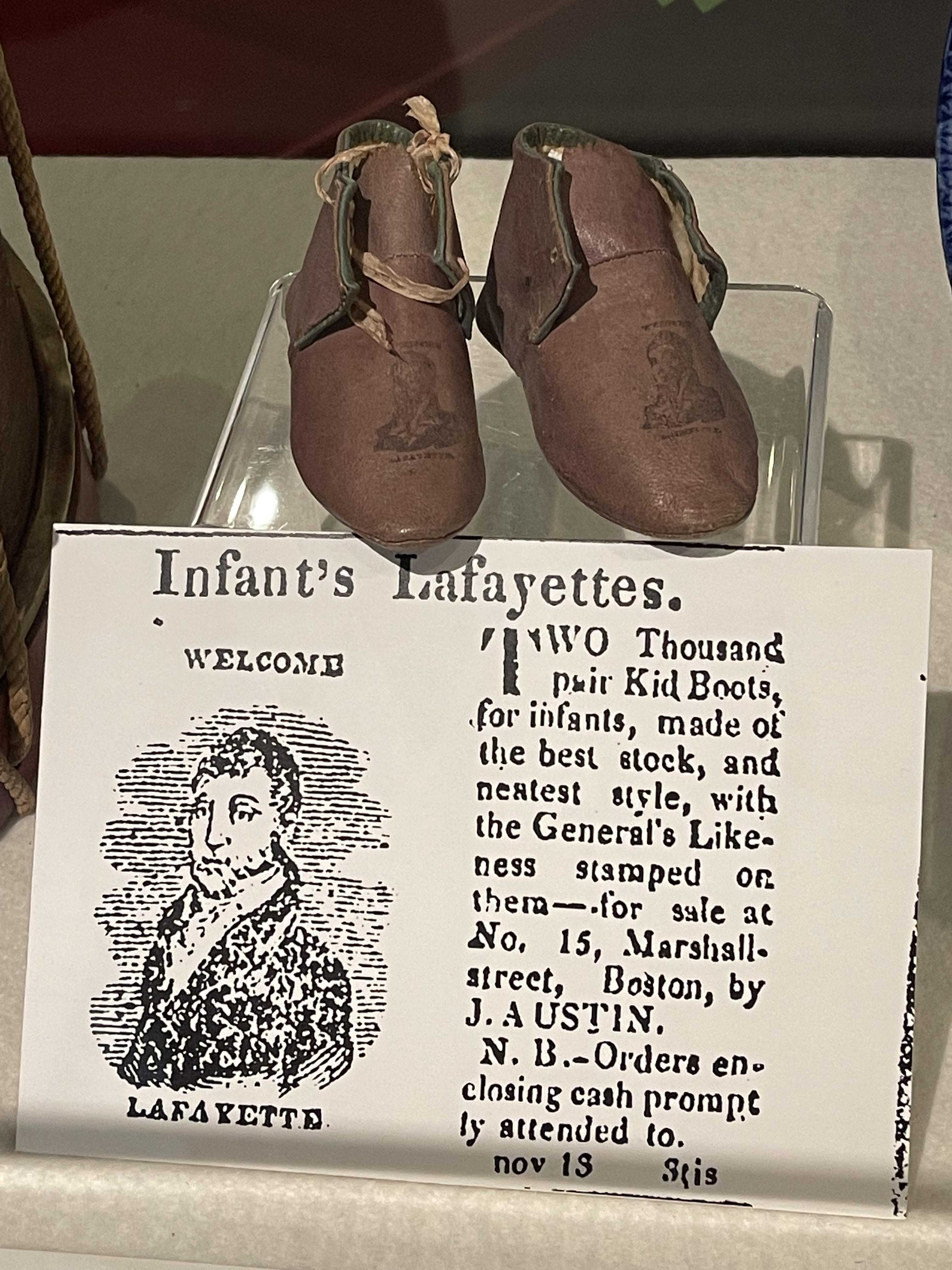
With the release of the motion picture, Air, about the recruitment to Nike of Michael Jordan in the 1980s, Emerging Revolutionary War wanted to bring our readers attention to an older model of a shoe. That predates Nike by a century and a half. But, who knows, could come into vogue again right?
The Marquis de Lafayette returned to the United States in August 1824 to September 1825 and toured all 24 states at the time. Feted as a living link to the American Revolution and the independence movement, he was dined, celebrated, and asked to speak at many, many events. Commemorative items were created in his image and likeness, including, apparently a pair of shoes.
These shoes can be viewed today at Old Sturbridge Village in Massachusetts. A link to their website and to plan a visit can be found here.
This Sunday, join Emerging Revolutionary War as we explore the prelude to Fort McHenry and the actions in Maryland and Washington D.C. in the summer of 1814. Joining Emerging Revolutionary War will be the American Battlefield Trust’s Senior Education Manager, Dan Davis.
This historian happy hour will discuss the first part of the campaign that eventually led to the climactic Battle of Baltimore, which included both the unsuccessful British attempts at Fort McHenry and North Point. Before that success for American arms, the United States suffered through the defeat at Bladensburg and the capture of the nation’s capital.
We hope you can join us on our Facebook page, on Sunday, April 30th at 7 p.m. EDT .







 Emerging Revolutionary War Era