Slathered on hamburgers across the United States of America. Added to coleslaw recipes. In Germany used to dip pomme frites, French fries into. This condiment or sauce is well-known throughout a large percentage of the globe. However, did you know that this white sauce has a tie to the French and Indian or Seven Years War?
Recently I was reading a book, Gibraltar: The Greatest Siege in British History by Roy and Lesley Adkins. When discussing some of the history leading up to the siege of Gibraltar from 1779-1783, the authors referenced an earlier siege, unrelated to Gibraltar actually, and had a note about the creation of mayonnaise.
Like any good historian, I decided to investigate the founding of this sauce that is used so predominantly in America. Below is what I found.
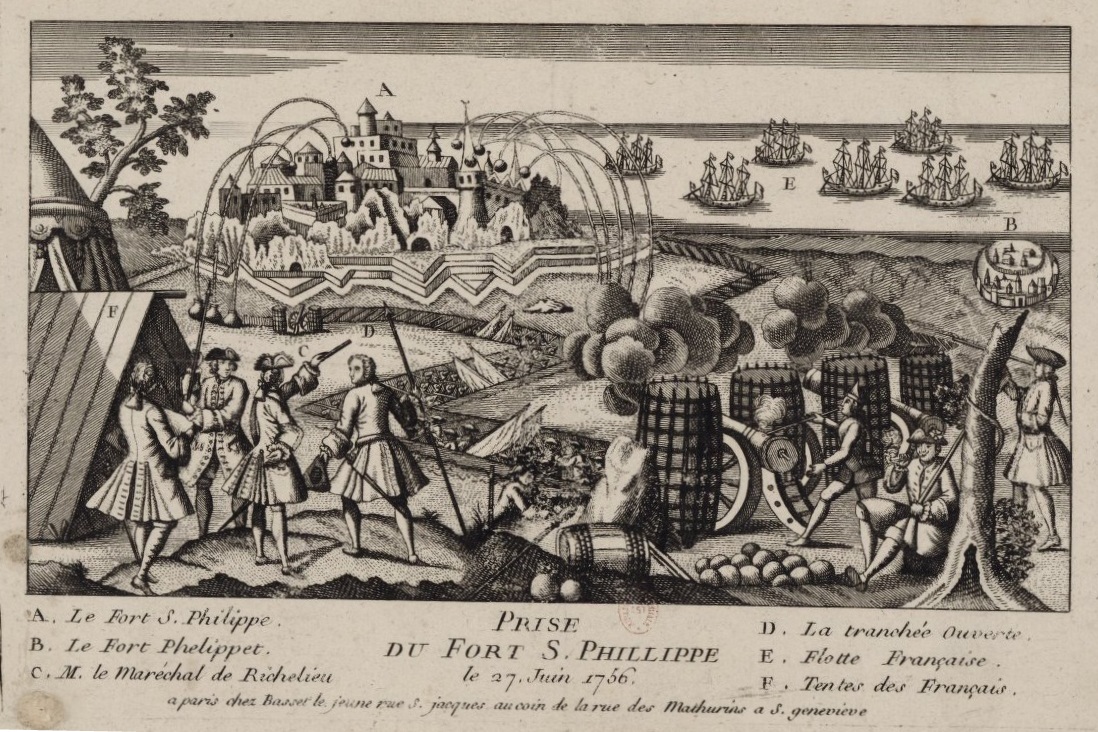
Created for a victory celebration after the French’s successful defeat of the British on the island of Minorca, also spelled Menorca which is the Catalan spelling. The siege and battle had lasted 70 days, from April 20 to June 29, 1756 and had cost the French approximately 3-4,000 casualties. The British loss around 400 men and one of the strategic defenses and the Mediterranean Sea. The French remained in control of the island until the end of the Seven Years’ War. The island recaptured by the Br was returned to the British at the end of the war, trading the island of Guadeloupe for it as part of the peace treaty signed in Paris.
Yet, after the British surrendered Fort St. Philip, in 1756, which protected the town and seaport of Mahon a large victory banquet was held. The French leader, the Duke de Richelieu instructed his chef to to create a feast that would honor the great victory. The island lacked the cream needed for the sauce the chef wanted to make so he invented the egg and oil dressing.
He named the concoction Mahon-aise, after the town he created the sauce in.
Hope you are reading this around lunchtime!
P.S. The author realizes that a few other accounts exist about the creation of the this sauce. Including that the chef of the French duke was told about the sauce by the inhabitants of the island who had already created it.
As 2022 winds down, Emerging Revolutionary War wanted to share one more round-up of what our good friends at Americana Corner were doing in this last month of the year. We hope to continue to partner with Americana Corner in the 2023 and bring new content and new enthusiasm for this critical period in American history to the forefront. To all our readers, thank you and we all at Emerging Revolutionary War hope you have a great ending to 2022 and a Happy New Year!
A few blog posts for light reading as you wind down December…
Washington Takes Command December 27, 2022
When it came to finding the right man to command the new Continental Army assembled around Boston, George Washington was the logical choice. John Adams quickly nominated Washington and Congress unanimously approved. As Adams stated, “This appointment will have a great effect in cementing and securing the Union of these colonies.”
George Washington Enters Politics December 20, 2022
As befitting a wealthy landowner in colonial Virginia, George Washington became active in the colony’s politics in the 1750s. He first ran for a seat representing Frederick County in the Virginia House of Burgesses in 1755 but lost the election. Interestingly, it was the only political race he would ever lose. Washington ran for that same seat in 1758 and was victorious, and he held this seat for seven years.
Martha Washington was our nation’s first First Lady and lived in the shadow of her larger-than-life husband George. However, most Americans do not realize that she was a very capable woman and, when given the opportunity, managed her own affairs quite well.
George Washington’s Life at Mount Vernon December 6, 2022
When George Washington resigned as Colonel and Commander of the Virginia Regiment in 1758, he returned to Mount Vernon to begin his life as a gentleman planter. Although in less than twenty years Washington would be called away by his country, his time between the French and Indian War and the American Revolution was a significant portion of this great man’s life.
As we prepare to celebrate the Holiday season, we want to thank everyone who has followed us this past year. We had a very successful year with nearly 30 Rev War Revelries, our Third Annual Rev War Symposium, two books published, various blog posts and a very successful bus tour to Valley Forge and Monmouth.
2023 will be another very busy year for us. We will have two more books released in our book series (Battles for Charleston by Mark Maloy and Battle of Camden by Mark Wilcox and Rob Orrison). We will continue our Rev War Revelry every other Sunday (check our Facebook page for our line up) and our Third Annual Bus Tour will take place on Nov 10-12, 2023 in Charleston, SC. Also, stay tuned for some very exciting news about our annual Revolutionary War Symposium (hint, a change of venue and location!) and we will continue our partnership with Historic Alexandria on a new 18th century style tavern program.
We will not have a Rev War Revelry this Sunday, but we will be resharing our video from last year of ERW historian Mark Maloy narrating the movie The Crossing to honor the anniversary of the Battle of Trenton. We will be back live on January 8, 2023 with historian Andrew Outten, Historical Programs Manager for the American Revolution Institute of the Society of the Cincinnati who will discuss his research on British cartographer William Faden’s maps of the Battle of Brandywine. In the meantime, check out our You Tube Channel to catch all of our nearly 200 videos and our podcast channel as well (every Rev War Revelry now is a podcast). We look forward to seeing you then and we hope Santa brings you history books!
Beginning on December 8, 1777, General George Washington and his Continental army left the environs of White Marsh to begin the movement toward their winter encampment. The rank-and-file crossed over the Schuylkill River and headed westward. Within three days the soldiers had trudged into an area called the Gulph on a December Thursday morning.
During this sojourn Washington wrote a a flurry of orders and letters, finally selecting Valley Forge. His reasoning was explained in the general orders for that day while also observing another delay in order to honor a day of fasting and thanksgiving decreed by the Continental Congress. Washington began that general order on December 17, 1777 by acknowledging the thousands of men that were braving the weather, lack of sustenance, and the rigors of the 1777 campaigning season.
“The Commander-in-Chief with the highest satisfaction expresses his thanks to the officers and soldiers for the fortitude and patience with which they have sustained the fatigues of the Campaign. Altho’ in some instances we unfortunately failed, yet upon the whole Heaven hath smiled on our Arms and crowned them with signal success; and we may upon the best grounds conclude, that by a spirited continuance of the measures necessary for our defence we shall finally obtain the end of our Warfare, Independence, Liberty and Peace.“
The march resumed around 10 a.m. on December 19, a Friday, as the Continental army trudged out of the Gulph Mills area and on to their final destination for 1777; Valley Forge. The army would soon spread out to occupy over 7,800 acres of Pennsylvania countryside and spend the next six months resting, recuperating, surviving, and training.
To read more about the end of the 1777 campaign and the winter spent at Valley Forge, check out the book, by yours truly, Winter that Won the War, part of the Emerging Revolutionary War Series, published by Savas Beatie, LLC.
During the War for Independence, Fort Ticonderoga’s guns, sited critically between Lakes Champlain and George, dominated north-south communications in upstate New York that were vital to both the British and American war efforts. In the public mind Ticonderoga was the “American Gibraltar” or the “Key to the Continent,” and patriots considered holding the fort essential to the success of the Revolutionary cause. Join us for this Sunday at 7 p.m. for the latest installment of our Rev War Revelry series as we welcome back award-winning historian, Dr. Mark Edward Lender, to discuss his newest book and the importance of Fort Ticonderoga in the oft-forgotten latter years of the Revolutionary War in Upstate New York.
The discussion will be held via Facebook Live on our page, https://www.facebook.com/emergingrevwar, and will be available afterwards on YouTube and Spotify.
Emerging Revolutionary War welcomes this guest submission by historian Werther Young, aka Elmer Woodard
Not THAT Lee. And not at Stratford Hall, Leesylvani, nor Shirley plantations. No rustle of silk, silver platters from the kitchen, obsequious servants bowing and scraping, no twitter of conversation, nor the tinkling of crystal. Our repast was much less spectacular. In his Memoirs, Henry “Light Horse Harry” Lee told of a dining experience during the Race to the Dan on or about February 11, 1781. We tried to recreate that meal.
Lee’s Legion had been assigned By Maj. Gen. Nathanael Greene to Col. Otho William’s Light Division, which had in turn been tasked with luring the British away from Greene’s main army on its retreat to Boyd’s Ferry (now South Boston, Virginia). Williams apparently roused his men at 3 a.m. at Guilford Courthouse (modern Greensboro, N.C.), drew rations, and marched north to collect his Delaware company at an outpost near Brice’s Crossroads (now Summerfield, North Carolina). He then marched northeast on the road to Dix’s Ferry (now US Rt. 158 towards Reidsville, North Carolina and Danville, Virginia) as far as Rodes’ House, six miles almost due north of Guilford Courthouse, and four miles northeast of Brice’s Crossroads. With Lee’s cavalry rearguard at Rodes’ House, Williams’ infantry was probably spread out along the present Scalesville Road northeast towards Troublesome Iron Works and modern Reidsville. A Lt. Harrington commanded cavalry patrols southeast towards Salem, North Carolina on the Scalesville Road, the direction of the last reported location of the British. In the cool and drizzly morning, everything was quiet, so quiet that Williams’ men had started the slow process of cooking their rations.
The latest intelligence put the British somewhere towards Salem (present Winston-Salem, North Carolina), some twenty-four miles away. Unfortunately, that information was stale. The British had marched early, passing through Dobson’s Crossroads (present day Kernersville, North Carolina) and by early morning were near present Oak Ridge, North Carolina just nine miles away from Rodes’ House and coming on hard, while Williams and his men were enjoying a “comfortable meal.”
On paper, Revolutionary War infantry regiments were made up of companies of fifty men each. Generally, cavalrymen counted each horse as a man, so their “company” was only about twenty-five men, and was called a “troop.” For ration purposes, each company/troop was further divided into subgroups of five or six men each, called a “mess.” In practice, a company could be anywhere from fifteen to seventy men, but let us stay with a typical size of fifty. By 1781 in North Carolina, with many, many exceptions, army rations were essentially a pound of protein and a pound of carbohydrate per day, roughly four Quarter Pounder hamburgers per day.
“Protein” in the 1781 south was meat, usually pork, fresh or salted. Carbohydrate was usually ground corn, and was packaged from the mill in barrels of about 200 pounds. Rations were usually issued in three day lots to the company, although six day lots were not unheard of. Indeed, the British 1768 warrant specified that the men’s haversacks were to be large enough for six days’ rations. Williams’ “Light” Division was ‘Light’ because it did not contain wagons, so the men had to carry everything, including rations, themselves. Stopping to distribute rations would certainly lose the Race to the Dan, so the men were probably issued six days rations (two pounds per man per day, or twelve pounds per man) beforehand.[1] Our theoretical fifty-man company would receive about 600 pounds of food for six days; the horsemen about the same because they had to feed the horse. One whole (500 man) regiment would receive about 3,000 pounds of food. Williams had about a regiment and a half, so his six days’ ration weight would approach 5,000 pounds.
Rations were issued raw, and it was the messes’ responsibility to cook them. One of the most essential pieces of equipment was therefore something to cook them in. This item was so important that four iron kettles were among of the few items specifically mentioned by the Williamsburg Public Store on the very day it opened, October 12, 1775.[2] Kettles were sometimes cast iron, like a witch’s cauldron, but most often were sheet iron with soldered joints, holding about four gallons. Many were made in Fredericksburg, Virginia. Each mess received one kettle, which someone in the mess had to carry where ever they went.[3]
By 11 a.m. or so, somewhat delayed by the difficulties of igniting wet wood, Williams’ Light Division was happily cooking their rations. Lee described the fare as “the meat was on the coals and the corn cakes in the ashes.”[4] Apparently, it also was pretty far along in the process, as Lee referred to having had (past tense) a “comfortable meal” at that time. For one five-man infantry mess with six days’ rations, this meant that they were boiling thirty pounds of meat and making thirty pounds of corn cakes per man.
Earlier this year my son Patrick and I decided to try some applied archaeology and figure out just how the corn and pork ration system in the 1781 south worked. We had found a first-person account from an Overmountain man who went through the Smoky Mountains from Sycamore Shoals (now Elizabethton, Tennessee) to King’s Mountain, North Carolina in ten days on twenty pounds of “parched corn,” about two pounds per day. While we had heard of parched corn, no one really knew what it was, because no one eats it anymore. Additional research showed that it’s just corn meal that has been browned over heat. It was usually mixed half and half with a sweetener of some sort. So, we browned some corn and mixed it with table sugar. It tastes like sweet cornmeal-flavored sand. We tried to make parched corn molasses bars, but this degenerated into a sticky mess, and we were … requested … to absent ourselves from the kitchen, permanently ending that part of that experiment.
The next project would be to figure out how Colonel Lee and his men prepared their February repast. Having thirty years’ experience as a Civil War reenactor with the 44th Virginia and 5th New York Zouaves, I knew that cooking meat on coals in a hurry results most of the time in semi-raw, inedible meat, and corn cakes made in the ashes are just gritty yellow discs that taste like burned dirt. Given that Lee’s Legion moved about sixty miles in five days, they weren’t eating raw meat and burned dirt.
Happily, I have a four-gallon mess kettle, and so the experiment began. As it turned out, a friend had recently killed his wife’s pet hog, and he generously donated ten pounds of frozen pork. In 1781, pork was either on the hoof or salted, the only way of preserving it at the time. Since Mr. Hogg was no longer on the hoof, our friend salted it. Finding a watertight oak barrel difficult to come by, he dry-salted it in a food safe plastic bucket, with a layer of pickling salt, then a layer of meat, and so on until the bucket was full, with the top layer being salt. It then sat for several months, during which time we turned to the carbohydrate issue.
Corn meal is a much more complex article than one would imagine. Back then in the South it was not just a staple, but THE staple. Farmers planted corn, which generated about twenty-six bushels (approximately 1500 pounds) per acre. When harvested in the fall, the stalk was cut and then a dozen or so stalks tied together and set upright into a “shock” to dry. Once dried, the ears went into the corn crib and the stalks fed the animals. Periodically the farmer removed the kernels from the cobs, placed them in a log bucket or a cloth bag, and took them to the mill to be ground. The miller ground the corn, taking a percentage, and returned the rest to the farmer. This would last a family of four for about two months before it became musty, at which time the farmer would shuck more corn and go back to the miller.
The mill was water powered and contained two mill stones which ground the corn kernels into meal. Nowadays, most “corn meal” is for baked corn bread, and is superfine, almost like powdered sugar. Back then, this was almost unheard of. The finer the grind, the higher the miller’s toll (grinding fee), so the grinds were usually much coarser. Fine meal, meal, and grits were what humans generally ate. One coarseness level below grits was “Indian grind,” which only Indians would buy, because it was the cheapest grind but still fit for humans, rather than animals. Soldiers received it, too. We managed to find a local mill that was happy to make us some Indian grind but we had to buy fifty pounds of it. Ten bucks later, we had a about eight gallons of Indian grind.
We were not too thrilled about eating burned, dirt flavored disks, so we decided not to make ash cakes. A bit of research revealed that non-ash corn cakes were often made on a flat rock, or even a shovel blade. We decided to use a spade blade with the edges bent up. Spades these days are surprisingly expensive, but a case of beer delivered to a pal at the local machine shop soon had us a brand-new steel spade blade with turned up edges and an integral handle, just as shown in the Collectors Encyclopedia.[5]
Rummaging through the pile of rarely-used reenacting gear produced a foot long “flesh” fork for manipulating the chunks of pork, a small kettle to mix in, a ladle, and a spatula for flipping, although these items could technically be considered cheating. Ten pounds of salt pork has its own unique needs, so we scrubbed out a cooler, put Mr. Hogg’s remains on ice, and set forth.
As members of the re-created 7th Virginia Regiment, we attended their annual living history event at the Gloucester Museum of History in Gloucester Courthouse, Virginia, where the 7th was initially mustered in April 1776. Since fires were not allowed, one of the members brought a charcoal brazier. Not exactly wet wood from February 1781, but it would do. Once the coals were going, the first task was to put the pork on. This was pretty simple, in that you put the pork in the kettle, fill it with water, and put it on the fire. The point of this is to remove the salt and cook the meat. Ten pounds of salt pork half-filled the kettle. With the pork simmering, we reviewed the next phase of the plan. When lard formed on the top of the water, we’d skim it off. When the pork was done, we’d use the salty pork water (the “liquor”) to make batter for the corn cakes, and then fry them in the lard on the spade.
Of course, the plan went awry almost from the beginning. Despite a lot of boiling, there was not much lard, and nothing was going to get fried without any lard. One of the kind folks at the museum had to run and errand and agreed to pick up a pound of lard for us. Of course, as soon as she left, the kettle hit critical lard mass, and we were up to our smallclothes in it. We needed a way to get rid of the lard, so my son Patrick used the small kettle to go ahead and mix water with the Indian grind, and I greased up the shovel. In the meantime, we were fighting a lard tsunami that threatened to boil over into the fire. We took turns using the spatula to skim, but had no place to put it, except my drinking cup. Hot lard is much like sand at the beach—it gets into everything. The cup was too hot to handle, so we had to use a rag. Which was soon hot and slippery, because it was full of lard. Soon our hands were covered with a layer of lard, which at least made everything else slippery.
We must have gotten the triple expansion Indian grind, because soon we had half a gallon of batter and a hot shovel, so we started frying. The soupy batter just ran all over the shovel and over and out the sides in a giant boondoggle, but over time the water soaked into the grind, stiffening it up. A three-inch portion, one-half inch thick, was enough to fry in place and we soon learned to flip it just as the visible top side began to tan, not brown, about five minutes for the first side, and four for the second.
We soon had it going like gangbusters, cranking out five shovelcakes every ten minutes. Surprisingly, the only thing that Indian grind likes to absorb more than water is – lard. All of the lard we had skimmed was soon gone, but we avoided disaster by fishing nice fatty chunks of pork out of the kettle and greasing the shovel with that. In no time, we had gone through two pounds of Indian grind and had a plate of thirty to forty shovel cakes to go with our salt pork. The moment of truth had arrived. Someone had to try it. This whole thing being my idea, this duty fell to me.
Honestly, it was pretty good. The boiled salt pork tasted exactly like boiled pork, now known as “pork loin.” We had accidentally used water in the Indian Grind instead of the kettle liquor from the pork, so the shovel cakes needed salt, but they were still really good, being essentially a crunchy corn pancake. Everyone was eating them like potato chips. We purloined some honey from the surgeon, and the shovelcakes became REALLY good. Shovelcakes differ from potato chips in that the former, like the parched corn, are immensely filling. After three or four each, everyone was stuffed, and we still had plenty of them, so we tossed them in a haversack, and turned to stopping car traffic to interrogate the drivers as to whether they were a friend of American Liberty or vile traitors in league with the pernicious Lord Dunmore. Most of the drivers had clearly never heard of Lord Dunmore, but they got it when we used somc…historical license… and changed the vile traitor to the pernicious Benedict Arnold. To our great surprise, the shovelcakes survived the trip home largely without crumbling, and we munched on shovelcakes while scrubbing out the kettles. We rustproofed the inside with lard. We cleaned the guns and oiled them with lard. And we still have a great deal of lard.
In summation, we had duplicated how Lee and his men fed themselves on the Race to the Dan. Each mess had cooked its six days ration of thirty pounds of meat and made dozens of ash/shovelcakes out of their thirty pounds of Indian grind for their “comfortable meal” on that cold drizzly day in February. What they didn’t eat hot went into their haversacks, and though we haven’t quite yet confirmed this, probably turned that item into a lard-soaked corny gritty pork mess. Since it was already fully cooked, they could reach in and munch at any time, and all they needed to do for the next meal was to reheat it over the fire.
Recipe for stovetop Gateaux de la Pelle (shovel cakes):
1 cup water
½ cup Indian grind
¾ teaspoon salt
4 tablespoons butter
Boil water and add salt. When hot, add butter. Once the butter has melted, combine this mixture with the Indian grind, adding small amounts of grind until the batter is stiff. Spoon onto well lard/bacon greased griddle/frying pan. Turn when the top side is just tan, just about to brown. Condiments include honey, butter, molasses, more butter, powdered sugar, and/or more butter.
Regular store-bought corn meal probably won’t work, as it is too fine. Uncooked yellow or white grits might work, but we haven’t tried that. Yet.
Returning to 1781, while “the meat was on the coals and the corn cakes in the ashes,” a citizen galloped into Williams’ camp at Rodes’ House. The man had found one of Lt. Harrington’s patrols and had been rushed to headquarters in the emergency. The British had evaded detection and were now only four miles away, approaching Brice’s Crossroads. It was all mess kettles and elbows. No doubt shocked that he had been so badly surprised, Williams ordered his men to stop cooking, fall in, and escape northeast. Lee and his men rode south to fight – and delay – Banastre Tarleton and his Legion.
[1] The British accounts reveal that they had to forage during the Race, and were nevertheless starving. In contrast, the American account mention extreme fatigue, but little hunger.
[2] Gregory B. Sandor, Journal of the Public Store at Williamsburg (privately published, 2015), 1. See also 9, 10.
[4] Henry Lee, Memoirs of the War in the Southern Department of the United States (Miami, FL: Hardpress, 2017), ebook location 4523-4542. No mention is made of any campfire grates, fire irons, dining flies, etc.
[5] Spade converted into a frying pan by soldiers, from the collections of Morristown National Historical Park. Pictured in George C. Neumann and Frank J. Kravic, Collector’s Illustrated Encyclopedia of the American Revolution, (Harrisburg, Pa.: Stackpole Books, 1975), 94.
Wether Young is a graduate of Norfolk Academy, Washington and Lee University, and Campbell University School of Law. He has practiced law in Virginia for 35 years. . Beginning in 1987, he has been a member or the 44th Virginia, Coppens’ Zouaves, Brian Pohanka’s 5the New York Duryees’ Zouaves (First Sergeant), the Life Guard, King Charles I, 151er Regiment de l’Armee de France, His Majesty’s Marines, and the 7th Virginia Regiment. Publications include “Evolutions of the Color Guard in the Cam Chase Gazette,” and “Johnson & Dow Waterproof and Combustible Cartridges” in the magazine of the Company of Military Historians. He is also the author of “A Bloody Day at Gaines’ Mill “ (McFarland, 2019).
Peter Kiteridge was born into slavery in Boston, Massachusetts and worked in the household of the Kittredge family, from Andover, Massachusetts. Although slavery is most often associated with the southern colonies, and later the southern states, it was an established institution across the the thirteen original colonies at the time of the American Revolution. Despite being born into the institution legalized in the colony in which he lived, African American Peter Kiteredge cast his lot with those fighting for the cause of independence. The Kitteridge family had as well. Many in the extended family of Kittredges were physicians, and Dr. Thomas Kittredge went on to serve as as surgeon for Colonel James Frye’s regiment (Essex County Regiment) that was raised in Andover. In May 1775, the regiment became part of the Army of Observation. During the war, Peter Kittredge served in Captain William H. Ballard’s company of Colonel James Frye’s regiment. Peter joined the army in 1775 or 1776, according to his memory over thirty years later, and served for five years in the army before later becoming a sailor.
By the early 1800s, Peter Kiteridge was struggling both with his finances and his health. In this letter dated April 26, 1806, he noted that he is a freeman and in need of financial assistance. This document reveals much more about Peter, including the time between when he was a slave and when he went into military service. But the heart of Kiteridge’s letter was his request for assistance from the Selectmen of the town of Medfield. Due to a “complaint” that he had suffered since the war, perhaps the lingering effects of a disease contracted during his time in the service, Peter was unable to continue to work, and he asked for help to support his wife and four children. Because he later signed this petition with an “X” we can assume that his years as a slave left him illiterate. By the turn of the century, however, he was not the only veteran of the Revolutionary War that needed financial assistance. As this generation of servicemen aged, a growing demand for what later became known as veteran pensions increased. Today, veteran pension records, and petitions for assistance such as this, provide scholars a wealth of information on those that lived and served during this turbulent period.
Below you will find the full petition of the Medfield Selectman of April 26, 1806 courtesy of the Gilder Lehrman Collection.
“Gentlemen
I beg leave to state to you my necessitous circumstances, that through your intervention I may obtain that succour, which suffering humanity ever requires. Borne of African parents & as I apprehend in Boston, from whence while an infant I was removed to Rowley and from thence again to Andover into the family of Doct. [Thom] Kiteridge, with whom as was then the lot of my unfortunate race, I passed the best part of my life as a slave. [struck: At the age of twenty five] In the year of our Lord 1775 or 6 & in the twenty fifth of my age I entered into the service of the U.S. as a private soldier where I continued five years [inserted: and] where I contracted a complaint from which I have suffered in a greater or less degree ever since & with which I am now afflicted. After leaving the army to become a sailor for two years; when I quited the sea & resided for some time in Newtown, from whence I went to Natick where I remained for a short time & then removed to Dover where I [struck: remained] [inserted: carried] as a day labourer during the period of seven years. Eight years past I removed to the place where I now live, & have untill this time, by my labor, assisted by the kindness of the neighbouring inhabitants been enabled to support myself and family. At present having arrived [2] at the fifty eight year of my life and afflicted with severe and as I apprehend with incurable diseases whereby the labour of my hands is wholly cut off, and with it the only means of my support. – My family at this time consists of a wife and [struck: three] four children, three of whome are so young as to be unable to support themselves and the time of their mother [struck: has] is wholy occupied in taking cair [sic] of myself & our little ones – thus gentlemen, in this my extremity I am induced to call on you for assistance; not in the character of an inhabitant of the town of Westfield, for I have no such claim, but as a stranger accidently fallen within your borders, one who has not the means of subsistence, & in fact, one, who must fail through want & disease unless sustained by the fostering hand of your care.
I am Gentlemen your mos obedient, most humble servant.
Peter Kiteredge His X Mark
Attent. Ebenezer Clark Paul Hifner
To the policemen Selectmen of the Town of Medfield. [docket] Medfield 26 April 1806 [docket] Peter Kittridge application – [address] To the gentlemen Select [Men] of the Town of Medfield – “
We have A LOT to be thankful for in 2022! We had a great year in releasing new Emerging Revolutionary War book titles, blog posts, 26 Rev War Revelries, many partnerships with the American Battlefield Trust, Americana Corner & many others. Most of all, we are thankful for a successful Second Annual ERW Bus Tour. We are now all recovered & ready for 2023’s bus tour! This Sunday’s Rev War Revelry focus is to reveal the topic and location of our Third Annual Bus Tour.
We will recap our 2022 bus tour, share some fun stories from this year’s tour and set the scene for 2023. We will discuss the sites we will visit, the personalities, battles and stories that our tour will focus on.
We hope everyone has a great Thanksgiving & as you think of gifts for friends and family that love history, be sure to check out our books & the 2023 bus tour.
You can tune in live to the discussion on our Facebook page on Sunday, November 27 at 7:00 p.m. EST. Can’t make it for the live viewing? Check out the recording later on our Facebook page, our YouTube page, or our podcast!
Sitting down to write on September 9, 1786 from Mount Vernon, George Washington addresses his letter to Virginian, veteran of the late revolution, and plantation owner John Francis Mercer. Mercer’s family had strong ties to Virginia and the Washington family, John’s father was Washington’s attorney for many years during the eighteenth-century. Even though John had married, moved, and settled in Maryland, the two continued to correspond, although this most recent response by Washington took much longer usual. When Mercer’s letter arrived to Mount Vernon several weeks earlier, Washington was able to do little as he was fighting a “fever.” Now, he sat down to reply, and although there were many topics on his mind in which he wished to discuss with Mercer, Washington’s feelings toward slavery were first on his mind.
At the time Washington composed his thoughts to Mercer, particularly on his plan to never purchase another slave, Washington owned approximately 277 slaves. Yet, he expressed his desire to slavery abolished through the gradual abolition of slavery. Washington was a man of principle, displayed time and again during the war, and his aversion to the institution only grew as Washington the man grew as well. And, his was not alone. Many founders of era, including many from the upper South, looked for gradual solutions to ending the institution, despite the modern historical narrative. In the end, Washington ensured the emancipation of his slaves following his wife’s death in his will.
Gov. John F. Mercer, circa 1803.
Mount Vernon 9th. Sep 1786
Dear Sir,
Your favor of the 20th. ulto. did not reach me till about the first inst. – It found me in a fever, from which I am now but sufficiently recovered to attend to business. – I mention this to shew that I had it not in my power to give an answer to your propositions sooner. –
With respect to the first. I never mean (unless some particular circumstances should compel me to it) to possess another slave by purchase; it being among my first wishes to see some plan adopted by, [inserted: The Legislature by] which slavery in this Country may be abolished by slow, sure, & imperceptable degrees. – With respect to the 2d., I never did, nor never intend to purchase a military certificate; – I see no difference it makes with you (if it is one of the funds allotted for the discharge of my claim) who the the purchaser is [2] is. – If the depreciation is 3 for 1 only, you will have it in your power whilst you are at the receipt of Custom – Richmond – where it is said the great regulator of this business (Greaves) resides, to convert them into specie at that rate. – If the difference is more, there would be no propriety, if I inclined to deal in them at all, in my taking them at that exchange.
I shall rely on your promise of Two hundred pounds in five Weeks from the date of your letter. – It will enable me to pay the work men which have been employed abt. this house all the Spring & Summer, (some of whom are here still). – But there are two debts which press hard upon me. One of which, if there is no other resource, I must sell land or negroes to discharge. – It is owing to Govr. Clinton of New York, who was so obliging as to borrow, & become my security for £2500 to answer some calls of mine. – This sum was to be returned in twelve [3] twelve months from the conclusion of the Peace. – For the remains of it [struck: this sum], about Eight hundred pounds york Cy. I am now paying an interest of Seven prCt.; but the high interest (tho’ more than any estate can bear) I should not regard, if my credit was not at stake to comply with the conditions of the loan. – The other debt tho’ I know the person to whom it is due wants it, and I am equally anxious to pay it, might be put of a while longer. – This sum is larger than the other
“The Importance of the North River (the Hudson), and the sanguine wishes of all to prevent the enemy from possessing it, have been the causes of this unhappy catastrophe.” So wrote General George Washington in 1776 as the British invaded New Jersey. Worse was to come, as the British overran the state, and the Americans suffered one unhappy catastrophe after another.
Central New Jersey witnessed many small battles and important events during the American Revolution. This area saw it all: from spies and espionage, to military encampments like Morristown and Middlebrook, to mutinies, raids, and full-blown engagements like Bound Brook, Short Hills, and Springfield. The British had their own catastrophes too. So did civilians caught in the middle.







 Emerging Revolutionary War Era