Uncovering the Continental Army in Morristown

Part of an ongoing series about the Continental Army in Morristown, New Jersey. To read previous posts, click here.
IMG_3370
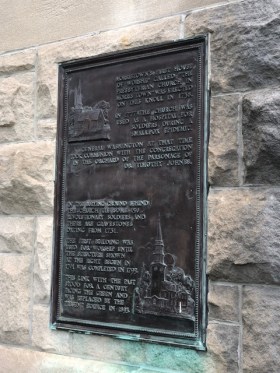
Plaque on wall of the Presbyterian Church

During the winter encampment, in 1777, at Morristown, George Washington ordered the inoculation for smallpox of the Continental Army. Although knowing the probability that some of his men would succumb to the disease when infected with even a small dosage of the puss, the commander-in-chief knew that the necessity of the process. By the end of the American Revolutionary War, more American soldiers would die of smallpox than British shot and shell.


With a population of 700 people and less than 70 dwellings, any public space of size was utilized to treat and quarantine the soldiers undergoing the smallpox inoculation. One of the religious establishments that was used was the Presbyterian Church across the street from Morristown Green, the center of town.

The Presbyterian Church already had a long history in Morristown, being the first congregation founded in the town, dating back to 1733 (the one you see today is actually the third to grace the same site).

IMG_3369

Behind the church is a graveyard referred to as “The Burying Ground” which holds the remains of over 1,700 individuals. Included in that number are the remains of numerous soldiers that succumbed to the smallpox inoculation during the winter encampment of 1777. From the burials that are known, 138 remains are those of soldiers from the American Revolution.IMG_3383
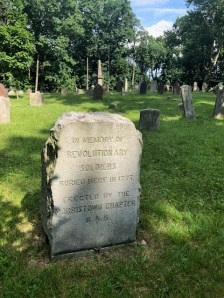
During the annual commemoration of Independence Day, the town of Morristown will offer guided programs of “The Burying Ground.” At other times throughout the year, the church itself will offer tours. You can find information about the church programs of the  cemetery here.

Whether you visit on a guided tour or independently stroll the ground, the though to keep in mind is; the men who died whether on the field of battle, succumbed to smallpox, or lived a long life as a veteran, the all helped make Morristown the placed where “America Survived.”
A new park and museum for Great Bridge

Most of us who study the Revolution know of the battle of Great Bridge, fought December 9, 1775. While short and small, it was extremely significant, resulting in British evacuation of Virginia and allowing the colony to move forward with independence and unhindered support of the war effort.

Until recently, the site of this important local landmark, and significant battle, were unpreserved. Nearby, thousands of vehicles drive on the Chesapeake Expressway, largely unaware that they are whizzing past the site of a significant Revolutionary War site. Area preservationists intend to change that.

Local citizens began the effort in 1999. Realizing that the site was unmarked, residents of Chesapeake began working with the city and the Army Corps of Engineers. The result was the Great Bridge Battlefield and Waterways History Foundation.

Thus far they have created a public park with an interpretive trail, historic markers, monuments, and are building a museum/visitor center on the site. Future plans include another monument and interpretive signage and public access at the rest of the battlefield.

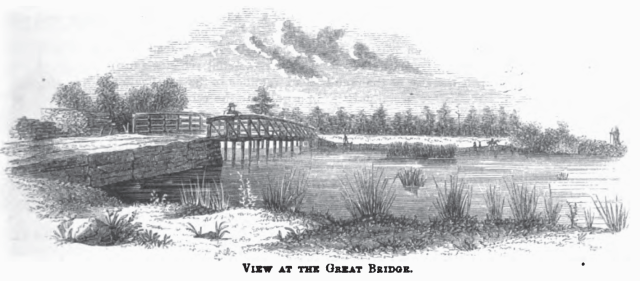
The area south of Norfolk, the Great Dismal Swamp, was largely inaccessible in the Eighteenth Century. A solitary road ran south from Norfolk, crossing the Southern Branch of the Elizabeth River at Great Bridge. Here local citizens were responsible for maintaining the bridge for public use. The road continued on into North Carolina.

Great_Bridge_view_LossingSketch by artist Benson Lossing, 1850s. Continue reading “A new park and museum for Great Bridge”
Burning Colonel Crawford

Last year I came across Dr. John Knight’s account of the torture and execution of Colonel William Crawford by members of the Delaware Indian tribe in 1782.  It was a vicious execution, but not unheard of in the wars on the American frontier, where violence and brutality from both sides were common.

Wiliam Crawford at 40 (Wikimedia Commons)
Crawford at about 40, twenty years before his execution (Wikimedia Commons)

Born in 1722, Crawford was a long-time business partner of George Washington, particularly in the acquisition of land in the Ohio River valley.  A veteran of frontier conflicts, during the Revolution he had served as the Lieutenant Colonel of the 5th Virginia Regiment, commanded the 7th Virginia in the east, and then returned to the Pittsburgh area to raise the 13th Virginia.  Sidelined during the war’s last years, he commanded local Pennsylvania militia and was largely retired by 1782.  For years, settlers in the Ohio Valley had agitated for punitive raid against the Ohio Tribes along the Sandusky River in today’s northwestern Ohio.  Their goal was to retaliate for Indian raids across the Ohio and spoil future raids.  By the spring of 1782, they could not be restrained.  After the militia massacred defenseless Christian Indians at Gnadenhutten in March, Brigadier General William Irvine, the Continental Commander at Pittsburgh, arranged for Colonel Crawford to lead the inevitable militia expedition, likely in hopes that Crawford could prevent a repeat.  (Crawford had taken no part in the Gnadenhutten Massacre).

Continue reading “Burning Colonel Crawford”

Review: Rethinking America From Empire to Republic by John M. Murrin

erw-book-reviews-11

In the introduction, Andrew Shankman narrows down the one word that has driven the history career of Dr. John M. Murrin; “Anglicization.” (page 1).  This process happened in a period of approximately 60 years, as the colonists along the eastern seaboard of North America became “in virtually every measurable way…more not less British in their attitudes, outlooks, and actions…” (page 1).

With that thought in mind, the collection of essays from the pen of Dr. Murrin comprise this single volume, Rethinking America, From Empire to Republic published by Oxford University Press. Understanding the history and historiography of these decades and the military, political, social, and economic sub-themes of the time period define the work. Yet, this is not history from just the top down; from the perspective of the elites nor from the bottom-up, but a melding of the various tiers of society.  Continue reading “Review: Rethinking America From Empire to Republic by John M. Murrin”

Visiting a Tragedy: Gnadenhutten, OH

Few places in the American Revolution evoke sorrow like Gnadenhutten, Ohio.  There, in March 1782, militia from Western Pennsylvania bludgeoned, scalped, and burned to death some ninety-six bound Indians who had adopted the Christian faith preached by missionaries from the church of the United Brethren.  Thirty-four of the victims were children.  Benjamin Franklin called the killings “abominable murders.”[1]

IMG_2540
The Chapel at Gnadenhutten with the 1872 memorial.  The Cooper’s Hut is to the right.  (ES Photo)

Continue reading “Visiting a Tragedy: Gnadenhutten, OH”

Uncovering the Continental Army in Morristown

Part of an ongoing series of about the Continental Army in Morristown, New Jersey. For the first post, click here.

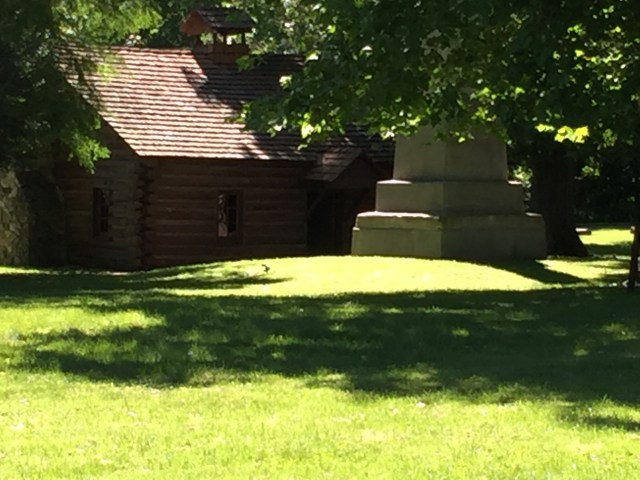
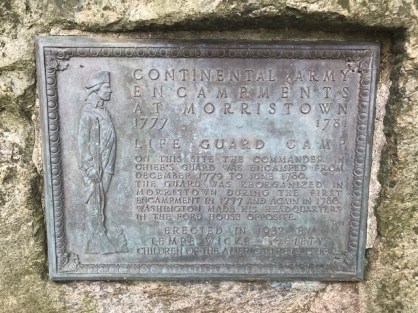
Across the street from the Ford Mansion, the elegant home of the Jacob Ford, Jr. and his family, and the headquarters for George Washington during the winter encampment of 1779-1780, sits a small boulder with a iron plaque plastered on the side.IMG_0027

Erected in 1932 by the Tempe Wicke Society Children of the American Revolution, the monument commemorates the Life Guards that served as Washington’s headquarters command during the American Revolution. Although the unit went by different names and reorganized at least twice, including once during the winter encampment at Morristown, the company, numbering approximately 150 men, would be around for the duration of the war. Continue reading “Uncovering the Continental Army in Morristown”

“It is my father!”: Francis Halkett’s Mission to the Monongahela Battlefield

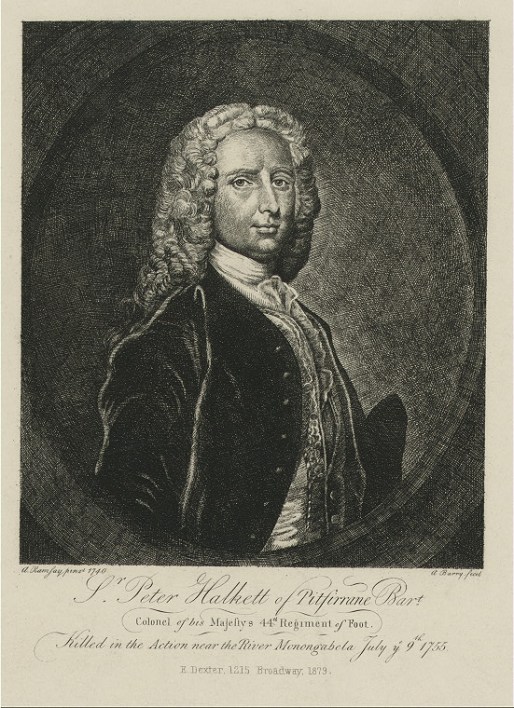
Two-hundred and sixty-three years ago, July 9, 1755, Britain suffered one of the country’s most humiliating military defeats along the banks of the Monongahela River in western Pennsylvania. Only miles away from its objective – Fort Duquesne – Maj. Gen. Edward Braddock’s army of some 1,400 men was attacked and cut to pieces by a detachment of Canadians and their Indian allies. In several hours of vicious fighting, Braddock’s force sustained over 900 casualties and was sent fleeing from the Ohio River Valley. Among the dead was the commanding officer of the 44th Regiment of Foot, Col. Peter Halkett.

Sir Peter Halkett
Col. Peter Halkett, 44th Regiment of Foot. New York Public Library

Three years following Braddock’s Defeat, another British Army trudged its way west with its crosshairs set yet again on Fort Duquesne. Accompanying General John Forbes’ expeditionary force was an officer of the 42nd Regiment of Foot, Maj. Francis Halkett – Sir Peter’s son. He had attached himself to Forbes’ command with the desire to return to the battlefield of 1755 and locate the remains of his father and younger brother, James, who served as a subaltern and was also killed in action that day. Because of the army’s hasty retreat, the British dead and dying that could not be carried from the field were left behind. It would be a near impossible task to identify the remains if any could be found, but Halkett was determined to try. Continue reading ““It is my father!”: Francis Halkett’s Mission to the Monongahela Battlefield”

Washington’s Marshals

Emerging Revolutionary War welcomes back guest historian Michael Aubrecht

September 24 of each year is the anniversary date of the Judiciary Act of September 24, 1789. It also means that the United States Marshals Service is a year older. Along with the first federal law enforcement agency in the United States, President George Washington signaled the start of the entire federal judicial system with his signature on that date. It was a broad document covering many positions from judges to prosecutors. Sections 27 and 28 were specific to the U.S. Marshal’s roles and responsibilities. A segment of Section 27 specifically outlines their general powers. It states:

And be it further enacted, That a marshal shall be appointed in and for each district for a term of four years, but shall be to attend the district and circuit courts when sitting therein, and also the Supreme Court in the district in which that court sit. (b) And to execute throughout the district, all lawful precepts directed to him, and issued under the authority of the United States, and he shall have the power to command all necessary assistance in the execution of his duty, and to appoint as shall be occasion, one or more deputies… Continue reading “Washington’s Marshals”

Origins of a Revolutionary Orator

Studley state historical marker
State of Virginia historical marker for Studley

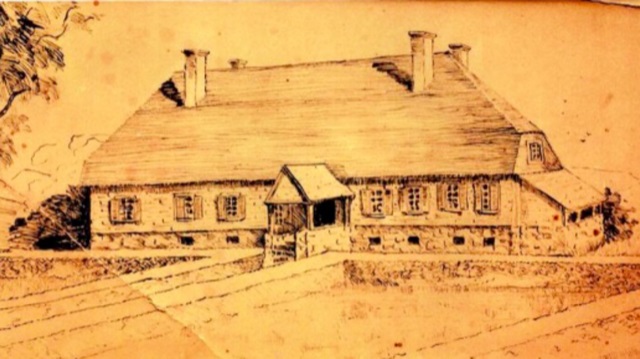
Nestled in Hanover County, VA, near where modern residential communities meet farm fields that have been worked for centuries, is the site of a colonial-era plantation home called Studley.  It was here on this site that Patrick Henry, the “Voice of the Revolution”, was born.

A 600-acre tobacco plantation, Studley was built in the 1720’s for its original owner, Colonel John Syme and his bride, Sarah, the former Sarah Winston.  The surrounding community, as it does today, took its name from the site. (By the mid-19th century, the Studley area was called Haws Shop, after a nearby blacksmith shop.  In the latter part of May, 1864, Union and Confederate cavalry units fought a dismounted action here just prior to the battle of Cold Harbor.  Prominent among the Union commanders engaged was Brig. Gen. George Armstrong Custer.)

Sketch of Studley
Sketch of Studley

Continue reading “Origins of a Revolutionary Orator”

Uncovering the Continental Army in Morristown

Part of an ongoing series about the Continental Army in Morristown, New Jersey. To read previous posts, click here.

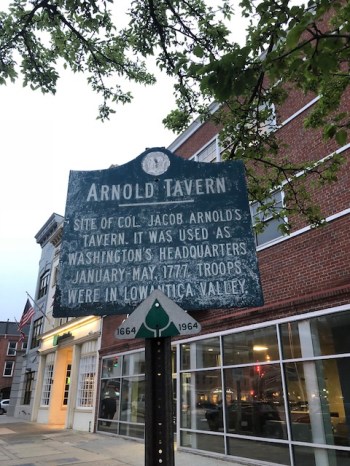
All that remains is a historical marker, on the side of North Park Place across the street from Morristown Green. For a few months, between January 1777 and May 1777, in this location, the headquarters of the Continental Army was located. Within that headquarters, obviously, was George Washington.

IMG_3024
Arnold’s Tavern historic sign (author’s collection)

Although no specific date of construction exists, it is believed that Arnold’s Tavern was built by Samuel Arnold between 1735 and 1750. By the time of the American Revolution owned by the son, Colonel Jacob Arnold. The structure was three stories high, with a wide hallway that bisected the building, a front and back parlor, barroom, dining room, and kitchen. Continue reading “Uncovering the Continental Army in Morristown”