“He Stood the Field with Great Bravery” The Story of Major Andrew Leitch, Part 1

After his first battlefield victory at the Battle of Harlem Heights on September 16, 1776, General George Washington wrote “The General most heartily thanks the troop commanded yesterday by Major Andrew Leitch, who first advanced upon the enemy, and the others who resolutely supported them.” The battle was a small victory for the American army, but instilled some confidence in the men who had suffered many defeats since August on Long Island and lost New York City to the British.  One of the main players in this action was Major Andrew Leitch. A little known Continental officer who at the time was considered a rising star, but today is mostly forgotten.
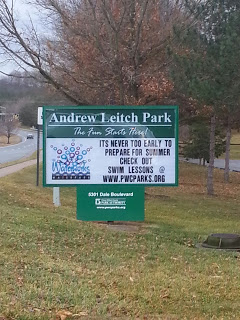
Dale City WaterparkBut my  connection with Andrew Leitch goes beyond my love and interest of the American Revolution, it is more personal than that. In 2008 I met the woman that became my wife. At the time, she ran a park locally named Andrew Leitch Park. Having worked here locally for a few years, I was not aware of who the park was named after. I did a quick search of the name Andrew Leitch and realized we had a Revolutionary War hero. In my ignorance thinking everyone was as interested in history as I was, I assumed my future wife knew this fact. Of course…she didn’t. But now I had an “in” to keep talking to this young lady. And of course…she saw through it and had little interest in Andrew Leitch but it worked out and now we are married and have two great young kids. So, I partly owe all of this to Mr. Andrew Leitch.

Who was this little known hero and why did have a park named after him in Prince William County, VA?   In 1774 Andrew Leitch moved to Virginia from Maryland and began a new life in Northumberland County. He and his wife Margaret had three children and Leitch must have had influence because he was able to secure a commission as Captain in the 3rd Virginia Regiment on February 6, 1776. In this capacity he recruited men from Prince William County and led the Prince William Battalion (which also included men from Loudoun County). The Prince William Battalion joined the rest of the 3rd Virginia in Williamsburg in late February. Soon though Leitch received a promotion on June of the same year to Major in the 1st Virginia Regiment (though there is one source that places his promotion to Major on March 18th). As Washington moved his Continental Army from Boston to New York City in March 1776, he called for reinforcements. Men of the 1st Virginia and 3rd Virginia were called to join Washington in New York. For reasons unknown, the 1st Virginia was slow to get to New York. Leitch seemed to be a man of action as he joined his former men in the 3rd Virginia on their march to New York as they were a few weeks ahead of the 1st Virginia.

The 3rd Virginia did not arrive in New York in time for the disastrous Battle of Long

320421
The Third Virginia flag captured at the Battle of Waxhaws on May 29, 1780. The flag is in a private collection.

Island, arriving in early September to join the American army on Harlem Heights. Washington was happy to see his fellow Virginians and he needed the reinforcements. The Americans had lost New York City and were pushed off of Long Island, all the way up to the northern tip of Manhattan Island. The Americans needed something to encourage them, a battlefield victory. Major Andrew Leitch played a crucial role in delivering that victory, though at a horrible cost.

Part 2 will cover Andrew Leitch’s role in the Battle of Harlem Heights and his once forgotten legacy.


Northwest Territory: Setting a Precedent

A precedent was set in early July for the young and aspiring American republic. A date other than July 4th and in fact, nine days and eleven years later.

July 13, 1787.

doc_008_big
Northwest Ordinance (courtesy of OurDocuments.gov)

On that date, the United States Congress enacted the Northwest Ordinance which set in motion the precedent for how new states would enter the burgeoning United States of America. In 1784 the groundwork for the Northwest Ordinance was laid, rejecting a proposal that new territories, carved from ceded land of current states, would enter as colonies. Congress set up the following parameters.  Continue reading “Northwest Territory: Setting a Precedent”

Standing on a Street Corner…

Now I know what you are thinking…the famous song by The Eagles. But, no.

IMG_1438
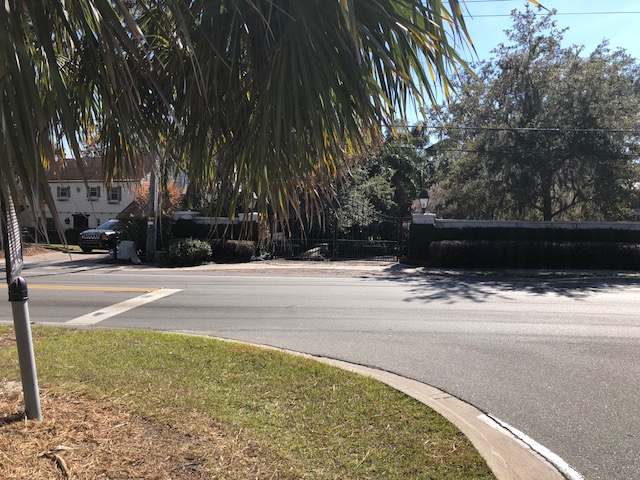
Corner where Fort Gatlin once stood, Gatlin Avenue is running left to right, South Summerlin is off the right of the photo. Historical marker sign on left side of photo, D.A.R stone marker across street (to the right of the Jeep in the driveway) 

Continuing a theme from the last post, military history in Orlando, I did find myself standing on a street corner, South Summerlin Avenue and Gaitlin Avenue. That is when I noticed the small stone marker, placed by the Daughters of the American Revolution. Placed next to a hedge, on the corner of a driveway, sits until recently, the only reminder of this former military installation. Around this fort sprung a small county that became the county seat of Orange County, Florida by 1856. Which grew into Orlando.

nov9
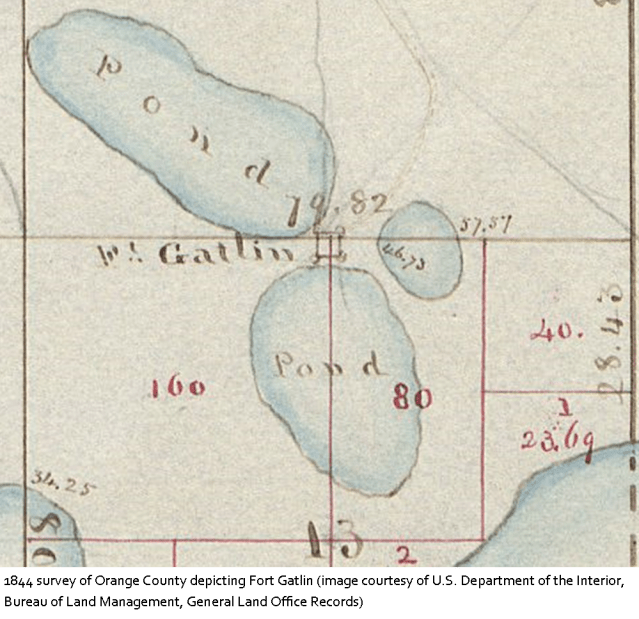
An 1844 survey of Orange County, depicting Fort Gatlin (courtesy of the Bureau of Land Management, General Land Office Records and The Florida Historical Society

Constructed on November 9, 1838, by Lieutenant Alexander Fanning and four companies of the 4th U.S. Artillery, the post was one of several built across the breadth of central Florida during the Second Seminole War. Named in honor of Dr. John S. Gatlin, who had been killed in Major Dade’s Massacre on December 28, 1835. After completing the post, which was situated on a rise that commanded three lakes, Lt. Fanning and three companies departed, leaving 1st Lieutenant F.E. Hunt.

After June 1839, the United States Army had abandoned the post, yet state militia continue to garrison the wooden ramparts. A brief return in October 1849 by the army led to it becoming an active post, briefly, until the soldiers left shortly thereafter.

IMG_1431
One side of informational panel of the Eagle Scout project for Fort Gatlin

Abandoned, besides the stone marker, until recently. A great Eagle Scout project produced a wooden two-panel history of Fort Gatlin, Native American history, early settlers, and the 2nd Seminole War. This stands on the same corner as the Florida historical marker and across the intersection from the Daughters of the American Revolution stone marker.

And standing for one day, a man on astreet corner, looking for history, a fine sight to see.


Revolutionary Era Connection in Orlando, Florida?

When one mentions the word “Orlando” what is the first thought to pop into your head?

Universal?

Or maybe two words; “Disney World or Walt Disney?”

In all likelihood, the name Francis Wayles Eppes, is not one of the people you would associate central Florida with. You may even be asking, who is Francis Wayles Eppes.

Eppes
Francis Wayles Eppes

Born on September 20, 1801, Francis was the only surviving child of Thomas Jefferson’s daughter Maria and her husband, John Wayles Eppes. When his mother died in 1804, his grandfather, the third president of the United States at the time, took young Francis under his care and the child resided at Monticello, Jefferson’s Virginia estate.

As young Francis grew, he spent time at Poplar Forest, Jefferson’s estate near Lynchburg, Virginia, which was bequeathed to him by his grandfather after the grandson married Mary Elizabeth Randolph in 1822. Francis, prior to marriage, studied law at both Georgetown College and South Carolina College.

With the death of his father and grandfather within three years of each other; 1823 and 1826 respectively, Francis and his wife joined the movement south, leaving Virginia for sunny Florida.

Initially settling outside Tallahassee and was instrumental in the formation of one of the first Episcopalian churches in the Florida territory, when he donated $500 to a construction of St. John’s Episcopal Church. He was a vestrymen, delegate to the Episcopalian convention in Florida, and also secretary of the local diocese for many years.

After a long public service record in Tallahassee, including serving as intendant or mayor of the capital for a few terms and being an early proponent of a school of higher learning–Jefferson-esque–which became the precursor to Florida State University, Eppes relocated to central Florida in 1869.

Even in his 60’s, Eppes stayed active, becoming a citrus farmer and was part of the group that founded the Cathedral Church of St. Luke in Orlando, the first Episcopal church in the growing town.

IMG_1446
Eppes’s home in Orlando. Plaque on front porch reads; “Site and home of Francis Eppes Grandson of President Thomas Jefferson Original House Built in 1868 Marker Placed by Orlando Chapter NSDAR December 3, 1998”

A historian, writing about Eppes’s contributions of that era summarized the Virginian in the following words; “Through the 40’s, 50’s, and 60’s [1800s] there were few civic, religious, or educational affairs in which he did not have a prominent  part.”

On May 30, 1881, Francis Wayles Eppes passed away at his home and would be buried in Greenwood Cemetery. He was 79 years old.

New Year’s Eve, 1776: “Your country is at stake”

6F487938-6D2D-4B12-88BE-49816A8C4044

On New Year’s Day 1777, Robert Morris wrote to George Washington and said: “The year 1776 is over, I am heartily glad of it and hope you nor America will ever be plagued with such another.”  While many of us have similar thoughts every New Year’s about the previous year, the year 1776 was exceptionally bad for the patriot cause, despite the Declaration of Independence being signed that summer.  After losing New York and a string of battles, Washington had shocked the world at Trenton on the day after Christmas.  This glimmer of hope was almost crushed by the fact that most of his army’s enlistments expired on January 1st.

51GqdvdQhGL._SX332_BO1,204,203,200_

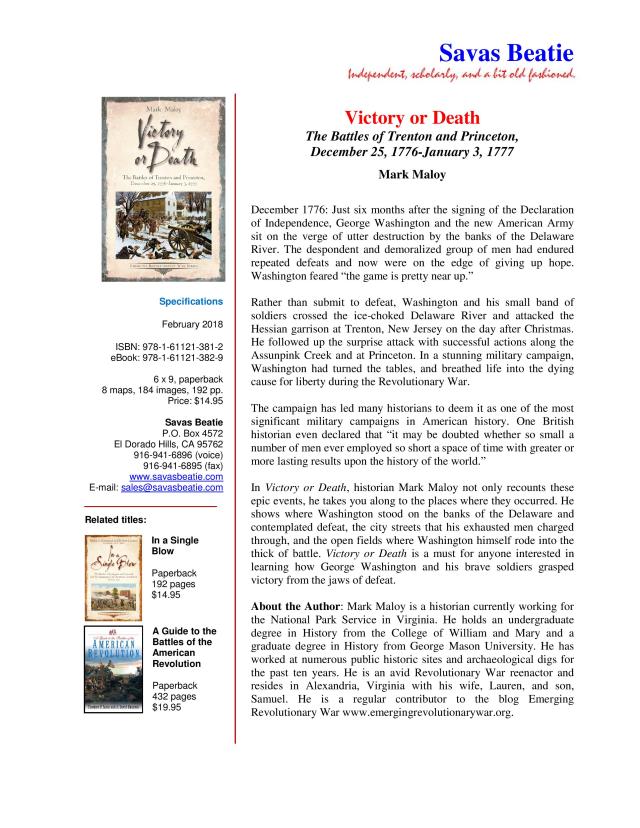
Here is an exclusive excerpt about this pivotal moment from the forthcoming book Victory or Death by Mark Maloy, one of the inaugural books of the Emerging Revolutionary War Series:

“Washington’s men had sacrificed much in the past few weeks and suffered greatly. Many believed they had done their duty, and rightly so. But at this moment, they were needed more than ever before. All day on December 31, 1776, Washington’s generals appealed to the soldiers to reenlist. Washington authorized an exorbitant $10 bounty
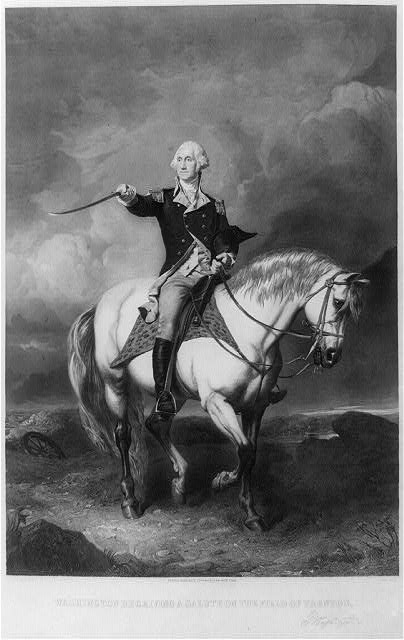
to those men who agreed to remain, this being funded by financier Robert Morris in Philadelphia. Some of his generals, such as Gen. Thomas Mifflin, a politician and public speaker from Philadelphia, were successful in retaining some of the men, others were not as successful. However, the most affecting scene was when Washington himself personally appealed to the patriotism of the men who had campaigned by his side. Washington paraded Gen. John Sullivan’s and Gen. Nathanael Greene’s divisions just outside Trenton. He entreated the men to stay on just a few weeks more. He asked those who wished to reenlist to move forward, but at that point no one moved. Sergeant Nathaniel Root of the 20th Continental Regiment (Connecticut) remembered that the men were “worn down with fatigue and privation” and had their “hearts fixed on home.” Washington, pleading with his brave soldiers wheeled his horse in front of the men and declared to them, “My brave fellows, you have done all I asked you to do, and more than could be reasonably expected; but your country is at stake, your wives, your houses and all that you hold dear. You have worn yourselves out with fatigues and hardships, but we know not how to spare you. If you will consent to stay only one month longer, you will render that service to the cause of liberty and to your country which you probably never can do under any other circumstances. The present is emphatically the crisis which is to decide our destiny.” After considering their commander’s words, more than two hundred of these men stepped forward to stay on and fight, and some of these men would be killed in the coming battles. The combination of patriotic pleas and hard currency helped persuade many more to
stay. Washington retained a force of about 3,000 men from his army. These veterans would prove invaluable in the coming days.”

Christmas 1776

In preparation for an upcoming publication by Emerging Revolutionary War’s historian Mark Maloy, I was doing some light reading about the Battles of Trenton and Princeton. That is when I came across the following quote by the late Albert Chestone;

“The great Christmas raid in 1776 would forever serve as a model of how a special
operation–or a conventional mission, for that matter–might be successfully
conducted. There are never any guarantees for success on the battlefield; but with a
little initiative and a handful of good Americans, the dynamics of war can be altered
in a single night.”

There is no doubt that the actions that followed the daring enterprise of crossing the Delaware was a turning point in the long road to independence of the American colonies. Yet, sometimes we overlook the entire operation as a fait accompli. Continue reading “Christmas 1776”

From Campaign 1776: Ten Crucial Days

Emerging Revolutionary War is pleased to share the following information from our friends at Campaign 1776 managed by the Civil War Trust. 

unnamed

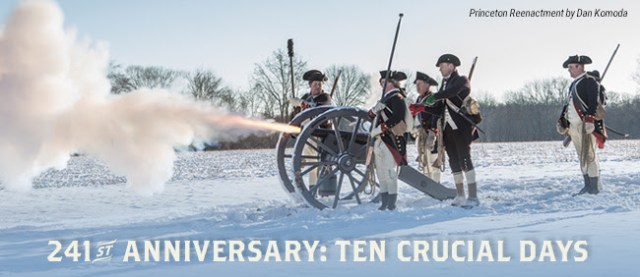
“As many of you may know, this winter marks the 241st anniversary of the American victories at the battles of Trenton and Princeton. The Continental Army’s triumphs in the Ten Crucial Days campaign proved instrumental to rekindling Patriot morale and keeping the cause for American independence alive in the wake of early defeats. Continue reading “From Campaign 1776: Ten Crucial Days”

Emerging Revolutionary War Weekender: The Boston Tea Party Ships & Museum

Emerging Revolutionary War welcomes guest historian Paige Gibbons Backus to the blog. This Weekend marks the 244th anniversary of the Boston Tea Party.

boston-museum-about-museum-experience

Boston Tea Party Ships and Museum

306 Congress St., Boston, MA 02210

http://www.bostonteapartyship.com

We all know the holidays are some of the heaviest travelled times of the year and over my Thanksgiving holiday, I had the opportunity visit Boston for a day. When in the city for only one day, what do we go and see? Do you go to the U.S.S. Constitution, Bunker Hill, Faneuil Hall, or the Paul Revere House? Do you go to the colonial meetinghouses, the historic cemeteries, or just walk around the historic sections of the city? One of the sites that I decided to visit was the Boston Tea Party Ships & Museum. I heard many good things about it from online reviews and professional colleagues about the interactive exhibits and experiences available there. Working at an immersive historic site myself, I was definitely curious to see what they had done to make their history exciting to audiences, and despite the museum’s shortcomings, make it interesting they did.

One of the highlights of the Boston Tea Party Ships is that they did a decent job creating an interactive experience for visitors. After purchasing tickets outside, visitors receive an identity card and a feather, and are then invited into a room meant to replicate the South Meetinghouse. From there, first-person actors serving as tour guides take visitors through the planning, implementation, and effects of the Boston Tea Party. For example, Sam Adams rallied the crowd weaving in the events leading to the Boston Tea Party, even teaching visitors how to show approval or displeasure in a public setting, (to which I was hissing before it was cool). He even called on visitors with various identity cards to voice their opinion, bringing in interesting, albeit reluctant, audience participation. After the visitors were riled up, we donned our feathers in our hair and were lead onto the ships to commence tossing the tea. Continue reading “Emerging Revolutionary War Weekender: The Boston Tea Party Ships & Museum”

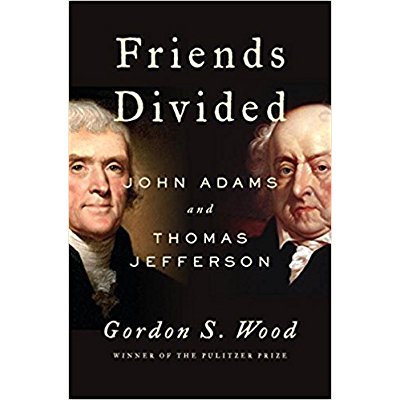
BOOK REVIEW – Friends Divided: John Adams and Thomas Jefferson


ERW Book Reviews (1)Poor John Adams.

I think it would be fair to say that John Adams spent the last 25 years of his life feeling sorry for himself.  He was a grumpy and vain old man searching for the respect he thought he deserved.34347432._UY400_SS400_

If Adams were to read the highly anticipated new book by Pulitzer Prize-winning author Gordon Wood, the old curmudgeon would be no happier.  In fact, the final lines of the book, handed down like a final judgement, would only confirm what Adams believed would be the view of historians forever.  “To be an American,” Wood wrote, “is not to be someone, but to believe in something.  And that something is what Jefferson declared.  That’s why we honor Jefferson and not Adams.”[i]

Continue reading “BOOK REVIEW – Friends Divided: John Adams and Thomas Jefferson”