Review: Standing in Their Own Light: African-American Patriots in the American Revolution

ERW Book Reviews (1)

Emerging Revolutionary War welcomes guest historian Bill Backus to the blog. 


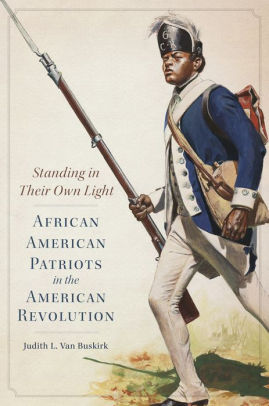
Fighting for Independence, Patriots commonly argued they were combating an attempt by the English Crown to reduce the American colonies to slavery.  The irony that most leaders crowing against “English slavery” owned enslaved African-Americans is one of the greatest contradictions of American history.  In a struggle about slavery, enslaved people played an important role.  In her new book, Standing in Their Own Light: African-American Patriots in the American Revolution, Professor Judith L. Van Buskirk explores African-American participation in the Patriot cause.
9780806156354_p0_v1_s550x406
“Standing in Their Own Light” by Judith L. Van Buskirk

The foundation for Van Buskirk’s study is the pension claims for nearly 500 soldiers made decades after the war.  To obtain a pension, veterans had to prove in a county court that they had served in the military during the war.  In addition to their recollection of when they enlisted, with whom they fought with, and where they campaigned, aspiring pensioners routinely recruited serving comrades and officers to offer testimony on their behalf.  While the pension records are an important source for historians, these documents were intended to prove wartime service and thus offered only a cursory examination of their military career.  The limitations of using these sources become apparent throughout the study

The book is divided into six chapters.  Van Buskirk first examines slavery prior to the American Revolution with South Carolina standing in for the Deep South, Virginia for the Upper South, Pennsylvania for the Middle Atlantic, and Massachusetts for New England.  In the second chapter, Van Buskirk utilizes the pensions to explore the life of an African-American patriot soldier, from enlistment, to camp life, and battle.  The subsequent two chapters explore two case studies of attempts to recruit, African-American soldiers: the segregated 1st Rhode Island Infantry and the story of the Laurens family connection of the recruit of African-Americans in South Carolina.  The final two chapters explore the pensions after the war.

The study on the 1st Rhode Island is outstanding. On May 14,1781, a detachment of the regiment on picket duty was ambushed outside of Peekskill, New York, by a local loyalist unit.  In the space of a few minutes, the Continentals lost eight killed, including both its colonel and major killed or mortally wounded, four wounded and twenty-four captured. The majority of the killed were black while those captured tended to be white.  Stories of the field officers either bayonetted or shot while in their beds added a salacious detail to this American disaster.  While its unknown if race played a crucial factor, the Battle of Pines Bridge foreshadowed the bloody battles involving African-American soldiers 80 years later in the Civil War.

While inconclusive , enough evidence survives in various pension claims that some of the first soldiers who entered the British fortifications at the Battle of Stoney Point weren’t officers, but black enlisted men.   Finally how subsequent generations of Americans used black soldiers involved in the Revolutionary War is another important contribution to the literature.

The limitation of the source material becomes evident in several places throughout the study.  For example in exploring the Battle of Stoney Point, Van Buskirk prefaces many observations with “probably” and “likely”.  At other sections, Van Buskirk generalizes the service of the men, an example being Jacob Francis and his military career.  Van Buskirk fleshes out Francis’ pension claim with an overly generalized overview of a battle experience in a Revolutionary Era army.  Sources for 18th century battles can be somewhat sparse compared with other events, but the qualifying terms that Van Buskirk uses diminishes some of the conclusions that she reaches

These quibbles aside, Standing in Their Own Light: African-American Patriots in the American Revolution is a tremendous addition to the historiography of the American Revolution, such as the sections about the 1st Rhode Island and black patriots after the war. Anyone interested in African-American history or the Continental Army should pick up this book.


 *Bio*

A native of Connecticut, Bill Backus graduated from the University of Mary Washington with a bachelor’s degree in Historic Preservation. Currently working as a historian for multiple Civil War sites in Northern Virginia, Bill has worked for the National Park Service at Vicksburg National Military Park and Petersburg National Battlefield. Bill currently resides in historic Brentsville, Virginia, with his wife, Paige, and their dog, Barley.

 

Independence and Contradiction: Our Founding Slaveholders

Emerging Revolutionary War welcomes guest historian Michael Aubrecht. A biography of Mr. Aubrecht is attached below. 

In 2011 an exhibit titled “Slavery at Jefferson’s Monticello: Paradox of Liberty” started running at the Smithsonian’s American History Museum from January 27, 2012 – October 14, 2012. This somewhat controversial exhibition explored slavery and enslaved people in America through the lens of Jefferson’s plantation and was a collaborative effort between the Thomas Jefferson Foundation at Monticello and the African American History and Culture Museum in Washington DC. It helped to instigate public discussion about the dichotomy between the Founders and freedom. The paradox of course is that Thomas Jefferson drafted the Declaration of Independence and called slavery an “abominable crime,” yet he was a lifelong slaveholder. The exhibition provides a glimpse into the lives of 6 slave families living at Monticello and reveals how the paradox of slavery in Jefferson’s world is relevant for generations beyond Jefferson’s lifetime.

founders-presidents-slaveowners
Founders, presidents, slave-owners

Continue reading “Independence and Contradiction: Our Founding Slaveholders”

Happy Thanksgiving

From all of us here at Emerging Revolutionary War, we want to wish you and yours a “Happy Thanksgiving.” Below is the official proclamation by President George Washington dedicating a day of “public thanksgiving.” in 1789.

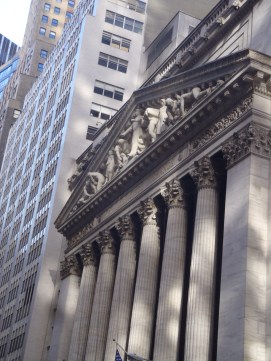
Federal Hall New York City
Federal Hall, New York City, where George Washington was sworn in as president in 1789.

By the President of the United States of America. a Proclamation.

Whereas it is the duty of all Nations to acknowledge the providence of Almighty God, to obey his will, to be grateful for his benefits, and humbly to implore his protection and favor—and whereas both Houses of Congress have by their joint Committee requested me “to recommend to the People of the United States a day of public thanksgiving and prayer to be observed by acknowledging with grateful hearts the many signal favors of Almighty God especially by affording them an opportunity peaceably to establish a form of government for their safety and happiness.”

Now therefore I do recommend and assign Thursday the 26th day of November next to be devoted by the People of these States to the service of that great and glorious Being, who is the beneficent Author of all the good that was, that is, or that will be—That we may then all unite in rendering unto him our sincere and humble thanks—for his kind care and protection of the People of this Country previous to their becoming a Nation—for the signal and manifold mercies, and the favorable interpositions of his Providence which we experienced in the course and conclusion of the late war—for the great degree of tranquillity, union, and plenty, which we have since enjoyed—for the peaceable and rational manner, in which we have been enabled to establish constitutions of government for our safety and happiness, and particularly the national One now lately instituted—for the civil and religious liberty with which we are blessed; and the means we have of acquiring and diffusing useful knowledge; and in general for all the great and various favors which he hath been pleased to confer upon us.

and also that we may then unite in most humbly offering our prayers and supplications to the great Lord and Ruler of Nations and beseech him to pardon our national and other transgressions—to enable us all, whether in public or private stations, to perform our several and relative duties properly and punctually—to render our national government a blessing to all the people, by constantly being a Government of wise, just, and constitutional laws, discreetly and faithfully executed and obeyed—to protect and guide all Sovereigns and Nations (especially such as have shewn kindness unto us) and to bless them with good government, peace, and concord—To promote the knowledge and practice of true religion and virtue, and the encrease of science among them and us—and generally to grant unto all Mankind such a degree of temporal prosperity as he alone knows to be best.

Given under my hand at the City of New-York the third day of October in the year of our Lord 1789.

                                                                                                                              Go: Washington


Lachlan McIntosh

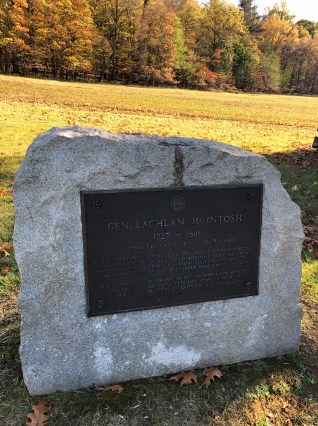
On a recent trip to Valley Forge National Historical Park I came across the monument to featured below, of a general that did not initially ring a bell in my memory. So I did a little investigating. The first name was intriguing. His story even more so. Especially how he came to spend the winter at Valley Forge.

Lachlan McIntosh
Lachlan McIntosh Monument, Valley Forge National Historical Park (author collection)

Born near Raits, Badenoch, Scotland on March 17, 1725 and at the age 11, Lachlan, along with his family and approximately 100 other Scottish immigrants, landed in Georgia where they founded the town of New Iverness. Out of all the cruelties that could visit a family eking out a future on the frontier, the calamity that claimed Lacklan’s younger brother would have been far down the list. While swimming in the Altamaha River in 1737, Lewis McIntosh was killed by an American alligator.  Continue reading “Lachlan McIntosh”

The Battle of Crooked Billet

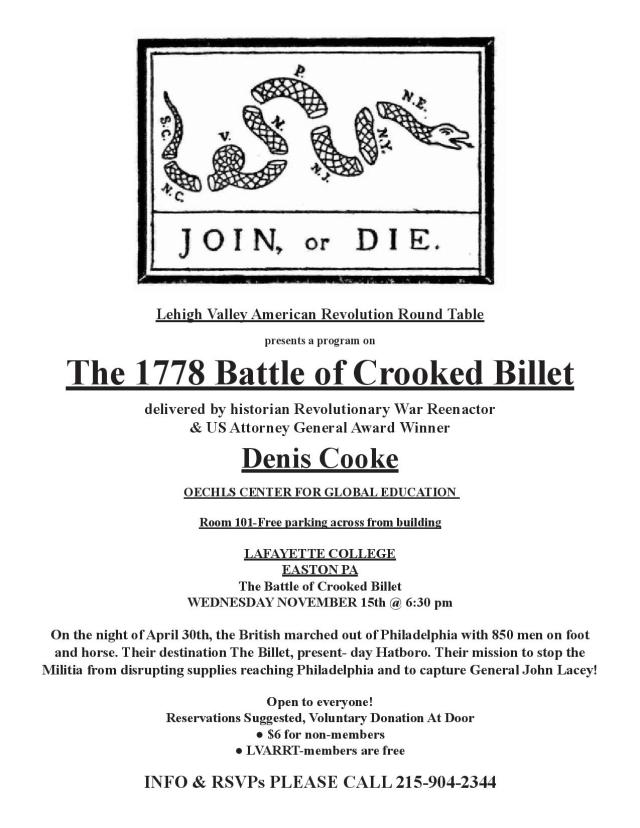
Join our friends at the Lehigh (PA) Valley American Revolution Round Table on Wednesday, November 15, 2017 at 6:30 p.m. at the Oechls Center for Global Education at Lafayette College in Eastern, Pennsylvania. The topic is the battle mentioned above.

Noted historian, reenactor, and U.S. Attorney General Denis Cooke will be the speaker. See flyer below for further details.

LVARRT Poster-page-001

AfterWARd, the new exhibit at the American Revolution Museum at Yorktown. A visit with Curator Kate Gruber

IMG_20170927_153356397
The stacks of books reflect Knox’s role as a bookseller before the war.

If you have not made a trip to the new American Revolution Museum at Yorktown (the former Yorktown Victory Center) then you are missing out. Not only does the museum great exhibits on the causes of the war and the events leading up to Yorktown (with great technology), there is a changing exhibit gallery that allows for short term exhibits. The first exhibit opened in June and features the lives of four prominent Revolutionaries after the American Revolution. Continue reading “AfterWARd, the new exhibit at the American Revolution Museum at Yorktown. A visit with Curator Kate Gruber”

Three American Revolutionary War Luminaries

A few years ago I had the opportunity to visit Yorktown National Battlefield. This evening I was scrolling through my cache of American Revolution photos on an external hard drive, when I came across the picture below.

IMG_5993

A simple monument to three luminaries of the American Revolution. Three brilliant young men, one of which, John Laurens, would fall in one of the last small engagements of the war.

Could you imagine the conversation between the three that fateful October evening of 1781?

Upcoming Lectures, Talks, and/or Events

With autumn just around the corner, cooler weather on the horizon, and the holidays quickly approaching. Some stores in the local area have Halloween, Thanksgiving, and Christmas decorations all for sale currently, Emerging Revolutionary War wanted to bring your attention to a few different Revolutionary War Era happenings to mark on your calendars.  Continue reading “Upcoming Lectures, Talks, and/or Events”

Review: Dunmore’s War, The Last Conflict of America’s Colonial Era by Glenn F. Williams

ERW Book Reviews (1)
Reviewed by guest historian  Robert “Bert” Dunkerly.

Lord Dunmore’s War remains one of the murkier events of the Colonial era.  Historian Glenn F. Williams has produced a book that will set the standard for the study of this conflict.

9781594161667_p0_v2_s1200x630
Dunmore’s War, the Last Conflict of America’s Colonial Era by Glenn F. Williams

Dunmore’s War, The Last Conflict of America’s Colonial Era by Williams,  explains the complexity of the conflict and goes into detail analyzing the intertwined diplomatic and military events.  The late 1760s and early 1770s were a fascinating and complex time on the frontier.  Violence from the French and Indian War and Pontiac’s War had subsided, tribes were shifting alliances, settlers were moving into the region, and the colonies were still adjusting to the new realities following the Treaty of Paris.  The British regulations that would trigger colonial resistance were already coming, and tensions were slowly building.  Yet the issues which dominated the attention of most colonists were inter colonial rivalries, such as that between Virginia and Pennsylvania. 

Continue reading “Review: Dunmore’s War, The Last Conflict of America’s Colonial Era by Glenn F. Williams”

A Detour to Cowpens

Cowpens Cow Pasture
The sign at the first pull-off left me underwhelmed. Fortunately, my impression of the battlefield got better and better.

I know we’re getting close to the Cowpens battlefield when we pass Redcoat Drive and then Tory Trail. Unfortunately, my GPS takes us to the maintenance shed rather than the visitor center, but the park’s signage finally manages to get us where we need to go.

I know nothing about the battle of Cowpens, but my colleague Rob Orrison has strongly recommended I visit the battlefield. It involves some of the most colorful characters of the war, he tells me: Daniel Morgan and Banastre Tarleton. “The battle changed the course of the war in the Carolinas, in my humble opinion,” Rob adds.

That seems like a pretty ringing endorsement to me. My son and I, on our way back from Atlanta, decide to make the hop off I-85 for a visit. Continue reading “A Detour to Cowpens”