

The British Perspective….Best Book?

I recently needed to look up a quote from a British politician in the House of Commons during the American Revolutionary War. I went to my personal library (like to call it a study but since I have not found a desk to “study” on in there, I’ll continue to call it my library).
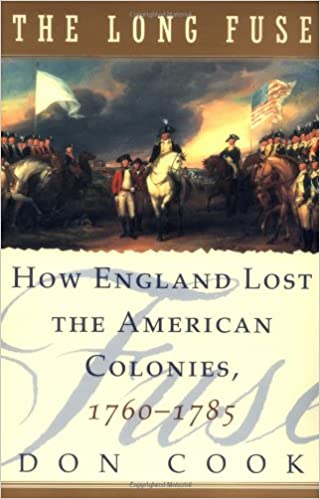
I grabbed Don Cook’s book The Long Fuse, How England Lost the American Colonies. A great read about the opposing side in the American Revolution. I found what I needed, but, as many of you probably do, that took me down a reading tangent.

Disclaimer; those of us under stay-at-home orders have some additional free time to explore more of our personal libraries. Those who can relate know what I am talking about. You pick up a book looking for something specific, which leads you to finish that book, then find one in the same genre or another micro-study of the same topic, until you have consumed multiple tomes within a matter of days, weeks.

Cook’s book led me to The Men Who Lost America: British Leadership, the American Revolution, and the Fate of the Empire. I gained a different appreciation for King George III, Lord Frederick North, and other British leaders from their perspective, filling in the gaps of historical scholarship that more America-centric volumes do not have the word count or inclination to fill.

I then went deeper down the proverbial rabbit-hole. Delving into With Zeal and With Bayonets Only: The British Army on Campaign in North America, 1775-1783, I went on a reading campaign with the British in the colonies.

Which now leads me to this blog post, what else would you recommend? What are your go-to books on the British perspective in the American Revolution?

Side note, I may delve into the loyalist viewpoint histories next, as I came across an interesting fact; the largest diaspora in the 18th century was American citizens that chose loyalty to the British crown who left or were forced to evacuate during and after the end of the American Revolution. So, as any history enthusiast will do, I will do more research….reading I mean.

ERW Weekender: Ninety Six, The Site That Has It All

Emerging Revolutionary War welcomes historian Vanessa Smiley to the blog.

The thing about Ninety Six National Historic Site is that it’s unassuming exterior hides a wealth of history. It’s also nowhere near a major highway, meaning you have to want to get there if you’re thinking of visiting. And when you do get there, you will realize that there’s more history per acre than its demur entrance lets on. Located in the back country of South Carolina, Ninety Six has a history that speaks to the stories of Native Americans, the American frontier of the 18th century, and the American Revolution.

Entrance to the park
(courtesy of Ninety Six NHS, NPS)

The site at Ninety Six holds a treasure trove of study on these subjects. Native American, mostly Cherokee, activity was heavy in the area long before European settlers arrived. One of the earliest backcountry trading posts, established by Robert Gouedy in 1759, made Ninety Six a hotbed of trading activity thanks to its location at the crossroads of twelve different roads and paths, linking the area to nearly all parts of the colonies.

Continue reading “ERW Weekender: Ninety Six, The Site That Has It All”

ERW Weekender: Wheeling

Emerging Revolutionary War welcomes guest historian Jon-Erik Gilot. A short bio is attached at the bottom of this post.

Though perhaps more widely known as the birthplace of West Virginia during the Civil War, Wheeling and its environs retains several significant sites associated with the Revolutionary War. The name itself is translated from the Delaware language meaning “place of the skull,” legend having that the severed head of a white settler was placed on a pole by local Native Americans as a warning to others to stay away.

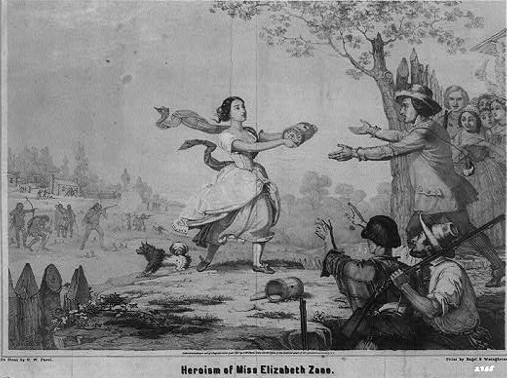
Betty Zane’s Run for Gunpowder during Second Battle of Fort Henry–1782
(image courtesy of Library of Congress)

Wheeling was founded in 1769 by Colonel Ebenezer Zane and his brothers Jonathan and Silas. Five years later in 1774 Fort Henry (originally called Fort Fincastle) was built overlooking the Ohio River to protect the growing numbers of settlers from attack. The fort was twice attacked during the Revolutionary War, first in 1777 and again on September 11 – 13, 1782, when a force of British loyalists (Butler’s Rangers) and Native Americans (under the command of outlaw Simon Girty) attacked the fort’s 47 defenders. The fort was besieged over two days, culminating in Betty Zane’s heroic run for gunpowder in a nearby cabin. The British and natives broke off the battle with the arrival of Virginia militia reinforcements. Fort Henry is acknowledged as one of the final battles of the Revolutionary War.

Continue reading “ERW Weekender: Wheeling”

Review: Revolutionary Brothers, Thomas Jefferson, the Marquis de Lafayette, and the Friendship that Helped Forge Two Nations by Tom Chaffin

Thomas Jefferson, Marquis de Lafayette, two household names from the American Revolutionary War. One the author of Declaration of Independence and one of the great political minds of the era. The other, a Frenchman, enamored with the ideals of the rebelling colonies of British North America who risked a maritime crossing, was wounded at Brandywine, and served both on the field of battle and the international sphere to help achieve American independence.

That much is known about these two gentlemen, icons of history. How about their friendship, one that spanned decades and brought both men through times of personal and professional difficulties. Although years separated visits and both men were well into adulthood before making their respective acquaintance, the friendship helped cement the bond between countries, from aid during the American Revolution to a thankful nation celebrating the return of the Marquis in the mid-1820s.

This friendship has finally been captured in narrative form by historian Tom Chaffin, author of other historical works and biographies in a book published by St. Martin’s Press in 2019.

Continue reading “Review: Revolutionary Brothers, Thomas Jefferson, the Marquis de Lafayette, and the Friendship that Helped Forge Two Nations by Tom Chaffin”

A Portrait of John Cuppy

Emerging Revolutionary War welcomes guest historian Gabriel Neville

Most of the enlisted men of the Revolutionary War are faceless and forgotten—just names on lists. Biographies and painted portraits are honors that were reserved for officers. Even so, it is possible to trace the lives of some common soldiers using original sources. Many of them applied for pensions after 1818, which required them to provide (usually brief) narratives of their service. Some gave similar attestations when they applied for military bounty land. A small number left detailed accounts of their experiences in interviews, letters, or diaries. Finally, and very rarely, we have photographs taken in the last years of some veterans’ lives. Virginian John Cuppy may be the only Revolutionary War soldier to leave us an artifact in each of these categories.

John Cuppy

Cuppy was born near Morristown, New Jersey on March 11, 1761. While still an infant, he was brought to Hampshire County, Virginia by his German parents. Their new home was on the South Branch of the Potomac River near the town of Romney, which is now in West Virginia. About forty miles west of the Shenandoah Valley, this was the very edged of settled Virginia territory. John was just fourteen years old when the war began—too young to be a candidate for service when Hampshire was directed to raise a rifle company in July of 1775. He was still too young when Dutch-descended Capt. Abel Westfall recruited a company there that winter for Col. Peter Muhlenberg’s new 8th Virginia Regiment.[1]

Continue reading “A Portrait of John Cuppy”

Review: Rick Atkinson, The British Are Coming: The War for America, Lexington to Princeton, 1775-1777

Emerging Revolutionary War welcomes guest historian Joshua Shepherd to the blog who reviewed the book mentioned above. Short bio of Joshua is at the bottom of this post.

In recent years, there’s been a fortunate resurgence of interest in the Revolution and founding era. To meet the mounting demand for Revolutionary history, some of the nation’s most gifted popular authors have written highly successful volumes that cover the War for Independence and the Early Republic.

Some outstanding books have consequently gone to press, but, by and large, the publications have very often been biographies; occasionally, publishing houses introduce monographs that cover a single campaign. From professional circles, much of the new scholarly research focuses on the currently-vogue academic preference for social history. At least in recent decades, the relative paucity of military history has left an appreciable gap in the historiography of the Revolution. With the release of The British Are Coming, author Rick Atkinson has met a vital need for an up-to-date and comprehensive military history of the American Revolution.

Continue reading “Review: Rick Atkinson, The British Are Coming: The War for America, Lexington to Princeton, 1775-1777”

Annis Boudinot Stockton, Mythmaking, and the American Revolution (cont.)

Emerging Revolutionary War welcomes back guest historian Blake McGready for part two of the series. To read part one, click here.

While her poetry avoided wartime setbacks and conjured stories of revolutionary unity, Stockton’s poems did confront the violent realities of what she called “a most cruel and eventful war”. Her choice allusions demonstrate how, in her mind, wartime violence bound the revolutionaries together. Following the death of General Joseph Warren at the battle of Bunker Hill she lamented, “That heart, which, studious of his countries good / Held up her rights and seal’d them with his blood!” In 1776 Stockton wrote of revolutionary soldiers who “fought and bled to save their native land / From bowing to a tyrant’s stern command,” and honored great men dying on battlefields “Made fertile by the blood of heroes slain.” Whereas historians have noted how the war’s violence was often deliberately excluded from the popular imagination, by contrast, Stockton’s war and violence were inseparable.[i]

Continue reading “Annis Boudinot Stockton, Mythmaking, and the American Revolution (cont.)”

Annis Boudinot Stockton, Mythmaking, and the American Revolution

Emerging Revolutionary War welcomes guest historian Blake McGready. A short bio is at the end of this post.

In December 1776, Richard Stockton of Princeton, New Jersey, a signer of the Declaration of Independence, disavowed the American Revolution and swore allegiance to King George III. After British forces imprisoned Stockton, he accepted his captor’s amnesty offer. Revolutionaries considered Stockton’s decision an act of cold betrayal and condemned his perfidy. And yet, following his death in 1781, most biographies avoided or ignored Stockton’s questionable political commitment; one tribute claimed his conviction inspired “the utmost confidence of his associates and the country at large.” Stockton owed much of this comeback to his wife, Annis Boudinot. As a prolific and published poet, she helped erase much of her husband’s political infidelity in her writings. At the time of his death she praised him in one tribute, “Can we forget how patiently he bore / The various conflicts of the trying hour / While meekness, faith, and piety refin’d.” She carefully forgot that her husband abandoned the revolutionaries during “the trying hour.”[i]

Annis Boudinot (Mrs. Richard) Stockton by James Sharples Senior, from life, 1796-1797. Courtesy, Independence National Historical Park.
Continue reading “Annis Boudinot Stockton, Mythmaking, and the American Revolution”

The Ring Fight and the Emergence of Andrew Pickens

While the Second Continental Congress met in the early summer of 1776, colonists in the far away backcountry of South Carolina faced a threat from a perennial foe, the Cherokees. While delegates debated a declaration of independence, war parties struck settlements between the Broad and Saluda Rivers in the Ninety Six District. In response to these raids, militia Major Andrew Williamson mustered his Ninety Six regiment. Augmented by militia from the Carolinas and Virginia, he commenced a campaign against the Cherokee villages along the eastern face of the Blue Ridge.

General Andrew Pickens of South Carolina

Williamson struck at Esseneca on August 1. The colonials sustained twenty casualties but forced the warriors to abandon the village. Over the course of the next week, Williamson moved further into enemy territory. Rather than engage his force, the Cherokees retreated before the advance. Williamson burned a number of towns including Oconee, Estatoe and Toxaway.

The regiment reached Tamassee on August 12. Once again, Williamson found the village abandoned. He decided to send out scouting parties to examine the nearby hills. One of the patrols was led by a company commander from the Long Canes region of South Carolina, Captain Andrew Pickens. He took with him about sixty men. To cover more ground, Pickens divided his group and continued on with thirty five militiamen.

“Judiciously Designed and Vigorously Executed”: The March to the Dan River

Emerging Revolutionary War welcomes back guest historian Daniel T. Davis. 

Last month, I heard Emerging Revolutionary War co-founder Phill Greenwalt remark “when you think about retreats, victory is a word that doesn’t come to mind.” The period of January 18 to February 14, 1781 is the exception to the rule. During this time frame, the American army under Maj. Gen. Nathanael Greene and the British under Charles, Lord Cornwallis, marched across the backcountry of the Carolinas. Known as the “Race to the Dan”, this episode between the engagements at Cowpens and Guilford Courthouse, is a largely forgotten but consequential even in the Southern Campaign of 1781.

13615353_10154159045361343_4661891239939243645_n
The Dan River (courtesy of Rob Orrison)

Continue reading ““Judiciously Designed and Vigorously Executed”: The March to the Dan River”