Emerging Revolutionary War welcomes back guest historian and park ranger Eric Olsen. Ranger Olsen works for the National Park Service at Morristown National Historical Park. Click here to learn more about the park.
What do poor health, a dead mother, a need to shop for new clothes, a pregnant wife, army business, a wife’s mental illness, family financial problems, and a desire to see family and old friends all have in common?
They are all reasons officers gave for asking for furloughs during the winter encampment of 1779-1780.
While the regulations and the various orders issued give us a general idea of the problems related to furloughs, we can get a different viewpoint by looking closer at the different Divisions, Brigades, and individuals who made up the army. The individual soldiers’ correspondence can also give us a more personal take on the furlough story. This paper will be far from comprehensive. It will just cover the furloughs that turn up in the surviving documentation. To make it easier to follow I have grouped the numbers and correspondence regarding furloughs by divisions and brigades.
Emerging Revolutionary War welcomes back guest historian and park ranger Eric Olsen. Ranger Olsen works for the National Park Service at Morristown National Historical Park. Click here to learn more about the park.
What do poor health, a dead mother, a need to shop for new clothes, a pregnant wife, army business, a wife’s mental illness, family financial problems, and a desire to see family and old friends all have in common?
They are all reasons officers gave for asking for furloughs during the winter encampment of 1779-1780.
While the regulations and the various orders issued give us a general idea of the problems related to furloughs, we can get a different viewpoint by looking closer at the different Divisions, Brigades, and individuals who made up the army. The individual soldiers’ correspondence can also give us a more personal take on the furlough story. This paper will be far from comprehensive. It will just cover the furloughs that turn up in the surviving documentation. To make it easier to follow I have grouped the numbers and correspondence regarding furloughs by divisions and brigades.
Emerging Revolutionary War welcomes back guest historian and park ranger Eric Olsen. Ranger Olsen works for the National Park Service at Morristown National Historical Park. Click here to learn more about the park.
What do poor health, a dead mother, a need to shop for new clothes, a pregnant wife, army business, a wife’s mental illness, family financial problems, and a desire to see family and old friends all have in common?
They are all reasons officers gave for asking for furloughs during the winter encampment of 1779-1780.
While the regulations and the various orders issued give us a general idea of the problems related to furloughs, we can get a different viewpoint by looking closer at the different Divisions, Brigades, and individuals who made up the army. The individual soldiers’ correspondence can also give us a more personal take on the furlough story. This paper will be far from comprehensive. It will just cover the furloughs that turn up in the surviving documentation. To make it easier to follow I have grouped the numbers and correspondence regarding furloughs by divisions and brigades.
Emerging Revolutionary War welcomes back guest historian and park ranger Eric Olsen. Ranger Olsen works for the National Park Service at Morristown National Historical Park. Click here to learn more about the park.
What do poor health, a dead mother, a need to shop for new clothes, a pregnant wife, army business, a wife’s mental illness, family financial problems, and a desire to see family and old friends all have in common?
They are all reasons officers gave for asking for furloughs during the winter encampment of 1779-1780.
While the regulations and the various orders issued give us a general idea of the problems related to furloughs, we can get a different viewpoint by looking closer at the different Divisions, Brigades, and individuals who made up the army. The individual soldiers’ correspondence can also give us a more personal take on the furlough story. This paper will be far from comprehensive. It will just cover the furloughs that turn up in the surviving documentation. To make it easier to follow I have grouped the numbers and correspondence regarding furloughs by divisions and brigades.
Emerging Revolutionary War welcomes guest historian Andrew J. Lucien. Brief bio of Andrew follows the post.
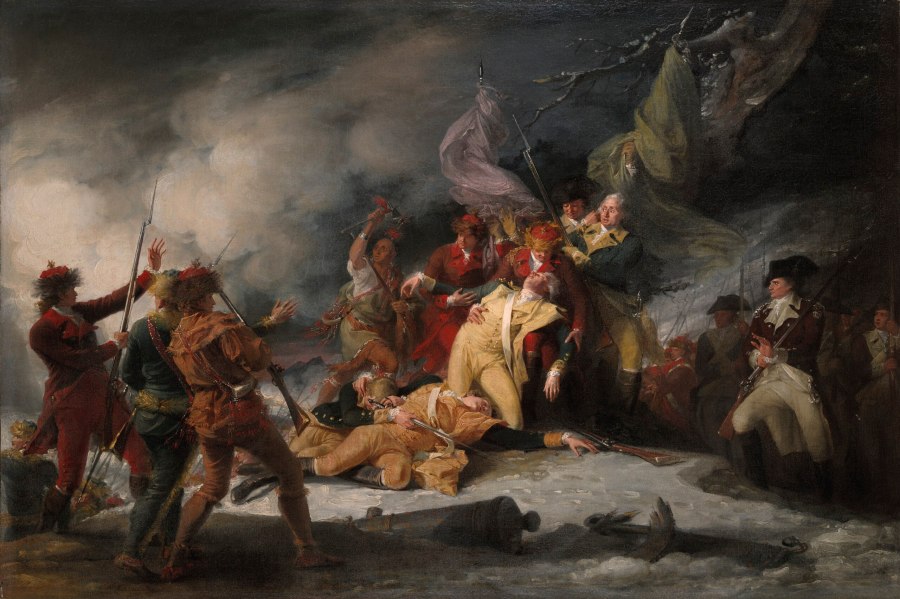
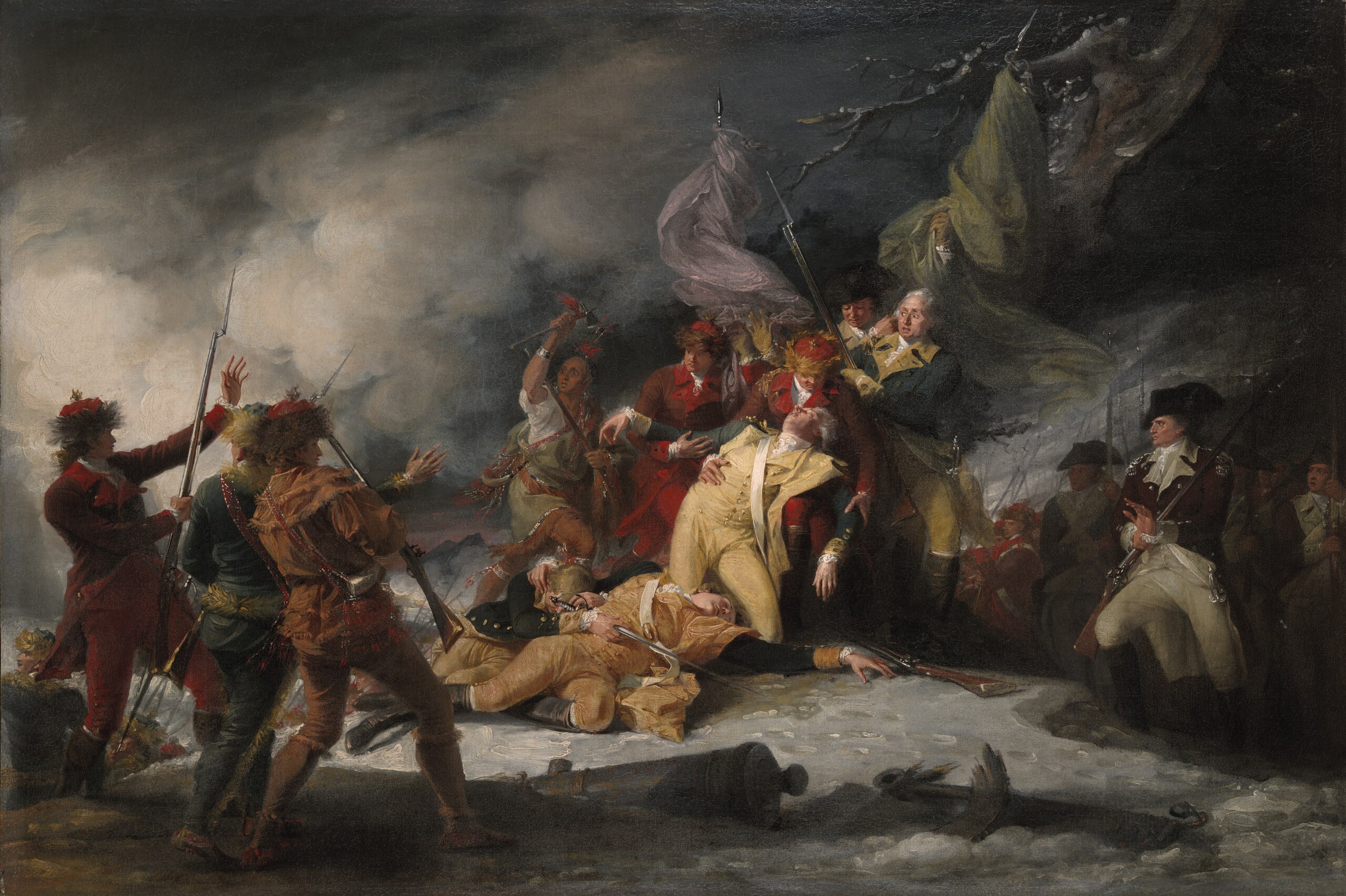
Death of General Richard Montgomery
Bunker Hill, Valley Forge, Yorktown, July 4, George Washington. These are the most common images that come to mind when the American Revolution is mentioned by most people. The collective unconscious of America has become steeped in the imagery of glorious American victories to win our independence from the superpower of the time. However, what many are unaware of is the unusual campaign that took place from 1775 to 1776, in an attempt to gain the support of Canada in our quest for independence. This campaign featured several battles, with the key one being the Battle of Quebec. This marked a significant turning point in the campaign and the war as a whole.
In 1775, the fate of the impending schism between Britain and its North American colonies was all but sealed. The colonial fervor had reached a climax at the Battles of Lexington and Concord in the spring of 1775, setting the mother country and its colony down a path of armed conflict. As tensions rose in 1775, Ethan Allan, along with Benedict Arnold, captured the British fort at Ticonderoga in early May, resulting in much-needed guns for the colonials. With successful action undertaken in the northern reaches of New York state, the Continental Congress approved plans to invade Canada. Intelligence led the patriots to believe that there were fewer than 700 British soldiers stationed in the Canadian territory and that the popular sentiment in the territory was in favor of rebellion, and that they, too, might take up arms against the British Crown.
By late September, Ethan Allan unsuccessfully attempted to capture Montreal. Near the same time, Benedict Arnold began to lead a force of around 1,100 men from Boston on an enterprise aimed at aiding in the capture of Canada (only about 600 would reach their destination). These men would eventually join forces with Richard Montgomery’s force around Quebec in December of 1775, “to finish the Glorious work you begun,” to quote George Washington. By the time Arnold’s men reached Canada, they were “in a very weak condition.” Montgomery’s force was moving north from Lake Champlain. His men captured Fort Chambly and Fort St. Johns. Following these captures, the force under Montgomery advanced on Montreal. The British governor, Guy Carlton, took approximately 150 men with him from Montreal to Quebec, believing it to be a more important and defensible position. Montreal was easily captured on the 13th. Montgomery did not rest long after capturing the fort, leaving a small garrison in Montreal and heading to join forces with Arnold’s men at Point aux Trembles. Montgomery, “…was anxious, after the capture of Chamblee, St. Johns and Montreal, to add Quebec, as a prime trophy to the laurels already won.”
With the combined force of Montgomery and Arnold now outside of Quebec, Montgomery sent Carlton multiple messages to surrender, which were all rejected. Upon hearing the refutation of his final offer, Montgomery was supposed to have said he would “dine in Quebec or Hell at Christmas.” Finally, with all other options seemingly exhausted, it was planned to forcibly take the city by sending Arnold’s corps to assault the lower town via St. Roque. Montgomery was to attack the lower town via Pres-de-Ville, near Cape Diamond. There was to be a fient east of St. John’s Gate under Colonel Livingston and one at Cape Diamond under Major Brown. The ultimate goal was to meet in the lower town, then storm the upper town.
Around midnight as the 31st began, clouds began to fill the sky and snow began to fall. This was a signal to the Americans to begin preparing for an assault, using the snowstorm as cover. By 2 a.m., the American troops began their movements. At about 4 a.m., Captain Malcolm Fraser saw flashes and lights on the Heights of Abraham. Fraser suspected that the lights were a sign of the American troops’ movement and ordered his guards to arm. The British began to play their drums and ring their bells to alert the men of Quebec to prepare for the city’s defense. The Americans launched two rockets to signal the beginning of their assault. With the rockets illuminating the early morning sky, the rebels began to fire their muskets into the British line. With the darkness of the morning still upon the soldiers, the British were unable to see their opponents, except when their muskets would flash and illuminate their heads. They used the flash of the muskets to guide their return volleys. The Americans began to launch artillery into Quebec from St. Roque. When Arnold saw the rockets in the morning sky, he led about 600 men from St. Roque to attack the British works at Saut-au-Matelot. Montgomery led his force of about 300 men to attack the works at Pres-de-Ville. Montgomery believed that this location was ripe for an escalade.
Arnold and the rest of his column advanced along the waterfront through St. Roque. The British sailors stationed there rained fire down on the Americans from atop the ramparts. The Americans “could see nothing but the blaze from the muzzles of their muskets.” As the Americans pressed forward, they lost the cover of the houses. Arnold was hit in the leg by enemy fire near the first barricade, and he was taken from the field by two men. Arnold tried to rally his men as he was taken away. Despite the setback, the Americans under Daniel Morgan pressed forward and used their ladders to scale and capture the first barricade at Saut-au-Matelot, along with 30 British troops. Here, the Americans found their muskets useless due to the snow. Many colonial troops resorted to confiscating British muskets. The Americans continued about 250-300 yards further to attempt to capture the second barrier, where they met opposition from the British. The Americans, on a narrow street, moved against the British, who had their own strong defenses, including a 12-foot-high barrier, cannons, and two lines of soldiers ready to repulse the attacking Americans. The British fired down on the Americans from the tops of the buildings. The colonial troops attempted to climb the barrier but were forced back by the British inside with their bayonets fixed. They then fired from under the cover of the houses, allowing the British to see them only as they moved from house to house. The attackers contemplated retreating; however, they tarried, ultimately a dire mistake. Carleton, aware of the developing assault, men to attack the flank of the Americans. With the Americans now flanked and facing stiff opposition in front, they surrendered to the British force.
Montgomery and his men suffered a far more deadly fate. As his column approached Pres-de-Ville, Captain Barnsfair had his men next to their guns and at the ready when the Americans arrived. The British had erected a barrier here with a battery. The Americans advanced within 50 yards of the British guns and halted, then resumed their advance, likely because they believed the soldiers were not on guard. Barnsfair “declared he would not fire till he was sure of doing execution, and… waited till the enemy came within… about thirty yards’ distance” and then called out, “fire!” “Shrieks and groans followed the discharge.” The fire of canister, grapeshot, and musketfire was deadly. When the fire stopped, the field of battle was clear with no rebels left standing on the field. Montogemery was one of the casualties of the action, found lying on his back with his arm still in the air. Seeing the folly of another assault, the remaining men retreated. An officer of Carlton’s declared the battle “a glorious day for us, and as compleat a little victory as was ever gained.” When the dust settled, the Americans suffered about 50 killed, 34 wounded, and 431 captured or missing, while the British defenders lost only 5 killed and 14 wounded. The fighting had lasted only around 4 hours.
Bibliography:
“An Account of the Assault on Quebec, 1775,” The Pennsylvania Magazine of History and Biography 14, no. 1 (1890): 47–63.
Blockade of Quebec in 1775–1776 by the American Revolutionists (les Bastonnais). Historical event, Quebec City, 1775–1776.
Caldwell, Henry. The Invasion of Canada in 1775. Quebec: Literary and Historical Society of Quebec, [microform].
Hatch, Robert McConnell. Thrust for Canada: The American Attempt on Quebec in 1775–1776. Boston: Houghton Mifflin, 1979.
Henry, John Joseph. Account of Arnold’s Campaign Against Quebec, and of the Hardships and Sufferings of That Band of Heroes Who Traversed the Wilderness of Maine from Cambridge to the St. Lawrence, in the Autumn of 1775. Albany: Joel Munsell, 1877.
Bio:
Andrew Lucien is a social studies curriculum director at the Cleveland Metropolitan School District, host of The Civil War Center podcast, and founder of thecivilwarcenter.com. He has written extensively on the Civil War and Revolutionary War.
As you settle into your winter holidays or looking for one more gift for that history enthusiast on your Christmas list (and speaking for fellow book-lovers, a late Christmas gift book is always appreciated), Emerging Revolutionary War welcomes you to join us for the return of Tom Hand, of AmericanaCorner as he discusses his second volume, America Victorious, Lesser Known Campaigns and Commanders That Helped Win American Independence.
Tom, who created AmericanaCorner in 2020, is a graduate of the United States Military Academy at West Point, Class of 1982, and a lifelong student and enthusiast of American History. He also sits on the Board of Trustees for the American Battlefield Trust.
During the Revelry on Sunday night, at 7 p.m. EDT, a special discount code (we have heard from our sources) will be offered for those interested in purchasing the book. Tom will also discuss upcoming book signings and other happenings at AmericanaCorner.
Tune in and end the weekend (and the last Revelry of 2025) with Emerging Revolutionary War and Tom Hand!
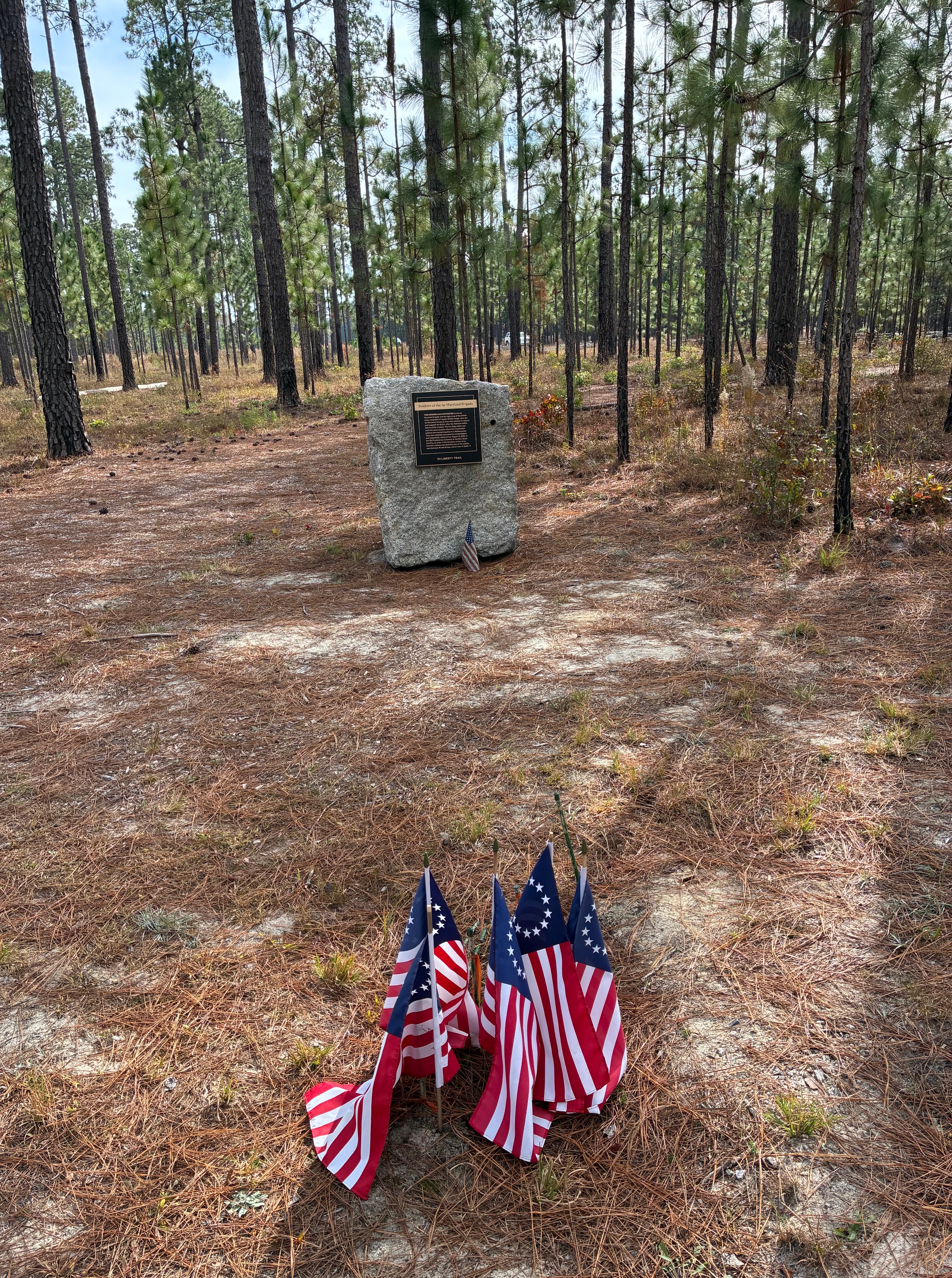
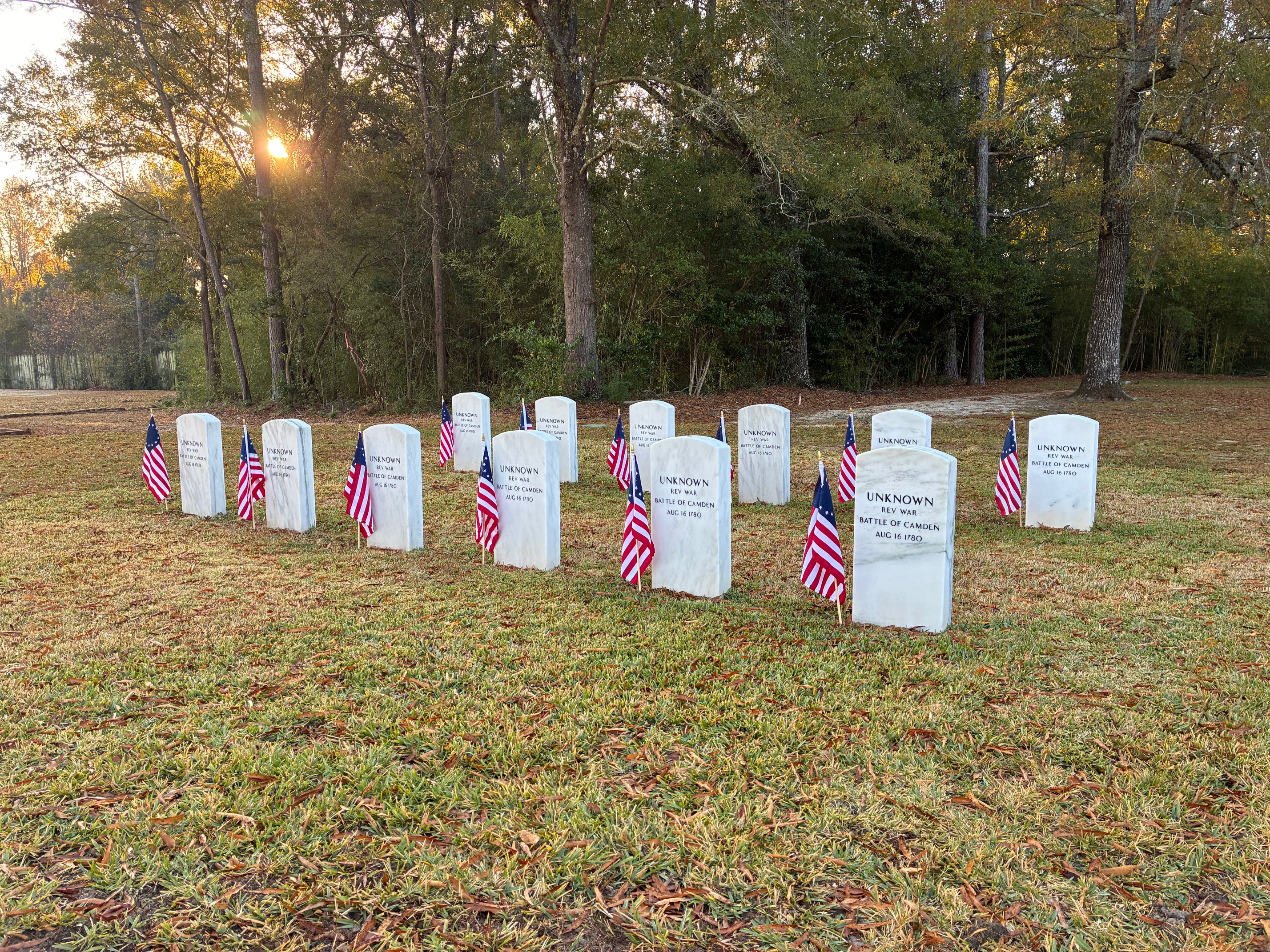
On Veteran’s Day in 2022, the American Battlefield Trust published the following article on their website “Archaeologists, Historians Unearth Remarkable Discovery at Camden Battlefield.” The Battle of Camden, fought in South Carolina on August 16, 1780, was a disastrous defeat for the American army, which suffered 1,900 casualties out of 3,700 engaged. Among those 1,900 approximate casualties were 5 Marylanders of the 1st Maryland Brigade. Over 242 years later, these five soldiers’ remains were found on the battlefield in a shallow grave. Another nine were found buried in other sites on the hallowed ground of Camden.
With forensic analysis and other research done in the ensuing months, a few facts about who these men were came to light. One of the most poignant discoveries was the age of two of the fallen Marylanders. Their ages were 16 to 19 years of age.
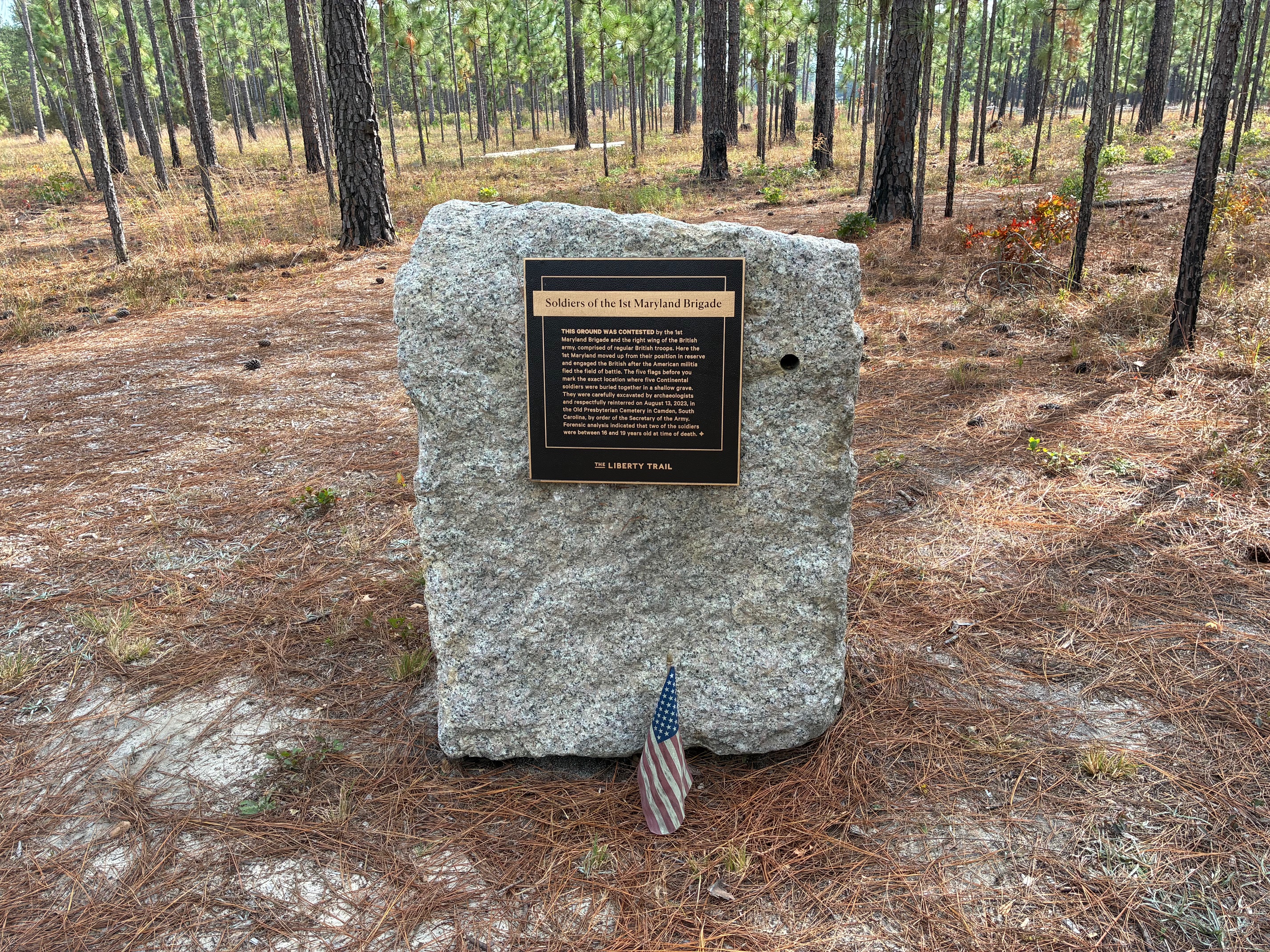
Although I have studied, lectured, and written about numerous engagements in two American wars, the simple fact of how young these soldiers were, as I read the memorial bronze plaque on the boulder monument, gives a deeper sense of sadness. Wars kill people of all ages, bullets don’t differentiate.
As we enter the holiday season and gather with friends and family, young and old, the fact that one of these soldiers, as young as 16, possibly, sacrificed his life, still name unknown, and lost to history for over 242 years. A family never knew what happened to their relation.
It is why it is invaluable that history continues to be studied. Archaeology is still important. And preservation of hallowed ground, like Camden, is worth preserving and interpreting. As you spend your holidays in the fashion that suits you, take a moment to think about a fallen soldier at Camden, in August 1780, sacrificed at sixteen.
Monument to the MarylandersThe flags mark the location of the five remainsGravestones of nine American soldiers, their remains found on the Camden Battlefield, now in the Revolutionary War Memorial outisde Quaker Cemetery in Camden, SC.
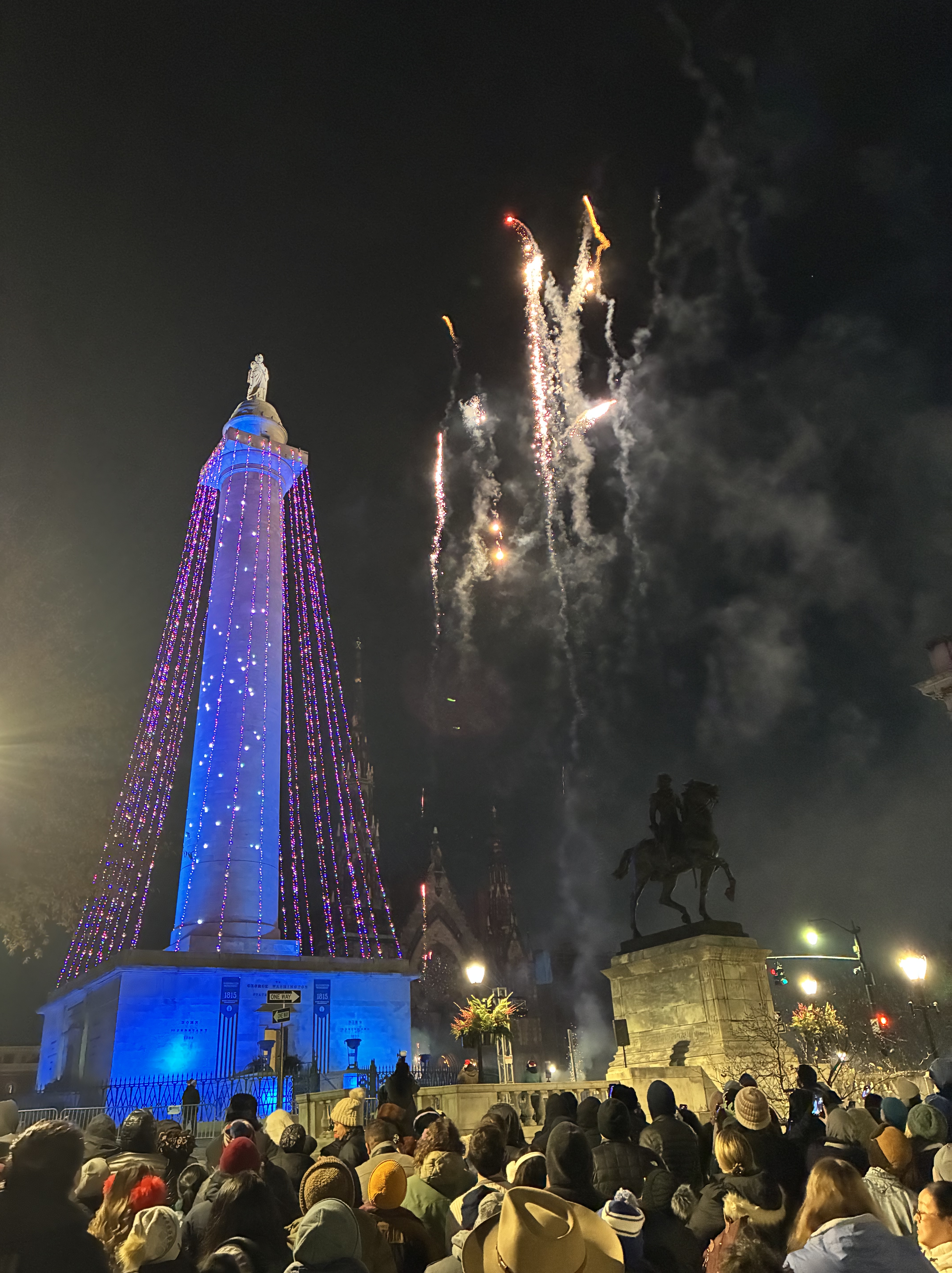
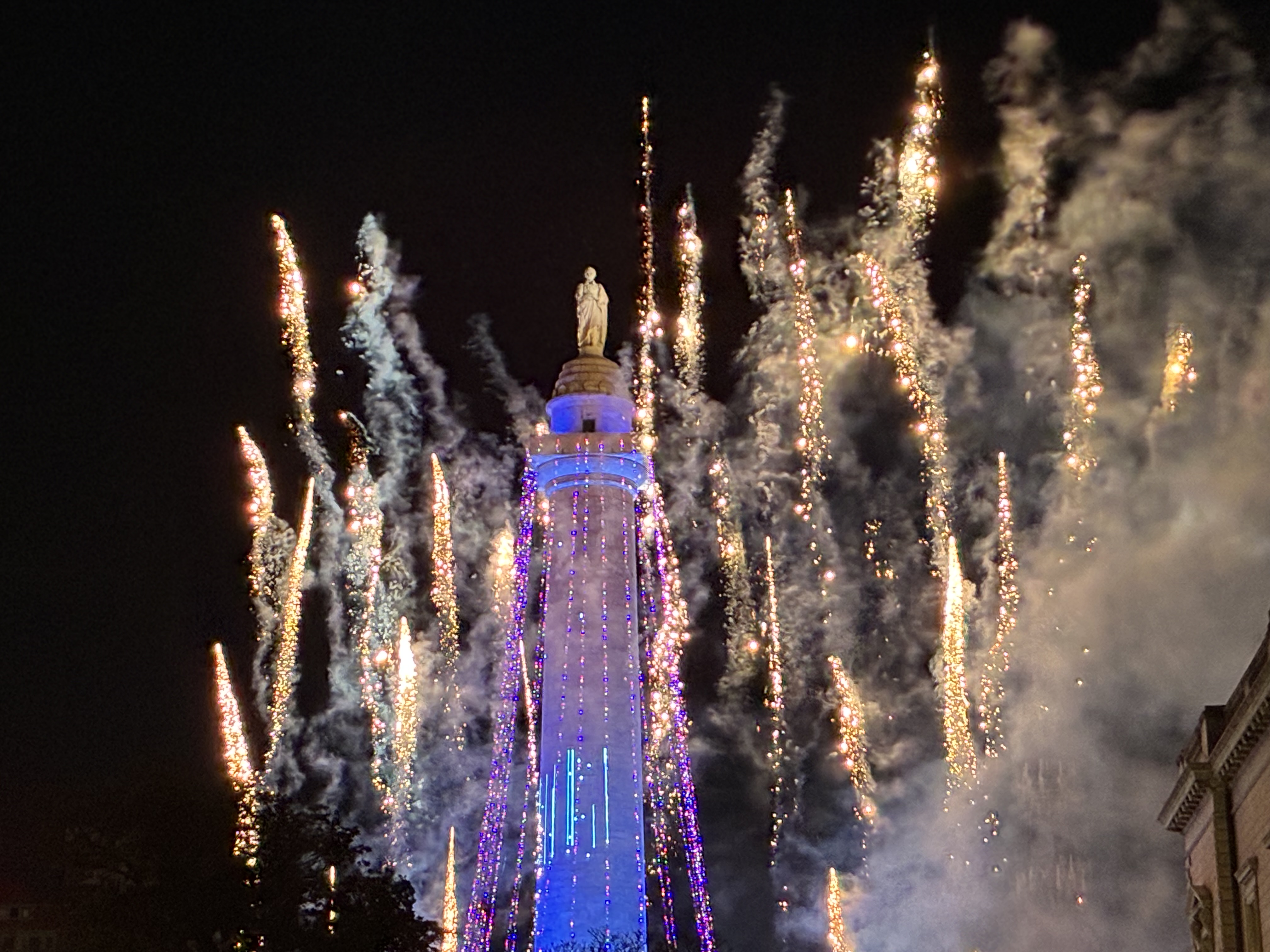
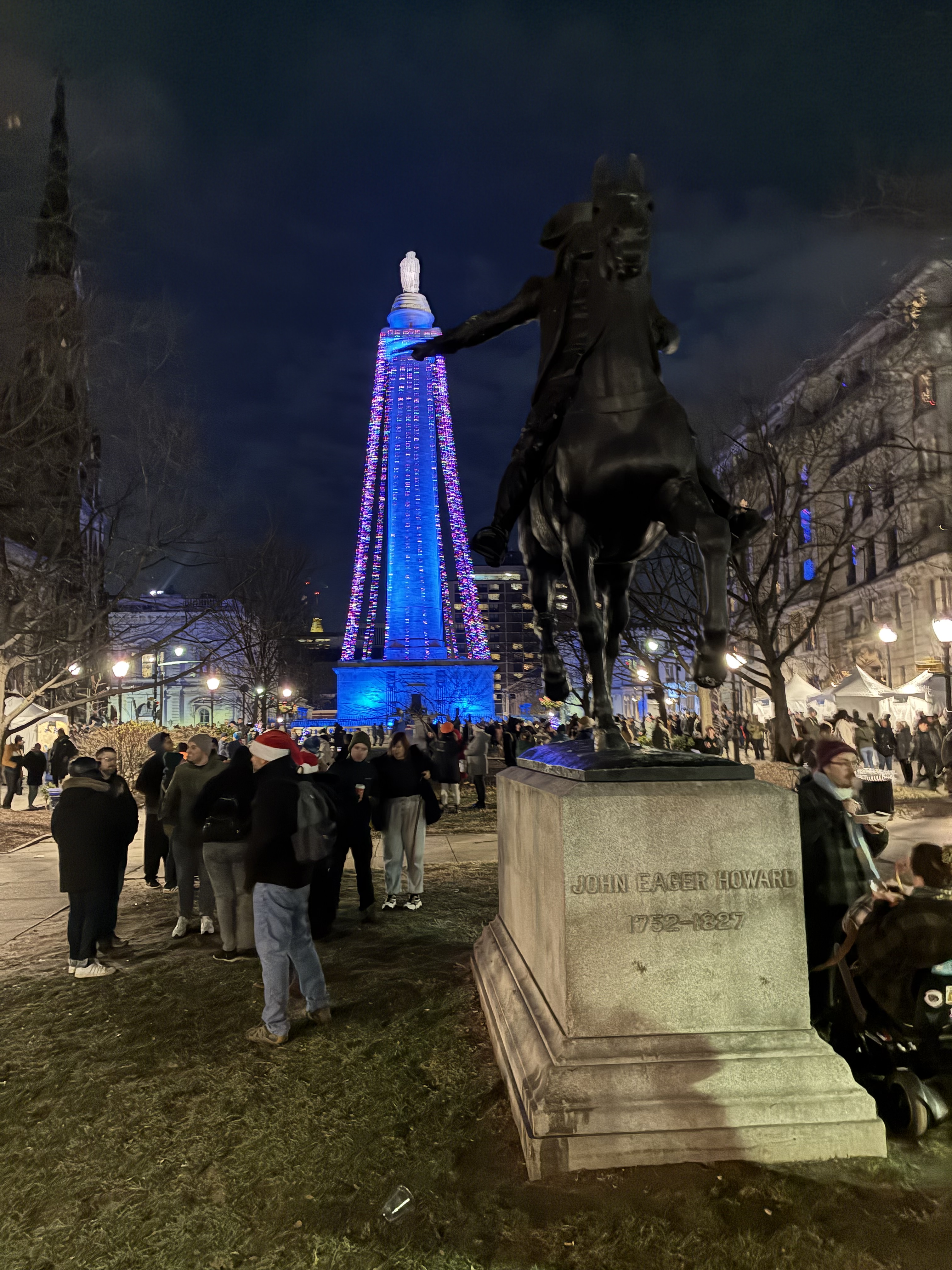
On the first Thursday of December, the unofficial kick-off to the holiday season takes place in Baltimore, Maryland. This year, on December 4, was the 54th year of the celebration. The 178-foot-tall George Washington Monument, the construction of which started on July 4, 1815, and was completed in 1829, is graced with lights and fireworks that light up the city sky about the figure of Washington.
On both sides of the Washington Monument stand two equestrian statues grace the grounds. One is of a local American Revolutionary War hero, John Eager Howard, born in Baltimore County in 1752. On the other side is honorary American, the Honorable Marquis de Lafayette.
If you peer to the left of the Howard equestrian statue photo, you see the spire of a Victorian Gothic church. Built in 1872, the church stands on the location of the Howard residence. On January 11, 1843, Francis Scott Key died there, at the age of 63.
If you celebrate, Emerging Revolutionary War hopes your holiday season kicks off grandly as well. If I may, if looking for a gift for that history enthusiast, check out the Emerging Revolutionary War storehere. Or the Emerging Revolutionary War Series, here.
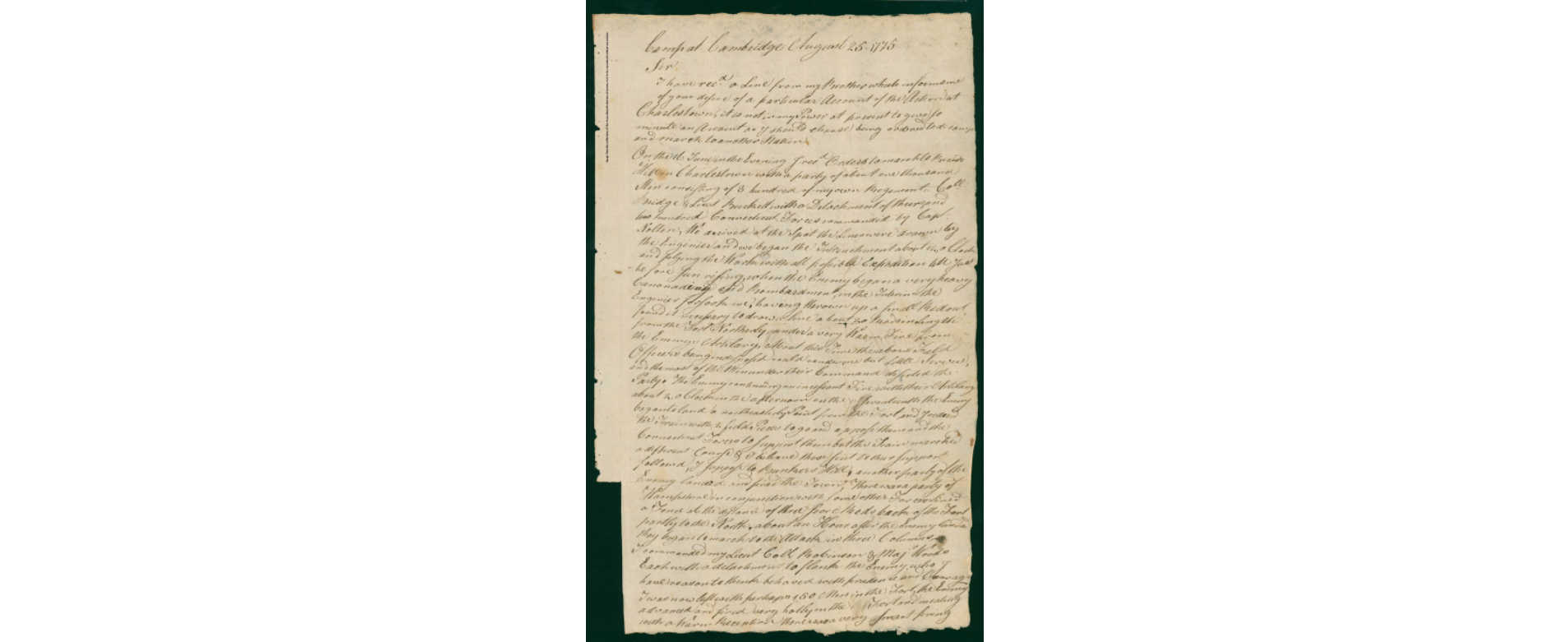
Approximately two months after waging the defense of Breed’s Hill, on the Charlestown peninsula, against the British, Colonel William Prescott put quill to paper to write to John Adams. In this communique, he discussed the action at Breed’s Hill, known as the Battle of Bunker Hill, fought on June 17, 1775, to his fellow Massachusetts native. Take note that he even wrote his account about the orders he received and which hill that missive directed him to. Since the waft of smoke has drifted from the battle on that June day, veterans, officers, and historians have debated why Prescott and company chose Breed’s Hill instead of Bunker Hill. This letter is just another wrinkle in that timeless debate.
Camp at Cambridge August 25.1775
Sir
I have recd. a Line from my Brother which informs me of your desire of a particular Account of the Action at Charlestown, it is not in my Power at present to give so minute an Account as I should choose being ordered to decamp and march to another Station.
On the 16 June in the Evening I recd. Orders to march to Breeds Hill in Charlestown with a party of about one thousand Men consisting of 3 hundred of my own Regiment, Coll. Bridge & Lieut Breckett with a Detachment of theirs, and two hundred Connecticut Forces commanded by Capt. Nolten, We arrived at the Spot the Lines were drawn by the Enginier and we began the Intrenchmant about 12, o Clock and plying the Work with all possible Expodition till Just before sun rising, when the Enemy began a very heavy Canonading and Bombardment, in the Interin [Interim] the Enginier forsook me, having thrown up a small Redout, found it necessary to draw a Line about 20 Rods in length from the Fort Northerly, under a very Warm Fire from the Enemys Artilary, About this Time the above Field Officers being indisposed could render me but Little Service, and the most of the Men under their Command deserted the Party. The Enemy continueing an incessant Fire with their Artilary. about 2, o Clock in the afternoon on the seventeenth the Enemy began to land a northeasterly Point from the Fort, and I orderd the Train with 2 field Pieces to go and oppose them and the Connecticut Forces to support them but the Train marched a different Course & I believe those sent to their support followd, I suppose to Bunkers Hill, another party of the Enemy landed and fired the Town, There was a party of Hampshire in conjunction with some other Forces Lined a Fence at the distance of three score Rods back of the Fort partly to the North, about an Hour after the Enemy landed they began to march to the Attack in three Columns, I commanded my Lieut Coll. Robinson & Majr. Woods Each with a detachment to flank the Enemy, who I have reason to think behaved with prudence and Courage.
I was now left with perhaps 150 Men in the Fort, the Enemy advanced and fired very hotly on the Fort and meating with a Warm Reception there was a very smart firing on both sides. after a considerable Time finding our Amunition was almost spent I commanded a sessation till the Enemy advanced within 30 yards when we gave them such a hot fire, that the [y] were obliged to retire nearly 150 yards before they could Rally and come again to the Attack. Our Amunition being nea [r ]ly exaustid could keep up only a scattering Fire. The Enemy being numerous surrounded our little Fort began to mount our Lines and enter the Fort with their Bayonets, we was obliged to retreat through them while they kept up as hot a fire as it was possible for them to make we having very few Bayonets could make no resistance, we kept the fort about one hour and twenty Minutes after the Attack with small Arms, This is nearly the State of Facts tho’ imperfect & too general which if any ways satisfactory to you will afford pleasure to your most obedient humble Servt.
William Prescott To the honble John Adams Esqr.
Image of original letter from Prescott to Adams, courtesy of Massachusetts Historical Society
Emerging Revolutionary War welcomes guest historian Ben Powers
Introduction
Nathaniel Greene is renowned for leading the Southern Department during the American Revolution, achieving significant strategic results against Lords Cornwallis and Rawdon, even though he lost several battles. Historian Theodore Thayer called him “the strategist of the American Revolution.”[1] Greene carefully planned his army’s movements to maximize maneuverability, chose to fight in situations with roughly equal numbers, strengthened support from auxiliary and irregular forces, and put the British in increasingly worse positions. His main goal was to keep his army active—success meant staying in the field and avoiding severe losses. This led Cornwallis to make decisions that resulted in his defeat at Yorktown, Virginia, in October 1781. Greene’s careful coordination of military actions to achieve strategic results hinted at what would later be called “operational art,” a concept later connected to leaders like Napoleon Bonaparte and Soviet theorists.[2] Greene’s skills showed the main elements of operational art, making him more than a strategist—he was an early example of an operational artist.
Some Definitions
The “operational level of war” is a twentieth-century concept describing military activities between the tactical level (winning battles) and the strategic level (achieving national aims through armed force and other instruments of power). In current doctrine, tactics involve sequencing forces in time and space to accomplish missions like seizing terrain. Strategy is how national leaders and senior commanders use available means to achieve defined ends. The operational level connects these two, as theater commanders sequence campaigns to achieve strategic objectives, a concept relevant for analyzing Greene’s approach.