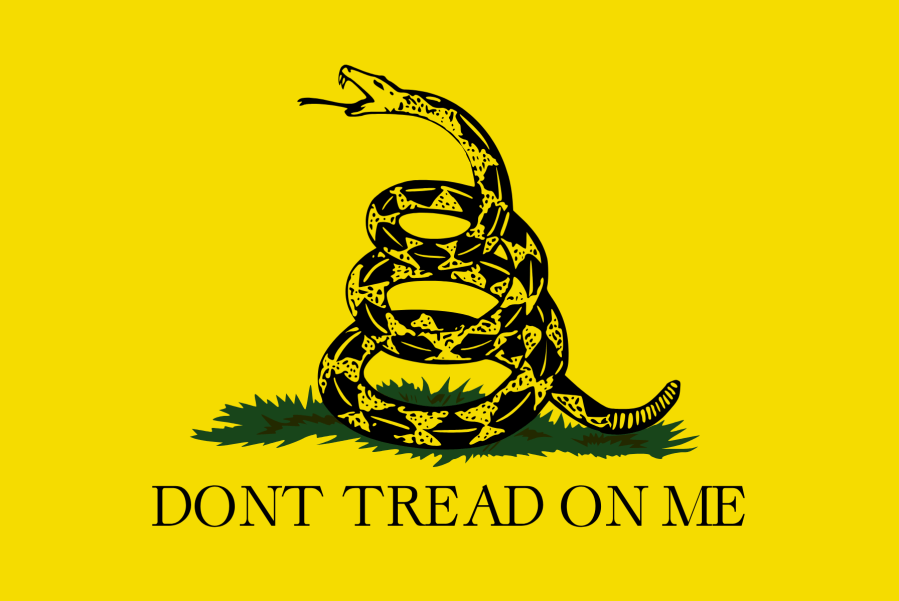
Every so often news stories arise about popular symbols of the American Revolutionary War that are used by various people to promote modern political agendas. One prominent symbol is the yellow flag with a coiled rattlesnake and the words “Don’t Tread on Me” below it. This flag, often referred to as the Gadsden flag, has a fascinating history dating back to the Revolutionary War.
The first real use of the snake representing the colonies begins before the Revolutionary War, during the French and Indian War, when Benjamin Franklin created a cartoon using a snake to represent the various colonies each separated from one another with the words “Join, or Die” under the image. This was an effort to get the various colonies to unite for common defense during that time period.
By the time of the Revolutionary War in 1775, the symbol had become a solitary rattlesnake, coiled and ready to strike often accompanied by the warning “Don’t Tread on Me.” Christopher Gadsden, a prominent South Carolina patriot, served in the Continental Congress and designed the yellow flag as a naval ensign. Beginning in 1776 the flag was hung up in the room where Congress met in Philadelphia and because it was designed by Gadsden, it became known as the Gadsden flag.
Emerging Revolutionary War welcomes a guest post from historian Keith J. Muchowski. Keith is a librarian and professor at New York City College of Technology (CUNY) in Brooklyn. He blogs at thestrawfoot.com.
The plaque dedicated King Juan Carlos I in June 1976 today tucked in a corner of the visitor center. Courtesy Author
King Juan Carlos I arrived in Brooklyn’s Fort Greene Park on Saturday June 5, 1976 to great fanfare. The thirty-eight-year-old monarch had ascended to the Spanish throne just seven months previously, two days after the death of Francisco Franco. The new leader was determined to reform his nation after three and a half decades of strongman rule. Juan Carlos I’s ancestor, King Carlos III, had helped the colonists achieved their independence nearly two centuries previously with his supply of money, matériel, and men. Many of those Spaniards made the ultimate sacrifice; well over one hundred of them alone perished in British prison ships moored off Brooklyn Wallabout Bay during the war.[i] Now King Juan Carlos I was in the outer borough to recognize them, dedicate a tablet to his fallen countrymen, and help his American hosts celebrate the bicentennial of their independence. The entombed Spaniards were among the over 11,500 men commemorated by the Prison Ship Martyrs Monument. The king’s visit in the mid-1970s was the latest in a series of public commemorations of the prison ship dead dating back over a century and a half. Some of the institutions that did so much to recognize the martyrs, such as the Society of St. Tammany, are today long gone. Others however very much remain. The Society of Old Brooklynites, a civic organization founded in 1880 when Brooklyn was still an independent municipality, has been holding events since the late nineteenth century.
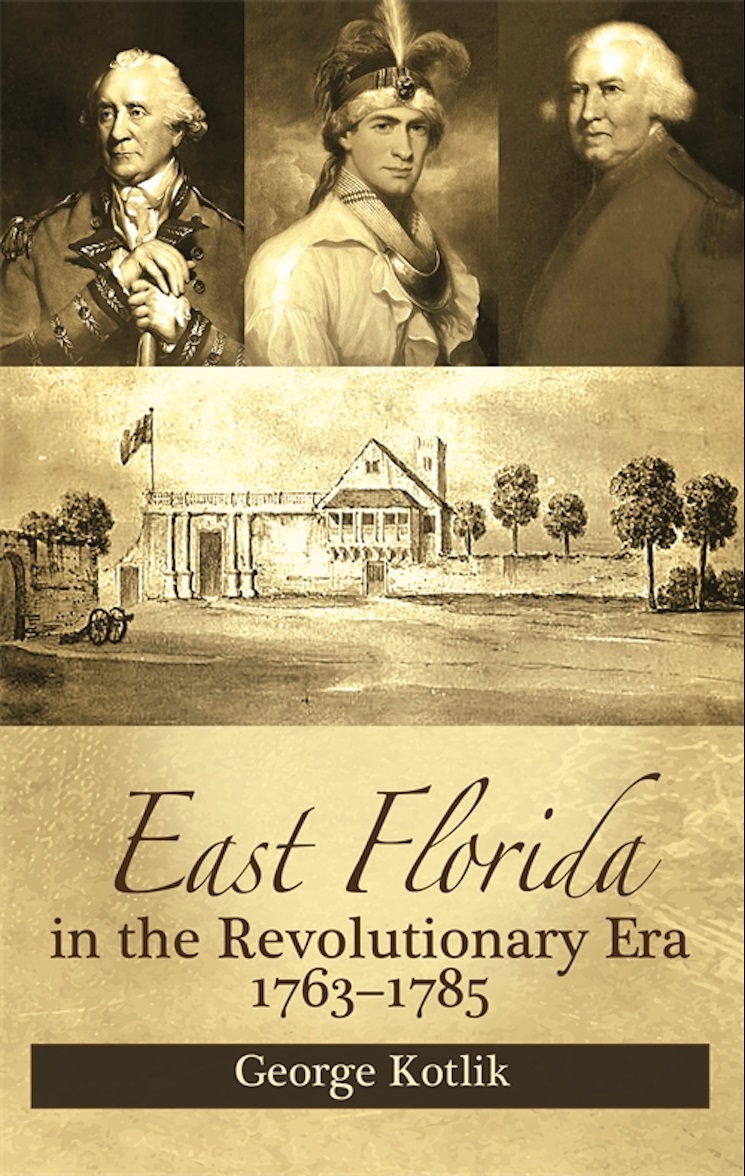
Thirteen of the Great Britain’s North American colonies moved toward independence in 1775, declaring the fact officially the following year with the issuance of the Declaration of Independence. Perched below these thirteen rebellious provinces was the colony of East Florida. Earned after the Seven Year’s War by Great Britain from Spain, the most populous city an oldest permanently established European metropolis was St. Augustine, which was also the capital of the colony. This colony, through the eight years of the American Revolutionary War, had a tenuous connection with their neighbors to the north. Largely forgotten in the pantheon of history describing this period, from the time of Britain gaining possession in 1763 through the end of the Revolutionary era in this historian’s estimation, in 1785.
Entitled, East Florida in the Revolutionary Era, 1763-1785 and penned by George Kotlik, a historian specializing in 18th century North American history, the publication offers “an accessible and detailed narrative of the East Florida during the American Revolution.” (pg. 8).
What ensues in the following pages is a brief yet complete overview of the military, political, social, and economic history within those years of East Florida. Some of the names in the pages are well known to enthusiasts of the American Revolutionary War era whereas others will be new names to add to the repertoire for further study. From Governor Patrick Tonyn, British general and last governor for England of East Florida to bringing attention to the William Augustus Bowles, a Maryland born Loyalist, sympathetic to the Muscogee Native Americans of East Florida who tried in vain from the last decade of the 18th century, to establish an independent state for the tribe, with British support. These are just two of the historical personas that Kotlik discusses in his narrative, the rest await you within the pages of the book!
Although no major military actions happened within the confines of the colony that does not mean the role of East Florida in relation to the American Revolution should not be marginalized. “Militias were raised, a general assembly was postponed, St. Augustine experienced a heightened British troop presence, planters between the St. Johns and St. Marys Rivers suffered at the hands of George raiding parties, and a constant threat of a Spanish or American invasion” all affected the psyches and lives of East Floridians. (pg. 104-105).
The hope from Kotlik is to provide the launching point for further discussion into the role of East Florida specifically and Florida in general during the revolutionary period. “Such a lack of coverage is a reminder for scholars to to emphasize East Florida’s presence in the war that made America.” (pg. 111). With this history in hand, Kotlik has provided the necessary overview for further exploration.
Publisher: NewSouth Books, University of Georgia Press, 2023 156 pages plus images
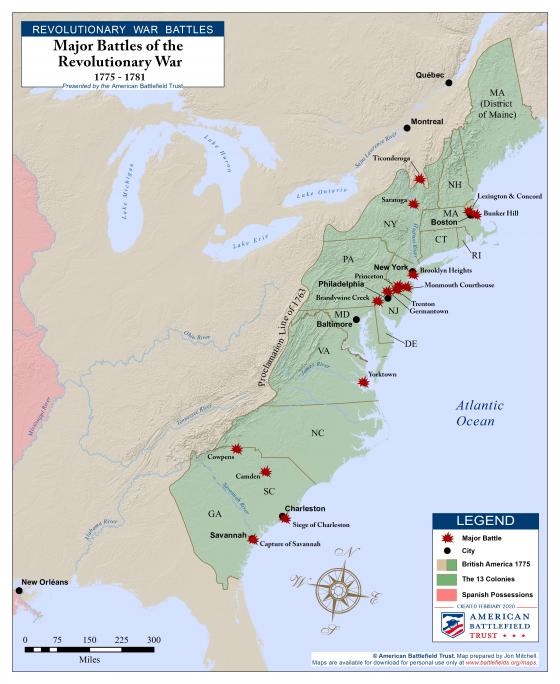
Lexington and/or Concord or both? Same question, Trenton or Princeton or both? Guilford Court House? Yorktown Battlefield? Ask any historian or history enthusiast of the American Revolutionary War period what their favorite battlefield is and you may get one of the places above. Or some other hallowed ground.
This Sunday, at 7 p.m. EDT, join Emerging Revolutionary War on our Facebook page for a panel discussion on our favorite battlefields of the American Revolution. Discussion will also include the successes, pitfalls, or failure of preservation and what one can see or not see at these sites. We look forward to a lively conversation and your comments on what is the battlefield of choice.
Thomas Paine wrote the line used as the title for this post in his pamphlet titled “American Crisis” in 1776. Most people recognize the opening lines that Paine penned in that same essay.
“These are the times that try men’s souls: The summer soldier and the sunshine patriot will, in this crisis, shrink from the service of their country; but he that stands it now, deserves the love and thanks of man and woman.”
However, on this Memorial Day, while reading through his essay, I was struck by the line I used for the title. Furthermore, by the far too numerous men who served in the militia and Continental service that lay in unknown or unmarked graves throughout the eastern United States. To them that gave the ultimate sacrifice in pursuit of the principles they held most dear, we remember on this day. To them and the thousands that came after and paid with their lives so others can have “life, liberty, and the pursuit of happiness” we also remember today on this Memorial Day.
One of the main objectives of Emerging Revolutionary War is to visit the sites attributed to the American Revolutionary War era and to provoke interest and expand learning on the people, places, and history. That includes remembering those that lay in these unmarked graves “known only to God.”
Tell me I am not the only one that randomly goes on a car ride to a random town in their home state to just “see what is there?”
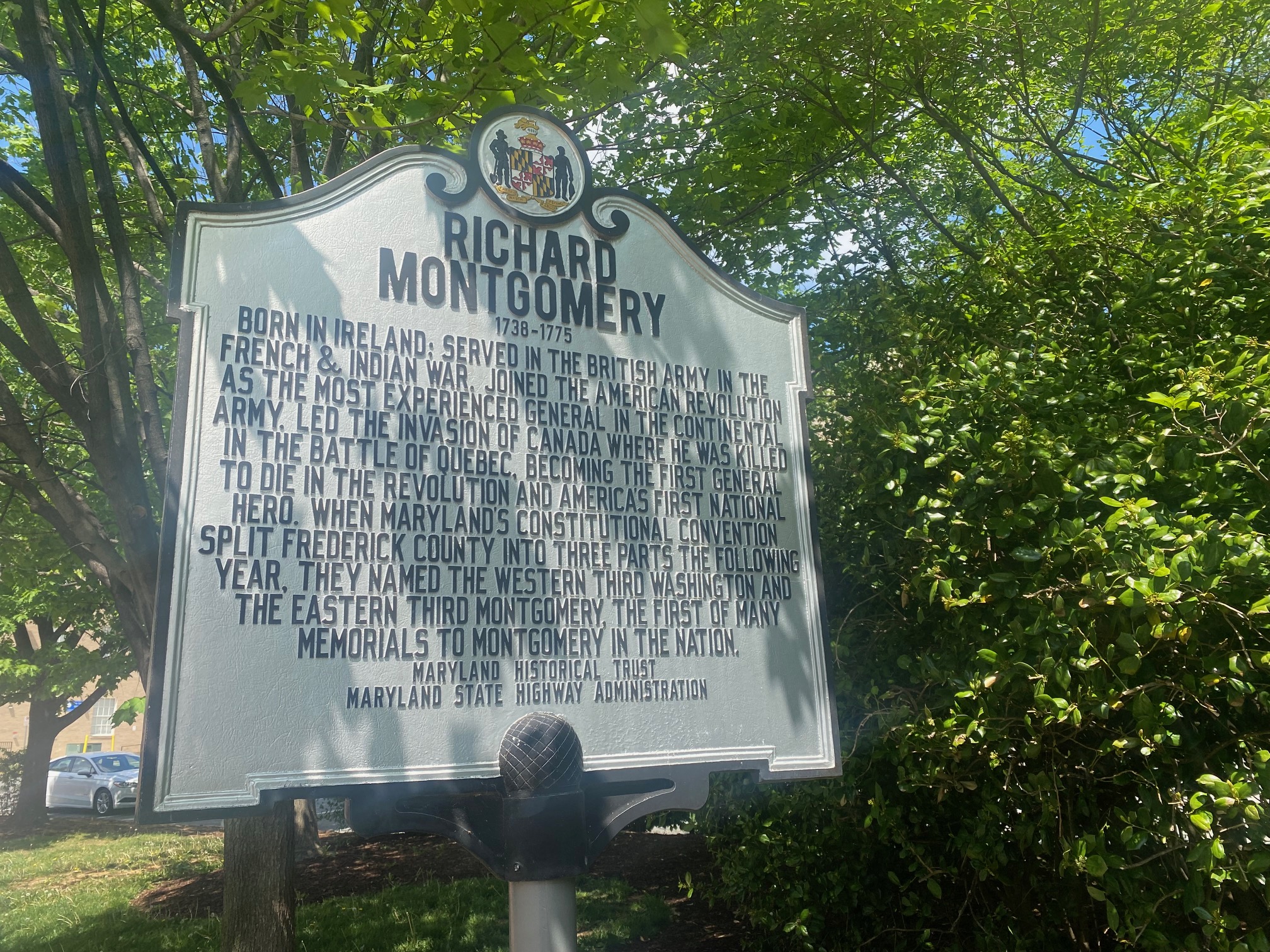
Regardless, that is what I decided to do on a sunny late April Sunday afternoon. I ended up in Rockville, Maryland. The town astride I-270 today was also on a major thoroughfare during both the 18th and 19th centuries that brought armies from the area, like General Edward Braddock’s in 1755 or General Jubal Early’s in 1864.
However, a different historical sign attracted my attention on this excursion.
I read the title and the first line, Richard Montgomery…Born in Ireland. Served..” Which was all I could read as I slowly drove by, since it is near the court house and county government buildings. Even though it was a Sunday still not wanting to speed through. So…Naturally, I pulled over, as evidenced by the vehicle you see in the background!
I knew Montgomery, as the sign reads, died at the Battle of Quebec in a futile attempt to take the city for the American cause. He was the first general–Continental–to die in the cause of American independence.
On September 6, 1776 Thomas Sprigg Wootton, who hailed from Rockville, introduced legislation in the Maryland Constitutional Convention to separate the Frederick County into three. The upper or most western half, to become Washington County, named in honor of George Washington and the lower half, or most eastern, to be named Montgomery, in honor of Richard Montgomery. The remaining middle portion would retain the name Frederick. This may be the first recorded instance in the rebellious British colonies of names of counties, towns, or cities that did not refer to something in British history or famous persons. Another act of defiance at the beginning of the American Revolution!
With a random Sunday excursion one never knows what one will find. History is all around us, beckoning to be explored.
Emerging Revolutionary War thanks historian Christian Di Spignafor the picture.
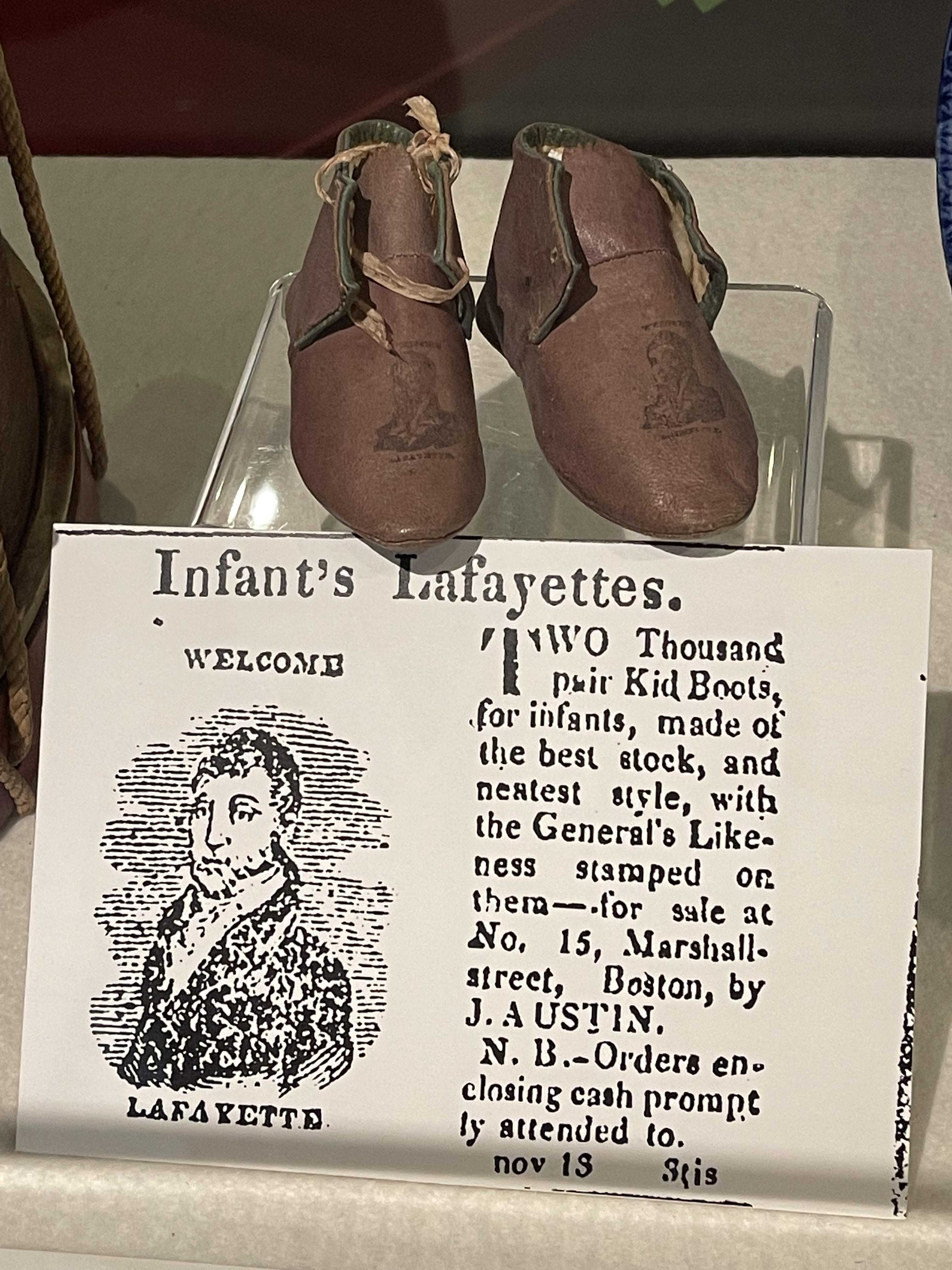
With the release of the motion picture, Air, about the recruitment to Nike of Michael Jordan in the 1980s, Emerging Revolutionary War wanted to bring our readers attention to an older model of a shoe. That predates Nike by a century and a half. But, who knows, could come into vogue again right?
The Marquis de Lafayette returned to the United States in August 1824 to September 1825 and toured all 24 states at the time. Feted as a living link to the American Revolution and the independence movement, he was dined, celebrated, and asked to speak at many, many events. Commemorative items were created in his image and likeness, including, apparently a pair of shoes.
These shoes can be viewed today at Old Sturbridge Village in Massachusetts. A link to their website and to plan a visit can be found here.
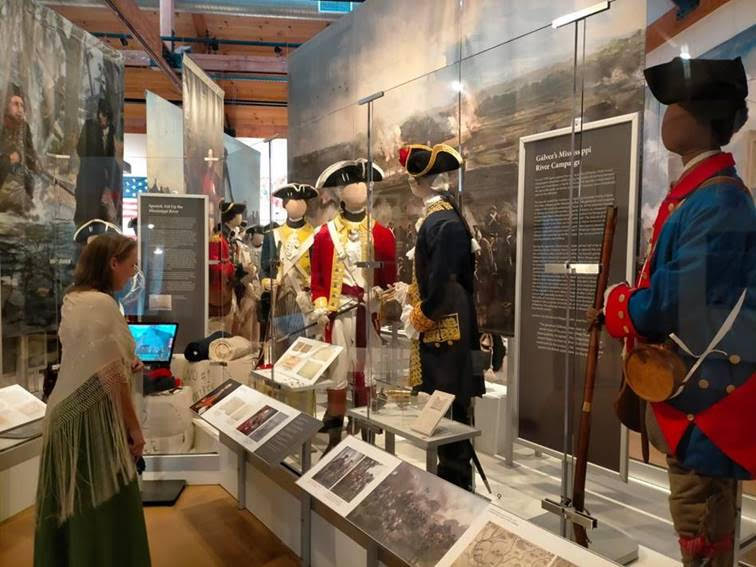
This conference will focus on the military, political, social and material culture history of the western theater of the American Revolutionary war, featuring scholars from across the U.S. and from Spain.
Location: The Sheraton Westport Plaza Hotel, St. Louis County, Missouri
Speakers and Topics:
Larry L. Nelson—”George Rogers Clark, the Illinois Campaign, and American Ambitions in the West”
Robert M. Owens – “Jean Baptiste Ducoigne, the Kaskaskias, and Pragmatic Patriotism in the Revolutionary Era”
José Manuel Guerro Acosta – “Spain and the Support for the American Revolution”
Friederike Baer – “’O, how the Mississippi is costing us many a good man!’: German Soldiers in West Florida, 1779-1781”
Frances Kolb Turnbell – “Indian Politics and the American Politics in the Lower Mississippi Valley”
Stephen L. Kling, Jr. – “An Opportunity to be Seized: The British Grand Plan to Conquer the Entire Mississippi River Valley”
Alexander S. Burns – “The Worst Looking Soldiers and the Drunkest Men to Ever Carry a Musket?: The 8th Regiment and the War in the West”
Kristine L. Sjostrom – “Valentía y Visión: Lt. Governor Fernando de Leyba and the Defense of St. Louis”
Kimberly Alexander – “O What Can These Things Tell Us: Material Culture at Revolutionary War St. Louis”
Jim Piecuch – “Fighting from Horseback: A Comparison of Revolutionary War Cavalry in the Eastern and Western Theaters”
Paul Douglas Lockhart – “For Want of a Good Musket and a Sharp Knife: Weaponry and Wilderness Warfare”
Evening Events: A cocktail reception will be held on Friday evening at 6:00pm at the Sheraton Westport Plaza Ballroom. A private party on Saturday evening at 6:30pm at the St. Charles County Heritage Museum will include a private tour of The American Revolutionary War in the West museum exhibit.
Registration: Conference registration cost including evening events: $75.00. Registration can be made through the St. Charles County Historical Society by 1) mailing a check to The St. Charles County Historical Society, 101 S. Main St., St. Charles, MO 63301, Attn: Joan Koechig; 2) credit card or PayPal by calling at (636) 946-9828 MWF, 10am-3pm; or 3) online at scchs.org. Registrations are limited and will be filled on a first come, first served basis. Questions, call Melissa at: (314)-561-5077. NOTE, online registration will be available starting April 19, 2023.
We are happy to welcome Eric Sterner to our Third Annual Symposium on the American Revolution, co-hosted with Gadsby’s Tavern Museum, The Lyceum and Emerging Revolutionary War. This year’s theme is “The World Turned Upside: The American Revolution’s Impact on a Global Scale. We asked Eric to answer a few questions about their talk and their passion for history.
Eric Sterner is a writer focusing on American history, particularly the Revolutionary War and Civil War. He writes frequently for the Journal of the American Revolution (http://allthingsliberty.com) and blogs regularly at the Emerging Revolutionary War Era (http://emergingrevolutionarywar.org) in addition to contributing to other publications over the years. Westholme Publishing released his book: Anatomy of a Massacre: The Destruction of Gnadenhutten, 1782 in 2020. He is currently working on a micro history of the Crawford Campaign (1782) and a survey of George Rogers Clark’s Illinois Campaign (1778-1779).
In his prior life, Eric worked in the fields of national security and aerospace, holding senior staff positions for two different Congressional committees and serving at the Department of Defense and NASA. In the private sector, he worked in the fields of national security policy analysis and telecommunications and then held fellowships at the George C. Marshall Institute and the American Foreign Policy Council. At both places, his work focused on national security, cyber-power, and space policy and appeared in the academic, trade, and popular media. He also taught graduate courses in cyber power at Missouri State University, Georgetown, and George Washington University. He holds a Bachelor’s Degree in Soviet and International Studies and
What first attracted you to the study of early American history? What keeps you involved in the study of this history? Do you find these things are the same or different?
I was born in the Land of Lincoln, but as a kid, we often visited our grandparents outside Philadelphia, touring the local sites. My great-grandfather sometimes took us on walks through Valley Forge and the memories stuck. History became a hobby after that, but stories about real people and events always held more fascination than fiction. So, when the opportunity came later in life to pursue that interest with intensity, it was only natural to take it.
Why do you think it is important for us to study the Revolutionary Era?
We still wrestle with many of the same questions as the founding generation: what conditions warrant rebellion, how to prevent the abuse of power, how to secure individual liberty, how to determine and enact the majority’s will, etc. Despite their limitations, that generation’s answers to those questions are still relevant and illuminating.
What do you think was the most significant foreign impact on the American Revolution?
France’s declaration of war and alliance with the United States, followed by Spain’s declaration of War on Great Britain, transformed the Revolution into a global struggle. The stakes grew exponentially from an imperial and philosophical perspective and Britain immediately had to change its strategy.
What are some of the important lessons of the American Revolution do you think are still relevant today?
Warfare always exacerbates a tendency towards extremism, dehumanization, and excess, often reducing people to the most base instincts. Somehow, the Revolutionary War generation managed to overcome—in the main—the disastrous effects of these tendencies. While they failed to adhere to their ideals in many ways, principally by in leaving the institution of slavery in tact, the the fact that they managed to bridge differences, compromise, and create a republic in the aftermath of a war with so many facets is remarkable. Understanding how they did that and what it might require of us would serve the United States well 250 years later.
What was it about the American Revolution that elicited such global interest?
It is easy to focus on the effects of a colonial rebellion on European states with colonies all over the world. Clearly, a successful rebellion had implications for those colonies. But, Enlightenment ideas also popular in Europe ranged from the rationalization and efficiency of government institutions to more well-known and celebrated concepts of human individuality and the sources of sovereign authority. In many ways, the American Revolutionary Era was the first real-world test of those ideas. Thus, whether one opposed the Revolution for imperial reasons or supported it for philosophical ones, it could not help but fascinate the world.
Join us for our Third annual Emerging Revolutionary War Symposium on September 24, 2022. Emerging Revolutionary War is excited to continue our partnership with Gadsby’s Tavern Museum and The Lyceum of Alexandria, VA to bring to you a day-long Symposium focusing on the American Revolution.
Registration fee is now only $60 per person and $50 for OHA members and students. If you feel more comfortable attending virtually, the fee is $30. To register visit: https://shop.alexandriava.gov/EventPurchase.aspx
It’s nearly 25 years ago now. I was driving through western North Carolina, on my way south to Cowpens National Battlefield located in Gaffney, SC, scene of the January 17, 1781, battle.
These were the days before the internet or GPS. Travelers of the day, such as I, depended solely on our wits and a good old-fashioned state map. I had recently finished reading a wonderful biography on the life of American frontiersman, Daniel Boone by John Mack Faragher. So, when I crossed a bridge over the Yadkin River, I knew I was in Boone country.
The Boone family had migrated south from Exeter Township, in Berks County, PA in 1750. The father of Daniel, Squire Boone, Sr, had purchased land in the Yadkin Valley. It’s where young Daniel Boone took his bride, Rebecca Bryan, and where the couple would be domiciled longer than anywhere else they would live during their long marriage. This is where they would start a family of their own.
After consulting my map and the copy of Faragher’s book, I knew I was near the small community of Mocksville, south of Winston-Salem, not far off I-40. There in the old Joppa Burial Ground, can still be found the graves of Squire and Sarah Morgan Boone; the parents of the famous frontiersman.
It’s almost 25 years now since I first pulled up to this ancient cemetery; I parked in a small strip mall adjacent to it. Souvenir hunters had chipped off pieces of the grave stones over the years, so they were later encased in a small masonry wall for protection. I had almost forgotten this impromptu stop; that is until quite recently when I found myself heading south again, this time on my way to visit the Guildford Courthouse battlefield in Greensboro. Remembering the area, I decided to stop off again to pay my respects to the Boones.







 Emerging Revolutionary War Era