Mention the words “artillery” and “American Revolution” and what name instantly pops into your mind? Henry Knox.
Rightfully so.
Yet, like George Washington, Knox needed competent officers under him to successfully organize, train, lead, and develop the artillery arm of the Continental Army.
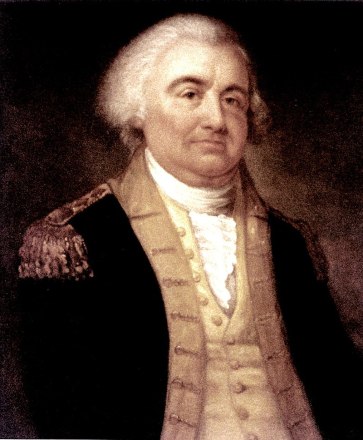
Enter John Lamb.
John Lamb
Born on the first day of 1735 in New York City, he was destined to rebel. The reason he was even born in New York City was due to the fact that his father, a convicted burglar had been sentenced for deportation to the colonies in the 1720s.
His early upbringing saw him become a prosperous wine merchant and he quickly ingratiated himself into the burgeoning patriot movement by becoming an integral part of the Sons of Liberty in New York City. Continue reading “The Other Great Artilleryman”→
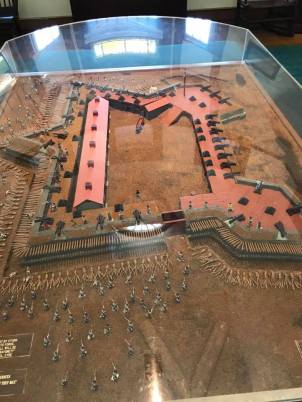
With British soldiers pouring into the fort, Colonel Ledyard ordered a ceasefire, and prepared to surrender Fort Griswold to the victorious British. However, the British disregarded the ceasefire and continuing pouring fire into the American garrison, killing or wounding nearly all of the fort’s defenders. “I believe there was not less than five or six hundred men of the enemy on the parade in the fort,” claimed American soldier Rufus Avery. “They killed and wounded nearly every man in the fort as quick as they could.”
Maj. Stephen Bromfield, the ranking British officer after Montgomery fell, called out, “Who commands this fort?” Ledyard stepped forward and responded, “I did, sir, but you do now.” Another American, Jonathan Rathbun, watched Bromfield run Ledyard through the heart and lungs with Ledyard’s own sword:
“…the wretch who murdered him [Ledyard], exclaimed, as he came near, “Who commands this fort?” Ledyard handsomely replied, “I did, but you do now,” at the same
moment handing him his sword, which the unfeeling villain buried in his breast! Oh, the
hellish spite and madness of a man that will murder a reasonable and noble-hearted officer, in the act of submitting and surrendering!”
Lt. Col. Edmund Eyre’s battalion of 800 Regulars and Loyalists landed on the east bank of the Thames River, facing tangled woodlands and swamps. The New Jersey Loyalists, in fact, had so much difficulty moving the artillery that they did not participate in the assault on Fort Griswold.
Model of Fort Griswold (author collection)
Eyre sent a Captain Beckwith to the fort under a flag of truce to demand its surrender. Ledyard called a council of war and consulted with his officers. The Americans believed that a large force of militiamen would answer the call, and that this augmented force could defend the fort. Ledyard responded by sending an American flag to meet the British flag bearer. The American told Beckwith, “Colonel Ledyard will maintain the fort to its last extremity.” Displeased by the response, Eyre sent a second flag, threatening no quarter if the militia did not surrender. Ledyard gave the same response even though some of the Americans suggested that they should leave the fort and fight outside instead. Continue reading “Part Two: The Battle of Groton Heights, September 6, 1781: The Fort Griswold Massacre”→
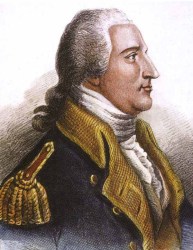
After turning coat, Benedict Arnold received a commission as a brigadier general in the British army as part of the deal that he made in order to betray his country.
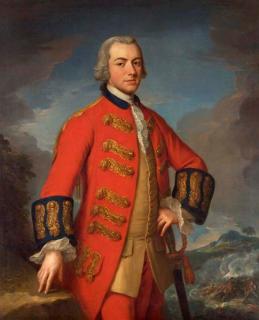
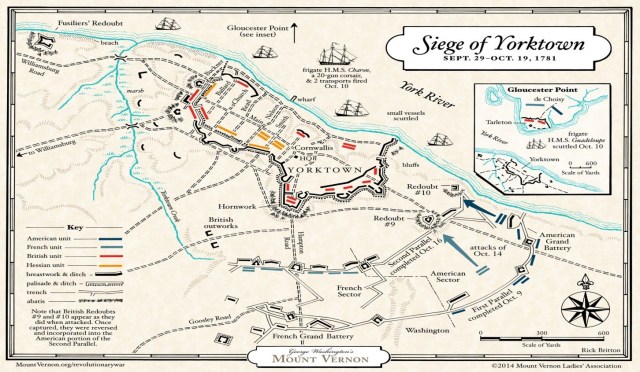
In August 1781, George Washington decided to shift forces in order to attack the army of Lt. Gen. Lord Charles Cornwallis in Virginia. Washington began pulling troops from the New York area. Lt. Gen. Sir Henry Clinton, the British commander-in-chief in America, realized on September 2 that Washington’s tactics had deceived him, leaving him unable to mobilize quickly enough to help Cornwallis. Further, there was still a significant force of Continentals facing him in front of New York, and Clinton did not feel that he could detach troops to reinforce Cornwallis as a result.
Instead, Clinton decided to launch a raid into Connecticut in the hope of forcing Washington to respond. Clinton intended that this be a raid, but he also recognized that New London could be used as a permanent base of operations into the interior of New England. Clinton appointed Arnold to command the raid because he was from Connecticut and knew the terrain.
Arnold commanded about 1,700 British solders, divided into two battalions. Lt. Col. Edmund Eyre commanded a battalion consisting of the 40th and 54th Regiments of Foot and Cortland Skinner’s New Jersey Volunteers, a Loyalist unit. Arnold himself commanded the other battalion, made up of the 38th Regiment of Foot and various Loyalist units, including the Loyal American Regiment and Arnold’s American Legion. Arnold also had about 100 Hessian Jägers, and three six-pound guns. This was a formidable force anchored by the three Regular regiments. Continue reading “The Battle of Groton Heights, September 6, 1781: The Fort Griswold Massacre”→
Emerging Revolutionary War welcomes back guest historian Malanna Henderson
Part One
“It is not for their own land they fought, not even for a land which had adopted them, but for a land which had enslaved them, and whose laws, even in freedom, oftener oppressed than protected. Bravery, under such circumstances, has a peculiar beauty and merit.” – Harriet Beecher Stowe.
The words spoken by “the little woman who wrote the book that started this Great War,” so said Abraham Lincoln, according to legend, upon meeting Mrs. Stowe sometime in 1862, rang true for black patriots in the Civil War as well as those in the Revolutionary War.
The Smithsonian tome, The American Revolutionary War: A Visual History quotes a Hessian officer in 1777, as saying, “No regiment is to be seen in which there are not Negroes in abundance and among them are able-bodied and strong fellows.”
In every battle of the Revolutionary War from Lexington to Yorktown; black men, slave and free, picked up the musket and defended America; and yet, many historians as well as visual artists have omitted their contributions in the history books and their images on canvases depicting historic battles. The need for white historians to “overlook,” “underestimate,” and or “erase,” these sacrifices is a gross negligence that distorts and misrepresents American history; and furthermore, it continues to disenfranchise the patriotic heroes of the past and malign the self-image of millions of Americans today simply because of the color of their skin.
Black soldiers have always fought two wars simultaneously; wars declared by their government and the unspoken wars at home for liberty, equality and before the Civil War, for citizenship.
What kind of men fight for the liberty of others when their own liberty isn’t guaranteed?
True patriots: James Armistead Lafayette was one such person.
James Armistead Lafayette (1760-1832) Blackpast.org
Slaves serving in the rebel military was a question that manifested itself early amongst the colonial government agencies. Their presence rankled many, while others welcomed them and praised their bravery. Some men of color had fought gallantly and with distinction as they stood alongside their white compatriots, defenders of liberty on the Lexington Green in April of 1775.
For instance, in the Battle of Bunker Hill, Peter Salem, a slave, served with courage under fire, as varying accounts reported. Salem was introduced to George Washington as “the man who shot Pitcairn,” the British Royal Marine Major who shouted to his men before Salem shot him down, “The day is ours.” Despite the competence and bravery of such men on the battlefield their exploits didn’t convert the wide-spread reluctance of most colonists to accept black men as soldiers.
General George Washington, Commander-in-Chief of the Continental Army, harbored the same common prejudices of the southern-planter ruling class of which he was a member. In July, he instructed recruiters “not to enlist any stroller, negro, or vagabond, or person suspected of being an enemy to the liberty of America.” Commanders in each colony and regiment made up their own minds. Some ignored his command. Their decision was based on need and experience. Those who had already served successfully with black militia and minutemen may have seen no cause to alter their regiments.
By December of 1776, Washington back-pedaled on his decision, allowing for black veterans of Lexington, Concord and Bunker Hill to serve; but of the slave, he maintained his objection. However, some junior officers appreciated the contributions of blacks. Col. John Thomas wrote John Adams on October 24, 1775, “We have negroes, but I look upon them as equally serviceable with other men, for fatigue (labor); and, in action many of them have proven themselves brave.”
As the war raged on, the necessity for able-bodied men settled the question. White soldiers, who usually served for only a few months to a year, mustered out, died or were wounded; while others deserted. Black soldiers who expected to receive their freedom if they served were in the war for the duration. This was a positive factor for the commanding officers who had to re-train all new recruits. Around five-thousand blacks served in the Revolutionary War as soldiers. However, a vast unknown number provided a myriad of support services.
Another reason the colonials reconsidered enlisting blacks was the bold military tactic that occurred in November of 1775. Lord Dunmore, the last royal governor of Virginia, ratified a proclamation freeing all indentured servants and slaves of rebels if they would fight for the British. Thousands of people fled the plantations to gain their freedom. This single act struck a devastating blow on two fronts, it threaten their economic stability and increased the tension between master and slave, with the master fearing slave revolts and the permanent loss of their property. Moreover, it upset the social order. Enslaved men serving alongside whites put them on an equal footing in the battlefield, which violated the white supremacy dogma that governed current thought and practice.
Born into slavery on December 10, 1748, in New Kent, Virginia to owner William Armistead, James enlisted in the Revolutionary War under General Marquis de Lafayette in 1781. His owner was a patriot and most likely received the bonus James would have gotten for enlisting had he been free or white. Enlistment bonuses comprised of money, land or slaves.
By the time Armistead entered the war, the efforts of Benjamin Franklin and other colonial agents had secured a military and economic alliance with the French. A long-time imperial rival of British expansion, the French provided naval ships, money and personnel.
Marquis de Lafayette (born Marie Joseph Paul Yves Roch Gilbert du Motier) was a descendant of ancient French nobility. His father, a colonel in the French Grenadiers had died in the Seven Year’s War (known as the French and Indian War in America) when the young nobleman was only two years old. The political ideals of liberty and equality espoused by the colonials matched his beliefs and fired his military ambitions. Perchance, his yearning to play a role in America’s fight for independence from British rule may have been spawned by a desire to avenge his father’s death.
Since Lord Dunmore’s Proclamation, it was easy for Armistead to gain access in the enemy camps as a runaway slave seeking his freedom. While providing varied services to the British, he gained the confidence of Brigadier General Benedict Arnold, who by now had defected to the British. He charged Armistead with scouting, foraging and spying. Armistead was able to comfortably go between both camps, in essence becoming a double spy. He carried false and misleading information to the British but provided accurate intelligence on the movement of British forces and details of their military strategies to General Lafayette.
When Arnold left Virginia, Armistead was able to deceive General Charles Cornwallis as well, who rampaged through parts of Virginia and burned Richmond, the capital. He sent Colonel Banastre Tarleton to capture the entire legislative assembly, which included Daniel Boone, Patrick Henry and the governor. The plan was thwarted by an astute young man named Jack Jouett. Although, a few were apprehended, among them Daniel Boone; Jouett’s actions prevented the British from arresting the biggest prize: Governor Thomas Jefferson.
By early August, Cornwallis had made plans to establish fortifications in Yorktown, expecting reinforcements to increase his troops of approximately nine-thousand.
General Washington, in the meantime, had joined forces with Comte de Rochambeau to recapture New York. With intelligence supplied by James Armistead, they learned that Cornwallis was in Yorktown waiting for military support. French Admiral de Grasse, with a fleet of about twenty-eight naval ships, was on his way to the Chesapeake from St. Dominick (present-day Haiti). A plan to surround Cornwallis by land and sea appeared possible. The French naval fleet, along with the Washington’s Continental and Rochambeau’s French forces, headed to the enemy’s headquarters. Once Washington reached Yorktown, General Lafayette’s regiment joined him. Thus, Armistead’s accurate and meticulous reports were vital to the American victory that culminated in Yorktown on October 19, 1781.
Later Cornwallis met the Marquis at his headquarters and was flabbergasted to find his spy James Armistead present.
The Treaty of Paris in 1783 severed ties from Britain, the mother country, and established America as an independent nation. That same year, the Act of 1783 was passed freeing slaves who had fought in the Revolutionary War on their masters’ behalf. However, it excluded slave-spies. Ergo, James Armistead, who risked his life by providing information to help win the freedom of many, was himself denied freedom. Was his life in less danger operating under subterfuge as a spy amongst the British than it would have been, had he served as a soldier on the battlefield? I think not. Had his espionage been discovered, he surely would have had to forfeit his life.
After the war, Armistead was returned to slavery. Even his own master didn’t have the legal right to free him because of the Act of 1783, omitting slave-spies from emancipation.
When learning of his compatriot’s status, the Marquis penned a certificate to the Virginia legislator in October of 1784 imploring them to grant Armistead his freedom, declaring:
“This is to Certify that the Bearer By the Name of James Armistead Has done Essential Services to me While I had the Honour to Command in this State. His Intelligences from the Ennemy’s Camp were Industriously Collected and More faithfully deliver’d. He properly Acquitted Himself with Some Important Commissions I Gave Him and Appears to me Entitled to Every Reward his Situation Can Admit of. Done Under my Hand,” Richmond, November 21st 1784.
The legislator didn’t act upon the request straightaway. However, again in 1786, James Armistead applied for his freedom and it was duly granted on January 9, 1787, with a fair compensation to his master, William.
In honor of his benefactor, James Armistead added Lafayette to his surname. After emancipation, he moved a short distance south of New Kent, near Richmond, Virginia and acquired forty acres of less than suitable farmland. He married and had a family. He even owned slaves. History doesn’t tell us if he bought enslaved relatives to free them or if they were bought to farm his land as field hands.
It wasn’t until 1819 that he applied to the state legislature for financial assistance to ease his poverty. This time, the response was immediate; he received $60 and an annual pension of $40 for his service during the Revolutionary War.
Unlike James Armistead Lafayette, many blacks who worked as laborers, guides, messengers and spies were not as fortunate. Whether they were pressed into service or willingly answered the call, most neither received their freedom nor wages for their behind-the-scene contributions to the war.
In 1824, the Marquis de Lafayette visited the United States and was lauded as a hero of the American Revolutionary War in Richmond with festivities and a parade. Spying Armistead in the crowd, it is said he halted the procession, dismounted from his horse and embraced his old comrade.
Kareem Abdul-Jabbar and Alan Steinberg Black Profiles in Courage: A Legacy of African-American Achievement. (New York: William Morrow and Company, Inc.1996) pages 32-34.
Col. Michael Lee Lanning (Ret.) Defenders of Liberty: African Americans in the Revolutionary War. (New York: Kensington Publishing Corp. 2000) pages 45-46; 130
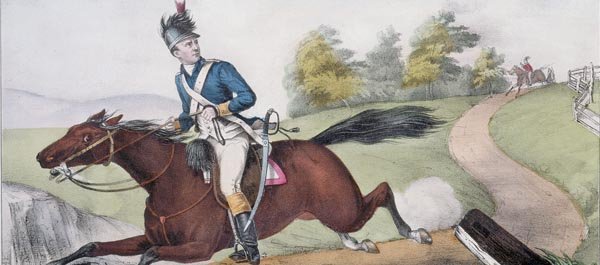
The past few months of John Champe’s life were probably the most memorable. In the fall he was asked to go on a mission to capture the recent traitor Benedict Arnold. The mission was ordered by George Washington himself and only known to Washington and “Lighthorse” Harry Lee. Champe, a trusted member of Lee’s Legion, was promised a promotion for undertaking the daring mission. He successfully fled from the American camp, gained the trust of British General Sir Henry Clinton and Arnold and was given a commission in Arnold’s Loyalist regiment. He worked with patriots in New York and recruited others to help him in his plan to kidnap Arnold. Now it was December and the next day was the day to kidnap Arnold and return him to Washington.
Then the day before the kidnapping was planned, Clinton set into motion a plan to finally use Arnold militarily. Arnold would take his Loyalist troops and some British regulars and invade the Virginia Capes. Virginia had largely dodged the hardships of war and Clinton believed this would be a great opportunity for Arnold to prove himself. With only Virginia militia located in the colony, Arnold should have no problem wreaking havoc on the Commonwealth.
These new developments ruined Champe and Lee’s plans. When Arnold got orders from Clinton, he moved his headquarters – one day before Champe was to carry out his plan. Furthermore, Champe was also moved to another part of New York and was not able to get word to Lee that the plan was off. Lee and his dragoons waited and waited at Hoboken with no sight of Champe. Soon Lee returned to camp without any word on what happened to Champe. Lee and Washington worried that the worst had happened and Champe was “discovered.”[i]
Grave at John Champe, Prickett Cemetery, Fairmont, WV
Champe soon found himself on a transport in New York harbor with Arnold’s “American Legion.” The destination was unknown to most of the men. Soon though Champe learned that he was to be part of an invasion force against his native state! The thoughts that must have gone through his mind; he had risked everything to capture Arnold – labeled a deserter and now he would have to go into battle against his fellow Virginians. The two week trip to the Virginia Capes must have afforded Champe plenty of time to ponder how close he was coming to succeeding and now what he was called upon to do.
Champe was involved in most of Arnold’s campaign against Virginia. He was part of the force that captured Richmond and found himself in several battles and skirmishes against his fellow Virginians. Arnold was replaced by Gen. William Philips and soon Cornwallis’s army joined Philips in Virginia in May 1781. Sometime after this, Champe was able to “escape” the British army and headed west to the Blue Ridge Mountains. Champe then worked his way south and finally by July he was back with Lee who was then with Nathaniel Greene’s army in the Carolinas. Lee was delighted to see his devoted cavalryman. Surely Champe and Lee had a lot to discuss.
Though Champe was promised a promotion, it was believed by Lee and Washington that it would be too dangerous for Champe to take the field again. If he was captured, the British would surely execute him as a spy. Champe was offered an unknown sum for a reward and headed back home to Loudoun County. His legendary adventure was over.
Sergeant Major John Champe Memorial, Aldie, VA
After the war, Champe did not seek fortune or fame from his exploits. He led a simple life and was a middle class farmer. He struggled to support his family and continuously looked for cheaper and more fertile land to the west. It was due to his desire for new land that he was on a trip looking at land near Morgan Town (modern day Morgantown, WV) in 1798 where he became ill and died. Washington did not forget Champe. In 1798 Washington was appointed by President John Adams commander of the American army in preparation for war with France. Washington called on Champe to be an officer in his army, only finding out that he had recently died.[ii]
Though Champe disappeared mostly from the history books in 1781, his family fought for nearly 100 years to gain the compensation that was due to Champe. Champe was never paid a pension nor given bounty lands that were owed to him for his service. Plus, his promised promotion was never given and they argued that the owed pension should be based off of the rank that was promised him personally by Washington. Unfortunately, the mission was so secret, that very few could confirm it. In petitions filed with Congress in 1818 and 1839, Champe’s widow was finally given a life time pension, though in an amount not reflecting his rank. Finally in 1847, a Congressional act provided for compensation in the amount of $1,200 to the heirs of John Champe and granted him the promotion that was promised to him by Washington. [iii]
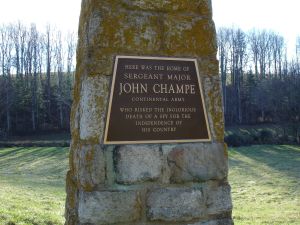
Champe has remained a local hero in Loudoun County. In 1861, a local Confederate unit went off to war as the “Champe Rifles” (8th VA Infantry). In the early 20th century, the location of his home was marked with a small obelisk (reportedly made by stone from the foundation of the home). Today the monument sits on the south side of Route 50 a few miles west of Aldie.
In 2001, his grave was finally properly marked with a head stone and a full ceremony. Most recently Champe has been bestowed the highest honor a local hero can be given, a high school in his honor. John Champe High School was opened in Aldie in 2012 and one hopes that his name and legacy will be no longer be forgotten.
Lyrics from Sergeant Champe, ca. 1781
Come sheathe your swords! My gallant boys, And listen to the story, How Sergeant Champe, one gloomy night, Set off to catch the tory
[i]The Revolutionary War Memoirs of General Henry Lee; DeCapo Press, 1998, 409.
The rectitude of the decision John Champe made on that October night to “desert” his men and “join” the British must have weighed heavily on his mind as he approached the Hudson River. The mission, offered by “Lighthorse” Harry Lee, to capture the traitor Benedict Arnold was a serious one. The only hesitation Champe felt was how his reputation and honor would be injured by his desertion. No one but Lee and Washington could know the truth, the success of the mission counted on secrecy.[i]
As Champe reached the Paulus Hook area of the Hudson River, the details are murky. Some accounts have Champe jumping into a boat along the shore and pushing off into the river and rowing to a British war ship. Other claims have Champe clearing a British patrol along the river and escorted by the patrol to a nearby ship. [ii] Either way, Champe eluded his American pursuers and accomplished the first goal of his mission, to reach the British lines.
Lee, already having established a spy network, lined up a system of couriers to communicate with Champe. By October 25th, Lee had heard from Champe and wrote to Washington that “my friend got safe to New York; he was before Sir Henry Clinton and has passed all the forms of the garrison; he accidentally met General Arnold in the street which has paved a natural way for further acquaintance; the party entertains high hope of success…”[iii]
Clinton and Arnold expected many other American officers to be inspired by Arnold and
Sir Henry Clinton
join the British army. Champe, a modest officer in a fabled unit was just the kind of man that Clinton wanted to attract. The fact that Champe was fleeing his own men who were in hot pursuit of him made the deception complete. Clinton questioned Champe about the condition of the American army and morale. Champe informed Clinton that other officers were sure to desert and Washington’s ranks were thinning with men heading home. Clinton soon trusted him to be a deserter and attached him to a unit of Loyalists that Arnold was raising.[iv]
Champe became close to Arnold and spent a lot of time with him. Champe spent a lot of time at Arnold’s headquarters at the King’s Arms Tavern on Broadway in New York City. He would take the next several weeks to study Arnold and his habits. Champe also watched for other deserters joining the British army in New York. The fear by Washington was that Arnold was acting with other American officers in defecting. Soon Champe realized that Arnold had acted alone in his treason.
Finally in early December Champe informed Lee that his plan was to kidnap Arnold one night as Arnold took his nightly walk in a garden next to his headquarters. Champe was even able to recruit fellow patriots to assist him in the kidnapping of Arnold. On the selected night, Champe would have a boat waiting for him at a nearby landing. He also had loosened some of the fence boards around the garden area so he could sneak Arnold out of the garden. After getting Arnold onto the boat, Champe would take him to Hoboken (western side of the Hudson River). There Lee and three of his dragoons would wait for Champe and his cargo. Washington insisted to Lee and then to Champe that Arnold was not to be harmed. Champe was sure of his success and spent days and weeks in planning the capture of Arnold. [v]
As the evening approached, everything was in place. He had earned the confidence of Clinton and Arnold. He was now a sergeant in the British army and spent countless hours preparing and making the necessary connections to fellow patriots in New York. The boat was prepared and waiting, Lee would be at Hoboken with his dragoons. Everything was in place to bring home the traitor Arnold.
[i]The Revolutionary War Memoirs of General Henry Lee; DeCapo Press, 1998, pg. 399.
[ii] “Sergeant John Champe and Certain of His Contemporaries”, William and Mary College Quarterly, April 1937, pg. 153.
Along Route 50, west of Aldie, Virginia is a small obelisk in the middle of a cow pasture. Thousands of car drive by the marker, not knowing what it is or who it is for. Most people that come to this area of Virginia for history are interested in the American Civil War. In this region of Virginia the legendary John S. Mosby operated behind Union lines for two years. Also here were the hard fought cavalry battles that preluded the Battle of Gettysburg. But this monument doesn’t refer to anything in the Civil War. This monument commemorates a local American Revolutionary War hero. A man that has been mostly forgotten until recently.
John Champe was born in ca. 1755 from a family that was well established on Virginia’s Northern Neck. His family owned substantial land in King George, Stafford and Prince William Counties. At some point, his family moved to the Aldie region of Loudoun County, where John was born. The men of the Champe family were involved in the local militia and civil office as road builders. Though the family had substantial land holdings and slaves, John was one of many siblings and sought out his future with the military at the outbreak of the American Revolution.
John Champe enlisted as a private in the 1st Regiment, Virginia Light Dragoons in December 1776. Champe’s abilities were quickly noticed and saw himself promoted to corporal by 1778 and then a sergeant by 1779. Champe’s abilities were quickly noticed by his commander, Major “Lighthorse” Harry Lee. Lee described Champe as “rather above the common size – full of bone and muscle; with a saturnine countenance, grave, thoughtful and taciturn – of tried courage and inflexible perseverance.” [i] Though Champe might have quickly risen in the non-commissioned ranks, he desired more. His opportunity for promotion and a date with history came on September 27, 1780 at West Point, NY.
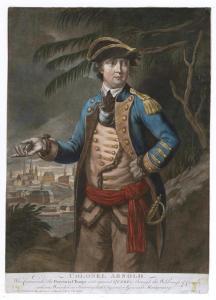
The treachery that took place on September 24th at West Point by once beloved American General Benedict Arnold is well documented. Arnold planned on turning over the fortress at West Point to the British (thus giving up the vital Hudson River). Arnold, receiving command of the post at West Point in August 1780, quickly reduced the viability of the fortifications by neglecting repairs and sending troops away from the post. Arnold’s treachery was not exposed until British officer, Major John Andre was captured, carrying on him copies of letters and Arnold’s plans. Luckily for Arnold, he learned on the morning of September 24th of Andre’s capture and he quickly fled to the HMS Vulture then on to safety in New York City.
Washington also learned of Arnold’s treason on September 24th during his planned visit to West Point. Washington reportedly took the news calmly and began to investigate the depth of treason in his officer corps. Maj. Lee assisted Washington in his investigation, and both found no evidence of other American officers involved in the plot. Washington then turned to the capture of Arnold, and that is where our “hero” comes into the story.
In October of 1780, Washington looked to Lee to find someone in his talented cavalry command that could “defect” to the British and carry out an elaborate plan to capture Arnold. Calling Lee to his headquarters, Washington and Lee discussed the proposition of capturing Arnold and how to carry out such a plan. Lee was tasked with finding someone in his command that could successfully carry out the plan. Lee soon wrote to Washington that he had two men in mind, but his top choice was a sergeant in his cavalry unit
“The chief of the two persons is a sergeant in my Cavalry; to him I have promised promotion…if your Excellency approves of what is done, the sergeant will desert from us tomorrow; the sergeant is a very promising youth of uncommon taciturnity and inflexible perseverance…I have incited his thirst for fame by impressing on his mind the virtue and glory of the act.” [ii]
Washington quickly responded and agreed to Champe’s terms of promotion and soon the mission was hatched. Champe would desert to the British and only Lee and Washington would know about it. He would be labeled a traitor and his family name tarnished. If he was captured by the Americans, he would be executed and if he was exposed as an American spy to the British, he would also be executed. Champe accepted the risk and on the night of October 21st, Champe mounted his horse and made way for the Hudson River where he hoped to find either a British picket line or ship. With him Champe carried his orderly book, saddle bags and five guineas (provided to him by Lee).
Quickly Champe was challenged by an American patrol and he quickly fled,. This is exactly what Champe and Lee wanted, for the British to believe him, his desertion had to seem real. Soon the patrol reported to Lee about Champe’s departure. Lee delayed the pursuit, by first inquiring with other patrol members. Surely a man of Champe’s stature was not defecting. Soon though Lee knew he had to order a pursuit, he just hoped Champe had put enough distance between him and the Americans to make his escape.
“Light Horse” Harry Lee
Though Lee’s delay allowed Champe some time, it was not enough to break away cleanly. As Champe was making his way to the Hudson River, the American patrol was on his heels and calling for his halt. In front of him were British warships in the Hudson River and a British patrol on the banks for the river. Now was the time of decision, he could be shot dead by the British or captured and executed by the Americans. The plan to capture Arnold and punish the traitor was already at its first “Rubicon.”
[i]The Revolutionary War Memoirs of General Henry Lee; DeCapo Press, 1998, pg. 396.
[ii] “Sergeant John Champe and Certain of His Contemporaries”; William and Mary College Quarterly, April 1937, pg. 153.
We welcome back guest historian Scott Patchan as he continues his series on Daniel Morgan.
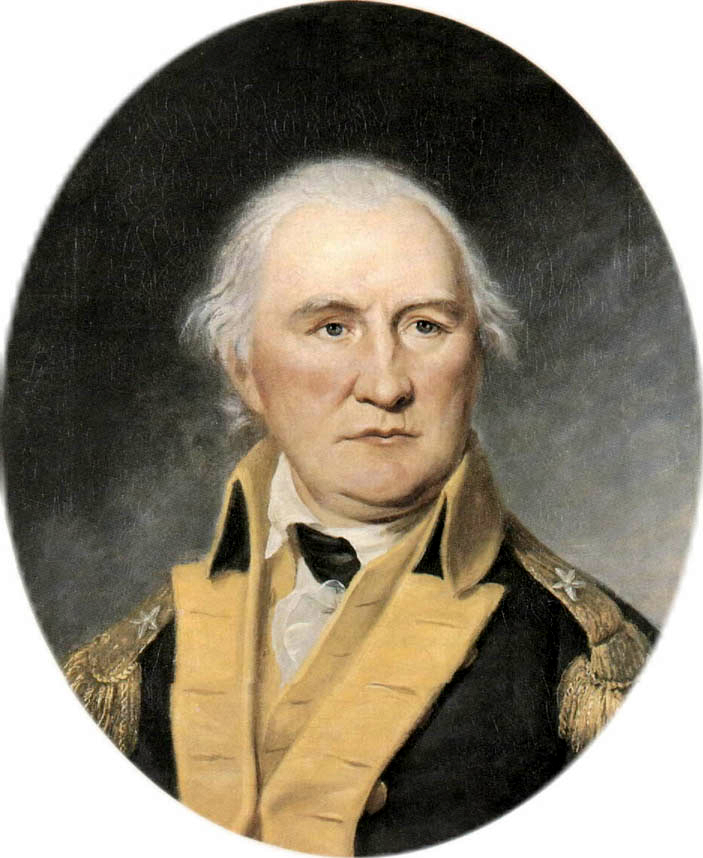
When the situation deteriorated to outright rebellion against the crown, Morgan raised a regiment of crack riflemen from Frederick County, and marched them to Boston in twenty-one days to take part in the siege of Boston. There, he served under his former commander from the French and Indian War, General George Washington. Morgan learned the hard way that orders must be followed. He once allowed his riflemen to exceed orders in firing upon British positions at Boston. Washington called Morgan on the disobedience, and Daniel thought that he would be cashiered from the army. Washington, however, relented the next day, but Morgan had learned a valuable lesson about following orders.
Daniel Morgan in the American Revolution
In the fall of 1775, Washington sent Morgan as commander of three companies of Continental riflemen on a mission to capture Quebec from the British. Morgan’s command marched with the column of Colonel Benedict Arnold. They traversed the Maine wilderness, rowing up stream to the “Great Carrying Place,” where carried their canoes and bateaux for great distances overland to another series of streams and lakes that took them to Quebec. As the cold weather set in, sickness and hunger overtook the column and Arnold sent those unfit for duty back to the rear. After covering 350 miles, the American arrived in front of Quebec in early November, surprising the British.
Although Morgan wanted to attack immediately and utilize the element of surprise, he was overruled and the small American force besieged Quebec, waiting for another column under General Richard Montgomery to arrive from the Hudson Valley. When a British party sallied forth and captured one of Morgan’s riflemen on November 18, Arnold believed the British would come out and fight in the open. As such, Arnold drew up his army in front of the fortifications to meet them. They declined his offer and instead looked down on the ragamuffin Americans from the ramparts and exchanged taunts and catcalls. The overall situation frustrated the irascible Morgan, and when his men complained that Arnold was not giving the riflemen their fair share of rations, the “Old Wagoner” violently argued with Arnold, and nearly came to blows with the future traitor. Morgan departed Arnold, leaving him with angry warning about poor treatment of the riflemen. From that time forward, Morgan’s command always received their fair share of the army’s rations.
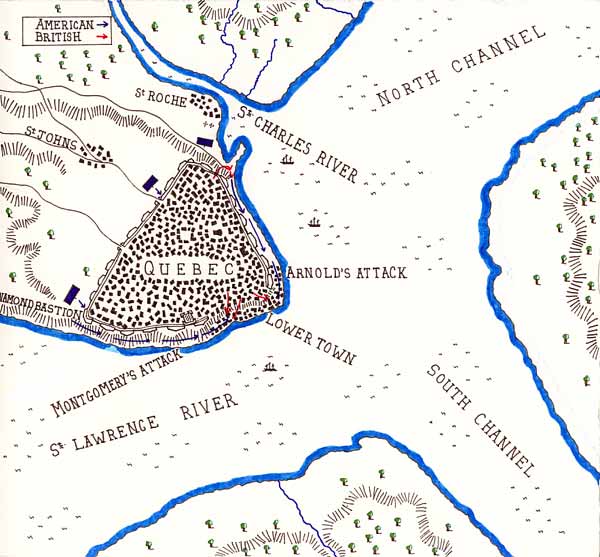
Montgomery’s column arrived on December 5, and the Americans commenced setting up his mortars and artillery outside of Quebec. The Americans finally attacked during a snowstorm in the early morning darkness of December 31, but their force numbered only 950 men. Arnold’s column came under fire as it moved toward the ramparts of Quebec, and a musket ball struck Arnold taking him out of action. Although Morgan was not the senior officer, the others insisted that he take command, having seen actual combat which they had not. Morgan later noted that this “reflected credit on their judgment.” At Morgan’s order, his riflemen rushed to the front, armed with both their Pennsylvania rifles and a spontoon for the assault while some carried ladders to storm the walls. They quickly drove a small force of British away and closed in on the walls.
Map of Battle of Quebec, 1775 (courtesy of British Battles)
Morgan ordered the men up the ladders and first one gingerly began the climb. Morgan sensed his hesitancy, pulled him down and scaled it himself, shouting, “Now boys, Follow me!” The men instantly complied, and Morgan reached the top of the wall where a volley of musketry exploded, knocking him back to the snow-covered ground. The burst burnt his hair and blackened his face; one ball grazed his cheek and another pierced his hat; but Morgan was otherwise unhurt. Stunned he laid motionless on the ground for a moment, and the attack stopped, his men thinking him dead. But he soon stirred and clambered up the ladder to the cheers of his men who followed suit. This time he stopped before reaching the top, and hurtled himself over the rampart into the midst of the enemy. He landed on a cannon and injured his back and found British bayonets levelled at him from all directions. While the British focused on Morgan, his riflemen poured over the wall and came to his rescue, driving off Morgan’s would-be impalers. Morgan kept up a close pursuit of the British who offered weak resistance to the attacking riflemen. Although Morgan had broken into Quebec, the main body of Arnold’s division failed to follow the riflemen over the wall and exploit the opportunity at hand. Morgan captured much of the lower portion of Quebec with only two companies of his riflemen. He later described the breakdown that occurred:
“Here, I was ordered to wait for General Montgomery, and a fatal order it was. It prevented me from taking the garrison, as I had already captured half of the town. The sally port through the (second) barrier was standing open; the guard had left it, and the people were running from the upper town in whole platoons, giving themselves up as prisoners to get out of the way of the confusion which might shortly ensue. I went up to the edge of the upper town with an interpreter to see what was going on, as the firing had ceased. Finding no person in arms at all, I returned and called a council of war of what few officers I had with me; for the greater part of our force had missed their way, and had not got into the town. Here I was overruled by sound judgment and good reasoning. It was said in the first place that if I went on I should break orders; in the next, that I had more prisoners than I had men; and that if I left them they might break out and retake the battery we had just captured and cut off our retreat. It was further urged that Gen. Montgomery was coming down along the shore of the St Lawrence, and would join us in a few minutes; and that we were sure of conquest if we acted with caution and prudence. To these good reasons I gave up my own original opinion, and lost the town.”
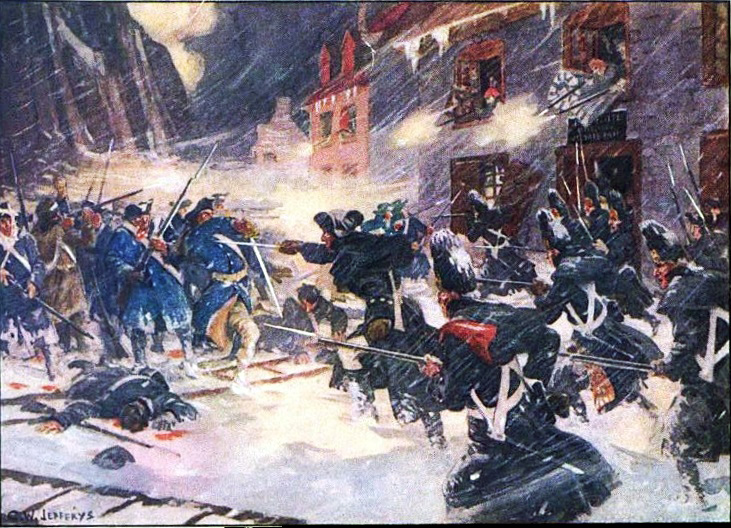
Montgomery never arrived; he had been killed in the first blast of musketry against his column, and his command broke. As time went on, the British regained their composure and pushed back against Morgan’s command. Morgan went back and brought up 200 New Englanders who joined the riflemen as they attempted to renew the attack. Now, the previously undefended point, was well manned, and daylight illuminated the paucity of Morgan’s numbers. Nevertheless, Morgan pressed them back further into the town to an interior fortification. A brave British officer led a counterattack, but Morgan personally shot him dead and disrupted the assault. Nevertheless, the time for action had passed. The British had become aware that Morgan’s was the only active American force in the city and closed in around him. In the meanwhile, additional British forces reoccupied the gates Morgan had initially taken and trapped him in the city. Morgan had no choice but to surrender his small command.
One artist’s depiction of the Battle of Quebec, 1775. Both forces are wearing blue overcoats. (courtesy of British Battles)
Morgan and the other officers enjoyed a liberal captivity with generous quarters in a seminary. The British officers visited them often and remained on friendly terms with the Americans. Morgan developed a dislike for some of his fellow officers whom he regarded as dishonest and scheming, and his fighting skills were brought to bear on at least one occasion when several men teamed up against big Dan Morgan. The imprisonment ended when the British returned the American officers on September 24, 1776, in New Jersey. Morgan returned to his wife and two daughters at his home outside of Battletown or Berryville, where he awaited his proper exchange. While there, he named his home “Soldier’s Rest,” as he recuperated from the trials of the taxing expedition to Quebec. The war was still young, and the Continental Army would soon be calling upon his services again. A special command of riflemen was being organized and Morgan would be its commander.
On April 25, approximately 2,500 smartly dressed but campaign worn uniformed invaders attacked Virginians defending their homes and hearths around Petersburg, Virginia.
One would suspect that the next few sentences would talk about the latest Union excursion against their Southern counterparts in the nine month siege that broke the back of the Confederacy.



 Instead, Clinton decided to launch a raid into Connecticut in the hope of forcing Washington to respond. Clinton intended that this be a raid, but he also recognized that New London could be used as a permanent base of operations into the interior of New England. Clinton appointed Arnold to command the raid because he was from Connecticut and knew the terrain.




 went off to war as the “Champe Rifles” (8th VA Infantry). In the early 20th century, the location of his home was marked with a small obelisk (reportedly made by stone from the foundation of the home). Today the monument sits on the south side of Route 50 a few miles west of Aldie.

 Washington also learned of Arnold’s treason on September 24th during his planned visit to West Point. Washington reportedly took the news calmly and began to investigate the depth of treason in his officer corps. Maj. Lee assisted Washington in his investigation, and both found no evidence of other American officers involved in the plot. Washington then turned to the capture of Arnold, and that is where our “hero” comes into the story.

 Emerging Revolutionary War Era