Why Tea? Events Leading up to the Boston Tea Party

As we move towards to the 250th anniversary of the Boston Tea Party, we at ERW have gotten a lot of questions with a central theme…” why was it tea that led to revolution?” Was tea so central to colonial life that it was worth risking war or was it something else? The answer is somewhere in the middle and as with most history, there is nuance to the story (and yes, tea WAS a big part of everyday live in British America).

On May 10, 1773, Parliament passed the Tea Act, this act was a way for the British government to help bail out a major corporation, the British East India Company. The British East India Company was one of the largest global companies and faced immense debt and financial trouble. Furthering their troubles, they held a large amount of tea stored in warehouses in London. The British East India Company sought a way to offload this tea, which was considered some of the best tea in the world. The company’s success was directly tied to Great Britain’s international strategy, as the company spread British influence across the globe especially in India where they basically managed the British colony. The Tea Act reduced the cost on the tea (cutting out the “middleman” in Great Britain), and now the colonists could buy the tea directly from the British East India Company.

The British colonies in North America consumed on average of 1.2 million pounds of black tea annually. In 1773, about 1/3 of the population drank tea at least twice a day. It was a common luxury among most middle- and upper-class colonists. They preferred black tea but also drank green tea. Black tea varieties included Bohea, Congou and Souchong and common green tea varieties included Singlo and Hyson. All the tea that the British East India Company sold was grown and imported from China. Tea from China was preferred by most for better flavor, but it tended to be more expensive. The North American colonies consumed a lot of smuggled tea from the Dutch, the quality of the tea was not the same but much cheaper. A large market grew for smuggled tea with most British port officials looking the other way. All of this changed when the Tea Act was passed.

Nineteenthcentury lithograph depicting a tea plantation in Qing China 

Many in Parliament believed the colonists would have little opposition to this new act. They could now purchase their preferred tea for a cheaper price than the smuggled tea from the Netherlands. Unfortunately for Royal leaders, this was not the case. As word reached the colonies Whig leaders such as Samuel Adams called it nothing more than a British authorized monopoly of the tea market, cutting into the pockets of colonial merchants (though their tea smuggling business was illegal to begin with). The Tea Act also highlighted a British policy that the colonists opposed for many years, the Townshend Acts. The Townshend Acts imposed duties on imported lead, glass, paper, paint, and tea. This “tax” was payable at ports and funded the salaries of colonial judges, governors, and other government officials. This angered many colonial leaders for two reasons. First, it levied another tax on the colonists without having their own representation in Parliament. Secondly, it made the government officials more beholden to the British government (and the tax) than the colonial governments.

Whig groups like the Sons of Liberty used local taverns as places for their meetings. The most famous being the Green Dragon Tavern in Boston. It no longer stands today.

As the news of the Tea Act reached the colonies, the reaction was mixed. Whig leaders in major cities such as Charleston, New York, Philadelphia and Boston saw it as a way to reinvigorate their cause of opposing British rule. Recently things were mostly quiet with little interest by the public for protest. But now the Whig spin machine went into full affect. The Tea Act was a direct affront to colonial self-rule and economic interest. The taxes paid for the tea went to British officials in the colonies and the cheaper priced (and better quality) tea would put many American merchants out of business. Whigs were able to control the message that the Tea Act was just another way for Parliament to make money off the colonists, who did not have representation in Parliament.

As part of the Tea Act, consignees were appointed to oversee the sale of tea and the collection of the taxes on behalf of the British East India Company. As the tea began to arrive in colonial ports, public pressure was put on consignees to resign. This pressure was successful in New York, Philadelphia and in Charleston. Each of these cities were able to either stop the tea from being offloaded or, as in the case of Charleston, they confiscated the tea and didn’t allow any duties to be paid on it. All of these were direct affronts to the law but the events in Boston proved to be the most dramatic.
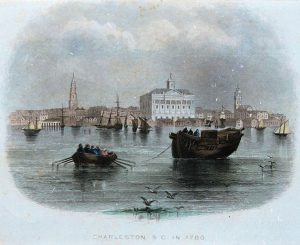
Ca, 1780 view of Charleston Harbor, and the Exchange Building where the confiscated tea was locked away by Whig leaders.

Unlike in other port cities, the consignees in Boston refused to resign. Richard Clarke, leading merchant in Boston and one of consignees faced a mob at his warehouse trying to pressure him and the other consignees to resign. Encouraged by the Massachusetts Governor Thomas Hutchinson (who had two sons serving as tea consignees) to stand their ground, the consignees refused to resign. Soon news arrived that the first ship carrying the tea, the Dartmouth, was arriving in Boston soon.

Hosting several town meetings, some hosting thousands of people, Whig leaders such as Samuel Adams, Dr. Joseph Warren and John Hancock were able to organize a strong opposition to the tea. Of course, Boston was already a tinderbox due to the “Boston Massacre” in 1770 and the large contingent of British regular troops stationed in Boston. Bostonians were reminded daily of Royal influence. The Whigs protested to the Governor to order the ships to return to England, but Hutchinson refused to do so and claimed he didn’t have that authority. Many historians believed Hutchinson, who recently had resigned as Governor and was awaiting his replacement, had grown tired and frustrated with the likes of the Whigs and Sons of Liberty in Boston and was trying to press the issue.

On November 28, the Dartmouth arrived in Boston Harbor. Captain James Hall was turned away at the first wharf he sailed too and was redirected to Griffins Wharf. Everyone knew that once a ship entered the harbor, the captain had twenty days to unload the cargo and pay the custom duties. Soon two more ships arrived at Griffins Wharf with more tea. With the Governor refusing to allow the ships to leave the harbor and local patrols watching the ships to make sure the tea was not offloaded, the stage was set for December 16th, the last day the ship’s captains had to unload their cargo.

Rev War Revelry: Old South Meeting House and the Boston Tea Party

Join us this Sunday, October 15th at 7pm as we welcome Matthew Wilding, Director of Education and Interpretation at Revolutionary Spaces. Revolutionary Spaces manages the Old South Meeting House and the Old State House in historic Boston. We will discuss the history of the Old South Meeting House and its important role in the revolutionary movement in Boston (especially during the Boston Tea Party). We will also cover their plans for the 250th anniversary of the Boston Tea Party, including their new exhibit on the destruction of property in public protests.

Grab a drink and follow along as we start to gear up for the 250th anniversary of the Boston Tea Party with Emerging Revolutionary War!

With Lucy Knox on the Home Front

Henry Knox received much of the glory and distinction in the Knox family during the war years. Yet, his wife, Lucy Knox, had much to say to her husband regrading the future if the war effort turned out successfully for the colonies. Lucy, a daughter of loyalists who ultimately sailed for England at the start of war, remained in Boston, Massachusetts while her husband rode off to war and Washington’s army. Much of her correspondence to Henry during the war focused on events in and around Boston, news from the various battlefield fronts that had reached the city, the family business, and many other assorted topics. But, she also made sure to remind Henry that upon his return home, he would no longer be in command, nor have a generalship around the house; rather he would need to be willing to share “equal command” within the household.

Read more: With Lucy Knox on the Home Front

The following letter, written on August 23, 1777, finds Lucy at home, slowly recuperating from a days-long illness. Wanting to hear more of her daily routine while he was gone, she obliged Henry’s request to write about the ebb and flow of her life at home each day. She notes her solitary lifestyle now that both her parents are gone as well as her husband but shares with him the comfort she finds when opportunity allows to spend time with friends. Lucy, like many other wives and families left behind on the homefront fears that she may be forgotten during his extended time with the army. Then, Lucy shifts to news from the war front and requests information regarding several in the army in which Henry might know. It is also evident, as the letter draws to an end, that inflation on goods, and subsequent supply thereof, has led her to need more money from her husband in which to purchase linen.

The following letter is courtesy of The Gilder Lehrman Institute of American History.

Boston August 23rd 1777 –

My Dearest Friend –

I wrote you a line by the last post just to lett you know I was alive which indeed was all I could then say with propriety for I [struck: then] had serious thoughts that I never should see you again – so much was I reduced by only four days illness but by help of a good constitution I am surprisingly better today – I am now to answer your three last letters in one of which you ask for a history of my life. it is my love so barren of adventures and so replete with repetition that I fear it will afford you little amusement – however such as it is I give it you – In the first place, I rise about eight in the morning (a lazy hour you will say – but the day after that, is full long for a person in my situation) I presently after sitt down to my breakfast, where a page in my book, and a dish of tea, employ me alternately for about an hour – when after seeing that family matters go on right, I [struck: repeair] repair to my work, my book, or my pen, for the rest of the forenoon – at two oclock I usually take my solitary dinner where I reflect upon my past happiness when I used to sitt at the window watching for my Harry – and when I saw him coming my heart would leap for joy – when he was all my own and never happy from me when the bare thought of six months absence would have shocked him – to divert these ideas I place my little Lucy by me at table – but the more engaging her little actions are so much the more do I regret the absence of her father who would take such delight in them. – in the afternoon I commonly take my chaise, and ride into the country or go to drink tea with one of my few [struck: acquaintance] [inserted: friends]. They consist of Mrs Jarviss Mrs Sears Mrs Smith Mrs Pollard and my Aunt Waldo – I have many acquaintance beside these whom I visit but not without ceremony – when with any of [inserted: the] former I often spend the evening – but when I return home – how shall describe my feelings to find myself intirely alone – to reflect that the only friend I have in the world is at such an imense distance from me – to think that [inserted: he] may [inserted: be] sick and I cannot assist him ah poor me my heart is ready to burst, you who know what a trifle would make me unhappy, can conceive what I suffer now. –

when I seriously reflect that I have lost my father Mother Brother and Sisters – intirely lost them – I am half distracted true I chearfully resigned them for one far dearer to me than all of them – but I am totaly deprived of him – I have not seen him for almost six months – and he writes me without pointing out any method by which I may ever expect to see him again – tis hard my Harry indeed it is I love you with the tenderest the purest affection – I would undergo any hardships to be near you and you will not lett me – suppose this campaign should be like the last carried into the winter – do you intend not to see me in all that time – tell me dear what your plan is –

I wrote you that the Hero Sailed while I was at Newburg – She did but has [jnserted: been] cruiseing about from harbour to harbour since – to get met – she is now here, and will sail in a day or two for france –

I wish I had fifty guinies to spare to send by her for necessarys – but I have not – the very little gold we have must be reserved for my Love in case he should be taken – for friends in such a case are not too common. – I am more distressed from the hott weather than any other fears – God grant you may not go farther south’ard – if you should I possitively will come too – I believe Genl Howe is a paltry fellow – but happy for as that he is so – are you not much pleased with the news from the Northard we think it is a great affair and a confirmation of StClairs villainy baseness – I hope he will not go unpunished – we hear also that Genl Gates is to go back to his command. – if so Master Schuyler, cannot be guiltless – it is very strange, you never mentioned that affair in any of your letters –

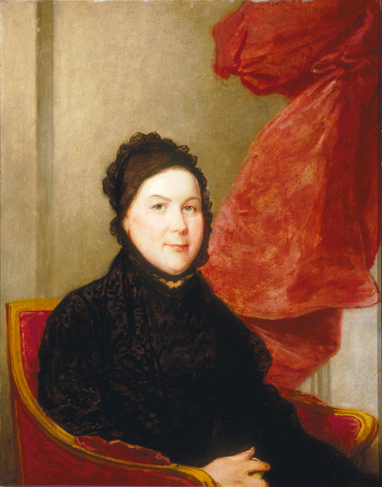
Catharine Littlefield Greene – Courtesy Telfair Museums

What has become of Mrs Greene, do you all live together – or how do you manage – is Billy to remain with you payless or is he to have a com[inserted: m]ission – if the former I think he had much better remained where he was – if he understood business he might without a capital have made a fortune – people here – without advanceing a shilling frequently clear hundreds in a day – such chaps as Eben Oliver – are all men of fortune – while persons – who have ever lived in affluence – are in danger of want – oh that you had less of the military man about you – you might then after the war have lived at ease all the days of your life – but now I don’t know what you will do – your being long acustomed to command – will make you too haughty for mercantile matters – tho I hope you will not consider yourself as commander in chief of your own house – but be convinced tho not in the affair of Mr Coudre that there is such a thing as equal command – I send this by CaptRandal who says he expects to remain with you – pray how many of these lads have have you – I am sure they must be very expensive – I am in want of some square dollars – which I expect from you to by me a peace of linen an article I can do no longer without haveing had no recruit of that kind for almost five years – girls in general when they marry are well stocked with those things but poor I had no such advantage –

little Lucy who is without exception the sweetest child in the world – sends you a kiss but where [inserted: shall] I take it from say you – from the paper I hope – but dare I say I sometimes fear [struck: what] [inserted: that] a long absence the force of bad example may lead you to forget me at sometimes – to know that it ever gave you pleasure to be in company with the finest woman in the world, would be worse that death to me – but it is not so, my Harry is too just too delicate too sincere – and too fond of his Lucy to admit the most remote thought of that distracting kind –away with it – don’t be angry with me my Love – I am not jealous of you affection – I love you with a love as true and sacred as ever entered the human heart – but from a diffidence of my own merit I sometimes fear you will Love me less – after being so long from me – if you should may my life end before I know it – that I may die thinking you wholly mine –

Adieu my love
LK

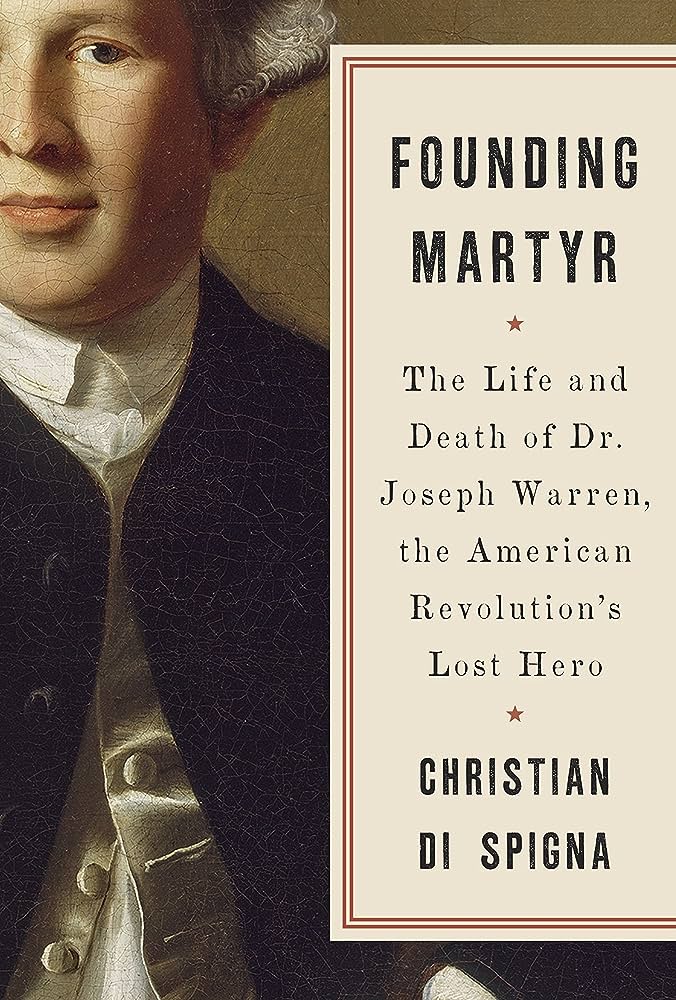
“Rev War Revelry” Founding Martyr Dr. Joseph Warren

Dr. Joseph Warren is considered by many “the lost hero of the American Revolution.” Warren was the brainchild of the revolution movement in Boston. Warren was involved in almost every major insurrectionary act in the Boston area for a decade, from the Stamp Act protests to the Boston Massacre to the Boston Tea Party, and his incendiary writings included the famous Suffolk Resolves, which helped unite the colonies against Britain and inspired the Declaration of Independence.

Joining Emerging Revolutionary War will be historian and author Christian Di Spigna. He is the author of Founding Martyr: The Life and Death of Dr. Joseph Warren, the American Revolution’s lost hero. He is the Executive Director of the Dr. Joseph Warren Foundation and is the vice chairman for the Revolution 250 committee of Massachusetts Freemasons. He also serves on the board of the Bunker Hill Monument Association.

As we approach the 250th commemoration of the Boston Tea Party, we will focus on Warren’s life, his role in the Boston Tea Party and his lasting impact on the Revolution. Grab a drink and join us as we talk with author and historian Di Spigna about Warren, the patriot who once said…

“When Liberty is the prize, who would shun the warfare? Who would stoop to waste a coward thought on life?”

See you Sunday at 7 p.m. EDT on Emerging Revolutionary War’s Facebook page!

“Rev War Revelry” Sails into Boston Harbor to talk Tea Party

On December 16, 1773, a protest orchestrated by the Sons of Liberty in Boston, Massachusetts turned words into action. Upset over recently passed legislation and the belief that “no taxation without representation” 116 people dumped 342 chests of tea owned by the British East India Company into Boston Harbor. The event was one of the milestones on the way to the American Revolution and American independence. As the Boston Tea Party, as it is known to history, closes in on its 250th anniversary, Emerging Revolutionary War will invite Evan O’Brien, the creative director for the Boston Tea Party Ships and Museum this Sunday, June 25, evening for the next “Rev War Revelry.”

We hope you can join us at 7 p.m. EDT on Emerging Revolutionary War’s Facebook page for a discussion of the history behind and on December 16, 1773 and the efforts to commemorate and interpret that time frame. If you are contemplating venturing up to Boston in December to be in the city for the 250th anniversary of this event, you will not want to miss this discussion, as Evan will share some of what the museum has been planning to commemorate when Boston Harbor became a “tea-pot.”

Financial Assistance for a Veteran

Peter Kiteridge was born into slavery in Boston, Massachusetts and worked in the household of the Kittredge family, from Andover, Massachusetts. Although slavery is most often associated with the southern colonies, and later the southern states, it was an established institution across the the thirteen original colonies at the time of the American Revolution. Despite being born into the institution legalized in the colony in which he lived, African American Peter Kiteredge cast his lot with those fighting for the cause of independence. The Kitteridge family had as well. Many in the extended family of Kittredges were physicians, and Dr. Thomas Kittredge went on to serve as as surgeon for Colonel James Frye’s regiment (Essex County Regiment) that was raised in Andover. In May 1775, the regiment became part of the Army of Observation. During the war, Peter Kittredge served in Captain William H. Ballard’s company of Colonel James Frye’s regiment. Peter joined the army in 1775 or 1776, according to his memory over thirty years later, and served for five years in the army before later becoming a sailor.

Read more: Financial Assistance for a Veteran
Black Continental Soldier (T. Payton, 1997)

By the early 1800s, Peter Kiteridge was struggling both with his finances and his health. In this letter dated April 26, 1806, he noted that he is a freeman and in need of financial assistance. This document reveals much more about Peter, including the time between when he was a slave and when he went into military service. But the heart of Kiteridge’s letter was his request for assistance from the Selectmen of the town of Medfield. Due to a “complaint” that he had suffered since the war, perhaps the lingering effects of a disease contracted during his time in the service, Peter was unable to continue to work, and he asked for help to support his wife and four children. Because he later signed this petition with an “X” we can assume that his years as a slave left him illiterate. By the turn of the century, however, he was not the only veteran of the Revolutionary War that needed financial assistance. As this generation of servicemen aged, a growing demand for what later became known as veteran pensions increased. Today, veteran pension records, and petitions for assistance such as this, provide scholars a wealth of information on those that lived and served during this turbulent period.

Below you will find the full petition of the Medfield Selectman of April 26, 1806 courtesy of the Gilder Lehrman Collection.

“Gentlemen

I beg leave to state to you my necessitous circumstances, that through your intervention I may obtain that succour, which suffering humanity ever requires. Borne of African parents & as I apprehend in Boston, from whence while an infant I was removed to Rowley and from thence again to Andover into the family of Doct. [Thom] Kiteridge, with whom as was then the lot of my unfortunate race, I passed the best part of my life as a slave. [struck: At the age of twenty five] In the year of our Lord 1775 or 6 & in the twenty fifth of my age I entered into the service of the U.S. as a private soldier where I continued five years [inserted: and] where I contracted a complaint from which I have suffered in a greater or less degree ever since & with which I am now afflicted. After leaving the army to become a sailor for two years; when I quited the sea & resided for some time in Newtown, from whence I went to Natick where I remained for a short time & then removed to Dover where I [struck: remained] [inserted: carried] as a day labourer during the period of seven years. Eight years past I removed to the place where I now live, & have untill this time, by my labor, assisted by the kindness of the neighbouring inhabitants been enabled to support myself and family. At present having arrived [2] at the fifty eight year of my life and afflicted with severe and as I apprehend with incurable diseases whereby the labour of my hands is wholly cut off, and with it the only means of my support. – My family at this time consists of a wife and [struck: three] four children, three of whome are so young as to be unable to support themselves and the time of their mother [struck: has] is wholy occupied in taking cair [sic] of myself & our little ones – thus gentlemen, in this my extremity I am induced to call on you for assistance; not in the character of an inhabitant of the town of Westfield, for I have no such claim, but as a stranger accidently fallen within your borders, one who has not the means of subsistence, & in fact, one, who must fail through want & disease unless sustained by the fostering hand of your care.

I am Gentlemen your mos obedient, most humble servant.

Peter Kiteredge
His X Mark

Attent. Ebenezer Clark
Paul Hifner

To the policemen Selectmen of the
Town of Medfield.
[docket]
Medfield 26 April 1806
[docket]
Peter Kittridge
application –
[address]
To the gentlemen Select
[Men] of the Town of
Medfield – “

Americana Corner

Our monthly recap of what our good friend and fellow historian Tom Hand has written on his blog, AmericanaCorner.

The Midnight Ride of Paul Revere
October 26th

The story of Paul Revere and his Midnight Ride is one of the many fascinating subjects of the grand American past. Taking place in conjunction with the Battles of Lexington and Concord, on April 19, 1775, the tale has passed down from generation to generation. Read more here.

Forefathers Gather at Historic First Continental Congress
October 19th

The First Continental Congress was a key link in the chain of events that led to our nation’s gaining its independence from England. The brief convention brought together most of the influential leaders from colonial America to determine an answer to Parliament’s recently enacted Coercive Acts. Read more here.

The Boston Tea Party Takes Colonists Past the Point of No Return
October 12th

The Boston Tea Party is one of the most iconic moments in American history. In some ways, it sealed our fate to separate from England and become our own nation. The road that led to this watershed event began several years earlier with the Townshend Acts. Read more here.

Aftermath of the Boston Massacre
October 5th

The violence on the evening of March 5, 1770, in Boston is known to us today as the Boston Massacre. It was an unfortunate incident that left five people dead and growing anger between American colonists and leaders in England. Read more here.

Review: American Rebels, How the Hancock, Adams, and Quincy Families Fanned the Flames of Revolution

Two of the above three last names are very familiar to even casual observers of American history. John Hancock, whose signature is readily apparent at the bottom of the Declaration of Independence, where it was joined by John Adams and Samuel Adams. Yet, that last name in the title, Quincy, may not be as obvious as should be at first glance.

What is remarkable about these last names? Besides, the simple fact that members with those three surnames played a major role in the road to revolution and surprisingly on both sides of the chasm of loyalties? All could trace their roots to a small town in Massachusetts; Braintree.

“The covenant of liberty that they shared would be sharpened by ambition and envy, polished through friendships and love, and fought for in a revolution fomented by these children of Braintree” (pg. 8).

In that town, from its first inhabiting European settlers, the spirit of questioning accepted decrees took root, matured, and blossomed. And until now, the intertwining vines of those family trees had not been put under the microscope of historic observation until the publication this year of American Rebels, How the Hancock, Adams,and Quincy Families Fanned the Flames of Revolution. Penned by Nina Sankovitch an Illinois native, author of several nonfiction works, and resident of New England, she effortlessly weaves the stories of these families into part biography, part family history, and part United States history. All parts equally important and very well written.

“Even as the fortunes of these children of Braintree diverged, their futures would bring them together again. A shared promise connected them, fostered by the history, the land, and the people of Braintree…” (pg. 8)

One of the highlights in the book is the emergence of the Quincy family into a popular history such as this. One of the unsung heroes of the road to revolution was Josiah Quincy Jr.

“As Reverend Hancock preached, the “solemn covenant….of their Liberty” was not obtained through faith alone but could only be realized through hard work performed by a community together. And this sacred covenant would be protected against any and all usurpers who attempted to take their liberty away.” (pg. 15).

Furthermore, Sankovitch brings to the forefront the role of women in the various families and their impact on the time. The best known is Abigail Adams who is the confidant and intellectual equal of her husband, John. Another is the aunt of John Hancock, Lydia, who constantly watches out for John’s place in society. She is the driving force that will bring to fruition the connection between the Quincy and Hancock families. Or Abigail Quincy, who had married Josiah Quincy, Jr., would never remarry but dedicated the rest of her days to raising their son and preserving his memory and contributions to the cause of America. The anguish of losing her beloved is quite evident:

“I have been told that time would wear out the greatest sorrow, but mine I find is still increasing. When it will have reached its summit, I know not.” (pg. 348).

Highlighted by the quote above, the author brings these historic personas and people to life, capturing the heartache, familial turmoil, ambition, and connections. Just as these families bred revolutionaries, there were sons that stayed loyal to the British crown, including a brother and brother-in-law of Josiah Quincy.

From weaving the families together, to connecting the threads of the evolution of political thought, and showing the personal strains of what the road to revolution looked like, Sankovitch has compiled an easily readable, insightful look into the 18th century world.

Enjoy!

*Book Information*

Publisher: St. Martin’s Press (March 2020)

Pages: 416

A Connecticut Response to the Coercive Acts

On December 16, 1773, Bostonians dumped 340 chests holding 92,000 pounds or 46 tons of East India Company tea into the harbor. Due to the distance news had to travel across the Atlantic Ocean and then for the gears of government to crank a response, it was not until March of 1774 that Lord Frederick North, his administration, and Parliament passed the Coercive Acts.

The Coercive or Intolerable Acts as they were referred to in the American colonies were actually four acts in total, including the Boston Port Act, which closed the port to all commerce, the Massachusetts Government Act, restricting town meetings and changed the governor’s council to an appointed body, the Administration of Justice Act, which gave immunity to British officials from prosecution in Massachusetts, and lastly the Quartering Act, ordering colonists to house British troops when demanded.

Side note: A fifth act, the Quebec Act extended freedom of worship to Canadian Catholics and this decree was looped into the Intolerable Acts by the colonists.

Understandably the response in Massachusetts was one of defiance, protest, and angst and the acts are credited with promoting momentum toward independence. What was not truly appreciated by the British government was the outcry from other colonies.

On this date in 1774, the town of Farmington, Connecticut showed what the passage of the Coercive Acts meant. On May 19, a handbill, a small printed advertisement or notice, was distributed around the town inviting the inhabitants to a gathering to honor “the immortal Goddess of Liberty.”

Northwest View of Farmington from Round Hill – John Warner Barber, 1836
Continue reading “A Connecticut Response to the Coercive Acts”

ERW Weekender: Boston Massacre: 250 Years and 1-Day Later

Crispus Attucks. Every American school child learned that name in a social studies or history class in grade school. On the night of March 5, 1770, Attucks, an African-American was one of the six Bostonians that was killed by British soldiers.

Known in American history as the “Boston Massacre” the tragic event was used as fodder by the Sons of Liberty and pro-revolutionary minded individuals to propel the colonies toward rupture with Great Britain.

Continue reading “ERW Weekender: Boston Massacre: 250 Years and 1-Day Later”