Congress Creates the Marine Corps, November 10, 1775

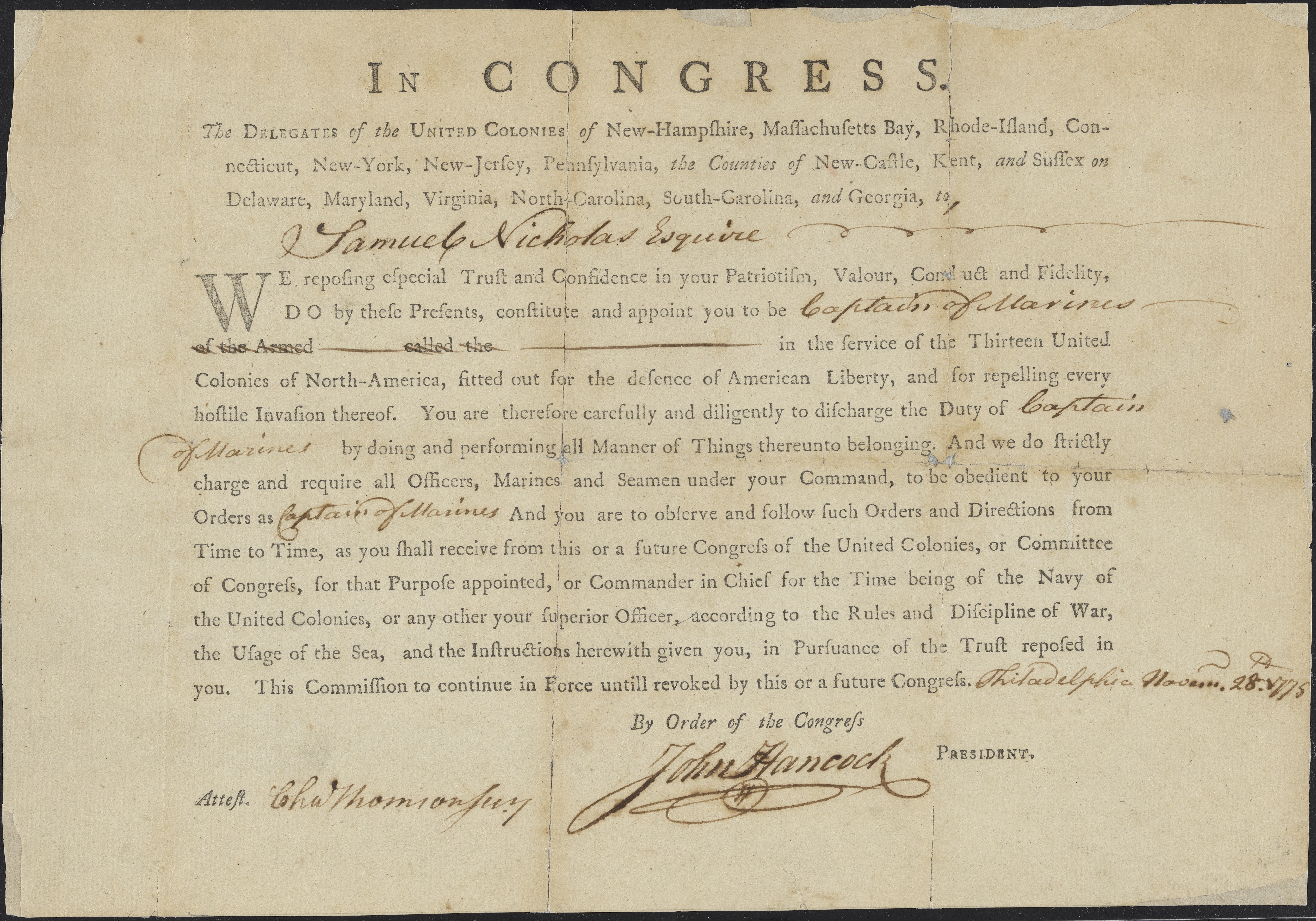
The Commission of Captain Samuel Nicholas, the first American Marine. (USMC)

Today marks the 250th birthday of the Marine Corps. November 10, 1775 was a milestone in the creation of American naval power, but the birthday story is a little more complicated.

The Continental Congress resolved to create a navy under its auspices on October 13, 1775, but much work remained to build American naval power to a point where it might serve a strategic purpose.  Individual colonies had already begun creating naval forces and George Washington had leased ships under the army’s authority.  Thus, the resolution served as more of milestone on a long road, rather than a fresh beginning.  

On October 30, the Continental Congress considered the reports of its naval committee and confirmed recommendations for two vessels of 14 and 10 guns.  Moreover, it resolved to add two more ships to its burgeoning navy, one of 20 guns and one carrying up to 36 guns.  It also added four new members to the naval committee, bringing it to a total of seven.  Stephen Hopkins (RI), Joseph Hewes (NC), Richard Henry Lee (VA), and John Adams (MA) joined John Langdon (NH), Silas Deane (CT), and Christopher Gadsden (SC).[1]  On November 2, Congress gave the naval committee authority to call on the treasury for up to $100,000 to acquire a navy and delegated to the committee the authority to recruit officers and seamen, offering them prize money in the amount of one-half the value of all warships and one-third the value of transports made prizes.[2]  It also took up a petition from a Committee of Safety in Passamaquoddy, Nova Scotia to join the association represented by the Continental Congress.  Naturally, Congress appointed a committee—Silas Deane, John Jay, Stephen Hopkins, John Langdon, and John Adams to consider the matter.  The naval expansion and Passamaquoddy petition sparked a new round of thinking about American naval power.
An October 1775 Birthday for the Continental Navy

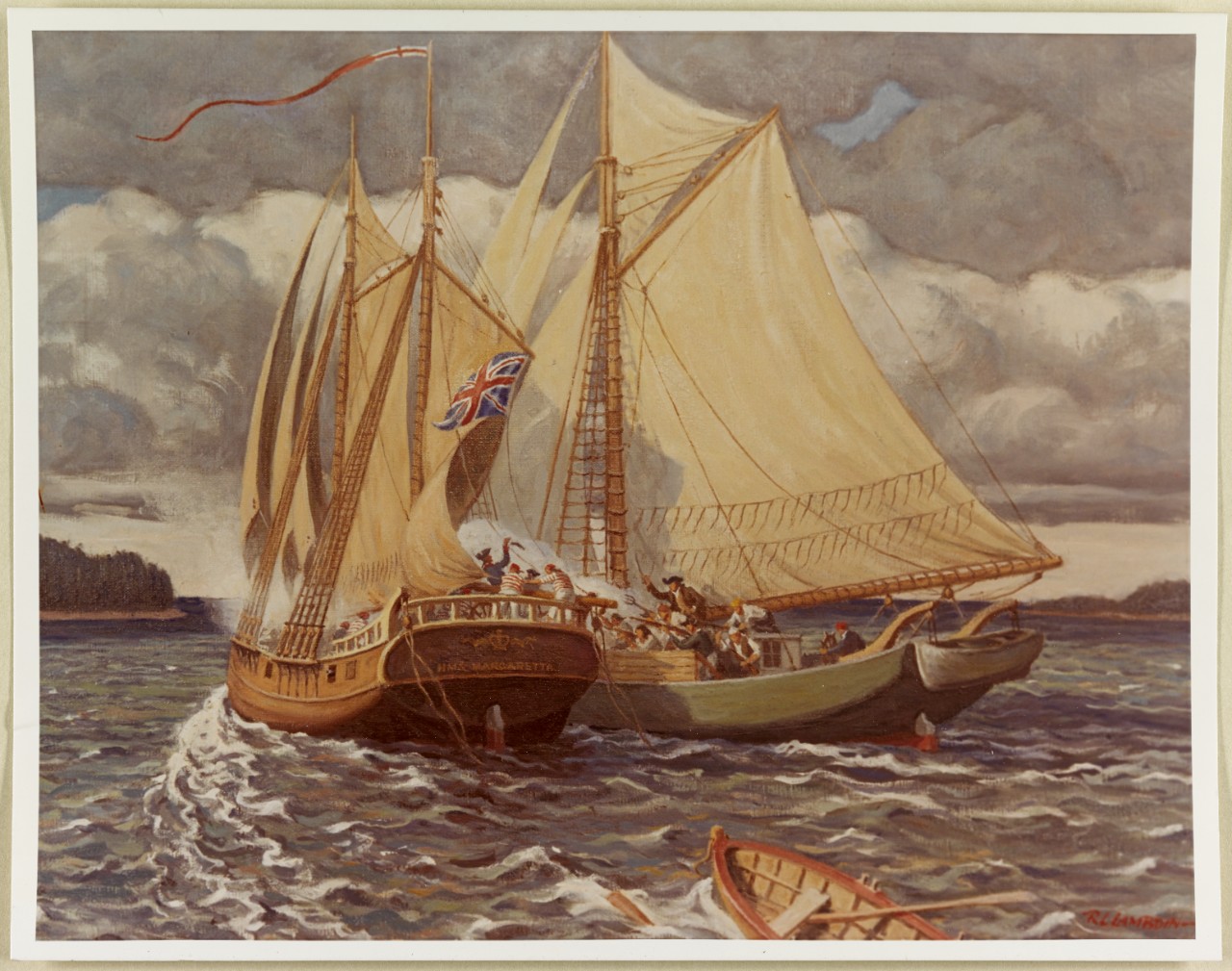
Unity vs. Margaretta, 12 June 1775 by Robert Lambdin (Naval History and Heritage Command). Margaretta was a Royal Navy vessel captured off Machias, then part of Massachusetts but now in Maine. The image illustrates the relatively small sizes of vessels involved in creating the early American navy.

During the first six months of the American rebellion, the colonies inched toward some means of dealing with Britain’s naval superiority.  Over the summer the Americans had already waged a sort of whaleboat war among the estuaries and islands around Boston, mainly to deprive the British army couped up there of forage and fodder.  Efforts escalated as the war continued.  A confrontation between small Royal Navy vessels and the Massachusetts town of Machias over the summer serendipitously resulted in a small Massachusetts Navy created by capture in June 1775.[1]  In June, Rhode Island’s General Assembly voted to charter two ships and outfit them for naval operations to protect the colony’s trade, essentially by contesting the Royal Navy’s control of Narragansett Bay.[2]  In September, Colonel John Glover in the Continental Army offered his fishing schooner, Hannah, as a charter to wage war on the sea.  George Washington naturally accepted, limiting its operations to capturing unarmed supply ships serving the British army.[3]  The army had essentially created its own navy out of necessity.

Captain James Wallace’s Tumultuous June 1775 in Narragansett Bay

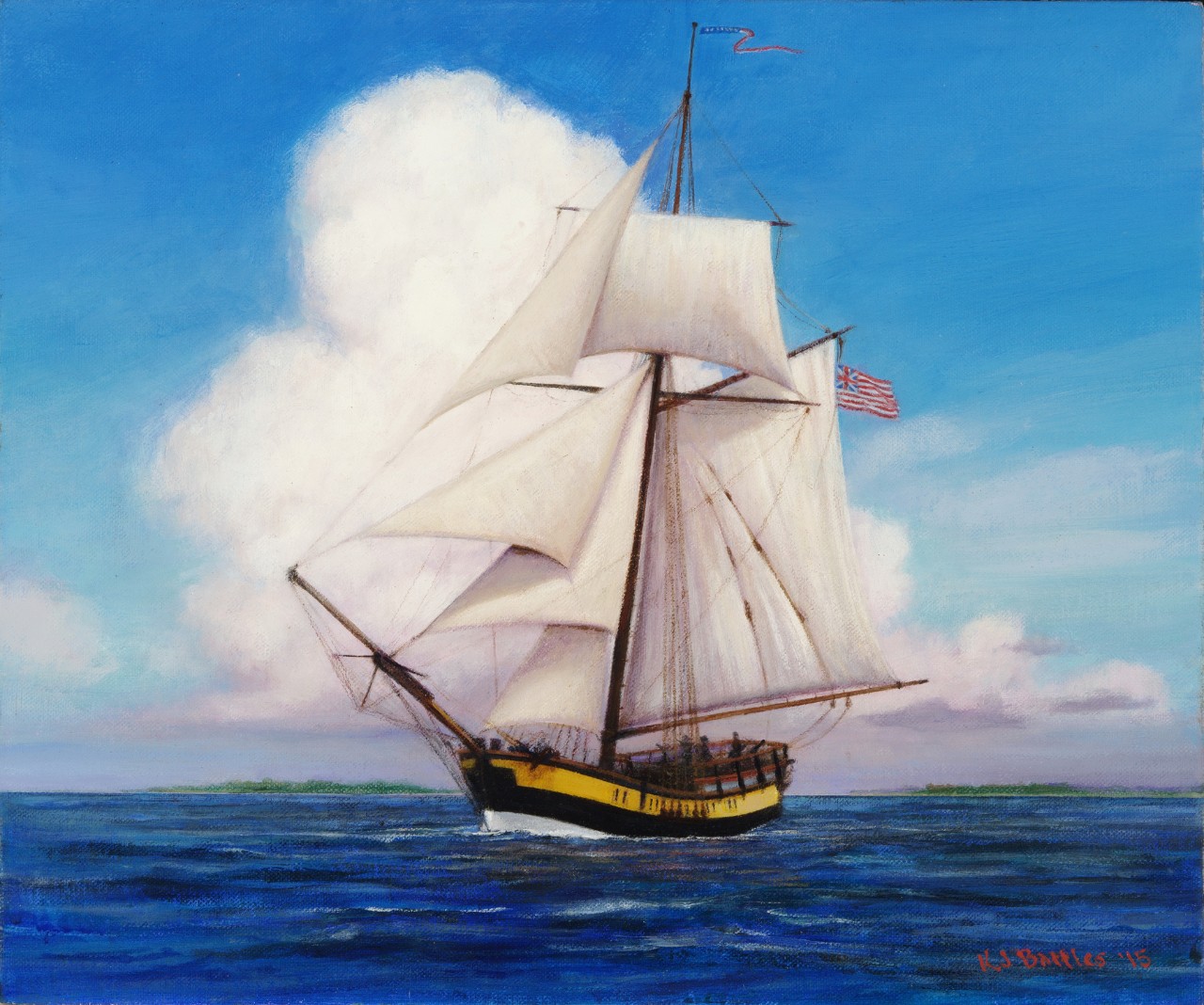
Katy in her later service as the Continental Navy ship Providence. “Sloop Providence under Sail by Kristopher Battles” (Naval History and Heritage Command)

Since his brief visit in November 1774 and his longer term stay commencing in December, Captain James Wallace of the British ship Rose (20 guns), had patrolled Narragansett Bay to enforce the Coercive Acts and prevent Britain’s rebellious colonies from importing gunpowder and armaments.  Loyalists had taken heart and rebels had been frustrated with his presence.   Not only were his patrols interfering with local commerce by seizing ships and their cargos—his main mission—but he created a more visible symbol of Britain’s ability and willingness to force its colonists to comply with Parliament’s laws.  

                One of the loyalists encouraged by the Royal Navy presence in Narragansett Bay was a Newport merchant named George Rome.  Wallace had visited Rome and was dining with him when a breathless messenger warned the captain that a mob was out to tar and feather him back in December, 1774.  In the moment, nothing came of it, but Governor Joseph Wanton warned Wallace that the town was not safe for British officers, sailors, or loyal subjects.  Things remained at a low simmer that winter and spring, including the initial weeks after the Lexington and Concord.  Tensions, however, could not help but rise.  Diarist Ezra Stiles, recorded on May 23 that some 90 Rhode Island soldiers under the command of Captains [John] Topham and [Thomas] Tew marched from the Newport courthouse and through town beating up volunteers to join the nascent American Army.  Wallace was dining in town that day and no doubt heard the racket.[1]  Stiles wrote, “The Tories were greatly mortified to see the daring Boldness of the Rebels as they called them.   The Tories had said that the Men o’War would fire the To[wn] if any Soldiers were raised in it.  But there was no Molestation.”  From Stiles’ version of events, the march appears as nothing less than a provocation to determine whether the rumored threat of Wallace and his ships to Newport proper was a bluff.  The lack of an immediate response may have demonstrated that it was.  In truth, a significant portion of Newport’s population opposed the rebels and voluntarily supplied Wallace and contracted for grain to provide to the British army.

Continue reading “Captain James Wallace’s Tumultuous June 1775 in Narragansett Bay”

The Nassau Cannon

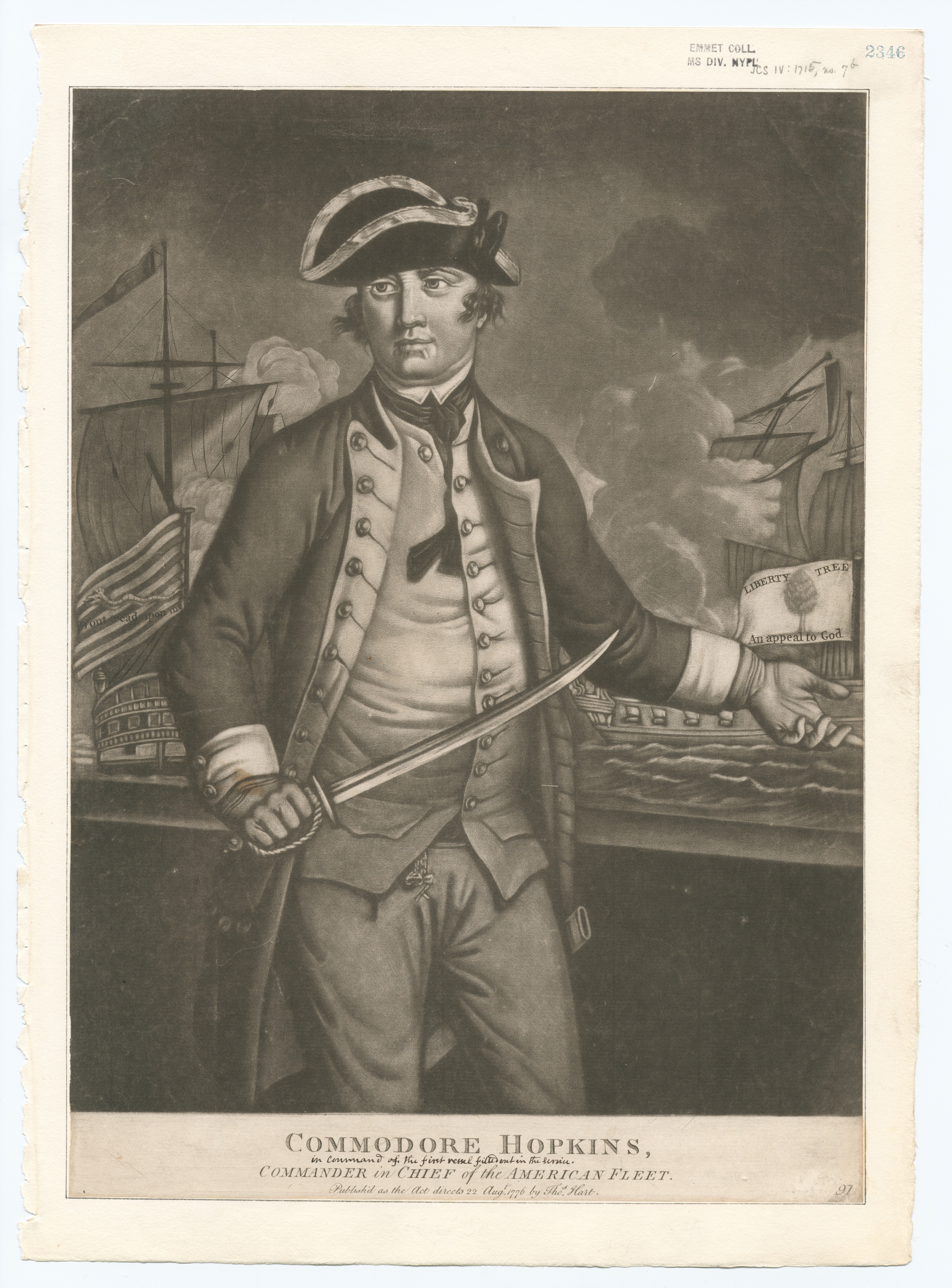
In March, 1776 Commodore Esek Hopkins led the bulk of the Continental Navy on a raid to the Bahamas, where it occupied the town of New Providence on Nassau Island for two weeks.  Hopkins and his captains were drawn by a report of gunpowder stored in the town, which the patriot cause desperately needed.[1]  Unfortunately for Hopkins, the colony’s governor had spirited away some 150 barrels the night before the American flotilla’s arrival.  Not all was lost as the Marines quickly demanded and received the surrender of two small forts defending the town and its harbor.  With those in hand, Hopkins and his men quickly got to work removing artillery, military stores, and other useful supplies.

            While the American Marines and sailors managed to recover just 24 casks of powder, their haul in sizeable artillery pieces and mortars was impressive: 88 cannon ranging from 9- to 36-pounders; 15 mortars from 4-11 inches; 5,458 shells; 11,071 roundshot; 165 chain & double shot, plus fuses, rams, sponges, carriage trucks, mortar beds, copper hoops, and various stores not required for artillery.[2]  It was a boon to be sure.  The curious part of Hopkins’ inventory of captured war material, however, is that he sent it to Connecticut Governor Jonathan Trumbull, not a representative of the Naval Committee that had issued his orders.  To John Hancock, president of the Continental Congress, he sent a report of his mission, but only mentioned “I have taken all the Stores onboard the fleet.”[3]  Indeed, his report of the armaments aboard the British schooner Hawke, which the fleet captured on its return to American waters, was more complete.  It took another day, until April 9, for Hopkins to forward the inventory of seized cannon.  Congress merely resolved that an extract of his letter should be published for delegates to peruse.[4] Perhaps inadvertently, Hopkins exacerbated regional political conflicts and undermined his own command.

Continue reading “The Nassau Cannon”

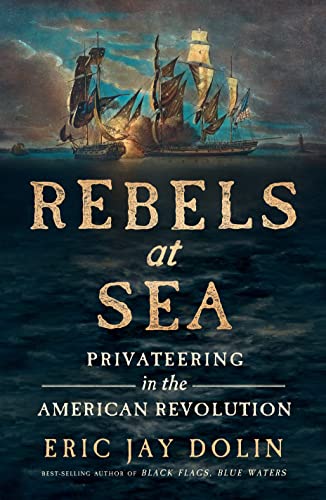
Review: Rebels at Sea, Privateering in the American Revolution by Eric Jay Doulin

“Many believed then and have believed since that privateering was a sideshow in the war” Furthermore, “privateering has long been given short shrift in general histories of the conflict, where privateers are treated as a minor theme if they are mentioned at all” [pg. xviii].

Best-selling maritime historian Erica Jay Dolin penned the two lines above in his introduction to his latest publication, Rebels at Sea, Privateering in the American Revolution. Building on previous works that covered specific aspects of “do succeed in showing how it [privateering] contributed to the American victory. But none of these books offers a comprehensive picture of the full extent of privateering” [xviii].

A bold statement to make, crafting a comprehensive picture “of the full extent of privateering” but that is exactly what Dolin does in his work. Starting with how individual colonies then states moved to outfitting vessels to begin preying on British maritime trade and on occasion Royal British Navy ships. The best tabulation of how much British maritime trade was affected during the American Revolution comes from John Bennett Jr. first secretary of Lloyd’s of London, the largest insurance marketplace at that time. He concluded that 3,386 British vessels were captured, only a 1,002 were recaptured or ransomed, which leaves a net gain of 2,384 that remained in enemy or American hands [pgs. 161-162].

Impactful.

The ensuing chapters after the introduction pivot the reader through the life of a privateersman, including the travails faced. He circles back to this in another chapter detailing the British response, including what imprisonment looked like; either in a British land jail or on the infamous Jersey prison ship in Wallabout Bay, New York. Keeping the narrative flowing, Doulin gives snippets on some of the greatest triumphs of American privateersman and some of the greatest tragedies to befall these sailors on the high seas. Tidbits of interesting information, for example, did you know that the future dentist of George Washington cut his teeth as a privateer? (Okay, pun intended).

Sandwiched in between is the role of the French, America’s steady ally, after 1777, and how that country and its ports helped American vessels. Lastly one of the other admirable additions to this text is the plethora of pictures Doulin was able to find and include. Having the visuals certainly enhances the public history side of this publication.

Overall, this is a great read on a lesser viewed subject of the American Revolution. However, what the privateers did enabled eventual American independence. As John Lehman, the secretary of the navy under President Ronald Reagan once wrote.

               “From the beginning of the American Revolution until the end of the War of
1812, America’s real naval advantage lay in its privateers. It has been said that
the battles of the American Revolution were fought on land, and independence
was won at sea. For this we have the enormous success of American privateers
to thank even more than the Continental Navy” [pg. xviii].

Individuals come to life in this narrative. The cat-and-mouse of life on the high seas comes to life in this book. Join Doulin in an adventure on the high seas and understand the role of privateers in securing American independence in the process. Enjoy!

Captain James Willing’s Mississippi Raid, Part 2

Bernardo_de_Gálvez (Wikimedia Commons(
Bernardo De Galvez, Governor of Louisiana (Wikimedia Commons)

Willing’s next target was the town of Manchack upon which he descended “so rapidly that they reached the Settlements without being discovered.”[1]  On the 23rd, Willing’s advance parties captured the 250-ton British sloop Rebecca, with sixteen 4-pounders and six swivels.[2]  It was a coup worthy of Navy SEALS.  Rebecca was normally a merchant vessel, but had been armed and sent upriver to contest the Rattletrap’s advance by protecting Manchack.  Instead, her presence had strengthened Willing’s force.  Captured while lying against the levy opposite the town, she only had fifteen men aboard when an equal or superior force of Americans struck about 7 am.[3]  With Manchack captured and the Rebecca renamed the Morris, Willing turned his attention to the end game at New Orleans, where he hoped to dispose of his booty and obtain supplies useful for the American war effort.

At New Orleans, the Congressional Agent, Oliver Pollock, was aware of Rattletrap’s advance and began making preparations to dispose of the property Willing and his raiders had taken, a growing portion of which constituted slaves.  He organized a small force under his nephew, Thomas Pollock, to go up river and help Willing bring his vessels and cargo into port.  Instead, Pollock and his men proceeded down the river, where they captured an English brig, the Neptune, eventually bringing her into New Orleans as a prize.[4]  (The British would argue strenuously that Neptune and a private boat were not in fact legal prizes.)

Continue reading “Captain James Willing’s Mississippi Raid, Part 2”

“Old Ironsides” To Set Sail Again!

Happen to be around Boston this weekend? Or live within traveling distance? Check out the special event happening this weekend from Sunday, July 23rd through Monday, July 24th at the U.S.S. Constitution Museum and Charlestown Navy Yard.

The U.S.S. Constitution, the oldest commissioned naval vessel still afloat will set sail again. Launched in 1797 and named by President George Washington, the vessel is a wooden-hulled, three-masted heavy frigate. She has been dry-docked since May 18, 2015 but will return to the water on July 23rd.

Old Ironsides
“Old Ironsides” the U.S.S. Constitution, photo taken April 2016 (author collection)

The event, co-sponsored with the National Parks of Boston will have a full-plate of free, family-fun events starting at 4:00 p.m. on Sunday and continuing into the morning hours of Monday.

For a full-listing of these events, including information about the museum, and answers to a few frequently answered questions, click here.

For those that cannot make it live to the re-launch, the event will be live on Facebook video streams at 4:00 p.m. and 6:00 p.m. along with live video streams throughout the night of the major events. Check out the Facebook site for the museum by clicking here.

Two Patriots: One Slave and One Free – James Armistead Lafayette and James Forten

Part Two by Malanna Henderson 

A hero who championed American independence was Revolutionary War hero James Forten; not particularly for what he did, but for what he didn’t do.

james-forten
James Forten, Possible attribution: Raphaelle Peale, c. 1800-1810, (Explorepahistory.com)

At the tender age of fourteen, Forten became a prisoner of war aboard the notorious British prison ship, the HMS Jersey, anchored in New York. Like nearly all of his fellow inmates who perished or survived the horrific tribulation, he remained loyal to the patriot cause in the face of death. Continue reading “Two Patriots: One Slave and One Free – James Armistead Lafayette and James Forten”