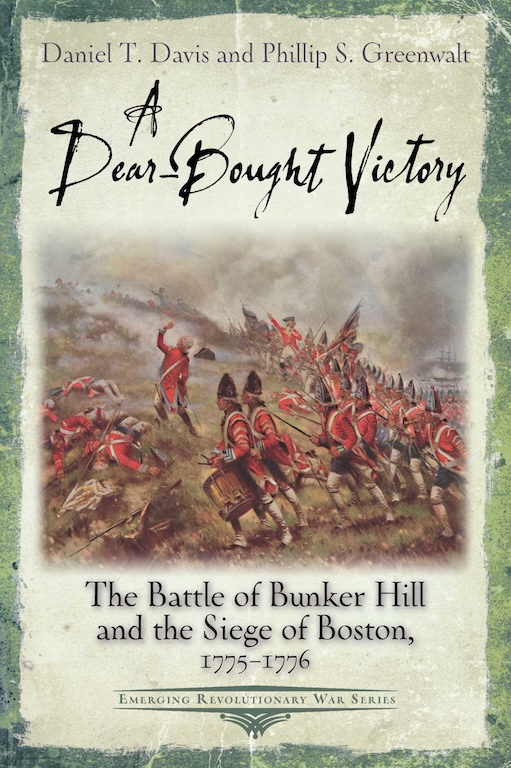
Coming Soon: A Dear-Bought Victory: The Battle of Bunker Hill and the Siege of Boston 1775-1776

We’re excited to share one of the 2026 new releases in the Emerging Revolutionary War Series. Published by Savas Beatie, a sneak peek, including the cover, is below.

About the Book:

“I wish we could sell them another hill at the same price we did Bunkers Hill,” Nathanael Greene wrote to the governor of Rhode Island after the battle of June 17, 1775.

Actually fought on Breed’s Hill outside Boston, Massachusetts, the battle of Bunker Hill proved a pyrrhic victory for British forces. Confident in their ability to overwhelm the New England militia that opposed them, long lines of neatly uniformed British infantry and marines swept uphill toward a quickly built earthen redoubt defended by a motely collection of farmers, shopkeepers, and tradesmen.

“Don’t fire until you see the whites of their eyes!” the colonials urged each other—or did they?

By the end of the fight, the British gained the summit and Colonial forces scattered. One of the patriot leaders, Dr. Joseph Warren, lay dead—one of the first martyrs of the American Revolution. But for the British, the scene was far, far worse: it would be the greatest number of casualties they would ever suffer in any battle of the American Revolution. As British General Henry Clinton commented afterward, “A few more such victories would have surely put an end to British dominion in America.”

The siege of Boston would continue, but the sobering lesson of Bunker Hill changed British strategy—as did the arrival soon thereafter of a new commander-in-chief of Continental forces: General George Washington.

In A Dear-Bought Victory, historians Daniel T. Davis and Phillip S. Greenwalt separate the facts from the myths as they take readers to the slopes of Breed’s Hill and along the Boston siege lines as they explore a battle that continues to hold a place in popular memory unlike few others.

About the Authors:

Daniel T. Davis is the Senior Education Manager at the American Battlefield Trust. He is a graduate of Longwood University with a bachelor’s degree in public history. Dan has worked as a Ranger/Historian at Appomattox Court House National Historical Park and Fredericksburg and Spotsylvania National Military Park. He is the author or co-author of numerous books on the American Civil War. This is his first co-authored book in the Emerging Revolutionary War Series. Dan is a native of Fredericksburg, Virginia.

Phillip S. Greenwalt is the co-founder of Emerging Revolutionary War and a full-time contributor to Emerging Civil War. He is a graduate of Wheeling Jesuit University with a bachelor’s degree in history along with graduate degrees in American History and International Studies and Leadership from George Mason University and Arizona State University, respectively. He is the author of co-author of seven books on the American Revolutionary and Civil Wars. Phill has worked for the National Park Service for the last 17 years at numerous natural and cultural sites. He is a native of Baltimore, Maryland.

Sir Henry Clinton’s Close Encounter

Emerging Revolutionary War welcomes the contribution of Eric Olsen, Park Ranger/Historian at Morristown National Historical Park

Military history tends to be a lot of “so and so’s” brigade advanced on the left wing, while “what’s his face’s” division withdrew.” Lots of movements of large faceless masses of soldiers. Personally, I prefer the little personal stories of individuals in the face of battle. Here is one such story from the battle of Monmouth in June 1778. 

Sir Henry Clinton

I recently ran across this little tidbit in a July 7, 1778, letter written by the Adjutant General of the Hessian forces in America, Major Carl Leopold Baumeister. He described an incident during the battle of Monmouth involving the British commander in chief, Sir Henry Clinton. “General Clinton in the thickest fire, was saved by one of his adjutants, Captain Sutherland, when a rebel colonel aimed at him, but missed. Captain Sutherland’s horse was wounded. Another adjutant, Lloyd, stabbed the colonel.”

The story sounded vaguely familiar. Then I recalled something I’d read written by a British officer named Thomas Anbury. He was a prisoner of war, part of Burgoyne’s captured “Convention Army.” Anbury and the other prisoners were being held near Charlottesville, Virginia. At a place called Jones’s Plantation, Anbury related the following story on May 12, 1779,

“A very singular circumstance took place in that battle [Monmouth], which fully marks the coolness and deliberation, though in the heat of action, of Sir Henry Clinton: As he was reconnoitering, with two of his Aide de Camps, at the short turning of two roads, they met with an American officer, exceedingly well mounted upon a black horse, who, upon discerning them, made a stop, and looked as if he wished to advance to speak to them, when one of Sir Henry Clinton’s Aid de Camps fired a pistol at him, and he instantly rode off. Sir Henry was much displeased at his Aide de Camp, and censured him for being so hasty, adding, he was confident that the man wished to speak to him, and perhaps, might have given intelligence that would have been very essential, remarking, that when he was in Germany last war, and reconnoitering with Prince Ferdinand, a man rode up in a familiar manner, and gave such intelligence as decided the fate of the day.”

To read more about the Battle of Monmouth, check out “A Handsome Flogging, the Battle of Monmouth, June 28, 1778 by William Griffith, part of the Emerging Revolutionary War Series.

The March in…on this date in 1777

Beginning on December 8, 1777, General George Washington and his Continental army left the environs of White Marsh to begin the movement toward their winter encampment. The rank-and-file crossed over the Schuylkill River and headed westward. Within three days the soldiers had trudged into an area called the Gulph on a December Thursday morning.

During this sojourn Washington wrote a a flurry of orders and letters, finally selecting Valley Forge. His reasoning was explained in the general orders for that day while also observing another delay in order to honor a day of fasting and thanksgiving decreed by the Continental Congress. Washington began that general order on December 17, 1777 by acknowledging the thousands of men that were braving the weather, lack of sustenance, and the rigors of the 1777 campaigning season.

“The Commander-in-Chief with the highest satisfaction expresses his thanks to the officers and soldiers for the fortitude and patience with which they have sustained the fatigues of the Campaign. Altho’ in some instances we unfortunately failed, yet upon the whole Heaven hath smiled on our Arms and crowned them with signal success; and we may upon the best grounds conclude, that by a spirited continuance of the measures necessary for our defence we shall finally obtain the end of our Warfare, Independence, Liberty and Peace.

The march resumed around 10 a.m. on December 19, a Friday, as the Continental army trudged out of the Gulph Mills area and on to their final destination for 1777; Valley Forge. The army would soon spread out to occupy over 7,800 acres of Pennsylvania countryside and spend the next six months resting, recuperating, surviving, and training.

To read more about the end of the 1777 campaign and the winter spent at Valley Forge, check out the book, by yours truly, Winter that Won the War, part of the Emerging Revolutionary War Series, published by Savas Beatie, LLC.

Valley Forge Documentary

244 years ago this week is when the Continental army, under the command of George Washington, marched into what would become their winter encampment as the year turned from 1777-1778. Recently, Phillip S. Greenwalt, one of the Emerging Revolutionary War historians was a “talking head” on a documentary about the Valley Forge encampment and what the soldiers and civilians faced during the ensuing six-month cantonment.

The documentary which features historians and park rangers is airing on Fox News Nation, the streaming service that is part of the Fox News network. Below is a screen shot of Phillip, who is also the author of Winter that Won the War, the Winter Encampment at Valley Forge, 1777-1778, which is part of the Emerging Revolutionary War Series published by Savas Beatie LLC.

So, if you need a break from the holiday specials that are airing, tune in for your history fix and learn more about the history at Valley Forge. If you want to dive even deeper into this period of the American Revolution, check out the link above labeled “2022 Bus Tour” and secure your tickets to join ERW at our second annual bus tour next November, which will include Valley Forge.

“Rev War Revelry” The Winter that Won the War, Valley Forge

In June 1778, the Continental army marched out of their winter encampment in Valley Forge, Pennsylvania and headed toward New Jersey in pursuit of the retreating British army. The past six months, from December 1777 to June 1778, ushered in a period of suffering, renewal, and change.

Valley Forge is imprinted into the psyche of Americans as the the toughest winter of the entire American Revolution. In fairness, it was one of many tough winters that the Continental army survived. However, the reasons why this winter stands out will be part of the discussion of this Sunday evening’s “Rev War Revelry” which can be found on Emerging Revolutionary War’s Facebook page at 7 pm. EDT.

This week’s historian happy hour includes a discussion with Philip S. Greenwalt author of the recently released Emerging Revolutionary War Series title, The Winter that Won the War. This is the fourth volume in the series, with previous ones covering Lexington and Concord, Trenton and Princeton, and Monmouth.

Greenwalt will discuss how the Valley Forge winter was the intersection of various issues and how the decisions made and the determination of survival by the army made this the winter that won the war.

Tune in as well to hear how you can purchase a copy of this book to take with you as you plan that summer trip to Valley Forge and the Philadelphia area!

Marching Out of Valley Forge

On this date, in 1778, the Continental army, under the command of General George Washington broke winter camp and began the spring campaign. Their objective was to catch the British army, under Sir Henry Clinton, retreating across New Jersey to the safety of New York City.

Nine days later, in the last major action in the northern theater, Washington’s forces would engage their adversary in the Battle of Monmouth. The army that fought this engagement in one of the hottest recorded days of any battle in American history, was a much improved military organization. Not perfect but much improved from the force that marched into Valley Forge six months prior.

During that half-year, from December 19 to June 19, the army saw an improved quartermaster department, the formation of a military handbook and tactical training, and the news that a powerful European nation had agreed to become allies in the quest for American independence.

Much is made of turning points or the critical importance of an event so I do not want to retread that argument here. However, what happened at Valley Forge was significant in the path to eventual American victory and the formation of the United States of America.

There is an old saying that even the greatest fiction writers cannot envision a story that is unbelievable as actual events can be. Or to sum it up more succinctly, a coincidence. After delays due to the pandemic, the latest volume of the Emerging Revolutionary War Series was released, in time for the 243rd anniversary of the end of the winter cantonment at Valley Forge.

The book is authored by yours truly and can be found via the publisher’s website by clicking here or through your favorite bookseller or by emailing Emerging Revolutionary War.

Then follow in the footsteps of Washington’s forces to Monmouth.

Inspiration

Merriam-Webster’s two two definitions of inspiration are “an aspiring agent or influence” and “the quality or state of being influenced.” Being a military historian that has spent a portion of his graduate school and adult life studying the American Revolution, there are a multiple examples of people, events, or circumstances that would fit that Merriam-Webster definition.

The 56-men who affixed a signature to the Declaration of Independence in the summer of 1776 and the gravity of what that meant.

Thomas Paine’s The American Crisis comes to mind during the bleak December 1776 days as George Washington’s army hurriedly moved through New Jersey.

George Washington’s personal heroics, at Princeton in January of 1777 and Monmouth Court House in June 1778, defying his own personal demise to rally the troops he led.

The tales of suffering, at Valley Forge, Morristown, and through the heat of a Carolinas campaign by the common soldier, many whose names are lost to history.

Recently, I have been looking for inspiration, I think most of us are, with how 2020 ended and the beginning of 2021, but this post is not about straying into current politics, viewpoints, or stances on the pandemic. This is more personal.

The pandemic has afforded me the opportunity to read more, as I am sure my fellow history enthusiasts and bookophiles can relate to. Those readings reawakened a question I tried to tackle as a graduate student a decade ago at George Mason University.

What inspired the men from Maryland to fight for American independence?

Or more accurately:

What did not inspire the men from Maryland to fight for American independence?

I ruled out pay, patriotism (at the start), and other tangible benefits. I gleaned from some of the primary sources that have survived, the chance to create a new life, for the soldiers themselves or their loved ones at home was a major motivator to serve. Family was the spark of inspiration.

On this date, that is something I can really relate to. My father, who will be celebrating his 71st trip around the sun, is battling dementia. He will know that this date, February 8, is his birthday, but will struggle to remember anything else. Yet, he was surprised to see his name in a book recently, one that I sent to him, one that I had helped in the editorial process. To see him reading it, cherishing it, and tearing up with happiness at the simple recognition of his name and mine, is an inspiration to myself.

So, he was and is an inspiration, half the duo of sparking my passion of American history (any guesses on the other half)?

What or who is your inspiration as we enter the second month of 2021?

Happy Birthday Dad, from the history enthusiast you helped create.

If curious, he is reading A Handsome Flogging: The Battle of Monmouth, June 28,1778 by William R. Griffith IV

“Rev War Roundtable with ERW” Author Interview: William “Billy” Griffith

This Sunday, at 7 p.m. join Emerging Revolutionary War on our Facebook page as we interview William “Billy” Griffith, author of the latest volume in the Emerging Revolutionary War Series.

His book, A Handsome Flogging, The Battle of Monmouth, June 28, 1778 was just released by Savas Beatie, LLC this month. The book is so new that Amazon still has it listed for pre-sale, but don’t worry, you can purchase the book directly from Savas Beatie by clicking here.

Billy Griffith is a full-time contributor to ERW and is also the author of The Battle of Lake George: England’s First Triumph in the French and Indian War, which was released in 2016 by HistoryPress. A native of Branchburg, New Jersey, he has a family connection to the the Monmouth area; he graduated with a degree in history from Shepherd University and holds a graduate degree in military history from Norwich University. He currently works as a full-time Gettysburg Licensed Battlefield Guide. We would be remiss if we did not include his other passion, besides American military history, the New York Yankees. Feel free to join the Facebook Live to disparage his love of the Evil Empire!

ERW looks forward to seeing you, hearing your questions, comments, and what personalized message you want inscribed on your copy of Billy’s latest publication. Although this happy hour historian discussion centers on an author interview, it is still a “happy hour” so bring your favorite brew; we can guarantee the two historians on the program will be imbibing theirs!

“Rev War Roundtable with ERW” All Things Independence Day

As this posting goes live today, July 2, there is a link to the American Revolutionary War era. This was the day that John Adams, future president of the United States, believed would be the date Americans would celebrate as their independence day.

Yet, the day reserved for that celebration would fall two days later, on July 4, the date that John Hancock affixed his signature as president of the Continental Congress.

However, join Emerging Revolutionary War historians and three guest historians this Sunday, July 5, at 7 pm EST, on our Facebook page, as another date to talk “All Things Independence Day” including John Adams and Independence Hall.

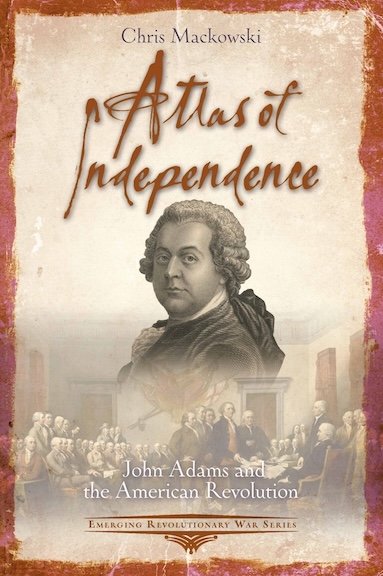
Joining ERW to discuss John Adams and Thomas Jefferson, which will be the volume in the Emerging Revolutionary War Series, is Emerging Civil War co-founder and Stevenson Ridge historian-in-residence, Dr. Chris Mackowski.

Savannah Rose, a National Park Service ranger at Independence National Historical Park and the new layout coordinator for the Emerging Revolutionary War Series. You can see her work with the upcoming A Handsome Flogging, on the engagement at Monmouth Course House, which just shipped from the printer this week.

Rounding out the triumvirate of guest historians will be Dan Welch, who you may remember from his dramatic reading of “A Midnight Ride” the poem about Paul Revere’s Ride. Dan is also a seasonal historian with the National Park Service at Gettysburg National Military Park.

As you round out your holiday weekend, we hope that you include “Rev War Revelry” as one of the events you attend to commemorate Independence Day weekend. We look forward to toasting you as we enjoy our favorite brews and discuss “All Things Independence.”