Review: Rick Atkinson, The British Are Coming: The War for America, Lexington to Princeton, 1775-1777

Emerging Revolutionary War welcomes guest historian Joshua Shepherd to the blog who reviewed the book mentioned above. Short bio of Joshua is at the bottom of this post.

In recent years, there’s been a fortunate resurgence of interest in the Revolution and founding era. To meet the mounting demand for Revolutionary history, some of the nation’s most gifted popular authors have written highly successful volumes that cover the War for Independence and the Early Republic.

Some outstanding books have consequently gone to press, but, by and large, the publications have very often been biographies; occasionally, publishing houses introduce monographs that cover a single campaign. From professional circles, much of the new scholarly research focuses on the currently-vogue academic preference for social history. At least in recent decades, the relative paucity of military history has left an appreciable gap in the historiography of the Revolution. With the release of The British Are Coming, author Rick Atkinson has met a vital need for an up-to-date and comprehensive military history of the American Revolution.

Continue reading “Review: Rick Atkinson, The British Are Coming: The War for America, Lexington to Princeton, 1775-1777”

Annis Boudinot Stockton, Mythmaking, and the American Revolution (cont.)

Emerging Revolutionary War welcomes back guest historian Blake McGready for part two of the series. To read part one, click here.

While her poetry avoided wartime setbacks and conjured stories of revolutionary unity, Stockton’s poems did confront the violent realities of what she called “a most cruel and eventful war”. Her choice allusions demonstrate how, in her mind, wartime violence bound the revolutionaries together. Following the death of General Joseph Warren at the battle of Bunker Hill she lamented, “That heart, which, studious of his countries good / Held up her rights and seal’d them with his blood!” In 1776 Stockton wrote of revolutionary soldiers who “fought and bled to save their native land / From bowing to a tyrant’s stern command,” and honored great men dying on battlefields “Made fertile by the blood of heroes slain.” Whereas historians have noted how the war’s violence was often deliberately excluded from the popular imagination, by contrast, Stockton’s war and violence were inseparable.[i]

Continue reading “Annis Boudinot Stockton, Mythmaking, and the American Revolution (cont.)”

Annis Boudinot Stockton, Mythmaking, and the American Revolution

Emerging Revolutionary War welcomes guest historian Blake McGready. A short bio is at the end of this post.

In December 1776, Richard Stockton of Princeton, New Jersey, a signer of the Declaration of Independence, disavowed the American Revolution and swore allegiance to King George III. After British forces imprisoned Stockton, he accepted his captor’s amnesty offer. Revolutionaries considered Stockton’s decision an act of cold betrayal and condemned his perfidy. And yet, following his death in 1781, most biographies avoided or ignored Stockton’s questionable political commitment; one tribute claimed his conviction inspired “the utmost confidence of his associates and the country at large.” Stockton owed much of this comeback to his wife, Annis Boudinot. As a prolific and published poet, she helped erase much of her husband’s political infidelity in her writings. At the time of his death she praised him in one tribute, “Can we forget how patiently he bore / The various conflicts of the trying hour / While meekness, faith, and piety refin’d.” She carefully forgot that her husband abandoned the revolutionaries during “the trying hour.”[i]

Annis Boudinot (Mrs. Richard) Stockton by James Sharples Senior, from life, 1796-1797. Courtesy, Independence National Historical Park.
Continue reading “Annis Boudinot Stockton, Mythmaking, and the American Revolution”

The Sons of Liberty in Kentucky

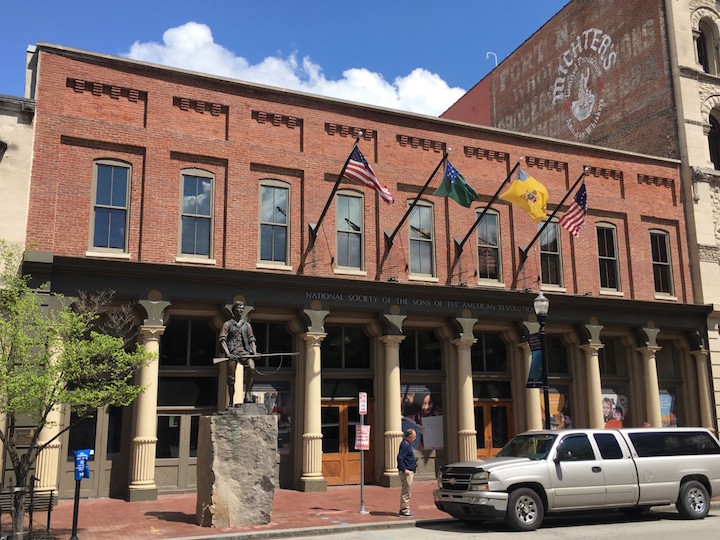
In Louisville, Kentucky, earlier this month, I paid a visit to the Louisville Slugger Factory and Museum downtown. Across the street, I was pleasantly surprised to see a marvelous statue of a minuteman.

Sons of American Revolution Statue

The plaque on the back reads

Sons of Liberty—1775

To Honor the History
of
Philadelphia Continental Chapter
1901

Pennsylvania Society
Founded 1893

By its Compatriots
2009

The statue stands outside the headquarters of the National Society of the Sons of the American Revolution. “Located along Main Street’s Museum Row in downtown Louisville,” the society’s website says, “the Sons of the American Revolution is the leading male lineage society that perpetuates the ideals of the war for independence.”

Sons of American Revolution Museum

The statue was publicly unveiled in November 2015. According to the Louisville Courier Journal, “The 800-pound, 8-foot high bronze statue of the Minuteman holding a musket rests upon 19,000 pounds of quarried Kentucky limestone, material specifically requested by the artist James Muir.”

Using the King’s Highway to Trap a King’s Army

A few weeks ago, heading to the airport after the first Emerging Revolutionary War symposium, fellow ERW historian Rob Orrison made a pit stop in a residential neighborhood in Prince William County, Virginia.

To the average traveler to the Ronald Reagan International Washington National Airport this slight detour would not be normal. Yet, for two historians of early American history, these detours are rarely common.

This particular detour took us to a portion of the King’s Highway that has been preserved by the Prince William County Historic Preservation Division. Along this stretch soldiers in the French Army under Comte de Rocambeau and Continentals under General George Washington traversed on their way to Yorktown to entrap the British under General Lord Charles Cornwallis.

Thus, one king’s soldiers, King Louis XVI took a route named for monarch to assist rebels in trapping the ground forces of another king, that of Great Britain by using a road named for the British monarch. Interesting to think about the naming of the road in those terms.

Portions of this route are still preserved today, other sections have been modernized and blacktopped to be Route 1.

Below are a few photos I snapped, including the size 14 Nike shoe belonging to yours truly, re-enacting marching down the thoroughfare like the patriots of 1781.

The Ring Fight and the Emergence of Andrew Pickens

While the Second Continental Congress met in the early summer of 1776, colonists in the far away backcountry of South Carolina faced a threat from a perennial foe, the Cherokees. While delegates debated a declaration of independence, war parties struck settlements between the Broad and Saluda Rivers in the Ninety Six District. In response to these raids, militia Major Andrew Williamson mustered his Ninety Six regiment. Augmented by militia from the Carolinas and Virginia, he commenced a campaign against the Cherokee villages along the eastern face of the Blue Ridge.

General Andrew Pickens of South Carolina

Williamson struck at Esseneca on August 1. The colonials sustained twenty casualties but forced the warriors to abandon the village. Over the course of the next week, Williamson moved further into enemy territory. Rather than engage his force, the Cherokees retreated before the advance. Williamson burned a number of towns including Oconee, Estatoe and Toxaway.

The regiment reached Tamassee on August 12. Once again, Williamson found the village abandoned. He decided to send out scouting parties to examine the nearby hills. One of the patrols was led by a company commander from the Long Canes region of South Carolina, Captain Andrew Pickens. He took with him about sixty men. To cover more ground, Pickens divided his group and continued on with thirty five militiamen.

Symposium Recap

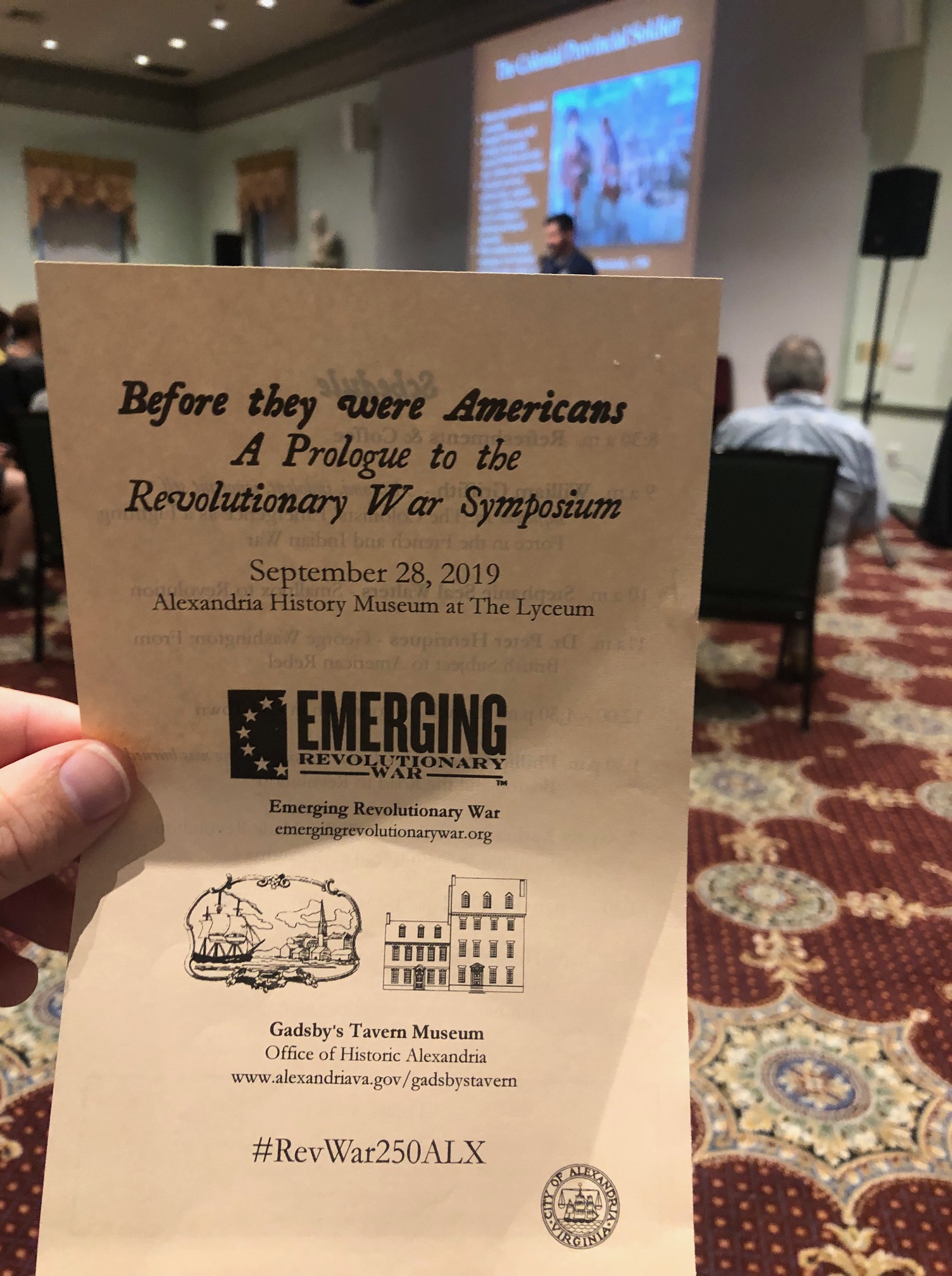
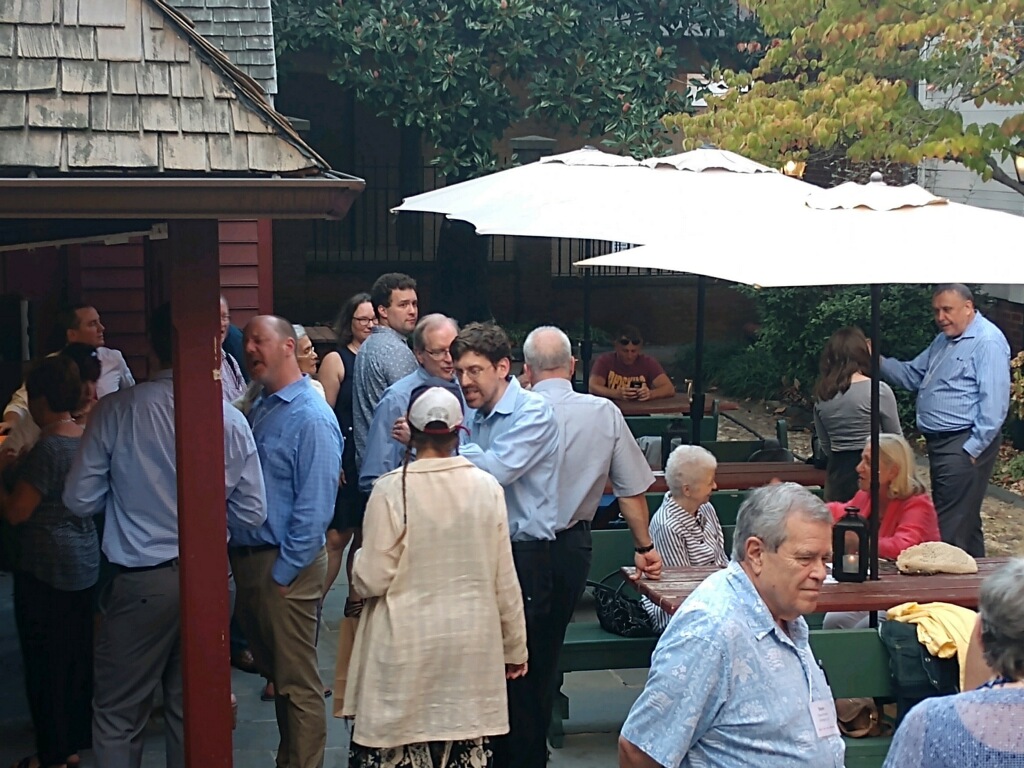
One week has passed since the first annual Emerging Revolutionary War symposium. Held in conjunction with Historic Alexandria, Virginia at the Lyceum, the theme was “Before they were Americans.”

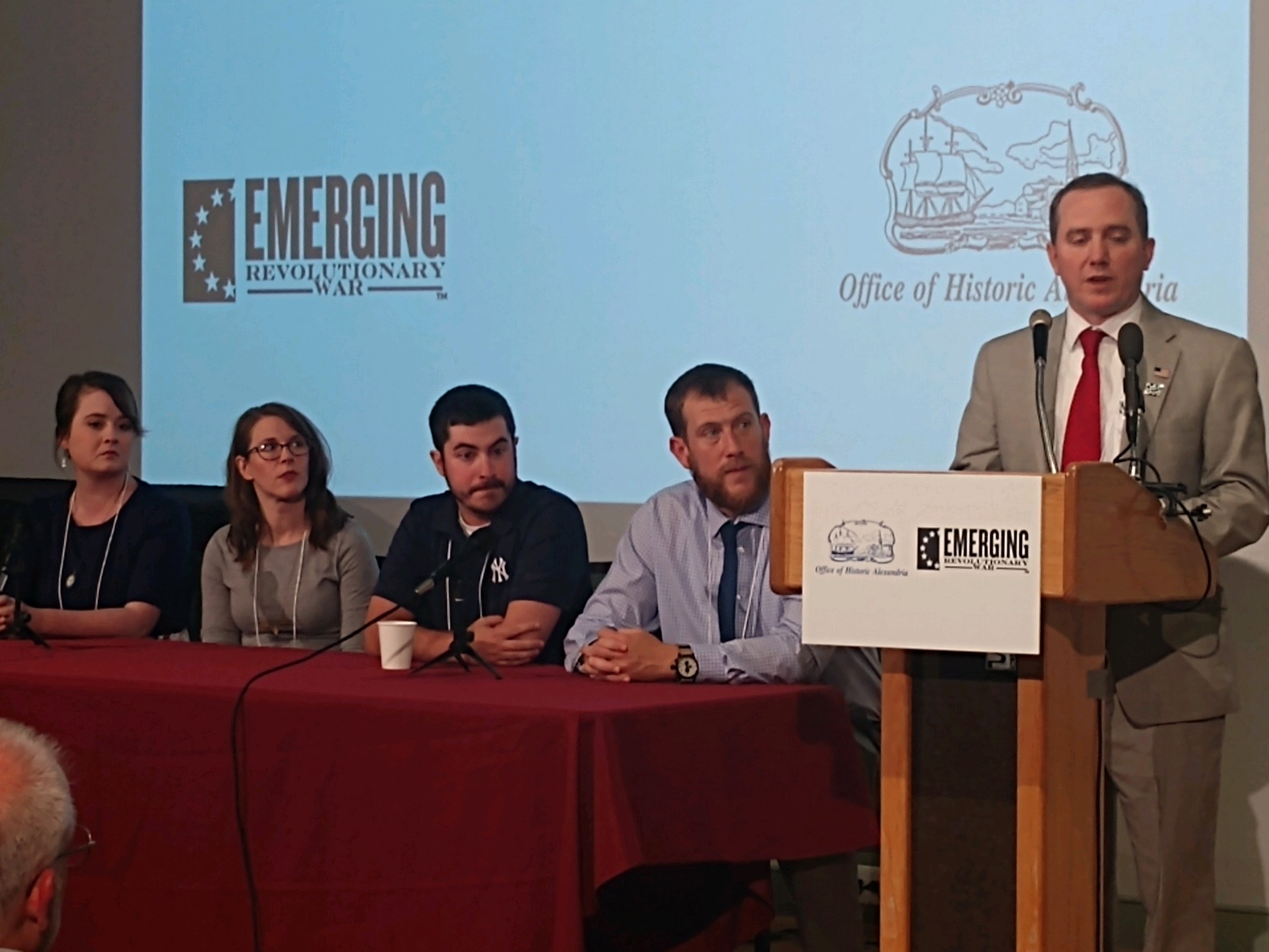
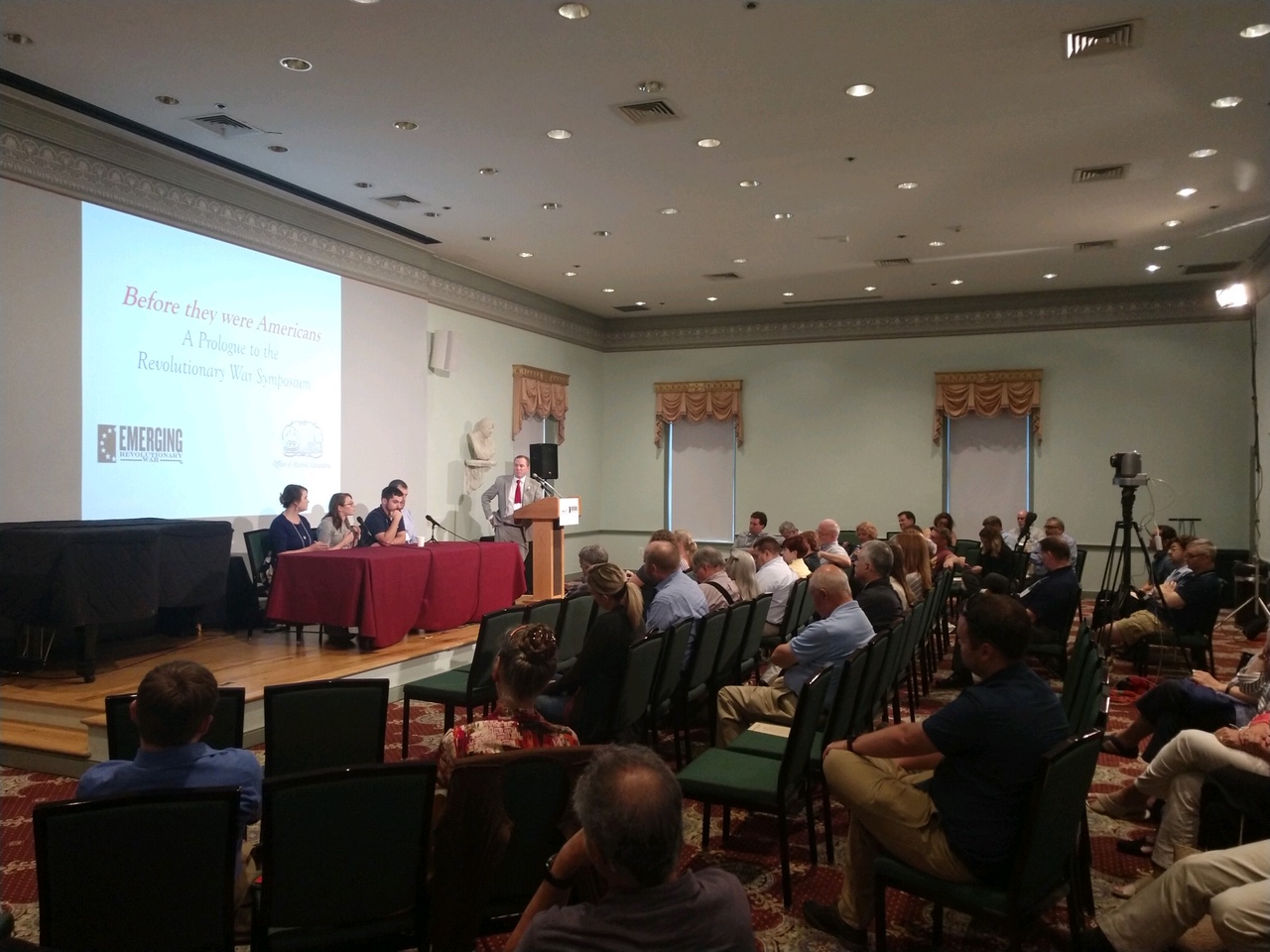
With a day of lectures, keynoted by Dr. Peter Henriques, professor emeritus of George Mason University the topics ranged from the French and Indian War, to George Washington, to material culture, smallpox, and Boston on the Road to Revolution. The day ended with a panel of historians in a Q&A session.

Over 70 people attended and many joined members of Emerging Revolutionary War and Historic Alexandria at Gadsby’s Tavern, an 18th century tavern with a great connection to American history, including a a ballroom used by Washington to celebrate his birthdays!

Plans are already in motion for the second annual Emerging Revolutionary War symposium to be held in late September of 2020 back in Alexandria, Virginia. Stay tuned to this blog and our Facebook page for information as that day draws near.

In the meantime, check out some of the photos below, taken by ERW historian Rob Orrison, who along with Liz Williams of Historic Alexandria were the driving forces behind making this symposium possible. A big thank you to all who attended and we hope to see you next year!

“Judiciously Designed and Vigorously Executed”: The March to the Dan River

Emerging Revolutionary War welcomes back guest historian Daniel T. Davis. 

Last month, I heard Emerging Revolutionary War co-founder Phill Greenwalt remark “when you think about retreats, victory is a word that doesn’t come to mind.” The period of January 18 to February 14, 1781 is the exception to the rule. During this time frame, the American army under Maj. Gen. Nathanael Greene and the British under Charles, Lord Cornwallis, marched across the backcountry of the Carolinas. Known as the “Race to the Dan”, this episode between the engagements at Cowpens and Guilford Courthouse, is a largely forgotten but consequential even in the Southern Campaign of 1781.

13615353_10154159045361343_4661891239939243645_n
The Dan River (courtesy of Rob Orrison)

Continue reading ““Judiciously Designed and Vigorously Executed”: The March to the Dan River”

Sébastien Le Prestre de Vauban

Sebastien Le Prestre de Vauban, Seigneur de Vauban, and finally Marquis de Vauban, as one of his biographies begins, is probably not a household name to many enthusiasts of American history. Especially since he died on March 30, 1707 and never set foot in the Western Hemisphere. However, he did have a nephew, Jacques Anne Joseph Le Prestre de Vauban who served as General Jean-Baptiste Rochambeau’s aide-de-camp during the war. So, there is a family connection.

Sebastien_le_Prestre_de_Vauban
Sébastien Le Prestre de Vauban (courtesy of Wikipedia)

Yet, he left his mark on places like Yorktown, Virginia, fought 74 years after his death and half-a-world away. French engineers, critical to eventual American victory in the American Revolutionary War, plied de Vauban’s craft and studied his text and learned from his exploits. Continue reading “Sébastien Le Prestre de Vauban”

“De Kalb has died, as he has lived, the unconquered friend of liberty”

Johann_de_Kalb
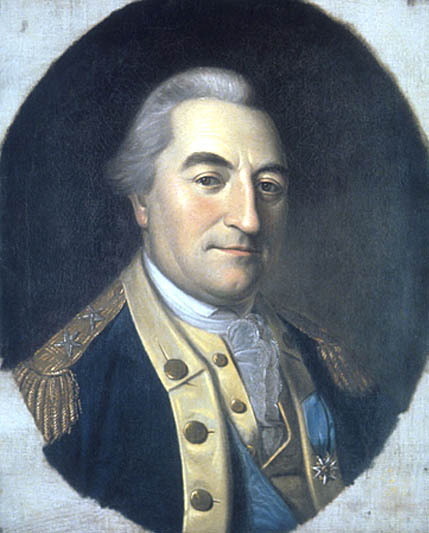
Johann de Kalb (Charles Willson Peale)

On this date in 1780, Johann von Robias, Baron de Kalb, died of wounds received three days earlier during the Battle of Camden, South Carolina.

de Kalb, born on June 19, 1721 in the Principality of Bayreuth, was in charge of the American right wing during the engagement at Camden, leading the premier units, the Delawareans and Marylanders, of General Horatio Gates’ Southern Army.

When the left and center of the American line disintegrated, de Kalb’s force had to beat a hasty retreat before becoming completely surrounded. During this juncture of the fighting, the Baron’s horse was shot out from under him and the German was thrown to the ground. Before he could gain his feet, he was hit with three musket balls and bayoneted multiple times by approaching British soldiers. The wounds would prove mortal. Continue reading ““De Kalb has died, as he has lived, the unconquered friend of liberty””