Emerging Revolutionary War welcomes guest historian Joshua Shepherd to the blog who reviewed the book mentioned above. Short bio of Joshua is at the bottom of this post.
In recent years, there’s been a fortunate resurgence of interest in the Revolution and founding era. To meet the mounting demand for Revolutionary history, some of the nation’s most gifted popular authors have written highly successful volumes that cover the War for Independence and the Early Republic.
Some outstanding books have consequently gone to press, but, by and large, the publications have very often been biographies; occasionally, publishing houses introduce monographs that cover a single campaign. From professional circles, much of the new scholarly research focuses on the currently-vogue academic preference for social history. At least in recent decades, the relative paucity of military history has left an appreciable gap in the historiography of the Revolution. With the release of The British Are Coming, author Rick Atkinson has met a vital need for an up-to-date and comprehensive military history of the American Revolution.
Emerging Revolutionary War welcomes historian Dan Welch
As we commemorate the 244th anniversary of the engagements at Lexington and Concord, it is an opportunity to reflect upon this moment’s importance in American history. The results of what happened in April 1775 were truly “heard around the world.” The importance of those events are commemorated and remembered in various forms across the fabric our country. This holds true, even in Youngstown, Ohio.
The Road to Remembrance Memorial on the southside of Youngstown, Ohio. (Image courtesy of the author)
As the country grappled with the effects of the Great Depression, numerous civic organizations in the state of Ohio sought to construct a “Road of Remembrance” in honor of the servicemen from the country’s previous conflict. On June 17, 1930, the state legislature designated a portion of Route 193 from Lake Erie to 422 in Youngstown as a memorial roadway in honor of those soldiers who gave their last full measure of devotion during the Great War. Many towns planted memorial trees along the route, some erected monuments, while other organizations held ceremonies marking the occasion. This special route was to be just a small portion of remembrance that was to span from Montreal, Canada to the Gulf of Mexico. Continue reading “The Shot Heard in Youngstown?”→
Lexington Minuteman Statue , facing the route of the British advance (author collection)
We all have bucket list items that we want to check off in our lifetime. Some revolve around traveling, some may revolve around learning a new hobby or skill. We may have different categories of items. The last is true for me.
One of those categories was to see the first shots of the wars of the United States (okay and the French and Indian War, since that started the march toward independence, when looked at through the lens of history and distance). Continue reading “First Shots”→
In honor of April being National Poetry Month, we share the connection of the literary icons of Concord (MA) and its American Revolution heritage. Concord historian Jayne Gordon wrote about these connections in an appendix in our recent release “A Single Blow.” Below is part of that text.
None of the eighteenth-century Concord authors lived through the American Revolution, yet reminders of that eighteenth-century war abounded in Concord in their lifetimes. Their neighbors were the grandchildren of the minutemen; veterans of the war were still among the townsfolk. Buildings, gravestones, old roads, and other landmarks evoked that part of the past, and they were surrounded by the stories of the fateful day of April 19, 1775. They each drew on their interpretations of the Revolution’s symbolic meaning, and incorporated those ideas into both their private and public writings.
The “Old Manse” next to the North Bridge in Concord
In the case of RALPH WALDO EMERSON (1803-1882), there was a direct historical link to a grandfather who had played a significant role in the beginnings of the Revolution. Sixty years after colonial militiamen confronted the British troops at the North Bridge within sight of the Old Manse, the grandson of patriot minister Reverend William Emerson would come to his ancestral home to stay, writing in his journal, “Hail to the quiet fields of my fathers! . . . Henceforth I design not to utter any speech, poem, or book that is not entirely & peculiarly my work.”Continue reading “THE AUTHORS AND THE AMERICAN REVOLUTION IN CONCORD”→
When writing a book, one of the most important initial aspects is picking a title. The author needs one that is expressive, attracts attention, but has some overall tie-in that provides a fitting capture of the essence of the book.
One of the advantages of writing history is the use of quotes. Let the participants, combatants, or witnesses of the event provide the context for a title. When one resonates, go with it!
With the recent publication, the co-author, Robert Orrison and myself bounced various potential titles off each other. Then we had a list of our favorites included in the initial information sheet sent to Ted Savas, of Savas Beatie, LLC, the publisher. Yet, one continued to stand out, as it was written in a diary by a British junior officer slightly more than a month before the Battles of Lexington and Concord.
The entire inscription is below:
“It is certain both sides were ripe for it, and a single blow would have occasioned the commencement of hostilities.” —Lieutenant Frederick Mackenzie, Royal Welch Fusiliers, March 6, 1775.
Mackenzie’s uncanny foresight predicted the exact outcome of the fighting that erupted on April 19, 1775. With casualties suffered by both sides, the war of words and near-misses became a war of shot and shell.
Hostilities had commenced and we had a title. A Single Blow: The Battles of Lexington and Concord and the The Beginning of the American Revolution.
Love brought Dr. Samuel Prescott, a practicing physician, to the town of Lexington on the night of April 18, 1775. The young doctor was courting Ms. Lydia Mulliken, when the alarm of the British soldiers marching from Boston went out to the local militia. Lydia’s brother was one of those called to gather.
Love. That emotion also drew Dr. Prescott back toward his hometown of Concord—this time to alert friends, neighbors, and family members of the urgent news of the evening. En route, Dr. Prescott along with Paul Revere and William Dawes, alerted the countryside of the moving British troops. After being vetted and vouchsafed as a true friend of liberty, Dr. Prescott rode posthaste to his hometown, where his word carried greater weight.
A artist’s interpretation of Paul Revere’s (or maybe William Dawes or Dr. Samuel Prescott)’s ride to warn the Massachusetts countryside. (courtesy of VFW)
As British General Thomas Gage and his American Whig (or Patriot) antagonists squared off in Boston and the surrounding towns, information gathering became the key to success. Both sides had created networks of spies, but the advantage was clearly in favor of the Whigs. During the winter 1774-1775, groups such as the Sons of Liberty had established a complex spy network within Boston comprised of a system of riders that spread information and “alarms’ quickly. The Committee of Safety and the Massachusetts Provincial Congress relied on this network to stay informed of what was going on in Boston and the British intentions. Continue reading “Two Riders….Gage Gathers Information”→
With autumn just around the corner, cooler weather on the horizon, and the holidays quickly approaching. Some stores in the local area have Halloween, Thanksgiving, and Christmas decorations all for sale currently, Emerging Revolutionary War wanted to bring your attention to a few different Revolutionary War Era happenings to mark on your calendars. Continue reading “Upcoming Lectures, Talks, and/or Events”→
Emerging Revolutionary War is honored to welcome back historian Katie Turner Getty. Biography of Ms. Getty is below the post.
On April 19, 1775, the placid farm of fifty-eight-year-old Jason Russell of Menotomy erupted into carnage when he, along with eleven other Americans, were shot and bayonetted by British soldiers in his home and yard.
Jason Russell House (author collection)
As American militia and minutemen poured in from surrounding towns, the British—fatigued yet furious—found themselves under increasingly heavy musket fire. As they pulled back from Concord and retreated to Boston, the main column passed near Russell’s house which stood near the battle road. Russell had just returned home after secreting his family at a nearby farm. Unbeknownst to him, American minutemen and British soldiers would soon converge upon his property and a desperate battle would occur within the walls of his own house.
Earlier that day, twenty-six-year-old Gideon Foster had set off from Danvers with a company of minutemen. The men had set a scorching pace and made the sixteen mile journey to Menotomy in four hours, running half the way.[1] Upon arriving, Foster’s men joined others from Lynn, Beverly, Salem, Dedham, and Needham.[2] Some took cover behind trees and others in Russell’s yard, where a breastwork was constructed out of shingles.
The Fight at the Jason Russell House, bicentennial painting by Ruth Linnell Berry (1974). Appearing with permission from the Arlington Historical Society.
The men focused their attention on the approaching main column of British troops and fired upon them. Capt. Israel Hutchinson, a seasoned French and Indian War veteran, warned that flank-guards would likely be traversing the fields alongside the road[3], helping the main column to pass unmolested. But before the men could reconsider their position or move to a more defensible location, the flank-guard was upon them, trapping the men against the main column.
In a frantic search for cover, many of the men bolted into Russell’s house. Jason Russell, too, attempted to dash inside but was slowed by his lame leg.[4] He was shot twice and fell on his doorstep. The soldiers tore inside the house in hot pursuit of the men, bayonetting Jason Russell’s body eleven times as they passed.
Once inside the house, the Americans had no choice but to fight for their lives in rooms with no egress, in very close quarters, against raging, bayonet-wielding soldiers. It was a bloodbath. With two rooms on the bottom floor, a narrow stairwell, and two rooms on the top floor, Jason Russell’s house offered very little refuge. Soldiers outside the house hailed musket fire into the windows.
Sign depicting what happened at the Jason Russell House on April 19, 1775
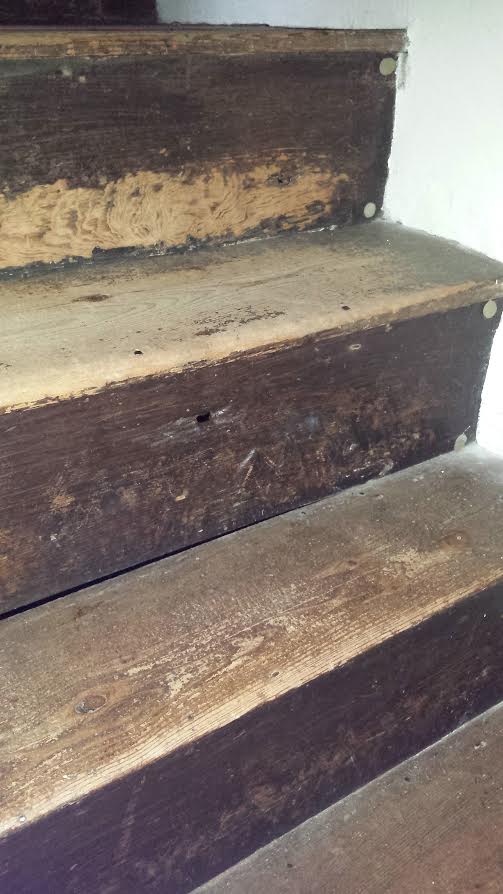
With nowhere else to go, several men rushed into the cellar. What at first would seem to be an ill-advised hiding spot turned out to be the only sanctuary that Russell’s home could offer. Taking position near the bottom of the stairs, the men raised their muskets and shot dead the first soldier who descended.[5] Any other soldiers who attempted to follow were met with blazing musket fire. Holes left by musket balls are still visible in the stairwell, attesting to the firestorm.
Soon, the house grew quiet. All of the men who had sought safety in the house had been killed, with the exception of the men who took refuge in the cellar. The British ransacked the house then left.[6]
In 1835, sixty years after the bloodbath at Russell’s house, a memorial was erected in Danvers to commemorate the townsmen who lost their lives in Menotomy that day. Danvers lost the second highest number of men, after Lexington[7], and all of them at Jason Russell’s house. Foster, the commander of the company of minutemen who had ran halfway to Menotomy, was by then the last surviving Danvers veteran of the war. Aged eighty-six, he addressed the crowd assembled for the dedication of the monument and recounted the events of April 19th:
On that morning, more than one hundred of my townsmen hastened to the field of battle…ready to offer their lives on the altar of their liberties. Seven of those who thus started in the prime of life and vigor of manhood, ere that day’s sun descended in the west, were numbered with the dead.[8]
Foster called the dedication of the memorial “One of the happiest days and most pleasing events of my life.”[9]
In total, twelve Americans were killed at Jason Russell’s house. Jason’s wife, Elizabeth, returned home to find her husband dead. He and the other fallen Americans, their bodies riddled with musket balls and slashed by bayonets, had been laid out on the floor in the kitchen, the blood from their wounds pooling around them. Elizabeth later said that “the blood in the room was almost ankle deep”.[10]
Musket ball damage to the staircase of the Russell House
*Biography: Katie Turner Getty is a lawyer, history enthusiast, and lifelong resident of Boston. She holds an A.A. from Bunker Hill Community College in Charlestown, Massachusetts, a B.A. in History from Wellesley College, and a J.D. from New England Law Boston. She can often be found exploring historic sites both on and off the Freedom Trail.





 Emerging Revolutionary War Era