Love brought Dr. Samuel Prescott, a practicing physician, to the town of Lexington on the night of April 18, 1775. The young doctor was courting Ms. Lydia Mulliken, when the alarm of the British soldiers marching from Boston went out to the local militia. Lydia’s brother was one of those called to gather.
Love. That emotion also drew Dr. Prescott back toward his hometown of Concord—this time to alert friends, neighbors, and family members of the urgent news of the evening. En route, Dr. Prescott along with Paul Revere and William Dawes, alerted the countryside of the moving British troops. After being vetted and vouchsafed as a true friend of liberty, Dr. Prescott rode posthaste to his hometown, where his word carried greater weight.
A artist’s interpretation of Paul Revere’s (or maybe William Dawes or Dr. Samuel Prescott)’s ride to warn the Massachusetts countryside. (courtesy of VFW)
As British General Thomas Gage and his American Whig (or Patriot) antagonists squared off in Boston and the surrounding towns, information gathering became the key to success. Both sides had created networks of spies, but the advantage was clearly in favor of the Whigs. During the winter 1774-1775, groups such as the Sons of Liberty had established a complex spy network within Boston comprised of a system of riders that spread information and “alarms’ quickly. The Committee of Safety and the Massachusetts Provincial Congress relied on this network to stay informed of what was going on in Boston and the British intentions. Continue reading “Two Riders….Gage Gathers Information”→
“the Country was an amazing strong one; full of Hills, Woods, stone Walls, & c., which the Rebels did not fail to take advantage of, for they were all lined with People who kept an incessant fire upon us…”
From the diary of Lieutenant Frederick Mackenzie who was part of the 23rd Regiment–the Royal Welch Fusiliers that survived the ordeal of April 19, 1775. He would keep a diary until the early 1790’s and chronicled his experiences in the American Revolutionary War. His account on April 19, of the retreat from Concord is most descriptive. The British did not just take the brunt of the firing as the marched hurriedly back toward Boston and safety, but;
“as we did too upon them, but not with the same advantage, as they were so concealed there was hardly any seeing them: in this way we marched between 9 and 10 miles, their numbers increasing from all parts…”
The column was led by Lieutenant Colonel Francis Smith and had been tasked by General Thomas Gage, British military leader in North America, to root out the military supplies being stored in Concord by the colonials. The mission, albeit supposedly secretive, did not remain so for long, and the colonials got word out to the countryside. After initial firing at Lexington Green and then at the North Bridge in Concord, the British had to march back through the countryside, facing arriving militia and minute men.
“while ours was reducing by deaths, wounds, and fatigue; and we were totally surrounded with such an incessant fire as it is impossible to conceive; our ammunition was likewise near expended.”
Modern-day view along Battle Road, the route the British column retreated back toward Boston on (author collection)
Luckily, for Mackenzie and the other struggling British officers and rank-and-file, on a rise in the ground, outside the town of Menotomy, was a relief column, ready to provide a few moments’ respite.
A version of this post appeared in the Emerging Civil War blog on August 17, 2018.
John S. Mosby, photographed here as a Federal civil servant
Those who know me know of my “interest” in famous Confederate partisan, John S. Mosby. Ok, some would say “love affair,” but either way, I grew up reading about Mosby and his exploits during the Civil War. It was not until later in my life that I started to read about the most interesting part of Mosby’s life—not his time in the war, but his time AFTER the war.
Mosby had a deep interest and passion in American history and you can see that on a trip that Mosby took north in April 1906 to one of the sacred sites of America’s founding: Boston, Massachusetts. In a 1906 letter to his friend Sam Chapman (a former member of Mosby’s Rangers), Mosby describes his visit and the many ironies (as a southerner) he experienced. Continue reading ““I hope my visit to Boston will do good…” Confederate Colonel John S. Mosby and American Revolution”→
A special thanks to Stacey Fraser at the Lexington Historical Society for the update on the new exhibit described below.
If one asked what a buzzword for 21st century communication would be today, what would be your answer?
Text? Tweet? Snap?
(courtesy of Lexington Historical Society)
What if the follow up question was that some of the same buzzwords of the 21st century could describe the 18th century? Thanks to the Lexington Historical Society at Buckman Tavern, you can see the similarities yourself.
Opening on April 8th, the interactive exhibit is part of the admission ticket to the tavern. Titled #Alarmed! 18th Century Social Media “explores how news went viral 250 years ago” in addition to letting “visitors imagine how colonials might have made use of modern media tools to kick start a revolution. Continue reading “#Alarmed”→
Leading up to the anniversary of April 19, 1775, we will be sharing some short remembrances from a few people who are from Lexington and Concord.This installment is by Rich Gillespie, a native of Lexington, Massachusetts.
If you live in Lexington, Massachusetts, the beginning of the American Revolution is an essential piece of life. The Minuteman statue dominates the center of town, the village green where the Alarm List stood to face the Regulars is much as it once was, the Town Seal seen on your friendly snowplow quotes Sam Adams’ comment to John Hancock upon hearing the firing—“Oh, What a glorious morning for America!”, and the high school’s team is predictably the Minutemen. The British marched to and from Concord within 150 yards of my 4th grade classroom, and the spring field trip was to the key sites of Lexington and Concord. My first job (as was my sister’s) was guiding visitors on Lexington Green.
Hip-hip Huzzah-Haughty British troops leave Lexington (author collection)
Leading up to the anniversary of April 19, 1775, we will be sharing some short remembrances from a few people who are from Lexington and Concord. Our first installment is by Alex Merenyi. Alex grew up in Lexington and moved to the Washington, DC area to attend college. He shares with us how he looks back on Patriots Day..
Patriots’ Day was always weird for me growing up.
Lexington’s Tourist Season would begin with a bang on Patriots Day – one specific bang, at 5:36-ish in the morning a Monday – and carry through until the snow would scare the tour busses back home for the winter. (Ironically, it meant that the foot and a half of standing snow made getting around a lot easier.) It wasn’t until I moved to DC that I realized nobody else knew what Patriots Day was.
What it was for us, in addition to being of the part of the year where tour busses blocked off the best way to Starbucks, was two discrete parts; the historical, which was the reenactment of the Battle of Lexington; and the festival, which was that the center was shut down for a carnival-like opening of the tourist season. (There was also a 5k, which I remember my Father running once. It always seemed odd that they’d run a race that day through the heart of town, but so it went.)
You couldn’t live in Lexington and not know about The Reenactment. Every year, on the third Monday in April, a bunch of Americans would stand up to the Regulars and be cut down in a single volley of fire. I went once, when I was young enough to ride on my Father’s shoulders, and watched my dentist and his friends get shot on the Battle Green. Two minutes later we began walking home, wanting to beat the crowds that had gathered there. A second volley of fire went off, and I remember asking my Dad if that meant the British had shot the wives that ran out to their fallen husbands. (He explained they fired to clear their rifles. I was maybe seven – by this point, ‘The British Were Evil” was pretty engrained; I remained suspicious.) All told, it took us longer to walk to and from the event than watch it. Even as a kid, I had to ask myself what all the fuss was about – a fifteen minute re-enactment of, let’s call it what it is – the first American defeat – seemed rather odd.
I mention my dentist not just as an anecdote, but to illustrate how deeply The Reenactment went – the men and women who would come together at the pre-dawn hours in April and fall over, year after year, were celebrities in Lexington. It was all over my dentist’s office, photos of him marching in the 4th of July parades, scenes of him at the then-standing Foxboro Stadium firing a musket for the other Patriots’ having scored. (Back in the pre-Brady days, those were fewer and further between). Schools would give extra credit for interviewing reenactors, and of course, every student had the requisite “Go to the re-enactment and write a paper on how important it is.” As a child growing up in Lexington, it had an aura effect that made all of the rest of American History seem rather… well, underwhelming – nobody was making a huge fuss about re-enacting the signing of the Constitution. (Adding to that of course was that my Mother is quite British; her answer to my asking about how the Battle of Lexington was covered for her in school? “It wasn’t.”) Until I left Lexington, I never really appreciated why all the fuss was made about The Reenactment, or why these few people were given such a disproportionate amount of attention; It was more than just “this is a thing that we do once a year”, it was a recognition of something that nobody ever dared point out:
“If it weren’t for these guys, Lexington wouldn’t be on the map.”
“Minutemen” on April 19, 1775 at Lexington and Concord have always been grouped together in history and textbooks. But, is that completely historically accurate? Well, no. There is a common misperception that most of the Americans that went to arms on the morning of April 19, 1775 were “Minutemen.” This view has become part of American mythology and popular memory, referenced in most histories dealing with this April day. Despite all of this, the fact remains that many of the men who answered the call that day were not “Minutemen” at all.
The British colonies in North America had a long standing tradition of locally based military units. Most men between the ages of sixteen and thirty five were required to be part of the local militia and these units would meet periodically throughout the year for basic training. Many of these occasions became festive events for the local community. The colonial militia was called out often by the colonial governor to defend against Native American attacks or foreign invasions. Frequently, the militia would supplement a professional force for short campaigns. This was especially common in the French and Indian War, fought between 1756 and 1763.
But the militia was far from a professional and well trained force. Colonies, such as Massachusetts, began to create select companies of men chosen from the local militia regiment. These companies would train more often and be better equipped. They were to be the “elite” force of the militia. Also, these men would be required to respond to an emergency at a short notice. The rise of the “Minuteman” concept can be found as early as 1645. In response to an Indian tribe disturbance, the Massachusetts Council of War created a new regulation. This regulation ordered militia companies to “appoint out and to make choice of thirty soldiers of their companies in ye hundred, who shall be ready at a half an hour’s warning.” The need for a quick response force was already recognized by colonial leaders.
Though the idea of the “Minuteman” can be found in 1645 Massachusetts, the more popular idea of the “Minuteman” came from Worcester, Massachusetts. In 1774 the town was in the forefront of opposing Governor (and General) Thomas Gage’s efforts to enforce Royal authority. The Worcester County Convention passed new militia regulations that highlighted/reinforced how the populace was getting closer and closer to open confrontation with the British Crown. In these new regulations, the Worcester Convention called for “officers in each town of the county, to enlist one third of the men of their respective towns, between sixteen and sixty years of age, to be ready to act at a minute’s warning…” Thus the “Minuteman” was born.
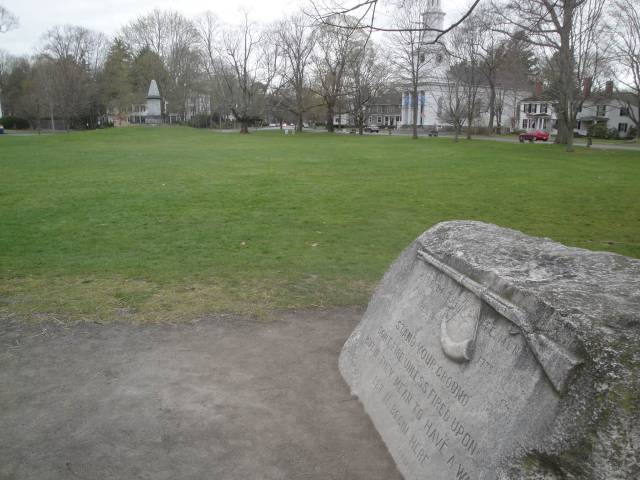
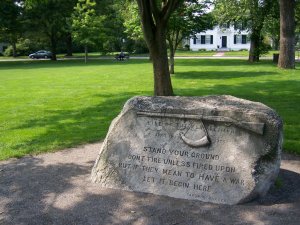
Monument on the Lexington Green marking the place where the “Lexington Minute Men” stood
As events in Massachusetts spiraled into open confrontation between the Whigs (Patriots) and the Crown, every town in Massachusetts ramped up their military training of their militia and created “Minuteman” companies. These units became a source of local pride. Along with the militia forces, towns and counties created a complex network of communication via riders that could notify hundreds if not thousands of militia units of possible threats. As Gage began to use his growing military force in Boston to search for colonial military stores, these riders and “Minutemen” showed their effectiveness.
On the morning of April 19, 1775 riders rode out to a very well prepared countryside west of Boston. Paul Revere, William Dawes and many others connected each town with the news that the British regulars were marching on Concord to capture provincial military stores (and possibly capture colonial leaders). Militia and “Minutemen” by the hundreds began to arrive along the road from Cambridge to Concord.
The first Americans the British confronted on the road to Concord were members of Captain Parker’s Lexington Militia. These men, gathered the night before at Buckman’s Tavern in Lexington after an early warning, were still in the area in the early morning of April 19th as the vanguard of the British column neared Lexington. As they formed up in two lines on the Lexington Green, the British quickly came onto the Green to confront the armed colonials. What happened next set off a shockwave not just through Massachusetts, but the entire British colonies in North America. These first shots were fired by militia, not the famed “Minutemen.”
It is here in Lexington that the confusion and myth of the “Minutemen” was born. Several of the monuments around the Lexington Green are dedicated to the “Lexington Minutemen.” But the men on the green were typical militia; they ranged in age and skill levels. They were not highly trained like a “Minutemen” company.
Isaac Davis Monument in Acton, MA. The Acton Minute Men were one of several Minute Men units to take part in the action at Concord.
As the British made their way to Concord, Militia and “Minuteman” companies began to answer the well-traveled call that the British were marching on to Concord. After the skirmish at the North Bridge in Concord, more and more colonials answered the call and began to confront the British column as it made its way back to Charlestown. Thousands of militia and “Minutemen” made their way to the towns of Lexington, Menotomy, and Cambridge to confront the British. Because of the great response of these men, there was no turning back after April 19th.
The importance of the “Minutemen” cannot be exaggerated but neither can the importance of the militia. They were two distinct colonial military forces, both created with their own specific uses. In modern times, most wanted to attach their local story to that of the famed “Minutemen.” Though it is most likely that more militia turned out on April 19th than “Minutemen.”
Many monuments in Lexington, Concord and along Battle Road mention the “Minutemen” of 1775. Also, many of the sites associated with the events of April 19th are preserved by Minute Man National Park. I guess “Militia National Park” didn’t have as good of a ring to it.
Recommended Reading:
The Minute Men: The First Fight: Myths and Realities of the American Revolution by John Galvin
Often the study of history can ground us and make us feel less “unique.” This allows us to hopefully put our own experiences into perspective and be able to hopefully learn from lessons of the past. Many today complain about how print and social media can distort facts to support a particular agenda. This is not a modern phenomenon. Many in the Sons of Liberty (such as Paul Revere) used print media to their advantage to promote resistance to and then independence from Great Britain.
Many pro-Patriot newspapers printed nothing less than propaganda pieces after the battles of April 19, 1775. Here is part of what was printed by the Massachusetts Spy on May 3, 1775.
“Americans! forever bear in mind the BATTLE of LEXINGTON! where British Troops, unmolested and unprovoked wantonly, and in a most inhuman manner fired upon and killed a number of our countrymen, then robbed them of their provisions, ransacked, plundered and burnt their houses! nor could the tears of defenseless women, some of whom were in the pains of childbirth, the cries of helpless, babes, nor the prayers of old age, confined to beds of sickness, appease their thirst for blood! – or divert them from the DESIGN of MURDER and ROBBERY!”
Obviously a historic study of the events on April 19, 1775 disputes much of what is claimed by the Massachusetts Spy. But when you have a point to make, an agenda to promote and a local population to rally to a cause…why should truth get in the way?! We have come a long way since 1775, but in many ways not much has changed.
The prints by Amos Doolittle of the events on April 19, 1775 did a lot to promote the Patriots cause in their “media war” war against the British.






 Often the study of history can ground us and make us feel less “unique.” This allows us to hopefully put our own experiences into perspective and be able to hopefully learn from lessons of the past. Many today complain about how print and social media can distort facts to support a particular agenda. This is not a modern phenomenon. Many in the Sons of Liberty (such as Paul Revere) used print media to their advantage to promote resistance to and then independence from Great Britain.
 Emerging Revolutionary War Era