Review: “The Ride: Paul Revere and the Night That Saved America” by Kostya Kennedy

“LISTEN, my children, and you shall hear
Of the midnight ride of Paul Revere,
On the eighteenth of April, in Seventy-five”

Henry Wadsworth Longfellow penned the poem, “Paul Revere’s Ride” in 1860. Now as America moves toward celebrating the 250th anniversary of Paul Revere’s famous ride, which happened on this date in 1775, another literary work has hit the market on this very topic.

Published on March 25 by Kostya Kennedy, Chief of Premium Publishing at Dotdash Meredith, with a lengthy career in writing, teaching, and journalism. The book reads like Revere’s ride, a fast-paced, descriptive overview of the man, events, and memories around the night of April 18, 1775. For those who have read David Hackett Fischer’s book, published in 1994, you may not find anything groundbreaking or new. However, that is not the point I feel in this book.

Kennedy pens this to get the reader hooked. Sets of rhetorical questions, “what-if” scenarios, and descriptive writing make the reader feel that they are in the environs of Boston or on the routes to Lexington traversed by Revere. Oh, and Kennedy does not forget Dawes, Prescott, and others who also played prominent roles in April 1775.

History enthusiasts and content experts may find a few shortcomings and errors, such as Kennedy continuing to use “Royal” when discussing the British Army. Since the English Civil War, the British Army has lost the right to use “Royal” in front of it. A few times, he labels the “British” as coming when the colonists would have used “Regulars” or “Redcoats.” Lastly, falling into the ag-old myth that Lexington had minutemen and a militia, the town just had the latter. Trivial things that do not impact the flow of the narrative.

A highlight to me, though, is the final sections about the memory of that day. Including a great insert of an interview with the direct descendant of Paul Revere and a comical anecdote about Paul Revere III being pulled over for speeding in Lexington, Massachusetts one year on April 18.

The book is a great read on the anniversary of Paul Revere’s Ride. Take it from me, I read the book in a day! Descriptive, vivid, and convince you that if you have not been, a trip to Boston and the Massachusetts countryside should be in your near future.

Published by: St. Martin’s Press, March 25, 2025
Images, sources, 282 pages
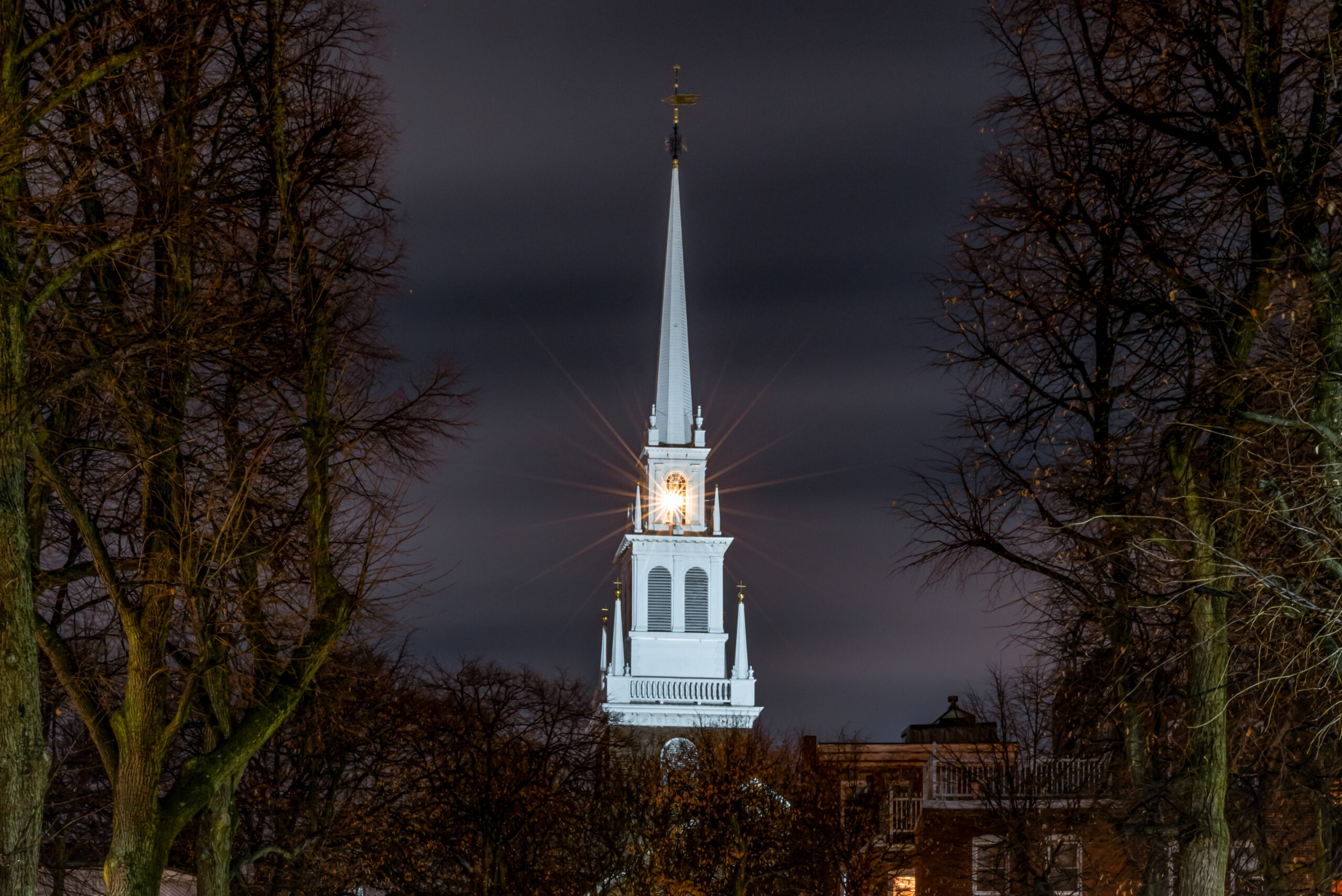
Rev War Revelry: Old North Church; Paul Revere and Two Lanterns

“He said to his friend, “If the British march
By land or sea from the town to-night,
Hang a lantern aloft in the belfry arch
Of the North Church tower as a signal light,–
One, if by land, and two, if by sea;”

These famous words from Henry Wadsworth Longfellow’s poem about Paul Revere’s ride recount the important role the Old North Church played in the events leading up to the first shots of the Revolutionary War. Join us just a few weeks before the 250th anniversary as we sit down with Emily Spence, Director of Education at Old North Church in Boston. We’ll discuss the history of the church, what occurred on April 18, 1775 and what happened during the war. We’ll also discuss the exciting events the Old North Church will be doing on the 250th anniversary. This will be a pre-recorded video and you will be able to watch it when we post it at 7 p.m. on our Facebook page.

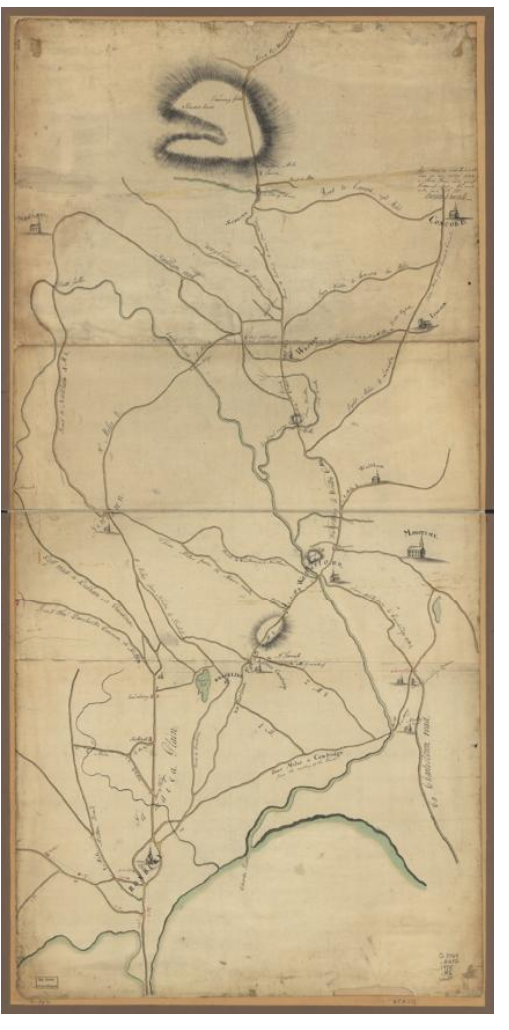
Captain John Brown and Ensign Henry De Berniere’s March 20, 1775 Excursion to Concord

The spy network of Dr. Joseph Warren and the Sons of Liberty is well documented and written about. Few things happened in and around Boston that Warren, Paul Revere or Sam Adams were not aware of. In the winter of 1775, British General Thomas Gage also established a spy network (one of the more famous British spies was supposed “Patriot” Dr. Benjamin Church was not revealed as spy until October 1775). Gage was using all the resources at his disposal to figure out what the Whigs were doing and to find out where weapons (and four cannon that were stolen from the British in Boston) were located.  On February 22nd, Gage sent out two officers, Captain John Brown and Ensign Henry De Berniere, to covertly ride out towards Worcester to locate stores and to map the road network for a possible British excursion. A few weeks later, on March 20th Gage sent out Brown and De Berniere again to map out routes towards Concord. Keeping in mind of potential geographic features that could endanger the future British column.

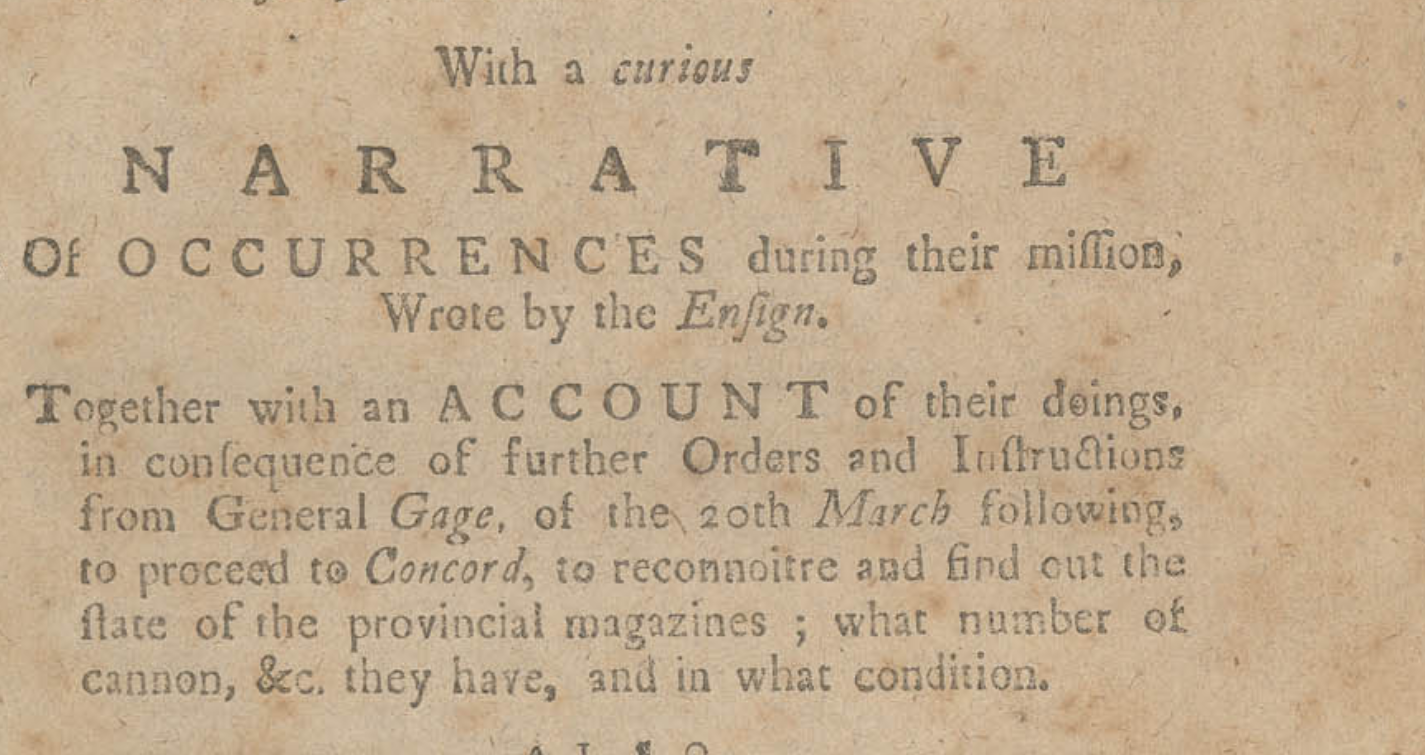
The following is an account of the March 20th mission by Ensign De Berniere. This account was found in Boston after the British evacuated and published by Boston printer J. Gill in 1779. Today it is located in the Massachusetts Historical Society. This mission was the precursor for the April 18-19th British raid to Concord that ignited the war.

Map, Roxbury to Concord. Roads & distances; by Brown and De Berniere, Library of Congress

Account of the proceedings of the aforesaid officers, in
consequence of further orders and instructions from
General 
Gage, of the 20th March following ; with
occurrences during their mission.

Scan of the original print by J. GILL, in Court Street.
1779, Massachusetts Historical Society

THE twentieth of March Captain Brown and
myself received orders to set out for Concord,
and examine the road and situation of the
town ; and also to get what information we
could relative to what quantity of artillery and provi-
sions. We went through Roxbury and Brookline, and
came into the main road between the thirteen and four-
teen mile-stones in the township of Weston ; we went
through part of the pass at the eleven mile-stone, took
the Concord road, which is seven miles from the main
road. We arrived there without any kind of insult
being offered us, the road is high to the right and low
to the left, woody in most places, and very close and
commanded by hills frequently. The town of Concord
lies between hills that command it entirely ; there is
a river runs through it, with two bridges over it, in
summer it is pretty dry ; the town is large and co-
vers a great tract of ground, but the houses are not
close together but generally in little groups. We were
informed that they had fourteen pieces of cannon (ten

iron and four brass) and two cohorns, they were mounted but in so bad a manner that they could not elevate them more than they were, that is, they were fixed to one
elevation ; their iron cannon they kept in a house in town, their brass they had concealed in some place behind the town, in a wood. They had also a store of flour, fish, salt and rice ; and a magazine of powder and cartridges. They fired their morning gun, and mounted a guard of ten men at night. We dined at the house of a Mr. Bliss, a friend to government ; they had sent him word they would not let him go out of town alive that morning ; however, we told him if he would come with us we would take care of him, as we were three and all well armed, — he consented and told us he could shew us another road, called the Lexington road. We set out and crossed the bridge in the town, and of consequence left the town on the contrary side of the river to what we entered it. The road continued very open and good for six miles, the next five a little inclosed, (there is one very bad place in this five miles) the road good to Lexington. You then come to Menotomy, the road still good ; a pond or lake at Menotomy. You then leave Cambridge on your right, and fall into the main road a little below Cambridge, and so to Charlestown ; the road is very good almost all the way.

In the town of Concord, a woman directed us to Mr. Bliss‘s house ; a little after she came in crying, and
told us they swore if she did not leave the town, they would tar and feather her for directing Tories in their road.

[Left in town by a British Officer previous to the evacua tion of it by the enemy, and now printed for the
information and amusement of the curious.]

BOSTON
Printed, and to be sold, by J. GILL, in Court Street.
1779.

Massachusetts Historical Society

“If you Fire, You’ll all be dead men” The Salem Alarm

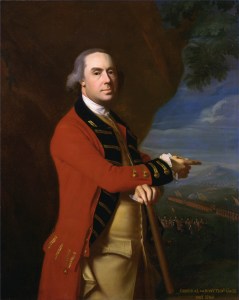
Thomas_Gage_John_Singleton_Copley
Thomas Gage

We reshare a post from 2018 about the Salem Alarm also known as “Leslie’s Retreat.” As we approach the 250th anniversary of this important event (February 26, 1775), we will share primary source accounts of the event. This event set the kindling for the spark that lit a war in Lexington a month later. 

As events quickly spiraled out of control in the winter and spring of 1774-1775 around Massachusetts, several armed confrontations between local “Patriots” and the British army heightened tensions. On many occasions, both sides adverted open confrontation and were able to diffuse the situation. Understanding these events and how they made an impression on both sides helps explain what happened on the Lexington Common on April 19, 1775.

As soon as British General Thomas Gage arrived in Boston in the spring of 1774, he set about enforcing the newly passed “Coercive Acts.” In response to these new laws that restricted many of the rights the people of Massachusetts had grown accustomed too, local groups began to arm themselves in opposition to British authority. Even though Gage was once popular in the colonies, he soon became an enemy to those around Boston who believed the Coercive Acts were an overstep of British authority. Continue reading ““If you Fire, You’ll all be dead men” The Salem Alarm”

First Shots? The Raid on Fort William and Mary, December 14-15, 1774

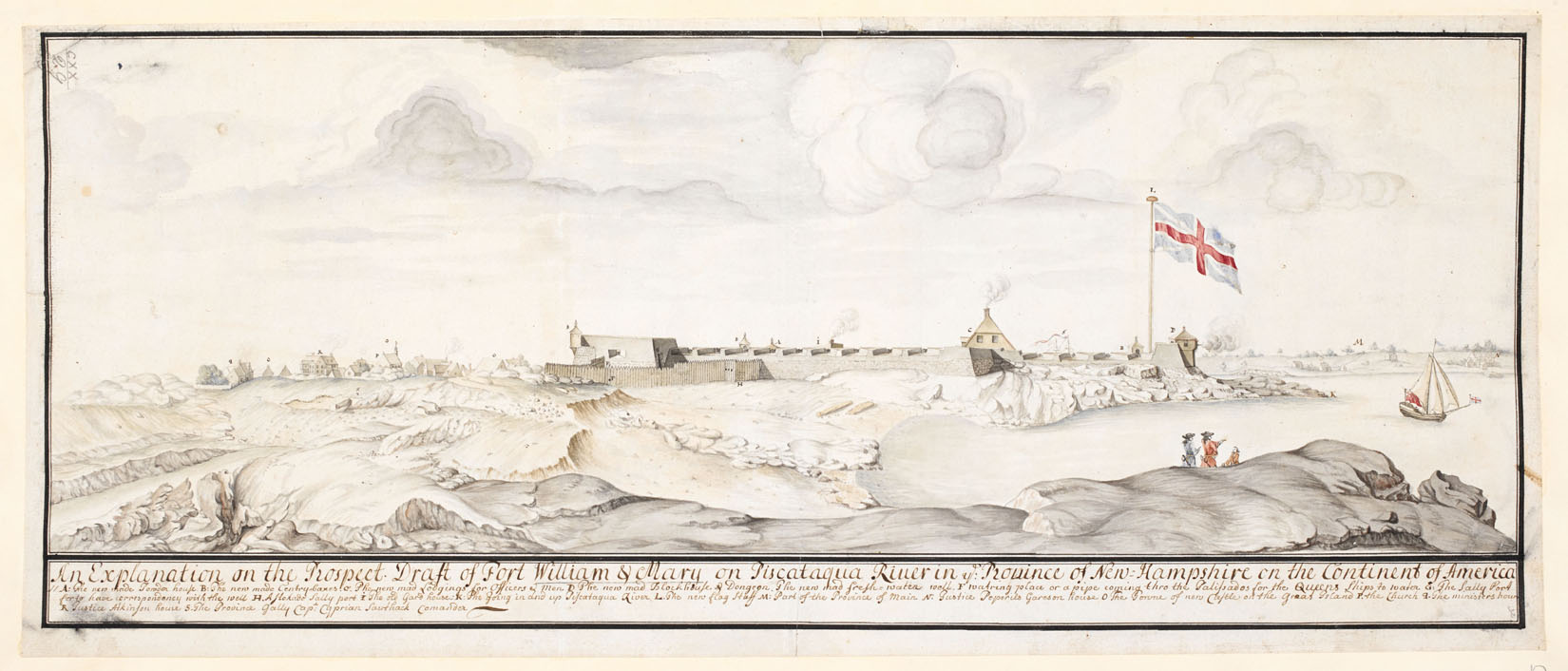
Everyone has heard of the “shot heard round the world” at the North Bridge, or the first shots of the war on the early morning of April 19, 1775 at the Lexington Green. But few people know about events that transpired in New Hampshire four months before Lexington and Concord. The events at Fort William and Mary on December 13 and 14 1774 were just as critical to the step toward war as the September Powder Alarm or the later Salem Alarm in February 1775.

Fort William and Mary, ca. 1705 by Wolfgang William Romer

In response to the Massachusetts Powder Alarm in September 1774, colonial Whig leaders in nearby colonies began to make plans to “capture” local and colonial powder supplies. The crux was the issue of who really owned the gunpowder. Whig leaders believe they owned the power, the colonial militias. Royal leaders, Gen. Gage specifically, believe the powder was the “King’s Powder.” So any attempt to take the powder, was theft and treason. On December 3, 1774 the Rhode Island Assembly ordered the removal of cannons and powder from Fort George in Newport. On December 9, local militia carried out the order without any incident. Gage began to look at larger powder supplies that he believe were vulnerable. One large such supply was located at Fort William and Mary, located near Portsmouth, New Hampshire. This fort was isolated on the island of New Castle, at the mouth of the Piscataqua River. Located here was a small garrison of six men, guarding the fort and its supply of gunpowder.

Paul Revere and his other Patriot leaders in Boston became expert spies and soon received word that Gage was to send a contingent of British marines to Fort William and Mary. On December 13, Revere set out from Boston to Portsmouth to warn them of the coming expedition. Though the British navy was active in the area off of Portsmouth, Gage ironically made no plans to send an expedition to the fort. That would matter little in what happened next.

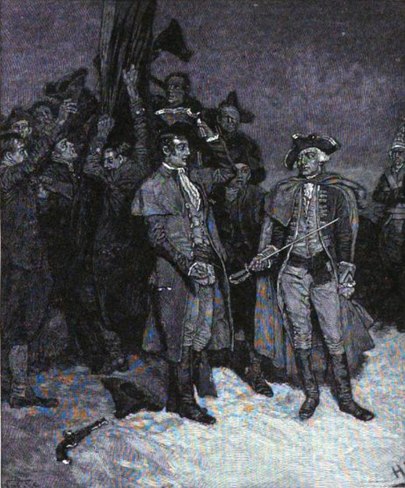
Surrender of Fort William and Mary by Howard Pyle

As Revere arrived in Portsmouth that afternoon, he gave the news of the supposed British expedition to the local Committee of Correspondence. Soon the local militia organized and, on the next day, nearly 400 militiamen assaulted the fort. The six-man British contingent inside the fort refused to surrender. They even fired three of their cannon at the attacking militiamen. For the first time, colonists were in open combat against British troops. The contingent eventually surrendered, having suffered a few injuries but no fatalities. That afternoon, the militia hauled away nearly 100 barrels of gunpowder. The next day nearly a thousand militiamen led by John Sullivan, arrived in Portsmouth due to the rider notification system. With no British to fight, these men assisted in going back to the fort to carry away muskets and cannon. Gage got word of Revere’s presence in Portsmouth and soon sent a small force from Boston to Portsmouth via the British navy. This force arrived the next week and at that point, there was nothing left of substance in Fort William and Mary.

The events at Portsmouth led Gage to be more aggressive in establishing a more coordinated spy network. As the new year began, Gage’s communications with England forced British officials to realize that this opposition was not like those in years past. The Patriots were arming themselves and establishing their own government in an affront to British authority. Former Prime Minister William Pitt, now sitting as a member of the House of Lords, knew the colonies well. He was well liked by the colonists, and he sought a compromise. He predicted the colonials would not back down and soon war would erupt between Great Britain and its colonies. Pitt proposed to remove British troops from Boston to lessen the tensions and to repeal the Coercive Acts. Both ideas were rejected overwhelmingly by Parliament.

In response to the news that the Continental Congress convened, Parliament on February 9, 1775, declared: “We find, that a part of your Majesty’s subjects in the province of the Massachusetts Bay have proceeded so far to resist the authority of the supreme legislature, that a rebellion at this time actually exists within the said province.” Now there was no doubt how the “Patriots” were viewed by Parliament and the King; they were rebels.

The events at Fort William and Mary were part of a succession of tense encounters between British authorities and local Whig leaders. Each one built on the tension from the previous. It is amazing that the “attack” by the New Hampshire militia on the fort, attacking the King’s troops, did not lead directly to war then. It would take four more months before another armed conflict sparked a revolutionary war.

To learn more about the Fort William and Mary 250th, visit: https://fortwilliamandmary250.org/

To read more about the events leading up to Lexington and Concord, visit the Savas Beatie website to purchase “A Single Blow: The Battles of Lexington and Concord and the Beginning of the American Revolution” by Phillip S. Greenwalt and Rob Orrison

https://www.savasbeatie.com/a-single-blow-the-battles-of-lexington-and-concord-and-the-beginning-of-the-american-revolution-april-19-1775/

Rev War Revelry: Fort William and Mary, December 1774

Many have heard of Paul Revere’s ride to Lexington and the shot heard round the world at Concord (and Lexington) but few know about the December 1774 raid and skirmish at Fort William and Mary in New Castle, New Hampshire. Here, inspired by news from Paul Revere, local militia attacked and captured a small British garrison at Fort William and Mary. Join us as we welcome Dr.
Dr. Cynthia Hatch to discuss this much over looked action leading up the American Revolution.

Dr. Hatch is an Oklahoma State University Institute of Technology instructor specializing in Revolutionary War history. With a PhD in History, she explores the intricate political, social, and cultural dynamics of the 18th century, with a particular focus on the colonial legal system and the pivotal role of local narratives in shaping historical interpretations during the Revolutionary Era.

Join us as we discuss the events leading up and during the raid of Fort William and Mary and learn, were these the FIRST shots of the American Revolution? This Rev War Revelry will be pre-recorded and posted to our Facebook page at 7pm on Sunday, December 8th.

Americana Corner

Our monthly recap of what our good friend and fellow historian Tom Hand has written on his blog, AmericanaCorner.

The Legacy of Paul Revere
November 2, 2021

Paul Revere began his famous ride from Boston to Concord, around 11:00pm on April 18, 1775, informing the residents and militiamen that the British were on the march. He arrived in Lexington, a town about 10 miles from Boston, around midnight. Read more here.

Lexington and Concord: Minutemen in Arms
November 9, 2021

The Battles of Lexington and Concord, fought on April 19, 1775, marked the start of America’s war for independence from England. The story of that fight is an inspiring account of how everyday Americans came together to resist the power of Great Britain. Read more here.

Lexington and Concord: The Shot Heard Round the World
November 16, 2021

The fight between our Minutemen and the British regulars at Lexington was over in a matter of minutes, and the British began the seven-mile march to Concord. By now, reports of the shooting had reached the minutemen in the surrounding area, and they began to assemble. A bad day for the British was about to begin. Read more here.

The Battle of Bunker Hill
November 23, 2021

The Battle of Bunker Hill, fought on June 17, 1775, is one of the most iconic and familiar events in American history. It was our first pitched battle against the British army and, although technically a defeat, the efforts of the American militiamen were inspirational. Read more here.

Dr. Prescott, Love & War

Love brought Dr. Samuel Prescott, a practicing physician, to the town of Lexington on the night of April 18, 1775. The young doctor was courting Ms. Lydia Mulliken, when the alarm of the British soldiers marching from Boston went out to the local militia. Lydia’s brother was one of those called to gather.

Love. That emotion also drew Dr. Prescott back toward his hometown of Concord—this time to alert friends, neighbors, and family members of the urgent news of the evening. En route, Dr. Prescott along with Paul Revere and William Dawes, alerted the countryside of the moving British troops. After being vetted and vouchsafed as a true friend of liberty, Dr. Prescott rode posthaste to his hometown, where his word carried greater weight.

paul_revere
A artist’s interpretation of Paul Revere’s (or maybe William Dawes or Dr. Samuel Prescott)’s ride to warn the Massachusetts countryside. (courtesy of VFW)

Continue reading “Dr. Prescott, Love & War”

ERW Weekender: Bunker Hill Monument & Museum

Emerging Revolutionary War welcomes back guest historian Katie Turner Getty. 

Towering over Charlestown, Massachusetts, its foundation set in sacred battleground soil, the Bunker Hill Monument is a 221 foot obelisk commemorating the Battle of Bunker Hill. The cornerstone of the monument was laid by the Marquis De Lafayette in 1825, fifty years after the battle was fought on June 17, 1775.

BunkerHillMon-KTGetty
Bunker Hill Monument (author collection)

Although the land surrounding the monument has been greatly developed since the battle, visitors today can get still get a sense of the 18th-century landscape just by walking through Charlestown and climbing the hill to reach Monument Square. Approaching visitors are greeted by the statue of Colonel William Prescott, the gray granite of the monument serving as an impressive backdrop behind him. Continue reading “ERW Weekender: Bunker Hill Monument & Museum”

Women Speaking Softly: Female Voices of the Boston Massacre

Emerging Revolutionary War welcomes back guest historian Katie Turner Getty

“Fire! Fire! You dare not fire!” “Cowardly rascals!” “Lobsters!”

Shouts pierced the icy stillness of the night as a raucous crowd gathered in Boston’s King Street on the night of March 5, 1770. With their voices carrying through the wintry air all the way to Long Wharf, the crowd hurled insults at eight British soldiers and their captain. The soldiers’ muskets rattled as snowballs, oyster shells, and chunks of ice lobbed by the unruly crowd rained down upon them.

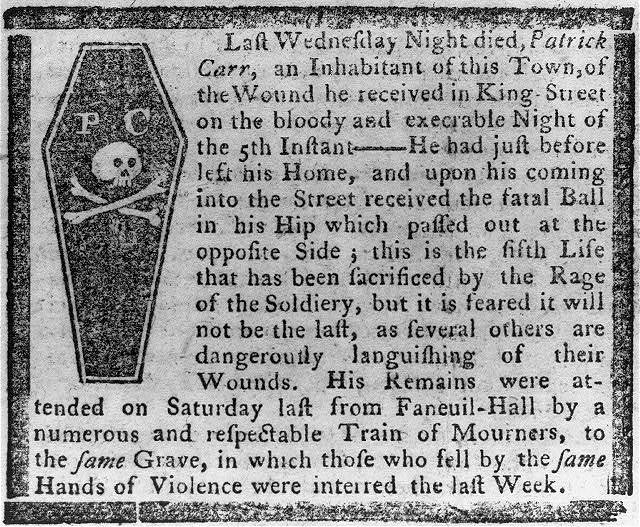
erw-fifth-victim
Fifth Victim is the sketch of the coffin of Patrick Carr, published in the Boston-Gazette and Country Journal on19 March 1770.

The soldiers shot eleven townspeople that night. Three died in the snow where they stood. Two more would later die from their wounds. The remaining six would survive. All of the victims were male.

Documentary evidence shows that the crowd in King Street on the night of the Boston Massacre was overwhelmingly male. The crowd was variously described as “mostly boys and youngsters”, “near 200 boys and men”, “a parcel of Rude boys”, and “chiefly consisting of boys and lads”.[1] Continue reading “Women Speaking Softly: Female Voices of the Boston Massacre”