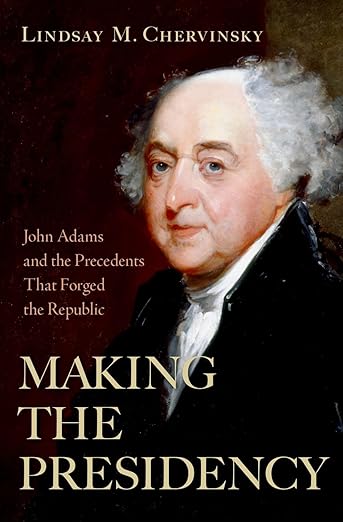
Book Review: “Making the Presidency: John Adams and the Precedents That Forged the Republic” by Lindsey Chervinsky

Emerging Revolutionary War welcomes guest historian and reviewer Al Dickenson

No president has an easy job. But imagine holding the position of president immediately after undoubtedly the best president the United States has ever had.

That was John Adams’ conundrum. Additionally, it is the subject of renowned historian Lindsey Chervinsky’s new book, Making the Presidency: John Adams and the Precedents That Forged the Republic. Initially released last year, in the midst of a politically fraught election season, Chervinsky places the modern world into a context we should all understand better: the history of the 1790s.

After a brief introduction regarding the Revolutionary War, the early republic, and George Washington’s presidency, readers are thrown into John Adams’ presidency. Federalists opposing Democratic-Republicans (commonly referred to as simply “Republicans” in Chervinsky’s text, as they referred to themselves), the Americans opposing the French, the North opposing the South, Federalists opposing Federalists: it seemed there could be no peace in the nation so split apart. Yet the nation stood for another 220 years. Why is that?

Chervinsky argues that the reason we are a nation today relies on how John Adams served his presidency, specifically the power sharing he enacted in his cabinet amongst Republicans (like Vice President Thomas Jefferson), Federalists (like Secretary of State Timothy Pickering), and Archfederalists (like Secretary of War James McHenry), the successful navigation of foreign affairs (see the ongoing French Revolution, specifically the XYZ Affair), and the peaceful transfer of power.

The final focus of Chervinsky’s book, Adams’ loss in the 1800 election, perhaps offers the most original outlook on Adams’ presidency. Being the loser of the election, and being the first incumbent president to lose an election, historians have often treated Jefferson a little kindlier than Adams. Where Chervinsky’s work shines, however, is in showing how these great, powerful men, the leaders of their respective parties, differed in how they saw power, and in how they wielded it.

Little scholarship focuses on Jefferson’s machinations to gain the presidency. Rarely researched are his Virginia and Kentucky Resolutions, which called for nullifying federal law, even though these ideas were eventually adapted into various Confederate causes and mentalities in the following decades. Nor are the essentially political and emotional blackmail Jefferson laid on Federalist members of Congress who refused to vote for him over Aaron Burr. Jefferson threatened the members of Congress with, in essence, secession of Republican states if they did not pick a president soon, given that this was the only election in American history where the House of Representatives made the presidential selection. The dirty tricks of politics manifested themselves in this election, including smear campaigns against Adams and unfounded warnings that the Federalist Party would forego the will of the people and simply appoint a new, Federalist president.

Compare this to John Adams, who, while certainly desirous of a second term, largely laid low during the turmoil occurring on the other side of the Capitol. When presented with suggestions to keep himself as president, he refused. When asked to annul the election, Adams refused. When asked to stand for himself and campaign in the final months of the election season, and during the contingent election in the House between Jefferson and Burr, Adams refused and stayed silent. He did not cling to power, nor did he view his opinion better than that of the American people who voted for a Republican and the House members who would choose the next presidency. Though he was a lame duck president in every sense of the word, he held true to his convictions of propriety in politics, though privately he fumed.

In this way, though history often sheds more light on the winner, makes historians wonder what other ways “losers” of an election may have impacted our politics and history. An interesting study question for any intrigued historian, but one that Chervinsky shows is vital to understanding American history and modern politics alike.

The Untold Story of America’s First Abolitionist Society – 250th Anniversary of the Society for the Relief of Free Negroes Unlawfully Held in Bondage

As we approach the 250th anniversary of Lexington and Concord, on April 14, 2025 another 250th anniversary is taking place but one that is much overlooked. When we think about the fight to end slavery in the United States, names like Frederick Douglass, Harriet Tubman, and William Lloyd Garrison often come to mind. But America’s organized abolitionist movement actually began decades earlier—with a quiet but powerful group of reformers in Philadelphia.

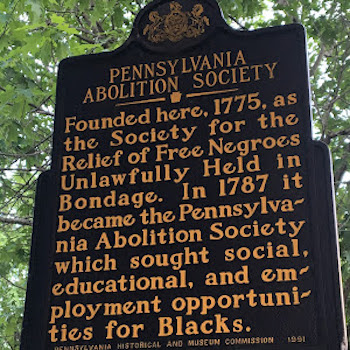
Historic marker located near the intersection of Front and Ionic Streets in the “old city” section of Philadelphia. Close to the original location of Tun Tavern.

In 1775 the American colonies were on the verge of war with Great Britain, calling for freedom and independence. But even as they demanded liberty, many Americans—including some of the nation’s founders—continued to own slaves. Amid this contradiction, a small group of Philadelphia Quakers stepped up to challenge the injustice of slavery. On April 14, 1775 in Philadelphia, they formed what would become the first formal abolitionist organization in America, the Society for the Relief of Free Negroes Unlawfully Held in Bondage.

The name was long, but its mission was clear. This group was determined to help free Black people who were illegally enslaved or kidnapped into bondage. Their founding was quiet, overshadowed by the Revolutionary War, but it planted the seeds of a movement that would eventually reshape the nation.

At the heart of the Society were the Quakers (17 of the original 24 members were Quakers) formally known as the Religious Society of Friends. Quakers believed deeply in the equality of all people and had long spoken out against slavery. Many had already freed the people they once enslaved, and by the mid-1700s, anti-slavery had become central to their faith.

So in April 1775, a group of these Quakers, joined by a few like-minded allies, came together to create the Society. Their initial goal was modest but critical: to protect the rights of free Black people and prevent them from being illegally sold into slavery. This was not uncommon at the time, especially in cities like Philadelphia where Black communities—both free and slave—lived side by side. However, the outbreak of war later that year put much of the Society’s early work on hold. But their mission didn’t die.

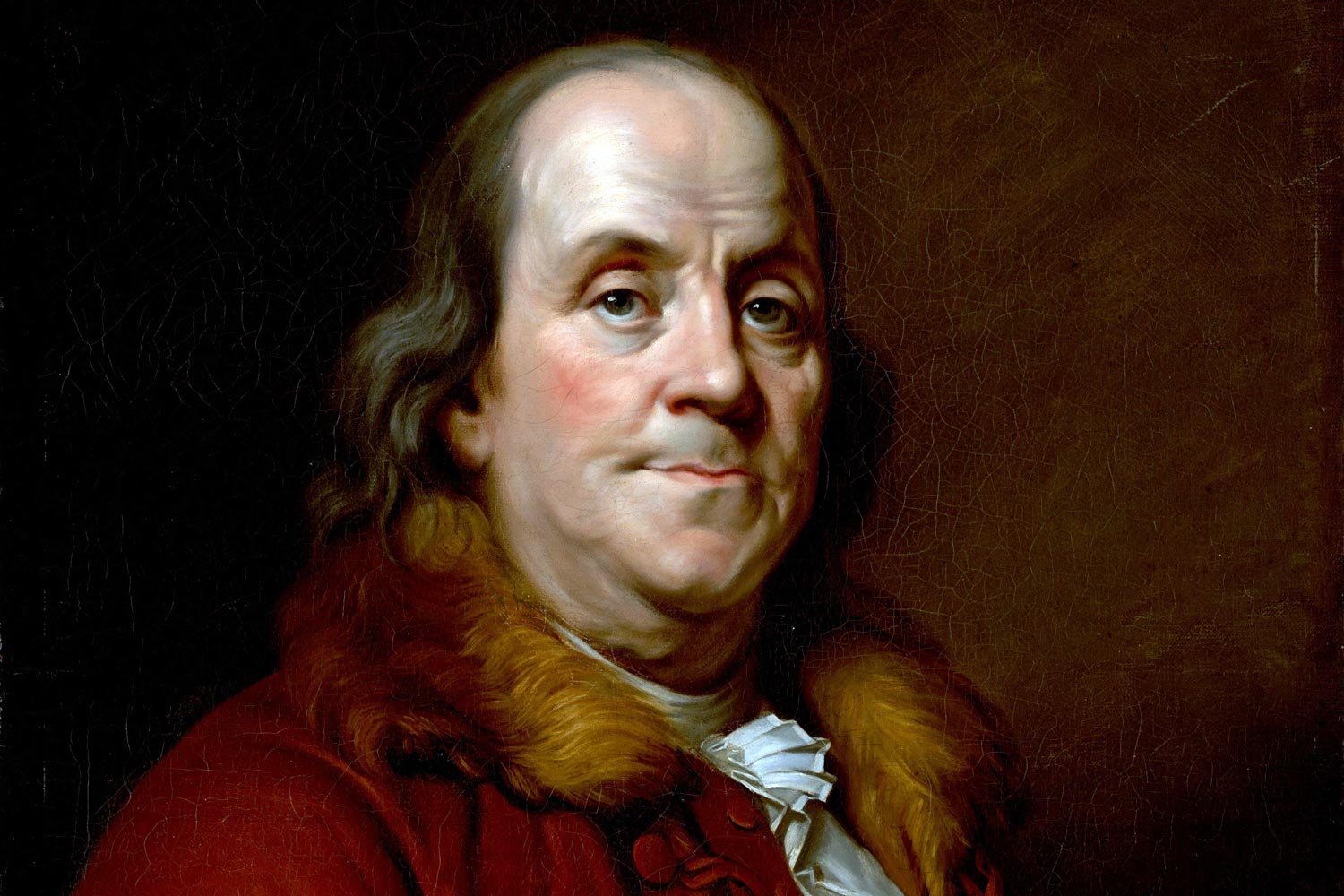
After the war, in 1784, the Society was revived with renewed energy and purpose. It was renamed the Pennsylvania Society for Promoting the Abolition of Slavery and the Relief of Free Negroes Unlawfully Held in Bondage—still a mouthful, but a more expansive vision. Benjamin Franklin, one of America’s most celebrated founding fathers, became the Society’s president in 1787. Franklin had once owned slaves himself, but his views evolved over time. By the end of his life, he was a vocal critic of slavery and used his influence to support the Society’s goals.

This time, they weren’t just focused on defending free Black people—they were actively working to end slavery altogether. Their efforts were both legal and educational. The Society hired lawyers to defend kidnapped individuals, lobbied lawmakers, and even began promoting schools for Black children.

The Society’s work helped inspire real change. Pennsylvania became the first state to pass a gradual abolition law in 1780, a huge step forward. While the Society didn’t write the law, many of its members pushed hard for its passage and later worked to ensure it was enforced.

Still, the road was far from easy. The Society operated in a world where slavery was deeply entrenched—not just economically, but socially and politically. In the South, slavery was expanding. Even in the North, racism was widespread, and support for abolition was often lukewarm.

Despite these challenges, the Society’s model paved the way for the much larger abolitionist movements of the 19th century. It showed that legal advocacy, public education, and grassroots organizing could make a difference. It also helped define Philadelphia as a hub of anti-slavery activism that would later become home to figures like Frederick Douglass and Sojourner Truth.

The Wallace House at 250: New Research and Rehabilitation on Washington’s WinterHeadquarters

Emerging Revolutionary War welcomes guest historian Paul F. Soltis

250 years ago in 1775 John Wallace of Philadelphia was preparing to move. Born in Scotland in 1718, John was the youngest son of the minister of the Church of Scotland at Drumelizer in the Scottish Lowlands south of Glasgow and Edinburgh. While his eldest brother William would take over the ministry in the Kirk following their father’s death, John emigrated from Scotland to the colonies of British North America. Like many Scottish emigrants, Mr. Wallace entered the merchant trade, first in Newport, Rhode Island and eventually in Philadelphia where he met and married Mary Maddox of an established Philadelphia family.

At the opening of the Revolutionary War in 1775, John Wallace purchased 95 acres on the Raritan River in Somerset County, New Jersey from the Rev. Jacob Rutsen Hardenbergh, minister to the Dutch Reformed Churches of the upper Raritan River Valley. At this country estate he called “Hope Farm” Mr. Wallace built the largest home constructed in New Jersey during the Revolutionary War, perhaps “hoping” to escape the revolutionary ferment of Philadelphia. Midway between the British garrison at New York and the Continental Congress in Philadelphia, John Wallace instead found himself at the Crossroads of the American Revolution.

In the fall of 1778, the Continental Army arrived to this region of Somerset County where the Middle Brook flows into the Raritan River for the Middlebrook Cantonment of 1778-79. Nathanael Greene, Quartermaster General of the Continental Army, wrote on October 18, “Middle Brook is situate in a plentyful Country, naturally strong and difficult of access and surrounded with a great plenty of Wood. Great security will also be given to this Camp by the militia of the Country.” Col. Sidney Berry, a deputy quartermaster to Gen. Nathanael Greene, arranged with Mr. Wallace for use of the Wallace House at Hope Farm, a few miles west of the village of Middlebrook, as headquarters for George Washington.

Continue reading “The Wallace House at 250: New Research and Rehabilitation on Washington’s WinterHeadquarters”

On This Date: An America 250th Anniversary

The 27-year-old from Thetford, Norfolk, England native had a long journey before he even sailed across the Atlantic Ocean for the colonies. Although receiving an education until age 13, and an apprenticeship with his father until age 19, both uncommon among his peers, Thomas Paine started his professional career as a privateer. It did not suit him for long, he returned to Britain in 1759. Paine then became a staymaker, and within several years, opened his own store in Sandwich, Kent. By the end of the same year, Paine had married.

Read more: On This Date: An America 250th Anniversary

Life seemed to be set for the young couple, but tragedy after tragedy ultimately led Paine to the American colonies. Paine’s shop ran into financial challenges not long after his nuptials, and although offset by the joy of pregnancy, a relocation to a new town may have been too much on Mary. She went into early labor, and both mother and child tragically died during the delivery. A series of moves, career changes, and troubles dotted the next dozen years.

A supernumerary, Excise Officer, staymaker, schoolteacher, were all ahead of time. Charges of fraud and dismissal were as well. By the age of 31, in 1768, Paine’s next professional endeavor took him to Lewes in Sussex. Over the ensuing years in Lewes, a town with a long history of opposition to the monarchy and republican sentiments, Paine became a member of the Court Leet and parish vestry, worked as a tobacconist and grocer, and married for the second the time.

Thomas Paine

By 1772, Paine wrote his first political piece. His time in his home country was now on the clock. By the spring of 1774, following his political priorities and ideologies, Paine had all but abandoned his post as an excise officer and was essentially fired. He next separated from his second wife, Elizabeth, and moved to London. It was while in London that Paine met Benjamin Franklin who suggested he emigrate to Philadelphia. Paine did exactly that.

His journey through life was turbulent, even more so during the first half of the 1770s, just like his voyage across the Atlantic on his to Philadelphia in the Pennsylvania colony. The water supplies aboard the ship were dreadful, and typhoid raged across the decks of the vessel. Paine was barely alive by the time the ship reached Philadelphia. He was so ill he was unable to leave the docked boat under his own power, Benjamin Franklin sending his personal physician to the ship and have him carried off. Yet, on this date, November 30, 250 years ago, Thomas Paine had arrived to the American colonies. After six weeks of recovery his new journey, a journey shared by all those that were to be swept up in the American Revolution, began.

Less than two years after landing in Philadelphia, Paine published his work Common Sense. Coupled with a series of works entitled The Crises, Paine, “ignited a nation to help the failing cause of the Revolution.”

Announcing our 2025 ERW Bus Tour…. Philadelphia Campaign of 1777 with Michael Harris!

We are excited to announced our FIFTH annual ERW bus tour will be on November 7-9, 2025 and will cover the 1777 Philadelphia Campaign.

Author and historian Michael Harris will join us as we cover the fall of 1777 campaign. The British Army under Gen. William Howe made a concerted effort to take the American capital of Philadelphia. George Washington and the Continental Army fought major actions at Brandywine and Germantown in an effort to hold and take back the city. The tour will cover sites associated with the Philadelphia Campaign, such as Brandywine, Germantown, Paoli and others.

Tickets are $250 per person and will include Friday night lecture at the host hotel, all day bus tour on Saturday and half day bus tour on Sunday. A lunch is included for Saturday.

Our host hotel is the Holiday Inn Express and Suites – King of Prussia. Lodging is NOT included in the registration fee. A room bloc has been established under the name of “Emerging Revolutionary War.” A link will be provided in the future for hotel lodging.

Join us for our FIFTH annual tour as we take on the beginning of the American Revolution just a few months before the 250th anniversary. Learn about the dramatic events that led to some of the bloodiest days in the American Revolution. There is no better way to experience history than to stand in the footsteps of where it happened!

To register, visit: https://www.eventbrite.com/e/battles-for-the-capital-1777-philadelphia-campaign-bus-tour-tickets-1048228358237?aff=oddtdtcreator

For more questions, please email emergingrevolutionarywar@gmail.com.

John Adams Goes to Catholic Mass

Emerging Revolutionary War welcomes back guest historian Evan Portman

Two future presidents walk into a Catholic church.

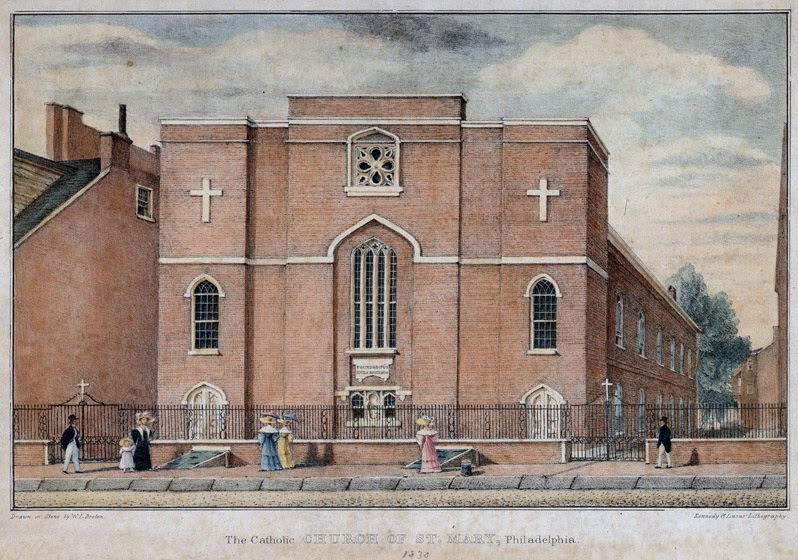
No, that’s not the beginning of a bad historical joke. It’s what happened on October 9, 1774, when George Washington and John Adams wandered into Old St. Mary’s Catholic Church while serving as delegates to the First Continental Congress in Philadelphia.

In September 1774, delegates from twelve of the thirteen colonies convened in Philadelphia for the purpose of discussing a response to Parliament’s recent Intolerable Acts. But after a month of debating (and bickering), Adams wrote that “the Business of the Congress is tedious, beyond Expression.”[1] Seeking a break from the monotony, Adams and Washington ventured to one of the oldest Catholic churches in the colonies. Established in 1763 by parishioners of Old St. Joseph’s, St. Mary’s Church grew from the need for a Catholic cemetery.

“[L]ed by Curiosity and good Company I strolled away to Mother Church or rather Grandmother Church, I mean the Romish Chappell,” Adams wrote to his wife Abigail that day.[2] The church stood just a few blocks south of the Congress’s meeting place at Carpenters’ Hall and starkly contrast anything the Protestant Adams had seen before. A descendant of some of America’s early Puritans, Adams was raised in the Congregational church of Braintree, Massachusetts, where “unfettered daylight through clear window glass allowed for no dark or shadowed corners, no suggestion of mystery.”[3] Old St. Mary’s could not have been more different. Light poured through several stained-glass windows before a large, ornate altar, behind which hung a dramatic depiction of Christ’s passion while burning candles and incense lit the nave.

Adams’s puritanical upbringing taught him to abhor such pageantry in the house of the Lord. He looked with pity upon “the poor Wretches, fingering their Beads, chanting Latin, not a Word of which they understood, their Pater Nosters and Ave Maria’s.” Even “their holy Water—their Crossing themselves perpetually—their Bowing to the Name of Jesus, wherever they hear it” appalled the young lawyer from Boston.[4]

Despite his disdain, some elements of the mass impressed and even moved, Adams. He described the priest’s homily as a “good, short, moral Essay upon the Duty of Parents to their Children, founded in Justice and Charity, to take care of their Interests temporal and spiritual.” Its brevity stood in stark contrast to the long-winded sermons of the Great Awakening, with which Adams would likely have been familiar. Even the priest’s flashy garments were noteworthy to the future president. “The Dress of the Priest was rich with Lace—his Pulpit was Velvet and Gold,” Adams noted.[5]

But most noteworthy of all was the “Picture of our Saviour in a Frame of Marble over the Altar at full Length upon the Cross, in the Agonies, and the Blood dropping and streaming from his Wounds.” That combined with the organ music, which Adams described as “most sweetly and exquisitely” was enough to move him. “This Afternoons Entertainment was to me, most awfull and affecting,” he confessed. But in the eighteenth century, the word “awful” did not mean what it does today. Adams quite literally meant that he was “full of awe” in observing the mass. He was so moved, in fact, that he wondered how “Luther ever broke the spell” of Catholicism.[6]

Perhaps Adams’s experience that day, 250 years ago, is indicative of the Revolution at large, as it brought together men from disparate backgrounds and regions. As a young man in Braintree, Adams likely never imagined he could be moved by a “papist ceremony,” nor could he probably have imagined signing his name on a document securing independence from his former country. In this way, the American Revolution made fantasy a reality, and the impossible, possible.


[1]“John Adams to Abigail Adams, 9 October 1774,” Founders Online, National Archives, https://founders.archives.gov/documents/Adams/04-01-02-0111. [Original source: The Adams Papers, Adams Family Correspondence, vol. 1, December 1761 May 1776, ed. Lyman H. Butterfield. Cambridge, MA: Harvard University Press, 1963, pp. 166–167.]

[2] Ibid.

[3] David McCullough, John Adams, (New York: Simon & Schuster, 2001), 84.

[4] “John Adams to Abigail Adams, 9 October 1774,” Founders Online, National Archives, https://founders.archives.gov/documents/Adams/04-01-02-0111. [Original source: The Adams Papers, Adams Family Correspondence, vol. 1, December 1761 May 1776, ed. Lyman H. Butterfield. Cambridge, MA: Harvard University Press, 1963, pp. 166–167.]

[5] Ibid.

[6] Ibid.

Rev War Revelry: Carpenters’ Hall and the First Continental Congress

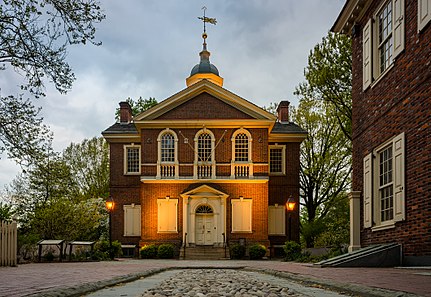
Join us this Sunday, July 7th at 7pm for our next Rev War Revelry as we continue to commemorate the 250th anniversary of the events that led to the American Revolution. We welcome Executive Director Michael Norris to discuss the historic Carpenters Hall in Philadelphia and the role it played in hosting the First Continental Congress. The First Continental Congress convened in Carpenters’ Hall in Philadelphia, Pennsylvania, between September 5 and October 26, 1774. Delegates from twelve of Britain’s thirteen American colonies attended. The Congress was a direct result of the Parliament’s reaction to the Boston Tea Party (December 1773). This gathering of colonial leaders intended to create a united front in their response to what they believed was Parliamentary over reach in the “Coercive Acts.”

Grab a drink and join us on our You Tube Channel: https://www.youtube.com/@emergingrevolutionarywar8217 Feel free to interact with the discussion by adding questions in the video chat. Once the video is over we will repost the video to our Facebook page and our Spotify account. We hope to see you then!

Galloway’s Foreshadowing

Joseph Galloway is best known as one of the preeminent and prominent Loyalists who remained in the American colonies through the majority of the American Revolution. Prior to the colonies declaring independence, especially during the First Continental Congress, Galloway was active in the debates that decided the path forward. Besides attending and being active in the discussions in Philadelphia he penned a pamphlet entitled A Candid Examination of the Mutual Claims of Great Britain and the Colonies.

Within the pages, he called African American slavery “the dangerous enemy within” and the “natural weakness” of the soon-to-be Southern states. If a division ensued, Galloway predicted that,

“If the colonies happen to vie and try their reciprocal strength with each other, the political force of the Northern Colonies will soon destroy the opulent force of the Southern.”

Furthermore, Galloway pointed to the colonies/states of Georgia, Maryland, North and South Carolina, and Virginia as vulnerable because of the institution of slavery. In a conflict without the overarching guidance by Great Britain, the division between Northern and Southern colonies/states would lead to a domestic civil war and the possibility that African American slaves would join the Northern effort in vanquishing their former owners.

Although Galloway was writing to prop support for remaining loyal to the British crown he foreshadowed accurately the rift that plagued the independent United States. In laying out his views, Galloway quite succinctly predicted what would happen in 78 years after independence was won by the United States.

Galloway left Philadelphia when the British evacuated the city in 1778 and left for England where he would position himself in a leading role for loyalists in exiles. He never returned to the United States. His succinct prediction of the future though proved eerily accurate.

Sources:

Disunion Among Ourselves, The Perilous Politics of the American Revolution by Eli Merritt

University of Michigan, Evans Early American Imprint Collection, click here for the link.

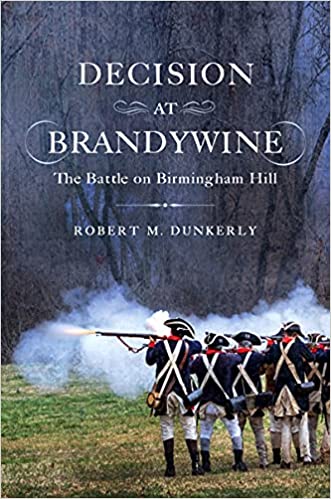
“Rev War Revelry” Author Spotlight  Decision at Brandywine: The Battle on Birmingham Hill with Robert Dunkerly

This Sunday on the Emerging Revolutionary War’s Facebook page, Robert Dunkerly will join the “Rev War Revelry” to discuss his newest publication, Decision at Brandywine: The Battle of Birmingham Hill.

The Battle of Brandywine, fought on September 11, 1777, saw the defeat of the American forces in southeastern Pennsylvania. The victory by the British opened the road to Philadelphia, which fell to Sir William Howe’s forces on September 26, fifteen days after the battle.

Dunkerly, a park ranger with Richmond National Battlefield Park and a contributing historian for Emerging Revolutionary War will discuss the pivotal action that happened around Birmingham Hill on that Thursday in 1777. The engagement at Brandywine was the largest and longest battle in the entire American Revolution and the third bloodiest. This new publication examines the action near Birmingham Hill and Meeting House where the action that day turned against George Washington’s forces.

Thus, this Sunday, at 7 p.m. EDT, tune into ERW’s Facebook page for the next historian happy hour as the popular “Rev War Revelry” series continues with this author spotlight.

“Rev War Revelry” The Importance of Germantown

On October 4, 1777, General George Washington’s Continental Army struck the British outpost at Germantown, Pennsylvania. Less than a month after the Battle of Brandywine and approximately a week after the loss of their capital, Philadelphia.

Initially successful, Washington’s forces got bogged down by fog and British holdouts in a stone structure called Cliveden. What started so promising did end in a tactical defeat for the Americans. Yet, coming days before the climatic battle in New York, dubbed Saratoga collectively, the cause of American independence was buoyed.

Although outshone in the annals of history by Saratoga, the setback at Germantown proved decisive in the French court, especially with the French foreign minister, who saw that the simple fact that Washington could regroup following Brandywine and come within some bad luck and fog of defeating the British was testament to resolve of the American effort for independence.

To cut through the fog and discuss the campaign, engagement, and repercussions of the Battle of Germantown, Emerging Revolutionary War invites back historian and author Michael C. Harris this Sunday for the next installment of “Rev War Revelry” at 7pm EST on our Facebook page.

He will join a duo of ERW historians. In addition, his publication, Germantown: A Military History of the Battle of Philadelphia, October 4, 1777, is now available through the publisher, Savas Beatie, LLC. Click here to order.

We look forward to hearing your comments, questions, and/or opinions this Sunday. So, set a side an hour-ish–as you know historians can get to talking and lose track of time easily, especially when books are also involved–for this historian happy hour.