Holiday Kick-Off from Mt. Vernon….Place, Baltimore

On the first Thursday of December, the unofficial kick-off to the holiday season takes place in Baltimore, Maryland. This year, on December 4, was the 54th year of the celebration. The 178-foot-tall George Washington Monument, the construction of which started on July 4, 1815, and was completed in 1829, is graced with lights and fireworks that light up the city sky about the figure of Washington.

On both sides of the Washington Monument stand two equestrian statues grace the grounds. One is of a local American Revolutionary War hero, John Eager Howard, born in Baltimore County in 1752. On the other side is honorary American, the Honorable Marquis de Lafayette.

If you peer to the left of the Howard equestrian statue photo, you see the spire of a Victorian Gothic church. Built in 1872, the church stands on the location of the Howard residence. On January 11, 1843, Francis Scott Key died there, at the age of 63.

If you celebrate, Emerging Revolutionary War hopes your holiday season kicks off grandly as well. If I may, if looking for a gift for that history enthusiast, check out the Emerging Revolutionary War store here. Or the Emerging Revolutionary War Series, here.

A Letter from William Prescott to John Adams

Approximately two months after waging the defense of Breed’s Hill, on the Charlestown peninsula, against the British, Colonel William Prescott put quill to paper to write to John Adams. In this communique, he discussed the action at Breed’s Hill, known as the Battle of Bunker Hill, fought on June 17, 1775, to his fellow Massachusetts native. Take note that he even wrote his account about the orders he received and which hill that missive directed him to. Since the waft of smoke has drifted from the battle on that June day, veterans, officers, and historians have debated why Prescott and company chose Breed’s Hill instead of Bunker Hill. This letter is just another wrinkle in that timeless debate.

Camp at Cambridge August 25.1775

Sir

I have recd. a Line from my Brother which informs me
of your desire of a particular Account of the Action at
Charlestown, it is not in my Power at present to give so
minute an Account as I should choose being ordered to decamp
and march to another Station.

On the 16 June in the Evening I recd. Orders to march to Breeds
Hill in Charlestown with a party of about one thousand
Men consisting of 3 hundred of my own Regiment, Coll.
Bridge & Lieut Breckett with a Detachment of theirs, and
two hundred Connecticut Forces commanded by Capt.
Nolten, We arrived at the Spot the Lines were drawn by
the Enginier and we began the Intrenchmant about 12, o Clock
and plying the Work with all possible Expodition till Just
before sun rising, when the Enemy began a very heavy
Canonading and Bombardment, in the Interin [Interim] the
Enginier forsook me, having thrown up a small Redout,
found it necessary to draw a Line about 20 Rods in length
from the Fort Northerly, under a very Warm Fire from
the Enemys Artilary, About this Time the above Field
Officers being indisposed could render me but Little Service,
and the most of the Men under their Command deserted the
Party. The Enemy continueing an incessant Fire with their Artilary.
about 2, o Clock in the afternoon on the seventeenth the Enemy
began to land a northeasterly Point from the Fort, and I orderd
the Train with 2 field Pieces to go and oppose them and the
Connecticut Forces to support them but the Train marched
a different Course & I believe those sent to their support
followd, I suppose to Bunkers Hill, another party of
the Enemy landed and fired the Town, There was a party of
Hampshire in conjunction with some other Forces Lined
a Fence at the distance of three score Rods back of the Fort
partly to the North, about an Hour after the Enemy landed
they began to march to the Attack in three Columns,
I commanded my Lieut Coll. Robinson & Majr. Woods
Each with a detachment to flank the Enemy, who I
have reason to think behaved with prudence and Courage.

I was now left with perhaps 150 Men in the Fort, the Enemy
advanced and fired very hotly on the Fort and meating
with a Warm Reception there was a very smart firing
on
both sides. after a considerable Time finding our
Amunition was almost spent I commanded a sessation
till the Enemy advanced within 30 yards when we gave
them such a hot fire, that the [y] were obliged to retire
nearly 150 yards before they could Rally and come again
to the Attack. Our Amunition being nea [r ]ly exaustid could
keep up only a scattering Fire. The Enemy being numerous
surrounded our little Fort began to mount our Lines and
enter the Fort with their Bayonets, we was obliged to
retreat through them while they kept up as hot a fire
as it was possible for them to make we having very few
Bayonets could make no resistance, we kept the fort
about one hour and twenty Minutes after the Attack with
small Arms, This is nearly the State of Facts tho’ imperfect &
too general which if any ways satisfactory to you will
afford pleasure to your most obedient humble Servt.

William Prescott
To the honble John Adams Esqr.

Image of original letter from Prescott to Adams, courtesy of Massachusetts Historical Society

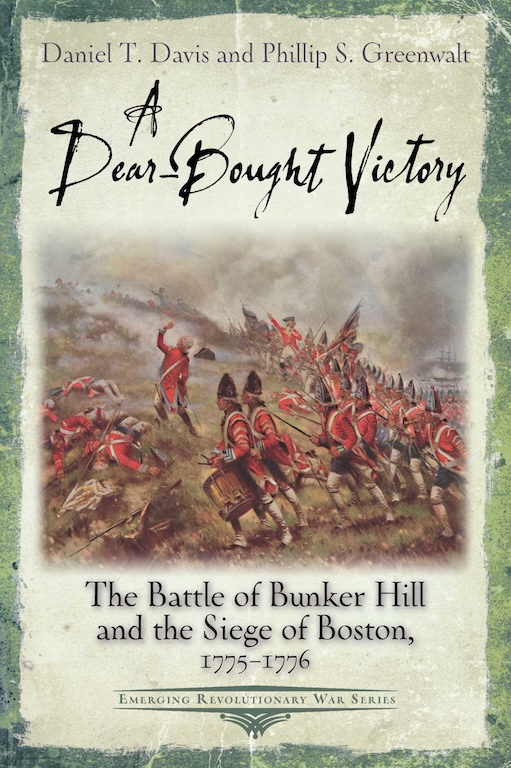
Coming Soon: A Dear-Bought Victory: The Battle of Bunker Hill and the Siege of Boston 1775-1776

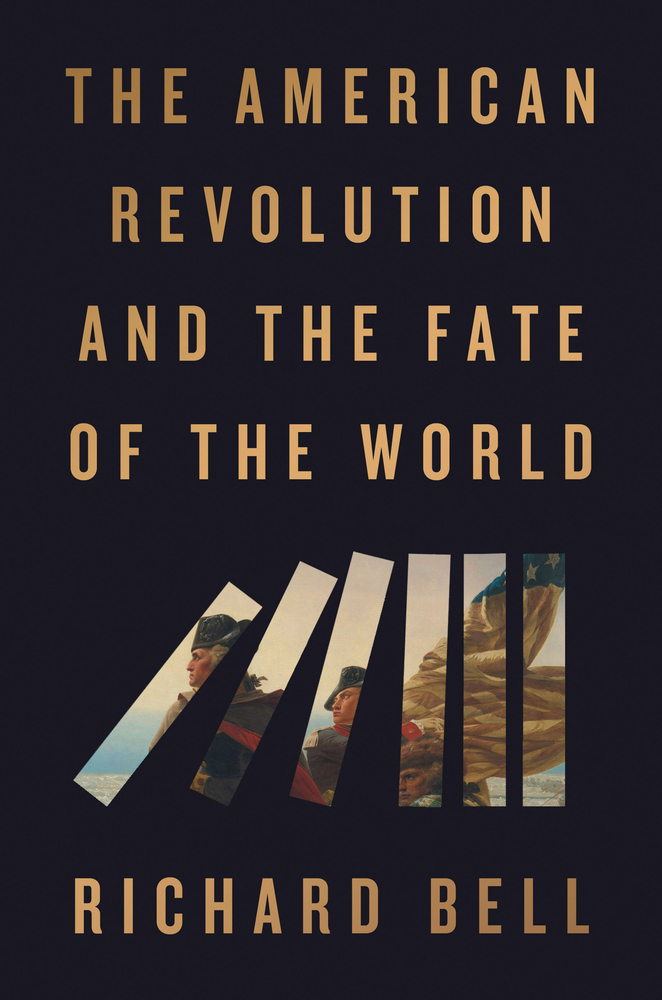
We’re excited to share one of the 2026 new releases in the Emerging Revolutionary War Series. Published by Savas Beatie, a sneak peek, including the cover, is below.

About the Book:

“I wish we could sell them another hill at the same price we did Bunkers Hill,” Nathanael Greene wrote to the governor of Rhode Island after the battle of June 17, 1775.

Actually fought on Breed’s Hill outside Boston, Massachusetts, the battle of Bunker Hill proved a pyrrhic victory for British forces. Confident in their ability to overwhelm the New England militia that opposed them, long lines of neatly uniformed British infantry and marines swept uphill toward a quickly built earthen redoubt defended by a motely collection of farmers, shopkeepers, and tradesmen.

“Don’t fire until you see the whites of their eyes!” the colonials urged each other—or did they?

By the end of the fight, the British gained the summit and Colonial forces scattered. One of the patriot leaders, Dr. Joseph Warren, lay dead—one of the first martyrs of the American Revolution. But for the British, the scene was far, far worse: it would be the greatest number of casualties they would ever suffer in any battle of the American Revolution. As British General Henry Clinton commented afterward, “A few more such victories would have surely put an end to British dominion in America.”

The siege of Boston would continue, but the sobering lesson of Bunker Hill changed British strategy—as did the arrival soon thereafter of a new commander-in-chief of Continental forces: General George Washington.

In A Dear-Bought Victory, historians Daniel T. Davis and Phillip S. Greenwalt separate the facts from the myths as they take readers to the slopes of Breed’s Hill and along the Boston siege lines as they explore a battle that continues to hold a place in popular memory unlike few others.

About the Authors:

Daniel T. Davis is the Senior Education Manager at the American Battlefield Trust. He is a graduate of Longwood University with a bachelor’s degree in public history. Dan has worked as a Ranger/Historian at Appomattox Court House National Historical Park and Fredericksburg and Spotsylvania National Military Park. He is the author or co-author of numerous books on the American Civil War. This is his first co-authored book in the Emerging Revolutionary War Series. Dan is a native of Fredericksburg, Virginia.

Phillip S. Greenwalt is the co-founder of Emerging Revolutionary War and a full-time contributor to Emerging Civil War. He is a graduate of Wheeling Jesuit University with a bachelor’s degree in history along with graduate degrees in American History and International Studies and Leadership from George Mason University and Arizona State University, respectively. He is the author of co-author of seven books on the American Revolutionary and Civil Wars. Phill has worked for the National Park Service for the last 17 years at numerous natural and cultural sites. He is a native of Baltimore, Maryland.

“Rev War Revelry” Fighting for Philadelphia

Fort Mercer. Fort Mifflin. The Whitemarsh Campaign. Names of battles and maneuvers that “receive but scant attention in the literature of the American Revolution.” Until now. Award-winning author and historian Michael C. Harris returns to Emerging Revolutionary War to discuss his latest book.

Finishing the trilogy, started with Brandywine, continued with Germantown, and now Fighting for Philadelphia. Just released by Savas Beatie this month!

Enjoy this pre-recorded “Rev War Revelry” and get a synopsis of why this book is needed on your bookshelf. Join Emerging Revolutionary War Sunday at 7 p.m. EDT.

Colonel William Prescott

Dedicated in 1881 and made of bronze, the statue of Colonel William Prescott stands over nine feet tall. Although the man who stood steadfast on the earthen parapet of Bunker Hill was not quite that tall. Yet, on June 17, 1775, the men of New England looked up to the approximately 50-year-old that day.

A National Park Service page on Colonel Prescott and Bunker Hill is titled, “A Glorious Immortality.”An account that was passed down about the Massachusetts militia officer vividly describes why he deserves that moniker.

“The breast work or redoubt was only constructed of such earth as the party had thrown up after the middle of the night and was not more than breast high to a man of medium height. Colonel Prescott being a very tall man, six feet and two or three inches in height, his head and shoulders and a considerable portion of his body must have been exposed during the whole of the engagement. He wore a three-cornered cocked hat and a ban-yan or calico coat. After one of his men was killed by cannon ball, Prescott, perceiving that this had made some of the soldiers sick at heart, mounted tile para-pet and walked leisurely around it, cheering his soldiers by approbation and humor. His clothing was repeatedly spattered with the blood and the brains of the killed and wounded.”

Leadership. Example. Personal bravery. He was also one of the last to leave the earthwork as the British captured it.

He now stands, in bronze, watching over the scene where he proved he was a match for the moment.

250 Years Ago…Right Now-ish

Shortly after 11 p.m. on the night of June 16, Colonel (although the monument calls him general) William Prescott led approximately 1,200 Massachusetts soldiers toward the Charlestown Peninsula from Cambridge Common. These men would spend the night fortifying Breed’s Hill before spending the majority of the next day defending the earthen redoubt from successive British attacks. Although forced to evacuate due to low ammunition and the British breaching the redoubt, the defeat had a positive impact on the morale of the “Grand Army” as the New England militia soon-to-be-Continental Army.

“Rev War Revelry” The Battle of Bunker Hill

On Tuesday, the 250th anniversary of the Battle of Bunker Hill, fought on Breed’s Hill on Charlestown Peninsula, will be remembered. On June 17, 1775, the last major engagement before George Washington arrived in Massachusetts to take command was fought between militia under Colonel William Prescott and British forces under General William Howe. Although a defeat for the patriots, resulting in the death of Dr. Joseph Warren, the victory was a pyrrhic one for the British.

Join Emerging Revolutionary War historians as they discuss the engagement, the personas, and the ramifications of the Battle of Bunker Hill. Also, stay tuned until the end for an announcement as well.

So, two days before the 250th, grab your favorite beverage and tune into our Facebook page at 7 p.m. EDT and have your questions ready. If you are unable to attend the live on Sunday evening, don’t fret, the video will be posted to YouTube by the anniversary and to our podcast channel as soon as possible

“Rev War Revelry” Bullet Strikes from the First Day of the American Revolution

Much has been written about the “shot heard around the world,” as the poet Ralph Waldo Emerson eloquently wrote in the 19th century. Yet, what about those actual shots? The musket balls fired on April 19, 1775? What was the damage, and how does this material culture history add to our overall understanding of the events that unfolded on that fateful day? Thanks to historian Joel Bohy, who is part of a duo of historians, along with Doug Scott, we now have insight into that answer.

Using forensic techniques, seemingly straight out of CSI, the authors have done painstaking research into the bullet holes and artifacts struck by bullets to shed even more light on the events that unfolded along Battle Road, Lexington, and Concord on the first day of the American Revolution.

Join Emerging Revolutionary War for this pre-recorded “Rev War Revelry” this Sunday evening at 7 p.m. EDT with author Joel Bohy as he explains the history and research behind this book. A much-needed addition to any Revolutionary War enthusiast’s bookshelf!

Review: “The Ride: Paul Revere and the Night That Saved America” by Kostya Kennedy

“LISTEN, my children, and you shall hear
Of the midnight ride of Paul Revere,
On the eighteenth of April, in Seventy-five”

Henry Wadsworth Longfellow penned the poem, “Paul Revere’s Ride” in 1860. Now as America moves toward celebrating the 250th anniversary of Paul Revere’s famous ride, which happened on this date in 1775, another literary work has hit the market on this very topic.

Published on March 25 by Kostya Kennedy, Chief of Premium Publishing at Dotdash Meredith, with a lengthy career in writing, teaching, and journalism. The book reads like Revere’s ride, a fast-paced, descriptive overview of the man, events, and memories around the night of April 18, 1775. For those who have read David Hackett Fischer’s book, published in 1994, you may not find anything groundbreaking or new. However, that is not the point I feel in this book.

Kennedy pens this to get the reader hooked. Sets of rhetorical questions, “what-if” scenarios, and descriptive writing make the reader feel that they are in the environs of Boston or on the routes to Lexington traversed by Revere. Oh, and Kennedy does not forget Dawes, Prescott, and others who also played prominent roles in April 1775.

History enthusiasts and content experts may find a few shortcomings and errors, such as Kennedy continuing to use “Royal” when discussing the British Army. Since the English Civil War, the British Army has lost the right to use “Royal” in front of it. A few times, he labels the “British” as coming when the colonists would have used “Regulars” or “Redcoats.” Lastly, falling into the ag-old myth that Lexington had minutemen and a militia, the town just had the latter. Trivial things that do not impact the flow of the narrative.

A highlight to me, though, is the final sections about the memory of that day. Including a great insert of an interview with the direct descendant of Paul Revere and a comical anecdote about Paul Revere III being pulled over for speeding in Lexington, Massachusetts one year on April 18.

The book is a great read on the anniversary of Paul Revere’s Ride. Take it from me, I read the book in a day! Descriptive, vivid, and convince you that if you have not been, a trip to Boston and the Massachusetts countryside should be in your near future.

Published by: St. Martin’s Press, March 25, 2025
Images, sources, 282 pages

Final, Final Resting Place

Situated along East Monument Street is a stone monument surrounded by a black iron fence. A wayside informational marker is placed right outside the fence. Underneath this monument rests the remains of Daniel Wells and Henry McComas. On September 12, 1814, one of their firearms changed the entire scope of the Battle of North Point, part of the Chesapeake Bay Campaign during the War of 1812.

Both young militia members, sent to the frontlines to skirmish and harass the approaching British infantry, fired a musket round that slammed through the left elbow and into the chest of Major General Robert Ross, British land commander, mortally wounding him. Both Wells and McComas, aged 19 and 18 respectively, would be killed during the day’s fighting. A third soldier, Aquila Randall, also slain that day, has his own small monument and crediting him with firing the fateful shot.

Although most historians credit either Wells or McComas. Both soldiers were reinterred here, the second time their remains had been moved, in 1858 when the monument was completed and a funeral song and dramatic play rounded out the day’s commemoration.

The site is part of the Star-Spangled Banner National Historic Trail. To learn more about the trail, click here.