

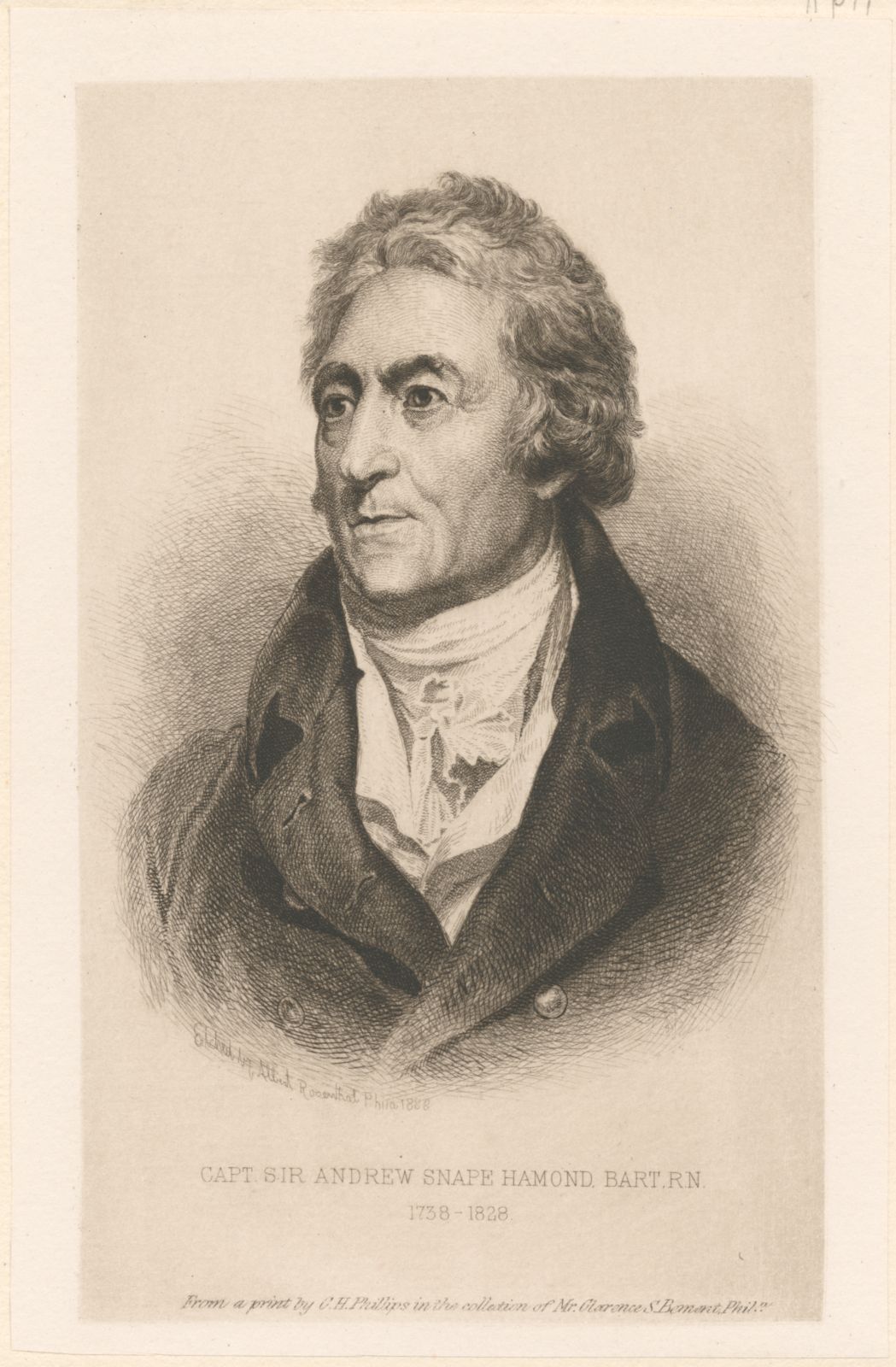
Captain Andrew Snape Hamond commanded the fifth-rate Royal Navy’s Roebuck. Although her 44-guns and rating technically qualified her for a position in a line of battle, a fifth-rate was among the smallest vessels considered for such a role in the Royal Navy. Yet, in February 1776, when Roebuck began operating off the American coast, she was one of the larger ships available to Vice Admiral of the Blue Molyneaux Shuldham, who had replaced Admiral Samuel Graves as the commander of the North American station.
Rather than adding to the growing flock of vessels in Boston, Shuldham sent Hamond and Roebuck south to patrol the colonial coasts, enforce the Coercive Acts, and stop ships smuggling gunpowder and arms. The task was all the more difficult since fighting had broken out and colonial governments had collapsed everywhere. Royal Governors fled to Royal Navy vessels, from which they attempted to preserve some modicum of British authority and rally loyalists to the king’s cause. Roebuck was not on station long before orders from Graves arrived and directed the captain to move his ship to the mouth of Delaware Bay and patrol the bay and river.[1] An aggressive sort, he exchanged fire with Delaware’s militia near Lewes at the capes on April 7, and then took his little flotilla up the Delaware fought Pennsylvania’s little navy near Wilmington on May 8-9.
Then it was down to the Chesapeake for the summer to provide some backbone to Royal Navy vessels operating in the lower Chesapeake Bay in support of Lord Dunmore, the royal governor, who had built his own little flotilla of ships to house loyalists and their defenders, but Hamond considered the task impossible. He wasn’t happy with it and wrote an acquaintance in August, “I have been under the absolute necessity of giving to Lord Dunmore & his floating Town, consisting of a fleet of upwards of 90 Sail, destitute of almost every material to Navigate them, as well as seamen, has given full employment for three Ships, for these three months past, to prevent them from falling into the hands of the Enemy.”[2] But, the assignment also convinced him that the Chesapeake was ripe for offensive naval operations, particularly if combined with significant land forces.
Shortly after penning his letter, Hamond and Roebuck departed Virginia, bound for New York. His crew was sick, as were the soldiers and civilians crowded aboard Dunmore’s ships and swampish haven on Gwynne’s Island. Lord Dunmore, for one, was grateful for Hamond’s service in the Chesapeake. As the vessel sailed north, Dunmore penned a letter to Lord George Germain, counting illness among his own forces, but praising Roebuck as “well regulated, and as clean a Ship as any in the Navy,” also noting that many of its crew were ill.[3] Once in New York, Hamond and his vessel supported the Army’s landings and advance on American positions on Long Island.
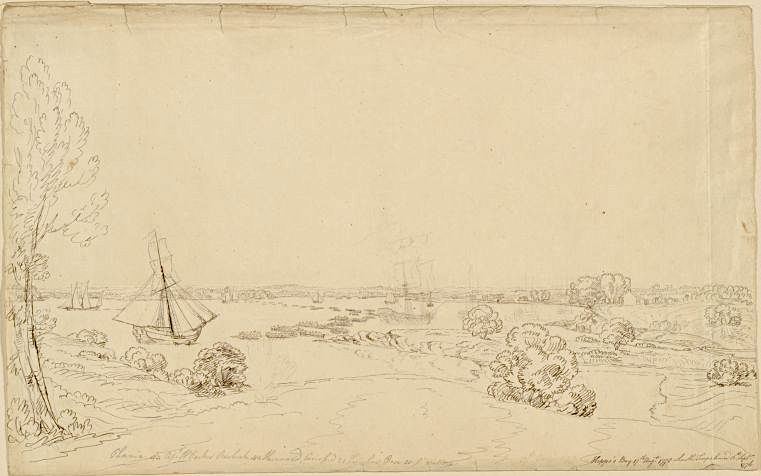
With the Americans turned out of Long Island, Roebuck’s next assignment was to support British landings on Manhattan at Kip’s Bay. While several vessels ran up the Hudson as a diversion, Roebuck joined a line of ships anchored in roughly 8 fathoms of water parallel to the shoreline on the East River, where the landings would take place.[4] At 11 am on September 16, the line, comprising Rose (20), Roebuck (44), Phoenix (44), Orpheus (32), and Carysfort (28), opened up on the landing site. It was a hellish bombardment. Aboard Orpheus, Batholomew James wrote, “It is hardly possible to conceive what a tremendous fire was kept up by those five ships for fifty-nine minutes.” Orpheus alone expended 5,376 lbs of gunpowder.[5] Hamond wrote, “The ships kept up a constant fire making altogether the finest scene one has ever beheld.”[6] The landings, of course, succeeded and the race to the north end of Manhattan island was on.
After Kip’s Bay, Roebuck dropped down the East River and moved around lower Manhattan to take position close to Paulus Hook on the Hudson. On the 21st, a sailor jumped ship and managed to swim ashore. Claiming to be a pressed man originally from Providence, he confirmed that a significant number of Roebuck’s sailors were ill, part of the reason Hamond was glad to be rid of Virginia, and that the Navy planned to attack American positions in New Jersey.[7] The men to whom he spoke had greater things on their minds, watching New York burst into flames across the river. Forty-eight hours later, the deserter’s words proved true when Roebuck, Emerald, and Tartar opened fire on American redoubts at Paulus Hook.[8] The Americans eventually abandoned their works.
It was like that for the Royal Navy during the initial phases of the New York campaign: move frequently to provide firepower from the rivers , support army landings and movements, reduce redoubts, and improve mobility. Washington was keenly aware that as an island, Manhattan was extraordinarily vulnerable to rapid movements by Royal Navy warships and transports. Roebuck played her part in operations that exploited those vulnerabilities. Her greatest challenge in the campaign, however, was still to come as September crawled to a close. The Hudson River forts and obstacles still stood and needed to be reduced.
(Further Reading about Captain Hamond and Roebuck)
[1] It could take weeks, even months, for ships carrying dispatches to find their intended recipients, sometimes creating a sense of command whiplash among sea captains constantly on the move and operating at some distance from higher command authorities. Good commanding officers learned to take the shifts in stride and exercised considerable latitude to fulfill their missions. Shuldham only held his position a few months before Vice Admiral Richard Howe replaced him, finally providing some consistent and innovative leadership to the growing Royal Navy presence in North America.
[2] “Captain Andrew Snape Hamond, R.N. to Hans Stanley, 5th Augst 1776,” NDAR, 6, 66.
[3] “Lord Dunmore to Lord George Germain, September 4th 1776,” NDAR, 6, 678.
[4] “Master’s Log of H.M.S. Roebuck,” NDAR, 6, 839-840;
[5] “Journal of Bartholomew James, September 15, 1776,” NDAR, 6, 841; David Syrett, The Royal Navy in American Waters 1775-1783 (Aldershot, UK: Scolar Press, 1989), 50-51. Batholomew’s estimate of gunpowder expended was questioned by later historians. John Dillon, Naval Support for the British Army During the American Revolutionary War, (Warwick: UK, Helion & Company Limited, 2019), 189-190.
[6] Rick Atkinson, The British Are Coming: The War for America, Lexington to Princeton, 1775-1777 (New York: Henry Holt and Company, 2019), 389.
[7] “Journal of Benhamin Boardman, September 21st 1776,” NDAR, 6, 933. The persistence of the illness, even as Roebuck conducted effective combat operations, suggested something periodically debilitating, like malaria. However, Dunmore’s forces had experienced a smallpox outbreak that likely spread to Roebuck.
[8] “Journal of H.M.S. Emerald, Captain Benjamin Caldwell,” NDAR, 6, 964.
 Emerging Revolutionary War Era