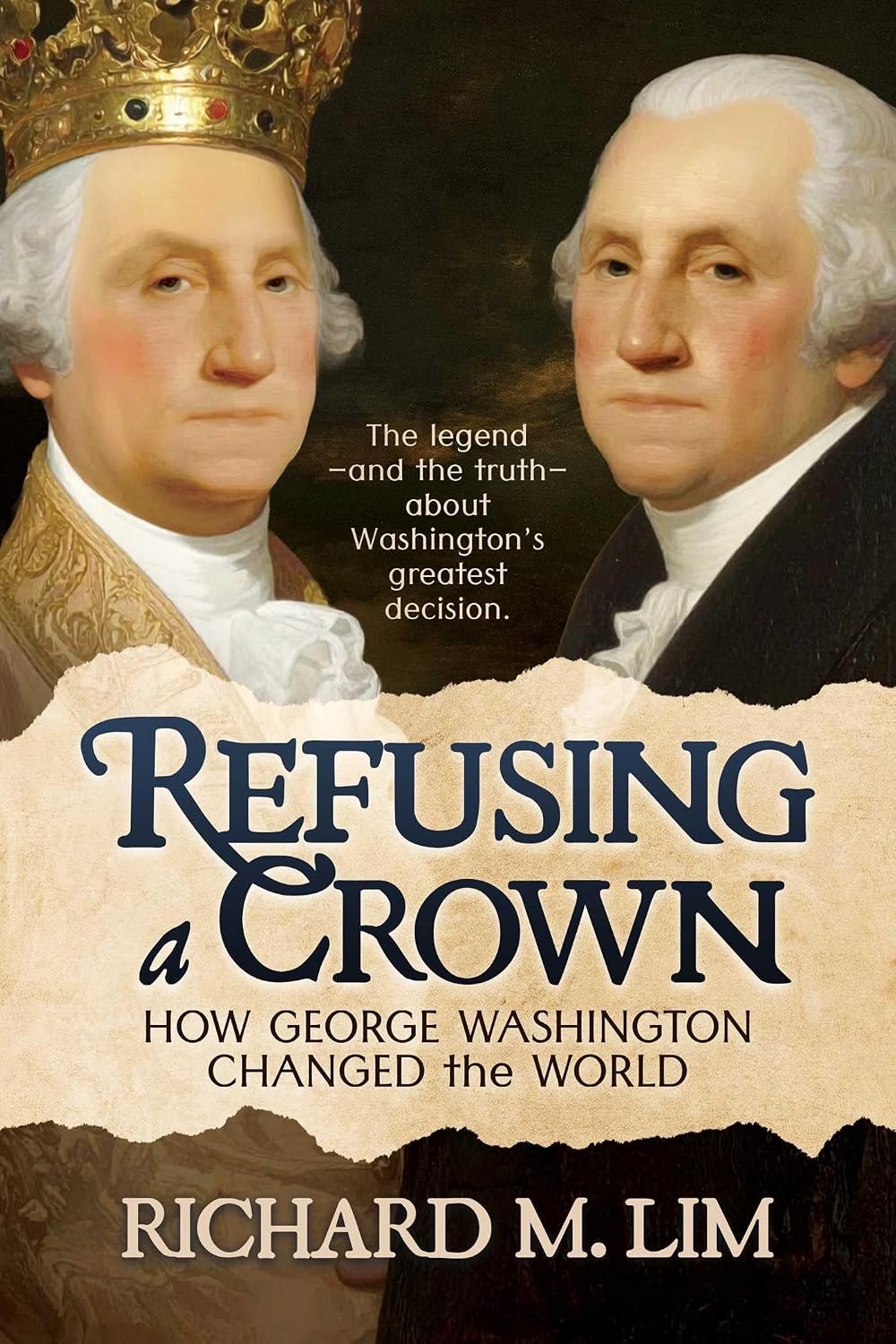
Join us this Sunday at 7pm on our Facebook page for our latest Rev War Revelry installment where we will welcome historian and author Richard Lim to discuss his new book; Refusing a Crown: How George Washington Changed the World . Lim explores America’s surprisingly complex transition from monarchy to republican government through the life and leadership of George Washington. The book argues that Washington’s decisions to relinquish power helped establish the norms of republican government not only in the United States but also inspired revolutionaries and reformers in Europe, Latin America, and Asia. It also examines how Judeo-Christian ideas about virtue, duty, and self-government shaped Washington’s understanding of leadership and informed some of his most consequential decisions. Timed for America’s 250th anniversary, the book offers a fresh perspective on how Washington’s example changed the course of world history.
This Revelry is pre-recorded and will post to our Facebook page this Sunday, September 20, 2026 at 7pm. You can also view it on our You Tube Channel.
We are excited to announce a NEW tour opportunity with Emerging Revolutionary War. Next Spring, May 1-2, 2027, we will be hosting a car caravan tour covering sites in Western Pennsylvania relating to George Washington’s time in the French and Indian War.
The tour will last all day Saturday and end at noon on Sunday, sites will include Jumonville Glen, Fort Necessity, Fort Ligonier, Braddock’s Defeat and a few other surprises! The cost of the tour is $150 per person. Meals, transportation, and accommodations are on your own. We have set up a room block at the Courtyard Marriott – Pittsburg/Greensburg for $189.00 a night. The hotel is located at 700 Power Line Drive, Greensburg, PA. For reservations, call 724-834-3555 and mention “Emerging Revolutionary War.”
To purchase tickets, email us at:emergingrevolutionarywar@gmail.com. We expect tickets to go fast as they are limited, so reach out soon if you are interested. We look forward to sharing our enthusiasm for early American history with this new tour. Many have enjoyed our annual fall bus tour, so we hope this provides additional ways to walk in the footsteps of history with ERW!
Following the American debacle at Kip’s Bay the previous day, the British troops marched into New York City and the Americans fell back to their entrenchments on Harlem Heights.
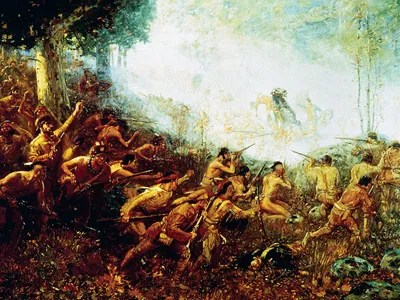
Washington ordered a small party of 150 men under the command of Lt. Col. Thomas Knowlton to move out and reconnoiter the British position. Knowlton quickly recognized the British were not planning a major assault but his force had brought about the attention of the British light infantry. Soon Knowlton’s Rangers were outnumbered and quickly retreated back to the American lines. When Knowlton reached safety, the British light infantry paused, placing them out in front of their main lines. Washington seized the opportunity and ordered an assault on their rear by Knowlton’s men and a reinforcement of 200 Virginia soldiers from the 3rd Virginia Regiment under Major Andrew Leitch.
Though the American attack was supposed to be in the rear of the British light infantry, because of confusing terrain and attacking too soon, the flanking column instead hit the British in their flank. The attack still had an adverse effect on the British light infantry as they began to fall back. The Americans fought with determination and bravery. Washington wrote the next day that “The General most heartily thanks the troop commanded yesterday by Major Leitch, who first advanced upon the enemy, and the officer who so resolutely supported them.”
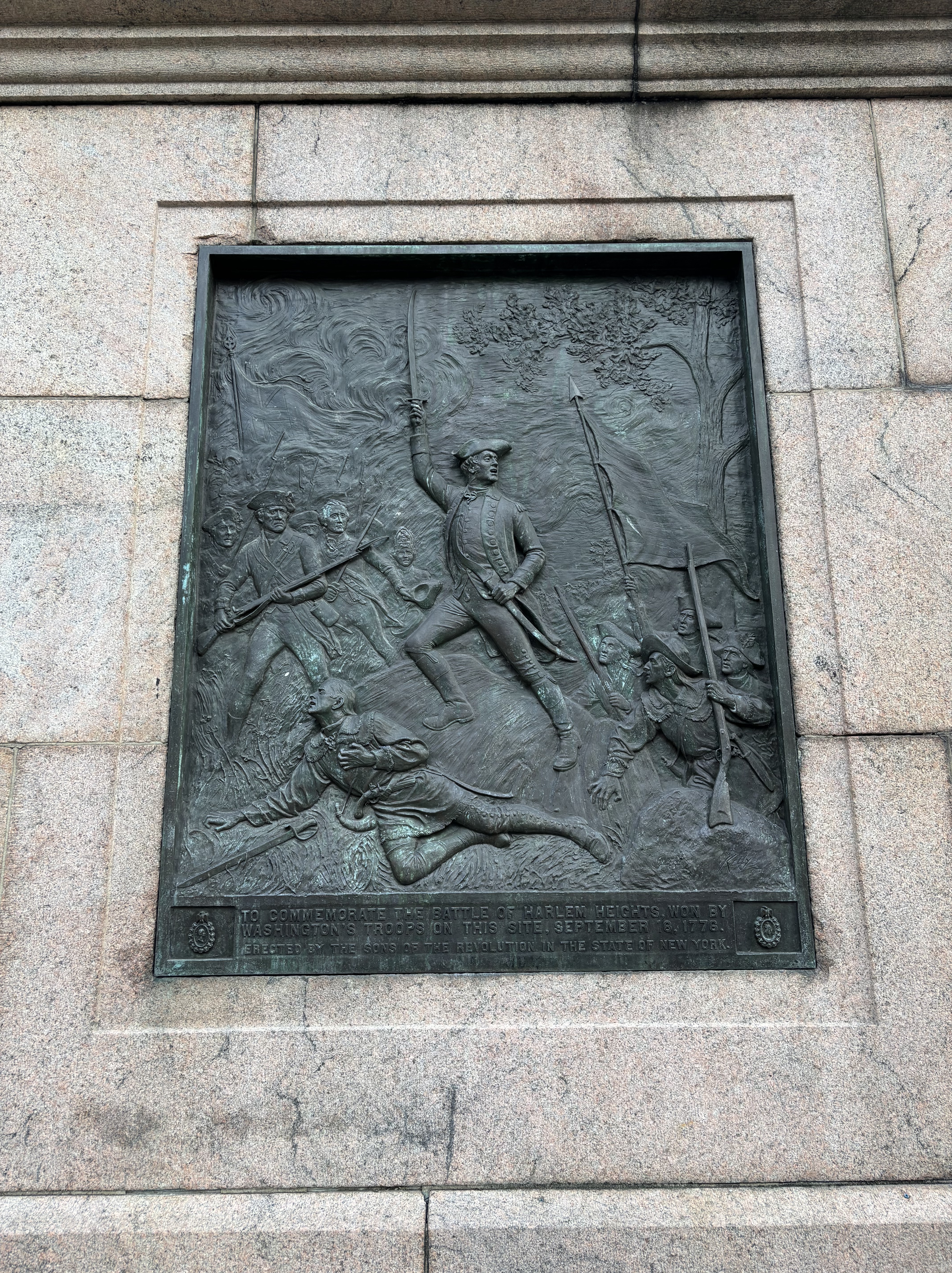
At the head of the attacking column both Knowlton and Leitch led their men forward to attach the British flank. Early in the attack both men went down wounded. Knowlton died that day, Leitch took three musket balls to the abdomen and was carried off the field. At first most reported his condition as improving and he was thought to survive his ordeal. But he would eventually die a few weeks later, the doctor writing that “[I] disagreeable duty of informing Mrs. Leitch through you, of the death of her husband is imposed upon me. He expired yesterday morning at Hackinsack Bridge where he had been removed for his better accommodation…But on the 28th Sept he was seized by lock’d jaw – with spasms about his neck and throat so violent as to baffle every effort to minister to him by medicine.”
Plaque with Knowlton raising his sword and Leitch falling and grabbing his chest.
Soon the British began to retreat back to their main line. Washington then ordered an attack along his line and the British light infantry fell back to the main line in confusion. Soon the entire British line began to give way. After about a 90 minute fight, Washington learned that more British forces were arriving on the field and ordered his men back to the main line. Though not a major victory, the American army had finally stood up to the British and even for a moment, pushed them off the field in combat. The British suffered 14 killed and an estimated 154 wounded, with the Americans suffering 30 killed and 100 wounded.
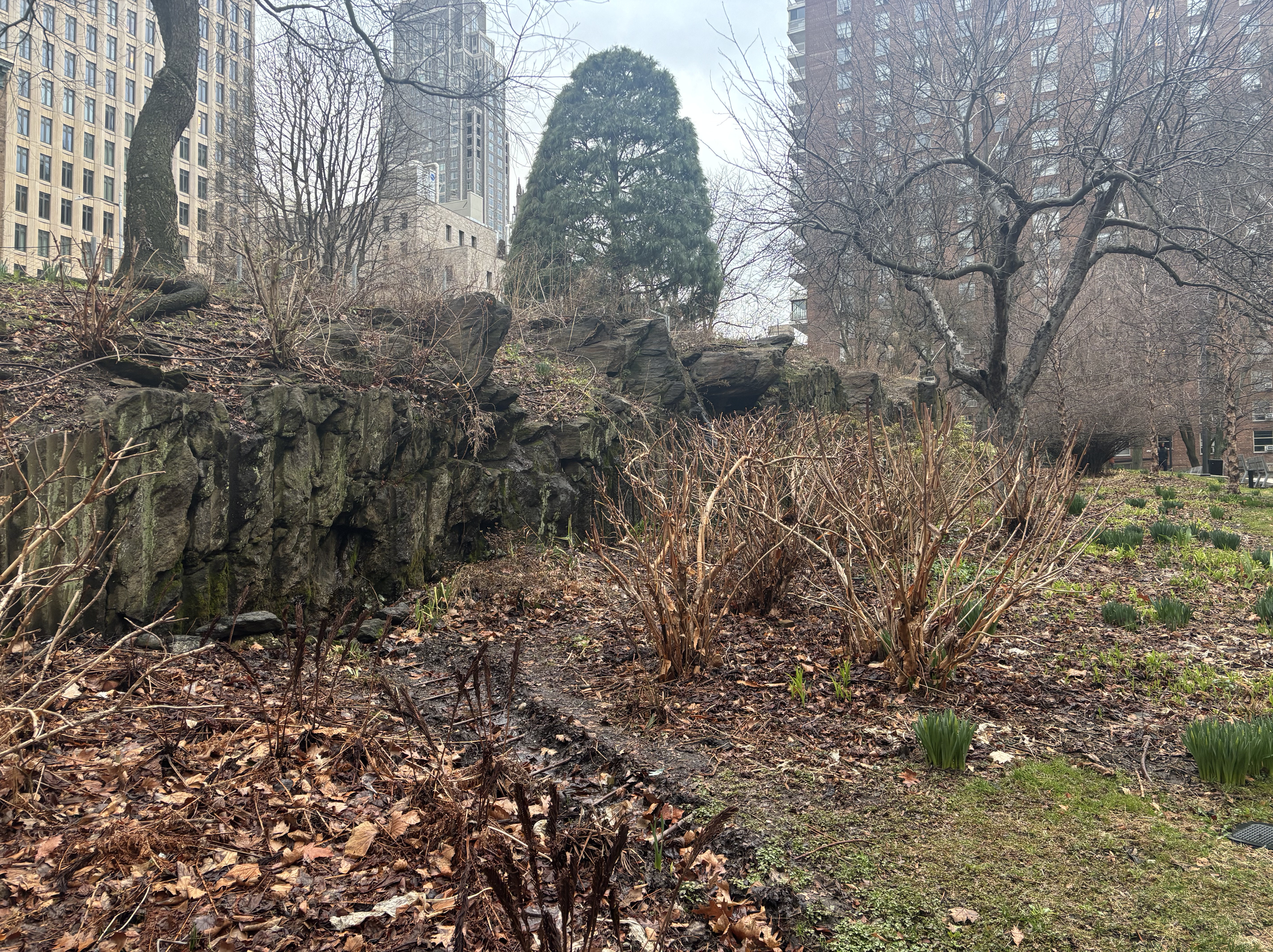
Today the area of the Harlem Heights battlefield is now partly under the campus of Columbia University in New York City. There is a simple plaque on the wall on the east side of Broadway north of 117th Street. This plaque commemorates the Battle of Harlem Heights and depicts Major Andrew Leitch and Lt. Col. Thomas Knowlton being wounded. You can still see the rock ledge nearby where they launched their ill-fated attack. Near here is where Leitch was mortally wounded while turning the flank of the British line.
The rock ledge where Knowlton and Leitch were mortally wounded.
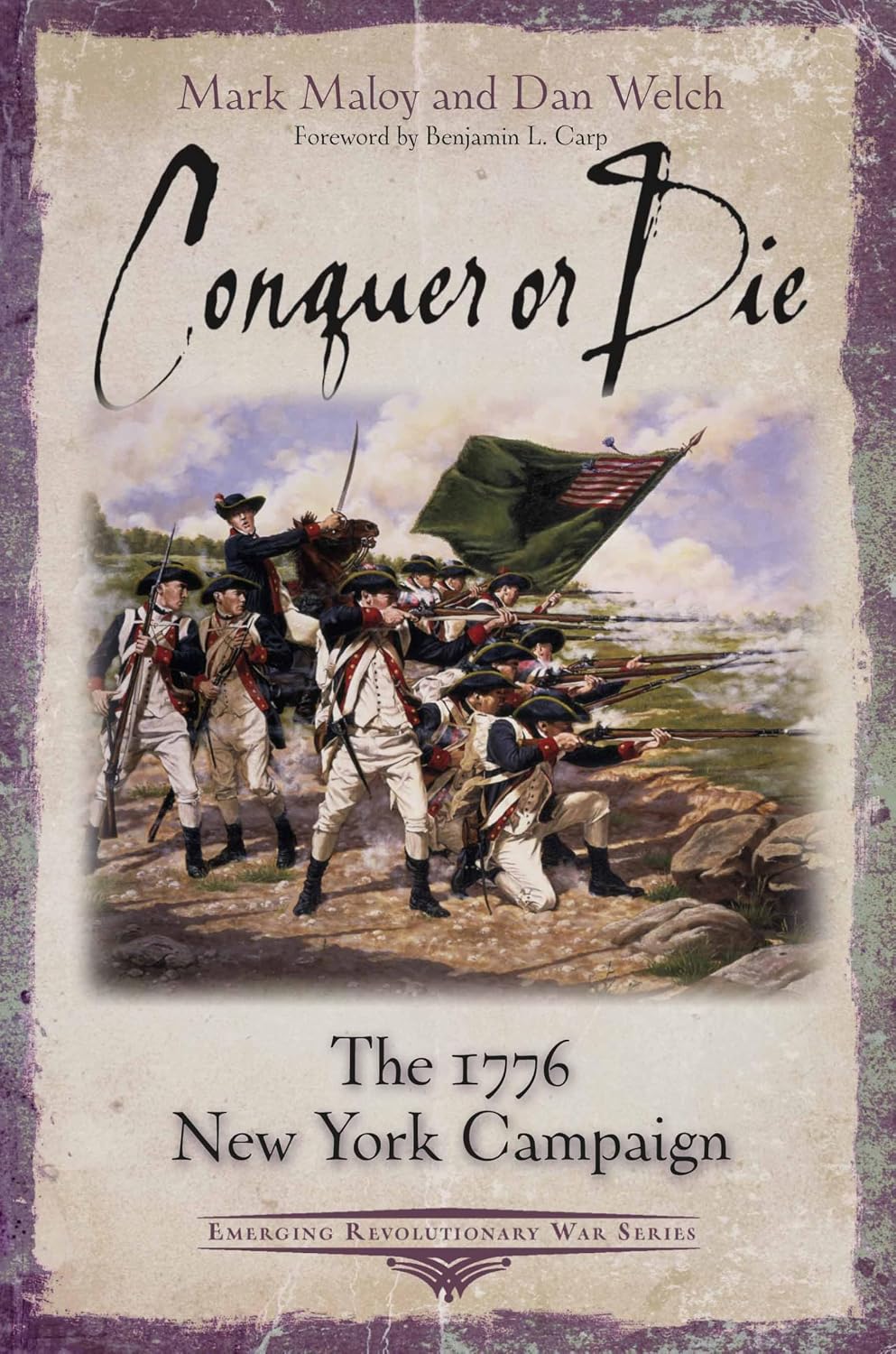
Learn more about this historic event in Mark Maloy and Dan Welch’s new book on the 1776 New York campaign: Conquer or Die, out this November!
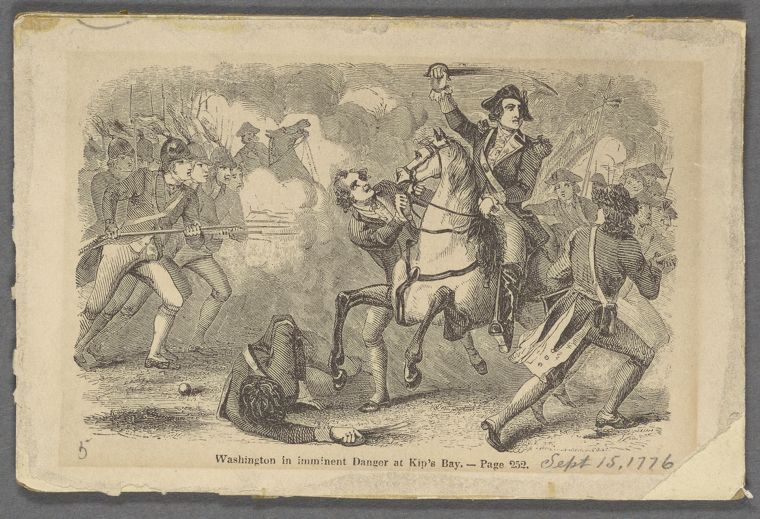
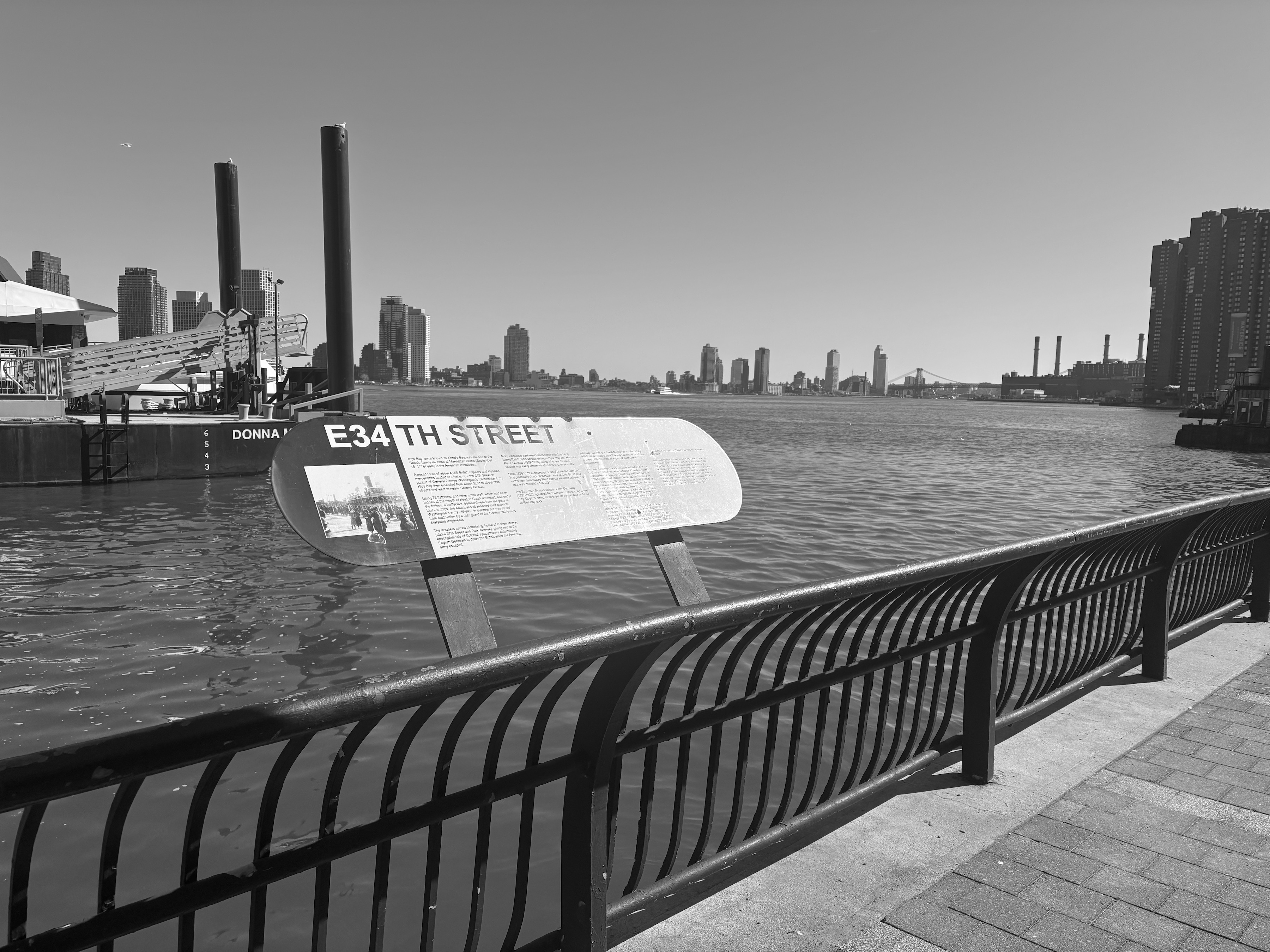
On September 15, 1776, William Howe’s troops landed at Kip’s Bay on Manhattan. After defeating Washington’s troops a couple weeks earlier at Long Island, Howe now intended to capture New York City. Kip’s Bay was located neat present-day E 34th Street on the East River. This area was a weak point in Washington’s defenses on Manhattan. The area was defended by Col. William Douglas’s 1,500-man brigade and a third of them were sick, and of the remainder, only half of that number were fit enough to man the trenches and oppose the landing.
At 10:00 a.m. the first wave of 80 British flatboats moved into the river with 4,000 British and Hessian troops aboard. By 11:00 a.m., the British fleet opened a cannonade against Douglas’s position. Approximately 80 guns fired on the militiamen for more than an hour. Their shallow ditches and weak defenses, coupled with their greenness, led them to a rout in the face of this overwhelming show of force by British naval superiority. General Clinton’s aide-de-camp, Francis Rawdon, from his boat saw Douglas’s men break and run. Clinton’s landing party thus, “pressed to shore . . . landed, and formed without losing a single man.”
The modern location of Kip’s Bay.
As the first wave of British and Hessians secured the beachhead, not all of Douglas’s men were able to escape as they retreated toward the King’s Bridge Road. Bartholomew James wrote in his journal that he “saw a Hessian sever a rebel’s head from his body and clap it on a pole in the intrenchments.” One historian asserted that, as other Americans surrendered, hands upward, that Hessians shot or bayoneted them.
While Douglas’s men fled, George Washington finally arrived within a mile of the Patriot position at Kip’s Bay. “As soon as I heard the firing, I rode with all possible despatch,” Washington wrote to Congress the next day. Somewhere on Murray Hill, Washington came across General Putnam, who also rode towards the sound of the British salvos. “[T]o my great surprise and mortification,” Washington recounted, “I found the troops that had been posted in the lines retreating with the utmost precipitation . . . flying in every direction. . . . I used every means in my power to rally them into some order; but my attempts were fruitless and ineffectual.”
Washington “drew his sword and snapped his pistols, to check them; but they continued their flight,” noted James Thacher, an army doctor. As Washington’s ire at his fleeing men raged on, Col. William Smallwood reported that the Connecticut troops in flight “were caned and whipped by the Generals Washington, Putnam, and Mifflin, but even this indignity had no weight, they could not be brought to stand one shot.”
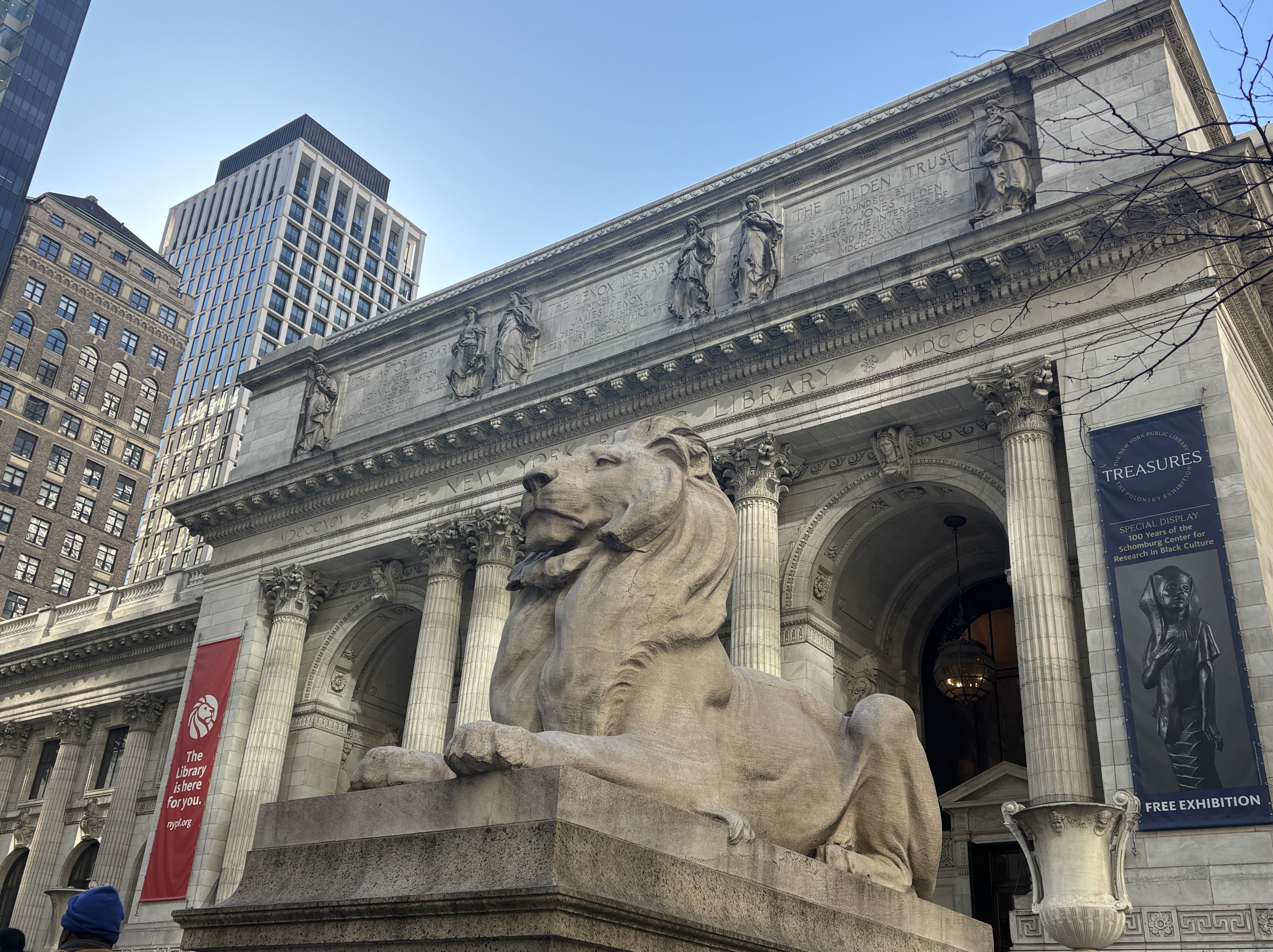
Washington confronted his retreating troops near the modern-day New York Public Library.
Approximately 2,000 Continental soldiers now appeared under the command of Brig. Gens. Samuel Parsons and John Fellows. Seeing the retreat of the Connecticut Militia and a pursuing enemy was enough to break these reinforcements. “The Panic that struck Gen. Fellows’s & communicated itself to Gen. Parsons’ Brigade disgraced the last Retreat,” General Greene recalled. “The 2 Brigades run away from about 40 or fifty men, and left Gen Washington standing alone within an hundred yards of the enemy.”
Washington was enraged by the cowardice of his men, and General Heath saw the normally reserved general break. “Gen. Washington threw his hat on the ground, and exclaimed, ‘Are these the men with which I am to defend America?’”
As the despondent commander tried in vain to rally and inspire his men, only the bravery and stubbornness of two of the general’s aides led them to grab the bridle of Washington’s horse and face him about to leave the field.
Learn more about this fateful and shameful day for American arms (and the patriotic efforts of a female New York patriot) in Mark Maloy and Dan Welch’s new book on the 1776 New York campaign: Conquer or Die, out this November!
Admiral Lord Richard Howe, 50 years old, found himself in an awkward position.
Admiral Lord Richard Howe, 1789, painted by John Singleton Copley
Howe commanded the Royal fleet even then investing Manhattan Island following the defeat of the Continental Army at Brooklyn Heights earlier in September. Nearly 400 ships of various sizes sailed under his command—the largest fleet England had thus far assembled.
Yet despite that military might, Howe had an additional role to fulfill. His Majesty, King George III, had appointed him as one of two “peace commissioners” charged with negotiating terms with the Americans. The other peace commissioner was Howe’s brother, General William Howe, commander of the Royal army. The makers of war were tasked with negotiating a peace.
Complicating matters even more, the brothers were not empowered to do much actual negotiating. Colonists first had to renounce their independence before any terms for a restored peace could be discussed. Pardons could then be liberally granted, although Howe did have a blacklist, a list of “Rebell[s] expressly excepted from Pardon.”
Lord Howe generally felt sympathetic toward the former colonies, and when he dispatched the paroled American general John Sullivan to Philadelphia with an overture for peace, Howe genuinely hoped for reconciliation.
War and politics can both necessitate some strange bedfellows, and that was certainly the case 250 years ago today when two of the Revolution’s leading figures found themselves literally sharing a bed.
During the battle of Long Island on August 27, 1776, the British captured Gen. John Sullivan of New Hampshire. They then paroled Sullivan and sent him to Philadelphia bearing a message from the British Peace Commissioners, Admiral Lord Richard Howe and his brother, General William Howe. The Howes invited the Continental Congress to discuss terms for peace.
Most in Congress considered the overture disingenuous, and some even bore ill-will toward Sullivan for bringing such an odious message. However, delegates also understood that if they rebuffed the overture out of hand, it would look as though they, not Great Britain, were to blame for continued war. On September 6, Congress decided to appoint a three-man delegation to travel to the British headquarters on Staten Island, New York, to hear what the British had to say.
How significant was religious rhetoric in gathering support for resistance to Parliamentary authority in the lead-up to the American Revolution and the subsequent War for American Independence? The historiography of the American Revolution includes several analyses of the struggle’s ideological roots. Historians consider whether colonial leaders identified with the Whig traditions of the Glorious Revolution, which placed monarchical power within a Parliamentary framework, or were more inspired by Enlightenment ideas focused on the natural rights of man and liberal notions of government by the consent of the governed.[1] The idea that the sources of inspiration for the rebellion, and much of its rhetoric, stemmed from religious rather than secular sources has received less attention, despite religion’s significance in the formation and administration of Britain’s North American colonies. Acknowledging the impact of religion on American revolutionary thought provides a more complete and balanced understanding of the inspiration for resistance during the War for Independence.
Religious identity, clerical leadership, and the power of Scripture as an ideological rallying cry all played a role in shaping public opinion in favor of resistance to Parliamentary interference, and ultimately in supporting the movement for Independence in the American colonies.[2] While the group of colonial leaders known collectively as “The Founding Fathers” drew inspiration from the Enlightenment and political theorists such as John Locke, a great many of their supporters throughout the colonies viewed the conflict with England through a religious lens and employed the language of evangelicals inspired by the Great Awakening to frame their arguments against tyranny. [3]
Additionally, many congregants of denominations established as Dissenters from the Church of England had extensive experience managing their own affairs, and they jealously guarded their sense of independence. As an example, Patricia Bonomi notes that Congregational Societies throughout colonial New England had extensive experience with governance systems in which the clergy and church members shared authority and responsibility. Through such arrangements, colonists learned to have a say in their own affairs, participated in a form of franchise through voting on church matters, and exercised budgetary control over ministers’ salaries.[4] In contrast to the traditions of Dissenting sects, the Church of England grew from a hierarchical tradition, in which centralized authority in the hands of the clergy controlled ecclesiastical affairs and church administration, with laity largely responsible for simply respecting the “descending hierarchy of the archbishop, bishop, and priest”.[5]
Dissenting denominations other than Congregationalists, including Presbyterians, Baptists, and Quakers, participated in both spiritual and temporal activities in colonial parishes, largely due to an absence of qualified clergy. Communities throughout Britain’s North American colonies demanded centers of religious leadership and activity, and when qualified clergy was not available, they took matters into their own hands through lay preachers or, when possible, by availing themselves of visiting, itinerant clergy. The end result was a disparate collection of religious communities increasingly used to running their own affairs.[6] The Church of England in the colonies experienced the same shortage of qualified clergy, with no Archbishop for the American colonies and a tradition of locally elected vestrymen responsible for selecting and hiring ministers[7]. However, because the Anglican Church was hierarchical, with religious authority ultimately resting with the monarchy, local autonomy did not produce the same sense of independence found in other colonial denominations.[8] Dissenting sects specifically rejected the notion of being governed by a distant, centralized authority, and the sense of religious independence engendered by this development eventually entwined with a sense of autonomy in political affairs.
The Great Awakening, an expansive revitalization of religious fervor experienced by Protestant congregations in Europe and the American colonies in the late 17th and early 18th centuries, reinforced the sense that religious communities existed within a covenant with God.[9] Great Awakening ministers such as George Whitefield preached a message of a personal relationship with God, brought on by encounters with the Holy Spirit, which detractors derided as religious enthusiasm that could upset the established social order.[10] Messages such as Whitefield’s shaped how many colonists viewed their relationship with God and fostered an interpretation that one’s natural rights stemmed from God rather than being granted by a sovereign. If a monarch refused to respect the natural rights of his people, the people had the right to resist. This interpretation meshed with the Enlightenment ideals of colonial leaders and served as a foundation for the movement towards American independence.[11]
In the mid-19th century, a young man named Mellen Chamberlain interviewed an American participant in the first day’s fighting of the American Revolution, Captain Levi Preston of Danvers, Massachusetts. Preston fought against British troops as they retreated from Concord. Chamberlain’s record of the discussion included the following exchange:
I suppose you have been reading Harrington, Sidney, and Locke about the eternal principle of liberty?”
“I never heard of these men. The only books we had were the Bible, the Catechism, Watts’ psalms and hymns, and the almanacs.”
“Well, then, what was the matter?”
“Young man, what we meant in going for those Redcoats was this: we always had governed ourselves, and we always meant to. They didn’t mean we should.”[12]
Preston’s responses to Chamberlain provide evidence of both the prevalence of religious literature in the homes of American colonists and their sense of autonomy. His statements are an example of what the Anglican Clergy of New York meant when they wrote to their superiors in England that Dissenters in general, and Presbyterians and Congregationalists in particular, were the active promoters of the rebellion.”[13]
The religious rhetoric espoused by colonial clergy on the eve of the American Revolution nested especially well with the rational arguments of Enlightenment philosophers. As Mellen Chamberlain’s interview with Captain Levi Preston indicates, the average colonist was not familiar with arguments from Thomas Hobbes or John Locke about the natural rights of man or the social contract between those who governed and those who lived under that government. The appeals to Enlightenment ideals and Classical examples that inspired the leaders of the American Revolution who attended the Continental Congress would resonate little with the men who would be asked to fill the ranks of the rebellion’s regiments.[14] Leaders such as Thomas Jefferson recognized that the religious heritage of the American colonies, which included traditional calls to fast and pray for God’s intervention during times of crisis, was the exact language the colonial populations would understand, and that by invoking these traditions through the messages preached in colonial churches and meeting houses, common people would recognize the immediacy of the danger posed by Parliamentary interference in colonial affairs. Scriptural rhetoric was a common language that was understood throughout all of Britain’s American colonies, from New Hampshire to Georgia, recently strengthened and refreshed by the work of the ministers of the Great Awakening.[15] Thus, American revolutionary leaders could link Enlightenment language to the Word of God to rally support for resistance.
This linkage to Colonial American religious tradition proved particularly effective in support of calls to resistance because the forms of dissenting Protestantism practiced by the colonists embraced a tradition of martyrdom. Political resistance contained a religious element that professed that “(t)o be a ‘true American’ was to be willing to die for the revolutionary cause, and to die for the revolutionary cause was to earn a ticket to paradise.”[16] Thus, religious duty intertwined with political duty, and colonial clergy invoked the Gospels to call forth their congregations to fulfill their civic obligations.
Historian Karen O’Brien notes in her 2005 PhD dissertation that the leaders of the American Revolution recognized they needed to share their message through community religious activities. She describes how doing so helped in“building communal resolve for the war. . . help colonists dispense with their initial anxieties over war; (and) unite soldiers and their communities around a shared moral purpose.”[17] Additionally, O’Brien notes that “local religious meetings. . .—be they in a local church or a hastily improvised backcountry clearing— provided a stage for people to negotiate between individual moral duties and the greater public good. Furthermore, the Bible offered a common language of moral right and political resistance, a type of ethical lingua franca able to reach even the most common colonist.”[18]
Religion played a significant role in community life from the establishment of Britain’s North American colonies. For example, when Puritans settled both the colony at Plymouth and the Massachusetts Bay Colony in the 17th century, a man had to be a full member of the church in order to exercise the right to vote.[19] Clergymen and religious lay leaders played prominent roles in their local communities, blurring the line between political and ecclesiastical affairs. Dissenting denominations became identified with colonial Whigs as tensions increased between the British Parliament and colonial legislatures after the Seven Years’ War. Revenue-producing legislation in the form of new taxes and stricter enforcement of mercantilist trading policies enacted in England became sources of political dissent, as colonial leaders viewed these policies as an infringement on their rights to govern their own affairs. Colonial pulpits broadcast calls to resist ministerial and monarchical oppression and rallied congregants to resist British tyranny. Massachusetts delegate to the Continental Congress extolled the clergy’s efforts, stating, “they with a fervor that will produce wonderful effects. Those … of every denomination . . . thunder and lighten every Sabbath.”[20]
Ministers used the Scriptures to provide a moral undertone to messages of defiance of authority. Reverend Samuel Langdon, a New England Congregationalist Minister, raised the question of Divine protection of natural rights when he asked in a sermon, “may we not be confident that the Most High. . .will vindicate his owner, and plead our righteous cause against such enemies to his government, as well as our liberties?”[21] For Langdon, government ministers and members of Parliament were the enemies of the local governance colonists had practiced for generations. Likewise, Presbyterian Minister John Rodgers of New York preached a sermon on 1 Kings 18:12 in which he implored the men of his congregation to resist tyranny, expressing plainly that the colony’s “rights are now invaded, and your country’s cause now looks up to her free born sons for guardianship and protection.”[22] Rodgers not only made clear the threat of Parliamentary overreach, but implored his listeners to actively fight against it to protect their natural rights.
As affairs between England and her colonies deteriorated further, local Committees of Safety in New England, particularly in Massachusetts, began to reorganize and train militia forces and stockpile munitions. These efforts led to British operations to seize military stores, and one such operation on 19 April 1775 at Concord, Massachusetts, erupted into open, armed conflict. Eventually, the British government declared the American colonies in open rebellion against the monarchy; colonial clergy found their roles shifting from preaching the gospel of resistance to actively recruiting and supporting troops in the field. Just as the clergy played a predominant role in calling for “liberty, independence, and a steady perseverance in endeavoring to shake off their allegiance to the mother country”[23], prior to April 19, 1775, they continued their efforts once the fighting began by assuming roles “peculiar to their character as ministers of the gospel, namely their activity as chaplains.”[24] Colonial ministers volunteered for military service, preached sermons to inspire men to arms, and joined military forces on campaign to provide spiritual comfort and mentorship.
Once hostilities commenced, the need for chaplains exacerbated the lack of qualified clergy in the American colonies. As indicated previously, religion served an organizing function in colonial communities, and ministers were not always available to provide spiritual leadership. Once the War for Independence began, the need for chaplains in fighting regiments meant many communities lost their parish leadership, who volunteered their services with the Continental Army or local militias. As a result, the religious lives of those left behind might have suffered during the war because they lost the men who served pastoral functions in their communities in peacetime.[25]
If religion was central to political and community life in Colonial America, it was no less important in military life once the colonies committed to armed resistance to British authority. Military leaders understood religion as a means to embolden, encourage, or chastise soldiers as the situation required, and they sought to ensure proper religious accommodations were available to their men. This most often took the form of enlisting an appropriate clergyman to serve as a chaplain and look after the spiritual welfare of the men in the ranks. A good Chaplain ensured that men who came from different walks of life and disparate faith traditions were sustained by the message that God would bring them protection and victory if they adhered to his laws.[26] The role of a military chaplain covered three broad, but overlapping areas. For commanding officers, chaplains were critical for the maintenance of morale and good order and discipline; for the chaplains themselves, their role was an opportunity to be useful to the cause, placing the fight for independence in the context of the Scriptures, and another opportunity to spread the Gospel, while the troops in the ranks viewed chaplains as sources of comfort and aid while confronting loneliness, sickness and threat of wounds and death, as well as concern for families at home.[27]
Continental officers codified the role of chaplains in maintaining good order and discipline almost immediately after Congress authorized the establishment of the Continental Army on June 14, 1775, appointing George Washington as its commanding general. Washington charged the chaplaincy with an array of duties, from looking after the morality of the soldiery, waging campaigns against vulgarity and alcohol in camp, setting an example of courage in combat, and providing the men the opportunity to regularly attend divine services.[28] Commanders expected chaplains to help inculcate in both officers and enlisted men a sense of moral superiority expected of soldiers fighting for republican ideals. Moral superiority went beyond merely displaying patriotic or soldierly behavior, but included behaving like a “virtuous, good man.”[29] According to historian Charles Metzger, developing this moral superiority proved challenging, as contemporary reports described Continental camps as filled with “the horrid sins of Cursing, swearing and other Vices with which . . . our Army vies with the most abandoned English troops.”[30] Chaplains also continued to attract fresh recruits to join Continental or militia regiments when other incentives, such as land or cash bounties, proved ineffective at enticing volunteers to the cause.[31]
An examination of the Scriptural language employed by Continental and patriot militia chaplains throughout the war reveals that they utilized similar themes when addressing the troops consigned to their pastoral care. Issac Mansfield served as the chaplain of the Continental Army’s 2d Massachusetts Regiment during the Siege of Boston from the fall of 1775 through early 1776. Mansfield delivered A Sermon, Preached in the Camp at Roxbury, November 23, 1775; Being the Day Appointed by Authority for Thanksgiving through the Province as the men of the 2d Massachusetts faced cold, boredom, and restrictions of military discipline. The Siege of Boston began as a loose collection of Massachusetts militia regiments that surrounded Boston in the opening days of the American Revolution in April 1775. As the spring turned to summer, the other American colonies sent troops in support, and the Continental Congress in Philadelphia, Pennsylvania, voted to organize these forces into a Continental Army, with Washington as its commanding general. The novelty, danger, and excitement of military life had long since evaporated by the fall of 1775. Mansfield used this sermon to remind his listeners that they had God to thank for protecting them throughout the siege and urged the troops to continue demonstrating Christian conduct to remain worthy of God’s blessings.
Mansfield’s sermon was laden with scriptural analogies, exemplifying how chaplains used religious allegories to demonstrate God’s sanction of the American Revolution. Mansfield’s preaching is biblically dense, beginning with Genesis 32:9–13 and the struggle between Jacob and Esau. The patriots are cast as Jacob, struggling against their more powerful brother, the British Army. Mansfield encourages the men of the regiment to continue to fight, illustrating through examples from Deuteronomy 28 and Proverbs 14 that God will bring success to their arms if they obey His commandments; if they fail to follow God’s laws, they will face a variety of calamities before being called before the Lord to face final judgment. Mansfield encourages the troops by reminding them that they have served for months in the field, with God protecting them from both disease and the death and wounds of battle, and that they have thrived by the grace of God rather than through their own efforts. He emphasizes that the men should endeavor to avoid sinful behavior that could offend God and thus bring about a reversal of fortune to the Continental Army. Mansfield cites Psalm 44 as he closes his sermon, encouraging the troops to place their faith in God rather than themselves for ultimate success.[32]
Other Patriot chaplains from different regions and periods of the war used similar scriptural language when preaching to their military congregants. John Carmichael (A Self-Defensive War Lawful, June 4, 1775)[33], Israel Evans (Brigade Thanksgiving Sermon, Dec 18, 1777)[34], and John Hurt (The Love of Our Country, 1777, before Virginia troops)[35] all emphasized that God was on their side and they must continue to deserve God’s favor through morally correct behavior. The similarities between these sermons reveal a shared vocabulary of resistance rooted in Christian imagery that transcends any specific region or campaign of the American Revolution.[36]
A Self-Defensive War Lawful, Proved in a Sermon, Preached at Lancaster, before Captain Ross’s Company of Militia, in the Presbyterian Church on Sabbath Morning, June 4th, 1775, marks the transition from political protest to armed resistance. Chaplain John Carmichael preached this sermon in Pennsylvania less than two months after the outbreak of hostilities at Lexington and Concord, Massachusetts. This moment carried significant weight, as it marked an irrevocable choice: men had to decide whether they were justified in taking up arms against their sovereign. Carmichael assured his listeners that they were embarking on a just war, in defense of their homes against an invasion. God provided all creatures with the means of self-defense, according to Carmichael, and He would not leave them “destitute of this necessary principle”. He further stressed that as followers of Jesus Christ, they were not only justified in, but duty-bound “to arm ourselves and use our arms for our own preservation against any invading enemy.”[37] Carmichael’s sermon is an excellent example of a chaplain motivating men to rally to the defense of their community while also assuaging their consciences that doing so was right in the eyes of God.
Chaplains in the field used remarkably similar language to sustain the spirits of soldiers in vastly dissimilar circumstances. Sermons thanking God for victory or asking Him for strength and fortitude in times of trial could both emphasize doing one’s duty to please God, regardless of a battle or campaign’s outcome. Chaplain John Hurt served as the chaplain for the Virginia Regiments of the Continental Army, known as the Virginia Line, troops with an elite reputation. Hurt gave The Love of Our Country: A Sermon Preached before the Virginia Troops in New Jersey, June 1777,at the beginning of the 1777 Campaign season. This was a remarkably difficult time for the Continental Army, which had almost ceased to exist the previous year during the fighting around New York City. An invading British Army had seized the city from Washington and his troops, who took tremendous casualties, mostly taken prisoner, and were driven across New Jersey into Pennsylvania. Washington managed to secure victories with raids against Trenton and Princeton, New Jersey, at the end of the campaign, giving the patriot cause a glimmer of hope, but the British held the initiative as the 1777 campaign began. Hurt’s sermon exhorts the men to do their patriotic duty with a spirit of self-sacrifice, comparing duty to one’s country with duty to God. A soldier who fought well pleased the Lord as well as his country, regardless of outcome.
Chaplain Israel Evans’ A Discourse, Delivered December 18, 1777, Being the Day of Public Thanksgiving, in the Brigade of the American Army Commanded by General Poor, celebrated the victory of General Horatio Gates’ Northern Army at the Battles of Saratoga in September and October of 1777. This victory marked the first instance of a British Army surrendering to American forces in the field in the War for Independence, with 8,000 British and Hessian troops captured, and resulted in overt French support for the American war effort. Evans preached that such a complete victory was Providential, but the troops could only deserve such Divine support by continuing to serve with a spirit of bravery, self-sacrifice, and moral correctness. He further emphasized that the troops should show such behavior regardless of whether they succeeded in battle, because in doing so they pleased God. The outcome of their battles was secondary to ensuring their behavior was correct according to the Lord’s commandments.
It is worth noting the similarity of language, biblical themes, and messaging used by Mansfield, Carmichael, Hurt, and Evans in their messages to the troops. Despite coming from different faith traditions, geographic regions, and fighting in a variety of circumstances, each chaplain emphasizes that success at arms comes through the grace of God, yet the men must endeavor to prove worthy of that grace through upright conduct and obedience to God’s commands. Each sermon draws on the Psalms, Proverbs, and Deuteronomy, emphasizing that God protects the righteous and punishes the sinful, reinforcing the notion that Providence will favor the Patriot cause, but that they must do their part through proper conduct and devotion to the Lord.
Rank-and-file soldiers sought out the preaching of their chaplains and took comfort from their sermons. Ammi Robbins, a Continental chaplain from Connecticut, wrote that “there appears a great desire among the people, at least many of them, to hear the Gospel” from among the men in camp. He observed that the men would travel great distances to hear a sermon preached, noting that many men had walked “some six or seven miles, as sheep without a shepherd.”[38]Despite the evident desire of the troops to hear their chaplains preach, they thought of the impact of Divine Providence in much more personal and pragmatic terms than those used by clergy in their sermons. Years of campaigning exposed the troops to primitive living conditions, extremes of weather, sudden violence, the risk of wounds and death, and bouts of homesickness. While the men sought comfort in the words of their chaplains, their view of God’s blessings commonly focused on Providence’s role in their personal experiences.[39] Samuel Haws, who fought against the British at the Battle of Bunker Hill in Charlestown, Massachusetts, in June of 1775, attributed his survival to God’s grace, writing that despite being heavily engaged by British troops “through the good hand of Divine providence in all their firing they did not kill one man nor wound any except one or two slightly.”[40] Similarly, another Continental soldier, Joseph Plumb Martin, considered that the will of Providence was imponderable after one firefight, recording that a comrade was killed and “(H)had I been at the same business I might have been killed but it might have been otherwise order(ed) by Divine Providence, we might have both lived.”[41]
The men did not consider only God’s blessings when thinking about surviving in battle. During the 1775 expedition through the Maine wilderness to besiege Quebec, Canada, the men lacked provisions, shelter, and clothing as they marched and paddled northward. One soldier, Abner Stocking, reflected that he had taken such things for granted until they were not available: “Little thought I, do we know of the value of the common blessings of Providence, until we are deprived of them.”[42] Thus, for the troops on the line, God and the chaplains who preached his word were more often sources of spiritual comfort rather than sacrificial inspiration.
The centrality of religion to the lives of colonial Americans, combined with the importance military commanders, clergymen, and the soldiers themselves placed on the availability of religious support, made chaplains an expected presence in nearly every campaign of the American Revolution, from William Emmerson accompanying the Minutemen at the Battle of Concord in April 1775, where he encouraged the militia to stand fast and telling them, “Your cause is just and God will bless you!”[43], to John Ellis of the 1st Connecticut Regiment at the British surrender at Yorktown, Virginia, in October 1781. Ellis enlisted during the Siege of Boston in 1775, served through the winter at Valley Forge, Pennsylvania in 1777-1778, and stood in the firing line at the Battle of Monmouth, New Jersey. Chaplains served with regular troops, short-service militia, at sea with American warships and privateers, and even continued to minister to the troops when taken prisoner by the enemy. [44]
Religious language fueled the rhetoric of rebellion throughout the American colonies between the end of the Seven Years’ War and the outbreak of the American Revolution. Colonists had grown used to self-determination in local affairs, religious practices independent of central authority, and the idea that their natural rights came from God alone. They found inspiration in clergymen who used Scripture to express resistance to tyranny. When political resistance turned to armed struggle, religious language continued to inspire men to enlist, fight, and endure. Clergymen became chaplains in a variety of Continental and militia military organizations, offering a message of continuity: the struggle for independence was a fight for their God-granted rights.
[1] Patricia U. Bonomi, “‘Hippocrates’ Twins’: Religion and Politics in the American Revolution,” The History Teacher 29, no. 2 (February 1996): 137.
[16] John Fanestil, American Heresy: The Roots and Reach of White Christian Nationalism (Minneapolis: Fortress Press, 2023), 149.
[17] Karen Elizabeth O’Brien, “Pragmatic Toleration: Lived Religion, Obligation, and Political Identity in the American Revolution” (PhD diss., Northwestern University, 2005): 92.
[19] John H. Schaar, “Liberty/Authority/Community in the Political Thought of John Winthrop,” Political Theory 19, no. 4 (November 1991): 517.
[20] Derek H. Davis, “Religion and the American Revolution,” Journal of Church and State 36, no. 4 (Autumn 1994): 710.
[21] Davis, “Religion and the American Revolution,” 710.
[22] Valerie Paley, “A Spirit of Patriotism: John Rodgers and New York City’s First Presbyterian Church in the American Revolution,” Journal of Presbyterian History 94, no. 2 (Fall/Winter 2016): 56.
[23] Charles H. Metzger, “Chaplains in the American Revolution,” The Catholic Historical Review 31, no. 1 (April 1945): 31.
[24] Metzger, “Chaplains in the American Revolution,” 31.
[25] Richard W. Pointer, “Religious Life in New York during the Revolutionary War,” New York History 66, no. 4 (October 1985): 361.
[28] Metzger, “Chaplains in the American Revolution,” 53-54.
[29] Craig Bruce Smith, American Honor: The Creation of the Nation’s Ideals during the Revolutionary Era (Chapel Hill: University of North Carolina Press, 2018), 106.
[30] Metzger, “Chaplains in the American Revolution,” 53.
[32] Isaac Mansfield, A Sermon, Preached in the Camp at Roxbury, November 23, 1775; Being the Day Appointed by Authority for Thanksgiving through the Province (Boston: S. Hall, 1776).
[33] John Carmichael, A Self-Defensive War Lawful, Proved in a Sermon, Preached at Lancaster, before Captain Ross’s Company of Militia, in the Presbyterian Church on Sabbath Morning, June 4th, 1775 (Lancaster, PA: Francis Bailey, 1775).
[34] Israel Evans, A Discourse, Delivered December 18, 1777, Being the Day of Public Thanksgiving, in the Brigade of the American Army Commanded by General Poor (Boston: Thomas and John Fleet, 1778).
[35] John Hurt, The Love of Our Country: A Sermon Preached before the Virginia Troops in New Jersey, June 1777 (Philadelphia: Styner and Cist, 1777).
[38] Roberto Oscar Flores de Apodaca, “‘Alas My Backsliding hart!’: The Religious Worldview and Culture of Continental Soldiers in New England, 1775–1783,” Journal of Presbyterian History 97, no. 1 (Spring/Summer 2019): 12.
[39] Flores de Apodaca, “‘Alas My Backsliding hart!,’” 8.
[40] Flores de Apodaca, “‘Alas My Backsliding hart!,’” 8.
[41] Flores de Apodaca, “‘Alas My Backsliding hart!,’” 8.
[42] Flores de Apodaca, “‘Alas My Backsliding hart!,’” 8.
[43] Jack Darrell Crowder, Chaplains of the Revolutionary War: Black Robed American Warriors (Jefferson, NC: McFarland & Company, 2017), 66.
[44] Crowder, Chaplains of the Revolutionary War, 66.
After returning from the War of American Independence, George Washington turned to his pre-war focus on the west, the vast lands beyond the Appalachians that had launched his public career as young Virginia militia officer and messenger for Lieutenant Governor Robert Dinwiddie in 1753. In 1784, he ventured to southwestern Pennsylvania and held a meeting with prominent locals. The question he put before them was finding the best way to connect the Potomac River with the Ohio River. It was rough country and the task would never be easy, but opening a reliable and robust route between the two would open Virginia’s access to the Ohio Valley more easily than the narrow passes and valleys that led to the Kanawha River or along the spine of the Appalachians to the Cumberland Gap through Kentucky. Washington’s interests were, of course, personal. He had invested heavily in the Ohio Country and stood to make, protect, or lose a personal fortune.
But, Washington’s interests were also public. He had long viewed the west as critical to the future of Virginia, and now the new United States. With the war over and independence secured, it had only become more so. Washington had personally experienced the sectional and regional differences that threatened to tear the country apart. As people flooded into the new territories won in the war, the east-west divisions had grown worse. Everything produced in one section and consumed in another had to be hauled across the Appalachians, a time-consuming, back-breaking effort that couldn’t happen fast enough for agricultural products. By connecting the rivers, Washington hoped to bind east and west together, strengthening the economic, social, and political bonds that were critical to building the new country.
The father of his country wasn’t alone in that thought. The Swiss-born Albert Gallatin, who opted to make his home in the west, shared it. Rising through a series of political offices, from state representative, to Federal representative, to Pennsylvania Senator, to Secretary of the Treasury for both the Jefferson and Madison Administrations, Gallatin picked up the baton as Washington passed from the scene. Although they had radically different politics and ideas of national interest, Gallatin focused on establishing a national road at the federal expense by setting aside a portion of proceeds from land sales in the west. After much political maneuvering, Gallatin and the westerners got a law for their road enacted in 1806. The resulting work would become the National Road, America’s first federal interstate highway. A decade later, as work progressed, Gallatin moved from the Treasury Department and national finance to the work of a diplomat with postings as the ambassador to France and then the United Kingdom.
While Gallatin shifted his focus to foreign affairs, Henry Clay of Kentucky picked up the baton of tying the country together and using roads to build figurative, and literal, bridges among America’s different groups. Clay served in the U.S. Senate early in his career, but it may have been his position as Representative from Kentucky and Speaker of the House that he learned the art of compromise and established his reputation as someone with the skills to bring warring factions together, at least sufficiently enough to keep the country growing and getting stronger. The National Road became his project.
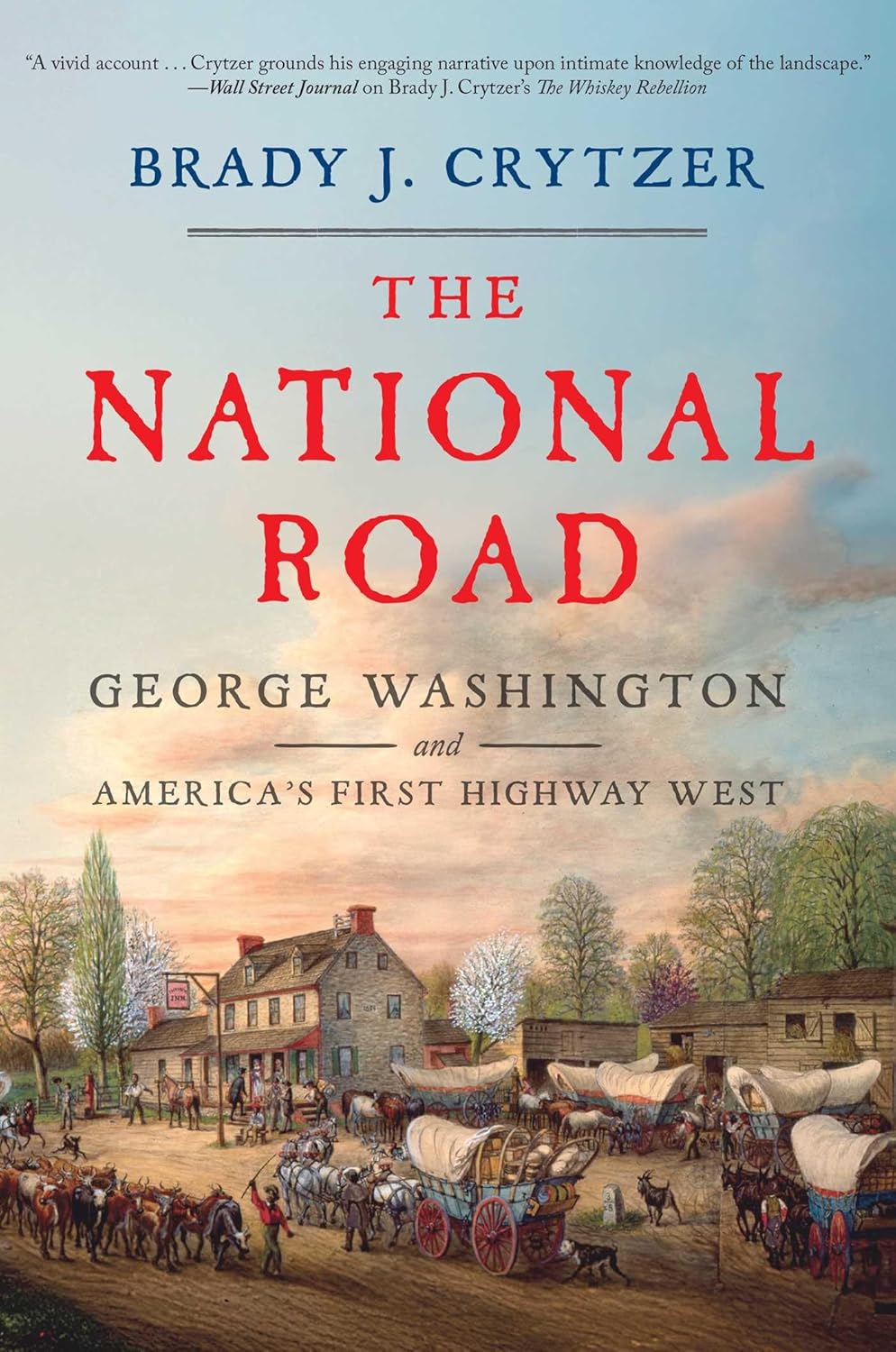
Award-winning historian Brady J. Crytzer takes up this broader tale of building a new country as it moved westward in his latest book: The National Road: George Washington and America’s First Highway West. Ostensibly, it’s about building the road and tackles the nitty-gritty job of exploring a route, surveying, cutting, hauling, pounding, and managing the construction of a road in the 19th century. Along the way, the technology changes, the money runs out, the road needs repairing, and competition crops up from canals and railroads. The road ran from Cumberland, MD to Vandalia, Il, but by the time it reached its western portions, the hard road painstakingly built through Maryland, Pennsylvania, Virginia and Ohio had become a slapdash affair of dirt, mud, ruts, and washouts. Eventually, time passed the road by and it fell into perpetual disrepair, useful more for local traffic than knitting states together.
Ultimately, though, The National Road is really about the people, from world historical figures like George Washington and national leaders like Gallatin and Clay to everyday drovers, bridge builders, settlers, and legendary Black teamsters like Sam Nimmey. The panoply of people that define a nation are all here. (Civil War buffs will even be pleased to find an appearance by Charles Ellet Jr., a civil engineer and bridge builder who went on to construct rams for United States Navy.) Building the road becomes a narrative structure for telling a larger story of the United States as it moved west from the time of the founding fathers through the time of governing compromises and pending Civil War. Solidly grounded in history, Crytzer clearly writes with an eye on the reader’s experience. With The National Road, Crytzer has given the public another excellent work of early American history and a wonderful peek into the complexities of doing big things. He ensures we understand it’s not just a road, it’s the story of diverse people coming together for a common purpose.
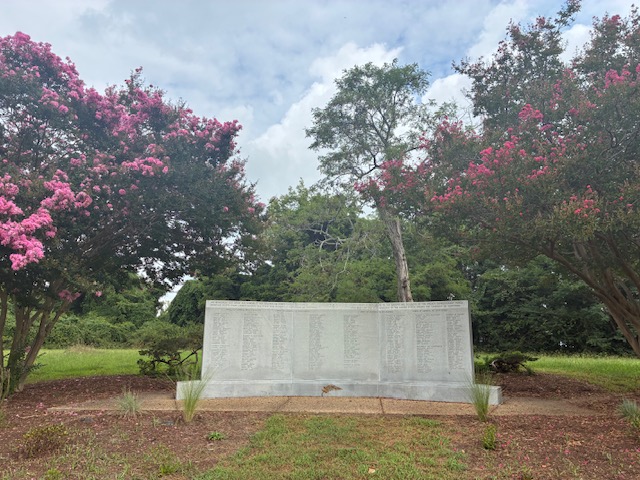
Situated near the York River, across the street from the American Revolution Museum of Yorktown, sits a monument commemorating the French soldiers that fought, bled, and for some, gave their lives during the siege.
A few years ago, or 1421 days ago to be exact, I pulled over into the parking lot for that monument, walked up, and gave a cursory look at the names and the wording. I did not speak or read French–much to the detriment of my French teacher in high school I must say–but determined there that I would. Later that same evening I downloaded the language learning app Duolingo and started a streak, which if you had not guessed already, has reached 1421 straight days.
I recently went back to that monument and could at least interpret enough of the wording to understand the gist. Good start.
The monument in question Author collection
I now take that rudimentary language foundation capability on the road. Where may you ask?
Screenshot to confirm streak
Next week, after deciding approximately a whole 10 days ago, that following the wedding of a cousin in Connecticut, I would drive the remaining 7 hours to Quebec, Canada. Impromptu? Kind of. Just have to remember to pack my passport!
A bucket list item of mine in the history column is to see the famous Plains of Abraham, from one of the climactic battles of the French and Indian (Seven Years’ War), fought 267 years ago this month, on September 13. I also want to walk the last footsteps of General Richard Montgomery as he led an unsuccessful attack by the fledging rebellious American military against the British during the first winter of the American Revolution. I may have missed the anniversary but at least I am within the same year-ish (since the battle was fought on New Year’s Eve 1775).
Side note, Maryland honors Montgomery by a county named in his honor, one of, if not the first, place, county, town, etc. to be named for a person not related to the British monarchy, aristocracy, or gentry. Along with Washington, the two counties in Maryland were siphoned off of Frederick in 1776.
Stay tuned next, week to Emerging Revolutionary War’s Facebook page as I will go live there.
And then I will retreat to a Quebec cafe…or brewery and test out my French…so if you have a suggestion of a can’t miss place, drop a comment below!
Join us this Sunday at 7pm as we ERW authors and historians Dan Welch and Mark Maloy continue their 250th anniversary coverage of the New York Campaign. They’ll chat with us about the events following the Continentals retreat from Long Island, Nathan Hale, the Turtle, the Peace Conference, and of course the fighting at Kip’s Bay and Harlem Heights. Welch and Maloy’s new book, “Conquer or Die” will be available this fall. This Revelry will be LIVE on our Facebook and You Tube pages at 7pm.






 Emerging Revolutionary War Era