Emerging Revolutionary War welcomes historian Daniel T. Davis.
1777.
An elder Daniel Boone (courtesy of the LoC)
The conflict ignited at Lexington and Concord finally reached beyond the Allegheny Mountains as the British stepped up their raids on American settlements in Kentucky. With so many troops dedicated to the colonies, Henry Hamilton, the Lieutenant Governor at Detroit, relied on Native tribes allied with the Crown to carry on the war effort. In March, Shawnees began to harass Harrodsburg, Logan’s Station and Boonesborough. Founded as part of the Col. Richard Henderson’s proprietary colony of Transylvania along the banks of the Kentucky River, Boonesborough derived its name from one of the most famous long hunters of the day and resident, Daniel Boone. Continue reading ““You are a fine fellow”: The April 24, 1777 Attack on Boonesborough”→
Emerging Revolutionary War welcomes historian Dan Welch
As we commemorate the 244th anniversary of the engagements at Lexington and Concord, it is an opportunity to reflect upon this moment’s importance in American history. The results of what happened in April 1775 were truly “heard around the world.” The importance of those events are commemorated and remembered in various forms across the fabric our country. This holds true, even in Youngstown, Ohio.
The Road to Remembrance Memorial on the southside of Youngstown, Ohio. (Image courtesy of the author)
As the country grappled with the effects of the Great Depression, numerous civic organizations in the state of Ohio sought to construct a “Road of Remembrance” in honor of the servicemen from the country’s previous conflict. On June 17, 1930, the state legislature designated a portion of Route 193 from Lake Erie to 422 in Youngstown as a memorial roadway in honor of those soldiers who gave their last full measure of devotion during the Great War. Many towns planted memorial trees along the route, some erected monuments, while other organizations held ceremonies marking the occasion. This special route was to be just a small portion of remembrance that was to span from Montreal, Canada to the Gulf of Mexico. Continue reading “The Shot Heard in Youngstown?”→
Emerging Revolutionary War welcomes guest historian Paige Backus.
Aron, Paul. “Fighting as a Common Soldier”. Colonial Williamsburg: Trends and Traditions (Spring 2017). Accessed March 12, 2019. Click here for URL.
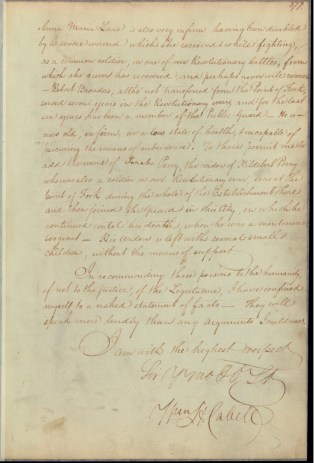
Women’s History Month is dedicated to celebrating extraordinary women and encouraging the women of today to be the same. Throughout American history, there are multitudes of women who certainly were put into extraordinary situations and rose to the challenge to make their place in history. Throughout the American Revolution, women were generally not allowed to serve in the armies so they accompanied their husbands to war as camp followers assisting with the cooking, cleaning, nursing and other domestic tasks needed by the army. This is no small feat considering that women were exposed to the hardships and challenges of war, working without the modern technology we take for granted today, and doing it all in skirts. However, one woman named Anna Maria Lane not only followed her husband into war, but she joined him in battle becoming the only known woman in Virginia to serve as a soldier during the American Revolution. Continue reading “Women’s History Month: The Story of Anna Maria Lane”→
The British and loyalists would not have to wait long. Word of the landing reached the Massachusetts government within a matter of days, and preparations for a counterattack began almost immediately. There was such a hurry to respond that the General Assembly voted to carry out the operation with state forces rather than wait for Continental assistance.[1] Despite the initial rush it still took a month to assemble a force of over 1,000 militiamen, as well as the food, arms, and other supplies to sustain them. All of these troops and their supplies would be transported by a fleet of 21 transports, accompanied by nearly twenty state and Continental navy vessels and privateers. Among the warships the largest was the Frigate Warren of 32 guns which served as the flagship of Commodore Dudley Saltonstall. The Connecticut born officer was given overall command of the naval forces – no small task given the lack of experience with large scale fleet actions among his subordinates. Command of the land forces was given to Massachusetts Brigadier Solomon Lovell. Lovell has seen experience early in the war outside of Boston, but was also relatively untested in battle. The inexperience and poor communication between Saltonstall and Lovell was to have a decisive impact on the coming expedition. Notable among the other officers in the expedition was Paul Revere, who commanded the Massachusetts artillery. The expedition was also joined by a band of the local Penobscot Indians allied to the Continental Congress.
The New England fleet entered the Penobscot Bay on July 25th and immediately attempted a landing. Clearly outnumbered and with their works incomplete, General McLean and his men were determined to resist the Americans, but expected the worst. Saltonstall’s fleet sailed in close to the shore and exchanged cannon fire with both the British defences and the three remaining Royal warships, now under the command of Captain Henry Mowatt. In the confusion and smoke the Americans lowered seven launches full of marines and militiamen, but as they neared the shore they were met by a hail of musket fire[2]. At least one of the attackers – a Native American – was killed and the boats returned to the safety of the fleet. It was an inauspicious start to the battle for the New Englanders and already the relationship between the two commanding officers was becoming strained. General Lovell knew little about sailing or naval operations. He questioned the Commodore as to why he couldn’t just sail his fleet into the harbor and blast the British to pieces while his troops landed under their covering fire. The Connecticut seaman replied curtly, exclaiming “You seem to be damn knowing about the whole matter! I am not going to risk my shipping in that damned hole!”[3]
On the 26th a second militia landing on the peninsula was repulsed after the lead boat carrying militia Major Daniel Littlefield was swamped by British chain shot, drowning the Major and two privates.That same day, however, the Americans scored a small victory when a force of 200 Continental marines and artillerymen landed on Nautilus Island and captured the small British battery there[4]. More artillerymen were landed and soon the Americans had a battery from which they could harass the British shipping. With the Americans making some headway Captain Mowatt withdrew the remaining British ships deeper into the harbor, creating a defensive line across the Bagaduce River.
Castine Harbor, looking out roughly where Captain Mowatt anchored the British transports and warships (Author’s photo)
Emerging Revolutionary War welcomes back guest historian Travis Shaw.
Part One
I’d be willing to bet that Maine isn’t the first place to come to mind when you hear the word “frontier”. For many Americans I imagine they immediately think of the wild west. Wagon trains of pioneers crossing the prairies, and Native nations like the Sioux and Apache ranging the plains on horseback. A century before the age of Manifest Destiny, however, the region that is now the state of Maine marked the eastern frontier of the English colonies. It was a wild and sparsely settled place, caught between New England and the French colonies to the north. The few European settlers eked out a living from the thin, rocky soil or turned to lumbering and to the sea. They lived alongside and often fought against the region’s original inhabitants – the Wabanaki or “People of the Dawn.” For two centuries the Eastern Frontier was torn apart by war between various European powers and their respective Native allies. Nowhere is this more clearly evident today than in the small coastal town of Castine, Maine.
Castine is located near the mouth of the Penobscot River, more or less in the middle of the Maine coast (Google Maps)
Captain John Ashby and his fellow Virginians would face their greatest test of the war on the afternoon of September 11th, 1777 at the Battle of Brandywine. Following a wide flank march the bulk of the Crown forces emerged on Washington’s right flank, ready to trap and smash the Continental Army. Washington reorganized his line, drawing men north in a desperate attempt to meet the new threat. The Third Virginia was ordered into position far in advance of the American lines – their objective was to hold a wooded hill near the Birmingham Friends Meeting House in order to buy time for the rest of the American troops to take up position. Ashby and his fellow officers arranged their men among the buildings and woodlot of the Samuel Jones farm and awaited the attack that was certain to come.
The Battle of Brandywine, September 11, 1777 (American Battlefield Trust)
Emerging Revolutionary War welcomes guest historian Travis Shaw.
Part One
As he looked northward across the open ground in front of his position, Captain John Ashby could see the advance guard of the British army moving steadily closer. They came on in a loose, open line, taking time to return the fire of Ashby’s men. Made up of red-coated light infantry and their German counterparts, the rifle-armed Jaegers, the advance guard were the cream of the Crown forces – men chosen for their fitness, marksmanship, and ability to endure hardship. Ashby and his men were veterans, so they must have known they’d be in for a fight. As the battle intensified around him, one wonders if Captain Ashby’s thoughts turned to home. The Brandywine Valley of Pennsylvania was a long way from his native Virginia Piedmont.
The Crooked Run Valley in northern Fauquier County looks much as it did when John Ashby lived there two centuries ago (Author’s photo)
John Ashby was born in 1740 in northwestern Fauquier County, among the foothills of the Blue Ridge Mountains. The son of Robert Ashby and Rosanna Berry, he grew up at Yew Hill, the family estate that lay just a few miles from the Gap that bears the family’s name to this day[1]. John’s uncle and namesake, Captain “Jack” Ashby commanded a company of Virginia rangers during the French and Indian War, where he made the acquaintance (and drew the ire) of a young George Washington[2]. Continue reading “Captain John Ashby”→
Emerging Revolutionary War welcomes back guest historian Michael Aubrecht
September 24 of each year is the anniversary date of the Judiciary Act of September 24, 1789. It also means that the United States Marshals Service is a year older. Along with the first federal law enforcement agency in the United States, President George Washington signaled the start of the entire federal judicial system with his signature on that date. It was a broad document covering many positions from judges to prosecutors. Sections 27 and 28 were specific to the U.S. Marshal’s roles and responsibilities. A segment of Section 27 specifically outlines their general powers. It states:
And be it further enacted, That a marshal shall be appointed in and for each district for a term of four years, but shall be to attend the district and circuit courts when sitting therein, and also the Supreme Court in the district in which that court sit. (b) And to execute throughout the district, all lawful precepts directed to him, and issued under the authority of the United States, and he shall have the power to command all necessary assistance in the execution of his duty, and to appoint as shall be occasion, one or more deputies…Continue reading “Washington’s Marshals”→
Emerging Revolutionary War welcomes back guest historian Bill Backus
The American Revolution ultimately set in motion a chain of events that transformed not only society in the Americas but also back in the Old World. Six years after the United States gained independence, revolution broke out across France. While Americans focused on building a new nation, across the Atlantic the French Revolution sparked a series of wars subsequently known as the French Revolutionary Wars. Eventually after many years of combat and political chaos, a young army officer named Napoleon Bonaparte emerged as the new Emperor of France. Led by the Emperor the French army and nation embarked on a series of new wars that spread from Spain to Russia. From the beginning of the French Revolution to the defeat of Napoleon at Waterloo, Europe was at war for nearly 26 years, or nearly the entire lives of people born during the American Revolutionary period.
European Armies of the French Revolution, 1789–1802 (Campaigns and Commanders Series) by Frederick C. Schneid
While Napoleon’s French Empire is widely known on both sides of the Atlantic, the wars that allowed Napoleon’s ascent to power are less prominent. Concerned that revolution could spread to the rest of continental Europe, Revolutionary France found itself engaged fighting the European status co intent on restoring the Bourbon monarchy in France. Over the course of years war and peace ebbed and flowed in Europe, with war sometimes sparked by the French in hopes of unifying a splintered public. In “European Armies of the French Revolution, 1789-1802”, historian Frederick Schneid has organized a study exploring the role of some of the prominent European armies in this period. Collaborating with noted scholars in their respective fields, the essays explore the armies of the nation-states of France, Prussia, Austria, Russia, Great Britain, Spain, and the Ottoman Empire, along side the various German principalities and the armies of the Italian states. Continue reading “Review: European Armies of the French Revolution, 1789–1802 (Campaigns and Commanders Series) Edited by Frederick C. Schneid”→
Emerging Revolutionary War welcomes back guest historian Michael Aubrecht
John Trumbull
John Trumbull’s paintings represent some of the most familiar depictions from the time of the American Revolution. Trumbull was a graduate of Harvard University and the gifted son of the Governor of Connecticut. As a child, Trumbull showed a remarkable talent for an attention to detail. This aptitude set his drawings apart from his contemporaries. Trumbull traveled to London in 1784 to study painting under the master Benjamin West. It was then that he started painting some of his most notable pieces. There he honed his expertise for realistic painting. A year later later Trumbull traveled to the City of Paris to do commissioned artworks. He later did portraits of George Washington, John Adams, Alexander Hamilton and Thomas Jefferson. In 1816, he was selected as the president of the American Academy of the Fine Arts where he would serve for 20 years. Emphasizing classic traditions Trumbull attempted to teach the skills he had acquired while overseas. Following his death in 1843 at the age of 87, Trumbull was buried beneath the Art Gallery at Yale University which he had designed. In 1867, his collection of artworks were displayed at the Street Hall building on the same grounds. He and his wife’s remains were later re-interred and buried on the grounds of that building. Trumbull’s approach to painting has been studied by art students around the world. Today Trumbull’s paintings remain some of the most cherished ever to be painted by an American artist. Continue reading “The Brush of John Trumbull”→





 Emerging Revolutionary War Era