“Rev War Revelry” The Importance of Germantown

On October 4, 1777, General George Washington’s Continental Army struck the British outpost at Germantown, Pennsylvania. Less than a month after the Battle of Brandywine and approximately a week after the loss of their capital, Philadelphia.

Initially successful, Washington’s forces got bogged down by fog and British holdouts in a stone structure called Cliveden. What started so promising did end in a tactical defeat for the Americans. Yet, coming days before the climatic battle in New York, dubbed Saratoga collectively, the cause of American independence was buoyed.

Although outshone in the annals of history by Saratoga, the setback at Germantown proved decisive in the French court, especially with the French foreign minister, who saw that the simple fact that Washington could regroup following Brandywine and come within some bad luck and fog of defeating the British was testament to resolve of the American effort for independence.

To cut through the fog and discuss the campaign, engagement, and repercussions of the Battle of Germantown, Emerging Revolutionary War invites back historian and author Michael C. Harris this Sunday for the next installment of “Rev War Revelry” at 7pm EST on our Facebook page.

He will join a duo of ERW historians. In addition, his publication, Germantown: A Military History of the Battle of Philadelphia, October 4, 1777, is now available through the publisher, Savas Beatie, LLC. Click here to order.

We look forward to hearing your comments, questions, and/or opinions this Sunday. So, set a side an hour-ish–as you know historians can get to talking and lose track of time easily, especially when books are also involved–for this historian happy hour.

Augustin Mottin De La Balme’s Disastrous Detroit Campaign, Autumn 1780

Junction of Saint Mary’s, Saint Joseph’s, and Maumee Rivers/Kekionga (Indiana Historical Society)

The Revolutionary War has more than its share of adventurers, rogues, soldiers-of-fortune, and risk-takers.  Augustin Mottin De La Balme combined all these characteristics in his person.  In November 1780, they brought the Frenchman and his soldiers to a horrible end outside the Miami Village of Kekionga, near the confluence of the Saint Joseph, Saint Mary’s, and Maumee Rivers in modern Fort Wayne, Indiana.

La Balme was born in France in 1736, entered the Gendarmerie in 1757, served in the seven Years War, gained experience in the cavalry, received an army appointment in 1763, and retired with a pension in 1773.  He wrote several books on cavalry training and tactics, but finding his fortunes stalled, left for America in 1777 with a letter of introduction from Benjamin Franklin, just one more French officer seeking rank, advancement, and his fortune in the war against Great Britain.[i]  Major General William Heath, who met him in Boston, wrote Washington, “We swarm with French Officers at this Place, Two arrived in the Ship on Sunday at this Place  They are much Superior to any that I have as yet Seen, One is an Engineer The other a Captain of Cavalry, They are Gentlemen of Education, Sense and Genius, The Captain has with him Two Treatises on the Discipline and management of the Horse, written by himself, and much Approved by all the Generals in the French Service.”[ii]  Despite a glut of would-be foreign officers, La Balme received a commission as a Lieutenant Colonel and then Colonel and Inspector General of Cavalry.  Dissatisfied with the appointment, he resigned, focused his attention on mobilizing Frenchmen still living in North America, and kept petitioning Congress to find useful work for him.  Eventually, Congress tried to pay him off and send him home, but the French officer stayed, trying his hand at various schemes to contribute, including mobilizing Indians in Maine to attack the British.  That short-lived campaign accomplished nothing, but resulted in La Balme’s capture and eventual escape.[iii]

Continue reading “Augustin Mottin De La Balme’s Disastrous Detroit Campaign, Autumn 1780”

240 Years ago Today in South Carolina: Lt. Col. Johann Christian Senf’s Journal and the Battle of Camden

Today 240 years ago in the back country of South Carolina, General Horatio Gates and his “Grand Army” were encamped around Rugeleys Mills South Carolina. He had come a long way in a short amount of time with his army from Deep Creek, NC. The men were ill fed, mostly poorly trained militia but he needed to strike a win for the American cause in the South. What he planned that evening is still debated today.

Gates had only been in command of the re comprised Southern Continental Army for a few weeks. He was tasked with turning around a disastrous year for the Americans in South Carolina. Most of the Southern army was captured at Charleston in May 1780 and then a bloody defeat of Virginia forces on May 29th at Waxhaws. American partisans such as Moultrie and Sumter had found some success, but the Continental Congress worried that they were about to lose the southern colonies. Something had to be done and many believed (though Washington and his supporters wanted Nathaniel Greene) the hero of Saratoga was the man for the job.

Now that Gates had brought his army so close to the British post at Camden, SC he needed intelligence on his next move. There could be no misstep, he was only 12 miles from the British at Camden. At that time, Gates believed he outnumbered the British under Lord Rawdon, but what he was soon to find out is he over inflated his own numbers and now Lord Cornwallis was in command. Gates’ force was still slightly larger, but it was mostly made up for militia. The British army comprised of some of the best units in North American. A very different situation indeed.

Gates ordered his engineer Lt. Col. Johann Christian Senf and Virginian Lt. Col. Charles Porterfield southward towards Camden. Senf was to find a suitable location for the American army to march and set up a defensive position. Gates had no illusions to attacking the British at Camden, and most likely he hoped they would abandon Camden all together. Senf wrote “reconnoitering a deep creek 7 miles in front was found impassable 7 miles to the right and about the same distance to the left, only at the place of the Ford interjects the great road”. (1) This creek was Saunder’s Creek and it is where Gates decided to move his “Grand Army” and await developments from Thomas Sumter who he had sent on a mission along the Wateree River in the flank and rear of Camden.

Continue reading “240 Years ago Today in South Carolina: Lt. Col. Johann Christian Senf’s Journal and the Battle of Camden”

“Rev War Round Table with ERW” Talks Turning Points

On Sunday, May 17th sy 7 p.m. EST, join Emerging Revolutionary War on our Facebook page for the next “Rev War Revelry” happy hour round-robin historian discussion.

This week’s theme is “Turning Points” a broad term that will most certainly conjure up an interesting conversation.

Word around the ol’ pub about potential topics that will be discussed include Valley Forge, Ten Crucial Days, Guilford Court House. Maybe a mention even of one of the more obvious, Saratoga?

But, you know how gossip goes! So, tune in on Sunday and bring your favorite drink, give the ERW historians a toast and a “Huzzah.”

We look forward to your comments, counterpoints, and conversation.

Saving 1862 Battlefield Land But Really Saving Land From the Siege of Yorktown

Emerging Revolutionary War would like to thank Drew Gruber, for bringing this connection to our attention.

During the May 5th, 1862 Battle of Williamsburg as Confederate soldiers ran down into what would be called the bloody ravine they ran headlong into men from New Jersey, New York, and Massachusetts. In an effort to push the Union soldiers out of the ravine and sweep them from the field brigade after brigade was sent into the fight. Among those was four Virginia regiments under AP Hill. After leaving the relative safely of the City they deployed in some form of a line and pitched down into the ravine too. 

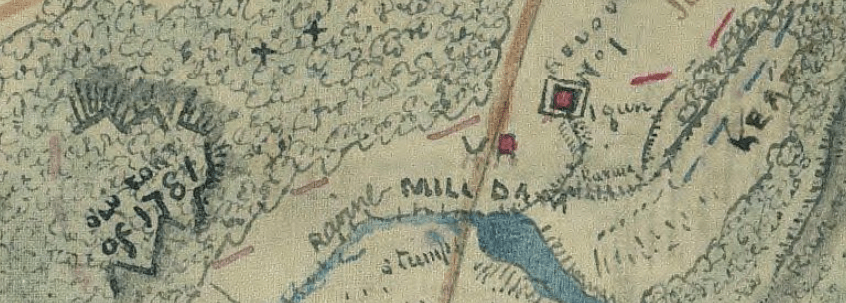
Portion of the map of the Battle of Williamsburg, showing the land the American Battlefield Trust is currently working to purchase (map courtesy of LOC)

In the ravine hand-to-hand combat, fallen trees, driving rain, and the thick smoke made communication almost impossible and command fell on company commanders to keep the battle moving in their favor. Among the men in Hill’s brigade fighting down in the bloody ravine was Tipton Davis Jennings of the 11th Virginia Infantry. His account of the fighting here at Williamsburg will be of particular interest to your readers of the ERW blog. 

Writing in 1897 his “Incidents in the Battle of Williamsburg” appeared in the Confederate Veteran Magazine. In fact Kate and I covered this in an earlier ERW post titled, Revolutionary Memory. (click here to read that post). 

“Just then,” he wrote, “we happened upon what was apparently an ancient line of grass-grown earthworks. We learned afterward that portions of Washington’s line of entrenchment were yet discernible thereabouts. And so it is possible that we ragged ‘Rebs’ were actually defending the same works were [sic] once stood the ragged continental ‘Rebs’ fighting, the hessian of Europe, as we were now, some eighty years later. So doth history repeat itself.”

At first glance is this a cool anecdote and yet rather odd. However, when you consult french maps from the Williamsburg region created during the Yorktown Campaign you’ll find references to Mulhenburg’s “lights” camped in this very area. Moreover, almost hidden in plain sight on one of Sneden’s 1862 maps is and “Old Fort of 1781.” Civil War soldiers seemed wholly cognizant of the Revolutionary landscape around them and like Jennings used it to spur on their cause(s). 

Yesterday, on the 158th anniversary of the May 5th, 1862 battle the American Battlefield Trust launched a campaign to save the 29 acres over which Jennings charged. Perhaps it is this very same ground where the original cast of “ragged continental ‘Rebs'” also campaigned. Click here to read about that initiative and for further information on how to donate.

“Rev War Roundtable with ERW” Heads to South Carolina (Virtually)

Join Emerging Revolutionary War this Sunday, at 7p.m. EST on our Facebook page as we head, virtually, down to South Carolina to discuss the importance of that colony/state in the American Revolution.

Most are familiar with the larger engagements, such as Cowpens and Kings Mountain or maybe the massacre at the Waxhaws. How about the Siege of Charleston, or the battles of Ninety-Six, or the countless other engagements that made the Palmetto State (which got its nickname from this era) one of the most hotly contested areas of the entire conflict.

Joining the “Rev War Revelry” will be ERW historians Vanessa Smiley, former Chief of Interpretation and Education at the Southern Campaign of the American Revolution National Park Group, which includes Cowpens, Kings Mountain, and Ninety-Six and Bert Dunkerly, former park ranger at Kings Mountain and author of a few histories on South Carolina in the Revolutionary War topics.

We look forward to seeing you for our sojourn into the Southern Theater this Sunday. Oh, and remember to grab your favorite brew for the trip!

The Southern Theater of the American Revolution | American ...
Battle of Cowpens
(courtesy of ABT)

“The Sword is Now Drawn…” The Powder Incident, Lexington and Concord moves Virginia to Revolution

download
Battle of Lexington by Amos Doolittle, December, 1775

One of the most amazing parts of the events on April 19, 1775 is just how sophisticated the colonial information network was. As soon as Lt. Col. Francis Smith’s British Regulars began to move across the Charles River, riders fanned out from Boston and to neighboring towns. Each town then had more riders that spread out and soon dozens of men were riding through the New England countryside warning of the fighting that took place. Soon information spread to the mid-Atlantic colonies and Philadelphia on April 24th. In the age of no electricity, the complexities and speed that news traveled from Boston to the other colonies was pretty amazing. Stories grew from person to person and it would take months and even years to decipher truth from exaggeration. It was imperative for both the “Patriots” and General Thomas Gage to get their version of the events of April 19th out as fast as possible. Facts or not, the importance of the public relations was of utmost importance to both sides to win the hearts and minds of the other colonies.

As the news reached Virginia, the colony was already at a crossroads with their

Sir_Joshua_Reynolds_-_John_Murray,_4th_Earl_of_Dunmore_-_Google_Art_Project_Square
Virginia Lt Governor, John Murray, 4th Earl of Dunmore

Governor. The last House of Burgesses that met in Williamsburg was dissolved in August 1774 over their vocal support of the people of Massachusetts after the Boston Port Act. The once popular Governor, John Murray, 4th Earl of Dunmore (Governor Dunmore), was angered over their overt support and ordered them dissolved and returned home. The legislature defied his orders and met soon after at the nearby Raleigh Tavern, thus constituting the “First Virginia Convention.” With questionable legal authority, the Convention called for solidarity and non-importation of British goods. They also agreed to meet again in the future. The “Second Virginia Convention” met in March of 1775 in Richmond, a safe distance from the Governor’s influence in Williamsburg. It was at this Convention that Patrick Henry made his famous “Give me Liberty or Give me Death” speech on March 23. Though considered radical at the time, the speech energized the Convention and set the tone. When the Governor learned of the Convention and especially Henry’s speech, he made a fateful decision to remove the gunpowder stored in the magazine in Williamsburg. Continue reading ““The Sword is Now Drawn…” The Powder Incident, Lexington and Concord moves Virginia to Revolution”

“Rev. War Roundtable with ERW” Continues this Sunday!

This Sunday, April 26, at 7 p.m. EST, Emerging Revolutionary War invites you to click on and listen to the next installment of our “Rev War Revelry.” This week’s happy hour will focus on the most over-looked battle or engagement from the American Revolution. Each of the historians slated to participate will bring their pick for that category.

Feel free to chime in with yours in the comments here or on the Zoom call on Sunday. The feed will be live on ERW’s Facebook page. So, grab your favorite beverage and join us for a free-flowing conversation to toast off the weekend with.

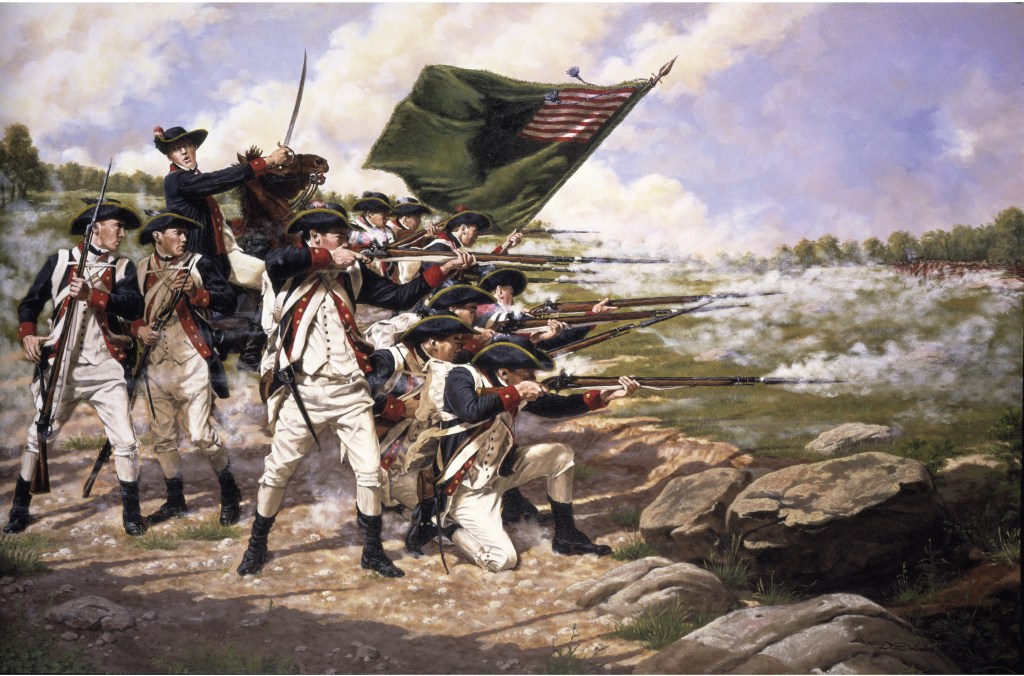
Delaware Regiment at the Battle of Long Island (Wikipedia)

“Rev. War Roundtable with ERW” Introducing Guest Historian….

Emerging Revolutionary War invites you to attend our “Rev War Revelry” tonight at 7 p.m. EST as we discuss the beginning of the American Revolution on April 19, 1775, 245 years ago today.

Yet, not only will Emerging Revolutionary War historians be on the call but we have a special guest historian joining us as well.

Stacey Fraser

Stacey Fraser is the Collections and Outreach Coordinator for the Lexington Historical Society. She has overseen new exhibits in the town and has assisted with the annual Patriots Day events. She will be on to share her expertise in this momentous day in American history and about what is happening, both virtually, and in the future with the Lexington Historical Society.

ERW looks forward to welcoming Stacey and all of you to our inaugural Zoom history call tonight!

Lafayette at Brandywine

Marquis de Lafayette was a French aristocrat serving in the French army, and recently married, when the Revolution broke out in America.  He followed events with interst, and was motivated to come and fight with the Americans.

He arrived in March, 1777, nineteen years old and eager.  He immediately formed a friendship with Washington, and was an aide on his staff.  In the meantime British forces had invaded Pennsylvania, intent on capturing Philadelphia.  Washington’s army took a position behind Brandywine Creek, and the British attacked on September 11, 1777.  British troops had flanked the Americans, and reinforcements were rushed to the threatened sector, making a stand on Birmingham Hill.

Eager to get to the fighting, Lafayette and a group of French officers rode to the unfolding battle at Birmingham Hill, arriving as the action was at its hottest.  Approaching from the south, they rode up the Birmingham Road, and turned to the left, coming in behind the brown-coated troops of General Thomas Conway’s Pennsylvania brigade.

Continue reading “Lafayette at Brandywine”